← The Origins Foundation Podcast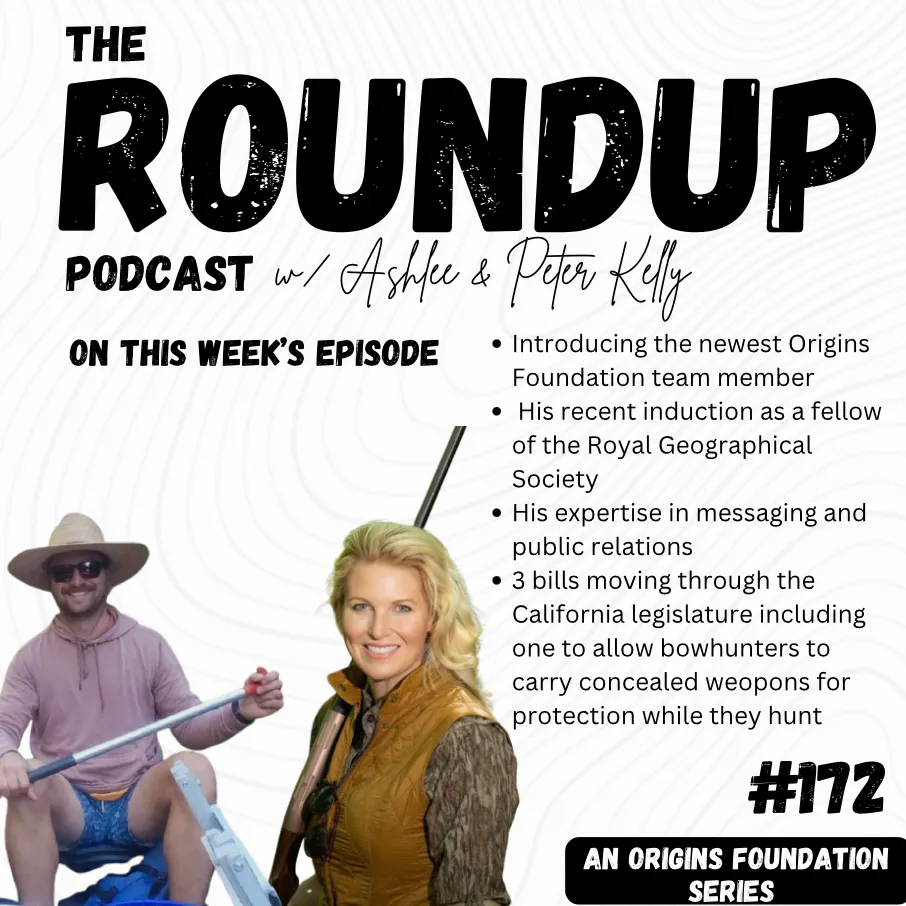
The Origins Foundation Podcast
Roundup with Ashlee Smith and new Origins team member Peter Kelly
00:54:45
Join Ashlee on today's Roundup with new Origins' team member Peter Kelly while Robbie is out of the country filming in Africa. Ashlee and Peter discuss his unique background, his recent induction as a fellow of the Royal Geographical Society, the Boy Scouts, his expertise in messaging and public relations, 3 bills moving through the California legislature including one to allow bowhunters to carry concealed weapons for protection while they hunt, a MI law to require MDNR to allow license applicants to register to vote when they apply for their license, the Department of Interior's proposed FY'27 budget and negative ramifications for wildlife and natural resources and the Farm Bill on the move.
Loading summary
Transcript99 lines
- [00:00]
A
Planning a fishing trip shouldn't feel like a full time job. With fishingbooker.com you can find and book the perfect fishing trip within minutes. FishingBooker.com connects you with trusted fishing captains around the world. Booking is fast, easy and secure with access to verified customer reviews, loyalty rewards and around the clock customer support. Everything you need to book with confidence is in one place. So head to fishingbooker.com and start planning your next fishing fishing adventure today. Planning a fishing trip shouldn't feel like a full time job. With fishingbooker.com you can find and book the perfect fishing trip within minutes. FishingBooker.com connects you with trusted fishing captains around the world. Booking is fast, easy and secure with access to verified customer reviews, loyalty rewards and around the clock customer support. Everything you need to book with confidence is in one place. So head to fishingbooker.com and start planning your next fishing adventure today.
- [01:03]
B
So five years ago there was a reason why I started this movement. And the truth then is the truth now that we need to champion our narrative. We need to champion the truth around what we do and who we are.
- [01:15]
C
There's a sweet spot with a gun,
- [01:16]
B
you know, too heavy and it's a
- [01:18]
C
burden to walk with. Too. Too light and you whipping it.
- [01:22]
B
Why is the project so important to the hunting community?
- [01:25]
C
It's. It's a. I think it's not only important, I think it's. I think it's vital. I think it's. It's just in time.
- [01:30]
B
It's like snakes and ladders. You guys are climbing the ladder and
- [01:35]
C
then somebody does something stupid and you just slide down.
- [01:37]
B
That is such an amazing analogy. Snakes and ladders.
- [01:41]
C
Yeah.
- [01:41]
B
You know, ivory in. In my opinion was the plastic of its age. Okay.
- [01:46]
D
The expensive you're going up.
- [01:47]
C
It goes a long way with families.
- [01:49]
D
We have families that do need it.
- [01:51]
B
Let me close this door because I have a little wiener dog. What you. Are you laughing because I said wiener?
- [01:57]
D
I'm really glad you finished the sentence out. I'm sorry the first happened. What are we doing here today?
- [02:04]
B
You're telling the whole world.
- [02:12]
D
Foreign. Welcome back everybody to the weekly roundup with the Origins Foundation. This is Ashley Smith and I am very excited today to introduce everyone to a new member of the Origins family, the Origins team. He is a friend of mine. I have actually known this gentleman for quite some time and apparently so excited to have him be a part of what we are doing in this space because he brings such a wealth of knowledge and a new perspective to our mission and so, Peter Kelly, I am really excited to have you on today. Robbie is in no Surprise, Africa right now doing some really important work. He has been gone. I know we haven't done Roundup in a few weeks, but. But Peter comes to us having a lot of outdoor experience, and you've done so many things, Peter. I don't even know where to start. You have a very, very recent honor that we are going to talk about in depth. But Peter runs Ship to Shore communications and PR firm. And we met Peter kind of in funny circumstances when you were working on a movie that was being filmed in Mississippi. And which movie was that?
- [03:44]
C
That would have been. It was actually season two of a History Channel television show called Great Escapes with Morgan Freeman. And I was production designing, and I was the head of the art department, and my team rented a house for me in Natchez.
- [03:57]
D
That's right, that's right, that's right. You had quite. Quite the crew. But I was so carnival work, for sure. Yes, yes. And I was so impressed with Peter then. Just your professionalism and your attitude, and you. You were corralling people from all different walks of life and. And doing a very good job of it. And I actually tried to hire Peter when I was the outgoing CEO of the Mississippi Wildlife Federation. And Peter turned. But he had a lot bigger and better things in store, including, of course, launching his own company. But, Peter, talk to us a little bit. Some of the things you've done. Like, I know that you are just an avid, avid outdoorsman, hiker, camper. You believe in public lands. You ran a program in Texas trying to get. And I may mischaracterize this, but from what I remember, you used to try to teach kids who lived in the city, and I think targeting inner city some outdoor skills. Is that a little bit. Did I get my.
- [05:03]
C
You're close. You're so close. Yeah. So my background really sits at the intersection of documentary storytelling, strategic communications, and field exploration. So I spend a lot of time thinking about how people emotionally connect to complex issues, especially within the conservation and the outdoor space. So, Ashley, if at any point you can't hear me well enough, you let me know. Cut me off, and I'll change. Change my situation. But I'm gonna keep running until you tell me.
- [05:31]
D
Okay. Having a little trouble hearing you. Just talk out a little.
- [05:34]
C
Talk up a little bit.
- [05:35]
D
If you don't mind.
- [05:36]
C
I'm just gonna lose my AirPods real quick and bring out loud to the table here. Give me one second. All right, great. Can you hear me Now?
- [05:47]
D
Yeah. Yeah.
- [05:49]
C
Okay, perfect. So my background sits at the intersection of documentary storytelling, strategic communications and field exploration. So I spend a lot of time thinking about issues, trying to figure out how people can emotionally connect to complex issues within the conservation space and within the outdoors. Everything from bridging the nature gap to getting the people outside hunting more and hiking more and exploring more and more. I've kind of to speak on what you were speaking on a minute ago. The the nonprofit I worked with down in Texas. It was. They had a really cool mission and so I worked with them in the operations side of things to help get at risk youth, give them the opportunity to explore the outdoors through backpacking and wilderness exploration and experience trips. So we worked with different kids around Texas.
- [06:45]
B
It is 2026 and my friends, big changes have happened in the world of firearm suppressors. The $200 tax stamp fee is now gone. Huge win for hunters, huge win for shooters, and a huge win for your wallets. If you're thinking about elevating your shooting experience and adding a suppressor, Silence Essential is the best way to shop. And you don't even have to get off your couch to do it. Go to silenceessential.com, browse hundreds of suppressor options. They literally have all of the popular makes and models. Then their experts will walk you through setting up your account, creating a free NFA trust, and then submitting your application to the atf. Once approved, Silence Essential ships your new suppressor directly to your door. That's when you're going to have to essentially get off the couch. It's a game changer, guys. You haven't done it yet. Do it. The old days of waiting eight to 10 months on a suppressor are gone. It's more like two weeks. Some have even gotten their suppressors in shorter time frames. It's never been easier to start shooting suppressed. Get started today by visiting silencer central.com it's really the simplest way to get your suppressors. Bushnell is eager to help you get set up for conservation success. That's right. They want to help you. The conservation and research community is dominated by good people doing good things and and investing significant time and effort for the benefit of habitat and the species. So what do you need to do? Pretty simple. Send us your conservation story and or your conservation wish. Could be managing whitetails. Could be understanding your environment or species or something else related to conservation. What would you be able to do if you had a great trail camera setup? We will select the best story every other month and sends you A camera bundle, cell camera, normal SD camera, SD cards, as well as optics. Everything you need to get set up for success. I can't wait to see what you submit. You can email us, DM us, message us, whatever you want. We are not hard to find. Good luck.
- [08:50]
D
Peter also volunteers at the Science Museum. Diving. He's an extensive diver and feeds the fish. Dives into these crazy tanks that I could never do. And feeds the fish. I mean, he does all sorts of things. But one of his recent accolades was being named a fellow in the. Is it the National Geographic Society? You're a. You're a fellow of the National Geographic Society. Am I saying that right?
- [09:21]
C
A fellow of the Royal Geographical Society.
- [09:24]
D
The Royal Geographic Society, yes. Okay. And explain what that is to everyone.
- [09:29]
C
Yeah. So the Royal Geographical Society, similar to National Geographical Geographic Society, is an organization founded in the 1800s to increase exposure to exploration and help people get a better understanding of geography and how we as humans interact with the natural world around us through exploration, through the study of maps, through the study of science, and through storytelling, which is kind of a big piece of how I ended up fitting into that as a filmmaker. One of my recent projects, I think was kind of the. The push over the edge for me in getting into that, which was a documentary film that we're in post production on right now, where I went and followed a. An archaeological field school where they went down to the Turks and Caicos and they taught a bunch of people how to dive shipwrecks while we explored the Endymion shipwreck, which is an HMS Endymion. It's a 1790 fifth rate British warship which sunk in about 45ft of water down in the South Turks and Caicos. So, yeah, I don't know.
- [10:37]
D
So cool. I mean, how did you even figure out that was going on and you wanted to do that?
- [10:43]
C
That's a good question. People ask me that a lot. You know, I've always been that guy that's like, I just don't do well sitting still. My ADHD starts running in circles. And I grew up with parents that always told me, like, if you don't ask, the answer is always no. So I've just learned to not be shy about reaching out. If there's something cool somebody's doing or something I want to be a part of, I'll be the annoying guy that reaches out trying to insert themselves into other people's situations and it's just kind of working.
- [11:12]
D
I've heard that saying before. If you don't ask the answer is always no.
- [11:19]
C
100.
- [11:20]
D
I love that quote. I love that quote for kids. I mean, kind of like if you don't even try one, you've already failed.
- [11:27]
C
That's it. Yep. 100. 100. So, yeah, no, I just. I don't know. I just. I'm kind of that guy. All of my friends know me as the guy that just kind of does all the weird stuff, but, you know, life's too short to go through it having lived. Lived it unremarkably. So I don't know. I. Congratulations. But on the conservation space. Thank you. Yeah. And on the conservation side of that, you know, I think that's a big part of this for me is I. I grew up in the Boy Scouts. I got my Eagle Scout at 16. I just kind of hit a point in my life where, you know, some people like to golf, some people play tennis, some people hunt, some people go hiking. I just realized that what I enjoy doing is being outside. And. And after having the chance to grow up being outside and going and exploring the wilderness in different countries around the world, you know, I had the opportunity to realize that this is. It is truly a gift, and it's one that's worth protecting and talking about and helping conserve. Yeah.
- [12:32]
D
Yeah. No. 100%. How you brought up the Boy Scouts and Eagle Scouts, how instrumental do you think being a Boy Scout and becoming an Eagle Scout was in shaping your love for the outdoors? Because I. I think it's an unbelievable organization. I know it's. It went through its struggles, and some. You know, I don't want to call them growing pains because I don't want to minimize the, you know, the legal troubles that they did have. A lot of organizations have had the same kind of troubles, but I think that it's an organization that is worth protecting and being involved in. And I started my boys out with little Cub Scouts, and I. I have never met an Eagle Scout that I didn't think was a pretty upstanding citizen. It's so hard to achieve that goal. And kind of like people that go into the military and are just. I feel like it's just a. A character shaping exercise and organization. I'd love your perspective on it.
- [13:36]
C
Yeah, for sure. I think that's definitely the case. I. I loved Scouts as a kid. I. I was absolutely. I was also a total nerd as a kid. I loved the Boy Scouts, though, and I caught flack for it when I was younger, but I'm so grateful that I had supportive parents who stuck with me and let me Stick with it, because it's one of those things that's opened a ton of doors for me. I did not choose the standard life route out of high school. I went to college for a year and a half and had a really, really great time, and then kind of went and started doing my own thing.
- [14:10]
D
I know that really, really.
- [14:12]
C
The one thing that's. The one thing that's opened doors for me, though, beyond that is being an Eagle Scout. And that's one of those things people have seen on my resume they've. They've heard about, and it's opened more doors in my life. And it's funny when my parents. We live in Mississippi now, and. And I went to high school in the Mississippi Delta, but when my parents were much, much younger, they worked on Wall street together for a firm called Solomon Brothers. And my mom worked in hr, and she said that people who did not have Eagle Scout on their resume, their resume went straight to the trash. And that was kind of. Even as a little kid, that was one of those things.
- [14:50]
D
No way.
- [14:52]
C
Yeah, because it was such a competitive company. It was so competitive. It was, you know, similar to Goldman Sachs or Bear Stearns. It was so competitive. So they. Yeah, they were. Had the ability to do that. And if you didn't have Eagle Scout. And so, you know, I think I saw the value of it as a kid, but I think the. It's so funny. You grow up doing these things and learning different things, especially in the Scouts, and you just never know what's going to stick and what you're actually going to end up using. And I'll tell you, with the Scouts, it's funny, the. My least favorite merit badge I ever got was the Family Life Merit Badge, where you had to figure out how to, like, manage a family and put together a family plan is. But it's now one of those things I use literally weekly, if not daily, of, like, budgeting and putting together menus, but as an outdoor guide. And. And so I got my outdoor guide certification through the University of Wyoming several years ago, but I take people on rappelling trips and teach people how to do repelling. And it's funny that the foray to that was the Scouts as well. So all the knots I used growing up in the Scouts, I never thought that that would be something I used as often as I do, but it's just kind of stuck. So. But I think it's awesome. I think the Scouts are, like you said, they went through a really traumatic time, and it was. I can't Imagine having been one of those kids who was put through something so horrific. But I will say that's coming from a Boy Scout troop where my parents were actively involved. We fortunately had none of that. And it was one of those things that helped shape me and put me on the course for the rest of my life, which is interesting, too. One thing my parents noticed and kind of saw this, that we always got involved with Scout troops where the moms were involved, because when the moms were involved, you didn't see any of those issues. So that was just kind of one of the things we stuck with. But, yeah, no, I love the Scouts. I think Scouting's incredible. And. And a lot of people, you know, got all upset that, you know, now it's just Scouting, it's not Boy Scout, and girls can do it. More power to them. The more people we can get involved in the Scouts. Awesome. More girls we can get outside. Awesome. I am 100% on board. I think it is a. A really cool and unique way to teach kids life skills, to teach them how to be somebody that is reliable and somebody that has accountability and integrity. So I love the Scouts brought to you by Boy Scouts. I'm just kidding.
- [17:26]
D
I love it. I love it. No, I think that's phenomenal. Before we get too off topic, because you and I could talk all day long about all sorts of things and never, ever, ever get to the news, but I do want to bring up a few different bills, and you and I have. We. We have worked together over the years on different things and have different perspectives. So I love. I would love to hear your perspective on some of these bills, because we have a little bit of. I wouldn't say I'm a hardcore hunter, but I do come from a perspective of, you know, pumping the hunting and fishing angle. And I think that you come from a more of a conservation, sustainable use. Like, that's usually more of your focus. And we both believe in both. You hunt, you fish. And I consider myself a true conservationist, so. But I like to hear the, you know, the wide range. And. And also you are like, okay, how. How are people framing this? How are they telling their story? How are they getting their message out on these different types of pieces of legislation? And so it's interesting, especially on the federal stuff right now, which I think is just kind of a complete disaster, just to be honest. I like. I really, like most of the state sessions have wrapped up, and we had some really good state sessions, and then we had some crazy things happen at the end, and Then there's a couple, there's a few states that are still going on. California, California goes pretty much year round. And there are actually some bills I like, I shot them to you earlier that are. Well, I know I say there's, there's, there's some bills I don't like in California and then some eye catching.
- [19:15]
C
Some eye catching bills, for sure.
- [19:17]
D
Yeah. Yeah.
- [19:17]
C
While you're looking through it, there's almost
- [19:19]
D
never bills I actually like in California. Let's say that there's one I like, there's one I really like, there's two I like and one I don't.
- [19:27]
C
I think one thing most. Go ahead. Sorry. I was gonna say most Americans, Most Americans interact with the outdoors constantly, but very few actually have an understanding of how conservation is funded, how habitats get protected, how public understanding actually shapes the policy for conserving our outdoor spaces. And the articles that you sent over, I think they're they're really, I mean, they're windows into a much larger conversation about stewardship and participation in communication. And some of them are, can be, detriment, can be seen as detrimental to the conservation space. Some of them are good news in the conservation space. But I think the important thing here is, you know, as we talk through them, is looking at the opportunity for the people who are actually living outdoors, who are in the outdoors, who are experiencing the outdoors. What can they be doing? What can we do as conservationists as. Or outdoors people to protect these spaces that we know and love.
- [20:28]
D
Right. And to impact how it's done and how things are funded. There's so much confusion just regarding who has jurisdiction over what, who pays for what, who staffs the law enforcement officers, where and what federal agencies are responsible for what public lands and what. I mean, just, just, there's just so much, I mean, USDA is, these lands are under USDA and these lands are under the Forest Service. And you know, just all of the different breakdowns in the, the, you know, in here in America, we have the public trust doctrine. So our wildlife and our natural resources are held in trust by these wildlife agencies. But there's so many of them. So who, who does what and who do we talk to and how do we impact it? And, and then where do the lawmakers who are elected come into play? Because sometimes they override those things and insert themselves. And so, yeah, it's really confusing and we try to help break these down into digestible pieces of information to make it less complicated. But, you know, it is complicated. There is a bill actually, we'll jump over California for a second because there's a bill moving in Michigan that I love because it is called the Sportsman Voter Registration Bill. Speaking of us making an impact. And it's a House bill, it's 4136. And it would require or, or I would say allow Michigan Department of Michigan, dnr, their Department of Natural Resources, to provide sportsmen and women the opportunity to register to vote when they purchase a hunting and fishing license, which doesn't seem like a very heavy lift, I mean, to me. So basically, you just check a box when you go buy your hunting and fishing license. If you want to register to vote, you check a box and then you're automatically registered to vote. And the thought is that we need more and more hunters and anglers and outdoorsmen and women registered and voting in these different issues. From a larger, wider perspective, I think we need more people to vote just in general. So anywhere we can allow people an opportunity to register. I think it goes farther than that. So I, I mean, regardless of your politics or what you believe in, I think that, you know, anywhere people are registering for anything in public, driver's license, whatever they're doing, you know, tsa, whatever it is, like, I mean, golly, have the, have the box there and let them register to vote. I don't, don't seem that as a. I mean, I'm sure it's going to be opposed. I'm sure there's some people that are going to be like, no, no more. I'm the animal rights activist, but I don't see the right, the big deal. Pass the House of Representatives 108 to 2, but it's stalled and it's not moving through the Senate.
- [23:26]
C
Sure. Well, and I think that I'm with you. I could see definitely there being an opposition to this for, from certain folks that lean one way or the other, or I think it leads to this opens up the conversation on misconception. And I was going to share this. I took a note down. Give me one second, let me find it. I was going to say that whether people like it or not, hunting and fishing participation, it still funds a massive portion of American wildlife conservation. And so when you do have people who hunt and fish who are active at the polls and are putting in the effort to go and vote, those are people that are going to be voting on issues that do protect wild spaces, they protect wildlife, they protect animals. Yes, there might be people that go hunting, but if animal populations disappear, well, guess what? There's nothing to hunt. So these people are not trying to go out and kill everything. I think this is a huge move and I think it could be super beneficial. Um, from a, just a, a standpoint, even from the state, from a tourism perspective, you're now showing the rest of the country that, hey, look, we actively care about. Not only do we care about our hunters and, and anglers, we care about the people that are actively trying to protect and conserve our wild spaces.
- [24:50]
D
Right. I think that's cool. Right. I like that. The next one that Michigan's doing is it's just a range protection. House Bill 4949. It would protect shooting ranges from being unfairly regulated by planning and zoning bodies. So sometimes what these states do, when you get lawmakers in there, they don't necessarily outright ban hunting or firearms or shooting ranges. They start putting in zoning and planning regulations so that they make it overly burdensome to put one in. And this would just restrict that happening so that it's not overly burdensome to put one in. So we don't have to talk in depth about that one. I just wanted to mention it, something we're watching. It's a bill we really like. We like to see.
- [25:37]
C
I'm curious, Ashley, have we seen this kind of thing other places and what's been the effect?
- [25:44]
D
I have never seen an anti zoning and planning range protection bill. I assume. I. I don't know if this is just a novel or if they are copying this from something that's been done before, but this is the first one that I've seen anywhere. So I like the idea of it. My assumption is that this situation has occurred where there have been counties where they haven't been putting in these overly burdensome zoning regulations. And so this is the legislature's response to that situation, which is usually where these kind of very, very narrowly tailored bills crop up. So the Michigan House of Representatives passed it and again, it's. The Senate has yet to hold a hearing. So these bills are moving through the House really well in Michigan and then they're not moving anywhere in the Senate. So come on, Senate, Michigan, we need you guys to push some of these bills through. So you guys call your senators in Michigan and tell them you like these bills. You like 4136 and you like 49.49. Okay, California. California, you've got a couple of good bills moving, which is. We don't get to say that very often, like shooting, shooting, hunting, sports realm. Well, let's talk about the good before we talk about the bad. Senate Bill 1021 would establish a program to increase hunting and fishing opportunities for youth with life threatening illnesses. So I mean, gosh, anytime we can get kids with special needs and problems out there. And I mean, so we have programs all over the South. Dream Hunt, Catch a Dream, different programs like that. And it is so, so important and special to those kids that get those opportunities to go out there. Opportunities we take for granted going to shoot a deer. And I mean these kids don't, they don't have to shoot a monster buck. I mean shooting a doe, you know, can be one of the biggest moments in those kids lives. So program that. I love that bill and I hope that Californians pass that bill. That would be amazing. Now. Okay, this one, this one just makes sense to me and I would like to hear your thoughts. I'm not a bow hunter. I would love to be. And if I have time to take up a new hobby, this will be me. And I will be teaching my children how to do. I am actually, my boys are learning to, they're doing archery right now, but I have not taken it up yet. Assembly Bill 1912 would allow bow hunters to carry a concealed firearm while archery hunting during deer season. So I've looked it up and I was like, wait, can they not already? Apparently they cannot already. They are currently prohibited from carrying a firearm while they are in the field. Archery hunters are. And to me that's kind of dangerous. I mean, if you're out there bow hunting and you wound a apex predator or any other, I mean, kind of, you know, predator that you are hunting, a bear, a mountain lion, something like that, and then you just make him angry, I mean, isn't he potentially gonna, or she gonna come after you? Like, don't you need some way to protect yourself? That to me, this one just, this kind of makes sense, like it's self defense. And, and I know that what they probably thought, well, we don't want people saying they're going to bow hunting and then they're just going out there and killing them. But I mean, at some point you got to have a little trust in people. But I don't know, what do you, what's, what do you think? Sure.
- [29:39]
C
No, I, I think you're spot on. I think you're spot on about the, the trust point too. And I mean, I mean that's also part of the reason why we have game wardens. You know, game wardens are out there making sure that people are doing what they're saying they're supposed to do. And it's interesting, you Know, we think of game wardens. Some people think of them like police, but really they're, they're not just police, they're coaches. They're friends that you chat about hunting with. They're people who can help you improve what you're trying to do. They'll, you know, talk you through things on your land. They'll also protect people. I've had friends in the Mississippi Delta that have had to call game wardens because they had poachers on their property that they felt personally threatened by. And so I think when you recognize game wardens for what they are as being a big piece of this puzzle for protection of hunters and protection of wild spaces, you realize that they are working to ensure people are doing things the right way. Now, the reason I bring up the game wardens, because they're making sure people doing things the right way. And I think genuine, generally people who hunt want to do things the right way too. But you have people out there making sure that, you know, you're not telling people, oh, I'm going to go bow hunt. But really you've got your 357 and you're just going open season, you know, so I don't think I, I, I'm, I'm, I'm a big advocate for this. I think this is a smart thing to be able to allow people to protect themselves full on.
- [31:07]
D
Well, they're not allowing, as much as we love it, you can't carry a shotgun, you can't carry a rifle. It's only a concealed firearm. So it's okay, you know, self, defense. Self defense, right. It has passed in the sim, the assembly, and it is moving over to the Senate and it's awaiting a hearing in the Senate Committee on Natural Resources and Water. So I, do you think that, what
- [31:31]
C
kind of, what I was going to say, what kind of pushback do you think people should anticipate?
- [31:39]
D
I mean, there's always pushback in California, always some pushback. But hopefully the hunting and fishing community out there in the outdoors community is the, the biggest thing. And, and you, this is your wheelhouse. The biggest, biggest thing is education, getting the message out there. Why is this needed? Why is this ne, why is it important? And, and our community just has to speak up. I mean, I feel like, I don't know if you've watched too much of the Catalina island deer situation. We've been pumping some stories out about it, but I mean, it's almost like the roles are reversed in that situation where, you know, our conservation community is, they're trying to the, the opposite side now. The, the normally what would be the animal rights side but the, the kind of anti hunting crowd wants all these deer annihilated from the island. And our side saying whoa, I mean you, you could just open it up and have regular hunting and manage the herd and you know, why are you just having, you want the government to come just column leave them there, they would not be allowed to be eaten, you know, harvested for food. And so that's just like a travesty of the resource and you're just wasting it like. And so our community has rallied and I think done a really good job of getting the message out about how that is just such a complete waste. Needless like look, let's, let's manage the resource this way. Allow hunting, allow like the proper, you know, science driven method over there. And so there's been, you know, a little short documentary, there have been news stories, there have been articles, there have been social media and I think the tide is turning and potentially could go our way. But we have to do an equally good of job getting our message out on why these things are important. And just a lot of times if you explain, explain it, it just makes sense. It makes sense. So this is one of those bills that to me just makes sense and I think has a pretty good shot.
- [34:01]
C
Yeah, for sure. And I think a big, and a big piece on that. You hit the nail on the head with education. I mean we have to be advocates, we have to take responsibility for teaching and showing and sharing and we have to, you know, as conservationists and outdoors people, whether you live in California or Mississippi or wherever, when things like this pop up, it, it's not. You can't just rely on action committees or politicians or lobbyists or voices in the community to share thoughts and to make it valuable and to reach out. You have to take an active part, share on social media, call your friends, call your senators, call your congressperson. And I think people, I mean we live in such a connected day and age when, and that's not news. But you know, I think people hear about something or they see something and it frustrates them or they're passionate about it. So often we think oh man, that's crazy. And then you keep scrolling, stop, stop scrolling. Share it. Take a moment to figure out, you know, how can I, how can I change this? How can I help educate people as to why this might be important?
- [35:13]
D
Share stories and tag your members of Congress because they monitor those accounts and when they get tagged, they're like, oh, who? You know, what did we just get tagged in? And then they go, look. And they don't love bad press and they like to be tagged in good things and they don't like to be tagged in bad things. And they also monitor those phone calls. So even if you are not getting connected to the legislative director, the chief of staff, the, you know, the policy decision maker in the office, there's usually two kids. I say call them kids because they are usually college interns answering the phones in each office. And they sound, you know, hey, what are you doing? You know, Senator blah blah's office. Okay, yes. You know, you tell them what you want, you tell them what you're calling about, you give them your talking points. I mean like. And you're like, oh my gosh, that's just went in one ear and out the other. They didn't. Well, they are requ. Wired to. They are sitting there on a computer and they are logging that phone call and they are putting it under. They are putting, you know, so and so just called Department of Interior Budget doesn't like it, you know, or hates the funding cuts or blah blah blah wants more in NRCS doesn't want knock a cut. And those go into a bank. And they look at how many calls they've gotten under certain issues. They, those are constantly monitored. Constantly monitored. So I know for a fact, like for instance, I don't like the way this one went, but we've talked a lot about the ESA Amendments act and it was scheduled for a House floor vote a few weeks ago and the vote abruptly got canceled. I know for a fact that some of the members were getting a bunch of calls, a bunch of calls. And they started calling saying, hey, we've gotten, I'm getting a lot of calls from our constituents about this, like not liking it or not are concerned about it, not even like specific. They don't like this provision, like, can we just amend this? It was just like they don't like, you know, like what's, what's the situation? You know, and so just, they just get nervous. They get nervous, they start getting a lot of calls against something then, you know, I mean those are their voters. So these calls to members offices really do work. And there are a couple of things right now that everyone should be calling about or tagging their members, emailing, whatever you can do. One is the farm bill. So the farm bill passed, this version of the farm bill passed the House on April 30th and it passed with a bipartisan vote. 224 to 200, which in this Congress is a pretty strong bipartisan vote. That means that a number crossed over to the other side to vote for it. And the Farm Bill is one of the most important conservation tools that we have on a federal level because it provides the most resources and funding for work on private lands that we have in America. It provides all of those programs that flow through nrcs, the Conservation Reserve Program, the Wetlands Reserve Program, eqip, all of these things that. Not necessarily on public lands, but on private lands. And you know, 70 something percent of America is privately owned. So if we don't have those private lands programs, we don't have conservation in most of America. So that's huge. It still has to move in the Senate. And so call your senators and tell them you love this bill. It's great. Like, whatever, you know, their version is going to be good. Senator Boozman is chair of Senate Ag and he is one of the best conservationists in the country. His version is going to be great. That Ag Committee is strong on the Senate side, so. So just call them and tell them to pass it. You don't even have to say anything else. Just say, please move it. Like, I'm like, really? Like we could break it down and there's a few nuances and whatever, but like the message right now is just, you know, move it. So.
- [39:33]
C
Right.
- [39:34]
D
I mean, that's. That, that's kind of. We could. We could do like eight podcast episodes.
- [39:39]
C
Some of the most effective conservation work in America happens. Oh, can you hear?
- [39:45]
D
Yeah, I can hear you. I gotcha.
- [39:47]
C
Can you hear me?
- [39:48]
D
Yeah, I gotcha.
- [39:49]
C
Okay, great. Sorry, I'm cutting in and out for a second. Some of the most effective conservation work in America happens when ranchers and scientists and hunters and farmers and nonprofits and landowners work together. You can't have healthy fisheries and migratory birds or elk populations or pollinators without these healthy ecosystems. And as you put it, you know, such a huge portion of these healthy habitat systems are on private land. So it is a truly. A rising tide lifts all boats.
- [40:20]
D
Yeah, it does. And from that we'll pivot now to something that is not so positive, because the funding in the Farm Bill, of course, has to be appropriated by Congress. And the Department of Interior's budget was put out in April, and it's technically the President's budget, but it also includes the Department of Interior and usda and it is. Has just drastic cuts across the board. I mean, I think it has a 20% cut for most of the Department of Interior Fish and Wildlife Service National Wildlife Refuges. It proposes cutting the. So what's known as technical assistance under the farm Bill, it proposes cutting it to zero. Well, that is all of the assistance that USDA that flows through to nrcs, National Resource Conservation Service, that does the on the ground work with those farmers, ranchers and landowners on the ground. If you cut out all of the technical assistance, so what they. So, so that funding is considered non discretionary under the budget. You have discretionary funding and you have non discretionary funding. And most of the non discretionary funding is like defense spending. Congress doesn't have the option of not appropriating it. They have to appropriate the non discretionary spending. Well, this is also a lot of the funding. Some of the, not a lot, but, you know, some of the funding under the farm bill, including this funding, is non discretionary. And so what they have done is they've tried to be really, really creative and to cut it. So basically they've passed all this weird. They've put in all this weird language, and so they just said that there's no more technical assistance and which is a way to like cut it down to zero, even though it's non discretionary funding. They have also proposed cutting the NACA funding down to. Okay, the number is something like crazy silly. And I'll have to. Let me. I don't want to mess this up because it's so drastic that you're like, wait, did I read that right? So that we're talking North American Wetland Conservation act is naca. What? And, and so that's the funding that goes. You always kind of think of. I, I think in my head about like a lot of the partners that put it on the ground are the Nature Conservancy, Ducks Unlimited, these big organizations. They work with private landowners who have to match it. It's matched. It's usually matched and leveraged five times by the end of the project because it goes in the ground in America. It's matched privately, it's sent up to Canada, it's matched again. Canada puts in money. And so it's like this amazing program because the government puts in a little bit of money, and then all these other people put in all of this other money. So right now it is. They want to cut it from 49 million to $10 million, which is a pretty big cut. The Clean Water Access, they would cut it from the state revolving funds. So the administration wants to cut that from 1.6 billion to 155 million. I don't even know what that percentage is. I became a lawyer so I didn't have to do math. But I mean, like, that. That's like 1.6 billion to 155 million. What is that, like 90% or something?
- [44:01]
C
I mean, like, that's 10. 10%? Yeah.
- [44:04]
D
Yeah.
- [44:04]
C
They've cut it down to 90 or cut it down to 10% of what it was. That's insane.
- [44:09]
D
Oh, I mean, like, it's just over and over and over. So I'm not going to walk down all of these things because people can Google the exact cuts in the budget. Just Google. Google president budget, or administration cuts to natural resources and wildlife, or cuts to hunting and fishing access or something like that. And I mean, you're going to get just a laundry list of the proposed cuts. Now, the good thing is Congress can override that. They don't have to follow the president's budget. They don't have to confirm it. They get Congress sets. You know, they pass the budget so they can put in their own amounts. They sort of use the president's budget as a guide. And Doug Burgam testified this past week in front of the House Natural Resources Committee. And I was up there in D.C. and he got some heated questions. More than normal, I would say. So look, I'm glad they're feeling the heat on this, because I don't necessarily think we should be sending all our money to war and none of it on, like, places. America, you know, trying to socialize here at home, 100%. I mean, you use all these spaces.
- [45:33]
C
I always go back to. I think it was Winston Churchill, quote. And it's. It's about the arts. It's not about conservation. But in World War II, and I'm probably gonna butcher this, but in World War II, they were suggesting cutting the arts funding to fund the war. And Winston Churchill's response was, well, if we do that, what are we fighting for? And I think the exact same applies to conservation. I mean, if you start cutting budgets to pay for things that. If you start cutting budgets to things that are so integral to the American existence, to being a human being here and to experiencing the wild that is the United States, you start taking away things to fight for. And it's disheartening because I think they're. And Ashley lives and breathes this stuff 24 7. I mean, anybody who is not totally in it on politics and totally in the know, even for those people who are listening or watching, if you go and Google it, the numbers will shock you. It is insane, because I'm I am not totally plugged in onto the political side like Ashley is, but when I started digging and started looking, it is dumbfounding how much money is being pulled out of our land.
- [46:52]
D
Well, let me give you a real life example because it's easy to think of this theoretically. So here in Mississippi, we have the Theodore Roosevelt National Wildlife Complex, and it is comprised of seven different national wildlife refuges. So let me make sure that I have the acreage correct because I don't want to get, I don't want to state this wrong.
- [47:30]
C
I've asked that looks like it's over a hundred thousand.
- [47:33]
D
Okay, it definitely is over a hundred thousand.
- [47:36]
C
Yeah, because it's Panther Swamp, Theodore Roosevelt, Yazoo hillside, Morgan break, Matthews break, and Holt Collier.
- [47:42]
D
Okay, so over a hundred thousand. Yeah, that's okay. That's what I've got too. So we're talking over a hundred thousand acres in this complex of seven refuges. At one time. They had over 30 employees, not counting law enforcement officers. So over 30 employees to manage over a hundred thousand acres. Which still doesn't really sound like a lot when you're talking about. This is for disking, planting, spraying, all of the things needed running all of the equipment, the visitor centers for the different complexes, you know, guiding people, following the habitat management plan for each one. They're quite extensive. You've got seasonal issues, pumping, you know, dealing with the different moist soil units and you know, the different impoundments and the, all of the infrastructure that you're dealing with. So today there are seven, seven total employees. Two of those are administrative only, so they just deal with computers, you know, things like just payroll and stuff like that. So there are five employees for hun, technical, for like to be out in the field running equipment, doing any of the stuff for over 100,000 acres. And this is the real kicker. That's a kicker. Enough. But one law enforcement officer for the whole complex. 1. How is one law enforcement officer supposed to manage, enforce, help over 100,000 acres and multiple counties? I mean, and, and, and the Department of Interior wants to decrease their budget. Decrease it. I mean, they don't have money for fuel to even run their equipment. They don't have money for seed. They can't run the pumps in accordance with the management plan because it costs so much to flood when they're supposed to flood. Not. It's not holding ducks. I mean, there's breaches in levees, There's. I mean, and it's not the refuge's staff fault. It is Congress's fault, it's the administration's fault because they're not funding what they need to run these refuges. And so that is a real life example of how these DOI proposed cuts are going to hurt even more then the last cuts and the last cuts and the last cuts. We're just digging ourselves deeper and deeper and deeper and deeper so that, that hopefully will make it very, very real to people. And look, that's not just the case in Mississippi. That's the case all around the country. And it's not just refuges. I mean, it's, it's public lands all over the country. So. And, and the polls show that Americans care more about these than just about anything else.
- [50:48]
C
Yeah, it's, it's disheartening.
- [50:50]
D
What's our message, Peter? What's our message?
- [50:54]
C
Call your friends, call your friends, call your congress people. That's the message right now is go out and connect with people and tell them that the land matters. Put your, you go out and honestly. And if you don't think so, just go walk around your neighborhood. Go.
- [51:09]
D
Should we be filming ourselves, like walking around outside? Like, I mean, care about this tick tock stories? I mean, I don't have tick tock. I think maybe I, maybe I do to watch some, some stuff, but I think I actually technically have. I don't get on it.
- [51:24]
C
I'm one of like five.
- [51:26]
D
I mean, like, yeah, should we all be out there going like, we care about this? Like, listen up.
- [51:31]
C
Yeah. Honestly. And I think advocacy is such. It is integral to being able to protect our wildlife and conserve our lands. If you're, if you, you know, I, I don't know one person that has gone for a walk outside and thought, oh, that sucked. This is gross and ugly. Like, nobody, nobody thinks that.
- [51:57]
D
Right?
- [51:58]
C
Everybody always feel worse.
- [51:59]
D
Now I feel worse than I did before I went outside.
- [52:02]
C
That's right. They call it, they call it nature therapy for a reason. So it's, it's one of those things. I think if you have any doubt in your mind as to whether or not you should be. Every person should be actively trying to protect our wildlands and make a concerted effort towards conservation in the United States. Go for a walk and it will give you the definitive yes or no or even do more. Go for a hike, go hunting, go fishing, go get outside, do something cool and share your experience.
- [52:35]
D
And speaking of, we will be coming up on Memorial Day next week, so no roundup. We hope everyone does get outside. I will be heading down to Texas hill country with my boys. To hike and bass, fish and swim in some of those natural swimming holes. If anybody has any suggestions and they're still listening to us on this call, I personally earlier. Do you send them to me. Oh, send them to me, Peter. 601-790-0607 is our Google Voice number. 601-790-0607. Any news you want us to talk about, anything you want to talk about, send it to us. We're so excited, Peter, that you are with the Origins team now. It's already been so much better integral since we have had you on board and awesome.
- [53:28]
C
Thank you so much and thanks for
- [53:29]
D
having me on the day when you have even better Internet.
- [53:32]
C
I know, I know. God, today was such a pain, but I am so grateful for the opportunity and I've gotten to jump on with you. I thought this was a lot of fun and I appreciate the work that you're doing to share this important information. I mean, I think this is all stuff that people. People need to know. People need to know because it doesn't affect just hunters and fisher people. It affects all of us.
- [53:51]
D
All of us. We're all in it together. All right, thanks, everybody.
- [53:56]
C
Thanks, Ashley.
- [53:58]
D
Have a good day.
- [53:59]
B
Well, that's it for today. I appreciate you listening. As always, leave a review, share it with your friends, and most importantly, do what's right to convey the truth around hunting.