← Boiling Point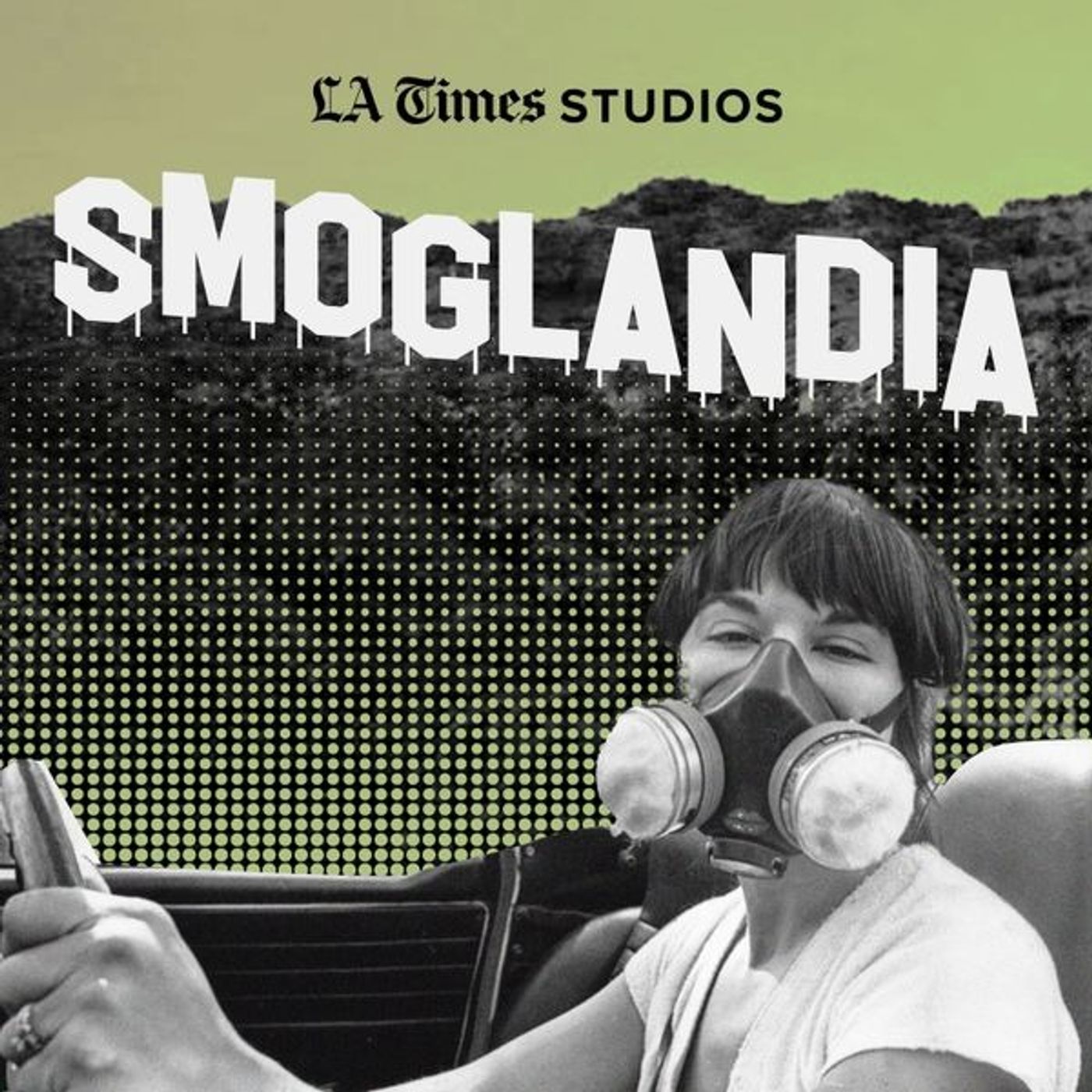
Boiling Point
Smoglandia Pt 1: L.A. SMOG – VERY OLD-SCHOOL
00:24:37
Don’t blame us – blame our geography! Modern LA earned its first smoggy nickname 450 years ago, as the “bay of smokes.” At the La Brea tar pits, we take a short walk through a long history with curator Regan Dunn, who explains how and why the first Angelenos, 130 centuries ago, would have set fires that filled the broad bowl of LA and foretold the curse of smog. Fast forward thousands of years to the early 1940s, and the renowned artist Helen Pashgian, who grew up in Altadena back when the light around LA – once so radiant and cool – was slowly smothered by the blight from wartime industries that hurt her schoolgirl lungs and blotted out the once-glorious vistas.
Loading summary
Transcript85 lines
- [00:04]
Helen Pashkian
And here is today's headline.
- [00:09]
Pat Morrison
Peeking at my X rays. It's the end of July 1943. Over the radio, Bing Crosby is crooning, Bob Hope is joking. And news of the war in Europe and in Japan keeps sizzling and crackling across the dial. But in Southern California, something else is creeping through the air. Something foul and inexplicable. Grown men are crying and mopping their eyes. Women's throats are sore and their eyes an unflattering shade of red.
- [00:42]
Chip Jacobs
It was a scorching hot day and sort of out of nowhere, a cloud bank enveloped downtown Los Angeles. It came at such a pace that it caught everybody off guard.
- [00:56]
Pat Morrison
This is Chip Jacobs. He's someone I know as a big name in Southern California journalism and books. A few years back he co wrote a book called the Lung Burning History of Pollution in Los Angeles.
- [01:07]
Chip Jacobs
Cops directing traffic all of a sudden didn't know what direction the streetlight was in. You know, think about a window washer, you know, three or four stories up. Now they can't see the person working the ropes. Mother supposedly grabbed children's hands, this sounds like my mom. And thrust them into a department store to get out of.
- [01:28]
Pat Morrison
This wasn't just a heat wave, Angelenos knew from heat waves. And this wasn't some random summer fog nor some odd blast of weird weather. This was something else. Something brownish, blackish, grayish and sickening.
- [01:45]
Chip Jacobs
Eyes started watering, your nose started running, you know, it was kind of a respiratory assault on you. And panic spread.
- [01:54]
Pat Morrison
Rumor ran amok. The year before, in February 1942, an enemy Japanese submarine had shelled an oil field near Santa Barbara. And the very next night LA was rattled by sirens and the noise of anti aircraft fire in the blackout. Now that was a false alarm and a citywide case of nerves. But maybe this time with whatever was in the air, it wasn't.
- [02:16]
Chip Jacobs
And so people thought, okay, this is. They've done something else, they're lobbing some chemical shell. I think that passed quickly, but there was really.
- [02:26]
Pat Morrison
So it wasn't the Japanese, but it was something of our own making from an enemy that LA would be fighting long after World War II was over. Smog.
- [02:38]
Chip Jacobs
Because smog had never hit with the.
- [02:39]
Pat Morrison
Intensity it did that day, July 1943, changed LA's story full stop. Even though we were just starting to call it smog. That wasn't a good word for this crude. Smog was a word born in the 20th century, a portmanteau of smoke and fog describing the sooty, deadly air of the London of Sherlock Holmes. What afflicted LA wasn't entirely smoke or fog, but something new, like LA itself. The air tasted like a chemistry set, and it looked like something that hadn't quite flushed down your toilet yet. Crazy as it sounds, this is a success story. Over seven or eight decades, we pretty much beat smog, at least to a standstill. Crazier still that we're now having to fight the old battles again with a White House that wants to flip back the calendar on LA's Clean Air Crusade. So we'd better reacquaint ourselves with how we did it the first time, how hard it was, because we may have to bring out the battle plans again. They're drinking the water. I'm Pat Morrison and you've crossed the border into Smoglandia.
- [04:03]
Rebuild SoCal Partnership Representative
Altadena and the Palisades are in the process of rebuilding after the devastating wildfires on the ground in la. Rebuilding after the Fires is a new video podcast series from Rebuild SoCal partnership that explores the stories of those working to rebuild. Communities are being reconstructed with the help of Anvil Construction, bringing experience and empathy to their work.
- [04:25]
Pat Morrison
It's very emotional as you can imagine, but our guys and girls will take the time to sift through the ashes with it.
- [04:31]
Rebuild SoCal Partnership Representative
One by one, thousands of homes will be rebuilt.
- [04:34]
Southern California Edison Representative
We are skilled union carpenters and we're.
- [04:36]
Pat Morrison
Ready to go to work. The operating engineers Local 12 has made a commitment to the community here and we're going to be here for the long haul.
- [04:44]
Rebuild SoCal Partnership Representative
Rebuild SoCal partnership is following the journey of the families, communities and small businesses as they come back to life. Stories of unbearable tragedy and unlimited hope. Tune in to the podcast Rebuilding Los Angeles for stories you will not forget.
- [05:03]
Southern California Edison Representative
During one of the most severe windstorms Southern California experienced in more than a decade, the Palisades and Eaton fires ignited, leaving heartbreaking losses in our community. Now, as we build back, we're building stronger, cleaner and more resilient in communities most vulnerable to dangerous weather conditions and wildfires. Southern California Edison is placing power lines underground, hardening the electric system by installing wires with protective coating and adding advanced technology to help keep communities safe. So when Southern California faces the next storm, the next most severe event, helicopters, structures adjacent here at Pipe Road will be ready. Learn more@sce.com disasterrecovery.
- [06:08]
Pat Morrison
You know the setup Once upon a time, yada yada, there was a far off land and at the newborn's cradle, three magical spirits came with gifts. In our version, beautiful beaches, magnificent mountains and spotless sunshine. Then the last of these Spirits bustled in, uninvited, unwelcome, and bestowed one last gift. Something stinky, greasy, ugly. A curse. In the fairy tale I'm about to tell, the baby in question is the beautiful, magical place called Los Angeles and its curse, smog. In Southern California, the smog changed the look of movies. Smog shredded women's nylon stockings right off their legs. It chewed through rubber tires and windshield wipers. It could kill off a crop of spinach in a matter of hours. It messed with aviation once. It skewed the odds of a beauty pageant at the Glendale airport because the planes flying in, contestants from around Southern California couldn't land in the smog. Smog is why even today, there's that rubber condom around the gas nozzle when you put gas in your tank. Also why you pay more for that gas. And it's why, as Dennis Farina's character Bones Barboni, says in the movie Get Shorty, the f cking smog is the f in reason you have such beautiful, f cking sunsets. Smog has been the blight on all that's beautiful in la. But what many people don't is that it hasn't just been here for a long time. It's been here for a really, really long time.
- [07:58]
Reagan Dunn
So you've been to the Tar Pits park many times.
- [08:00]
Pat Morrison
Oh, my gosh. The smell is still in my nostrils. Excuse me? The fragrance is still in my nostrils.
- [08:07]
Reagan Dunn
I know it's hard to sort of.
- [08:08]
Pat Morrison
I'm at the La Brea Tar Pits in Los Angeles, fabled for the fossils of Ice Age giant fauna like mammoths and wolves and massive sloths.
- [08:17]
Reagan Dunn
It's an amazing natural substance.
- [08:20]
Pat Morrison
My guide is Reagan Dunn, a paleobotanist, who's showing me the gardens surrounding these ancient and famously stinky pits.
- [08:27]
Reagan Dunn
So you think of the Ice Age here in Southern California. We didn't have ice, but we did have glaciers up in the Sierra Nevada.
- [08:35]
Pat Morrison
So more the slush age for us than the Ice Age. We wouldn't have recognized the Ice Age Los Angeles. It had huge shade trees and little streams and waterways crisscrossing everywhere. That's what's growing in the Tar Pits Pleistocene Garden. But keep walking and you see the coastal garden, a peek into the landscape of 13,000 years ago, which is more like what LA looks like today. Dense with scrubby growth, stuff that burned back then the way it does today, sometimes deliberately.
- [09:07]
Reagan Dunn
Well, the hypothesis that we have put out there is that these fires were ignited by early humans that came to this area.
- [09:20]
Pat Morrison
There's evidence for, shall we say, Renaissance era smog. The LA Basin is built like a pot and warm air sometimes puts a lid on it and keeps everything contained, even smoke. It's called the inversion layer. In October 1542, when sailors aboard a Spanish ship first laid eyes on the LA terrain, they saw this phenomenon. As Captain Juan Rodriguez Cabrillo's ship log made note. They approached land set in the large bay, which they called Bay of the Smokes Los Humos because of the large amount of smoke hovering over it. And there's some evidence right under our feet in the ground. The soil tells its own story. And it seems the Tongva and other indigenous people in Southern California did controlled burns. What made early Angelenos such fans of fire? Was it to keep the four legged carnivores at bay?
- [10:26]
Reagan Dunn
We don't know if this activity was part of making the environment more habitable for humans.
- [10:34]
Pat Morrison
In what way? You mean in keeping away the dire wolves and the saber toothed tigers?
- [10:40]
Reagan Dunn
That's right. Or opening up the landscape so humans can have a better view of what's hiding behind the trees or in the bushes.
- [10:48]
Pat Morrison
Fire is a tool, and early people would have used it to clear the way for plants they used like acorns for food, willows for huts and grasses for baskets. Whatever the purpose, human set fires were changing California even thousands of years ago and generating a lot of smoke.
- [11:06]
Reagan Dunn
There's some documentation out there that suggests that, you know, as much of the quarter of the state was burned each.
- [11:11]
Pat Morrison
Year, mostly by human hands.
- [11:14]
Reagan Dunn
Yes.
- [11:15]
Pat Morrison
Wow. So we don't have a 20th century license on smog then?
- [11:20]
Reagan Dunn
We don't, but it's, you know, it's part of the human adaptation to living in this landscape.
- [11:27]
Pat Morrison
Dunn and the team at the Natural History Museum learned this through a critical discovery in the prehistoric record. They used paleoenvironmental records to look at what the climate back then was like. They also tracked the history of fire by looking at charcoal preserved at the bottoms of lakes. And they found evidence of hot, dry weather, and they found evidence of large fires. But what the records couldn't show was what caused those fires. They had to deduce that themselves.
- [11:54]
Reagan Dunn
We know that the earliest evidence of human presence In California is 13,000 years ago because there are specimens of a human being from Santa Rosa island that date to that time period. What really was striking to me, which made me nearly fall out of my chair, was seeing this amazing record of charcoal from Lake Elsinore. That was work done by Lisa Martinez, a master's student at the time at ucla. She had been working separately. And when we discovered that this record existed, I pulled it up on Google Scholar and saw the record of charcoal over the last 33,000 years. And you can see there is very, very, very, very little fire up until 13,200 years ago. And when I saw that, my chin dropped and I just said, yep, it's humans.
- [13:05]
Pat Morrison
But Reagan Dunn told me something else. We can say that early Angelenos were responsible for what we now recognize as altering the environment, like filling the basin with smoke. But we can't call it blame. Humans always manipulate their environment to survive and don't always recognize what it might be damaging in the long run. Now push that rule forward by 13,000 years to today. Angelenos creating their own destruction with smog and not even knowing it until they did. That's after the break. The LA Times Festival of Books returns.
- [13:58]
Rebuild SoCal Partnership Representative
To the USC campus April 18th and 19th, 2026.
- [14:02]
Pat Morrison
Join us for a weekend packed with.
- [14:04]
Rebuild SoCal Partnership Representative
Hundreds of authors, celebrities, and activities for all ages.
- [14:07]
Pat Morrison
Admission is free.
- [14:09]
Rebuild SoCal Partnership Representative
Learn more@latimes.com fob that's latimes.com.
- [14:19]
Pat Morrison
Call it what you will. Ever since we have built cities, we've made smog. The ancient Romans burned so much wood and other fuel for cooking, for industry, for the vestal virgin's eternal flame. So much fuel that modern scientists concluded it would have lowered the climate of Europe by 0.3 degrees Fahrenheit, or as the Romans would say, point I I I degrees. A dozen centuries later, the English were choking on it too. So much so that a 13th century dowager queen of England had to move out of her home well castle because of the smoke from burning something called sea coal, a kind of driftwood coal. Years later, in 1307, her son, King Edward I drafted England's first recorded pollution proclamation. If you burned or even sold that filthy sea coal with its quote, hellish and dismal cloud, you will be tortured or hanged. At least one man chanced it anyway and was executed. There are a lot of ingredients in the recipe for smog, and each city's isn't the same. Looking at you, Houston and Bakersfield, pollution has changed just about everything around us, even the light.
- [15:39]
Helen Pashkian
Oh, we're going.
- [15:40]
Pat Morrison
We're going to come back here. Okay.
- [15:42]
Helen Pashkian
You can't take anything with you.
- [15:44]
Pat Morrison
The LA before smog was something to behold, and the artist Helen Pashkian is one of the people who remembers it.
- [15:50]
Helen Pashkian
Okay, now this is a. I'm not going to say anything about it. We're just going to Sit down.
- [15:54]
Pat Morrison
Paskian grew up in Altadena. It's a foothill neighborhood above Pasadena at the feet of the San Gabriel Mountains. And it suffered catastrophically in the fires of January 2025. And for the most part, until the early 1940s, it was all blue skies that the real estate agents in the Chamber of Commerce sold and sang about. Those decades when the air was literally fragrant with orange blossoms from the citrus groves and the backyard trees.
- [16:21]
Helen Pashkian
You know, California was very rural and all the little towns were connected by citrus and everything. Eucalyptus trees in between.
- [16:29]
Pat Morrison
As wind breaks the novelist and journalist Theodore Dreiser had this to say about the air of LA in 1921.
- [16:37]
Southern California Edison Representative
The freshness of the air, the sea, wind. We drive onto the edge of Beach Drive, then back and park the car, go to one of the best places and have sundaes, lemonades, etc. At 10:30 we start back. Delightful air.
- [16:52]
Pat Morrison
A dozen years later, he moved here and stayed back. Then, even from the hills 20 miles inland, you reached really could see Catalina and the Pacific. And streets with names like Seaview and Ocean View weren't just real estate. Come ons. You could see the mountains as clearly as if they were just at the end of your street. And the light, that crystalline light was clear and pure and brilliant.
- [17:18]
Helen Pashkian
It's a certain kind of cool light. You know how we call it? The Golden State? Wrong. The Golden Light is in the south of France and in Spain, around the Riviera. That's truly the golden light. But California, the light is cool. And if you talk to most artists, they agree with that.
- [17:35]
Pat Morrison
Pashkian has been a pioneer in California's light and space art movement since the 1960s. She's famous for her installations that challenge the way we interact with light. Over the decades, she has watched the light of Los Angeles change along with the rest of the world.
- [17:52]
Helen Pashkian
When Pearl harbor happened, everything happened very quickly. Because in the course of three or four years during the war, Southern California changed from a rural place with lots of agriculture to urban.
- [18:07]
Pat Morrison
The first part of the 20th century had filled Los Angeles with middle class Midwesterners enticed by the delights of the movies, the climate and of course, the air. When World War II came, it brought new people, the defense industries and their workers. Here's Chip Jacobs again.
- [18:26]
Chip Jacobs
There was a lot of reasons that people were moving here by the hundreds of thousands. And LA was creating a different type of culture than the east coast and the Midwest. It was creating a much more horizontal urban sprawl. Every man has his castle right From.
- [18:40]
Pat Morrison
Pasquian's home in Altadena, she could see the air beginning to take on a different quality.
- [18:45]
Helen Pashkian
We would see a line of this yellowish pinkish haze, which was new. We'd never seen that before.
- [18:53]
Pat Morrison
Some of the taller buildings downtown, including City Hall, 27 stories, were also starting to disappear from view.
- [19:00]
Helen Pashkian
They were always crystal clear. And we began to notice that they weren't so clear anymore. So something was obstructing them.
- [19:07]
Pat Morrison
Pashkian was witnessing the big bang of Los Angeles smog. Through grade school and then into high school, Pashkin saw the look of her beautiful hometown change with those afternoon visits from this new kind of air, strange and thick and stinky.
- [19:23]
Helen Pashkian
I think there was a smell to it. I guess it just smelled dead. We all got bikes one year for Christmas, and because we had to ride our bikes to school, so we rode our bikes down, we pedaled them back up the hill. And I remember in the afternoons pedaling my bike up this steep hill, I would be panting a little bit, and what I was taking into my lungs didn't taste so good. But later on, when the smog got really bad, before I left for college, you take a deep breath like, like that, and you could feel the pain right here.
- [20:01]
Pat Morrison
Helen Paskian and everyone she knew did the only thing they could.
- [20:05]
Helen Pashkian
They adapted in the morning, in the summer when it was hot, like in July, we'd go out and pick all the fruit early, you know, white nectarines and so forth, the Babcock peaches. And we'd go out because the smog was going to come. I mean, you guided your life and you changed your life to fit the patterns of the smog.
- [20:24]
Pat Morrison
As Paskian says, many Angelenos had started to accept smog as a fact of life. The English novelist Evelyn Waugh found Pawlanti to write about in Los Angeles, like his novel the Loved One, a satire about our over the top cemetery industry. This is what he wrote to a friend in February 1947, right after getting off the train in Pasadena. Empty building lots everywhere and vast distances. Since the war, they have succeeded in spoiling even the climate by inducing an.
- [20:58]
Halem Oh Yuddin
Artificial and noxious fog.
- [21:03]
Pat Morrison
For days at a stretch, usually in the late summer or September and October. You couldn't take a deep breath or get a good look around you. Do something, people told the men in charge. Do something. The country was at war with enemies. You could see enemy soldiers, tanks, bombers. But where could L. A put up a fight against smog?
- [21:26]
Chip Jacobs
They viewed it not as an environmental problem because nobody knew what an environmental problem was they viewed it as an industrial engineering problem and that it must be some bad factory or warehouse or a gas leak.
- [21:42]
Pat Morrison
To understand what happened next, you have to recognize the marriage of convenience between LA and the oil business. You probably know it already. You've seen the oil pump checks laboring away in nutty places like on the La Cienega Boulevard shortcut through Baldwin Hills to the airport. That all got started on November 4, 1892, when yet another hopeful newcomer to LA, a fellow named Edward Doheny, took a eucalyptus log and sharpened it like a number two pencil and went chonking away at a patch of dirt in Echo park and struck oil. Well, you couldn't stop the drilling after that. Between downtown and Venice beach, thousands of homeowners tore out the orange trees and put oil derricks right in their backyards. Signal Hill near Long beach was pincushioned with so many oil rigs that one writer said the place looked like an aroused porcupine. But the oil biz, with its lakes and streams of spilled oil, was also making Angeleno sick, even just a few years after Doheny struck it rich. And now with the war on, with the big smokestacks on those big oil refineries, we're sending out big black plumes of gunk. And that had to be making the smog, right?
- [22:57]
Chip Jacobs
Texco, Unocal, Arco, sort of the heart of LA oil. They felt scapegoated for air pollution before we'd even done any chemical analysis. Because the natural public inclination, well, it must be the black smoke. We see we coming out of a refiner or it must be be out of a factory. That created a kind of a negative feedback loop over the years of people and businesses and CEOs saying, you're blaming us before we even know the science.
- [23:28]
Pat Morrison
It looked like an obvious place to start. Follow the ugly fumes and find the smog. Elementary, my dear City Hall.
- [23:35]
Chip Jacobs
Maybe to mollify the public, they targeted a gas company, butadiene plant, Butadine. This plant was on Aliso street in downtown la, and it was helping produce artificial rubber.
- [23:49]
Pat Morrison
The factory was there to produce butadiene for the war. Some government official heard the complaints and made the call.
- [23:56]
Chip Jacobs
So they shut this plant down. And guess what? The smog, it eventually returned. And when that smog returned and that plant was shut down, well, by process of elimination, we know it wasn't that butadiene plant. And I think that's what really sent shock waves through people's systems.
- [24:18]
Pat Morrison
The smog control people versus the Oil people would be a thing for years to come. But for the moment, there was a war on. And if some smog was the price of victory, well, so be it. But when the war ended and the smog didn't, LA began to wipe its weepy red eyes and demand some answers. Dammit, that brown greasy cloud was taking something with it. Something of the paradise spirit, the economy, the outdoors, our culture and our pride in the place. Smaug didn't just change our character, it became a character in our lives. And a miserable one too. Then some people, and soon the right people began to ask the right questions.
- [25:08]
Helen Pashkian
And then people at Caltech. We knew lots of people at Caltech. And then they started looking at the changing atmosphere.
- [25:17]
Pat Morrison
Okay, yeah, people at Caltech are looking into the mystery of the universe. Einstein's looking into whether time is flexible. And oh, by the way, what the hell is causing the smog in Los Angeles of such a problem so serious as air pollution? Wishful thinking has no place and only an objective and realistic approach can help us in finding the right course to pick. The Mystery of the Sickening Fog was about to get its own Sherlock Holmes. He was brilliant, good looking, Dutch, and had a strange fascination for the scent of pineapples. Smoglandia is hosted by me, Pat Morrison. Our senior producers are Mary Knauff and Jonathan Shiflett of Studio Phonic. Our editors are Hugo Martin, Shelby graduates and Steve Clow. Our director of library services is Carrie Schneider. Additional sound design and engineering by Hannis Brown. Special thanks to our editor Hugo Martin for reading Cabrillo's Ship Log and LA Times reporter Richard Winton for voicing Evelyn Waugh. Our podcast marketing manager is Bryn Jura and our product Marketing director is Becca Dorman. Special thanks to LA Times Studio president Anna Mazani, President and Chief Operating Officer of the Los Angeles Times, Chris Argentiri and Executive Editor of the Los Angeles Times, Terry Tang. Smuglandia is executive produced by Darius Derekshon.
- [26:59]
Halem Oh Yuddin
Who'S abducting 100,000 children in China each year. And how was a cult where paedophilia, murder and torture were commonplace allowed to operate in Chile for nearly four decades? At True Crime Reports, a new video podcast from Al Jazeera, we'll investigate these stories from the global south and beyond. True crimes that often haven't reached the headlines in the West. I'm Halem. Oh Yuddin. In each episode we'll take you to a different country. You'll hear from experts and first hand accounts from those right at the heart of these stories. True crime reports. Find us under Al Jazeera's YouTube channel podcast tab and wherever you get your podcasts.