← Boiling Point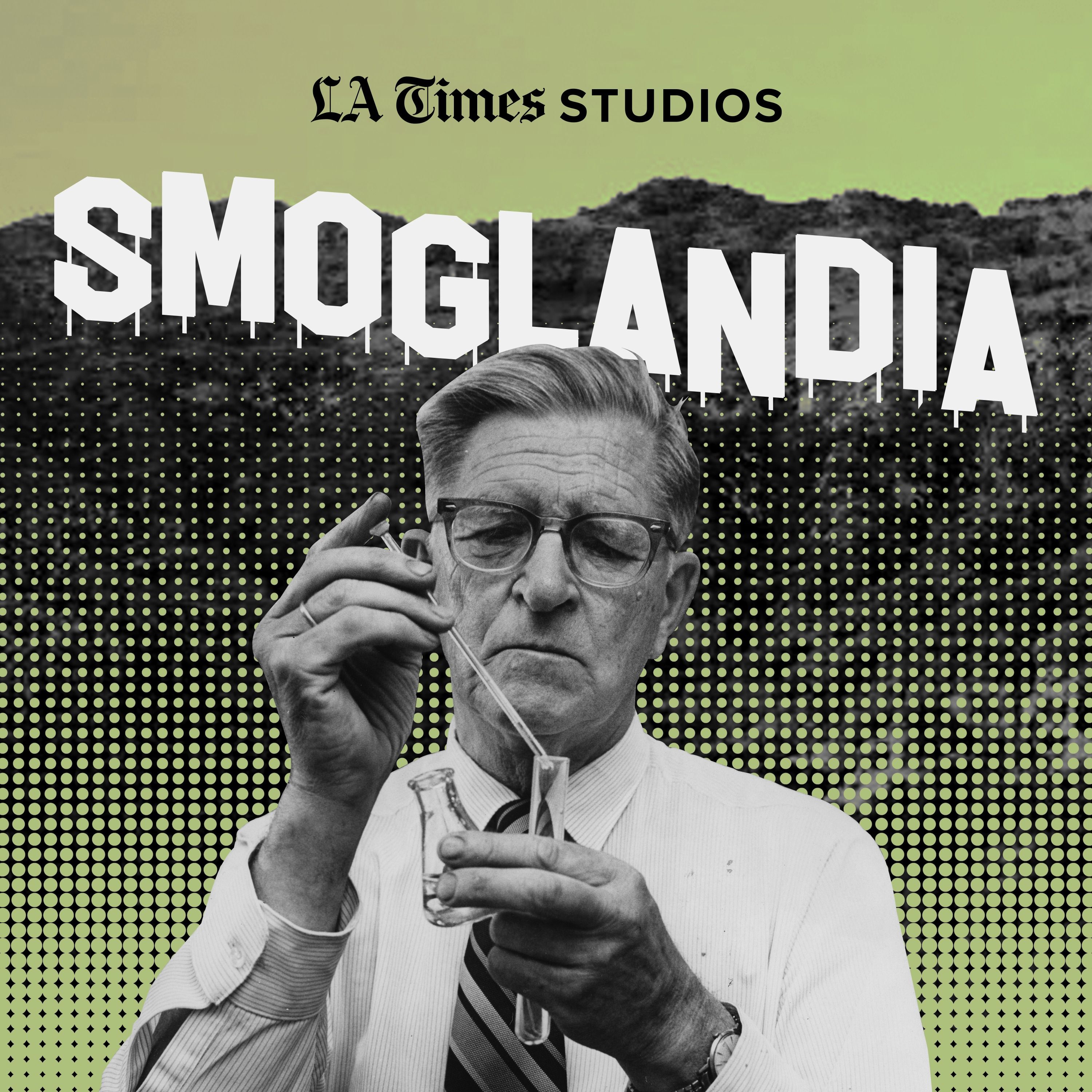
Boiling Point
Smoglandia Pt 2: SCIENCE TO THE RESCUE
00:33:16
By the late 1940's, Los Angeles had experienced several extreme smog days -- or "gas attacks" as they were called back then. Everyone had their eyes on wartime factories that had sprung up and were shooting black plumes into the air, but someone had a feeling that the cause might be something else. Arie Haagen-Smit, a Dutch professor at Caltech who would later be deemed the "father of air pollution," was technically supposed to be studying the taste and smell of pineapples when he first began to conduct research into smog. Through letters and interviews with Caltech faculty and historians, we piece together how Haagen-Smit discovered the recipe to smog, and how after he published his results, people weren't exactly ready to hear that their beloved cars were at the root of the problem.
Loading summary
Transcript97 lines
- [00:01]
Pat Morrison
This is an LA Times Studios podcast.
- [00:15]
Narrator/Announcer
The following program is presented by krca the Next Hundred Years, a probe into the future by the world's top scientists. Here to introduce Tonight's guest is Mr. James Miller, Director of Caltech's public relations department. Good afternoon. Certainly one of the most important problems faced by Southern California and many other communities is the problem of air pollution wherever millions of citizens.
- [00:43]
Pat Morrison
What you're hearing is from a long ago television broadcast called the Next Hundred Years.
- [00:48]
Narrator/Announcer
The problem of smog in Los Angeles is particularly difficult because of the lack of prevailing winds. Hence, Los Angeles must be much cleaner than most other cities in order to have tolerably pure air.
- [00:59]
Pat Morrison
This program was from 1959 and it's about air pollution in Los Angeles.
- [01:04]
Narrator/Announcer
I take pleasure in introducing Dr. Hagensmit, who will speak to you on the subject. The air and you.
- [01:11]
Dr. Ari Hagensmit
Good afternoon.
- [01:12]
Pat Morrison
The good doctor is standing at a lab table bearing a big round glass flask and what looks like a long necklace of huge wooden beads. In fact, it represents a molecule that even at its actual size, millions of times smaller, is. Is altering the quality of life across Los Angeles and parts of Southern California.
- [01:30]
Dr. Ari Hagensmit
Most people don't give much thought to air. It's after all, invisible and doesn't seem to have much weight. And so we only hear about air when it is too hot or too cold or perhaps too smoggy.
- [01:45]
Pat Morrison
In the movies, the hero rides to the rescue in a white hat. This time the hero wore a white lab coat. Dr. Ari Hagensmit, a man you've most likely never heard of, but he is probably the single most important figure when it came to cleaning up the air in southern California. Until Dr. Hagensmit got to work, Southern Californians were often pretty clueless about why their air had turned from fresh to foul in the space of a decade or so. Angelenos could see the smog, they could taste it. And nobody seemed to be able to figure it out, much less put a stop to it.
- [02:21]
Dr. Ari Hagensmit
This is very often not realized by people, and they don't think about the fact that a general overall pollution in the basin might be there, but the local pollution might be most exasperating to the person that lives here. And this causes a great deal of bad feeling.
- [02:44]
Pat Morrison
Now, no one else has seen or heard this film for maybe decades. We had the thrill of discovering it when a Caltech professor named Rick Flagan told us that years earlier he. He had found a can of film stuck away in a closet. Thankfully, we were able to restore this film and to bring Professor Hagensmit back to life. His face, his words, his findings, nearly 50 years after he died. It's like a time machine, a glimpse into L A. S polluted past and a hint of its clearer future. Here's the episode wherein we switch literary genres from the fairy tale to the murder mystery. It's late July in the summer of 1943, and a gross choking brown thing has settled over Los Angeles. And just like in a murder mystery, at first they fingered the wrong suspect. A gas plant near downtown Los Angeles, making something called Butadiene. Most people hadn't heard of butadiene before, couldn't even spell it, and it hardly fit in a headline. But the factory obediently shut down for a bit and everybody thought it was one and done, solved. But more of what they called a gas attack. And those daylight dim outs kept happening. In 1944, in 1945, and a lot more days were starting to look like July 1943. But as people said, there's a war on. Los Angeles was one vast chemical, metal and petroleum factory, supplying our boys in the Pacific and in Europe with the firepower they needed. There were plenty of clues and guesses about what caused it. A lot of the betting was on sulfur dioxide, that choking soot from coal. But LA wasn't burning coal. At one point, some frustrated experts just gave the substance a name out of a sci fi movie. Component X Chip Jacobs, the co author of Smogtown, explains, there was no science.
- [04:50]
Chip Jacobs
From 1943 to 1950. The science was so inferior, so marginalized and kind of like today. False equivalencies. I hate false equivalencies. Throughout the rest of America where there had been air pollution problems, none as bad as la. It was usually the result of a sulfur product coming out of a smokestack. And the belief was, well, sulfur was the culprit in St. Louis, thus it must be the culprit in Los Angeles. Completely wrong.
- [05:21]
Pat Morrison
And then the war came and it went and the smog came and it didn't leave. They couldn't blame the Japanese anymore, or even the wartime industry. Something was killing Angelenos. They didn't even know how or where it came from.
- [05:35]
Chip Jacobs
Interestingly, in a region with, you know, USC, UCLA, Occidental, there's a lot of college professors in the LA area. Nobody had done what Dr. Hogginsmidt had done.
- [05:48]
Pat Morrison
But when Ari Hagensmit told LA what his research had turned up, it's fair to say that most everyone, from oil refineries to carmakers to the millions of Angelenos behind the wheel was not ready to hear that news.
- [06:01]
Dr. Ari Hagensmit
This is an extremely disturbing situation. With the greatest effort, we might perhaps be able to hold the line for a while. But the time soon comes when existing controls are again neutralized by further increases in industry and other activities of people in general. And in an appraisal of the future of such a problem so serious as air pollution, wishful thinking has no place, and only an objective and realistic approach can help us in finding the right course to take.
- [06:37]
Pat Morrison
I'm Pat Morrison and you've crossed the border into Smoglandia. Pollution, pollution. Wear a gas mask and a bale.
- [06:50]
Narrator/Announcer
They're drinking the water and breathing.
- [07:02]
Rebuild SoCal Partnership Representative
Altadena and the Palisades are in the process of rebuilding after the devastating wildfires on the ground in la. Rebuilding after the Fires is a new video podcast series from Rebuild SoCal partnership that explores the stories of those working to rebuild. Communities are being reconstructed with the help of Anvil Construction, bringing experience and empathy to their work.
- [07:24]
Narrator/Announcer
It's very emotional as you can imagine, but our guys and girls will take the time to sift through the ashes with them.
- [07:30]
Rebuild SoCal Partnership Representative
One by one, thousands of homes will be rebuilt.
- [07:33]
Pat Morrison
We are skilled union carpenters and we're ready to go to work. The operating engineers Local 12 has made.
- [07:38]
Narrator/Announcer
A commitment to the community here and.
- [07:41]
Arnold Beckman (voiced by Steve Clow)
We'Re going to be here for the long haul.
- [07:43]
Rebuild SoCal Partnership Representative
Rebuild SoCal partnership is following the journey of the families, communities and small businesses as they come back to life, stories of unbearable tragedy and unlimited hope. Tune in to the podcast Rebuilding Los Angeles for stories you will not forget.
- [08:02]
Southern California Edison Representative
During one of the most severe windstorms Southern California experienced in more than a decade, the Palisades and Eaton fires ignited, leaving heartbreaking losses in our communities. Now, as we build back, we're building stronger, cleaner and more resilient in communities most vulnerable to dangerous weather conditions and wildfires. Southern California Edison is placing power lines underground, hardening the electric system by installing wires with protective coating and adding advanced technology to help keep communities safe. So when Southern California faces the next storm, the next most severe event, helicopters, structures adjacent here, we'll be ready. Learn more@sce.com disasterrecovery.
- [09:02]
Chip Jacobs
What people I think failed to realize initially, LA was very alone in this fight.
- [09:08]
Pat Morrison
That's Chip Jacobs again.
- [09:09]
Chip Jacobs
The federal government could not care less about LA air pollution. It was a local problem for them to fix with some engineering dial. The Governor of California did not care. He did not want to get involved in a la pollution issue.
- [09:25]
Pat Morrison
So I decided to use that 16 millimeter time machine and visit the epicenter for this epic discovery. It was a school originally named the Troop Institute, set on some lovely acres of Pasadena and dedicated to engineering. You'll know it by the name it's had for more than 100 years now, Caltech. Almost four dozen Nobel laureates have worked here. A man who received two of those prizes, Albert Einstein, spent three winters here in the 1930s. He said then that the place was like a paradise of sunshine and clean air. And every year for some 20 years, the celebrated physicist and cosmologist Stephen Hawking spent a month here. That's where I met him a couple of times, right before one of the student cooked dinners of the extremely spicy Indian food that Hawking loved. When Caltech heard we were putting together this podcast about air pollution, they matched us up with the guy.
- [10:22]
Dr. Richard Flagan
Now, that box there is an instrument from Hagensmit.
- [10:25]
Pat Morrison
Is it really? When Dr. Richard Flagan opened his office door to us, he had on hand an odd little gizmo he'd rescued from a retiring colleague's closet. Small but astounding for what it did.
- [10:37]
Dr. Richard Flagan
That was his early ozone monitor. It's very, very simple.
- [10:42]
Pat Morrison
I'm sitting on a sofa in Dr. Flagan's office, and there it is on the coffee table in front of us. So simple a contraption to answer such a complex puzzle.
- [10:53]
Dr. Richard Flagan
That's one I happened to find probably on ebay, right? No, I found it in a Caltech closet 40 years ago.
- [10:59]
Pat Morrison
Oh, my God.
- [11:00]
Dr. Richard Flagan
And I just said, I've always been interested in history. And it just said, this is something that shouldn't be thrown away, shouldn't be buried in a closet.
- [11:10]
Pat Morrison
If you hadn't guessed, Dr. Flagen is also the man who found that Hagensmit film neatly coiled in a standard old metal film can. He thought it could be important, and he held onto it all these years. Like Hagensmidt, Dr. Flagen is an expert in atmospheric science. But when he came to Pasadena, where he's the McCollum Corcoran professor of Chemical Engineering and Environmental Science, he. He had already visited la, as so many of us first did, as a tourist. He was a kid in the 1950s, tagging along with his dad.
- [11:42]
Dr. Richard Flagan
My father had some business in Southern California, and we drove across the country and came into Los Angeles. And when we came into the LA base and came over the mountains and started coming down into this terrible haze, foul smell. That was my introduction. We spent a couple of weeks here, and I recall not seeing my shadow and getting an incredible sunburn. The smog was so bad you didn't see the sun, you just saw the dense haze. I swore at that time that I would never live in Southern California. It was just so foul.
- [12:29]
Pat Morrison
Yet here he wound up at Caltech in The still smoggy 70s, working outdoors in the thick of it, doing some of the work that earned him California's Hagensmid Award for Clean Air. Part of the work was strapping a giant research balloon to the roof of a building.
- [12:44]
Dr. Richard Flagan
We had a big Teflon balloon, big pillow shaped balloon, about 60 cubic meters, 60 cubic yards. We would fill it with clean air, add to it particular reactants, and study how they reacted, how the sunlight drove the photochemistry, leading to the production of ozone and other oxidants, leading to the production of materials from feeds that were initially in the vapor phase, transformed into particles that were the haze that you see in this morning.
- [13:18]
Pat Morrison
Did your results surprise you at all?
- [13:22]
Dr. Richard Flagan
We constantly were learning, and yet there were many surprises along the way.
- [13:30]
David Zerler
From the beginning, Caltech has this magic where it's exciting, it's new, it has grand ambitions, it's attracting the very best researchers.
- [13:42]
Pat Morrison
This is David Zerler, the director of the Caltech Heritage Project.
- [13:46]
David Zerler
And it's the thing that attracts actors to come to Los Angeles and surfers and people who are interested in adventure and freedom and sunshine and all of that.
- [13:57]
Pat Morrison
In 1937, it attracted an intense Dutch chemist named Ari Hagensmit, who came to teach and to research.
- [14:05]
David Zerler
He came here, like almost every very promising professor comes here in the 20s and 30s, because it was clearly a place that had aspirations and already a record of excellence. And it felt wide open at the time, and you could do whatever you wanted here.
- [14:24]
Pat Morrison
LA was not yet the polluted place it would become, and Hagensmit's specialty also seemed to be a long way off from smog.
- [14:31]
Dr. Richard Flagan
Arie Hagensmit came to Caltech as a biochemist, and he was trying to understand the chemistry of flavor. One thing that he was looking at was that what is the origin of the taste of pineapple? He had a greenhouse, he had lots of plants.
- [14:49]
Pat Morrison
His must have been a popular lab for the leftovers.
- [14:52]
Narrator/Announcer
That I don't know.
- [14:53]
Dr. Richard Flagan
I was not here at the time.
- [14:56]
Pat Morrison
For some years, Hagensmit labored in the Caltech labs and classrooms, supporting his wife and three young children. Years later, his wife, nicknamed Zeus, told a Caltech interviewer that the couple were able to buy their house in Pasadena because home Hoggie, that was his nickname, Hoggie had a side hustle, earning extra money testing the urine of racehorses for illegal doping. The word nerd wouldn't come along until after World War II. But on a campus supposedly populated by that type, Hagensmit looked like he'd wandered in off the MGM lot by mistake.
- [15:30]
David Zerler
He was strikingly handsome. He was very confident, very kind. He was understated among his colleagues, and he liked to wear a white lab coat. He was always the mild mannered professor, and he'd think he was happiest in the lab. And that made him very much on brand for who Caltech professors were and are.
- [15:56]
Pat Morrison
Hagensmit would probably have been happy to keep working among his plants and Erlenmeyer flasks for the rest of his career. But dead plants and a live scientist and inventories, a very lively one, sent him in a different direction. One that put Hagen Smit right smack into the maelstrom of la smog.
- [16:16]
David Zerler
One of his colleagues said, there's all kinds of plants that are dying in my garden around Caltech. Try to figure out what's going on.
- [16:25]
Pat Morrison
That lively fellow was a Caltech grad, Dr. Arnold Beckman, a chemist himself, an inventor of vital scientific instruments, and a businessman who funded and promoted foundational work in electronics.
- [16:38]
David Zerler
If you look at photos of Beckman, first of all, the big thing that jumps out at me is his piercing gaze. Obviously I never met him, but in all of the photographs it looks like he could look right through you with his eyes. He was always intently focused.
- [16:55]
Pat Morrison
Years later, at a dinner in Hagensmit's honor, Beckman recounted how he met this flavor obsessed Dutchman and lured him into the study of smog. Here's Times colleague Steve Clow, reading from that speech.
- [17:08]
Arnold Beckman (voiced by Steve Clow)
Why did Dr. Hagensmit, a brilliant young biochemist facing a bright future in an exciting field of research, decide to abandon his research and engage instead in the nasty, unglamorous, inglorious field of air pollution? I can shed some light on this question, for I was responsible in some measure for getting him into the act. It may be of interest to review briefly some events that led to this drastic change in his life. Before the early 1940s, there was little public concern over atmospheric pollution in the Los Angeles area. Pasadenans told visitors of this problem proudly, on a clear day, you can see Catalina.
- [17:54]
Pat Morrison
Beckmann also hinted at haggard, whimsical nature. When people called him the father of photochemical smog, his answer was, who's the mother? Joking aside, the number of those clear to Catalina days began to get fewer and further between. For all that anyone could see, Catalina island might as well have been at the bottom of the sea. Keeping Atlantis company after the war, Beckman became a scientific advisor to LA's rudimentary air pollution control operations, an organization that existed only to figure out what the hell was causing the smog and how the hell to stop it. Dr. Lewis McCabe became the head of LA's air pollution agency.
- [18:35]
Arnold Beckman (voiced by Steve Clow)
Dr. McCabe set out on a campaign to reduce dust, smoke, fumes and sulfur dioxide.
- [18:42]
Pat Morrison
The ask was huge and the power to make it happen minuscule. Its success rate hit or miss.
- [18:49]
Arnold Beckman (voiced by Steve Clow)
The poor chap was being harassed from all sides. Industry said that he was being too tough and unreasonable. Others accused him of being not tough enough. Mr. William Jeffers, who had recently retired as president of Union Pacific Railroad and was chairman of the Citizens Smog advisory committee, blasted McCabe in the press. What's the matter with McCabe? He asked. He he's been on the job for three months and pollution is just as bad as ever. Dr. McCabe's reply to our request was, there's no time for research. Eventually we persuaded him that an analysis of polluted air was essential.
- [19:32]
Pat Morrison
In his speech, Beckman refers to William Jeffers, the head of a Citizens Smog Advisory Committee and the former head of Union Pacific Railroad. And keep in mind, railroads were were a big polluter. That McCabe was a frustrated man was clear as early as 1949 when he suggested that Angelenos had been misled about the seriousness of the smog problem and that industry had managed to block clean air proposals.
- [19:57]
Arnold Beckman (voiced by Steve Clow)
This is the point at which Dr. Hagensmit entered the scene.
- [20:02]
Pat Morrison
The air still wasn't clear, but the message sure was. Time to get a new sheriff in Smogtown.
- [20:13]
Rebuild SoCal Partnership Representative
The LA Times Festival of Books returns to the USC campus April 18th and 19th, 2026. Join us for a weekend of authors, celebrities and activities for all ages. Admission is free.
- [20:26]
Pat Morrison
Learn more@latimes.com FOB Arnold Beckman had just the man in mind for the job. His choice was Professor Ari Hagensmit. And not only did Hagensmit's discovery profoundly alter the future of California, of cars, of public health, and of LA's self image and identity, it changed his own life from the stereotype of the unknown scientist in a lab to a very public and not always popular figure.
- [20:55]
Arnold Beckman (voiced by Steve Clow)
Obviously a highly skilled microchemist was needed. Dr. Hagensmit was asked whether he would perform the analysis and he kindly agreed to do it.
- [21:06]
Pat Morrison
Beckman was about to draft a man who had devoted his life's work to analyzing the scent and flavor of compounds in plants. Cashews Radishes, onions, and, of course, those pineapples. And instead, to set him to work to figure out the mystery of smog. This is how Hagensmith's wife, Zeus, remembered it being read from her Caltech oral history. Ari was working on the flavors of pineapple at the time, and that was all microchemistry. He had been condensing fumes from the pineapple to make a very small volume in order to do a chemical analysis on it. Between them, Hage and Beckman devised unique instruments for experiments that Hage also often designed himself. One of the most effective was one that Rick Flagan showed me, a cold trap to collect air samples, or as.
- [21:53]
Dr. Richard Flagan
Flagin called it, used a cold trap, collected some samples. Essence of smog.
- [21:59]
Pat Morrison
The essence of smog is organic chemicals set loose in the air. And what happens to them when they encounter one essential and surprise element.
- [22:08]
Dr. Ari Hagensmit
Now, those two components, the hydrocarbons and the oxides of nitrogen, react in sunlight to give the eye irritating material that we know so well.
- [22:24]
Pat Morrison
Okay, one step at a time. First, oxides of nitrogen, also known as nitrogen oxides. And no, it is not laughing gas or otherwise. This would all be completely hilarious. No, it's what launches into the air when you burn fossil fuels like oil or natural gas or coal, which we do all the time in industry, in power plants, in gas stoves, and, of course, in cars and trucks. It's what humans have done ever since we figured out how to set fire to stuff. Now, hydrocarbons, they can be part of a family of things called volatile organic compounds, VOCs and those you find in nasty chemicals like benzene and toluene. Hagee described it like.
- [23:09]
Dr. Ari Hagensmit
And then, curiously enough, there is a compound, ozone formed. And ozone is a very active form of oxygen consisting of three atoms of oxygen instead of two, like ordinary ozone.
- [23:23]
Pat Morrison
These VOCs are everywhere in just about everything we've created somewhere along the 20th century. They're compounds that turn up in nail polish remover, candles, detergent, glue, some paints, some fabrics, some perfumes, insulation. They even create that new car smell that people love and which we might not like so much if we called it by its more technical name, off gassing. Still with me. Good gold star for you. Anyway, when these two get together in the environment, like in the air, and then beams of nice warm sunshine hit them, they create sensitive little baby molecules that science calls free radicals, but let's just call them sensitive little baby molecules. And that creates ozone. Now, ozone on its own has no color or smell, but mix it in with these other bits and it begets yellowish, brownish, grayish, stinkish smog. An ozone that's way up high. I'm talking as low as 6 miles above us and as high as 30 miles. That's good ozone. That's the stuff that shields us from dangerous ultraviolet light. The bad ozone is poison. And that's what's right here with us, us at ground level. Understanding the specifics of smog chemistry was beyond most Angelenos, this one included. But no one could fail to understand the famous rubber strip test. Here's how it Hage and his assistants kept exposing a loop of rubber to big whooshes of LA's smoggiest air. And literally right in front of their eyes, in literally seven minutes, the rubber cracked and split.
- [25:05]
Dr. Richard Flagan
One of the indications of the effect of the ozone was the rubber would crack.
- [25:13]
Pat Morrison
And this was happening all over Southern California, to people's tires, their windshield wipers, to rubber gaskets and hoses. I remember taking my car into the repair shop and the man in the overalls would tell me very matter of factly, gotta replace em. You know, this is what happens to rubber in la. Like, forget it, Pat. It's Chinatown.
- [25:33]
Dr. Richard Flagan
And the practical science that became very important because the ozone, the pollution, the smog was catching everyone's attention. You couldn't ignore it.
- [25:44]
Pat Morrison
If Hagee hadn't been much of an ice skater in his native Netherlands, in la, he sure had to learn fast because he was about to go skating on thin ice, politically and in a lot of other ways.
- [25:55]
Dr. Richard Flagan
But he added to that the automobile as a focal point. And he started trying to understand it and ultimately to understand the effects of it.
- [26:09]
Pat Morrison
Keep in mind that for a half dozen years, the not very powerful smog authority had been dinging factories and chemical plants and garbage dumps with good reason, because they were befouling the air. But still the smog had not vanished. And Hagee and instead of looking out to the industrial landscape, had looked somewhere else, somewhere as close as people's garages. So the fairytale curse had finally come home to roost. Angeleno's two greatest loves, their sunshine and their cars, were conspiring to create one of the worst blights on their lives. Photochemical smog. So he must have been regarded in some circles as the skunk at the picnic. You're blaming cars.
- [26:55]
Dr. Richard Flagan
He had lots of people who did not like his story. Yes.
- [27:03]
Pat Morrison
America in the 1950s was car mad, loony, insane. And Los Angeles was the throbbing engine of the auto erotic. Amateur racers pimped out coupes, woodies and ragtime sedate sedans, souped up hot rods all share the brand new wide open freeways and boulevard. We were out there having fun in the warm California sun. For 50 years, composers had been writing syrupy songs about sweet little California bungalows with fragrant orange trees. Our state song was written by two Angelenos. Now the popular music was about Corvettes and GTOs in that brand new shiny red superstock Dodge. And here comes this Dutchman with a weird name and a PhD telling us that our cars, our cars and trucks were the problem. That there may be a shiny grille and big hood ornament in the front, but it was all noxious exhaust crap in the back. Hockey himself test drove the freeways in a Plymouth fitted out as a test mobile. It had a specially made detector to analyze carbon monoxide, from which, among its other problems, makes drivers less alert. And how did we thank Dr. Ari Hagensmit for this stupendous, life altering, life saving discovery? Did they make him grand marshal of the Rose Parade? Did he win a Nobel Prize? No. This man practically saved Southern California from itself. And they didn't even name a freeway off ramp in his honor.
- [28:33]
Arnold Beckman (voiced by Steve Clow)
This conclusion produced impassioned outbursts of protests, especially from the oil companies and the auto manufacturers.
- [28:41]
Pat Morrison
Here's Arnold Beckman on what happened to Hoggie after he published his findings.
- [28:45]
Arnold Beckman (voiced by Steve Clow)
Hagen Smith was all wet, they said. Obviously much more had to be done. Haage did not wish to spend more time on the matter, for he had his research program to carry out.
- [28:59]
Pat Morrison
Hoggie wasn't expecting to have to go to the fight, but the fight came to him. He was, in fact, a champion boxer with big biceps under that lab coat. And he would not be backing down from a battle. Not long after Hagee's research hit the headlines, an outfit called the Western Oil and Gas association opened its checkbook to fight facts with money. For starters, it was the public face of the petroleum industry, which was already hip deep in the smog wars. It was blamed for airborne gunk from oil wells and refineries for those blue, blue, black lakes of oil right out there in the open. And it was feeling under siege by the prospect of more regulations. And now this chemist who'd studied pineapples was saying it was their products, their gasoline, their diesel fuel in almost every car and truck on the road that had a big hand in ruining the air. They'd had enough, so the association hired a big name to come up with its own set of findings, ideally to spread around the blame for smog and Maybe even do a smackdown of Hagee's work. The Stanford Research Institute. Yeah, I know. Stanford, right? Woo hoo. It set up a laboratory in South Pasadena, a few miles from Caltech. It seemed like all of Hage's research might be lost to oily fingers. In a speech at a dinner honoring Hage after he died, Beckman described what happened next.
- [30:23]
Arnold Beckman (voiced by Steve Clow)
I was reluctant to pressure Dr. Hagensmit very hard, for my conscience bothered me some. If I persuaded him to spend more time on air pollution matters, would I be guilty of interfering with his personal research programs, which quite possibly might lead to a Nobel Prize? Fortunately, that dilemma was solved by Hagee himself. One of the outspoken critics of Dr. Hagen Smith's work was the Stanford Research Institute, which was doing work for an association of Western oil and gas producers. It happened that a member of the SRI staff was to give a talk on air pollution in the chemistry lecture hall at Caltech. I got Hagee to attend with me after the speaker had described some of his own work. He attempted to discredit Dr. Hagensmitz work, saying that Hagee's research was not consistent with the SRI's findings and expressed regret that a respected scientist such as Dr. Hagensmidt could make such a serious mistake. Well, I could almost feel Hagee's blood pressure rise. He was furious. The validity of his work was being questioned. I'll show them who's right and who's wrong, he muttered as we left the room.
- [31:43]
Pat Morrison
Zeus Hagensmit echoed this sentiment in her Caltech organization oral history. He was so mad. Oh, he was furious. So he was going to prove to them that they were wrong. And boy, did he. Hagensmit was charismatic and good looking, and if he had been making his case, today he'd be on Instagram and TikTok and swapping smog jokes with Stephen Colbert and doing with Martha Stewart in a TV studio kitchen exactly what he liked to do in stuffy lecture halls. Proving his point by cooking up a flask of smog right in front of the audience's runny red eyes. Yes, car and truck engines were the biggest malefactors, but Hagee didn't stop with them. He blamed big business and big business interests.
- [32:32]
Arnold Beckman (voiced by Steve Clow)
He introduced a wholly new concept of air pollution that brought about a revolution in in efforts to obtain clean air. He identified and courageously named the major sources of air pollution, the automobile, oil refineries, power plants and steel factories.
- [32:51]
Pat Morrison
Later, he'd talk about what he'd run up against. He said, quote, I had a lot of trouble getting people to accept this. They said it was absolute nonsense and impossible, and the auto industry had the opinion that it was all none of my damn business. 70 years ago, encouraged by air pollution agencies, he went out on the hustings like a candidate. He appeared in popular magazines, all to persuade Californians he was telling them the truth once in a while. His frustrations burst through. In December 1975, at a big air pollution conference at Caltech, he said, the public wants clean air. Yes, they want clean air if they don't have too much trouble. Sometimes I get the feeling we should just ignore the public and feed them the controls. But far more often, he was the happy and hopeful warrior, promoting clean energy and cleaner cars and public transit. About six months before he died in March of 1977, he showed up to speak in an elementary school science class in the city of Monrovia, not too far from Caltech. And he did show and tell for the kids with his poster Smaug Factory in the Sky. There's one more movie genre in the story of Smog, and it's sci fi. Neil Degrasse Tyson, the astrophysicist and sometime movie reviewer, got it right that every disaster movie begins with a scientist being ignored. Smoglandia is hosted by me, Pat Morrison. Our senior producers are Mary Knoff and Jonathan Shiflett of Studio Phonic. Our editors are Hugo Martin, Shelby Grad and Steve Clow. Our director of library services is Carrie Schneider. Additional sound design and engineering by Hannis Brown. Special thanks to our editor, Steve Clow for voicing Arnold Beckman and Caltech professor Franke Hoffman for voicing Zeus Hagensmidt. Our podcast Marketing manager is Bryn Jura, and our Product Marketing Director is Becca Dorman. Special thanks to LA Times Studio President Anna Mogzanian, President and Chief Operating Officer of the Los Angeles Times, Chris Argentieri, and again Executive Editor of the Los Angeles Times, Terry Tang. Smoglandia is executive produced by Darius Derek Shawn. Hugh is a rock climber, a white supremacist, a Jewish neo Nazi, a spam king, a crypto billionaire, and then someone killed him.
- [35:46]
Dr. Richard Flagan
It is truly a mystery.
- [35:47]
Pat Morrison
It is truly a case of whodunit. Dirtbag Climber, the story of the murder and the many lives of Jesse James. Available now, wherever you get your podcasts.