← Boiling Point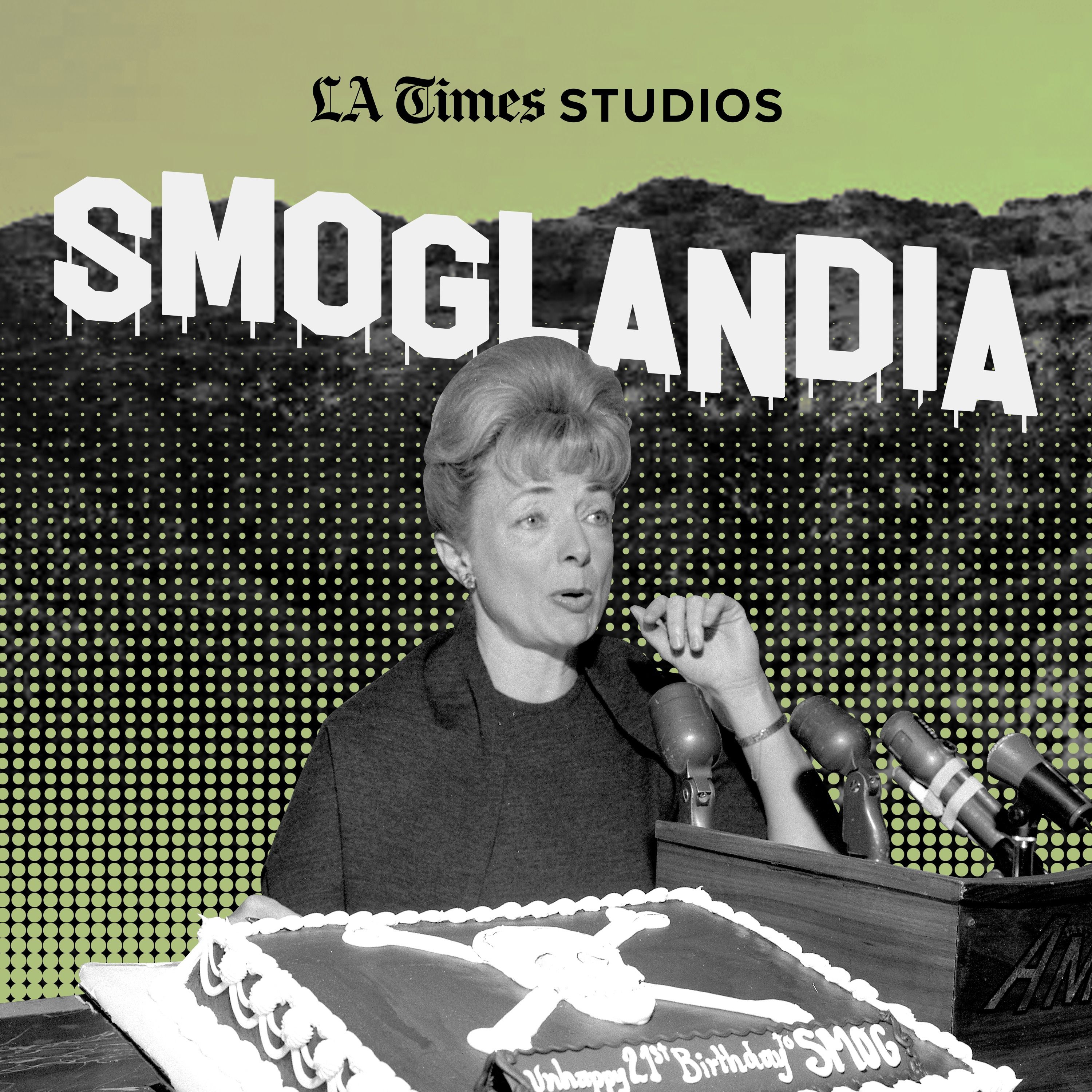
Boiling Point
Smoglandia Pt 3: COUGH COUGH
00:34:26
Living with smog was like living with an obnoxious neighbor. Angelenos tried protesting at city hall. They kept their coughing kids inside. A couple of actors manufactured joke cans of “genuine smog” and sold them to tourists. A few came up with earnest but crackpot solutions, like drilling a smog tunnel in the mountains. But serious pollution cost us serious money. Hollywood shoots had to shut down or move farther out of town to avoid it. And Southern California’s billion-dollar agriculture industry was being literally killed off by smog. One story we tell – of the Kaiser Steel plant in Fontana – made it look like LA had to choose between good jobs and good air, between pink slips and pink lungs.
Loading summary
Transcript80 lines
- [00:02]
Rick Dias
This is an LA Times Studios podcast.
- [00:11]
Katie Purdy
Shall I just do it? Okay. Dear Mr. Governor, I am a girl of 11, almost 12, and I would like to grow up. Is that surprising?
- [00:22]
Pat Morrison
No.
- [00:22]
Katie Purdy
Everyone wants to grow up. But what is there to grow up to? Oh, I can list a few things like smog bombs and lots more, but don't you think that I and everyone else should have a little more to grow up to?
- [00:34]
Pat Morrison
That is Katie Dilkes. Katie Purdy, now reading a letter she wrote 66 years ago to Pat Brown, the new Governor of California.
- [00:43]
Katie Purdy
The smog here in Los Angeles is so thick that it's pitiful. In one of my school classes, we had a fire drill. The teachers always take roll call when we get outside. The smog was so thick that we could not tell if we were pink or blue. I was thinking that since you're governor, you. I thought that maybe you could do something about it and a little more than taking away incinerators. Sincerely yours, Katie dilkes.
- [01:08]
Pat Morrison
Purdy was 11 then, living in LA's Silver Lake neighborhood.
- [01:13]
Katie Purdy
My mother and I lived all over la and part of the time we lived up in the. In the Canyons, which was great, but you could look down from there and see the smog level in LA just covering it. It was unbelievable.
- [01:27]
Pat Morrison
Then one day at school, something happened, not to her, but to her teacher that put that letter in motion.
- [01:34]
Katie Purdy
And that particular day that I was in school, I remember that very well, the teacher trying to take roll call. Her eyes were watering so much, she could not identify all the kids that she just. I remember her, she just kind of gave up. She started looking for kids and then she just kind of gave up. That really upset me that we were out of control. I remember coming straight home and just saying to my mother, isn't there anything we can do about it? And she suggested, she said, you know, you could write a letter.
- [02:05]
Pat Morrison
The most important word in the letter was smog. And she spelled it with two GS.
- [02:10]
Katie Purdy
I don't remember it. That's the way I thought it was spelled. I just know that. And my mother later said that she thought of correcting me and decided not to. She just let the letter go as it was. So I remember seeing headlines saying, she can't spell it, but she knows what it is.
- [02:27]
Pat Morrison
She never heard back from the governor, not directly, but he quoted her letter in the six point air pollution plan he presented to the legislature the very next month. And Katie was famous. Nothing unifies Angelenos like misery. Their throats were like sandpaper. Their chests hurt like the blazes. They were shedding more tears than a ladies club audience at a Hollywood tearjerker. A crowd of San Gabriel Valley ladies complained. They wore gas masks with their June Cleaver dresses and had protest signs, help us fight this Black death. Give us pure air. They called themselves the Smogeteers. T E A R S Angelinos were hitting a wall. They protested. They wiped their eyes. But they had to go on about their days finding a new mode of living. Smog was sending its grasping fingers into everything about that living, work, fun, food, even the movies. Something had to give. You might be surprised to hear what it was. They're drinking the water. I'm Pat Morrison, and you've crossed the border into Smoglandia.
- [03:49]
Southern California Edison Representative
During one of the most severe windstorms Southern California experienced in more than a decade. The Palisades and Eaton fires ignited, leaving heartbreaking losses in our communities. Now, as we build back, we're building stronger, cleaner and more resilient in communities most vulnerable to dangerous weather conditions and wildfires. Southern California Edison is placing power lines underground, hardening the electric system by installing wires with protective coating, and adding advanced technology to help keep communities safe. So when Southern California faces the next storm, the next most severe event, we'll be ready. Learn more@sce.com disasterrecovery and if you were impacted by the Eaton fire, you may qualify for direct compensation through Southern California Edison's Wildfire Recovery Compensation Program. File your claim directly with no legal fees, no litigation, and receive payment in months, not years. To file and learn more, visit sce.com.
- [04:47]
Pat Morrison
Directclaims the LA Times Festival of Books returns to the USC campus April 18th and 19th, 2026. Join us for a weekend packed with hundreds of authors, celebrities and activities for all ages. Admission is free. Learn more@latimes.com fob that's latimes.com.
- [05:12]
Suzanne Noreschot
Oh, and the stockings. They thought that stock that the smog was. Yeah, her stockings was nearly fell apart when she and other pedestrians were blanketed with stinging soot. On 6th Street.
- [05:26]
Pat Morrison
They call it soot, but yeah, it was smog. Over the years, I picked up here and there a little collection of smog related souvenirs which I donated to USC's Archives of LA History, where Suzanne Noreschot works.
- [05:40]
Suzanne Noreschot
I've been here for eight years next month focusing on Los Angeles history and all its multifaceted wonder and horror. And all of that.
- [05:54]
Pat Morrison
Wonder and horror indeed. Let's start with the wonder. One of my favorite smog chotchkis is A gag gift for tourists dreamed up in the 1950s by a husband and wife team of actors. He was a character part player named Carlton Young, and she was Noelle Toy Young, a Chinese American fan dancer and an actress you might have seen in small parts on the TV show mash. By the thousands, they made and sold genuine Los Angeles can smog.
- [06:24]
Suzanne Noreschot
There are a variety of cans of different size that are clearly souvenirs. And they have labels that show LA scenes like freeways and factories spewing smog next to freeways.
- [06:42]
Pat Morrison
And now this one, this one is my favorite one because it's full color and it has a blonde woman in a low cut dress reclining. And it says somewhere on the can breathe the air the movie stars breathe. The souvenir cans made another pledge. No pollutants or irritants removed.
- [07:01]
Suzanne Noreschot
We have a smog towel that was donated by you, a kitchen towel with green lettering that says Los Angeles Smog Towel. And there are several images with captions below that read. I'll just read a few out. Council considers New name for City of the Angels Smog Angelus, Toast of the town. Here's smog in your eye.
- [07:30]
Pat Morrison
The usual toast. Here's mud in your eye. But instead, we have smog files like these. Well, you just want to go wild rummaging through them. And the USC archives hold myriad such images. Noreshatz laid a tantalizing sampling of them out here from 40 years of photographs from the Los Angeles examiner newspaper. Now here's a photo from August of 1956. Grace Marquez tries to help her daughter Gracie, age 5, who has an eye full of irritating smog. And the caption says, note obscured. City Hall. City hall in the background. Looks like it was painted as a backdrop. You can scarcely see anything but the outlines. And here is a woman dabbing at the eyes of her little girl who's in this beautiful tulle party dress.
- [08:14]
Suzanne Noreschot
I mean, it's one thing, you know, the distant mountains to see them obscured, but to see a building that's literally maybe a block away to be completely obscured in smog is really quite striking.
- [08:30]
Pat Morrison
You know, la, if you mention Beverly Hills, people sit up and listen. In 1958, some Beverly Hills women formed SOS Stamp Out Smog. Now, one of the longest running and best known smog protest groups. Afton Slade and Marge Levy were brilliant at pr. They showed up at a county supervisors meeting with kids in smog masks. In 1964, Slade called a press conference for a sheet cake. It was decorated with a skull and crossbones. An unhappy 21st birthday sketched out in frosting to mark the 21st anniversary of the devastating 1943 smog attack. And this was epic. A 12 hour Radio SOS telethon fundraiser starring ready Groucho Marx, Alice Cooper, George Foreman, Tony Bennett, Ralph Nader, and with a special song written and performed for the occasion by Ringo Starr. Some of these images made the papers all over the country. And while the smog was a danger, this was embarrassing. In 1964, the Vice President, Hubert Humphrey, was campaigning here in the often smoggy month of October. And what photo of glamorous sunny LA did America see? Humphrey in a convertible, in a motorcade, mopping his weeping eyes in the smog. A Michigan newspaper wrote, kind of snippily, if you ask me, that it made the motorcade look like a funeral procession. For a while, the protests arrived almost as often as the smog. One month, one year in particular, turned out an awful lot of angry Angelenos.
- [10:06]
Suzanne Noreschot
There seemed to be a lot of protests in October of 1954.
- [10:10]
Pat Morrison
Yeah, I think it was a bad year. So, okay, we're looking at a photo From October of 1954 of the Optimist Club in Highland park where all of these men, most of these men and their guests are sitting there staring at the camera, wearing gas masks. And the banner reads, why wait till 55? We might not even be alive. It's the Optimist Club being kind of pessimistic.
- [10:34]
Suzanne Noreschot
It's an enormously funny photograph, isn't it?
- [10:37]
Pat Morrison
And yet so poignant.
- [10:38]
Podcast Narrator (Stop Rewind)
Mm.
- [10:39]
Pat Morrison
Norishot retrieved a photograph from in front of the Pasadena Civic Auditorium. Once Again, it was October 1954. At almost the same time the Highland park optimists were wearing gas masks to their get together.
- [10:53]
Suzanne Noreschot
Several Pasadena residents went out on the street of Pasadena holding signs and wearing masks and even what looks to be an entire body kind of protective shield.
- [11:08]
Pat Morrison
And they're doing it with a Texaco station and a tire company in the background. Two of the biggest culprits.
- [11:15]
Suzanne Noreschot
And I love this small child.
- [11:17]
Pat Morrison
Katie Dilkes wasn't the youngest smog protestor in Southern California. That might have been 3 year old Agatha Acker.
- [11:24]
Suzanne Noreschot
And she has very sweetly, a mask on herself as well as her doll.
- [11:30]
Pat Morrison
That's the killer. She's wearing this little Judy Garland gingham dress with her little socks and saddle shoes. And her doll has a gas mask too. More than even any earthquake, smog changed how we went about our lives, our pleasures and our work. No one could have seen or felt that dense Air pressing down on Angelinos and harbored any doubt that it was making people sick. And kids, especially Katie Dilkes, Grace Marquez, Agatha Acker, and remember Helen Pashkian talking about riding her bike home from school through the smog and those sharp pains in her lungs. Kids all over LA were feeling the burn and their parents were really burned.
- [12:15]
Jane Fonda
See, I was born in 37. There were 2 billion people in the world. That's the carrying capacity of Earth. There was no smog, there were no freeways.
- [12:25]
Pat Morrison
This is Jane Fonda, the activist and Oscar winning actress who's made air quality part of her crusade in her protests and in her book what Can I the Path from Climate Despair to Action. She was what we call an early adapter using wind and solar power decades ago. And she's still taking her protests to the streets and to the powerful.
- [12:46]
Jane Fonda
I think that people who grow up and live in it for a long, long, long time, they don't notice it so much. I grew up in a pristine, clear environment.
- [12:59]
Pat Morrison
Not for long.
- [13:00]
Jane Fonda
I went away and when I came back it was like, wait a minute, my eyes are burning. Don't you guys? Aren't your eyes burning? And they didn't notice it.
- [13:14]
Pat Morrison
Fonda soldiered through the smog herself for years, but it took a couple of decades before she really began to take more serious notice and get alarmed.
- [13:23]
Jane Fonda
My kids got asthma and I was married to Tom Hayden, who was an activist, to say the least. And, you know, we began to be really concerned about it.
- [13:37]
Pat Morrison
For Fonda, it's all of a piece. The air, the water, and the kids who suffer the most. 93 out of 100 children the world over breathe air so polluted that it risks their health.
- [13:49]
Jane Fonda
There are parts of the world where children are presenting at hospital with black lung children who never smoked. Air pollution, also in the US also contributes to 10,350 preterm births and 216,000 new cases of childhood asthma a year nationwide. And I know what that's like because my son Troy had terrible asthma. We oh, it's so terrible to have to sit in a hospital with your child in a tent struggling to be able to breathe.
- [14:44]
Pat Morrison
Take the month of October in 1965. A vicious smog attack sent cops home sick from their beats. It slowed the times of the horses running at Hollywood Park. Racetrack and Children's Hospital in LA was overrun with kids having trouble breathing. Does smog have a different effect on kids?
- [15:05]
Ed Avall
Yes, they are in a developmental phase of their life, so their organs are immature and developing.
- [15:12]
Pat Morrison
This is ed Avall, professor emeritus of clinical medicine at the Keck School of Medicine at usc, an expert in respiratory diseases and air pollution, and a former high school athlete himself and still a 5k runner.
- [15:25]
Ed Avall
They don't have the cognition, understanding to undertake personal protective behaviors to come in if they don't feel well. And they are typically outside exercising at higher ventilation rates per unit of tissue than adults. And so they tend to get overexposed, as it were.
- [15:47]
Pat Morrison
There was an LA Times headline in August 1969. It said, Game called on account of smog. A dozen smog warnings in six weeks from Pasadena to Pomona moved high school football practices into early morning or early evening and rescheduled afternoon games altogether. Esper Keezer was the head coach at Claremont High School and he was fine with the rescheduling. He said we'd be playing with fire if we didn't comply. We'd feel pretty bad if a boy keeled over. I can hear them coughing and hacking. This is ridiculous.
- [16:19]
Ed Avall
Well, we've shown from a number of studies both at USC and elsewhere around the world that children affected by pollution growing up do have long term problems with while your lungs are developing. Your lungs develop from your early years up until your late teens if you're a female, your early 20s if you're a male. But if they don't get a good start, if they don't get sort of rapid growth, you never catch up. And so there are documented measurable decrements in lung function development.
- [16:51]
Pat Morrison
And this is weird and maybe tinged with wishful thinking or guilt. Freeway builders in greater Smoglandia often put parks, little pocket parks or even playgrounds on odd bits of open land alongside freeways.
- [17:06]
Ed Avall
And historically, if you looked at the maps of Southern California, you see we've often used parks as buffers alongside the freeway because we thought, well, it's going to be noisy. People don't want to really live by the freeway. We'll put parks and, you know, in that sense have a sort of a green space buffer. And so you look at that and you say, well, maybe that wasn't such a good idea. Because what we've done essentially is encourage young children and families to go play alongside the freeways and thereby get exposed while their lungs are developing.
- [17:38]
Pat Morrison
The freeway to hell being paved with good intentions in this case.
- [17:41]
Ed Avall
That's exactly it. Yeah.
- [17:44]
Pat Morrison
What's astonishing is that even though kids chests hurt and their parents chests hurt and everyone's eyes streamed like, well, name a river that isn't the LA river. Persuading people that Smog was officially apparel to health was a hard sell. An Ohio University researcher came to town in October of 1956 and told Angelenos that smog was responsible not just for weepy eyes and runny noses, but for a lot of lung and heart deaths and the premature death of cancer patients. Yet a doctor in UCLA's pathology department called it pifle. I don't believe it, he said. Nobody is dead now. Who would be alive were it not for smog? As far back as 1953, the LA County Medical association was warning flat out that smog damaged human organs. Three years later, it also reported that doctors were seeing all the symptoms of what Angelenos were suffering the smog complex or smog syndrome. Southern Californians were breathing airborne garbage. Now, as far as I know, smog never appeared as the cause of death on California death certificates. But that doesn't mean it wasn't. Sometimes it was the first thing people suspected. Seven people, seven keeled over dead on New Year's Day 1949 during the Rose Parade in Pasadena. And the headlines wondered, was it smog? Thanksgiving Day in 1954 was a filthy smog and fog day. Two people were killed and and about 100 more injured in traffic smash ups. And drivers who couldn't see ahead simply abandoned their cars alongside the roads and went looking for help. And in the killing autumn of 1954, three infants, each of them three months old and living as far apart from one another as Hollywood and Van Nuys and San Pedro, died of breathing problems within 45 minutes of one another. There was one Los Angeles neighborhood everyone knew the world over. Surely Hollywood had no smog. The dream factory surely could not be stained by actual factories. Tremont. On a film shoot, smog meant lost time and money. The perfection of air and climate that lured filmmakers here in the first place was getting lost in the brown miasma. LA still had a year round climate, but it sure didn't have year round clear air. Outdoor shoots were forced to move farther and farther out of town for unimpeded sunlight. Runaway production. Before anyone used the phrase, directors now had to light up the outdoors. At Paramount, studio production chief Don Hartman complained that the smog quote makes the actors irritable and hard to get along with. In the space of one month in 1954, the cinematographer's trade magazine Action noted that three major productions the Marlon Brando picture, the Men, the musical Annie get yout Gun, and the Gregory Peck movie Brightleaf, all of them had to move scenes indoors because of smog. The year before Alfred Hitchcock was shooting Rear Window on a soundstage, but the blowers sucked in so much smoggy air that Hitchcock had to send his stars, Grace Kelly and Jimmy Stewart and everyone else home for the day. Cary Grant was working on his tan during a break and shooting a movie in 1959 and saying he was bailing on Hollywood. I can't take it anymore. I'm getting out. I can see no reason to stay here and get poisoned. It's a shame that Smaug has ruined this city. I can remember what a wonderful town it was when I first came here. It's not so wonderful anymore. That's a pretty persuasive voice. But a month later, the same message was delivered in a very different voice from actor Don Knotts. Mr. Chicken was ready to chicken out of LA. Everybody makes a joke of the smog, but it's not fun. It could kill us all. I didn't know it was that bad when I moved out here. I tell you, it's downright dangerous. If it doesn't get better, I'm selling my house in Glendale and heading back to Jersey. Smog took and took health, livelihoods even. And sometimes it gave. But the trade was not always clear or easy or fair.
- [22:29]
Podcast Narrator (Stop Rewind)
A kidnapped child whispers dark secrets from his past in a language he no longer understands. But a lost cassette will reveal the ugly truth. From Curious Cast and Blanchard House comes a cross continental odyssey to recover a stolen past. This is Stop Rewind, the Lost Boy, available on Spotify, Apple Podcasts, Amazon Music or wherever you find your favorite podcasts.
- [22:57]
Pat Morrison
Smog was an indiscriminate killer. It killed off people and it killed off a huge way of life and fortune in this age of high rises and subdivisions. Try to wrap your head around this, that for the first half of the 20th century, 50 years and then some, Los Angeles was the capital of very rich and very diverse farming. In fact, the richest agricultural county in the nation. There wasn't much we didn't grow here. Oranges, of course. Walnuts, avocados, peaches, plums, lettuce, lima beans, pinto beans, spinach, grapes, celery, tomatoes, olives, berries, onions. And the flowers. Commercial fields of them, acres of them. Carnations and zinnias, geraniums and lilies. From La Mirada to Gardena to Malibu. Smog, however, could kill off a spinach crop in half a day and scorch the leaves on beans in half an hour. An orchid grower in Inglewood had 3,000 plants in his greenhouse in 1958. After the smog was done with them. That year, only two dozen survived. By 1947, commercial beekeepers were moving their hives miles away. The smog was killing the bees or making them so crazy they couldn't find their way back home. No one saw this closer up, nor faster or more dramatically than the farmers of Fontana, California, trying to grow their grapes and oranges under the pall of the new Kaiser Steel mill.
- [24:22]
Rick Dias
There was a lot of sort of like, yeoman farmers living there, people raising rabbits, people raising pigs, having small truck gardens and so forth.
- [24:30]
Pat Morrison
This is Rick Dias, a professor of history at Northern State University in South Dakota and, and the author of the book Kaiser Steel of Together We Build.
- [24:40]
Rick Dias
The actual site where the Fontana steel plant was built had been the home of a huge hog farm. It called itself the largest hog farm in the world. Well, Pat, I'm not sure if that's true, but they called himself that.
- [24:56]
Pat Morrison
It happened exactly as the newspaper said it had. From pig farm to pig iron in eight months. People were already calling Henry J. Kaiser the Miracle man. He was one of those bootstrap titans, so celebrated in America. He'd helped to build the Hoover Dam, and his shipyard up in the Bay area was turning out massive Navy vessels. And then he set his sights on Fontana.
- [25:20]
Rick Dias
So there's an interesting story of a local agriculturalist who said, if you build this plant, the vineyards will die, the orchards will die, and all the stuff that we've come to love here about Fontana, the rabbit farms and all that kind of stuff, it's all going to be dead. And the response by one of the board of supervisors, he said, what we need around here is more smoke. Thank you, Mr. Herron, for your comment. And so it was approved. I think after, was it two minutes. The county board of supervisors gave their thumbs up to Kaiser to build a fully integrated plant in this unincorporated area.
- [25:59]
Pat Morrison
December 30, 1942, was almost 13 months after the attack on the American fleet at Pearl Harbor. The Kaiser Steel mill opened for business. War business.
- [26:09]
Rick Dias
Oh, golly, he was a hero. And I know that word's used an awful lot in some very loose ways, but he was a folk hero anyway. And there was a couple of pop songs written about Henry Kaiser.
- [26:23]
Pat Morrison
And now here he was in Fontana, standing next to his wife and sons at this latest miracle of wartime industry. In one hand, Mrs. Kaiser held a sheaf of roses. With the other, she flipped the switch that turned on the huge roaring blast furnace. Kaiser sentimentally had named it after her Bess. Fontana was an agricultural town in San Bernardino county. Working class folk labored hard over their little parcels of land. It was out here, far from the glamour and airs of Los Angeles, that the conundrum and trade off of Southern California's smog became almost instantly obvious. Not just during the war, but right down the years to now. It turned out to be a devil's bargain. And we didn't even know yet who the devil was.
- [27:10]
Rick Dias
Kaiser insists on having that fully integrated plant where he's going to bring rocks in one end and then consume Ray products at the other. There's going to be a lot of. Of pollution. It's an inherently dirty process. He could have instead been much easier to have like a rolling mill where he would just. His plant would accept steel slabs created somewhere else. All the pollution was made somewhere else. To take those steel slabs, heat them up, there'll be pollution there, and then roll them into the desired shape. It's much cleaner. But Kaiser didn't want middlemen. He wanted to be independent. He was insisting on that. So he insisted on. On a fully integrated operation.
- [27:49]
Pat Morrison
Kaiser officials knew what their pollution was doing to the crops and harvests.
- [27:53]
Rick Dias
The Kaiser Company had an agricultural department that they ran for at least into the 1950s. And so they maintained vegetation around the plant to show, like, see, things do grow here. I mean, look at this big. This 2 acres of wheat here, right? And so forth.
- [28:09]
Pat Morrison
A facade of green growing things while the smokestack still blew and billowed above them.
- [28:15]
Rick Dias
Leadership there in the company was very conscious of the fears that people had that they would have this pall. They would come over the Inland Empire and destroy this kind of garden space, right? They were very, very aware of it. And they were always promoting the idea that they were a good neighbor and that they weren't doing any harm and they wouldn't do any harm. You know, there was a constant effort and it was many faceted.
- [28:42]
Pat Morrison
And what about the people who worked there? Obviously, the awareness of health hazards was not then what it is now. But surely they knew that this was not the ideal place.
- [28:52]
Rick Dias
They must have been, you know. And when I pressed steel workers in the 1990s about their jobs and how they looked at their jobs and so forth, even people who had some very dirty jobs like in the coke ovens, right? Now, this is not a scientific survey, right? And I only spoke to probably 20 steel workers, right? So I'm not sure how representative this is. But I tried to find bitterness and I tried. I was looking for. I was thinking I'd see bitterness or like anger, you know, I've got this COPD because I worked in this open hearth. I didn't, I didn't get any. And so it must be there, but I sure didn't see any. Instead, people were happy to have those paychecks and, and happy to have those jobs.
- [29:35]
Pat Morrison
There's your paradox. Southern California thrived on industries that brought hundreds of thousands of people to la. They moved here for the jobs, bought cars by the zillions and drove them on those new freeways and bought houses in subdivisions and suburbs that developers were now conveniently able to build because the smog from these new industries and new cars had squeezed out or killed off the tens of thousands of acres of profitable orchards and gardens. Look, Oscar Wilde nailed it when he said, each man kills the thing he loves. But in la, each man still loved the things he was killing.
- [30:11]
Rick Dias
One of the great pleasures of doing the research for this work, I actually did in the 1990s when I was a student at UC Riverside and I got to interview some retired steel workers. And the most interesting of them are probably the women who worked in the tin plate Milk. And one of these women, she was just a young woman here when the plant came. She had this family operation, had a just kind of truck garden there, berries and stuff like that. And she said as soon as that plant fired up in 1943, everything died. Everything died. And what she did then was become a Kaiser employee and she got a job in the tin mill and she retired from there in around 1980 or so. So she said something like, I don't have her quote right in front of me. We just didn't have the money to stand up to Henry J. Kaiser.
- [31:00]
Pat Morrison
Of course, businesses like Kaiser and oil refineries and chemical firms didn't want to be cast as the pollution villains. And so they kept delivering their message as the only choice for Southern Californians. It's the same one that many businesses have argued down the decades. Do you want pink lungs or pink slips? You can't have it both ways. It's clean air or jobs. Prosperity or purity. So many thousands protested, but a very few thought they had the magic bullet to make smog vanish. And they weren't shy about sharing them with the air pollution authorities. Someone suggested we punch through the smog over LA and just let all the bad air out. Or how about we drill a tunnel in the mountains and blow out the smog toward the desert with big fans? Why can't we have helicopters whirl the bad air away? Well, here's why. A bad SMSmog day pressed 200 million tons of pollution down on the LA basin, and scientists calculated that it would take two weeks of power generated by Hoover Dam to move one day's worth of LA smog and using helicopters to bring in fresh air. Moving one hour's worth of LA Air would take 25 helicopters to the square mile. Here's my favorite. And even though it didn't work, it was a hell of a stunt. In September 1948, a couple of fellows who made a perfume called Black Satin performed one of those what the heck, la moments. They rented 10 Beechcraft Bonanza planes to fly about a quarter mile above LA and bomb it with about a thousand ounces of Black satin perfume at $18 an ounce. One of the developers bragged beforehand that, quote, it's a very lasting perfume. You can't wash it off. Alas, for milestones in perfumery and science, the wind was said to have blown all the Black satin out to sea. For the writer Raymond Chandler, the master of the Los Angeles noir novel, the shadow black atmosphere of sinister alleys and shady hotels was blotted out by the miserable brown sludge of air. In 1953, he wrote this in the Long Goodbye, his own kind of goodbye to that Los Angeles.
- [33:24]
Raymond Chandler
The weather was hot and sticky and the acid sting of the smog had crept as far west as Beverly Hills. From the top of Mulholland Drive, you could see it leveled out all over the city like a ground mist. When you were in it, you could taste it and smell it and it made your eyes smart. Everybody was griping about it. Everything was the fault of the smog. If the canary wouldn't sing, if the milkman was late, if the Pekingese had fleas, if an old coot in a starched collar had a heart attack on the way to church, that was the smog. Once in a while, a whole day would be clear. Nobody knew quite why.
- [34:05]
Pat Morrison
In California in 1960, the year after Katie Dilks wrote her letter, almost seven and a half million cars, trucks and motorcycles were on the road, almost all of them putting out the pollution that was also wasting a few cents for every bucks worth of gas they pumped. When Chandler wrote that Angelenos didn't know yet, but they would very soon. People might talk nostalgically of the old, far flung red and yellow electric car system or talk optimistically of a new mass transit network, as Ari Hagensmid often did. But come on, human nature being what it is, the complicated sprawl of LA being what it is, Southern Californians were not about to stop driving their cars so the cars themselves would have to change. The biggest car market in the United States was on course for a head on collision with the biggest car makers in the United States. It was a smash felt around the nation. Smoglandia is hosted by me, Pat Morrison. Our senior producers are Mary Knoff and Jonathan Shiflett of Studio Phonic. Our editors are Hugo Martin, Shelby Grad and Steve Clow. Our Director of Library Services is Carrie Schneider. Additional sound design and engineering by Hannis Brown. Special thanks to Laird McIntosh for reading Cary Grant and Christopher Goffert for Reading Raymond Chandler. Our Podcast Marketing Manager is Bryn Jura and our Product Marketing Director is Becca Dorman. Special thanks to LA Times Studio President Anna Mogzanian, President and Chief Operating Officer of the Los Angeles Times, Chris Argentieri and Executive Editor of the Los Angeles Times, Terry Tango. Smuglandia is executive produced by Darius Derek shon.
- [36:18]
Podcast Narrator (Stop Rewind)
Who'S abducting 100,000 children in China each year. And how is a cult where paedophilia, murder and torture were commonplace allowed to operate in Chile for nearly four decades? At True Crime Reports, a new video podcast from Al Jazeera, we'll investigate these stories from the global south and beyond. True crimes that often haven't reached the headlines in the West. I'm Halim oh Yuddin. In each episode we'll take you to a different country. You'll hear from experts and first hand accounts from those right at the heart of these stories. True Crime Reports. Find us under Al Jazeera's YouTube channel podcast tab and wherever you get your podcasts.