← Boiling Point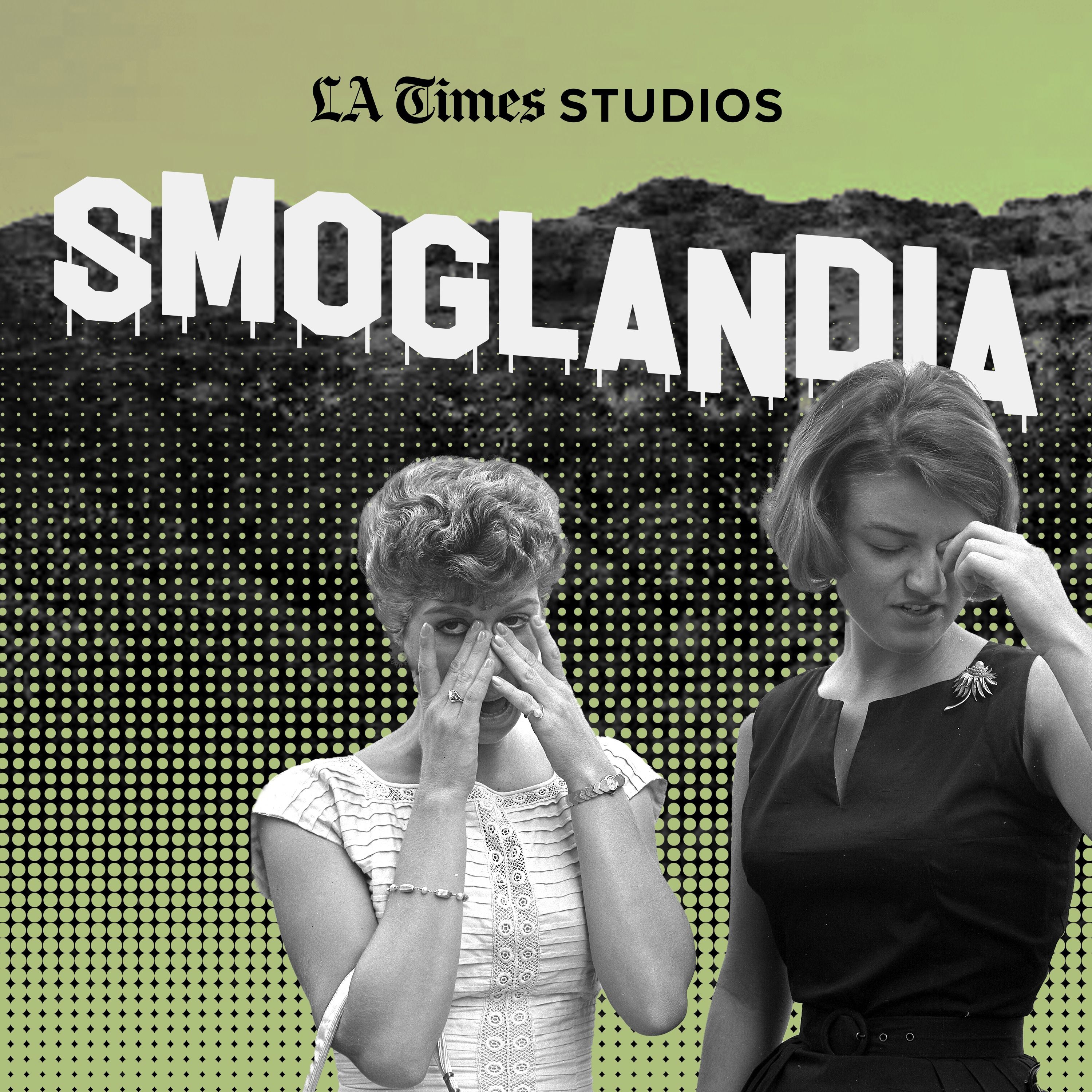
Boiling Point
Smoglandia Pt 5: SMOG CHECK AND DOUBLE CHECK
00:38:17
Whaddya know – the federal government sees the wisdom of working with California and its “queen of green” for cleaner air – up to a point. The Golden State gets its own “secret recipe” gas, but new partners mean new frictions over the smog check program familiar to every behind-the-wheel Californian.
Loading summary
Transcript93 lines
- [00:02]
Pat Morrison
This is an la times studios podcast.
- [00:12]
Ed Shad
One of the things I was thinking about before our meeting this morning was I was looking for my first.
- [00:22]
Vision of Los Angeles when I was aware of this city for the first time. The thing I came up with, which also happens to be true, is the opening credits of the A Team.
- [00:40]
The opening credits to the A Team shows downtown Los Angeles through the haze of overwhelming pollution and smog.
- [00:49]
Pat Morrison
That's Ed Shad, the curator and publications manager at the Broad Museum in downtown Los Angeles.
- [00:55]
Ed Shad
A lot of writers have mentioned that the smog does offer a strange quality to the light here, but the smog is also a bit of a metaphor.
- [01:10]
Pat Morrison
For the smog was the formative theme of the exhibition.
- [01:13]
Ed Shad
Yes, it was. Yes, it was. It came from a John Baldessari painting, Desire, Knowledge and Hope with Smog. And that exhibition was really trying to get under the covers of LA a little bit, sort of moving past some of the cliched ways of thinking about this city and to view it through the lens of some of the realities that we endure every day in this city or celebrate every day in this city.
- [01:53]
Pat Morrison
We're in the vaults of the Broad, about to take in a very specific artwork that goes to the heart of that exhibition and this podcast. It's Smaug.
- [02:03]
Okay, go ahead. You were going to.
- [02:05]
Ed Shad
Alright, so we're standing in front of a painting by Los Angeles artist Ed Ruscha. This painting by Ed Ruscha says, honey, I twisted through more damn traffic to get here.
- [02:18]
Pat Morrison
And it's sort of, if I can describe it, like an ombre look, because you start with a darker blue at the top, and as you get closer to what I guess is the horizon, it gets lighter and lighter and kind of denser.
- [02:30]
Ed Shad
It's true. It's a horizon. We're looking at a sky. And Ed Ruscha is really one of the great chroniclers of the sky and Los Angeles. Some of the paintings that people might know best by Ed Ruscha are the famous Hollywood sign set against a sky that could only be described as apocalyptic. Maybe something is burning, but things are certainly not going well. And that can appear in a lot of Ed Ruscha's work. And I find that the more I look at his work, the closer I feel to LA.
- [03:18]
Pat Morrison
If you lived in Southern California from the 1970s and 80s into, well, into the 90s, the smog was just part of your mental furniture. The landscape in front of your eyes and nose and inside your head. And like seeing the artworks in the Broad Museum Smog exhibition, it sometimes took another person's point of view to see it for what it really was.
- [03:41]
Ed Shad
I love this Ed Ruscha painting because that sums it up for me. I twisted through more damn traffic to get here. That is part of, but doesn't fully extinguish the fact that this is a beautiful sky that that's written against and.
- [03:56]
Pat Morrison
The subtext here is and here had damn well better be worth it.
- [04:00]
Ed Shad
Exactly. And sometimes it's worth it. Sometimes it's harder to feel like it's.
- [04:04]
Mary Nichols
Worth it.
- [04:07]
Ed Shad
But often it is worth it.
- [04:11]
Mary Nichols
They're drinking the water.
- [04:20]
Pat Morrison
I'm Pat Morrison, and you've crossed the border into Smoglandia.
- [04:27]
Jesse Alejandro Cottrell
During one of the most severe windstorms Southern California experienced in more than a decade. The Palisades and Eaton fires ignited, leaving heartbreaking losses in our communities. Now, as we build back, we're building stronger, cleaner and more resilient in communities most vulnerable to dangerous weather conditions and wildfires. Southern California Edison is placing power lines underground, hardening the electric system by installing wires with protective coating, and adding advanced technology to help keep communities safe. So when Southern California faces the next storm, the next most severe event, we'll be ready. Learn more@sce.com disaster recovery and if you were impacted by the Eaton fire, you may qualify for direct compensation through Southern California Edison's Wildfire Recovery Compensation Program. File your claim directly with no legal fees, no litigation, and receive payment in months, not years, to file and learn more, visit sce.com directclaims I'm Jesse Alejandro Cottrell.
- [05:28]
Mary Nichols
And I'm Emily Dreyfus, and this is Pacific Standard Time.
- [05:32]
Pat Morrison
We have stories from all over the.
- [05:33]
Ed Shad
State of California, all the big battles.
- [05:35]
Pat Morrison
That are happening here, Prop 50, housing, AFF tech and immigration.
- [05:39]
Mary Nichols
And we're really excited to bring you the stories about how California's dealing with what it means to be alive in 2025.
- [05:47]
Pat Morrison
Subscribe to Pacific Standard Time, a new weekly show from the San Francisco Standard.
- [05:51]
Mary Nichols
We'll have new episodes every Wednesday starting November 19th, wherever you get your podcasts.
- [05:59]
Pat Morrison
In the last episode, I mentioned the Queen of Green. That's the nickname that was bestowed upon Mary Nichols. She spent more than 15 years as head of California's Air Resources Board CARB, serving Democratic and Republican governors. And when she wasn't there, she served four years as an assistant administrator at President Bill Clinton's epa. She and Smog didn't meet until she was in her mid-20s. On a visit to California during a break from Yale Law School, I drove.
- [06:30]
Mary Nichols
Across country with a classmate who was coming out west to visit his girlfriend and was looking for somebody to ride along. And I had some free time and decided I'd like to see California.
- [06:44]
Pat Morrison
And could you see it?
- [06:45]
Mary Nichols
Well, we saw a lot of California because we started in Northern California. But when we hit la, we first saw the wall of smog. It was late afternoon, and the smog was blanketing the basin, and it was a very strange orange color, and it was appalling. I never got over that first impression. That was in 1969.
- [07:15]
Pat Morrison
Yet three brief years later, here she was, living in Southern California with her new state law license and plunging right into the smoggy crud and into the laws and regulations to clean it up.
- [07:28]
Mary Nichols
I had just graduated from law school, and I took the California bar in February of 1972 and shortly thereafter filed my first lawsuit against the Environmental Protection Agency on behalf of the cities of Riverside and San Bernardino, who were trying to find some way to leverage the federal government and the state government to help them get rid of the horrible impacts of smog damaging the orange trees. They were hurting tourism. They were a joke on national television. It was, you know, the air pollution situation was pretty bad.
- [08:11]
Pat Morrison
At the same moment that young Mary Nichols takes up residence here in our wretched air, California gets a partner in the federal government. The new Environmental Protection Agency was bringing its new authority to protect water, wildlife, habitat, and, of course, the air, and sometimes to partner with the Golden State in its work. And Californians themselves were undergoing an environmental epiphany. They were seeing California, the magnificent California, the glorious slipping away, disappearing into smog and being covered over by concrete. The catastrophic offshore oil spill in Santa Barbara in 1969 killed thousands of seabirds and marine mammals. And the nauseating images turned people's stomachs and changed their minds.
- [08:58]
1972, the year Nichols moved here, is the same year Californians voted to create the State Coastal Commission to protect the state's fragile and finite coastal lands. Did it surprise you, as you opened this door into smog science and smog politics, how big it was and how big the pushback was going to be?
- [09:22]
Mary Nichols
I think if I had been more mature, as opposed to as mature as I thought I was in my mid-20s, I might have been a little more reluctant to jump into this field. But honestly, it felt in those days like we had a real opportunity to take on big, thorny environmental problems because the federal government had recently passed the Clean Air act, we'd had Earth Day, we had the rise of organizations like the Natural Resources Defense Council and the Environmental Defense Fund that Had teams of young lawyers and scientists all devoted to taking on these environmental issues. So it seemed like it was a worthy battle and one that we could probably win.
- [10:21]
Pat Morrison
The ink on the clean air act had hardly dried in 1971, and it gave citizens the right to sue the federal government and the polluters to make them enforce the law.
- [10:32]
Mary Nichols
The courts felt like they had these new laws to interpret. They had a real problem that they were dealing with that was affecting the public very broadly. And so we got very good attention from the courts. Good decisions were written, Good results came out of those cases.
- [10:52]
Pat Morrison
Even in 1967, a year before CARB opened for business, California was marching ahead of the nation by requiring the country's first tailpipe emissions standards. A couple of years after Nichols moved here, the state got serious about limiting nitrogen oxide emissions, One of those stubborn parts of the smog recipe. And that put the development of catalytic converters into overdrive one after another. CARB policies, some of them popular, some not so much, Also showed other states how to get a handle on their air pollution, too. CARB stricter standards for noxious diesel fuel Also became the nation's rules. And in 1992, CARB ordered the phase out of lead in gasoline. And that, unleaded, is what you now pump into your gas tank. Now, just like daylight savings, California switches back and forth from winter formula gasoline to summer formula gasoline. Think Coca Cola or colonel Sanders chicken. California gas has its own special recipe, Just not secret. Summer gasoline is sold here from about April fool's day to Halloween and winter fuel the rest of the year. Summer blend gas is more expensive because it's brewed to limit higher summertime pollution. One reason our gas is more expensive is that a bit more than 50 cents per gallon goes to the cost of protecting the environment. Nichols knew her new job was going to be big, but maybe not until she overheard some men talking about her in an airport waiting lounge did she realize how big.
- [12:27]
Mary Nichols
I had some idea what I was up against When I was on my flight to Sacramento for my first meeting of the air resources board, When I overheard a conversation among some middle aged guys who I later found out were industry representatives on their way to the first meeting of the newly constituted board. And they were talking about how there's some girl who had been appointed. I was 29 years old at that time. I didn't think I was some girl. I felt more than well qualified to be on the air resources board. But in any event, they were talking about their concerns about what might happen to them and I realized that not only was I already known, even though if they didn't actually know who I was, but also that it was going to be a real fight.
- [13:30]
Pat Morrison
One of Nickel's predecessors as head of carb was Dr. Ari Hagensmidt. Dr. Ari Hagen. Smog, of course, became his nickname. He was a scientist, but he was no fool about human nature. In the year CARB was formed, he said, with good reason. One should not overestimate the public desire to support stiff measures. The personal effect they want to put in, such as inspection of their cars, use of small cars, support for better transportation is usually completely absent.
- [14:00]
Mary Nichols
We were under the scrutiny of the legislature from the very beginning, and there were already people who were poised to oppose whatever we were doing. So in addition to the businesses that were facing more regulation, and.
- [14:20]
There was also this built in avenue for them to go and protest against what we were doing.
- [14:27]
Pat Morrison
And they did, and they did.
- [14:31]
The public will sometimes meant the public won't, and any policymakers had to take that into account. The tension has always been between health benefits, which are generally unseen, and longer term, and economic benefits, which are immediate and visible. Their jobs, their paychecks, their industry operating locally. How did you navigate all of that for the decades that in fact is still going on?
- [15:06]
Mary Nichols
Well, we did have science on our side to show that the lung damage caused by smog.
- [15:18]
Was ongoing and that it could start with children and that their lung capacity would be impaired for life. And there was just a mounting body of evidence that it wasn't just a short term feeling that your lungs were constricted or you were having a hard time breathing, or even the asthma attacks that we knew from an early point were connected to the smog. And so people understand that and they experience it in a very visceral way, which is, I think, the reason why the public has continued to vote in favor of more regulation, even when they were told that it was going to raise prices.
- [16:13]
Pat Morrison
Over the seven decades of air pollution wars, both CARB and the Southern California Air Quality Management District, and sometimes the feds have experimented with a lot of different ways to bring Californians on board to cut the crud. Here are a few ones you may remember fondly or not Ride sharing programs, not Lyft or Uber, but two or more people riding to or from work in the same car. In 1973, the AQMD set up an actual carpool program, and big companies had to come up with plans to get employees to carpool or bike to work or take public transit. What was in it for them. Really good parking for one. And in 1996, carpoolers could be paid a buck a day, bicyclists $2 a day, and Metrolink transit riders $60 a month. I remember filling out forms asking me about my commuting habits to see whether I was a candidate for carpooling. I wasn't. Car vapor recovery. That's the formal name for the little rubber collar around the neck of the gas nozzle that seals it closed so that no gas vapor can escape and turn into smog. Cash for clunkers. That's what the feds called it in 2009 when it bought 700,000 geezer mobiles and got them off the road. Something under 10% of all the cars on the road were creating a big share of the smog. The program is still around, but with a smaller payout since the Fed's clean vehicle tax credit just closed up shop. And ah, the diamond lanes.
- [17:51]
They only lasted for 21 weeks back in 1976, but it must have felt like 21 years, both to the people driving the Santa Monica freeway with the new experimental carpool lanes and to Adriana Gianturco. She was the woman governor Jerry Brown appointed to head Caltrans, the first woman at that job. At 7 o' clock in the morning, Monday, March 15, 1976, Caltrans launched the carpool experiment to hold down the smog. One lane each way for about a dozen miles on the Santa Monica freeway, painted with white diamond shapes and reserved exclusively during rush hour for buses and for carpooling cars. One half hour later, at 7:30, Adriana Gianturco was sworn in as the Caltrans chief. Talk about your stormy career launch. Gianturco didn't create the diamond lanes, but she endorsed them. And oh boy, did the Hagensmit rule of human nature show itself. People rose up in protest in a way we hadn't seen since the smog outrage of the 1950s. Naturally, people who used diamond lanes loved them and could even be a little smug. But they got out. Shouted. The number of freeway fender benders soared. Solo drivers spitefully flung nails into the diamond lane. The masses were livid and the lengths people went to to dodge the rules. A hearse driver who got a ticket argued that the corpse in the back was a passenger. Pregnant women argued that the fetus was a passenger. My favorite diamond lane tale. A CHP officer pulled over a man driving with a very expensive and realistic looking mannequin in the front seat. How'd I get busted? The driver wanted to know the cop said he'd been watching the car and the woman passenger had worn the same dress three days in a row and that no real woman would ever do that. And that is how, after just a few weeks on the job, she Giant Turco, became known as the most hated woman in California.
- [20:02]
The Diamond Lanes didn't get people onto buses and they didn't get people out of their cars. Given time, they might have. But the Diamond Lanes ran out of time and fast, 21 weeks after they opened five months, a judge put the brakes on the diamond lanes. Today, nearly 50 years on, we might gripe at carpool lanes as elitist. Those fast track passes cost money. Electric car drivers are officially peeved at being booted out of the carpool lanes. But now we have hundreds of miles of carpool HOV lanes and we mostly go along with them. Although on some LA freeways the number of cheaters reaches 4 out of 10 cars and once in a while even outnumber the legit carpoolers. Chp those fines could be a sweet little extra to your budget.
- [20:49]
There were proposals to limit drivers and driving in specific times of day. Clearly the public had something to say about that. There was one letter to the AQMD that stood out. It was from Earlene Whittington in Westminster, Monday, Dec. 12, 1980. Dear board members, As I am unable to attend the December 16, 1988 meeting, I am sending a letter of protest. I am a native of Orange County, California. I resent being penalized for California being so overcrowded. My grandparents moved out to California by covered wagon when California was nothing. My father was a native of California. My mother moved to this state when she was 15 years old with her family. My stepfather moved to this state as an infant. My brother, sister and I were born out here. Those of us who are natives who have lived here 15 years or longer should not be restricted to our driving. Let those new to here be restricted. Take away the driver's license from the teenagers who have no jobs. They do not need to drive. All they do is waste fuel and use our roads for a racetrack. Take away the driver's license of those on welfare. Let them ride the public transportation as they do not work. They do not need to drive. Sincerely, Earlene Whittington Westminster, California.
- [22:18]
Ah, but almost no carb smog control measure has lasted as long or gotten as much grief as the smog check. Of course you know it. The sign with the sky blue background and the big check mark. Californians came up with a new verb for it Getting smogged. Here's Mary Nichols again.
- [22:36]
Mary Nichols
Smog check was one of the toughest things I ever worked on because it was going to affect everybody who owned a car, and I was going to have to take it in and get it smogged, as they would call it, or smog checked, where the legislature really did not want to face what they assume would be a big public backlash from a program like that.
- [23:04]
Pat Morrison
That was the Hagensmit rule. Again, the more burden on the individual driver, the more resistance, and this was burdensome. Time, money, and then maybe more money.
- [23:15]
Mary Nichols
Well, the first step is just having to take the time off to go to some inspection station in the beginning and pay to get it inspected. And then there was that. What would happen if you failed smog.
- [23:27]
Pat Morrison
Checking wasn't one single law or rule, but a rolling snowball of them. From the Smogchek real launch in 1984, the state added ways to help poor people's cars meet the rules to let some classic older cars off the hook, and mostly made sure that cars ran clean or it got old dirty cars off the roads by the hundreds of thousands.
- [23:49]
Mary Nichols
The reason why I have a particular allergic reaction when you mention smogchak is because.
- [23:57]
Not only was this very, very tough to get through the legislature, but when I was at the EPA later and trying to get California to toughen up the program under what was then the new Clean air Act of 1990, I had to come out to California to try and negotiate to get a stronger bill on behalf of the federal government. US.
- [24:28]
Going up against the state of California, which was completely resistant to doing that. And so I was sent out to try to somehow solve this problem.
- [24:39]
Pat Morrison
Oh, the California girl gets to go back into the jaws of the beast.
- [24:43]
Mary Nichols
Yeah, exactly.
- [24:50]
Pat Morrison
Mary Nichols was working at President Bill Clinton's EPA for some of the 1990s, and this time, the man pushing back against the EPA's smog check plan wasn't an oil company lawyer or a carmaker. He was, like Nichols herself, a Democrat.
- [25:06]
Mary Nichols
My principal opponent at that point was Richard Katz, who was the head of the Assembly Transportation Committee.
- [25:16]
Richard Katz
The reason air in LA is as cleat as it is now is Mary Nichols and what she did at the Air Resources Board and the trailblazer, she was in clean air. So never somebody we look to be in a disagreement with because she is usually the gold standard. But she was also reflecting US EPA and what their view was. And a lot of cases we see from the federal government the notion that one size fits all and it makes Their life easier, but it doesn't make any of our constituents lives easier out here.
- [25:53]
Pat Morrison
Katz is now the president of the Los Angeles Department of water and power's oversight commission. But back then he was a state assembly member from the north San Fernando valley and head of the assembly transportation committee. Once the federal government agreed that controlling tailpipe smog was a dandy thing to do, it had its own ideas about how to run the program. And those were not California's ideas.
- [26:17]
Mary Nichols
The federal government was willing to enforce the new clean air act, which required the state to improve the program, basically to turn it into a government run program, rather than the network of private garages that were running the program in the beginning.
- [26:36]
Richard Katz
Our alternative to that which we fought over and friendly fought, but we fought, was that we would much rather have a system where you have multiple smog shops that could take care of your car you drive in. We didn't want people having to drive five or 10 miles to get smogged. It didn't seem to make sense to be contributing more pollution while you're trying to clean it up. But. And we didn't buy into the one size fits all and thought neighborhood access was, would be important. People could do it on the weekends, people could do it before or after work, but we wanted to make sure that it was convenient enough that people didn't have an excuse for not participating.
- [27:22]
Pat Morrison
The federal plan was to have your car smogged at a government run smog center that only did testing. Smog testing equipment was expensive and the feds didn't want cars being smog checked at the same places. They might then offer to fix the cars if they failed because some repair shop owner might lie and say, oh, your car flunked the smog test, but we can fix it for you.
- [27:45]
Richard Katz
We had to make sure that bad actors couldn't get away with ripping off consumers. And that was a big part of it. Because for the consumer's confidence as well. And because we wanted the program to work so the folks that were responsible for that stepped up enforcement. They would run cars through there to test people and they would find people or cite people who were violating the law. Like undercover, undercover operations, you know, to try and, you know, weed out the bad apples. But which was an important part of it because people had to have confidence, you know, one, that if I take my car in, they're going to do a legitimate job on the smog check. And second, I'm not going to get ripped off for things that weren't broken before I pulled in.
- [28:28]
Pat Morrison
But there wouldn't be nearly as many government run smog check places as there were corner service stations. And for cats, that sounded inconvenient. And every extra mile or minute it took to get your car smog certified meant another excuse not to get it done. And it would take work away from thousands of privately owned California service stations.
- [28:50]
Richard Katz
We're very concerned about the impact, particularly on working folks.
- [28:54]
Pat Morrison
D.C. and Sacramento crafted a compromise. California could use private repair shops for smog checks. But the requirements for passing got stricter, especially for older, dirtier clunkers and a lot of muscle to go after cheaters. The state did not mess around. It was onto bogus smog certificates like the Treasury Department on bogus hundred dollar bills. A Whittier man was sentenced to prison for four years for falsifying smog certificates. In 1991, a Fontana smog station owner was arrested for allegedly awarding phony smog certificates to cars he'd never even inspected. The next year, a months long sting operation indicted 32 mechanics and auto repair shop owners who had allegedly sold nearly 100,000 bogus smog certificates at 50 or $60 each. About twice the cost of the real thing back then. And just last year, the federal government indicted a dozen Californians who'd allegedly been using and selling a smog check cheating device called the obdonator to get around the actual smog standards. The price of the real thing costs about $70 more for different kinds of vehicles. But watch for coupon specials.
- [30:13]
Mary Nichols
The idea that California is unique and very full of itself is certainly embedded in the culture of Washington D.C. and it rises up from time to time in a.
- [30:29]
Can actually hurt California's ability to move forward. But the fact that we have the ability as a state to set our own more stringent motor vehicle standards is because California held out against the very original Clean air Act in 1970, where the auto industry only went along with the bill because they thought they could preempt any kind of action by states or local governments. California withheld its vote until there was a guarantee that the state could continue to enforce its own stricter regulations.
- [31:15]
Pat Morrison
And we were the lab rats to the many ways to make us change our ways when we returned to Smogland, India.
- [31:38]
Celebrate the 101 best restaurants in LA at this year's launch party December 9th at the Hollywood Palladium. Presented by Open Table and Square. Mix and mingle with acclaimed chefs and culinary icons. Enjoy unlimited food and drink and be there for the live countdown to the number one restaurant in LA. It's the LA food scene's biggest night. Get tickets now@latimes.com 101 event. That's latimes.com 101 event.
- [32:04]
Meanwhile, back at Smoglandia Central in Southern California, while the biggest players were duking it out In Sacramento and D.C. the air quality bosses in Southern California counties were still turning up newer and sometimes unexpected things and places that created pollution. And it's fair to say that people were astonished and not necessarily in a good way. Sam Atwood was an award winning environment reporter at the San Bernardino sun before he moved offices to spend about 25 years as media relations manager for the AQMD.
- [32:39]
Sam Atwood
It was in the late 80s, around, I think in 1989 that the AQMD adopted at the time of the infamous barbecue rule, which was to basically limit the amount of smog forming stuff in, in your lighter fluid, your barbecue starter fluid. And you know, opponents were bandying about light a barbecue, go to jail, you know, kinds of slogans.
- [33:07]
Pat Morrison
Why all the agitation? Because it went way beyond barbecue lighter fluid. Angelenos were finding out that smog makers were right there in their houses and offices creating foam cups and takeout. Food boxes. Computer disks and computer chips and copier paper created smog. So did dry cleaners, almost every kind of paint deodorants, breweries and commercial bakeries. That enticing aroma that makes you break your pledge about carbs also contains huge helpings of ethanol, which was like instant smog.
- [33:42]
Sam Atwood
Things like paints and barbecue starter fluid, they, they contain volatile organic compounds which cause smog form smog. And the AQMD said to the manufacturers, you need to reformulate. And the manufacturers said, we can't do it. It's going to cost more money. They're not going to perform as well. We're taking you to court, which they did. We won. I think most of the cases and you know, people today go to their, their Lowe's or their Home Depot and they, they buy a paint that has, you know, very low polluting ingredients, in some cases zero. So it's, it's a great thing, it's a great thing that AQMD and in some cases the, the state has done to require cleaner paints, cleaner barbecue starter fluid and other kinds of consumer products that are less toxic to us personally when we use them and they're less toxic to the environment and to the millions of people who live in Southern California.
- [34:50]
Pat Morrison
At about the same time these new rules were in the works, Lee Torgerson was composing a letter to Suzanne Reed. The special projects coordinator for the AQMD. Here's how it began.
- [35:03]
Lee Torgerson
Dear Ms. Reed, I'm a recent college graduate who's very concerned about environmental issues. I grew up in Los Angeles, went to San Diego for college, and have recently returned to Los Angeles, where I expect to live for some time. While living in San Diego, I got used to consistently good air, and I'm now appalled at the air people in Los Angeles deal with on a daily basis. Something needs to be done about poor air quality. That was my opening paragraph.
- [35:30]
Pat Morrison
Torgersen isn't some random podium thumper. On his business card he has the fantastic title of Space Communications Architect at the Jet Propulsion Laboratory, basically trying to craft an interplanetary Internet to connect robotic missions and future lunar expeditions. And by one of those happenstances in la, he's also the nephew of an LA Times mentor of mine, Dial Torgerson, A foreign correspondent murdered on the job in Central America as a college class project, Lee Torgerson studied how the AQMD was underestimating air pollution by 10 or 15%. And then of course, that letter.
- [36:11]
Lee Torgerson
When I got back to California after having lived in Pensacola, Florida for the previous three or four years, I could see that the smog was better. But it still needed we still needed a lot of work on smog control and the AQMD came out with a public commentary period for the 1988 revision to the Air Quality Management Program. The three recommendations that I made in my letter one was to have some better education. We needed to warn them that the plan looked great, what they were doing, but people weren't going to accept it unless they had more education on why they have to bear this additional burden of cost. The second thing I specifically mentioned was the aerosol can solvents that they need to bring that out because you need to teach people not to use these industrial solvents and just spill them on the ground.
- [37:10]
Pat Morrison
A teenage memory also drove his urgency.
- [37:14]
Lee Torgerson
When I had a high school job at a metal reclamation company across the street from Lockheed and Burbank, they had us dipping our hands into open 55 gallon oil drums full of trichloroethane and methyl ethyl ketone solvents to dissolve rubber parts off of metal parts. So I worked about two hours at that. My hands got totally dry and there's no gloves. I worked about two hours, had a splitting headache, quit. I remember the foreman telling me I was a wimp and I said I may be a wimp, but I'm not stupid. I got on my motorcycle, I drove back to Van Nuys where I'd gotten an employment agency had given me the job and told them the story and they said they weren't going to send people there anymore. But so there was a lot of industrial use of these volatile solvents that nobody in those days knew were going to be that hazardous.
- [38:12]
Pat Morrison
His letter never got answered, but as impassioned and informed as it was, I have to think the AQMD took it to heart.
- [38:20]
Lee Torgerson
I think the last line said, I want to reiterate that the plan looks good and if implemented in its entirety, it will reach the aimed for goals. And then I close with some trite statement about how let's make all Los Angeles let's make Los Angeles a city people can be proud of.
- [38:46]
Pat Morrison
Ah, another story of life in smoglandia. Next time, 70 years of doing battle with the Smog Monster. Could it all be undone by the man in the White House and the original Electric car race? A cross country competition VW bus versus Chevy Corvair. The nerds of MIT versus the nerds of Caltech. Powered not by Chile but by chutzpah.
- [39:26]
Smoglandia is hosted by me, Pat Morrison. Our senior senior producers are Mary Knoff and Jonathan Shiflett of Studio Phonic. Our editors are Hugo Martin, Shelby Grad and Steve Clow. Our Director of library services is Carrie Schneider, additional sound design and engineering by Hannis Brown. Our podcast Marketing Manager is Bryn Jura, and our Product Marketing Director is Becca Dorman. Special thanks to LA Times Studio President Anna Mogzanian, President and and Chief Operating Officer of the Los Angeles Times, Chris Argentieri, and Executive Editor of the Los Angeles Times, Terry Tang. Smuglandia is executive produced by Darius Derek Shahn.
- [40:15]
It was the spring of 1988, northwestern Alabama. A preacher commits a sin, a deeply personal transgression, and from there everything spirals out of control. The amount of damage this man did is incalculable. It's still damaging all of us. It still hurts us to think about it. From Revisionist History this is the Alabama Murders. Listen to Revisionist History the Alabama Anywhere you get podcasts.