Loading summary
Transcript101 lines
- [00:00]
DSW Shoe Store Advertiser
I've never felt like this before. It's like you just get me. I feel like my true self with you. Does that sound crazy? And it doesn't hurt that you're gorgeous. Okay, that's it. I'm taking you home with me. I mean, you can't find shoes this good just anywhere. Find a shoe for every you from brands you love like Birkenstock, Nike, Adidas and more at your DSW store or dsw.com
- [00:32]
Lowe's Milo's Money Promoter
Milo's money days are here, and we're making it rain for rewards members. For the first time ever, when you make a purchase of $200 or more through July 12, you'll get up to $30 back in extra Milo's Money. Not a member yet? Join for free today because members get more at Lowe's. My Lowe's Money award varies based on status. Members in gold get 30, silver get 20 and bronze get 10. Milo's money valid for 30 days restrictions and more terms@lowe's.com Milo'sMoneyDays joy is essential,
- [01:02]
Hoda Kotb
and it's also elusive. But now there's a new and exciting way to start your journey toward a more joyful existence. Joy101 it's a new podcast hosted by me. How to kot me. If you're craving inspiration to maximize your joy, tune into these candid, uplifting and moving on air chats. Listen to Joy 101 on the iHeartRadio app, Apple Podcasts, or wherever you get your podcasts. Joy 101 with Hoda Kotb is presented by CBS.
- [01:31]
Narrator
This series includes sensitive and potentially distressing topics, including sexual assault and abuse involving children. Listener discretion is advised.
- [01:45]
Anthony (Inmate/Subject)
Prison is like a cemetery for the living man. It's like everybody is a shadow of themselves. A shell, a ghost. Some of those people with life, you look in their eyes and there is nothing, nothing good to say, nothing good to feel.
- [02:04]
Narrator
A couple of months after his conviction for the murder of Josette Wright, Anthony was transferred to Downstate Correctional. It's where they process new inmates into the system.
- [02:15]
Anthony (Inmate/Subject)
I went in young, unprepared, not as tough as I thought I was. When I got to Downstate, the counselor threatened me. The counselor, he says, you're going to have a really bad time. I'm like, how do you mean I didn't do it. He's like, yeah, sure, you're not going to have a good, good life.
- [02:34]
Narrator
His first day at Downstate corroborated that counselor.
- [02:39]
Anthony (Inmate/Subject)
It's two hours in and there's, I don't know A hundred of us. And you know, they're doing the spread your cheeks and then it shaved your hair, your eyebrows, all facial hair off. The next thing they did is they made us all undress all naked in one line. And they threw the shit they call lie the Lauser. They're taking a picture and now here I look like freaking mini Me. So it's like you're being processed. You as a human being in a factory of other human beings. You're moving the way they tell you. They put you on a line, they give you your clothes. You're giving an inmate ID number. Mine was 978-5639. You had to walk in two rows, paired off side by side in groups of 40. If you fell back a little bit, they would say something like, patch it up on the left retard. Or if somebody was talking, be like, what part of no talking in my hallway do you not understand? And so I started hearing these direct orders from this foul place. Somebody says something, laughs about something that unacceptable. There would be quiet and there would be order. And they would take guys that did these things and then you would hear them beaten and scream. I'm not gonna say nothing.
- [04:06]
Narrator
It was in places like downstate Penns built to terrorize entry level felons into a life of learned submission that Anthony would have to learn how to save his own life.
- [04:26]
Poet/Artist
Do you hear my madness? Laughter hides my fears Sorrow's depths are endless this valley of tears.
- [05:02]
Narrator
This is the devil's quarry.
- [05:13]
Ryan Reynolds
Hi, Ryan Reynolds here for Mint Mobile. Are you looking for a beach read this summer? May I suggest your big wireless bill? It's got suspense, mystery, a slightly flat emotional arc and a shocking twist where you realize you've been overpaying the entire time. Fortunately though, Mint's story is better. Every plan, $15 a month. Even unlimited. That's it. Happy ending, zero tears. Give it a try@mintmobile.com Switch upfront payment
- [05:36]
DSW Shoe Store Advertiser
of $45 for three months, $90 for six months or $180 for a 12 month plan. Required $15 per month equivalent taxes and fees. Extra initial plan term only greater than 50 gigabytes.
- [05:42]
Sam J
May slow when network is busy.
- [05:43]
DSW Shoe Store Advertiser
See terms Nix.
- [05:44]
Knix Underwear Advertiser
That's Knix. Leak proof underwear isn't just for one moment. It's for all the everyday moments you didn't realize leak proof underwear could make easier. Maybe it's day one of your period. Maybe it's a long travel day. Maybe it's hot outside, you're on the move and you just want to feel fresh. Their leak proof underwear comes in a range of absorbencies from light to ultra and helps protect against periods, light leaks, sweat and everyday surprises. And because they look and feel like real underwear, they're soft, invisible, underclothes and machine washable. No extra hassle, no complicated routine, just dependable protection. You can wash and rewear. See why millions have made the switch to leak proof underwear? Visit nyx.com that's knix.com and use code flow15 for 15% off. That's knix.com code flo15 what's up, fam?
- [06:43]
Ari Chambers
I'm sports journalist Ari Chambers.
- [06:45]
Sam J
Hey, what's up, y'?
- [06:46]
Poet/Artist
All?
- [06:46]
Sam J
It's your girl, Sam J.
- [06:47]
Ari Chambers
And we're the host of Everyone Watches Women's Sports, a new podcast from Together and iheart Women's Sports.
- [06:52]
Sam J
Because, let's be real, women's sports is giving us way too much to talk about these days.
- [06:57]
Ari Chambers
The highlights, the rivalries, the breakout stars, the moments that take over your entire
- [07:01]
Sam J
timeline and the conversations that start during the game and somehow keep going.
- [07:05]
Ari Chambers
All week, every week, we're breaking down the biggest stories across women's sports.
- [07:09]
Sam J
We'll give you our takes, our debates, and probably a few disagreements.
- [07:14]
Ari Chambers
We'll talk to athletes, celebrate big moments, and get into what's happening on and off the field, court, track and beyond.
- [07:19]
Sam J
Because we're not just interested in what happened, we're interested in why everyone's talking about it. Because everyone watches women's sports. So if you're already a fan or
- [07:29]
Ari Chambers
you're just getting into the game, there's a seat for you right here.
- [07:33]
Sam J
Listen to Everyone Watches Women's Sports on the iHeartRadio app, Apple Podcast, or wherever you get your podcast.
- [07:44]
Narrator
In the fall of 1997, Anthony was sent up top. That's what inmates call the max security pens in northern New York State. His new address, Chewangan Correctional, was where they kept the worst of the worst. David Berkowitz, better known as the Son of Sam, Robert Chambers, the Central Park Strangler, Larry Davis, who shot six cops in the Bronx and lived to tell the tale. In a crowd like that, you keep yourself to yourself. And if anyone asks what you're in for, you lie your fool head off.
- [08:19]
Anthony (Inmate/Subject)
I was like, for the first six or eight months, it was a robbery and murder. So I kind of altered the story to kind of protect myself from like having to explain it. But eventually your case comes out in the law books and people find out and people talk.
- [08:39]
Narrator
He didn't have to guess what happened to the untouchables he had a front row seat for that stuff.
- [08:45]
Anthony (Inmate/Subject)
Like, I seen a lot of stuff happening, like violent stuff. I seen a guy pick a guy up out of a wheelchair and start fighting him and putting them back in a wheelchair. I seen two guys fighting over a state burrito upstairs, slamming each other into their cages. I seen a guy on the weight bench cut, made a Nike sign on the kid's face while he was under. About 225. Yeah. I mean, I've seen enough blood to fill a bathtub.
- [09:21]
Narrator
Anthony knew his day was coming. The day you'd have to fight three gangsters in the shower or someone would slip behind him with a straight edge. He lived in a state of low level terror. It's one thing to hulk slam your backyard buddies. It's another to fend off lifers who squat 450 and who conspire with the guards to get at you. In short, you don't survive up top without a break or two coming your way. Anthony's break came to him out of the clear blue. He met some guys who knew the guy in the mafia there. And what was Anthony's calling card to the crime boss at Chawangunk? His stepdad, Big Larry.
- [10:04]
Anthony (Inmate/Subject)
There was a couple people that knew my stepfather, and then there was this guy, his name was Angelo, and he was high up in Lucchesis. He knew some people that knew some people, right? And those people knew my people.
- [10:21]
Narrator
Anthony put out word that he wanted to sit down with Angelo. That request went up the chain, and Anthony got his sit down. He went with every scrap of proof he had that the cops had stitched him up.
- [10:35]
Anthony (Inmate/Subject)
Like I brought out the Dominic recantation. Adam taking his story back, he told
- [10:41]
Narrator
him how Andy was tricked into a false confession, how his buddies said they were beaten into testifying against him. And they believed after hearing him out, the Italians made their ruling. This kid gets a pass. So hands off.
- [11:02]
Anthony (Inmate/Subject)
When you got a pass with your own kind, that kind, things fall in water. It didn't mean it put me at the top of the food chain, but no longer am I at the bottom. And so now not only are they like giving me a pass, they're like they're calling me to the table. They're breaking bread with me now. And so it's. I feel a little safer. Like when it was Happy birthday, they sung Happy Birthday. When it was Christmas, they brought out buffets of chips and cookies.
- [11:32]
Narrator
It surely didn't hurt that every couple of weeks he'd get a big care package from Home a carton cram with good easy chair with a crew aged salamis and sopressadas, tubs of dried fruits. Then there was the stuff that really opened doors. Crisp copies of Penthouse and Hustler. Those are the kinds of goods that make you a VIP in deep lock. Able to finally let a breath out, Anthony got back to the job of living. Started training in the jail yard every day, building a brick house chest and quads. It's where he met some of the other guys on his tier.
- [12:14]
Anthony (Inmate/Subject)
I had a friend of mine, his name was Mukmin. He was this big Muslim guy, but he was in a wheelchair. He just lost the body function from the waist down. He was military police, Vietnam vet. And believe me, he looked like he walked right out of a black exploitation film. If he had a soundtrack, it would be like, da na da da na da da na da da da da da da. And he was so cool. Mook was one of my best friends I ever met in jail.
- [12:44]
Narrator
Anthony got good and tight with Mook enough so that Mook shared a secret with him. He had a little helper that got him through the day. Nothing illegal, mind you. It was actually prescribed by the prison doctors, a muscle relaxant called Baclofen for his muscle spasms.
- [13:02]
Anthony (Inmate/Subject)
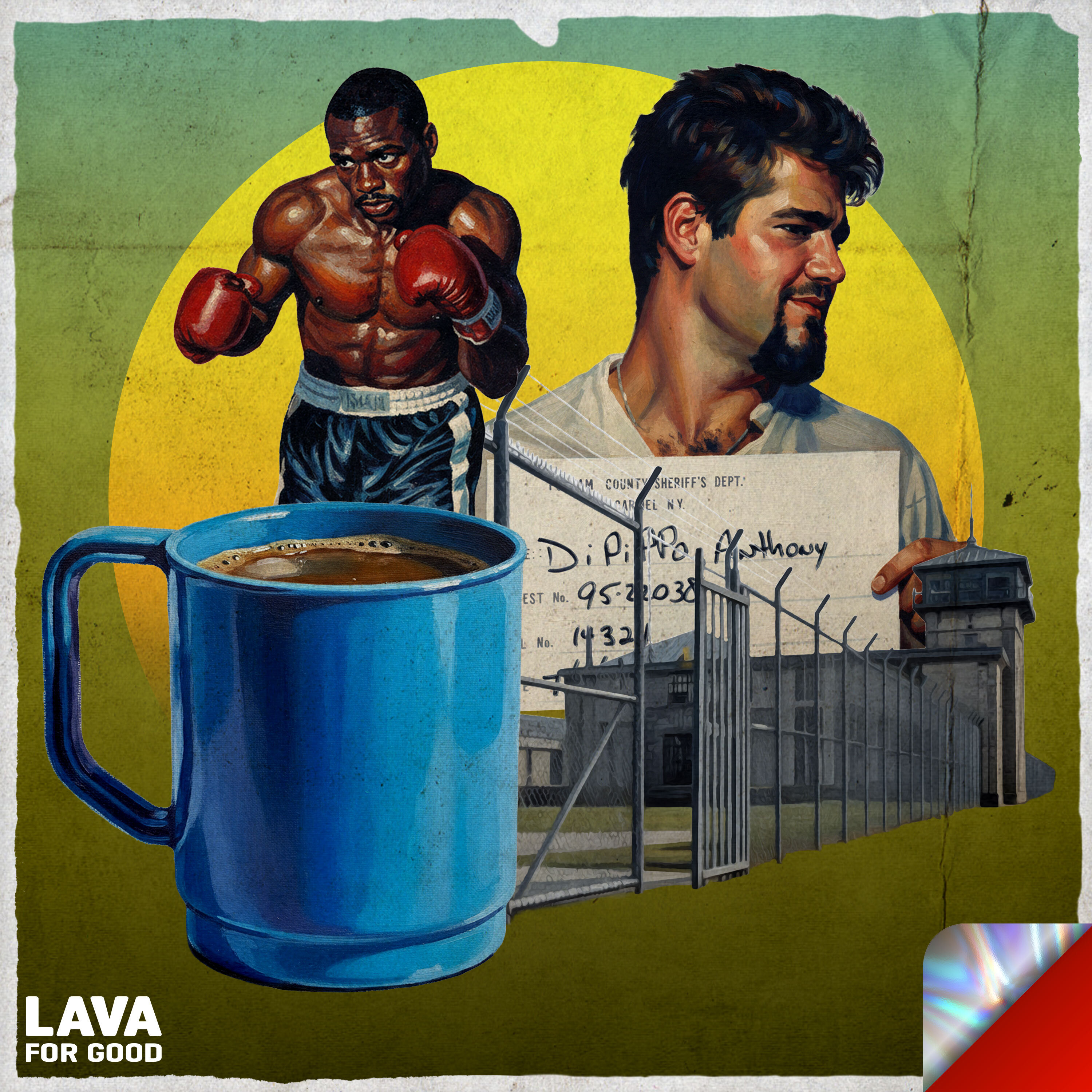
So he. He had like. They would give him like 90amonth. And he'd be like, yo, you should try this. I'm gonna try it. You should try. I'm telling you. You feel better finally, like, yeah, I'm gonna take them. I don't know if it was like, you know what, like, beta blockers do for college kids, but if you take 10 of them with two heaping spoons of Folgers crystals down the throat, you're gonna be. When I was doing with the Baclofen is I mix it with the coffee. I would take like, Folgers, and I would put just a little bit of water in a lot of the crystals to get like a super dose of caffeine late at night. And that would kind of counterbalance the down effect of the Baclofen. So I was like high and feeling good, but focused.
- [13:51]
Narrator
And with that focus came a rush of agency, the urge to fight back, to clear his name. As a kid, he'd had no shot against those Putnam cops. But now, with a clear head and his days free to work, he was ready to take them on. To get hold of his case file and read every word twice, than dig for the facts that weren't in that file.
- [14:16]
Anthony (Inmate/Subject)
I stopped weightlifting so much, I Could only do one or the other. I was either gonna be the best looking, most macho man in history or I was going home because I only had that much time. And so I dedicated my focus on my freedom. What the drugs did was kind of like resurrect, like my will. It gave me a passion to do the research late at night. And I took them and I became a freaking genius.
- [14:48]
Narrator
For all its reputation as a dumb site for psychos, Shawangunk had a library was proud of there. Anthony, a guy who'd failed the ninth grade twice, found a full set of texts called the case Law reporters. Curious, he pulled a volume off the shelf and started on page one. By the time he looked up again, it was dark outside and Anthony was bewitched. Here, in his hands was a starter kit for aspiring self taught lawyers. In a matter of months, he went from 9th grade kick out to D block's legal eagle.
- [15:25]
Anthony (Inmate/Subject)
I started sleeping all day like the
- [15:26]
Narrator
hurricane that would be Reuben Hurricane Carter, the great middleweight frame for murder in New Jersey. He'd famously written his way out of prison by becoming a jailhouse lawyer.
- [15:38]
Anthony (Inmate/Subject)
And I would stay up at night and I would study and I would print all these papers out from the law library. I would just love to learn the law. I had little highlighters and I had little notebooks and I started thinking. And when I start connecting the facts and the hope and the law as it applies, as it should be applied, and I say a way out, I get very hopeful and very dreamy and I kind of create my own kind of euphoria. And you know, it wasn't a fantasy. It drove me, it inspired me. It was part of a chain of things in my life that led me to. To learn this law.
- [16:16]
Narrator
As a fixture in those stacks, he found his tribe of jailhouse lawyers.
- [16:21]
Anthony (Inmate/Subject)
And so like in prison, it's like a cemetery for the living man. But the people that are innocent, the people that are fighting, the people that had hope, had a different level of energy. These are the people that I need to be around. These are the people that are focused and they were all learning together. And something new came out. And we all had ways of sharing the knowledge. Everybody followed the new laws, the advance sheets, the law journals, anything that came out and they just had the heart and that was the only way out.
- [17:00]
Narrator
He spent the first couple of years there framing an appeal. Big Larry had hired him new lawyers.
- [17:08]
Anthony (Inmate/Subject)
So in 98, we hired Joel Brenner. And Joel was just this legendary old peel monster whose name is all over these books. I mean, you guys might not know too much about him on the street, but in the jailhouse, he's a legend. You know, you want to go to, like, the guy that is going to get the job done. So Larry hires him from his jail cell.
- [17:34]
Narrator
Anthony worked morning and night writing and revising that petition.
- [17:40]
Anthony (Inmate/Subject)
There's about 12 to 13 points. A couple of those points are broken. And we argue.
- [17:46]
Narrator
When you say points, you're talking.
- [17:47]
Anthony (Inmate/Subject)
Well, when you file an appeal, you raise points of law. So these points of law are, you know, you want to break it down and give the court, you know, the basis of your claim and how that law supports you and how you didn't have a fair trial.
- [18:05]
Narrator
There's a format to follow in a post conviction relief appeal. Even if you find clear proof of your innocence, you still have to show the court that your conviction broke the law.
- [18:16]
Anthony (Inmate/Subject)
So our first we've. It's a statement of facts, basically, summarizing the trial. And then our point one is the evidence was legally insufficient and Denise Rose, the weight of the evidence goes against the verdict as a matter of law. Second point is the erroneous decision of the trial court to preclude Dominic Neglia.
- [18:37]
Narrator
Dom Neglia, you'll recall, was kept off the stand by the judge at Anthony's trial. This despite the fact that he'd invented the story to put the cops on Anthony's trail. The impact of that story was immense. Dom didn't just put Anthony and Andy in the frame. He also gave those cops the names of their stoner friends. Kids like Adam Wilson and Bill McGregor, whom the cops then stalked and coerced. Wilson at least had recanted. At trial, he told the jury the story of those cops coercion. But McGregor had grudgingly played along. He signed a statement that the Putnam cops wrote out and testified against Anthony at his trial. But his testimony would haunt McGregor for a decade. In 2005, a pair of investigators hired by Big Larry tracked him down in Florida. When they did, Bill told him he had a confession to make.
- [19:38]
Anthony (Inmate/Subject)
Bill is like, I've been waiting to say this for quite some time. I have a lot on my chest. And, you know, first of all, I wasn't there. I. First time I met Denise Rose was when the cops introduced her to me and tried to have her convince me of this story. I never met Josette Wright a day in my life. I wasn't in that van. I did not see nothing.
- [20:02]
Narrator
He said that those cops coerced him, dragged him up to Putnam county from Manhattan, detained and questioned him and flipped between threatening him with a murder count. And offering to erase a pending drug charge he had in New York.
- [20:17]
Anthony (Inmate/Subject)
He's like, he told me, they threatened me with accomplice to murder.
- [20:22]
Narrator
McGregor signed and swore out a full recantation. So now three of the four witnesses allegedly in that vampire, Andy Krievac, Bill McGregor, Adam Wilson, had recanted their coerced statements.
- [20:38]
Anthony (Inmate/Subject)
I got three of the four. Yeah, I got three of the four.
- [20:43]
Narrator
That left one last witness. Denise Rose, standing by her testimony in court. Alas, at this point in 2005, Big Larry ran out of money. He'd been funding Anthony's defense for nine long years, Paying expensive lawyers and private eyes. But his business had run aground, and he had to tap out for a while.
- [21:10]
Anthony (Inmate/Subject)
Big Larry is like, I can't pay. I'm having money problems. I can't pay for lawyers anymore. So I it's me. I'm on my own here.
- [21:21]
Narrator
So Anthony filed the next motion based on MacGregor's recantation. Then he filed another motion, Citing all the cops missteps. And the many omissions from his case file. After months of drafting and redrafting motions for an appeal, Anthony wound up nowhere with the courts. Each rejection left him gutted, but never out of gas. His rage against those cops was high test jet fuel.
- [21:52]
Anthony (Inmate/Subject)
I would be pacing my cell, and I would just put castald in that steel cage. And I would light the whole thing on fire. I put barbed wire on the top and bar. I would have steel bats with barbed wire around them and in my head. Yeah, and it would help me feel better.
- [22:09]
Narrator
He kept filing motions, hoping that something, anything, would stick.
- [22:15]
Anthony (Inmate/Subject)
I'm just motion proliferation and dilatory tactics. And I'm stalling. So all of the stuff. Stuff I know is like Hail Mary stuff, But I'm not ready, and I don't want my life to end.
- [22:27]
Narrator
And then at some point, Anthony changed directions. Instead of fixing on the cops, he turned to what those cops had missed. Because if he didn't kill Josette, someone else certainly had. He had access to his case file from the Putnam sheriff's office. Over and over, he read the cops notes and witnesses statements, Parsing them for unexamined clues. And what he found this time through Was a name he'd overlooked. The name of a man lurking in the margins. Wired on Folgers crystals and baclofen, Anthony spread out in a cell at night. He stayed up so late reading his own case file. That he slept through roll call many mornings. And got Written up by the guards. But he couldn't help himself. He kept finding clues that snapped together. The first of those clues was a witness statement from one of Josette's neighbors. Her name was Anita Albano and she talked to the cops on November 25, 1995, three days after Josette's bones were found.
- [23:52]
Anthony (Inmate/Subject)
This lady, Anita Albano, she's coming home from work on October 3, 1994.
- [23:58]
Narrator
That, of course, was the day Josette went missing. Albano was driving home from work when she stopped at an intersection.
- [24:06]
Anthony (Inmate/Subject)
This little corner, Seminary Hill in Willow, is a stone's throw away from the great house. Maybe a six minute walk at best.
- [24:13]
Narrator
There she saw Josette walking down the road. Suddenly, a sporty red car stopped beside her.
- [24:20]
Anthony (Inmate/Subject)
Josette speaks to the driver for half a minute, maybe a minute, then runs around to the passenger side, gets in. I guess they weren't getting in fast enough because it seemed like Albano drove around them. But as she's driving around them, she looks at the license plate because she's concerned.
- [24:41]
Narrator
That little red car at Connecticut plates, said Albano, who paused to get a look at the driver. He had a full mustache and blonde hair. She said everything in her statement. Track what other witnesses said about the day Josette went missing. Her sisters and their friends each told the cops that Josette left the house at 3:45, headed towards seminary Hill Road. That's where Albano saw her a few minutes later, heading down that road at
- [25:14]
Anthony (Inmate/Subject)
4pm she's getting in a red car. It certainly wasn't a brown van with a six foot six. Anthony DePipo. It was a red car with Connecticut plates.
- [25:28]
Narrator
Albana was alarmed that Josette got into that car. But from the look of it, she said Josette knew the driver and seemed happy to hop in with him. The cops taking her statement showed her a photo lineup.
- [25:41]
Anthony (Inmate/Subject)
She is then brought a photo array of six individuals.
- [25:46]
Narrator
The six loosely fit her description. Each was assigned a number one through six. Albano studied the mug shots. She said the guy she saw driving that day looked younger than his mugshot. But she pointed to his photo anyway.
- [26:02]
Anthony (Inmate/Subject)
And in this photo, Ray, she says if anybody number two, she. She picks number two, if anybody. And number two was Howard Gomb.
- [26:22]
Narrator
Reading through the file, Anthony saw that other Putnam detectives, not Castaldo and Quick, picked up the Albano lead and ran with it. They brought in Gombert's girlfriend, a young woman we'll call Anne Marie. But unlike Castaldo and Quick, those detectives made a recording. If the tape sounds a little fuzzy, Remember, it's been sitting in a drawer for decades. And Marie told those cops she met Gombra when she was just a teen, that she got pregnant by him when she was 16 or so. That he was almost 30 at the time. She said they shared a little girl together. And then she started dropping bombs on those cops.
- [27:07]
Anne Marie (Witness)
It was a very bad emotion. She find two, but I look inside, and that was it. He did whatever he wanted, not to ask questions.
- [27:25]
Narrator
For years. She said Gombert had raped her. Then there were all beatings and the times he choked her till she passed out. She said she'd left many times and even had him arrested for rape. But he'd always wriggle out of those jams. And then he'd stalk her and hunt her down again. When was the last time? Cops asked her. Six months ago. She said she'd fled with their toddler to a shelter in Connecticut. But he tracked her there and attacked her in her car. What did he do to you? Asked the cops. He put a knife to my throat, she said, and told me not to scream. And then? Then she laid the big one on them. She told them she drove a Pontiac Sunbird, a red and black sports car with Connecticut plates. And that he drove her car all the time. In fact, he'd been driving it the day they saw missing posters with Josette's name and face on them. Anne Marie saw that poster in the deli she went to every day.
- [28:34]
Anne Marie (Witness)
This was the first time I noticed the Smith posters. They just put that poster up, and I looked at the picture. She wanted him again and said, oh, my God.
- [28:45]
Narrator
She told the cops that after seeing the missing poster, she went back to the car and told Howard about it.
- [28:52]
Anne Marie (Witness)
Well, I went back to the car, I told him, and he was driving. He's always driving. I went into the deli to get a coffee, and I'm looking and I saw the news. Josette miss me? He said, what?
- [29:06]
Narrator
And that she and Howard knew Josette. Then Ann Marie told the cops about this one time before Josette went missing. She and Howard went driving one day when they saw Josette walking with some friends. She said Howard hit the brakes, pulled over to chat her up.
- [29:26]
Anne Marie (Witness)
We just drove by and across, drove by and we stopped and we talked to him. Who stopped? Howard stopped the car because was it reasonably stopped? He stopped the car because he saw Josette, wanted to talk to her.
- [29:40]
Narrator
She told them Howard asked Josette if she wanted to babysit for him.
- [29:44]
Anne Marie (Witness)
That's when I actually remember conversing with her about babysitting.
- [29:48]
Narrator
Oh, and one last thing, she said. That day they saw the missing posters. Howard told Anne Marie he'd given Joset
- [29:55]
Anne Marie (Witness)
a ride last week.
- [30:00]
Narrator
When did he give her that ride? Asked the cops. Emory paused a moment to think. The week before she went missing. In a cell at Chawangunk, Anthony read Anne Marie's statement and stopped and read it again and again. He found photos in the case file of the red Sunbird with Connecticut plates, the car Gombert drove all the time. There was a statement from John Reese, a Putnam sheriff's detective. He towed her red car in and dismantled it to hunt for evidence. When did he do that? Four days after Josette's body was found.
- [30:48]
Anthony (Inmate/Subject)
Taken apart, tires off, seats out, vacuumed. All debris are collected.
- [30:54]
Narrator
A diagram showed he'd scraped the car for forensics. There was a note attached from Reese about collected and saved contents, but his list of those contents was nowhere to be found. And then Anthony found a statement from Josette's sister, Chloe. She told the cops that Josette was hanging around Gombert, that there were rumors flying around town about him, that he'd raped a young girl. And then Anthony found a statement that topped them all. It was scribbled by one of the cops who'd gone to the right household. The day they found Josette's bones in the woods, Susan, Josette's mom, answered the door. They delivered the awful news to her and the very first words out of Susan Wright's mouth, oh my God, Howard Gomber killed my daughter. The Devil's Quarry is a production of Lava for Good in association with Rolling Stone Films and Signal Company Number One. I'm your creator and host, Paul Solotarov. Executive producers are Jason Flom, Jeff Kempler, Kevin Wardes, and Gilbert King from Rolling Stone Films. Our executive producers are Alexandra Dale and Sean Woods. Our producers are Kara Kornhaber, Hannah Beale, Jackie Pauley, Austin Smith, and Kathleen Horn. Our editor is Joel Lovell. Fact checking by Lucy Croning. Our sound designer is Brit Spangler and our engineer is Austin Smith. Additional reporting by Kathleen Horan. Original music arranged and produced by Alexis Quadrado at the Plaza Rojas Studio. Head of marketing and operations, Jeff Clyburn Publicist Nathaniel Baruch Art director Andrew Nelson Social Media Manager, Sarah Gibbons. Legal review provided by Clarice Law and Gibson Dunn. Our theme song, the One who's Holding the Stars, is performed by Alexis Quadrado at the Plaza Rojas Studio. Vocals by Rob Ready of Californicorns, written by Leo Schofield and Kevin Herrick at the Florida Department of Corrections, Hardy Correctional Facility.
- [33:46]
Poet/Artist
It.