Loading summary
Transcript164 lines
- [00:01]
Beth Shelburn
At Lowe's get up to 35% off select major appliances plus members get free delivery, install and more. When you spend $2,500 on select major appliances, Lowe's we help you save valid through 225 while supplies last. Selection varies by location. Excludes Massachusetts, Maryland, Wisconsin, New Jersey, Florida. Loyalty programs subject to terms and conditions. Visit lowe's.com terms for details subject to change.
- [00:25]
Narrator/Interviewer
Visit your nearby Lowe's on Colorado street in Kennewick. Hey, this is U.S. olympic gold medalist Tara Davis Woodhull.
- [00:34]
Beth Shelburn
And I'm U.S. paralympic gold medalist Hunter Woodhull.
- [00:36]
Narrator/Interviewer
As athletes, our lives are about having.
- [00:38]
Beth Shelburn
A clear path and a team that.
- [00:40]
Commercial Voice
You can absolutely trust.
- [00:41]
Narrator/Interviewer
So when it came to getting the.
- [00:42]
Beth Shelburn
Best mortgage, we chose PennyMac.
- [00:44]
Narrator/Interviewer
PennyMac is proud to be the official mortgage provider of Team USA and you.
- [00:49]
Commercial Voice
Learn more at pennymac.com PennyMac Loan Services LLC/ housing lender NMLS ID35953 licensed by the Department of Financial Protection and Innovation under the California Residential Mortgage Lending Act. Conditions and restrictions may apply. Every year people make the same fitness train harder. But most fail because recovery gets ignored. Especially connective tissue that muscles depend on to grow. Frog fuel was developed by Navy Seals and perfected by a Stanford trained scientist. Delivering 15 grams of nano hydrolyzed collagen protein that digests in just 15 minutes. It's science backed and ready to drink. No mixing, no sugar, no junk this year. Don't just train harder, recover smarter. Go to frogfuel.com that's frogfuel.com, stay unbreakable.
- [01:43]
Narrator/Interviewer
Last time on Ear Witness.
- [01:46]
Beth Shelburn
You are in a position now to be one of two things, okay? You can either be a witness or you can be a defender.
- [01:55]
Defense Lawyer (possibly Darrell Bender or Richard Jaffe)
Rodriguez was in his wheelchair sitting there and he looked at me and he said listen, I'm not gonna lie for anybody. I would happy to give tafares up in a heartbeat except it would be a lie. And I'm not gonna lie. I said all right, well they're gonna wheel you to jail and they're gonna charge you with capital murder, which is a death penalty offense. And he goes I wasn't there. Tell them to take me to jail. And they did.
- [02:24]
Narrator/Interviewer
Charged with capital murder of a law.
- [02:26]
Beth Shelburn
Enforcement officer was are 22 year old Torforest Johnson, 21 year old are Dragus Ford, 23 year old Oman Berry and 21 year old Quintess Wilson.
- [02:36]
Narrator/Interviewer
They are held without bond.
- [02:40]
Beth Shelburn
Evidence wise, well we had virtually no evidence. We had the word of a 15 year old who told lies A lot of lies.
- [02:53]
Narrator/Interviewer
I've lied, I've lied, I've lied.
- [02:56]
Beth Shelburn
We had this table empty with nothing on it and we were still trying to try that case and we were like, man, what we gonna do? How are we gonna.
- [03:21]
Narrator/Interviewer
It's 1997, two years after Deputy Bill Hardy was killed. Taforest Johnson and Ardregas Ford are headed to trial for the murder. And so far, the only evidence the state has presented connecting them to the crime is the changing story of Yolanda Chambers. But there was something else. Something detectives had known about for two years. Something they kept quiet. Until now.
- [03:53]
Beth Shelburn
This is Sergeant Tom Salter, Jefferson County Sheriff's Department president. Of the room are Sergeant Tony Richardson and Mrs. Violet Ellison and her daughter Katrina Ellison.
- [04:07]
Narrator/Interviewer
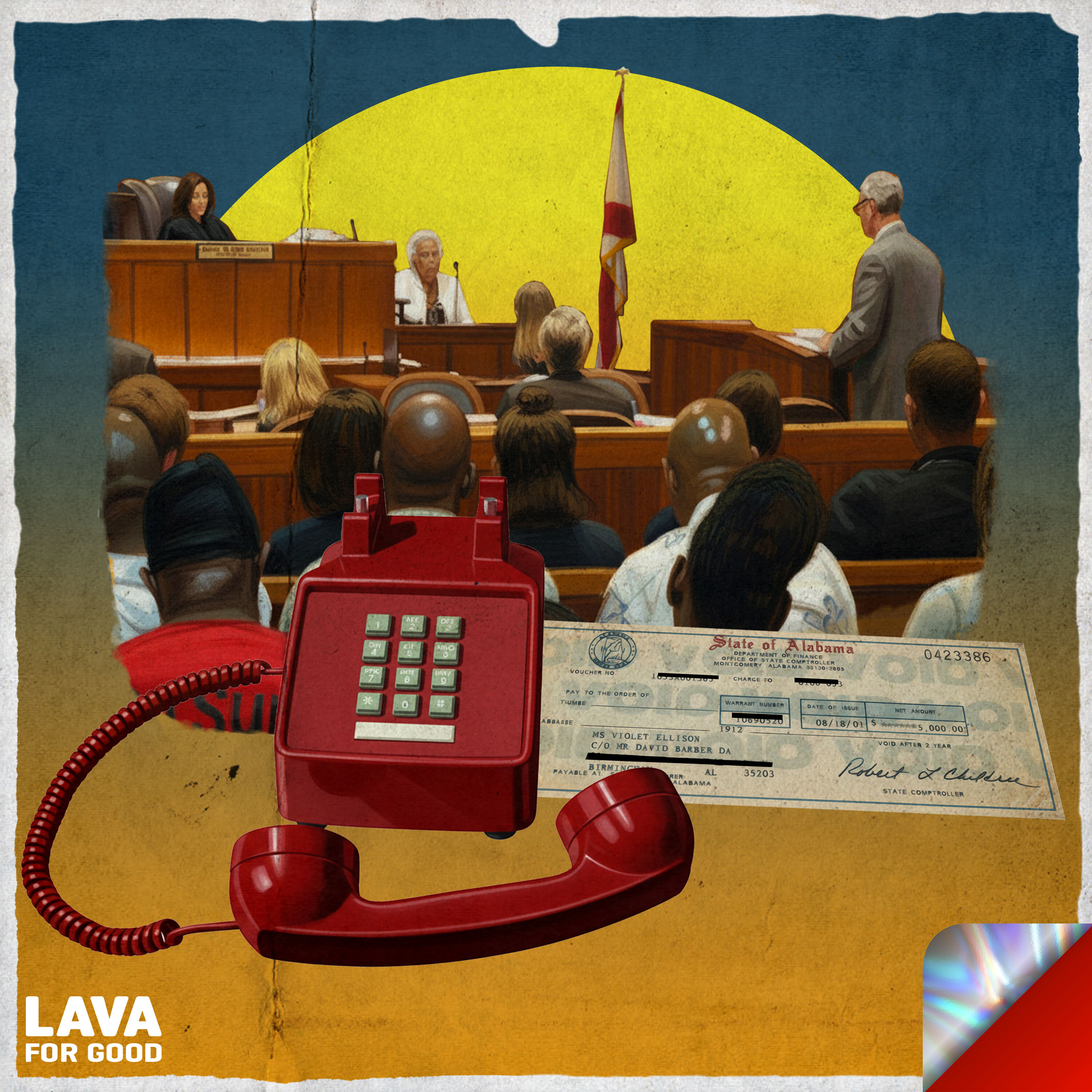
Violet Ellison, a 53 year old black woman, and her 16 year old daughter Katrina met with detectives Tony Richardson and Tom Salter at the sheriff's office. Violet Ellison, who knew Deputy Hardy, came forward a few weeks after Hardy's murder. She called investigators seven days after the governor announced an additional $10,000 for information, bringing the total reward offered in the case to $20,000. Her recorded interview with detectives is less than seven minutes long.
- [04:45]
Jeff Wallace
Ms. Ellison, would you tell us about.
- [04:46]
Beth Shelburn
The information that you have for us?
- [04:51]
Daisy Williams
A guy named Fred, I'm not sure of his last name, called my daughter Katrina Ellison on 8 3.
- [04:58]
Narrator/Interviewer
Violet Ellison says some guys in the jail were asking Katrina to make three way calls for them so they'd only have to pay for the original call to Katrina. They didn't want to keep fear feeding quarters into the payphone. One of those guys was named Fred.
- [05:15]
Daisy Williams
And he asked my daughter to use her three way to call for his homeboy and he named the fellow's name as Tavares Johnson.
- [05:25]
Narrator/Interviewer
Violet Ellison says her daughter dialed the number of a girl named Daisy to create a three way call in the jail. Fred handed the phone to Taforest so that he could talk to Daisy back in the Ellison house. Once Katrina heard the three way call go through, she put the phone down and walked away. But her mom, Violet Ellison, picked it up and listened in.
- [05:52]
Daisy Williams
He said that on the night of.
- [05:55]
Narrator/Interviewer
That incident, Violet Ellison tells detectives that she heard to Forrest Johnson telling Daisy what happened the night of deputy Bill Hardy's murder. I've listened to this recording over a dozen times and it's not easy to follow. But in summary, Violet says that Taforest described following a man. They planned to rob a man and.
- [06:24]
Daisy Williams
They had been following this man.
- [06:26]
Narrator/Interviewer
This man had a girl with him and the girl had a Gun a shot with. And Deputy Hardy heard the commotion and came out to investigate.
- [06:41]
Daisy Williams
And that's when Tavares Johnson shot one time. And he named another guy.
- [06:51]
Jeff Wallace
Which was.
- [06:54]
Narrator/Interviewer
Who?
- [06:56]
Beth Shelburn
Quintez. Both of them shot.
- [07:01]
Narrator/Interviewer
She says she overheard Taforest Johnson say that he and Quintess Wilson each fired one shot at Deputy Hardy. At this point, Quintess Wilson was also in jail, charged with Hardy's murder. The story Violet Ellison tells police is disjointed. There are a lot of details that are similar to the facts about the case that were reported in the news. But others that don't fit the evidence at the crime scene. And after less than seven minutes, detectives say they have no further questions for Violet Ellison and her daughter.
- [07:40]
Beth Shelburn
That makes a lot of sense.
- [07:42]
Narrator/Interviewer
Do you think of anything to ask? Two years after Violet Ellison first comes to police, the state is preparing to put Rodragus Ford and Taforis Johnson on trial. But Yolanda Chambers is falling apart. She's recanted her testimony under oath. And she doesn't always show up to court when she's supposed to be there. It's then, in their time of need, two years later, that detectives suddenly remember Violet Ellison's statements.
- [08:26]
Beth Shelburn
Violet Ellison walk in that door and stand up on this table and say what she said. We got a full table now. We got all the evidence we need. Well, not that we need. We'd like to have a lot more, but we got evidence.
- [08:43]
Narrator/Interviewer
Violet Ellison would become the state's star witness in the trial against Taforest Johnson. And her ear witness testimony would be the evidence linking him to Deputy Hardy's murder. But there wouldn't be just one trial for the murder of Deputy Hardy. Or two, or even three. The state will pursue four capital murder trials. And at each of these four trials, the state will present separate, mutually exclusive theories about who pulled the trigger and fired the fatal shots.
- [09:20]
Jeff Wallace
Sam.
- [09:43]
Narrator/Interviewer
Do you hear my man name? Laughter hides my fears. Sorrows deps are endless in this valley of tears I wanna see a RA Revelation I want to know who you.
- [10:25]
Jeff Wallace
Are.
- [10:29]
Narrator/Interviewer
I'm reaching out in desperation to the one who's holding the stars to the one who's holding holding the star. I'm Beth Shelburn. This is Ear Witness. Chapter five. Anybody will do. If Tony Richardson was initially enthusiastic about Violet Ellison's revelations. I can't tell by the investigative file. He wrote a report about the meeting he had with her. It's just seven sentences long. Concluding. The conversation concerned the crime. That's it. Detectives and prosecutors do not publicly Mention Violet Ellison or her claims for the next two years, it's like they just forgot about her. The most glaring example of this. Detective Richardson testifies at a grand jury hearing five months after his conversation with Violet Ellison. He says under oath that all four men charged with capital murder were in the back parking lot of the Crown Sterling Suites when Hardy was killed. But he says Omar Berry and Ardragas Ford were the shooters. This story is based on one of his conversations with Yolanda Chambers. And Detective Richardson tells the grand jury there is no doubt that Yolanda Chambers is telling us the truth. There is no mention of Violet Ellison until Taforest is on trial. But the state puts our Dragis Ford on trial first.
- [12:48]
Daisy Williams
My grandmother spent everything she had, everything that a poor woman had. She spent our money to defend him, you know, to get him the, you know, best representation she could.
- [13:01]
Narrator/Interviewer
Cousin Nicole Blunt Kirksey comes to my house to talk to me about the case. She's wearing a patterned dress and cowboy boots. Her hair is pulled back into a high bun. For many years, she grew up in the same house as our Dragis. Their mothers are sisters.
- [13:20]
Daisy Williams
It was a lot of money for a poor family. It really was a lot of. My grandmother had a lot of money stayed back then, even poor people, like, she didn't spend everything she had. She always put money back. She worked for Union Envelope, which was a. Like a factory over in Pret City, for years. And then she used to wash clothes and clean houses for people. And so she just tucked a lot of that money. She just tucked it away. And she exhausted just about everything to try to get him the representation that he needed for that trial. Other than my grandmother's money. I mean, we had barbecues and just, you know, things to raise money so that we could pay the attorney, Ardragas.
- [14:05]
Narrator/Interviewer
Mom, Joyce, tells me the same thing. So you had to raise some of the money?
- [14:10]
Beth Shelburn
Some of it, yeah.
- [14:12]
Narrator/Interviewer
Do you remember how much you ended up paying?
- [14:17]
Beth Shelburn
Looked like, I don't know.
- [14:22]
Daisy Williams
Might have.
- [14:22]
Beth Shelburn
Been over 40,000 or something or more.
- [14:25]
Narrator/Interviewer
Wow, that's a lot of money.
- [14:28]
Beth Shelburn
It was.
- [14:30]
Narrator/Interviewer
Ardragas family hires Richard Jaffe, a renowned defense attorney who had represented dozens of people facing the death penalty to Forrest Johnson's cousin. Antonio Green, remembers trying to figure out what his family could do to get to Forrest the best legal defense available.
- [14:51]
Beth Shelburn
One of the prominent attorneys during that time, me and my uncle went and talked to him about taking this case for Tafores during that time. And he told us right there, sitting in his office, he said, bring him a $10,000 retainer and he'll bring our loved one home. Of course. $10,000. He might as well say 10 million at that time to me, you know, and you know, we just, we just didn't have it, couldn't do it. Everybody's scratching to make it and feed the family and, and we all understood that because I'm thinking, okay, I, I got to get a loan, I got to do, you know, something, but, and that was what was amazing too. Beth Tafaris, he understood that. He was like, because don't worry about that. I'm gonna be all right. I didn't do this. You know, that was his whole thing. They're not gonna lock me up because I didn't do this.
- [15:48]
Narrator/Interviewer
Judge alfred Bayhackle appoints two attorneys to represent to Forrest, a sharply dressed 32 year old black man named Darrell Bender and Erskine Mathis, a white middle aged former police officer with a thick mustache. In 1997, Alabama paid appointed defense attorneys just $20 an hour for work outside the courtroom. With a cap of $1,000, most appointed lawyers can't afford to work for free. So this very low cap limited how well they could prepare for. Ford is first to go to trial in November of 1997. There's a photo of him in the newspaper. He's sitting in his wheelchair in court wearing a starched collared shirt and dark blazer. The junior prosecutor on the case is a 34 year old black man named Theo Lawson. Jeff Wallace is the lead prosecutor. He's tall, white, a commanding figure in the courtroom, 43 years old, 12 years into his career.
- [17:06]
Jeff Wallace
I think my reputation was of being a tough prosecutor, meaning if I had the case, I pushed it to his limits. And I think my reputation might be that I was maybe a little too tough Sometimes I hope that's not true, but I'm afraid it might be true.
- [17:23]
Narrator/Interviewer
Jeff Wallace was assigned to major cases and aggressively sought to please his boss, DA David Barber, who was a tough on crime leader, focused on getting convictions. And this case was personal for Jeff Wallace. He knew the victim.
- [17:41]
Jeff Wallace
Every prosecutor who is diligent works closely with the police. And when something happens to one of them, you're not one of the boys in blue, as they say, but they're your friends. So when this happened to Deputy Hardy, it got my attention.
- [18:02]
Narrator/Interviewer
The trial against Dodregus ford starts at 1:50pm on Nov. 5. In a short opening statement, the prosecution summarizes the crime for the jury, arguing that Ardregas Ford is guilty of capital murder. They don't mention a motive. Afterwards, Jeff Wallace calls the county's chief medical examiner to the stand. He explains that Hardy's wounds were at an upward angle through his head. Jeff Wallace argues this would be consistent with Ardragas firing the shots from his wheelchair. Prosecutors also call Yolanda Chambers as a witness, even though she recanted her story in court a year ago. Since then, she's gone back to saying that she was there when Hardy was killed. She now says she saw Ardragas Ford fire at least one shot. Richard Jaffe, Ardragas lawyer, argues that if the hotel witnesses had seen Ardregas Ford commit the crime, they would have seen this.
- [19:10]
Defense Lawyer (possibly Darrell Bender or Richard Jaffe)
Our Dragis Ford wheeling up about 30ft of an incline in his wheelchair, somehow finding an ability to shoot two shots into Deputy Hardy, then be wheeled down by someone all the way back to their car. The wheelchair would have had to been put in there. Our Dragos would have had to been physically put into the driver's seat. Tafarus would have had to have gotten back into the passenger seat and then they would have driven off. And that would have taken at least a minute or two, minimum.
- [19:49]
Narrator/Interviewer
Of course, no one at the hotel saw anything like that.
- [19:54]
Defense Lawyer (possibly Darrell Bender or Richard Jaffe)
The only thing they had on our Dragos Ford was Yolanda Chambers.
- [20:01]
Narrator/Interviewer
Jaffe calls witnesses to the stand who saw Ardragas at T's place at the same time that Deputy Hardy was shot.
- [20:09]
Defense Lawyer (possibly Darrell Bender or Richard Jaffe)
We didn't call any witnesses other than alibi witnesses.
- [20:15]
Narrator/Interviewer
The key decision the jury has to make. Do they believe Yolanda Chambers testimony that Ardragas killed Deputy Hardy behind the Crown Sterling Sweets? Or do they believe the three alibi witnesses who say he was at T's place at the same time that Deputy Hardy was murdered? The jury votes 10 to 2 to acquit Rodriguez Ford. But that's not enough. Murder trials requirements a unanimous verdict. Since this decision was split, Judge Bayhackel declares a mistrial. But our Dragus Ford is not set free. The state plans to try him a second time. Two weeks later, the first trial against Taforest Johnson begins. Here's to Forest's cousin, Antonio Green.
- [21:37]
Beth Shelburn
I remember me personally myself. I was very optimistic. I was very optimistic simply because I knew what they had, which was nothing as far as evidence goes. I'm like, okay, well this is just a part of the process. They'll hear the evidence or like thereof, and we'll be going home, you know, when this is all over. But as the days went on, from the first couple of days of the trial, you could see a really different Environment in the courtroom.
- [22:09]
Narrator/Interviewer
The only video from the trial I've seen is a short TV news clip. It's filmed through a window on the courtroom door. And Tiforest looks so young. Much younger than 24. He's clean shaven, baby faced, dressed for court in a striped button down shirt and tie with a gray blazer. He looks around the courtroom. Maybe he's nervous. But then he lights up with a huge smile when he sees a family member who comes over to speak with him. The state's lead prosecutor, Jeff Wallace, gets up in front of the jury. Just two weeks earlier he argued that our Dragis Ford shot Deputy Hardy. But now he tells a completely different story. He says that Taforis Johnson shot Hardy. The theory that the shooter was seated in a wheelchair is never mentioned. And Yolanda Chambers never sets foot in the courtroom. Instead, the prosecution tells the jury in opening statements that they will hear evidence that will convince them beyond a reasonable doubt that Taforest shot and killed Deputy Hardy. Then Jeff Wallace introduces the state's new star witness, Violet Ellison. She tells the jury she eavesdropped on several three way calls because she was concerned about her daughter talking to people at the jail and because she's naturally nosy. She says she contacted detectives six days after she listened in on the first call because she couldn't sleep after hearing information about the murder of Deputy Bill Hardy on the stand. Violet Ellison tells the jury that she overheard to Forest say these words. I shot the in the head and I saw his head go back and he fell and he shouldn't have got in my business messing up my. There was no mention of I shot the fucker in the head or anything like that. That and Violet Ellison's original recorded statement to police. She did write the statement down in notes on the back of an envelope that she submitted to police. But she gave them these notes six weeks after her first recorded statement on the stand. She says she jotted down the notes while she listened in on the call call between Taforest and Daisy and then copied the notes onto a sheet of paper. But it's hard for me to believe that these notes were written during the phone call she claims she overheard. For example, Violet Ellison is adamant in her testimony that she heard Taforest only use his first name. But her notes refer to him as Johnson. If she was just writing down what she heard while she heard it, why wouldn't she have written to Forrest? How would she have known his last name? Taforest's attorneys also say that what Violet Ellison Heard was just one side of a conversation. They say to Forest was telling Daisy what he was accused of doing, not what he did. He was responding to her question, why are you in jail? But when Darryl Bender questions Violet Ellison, she tells him she's positive that Daisy never asked to Forrest why he was in jail. But then she also says that she didn't pay any attention to Daisy's side of the conversation because she was only interested in what Taforest had to say. If this feels confusing to you, welcome. I've been trying to make this make sense for two years. How can Violet Ellison insist that she knows what Daisy did or did not say while also admitting that she only listened to one side of the conversation? Antonio Green, Taforest's cousin, remembers watching Violet Ellison on the stand.
- [26:38]
Beth Shelburn
The only evidence supposedly they had against was this ear witness who had never heard him speak before, who had no idea who he was. But to sit in there and see how the system from, you know, the judge, the prosecutors and all that pushed that case towards him. I mean, constantly it was, he did it, we got the right one. He forget the evidence. Don't worry about that. We just telling you he did it. It's pretty much it's all they had.
- [27:11]
Narrator/Interviewer
When Violet Ellison finishes testifying, Daisy Williams takes the stand. She says Tiforest did not admit to the murder on that phone call, and she never heard him say the things Violet Ellison claimed to overhear. So Violet Ellison, a friend of the victim, says she heard one thing. Daisy Williams, a friend of the accused, says she heard another. The case comes down to who the jury will believe. After five days of testimony to Forests supporters nervously wait as the jury begins to deliberate. And once again, the jury cannot reach a unanimous decision. Nine jurors vote to convict, but three others are not convinced beyond a reasonable doubt. The judge declares a mistrial.
- [28:21]
Beth Shelburn
They deliberated and they couldn't come to a verdict. So they took him back. They kept him locked up and immediately pretty much scheduled another date for a second trial.
- [28:33]
Narrator/Interviewer
So there wasn't really any time to celebrate.
- [28:36]
Beth Shelburn
No, no, no, no. It wasn't any of that. And then, even then, I didn't think. I didn't look at it as any, any type of victory because an innocent man should be found innocent.
- [29:08]
Commercial Voice
Every year, people make the same fitness goal train harder. But most fail because recovery gets ignored. Especially connective to tissue that muscles depend on to grow. Frog fuel was developed by Navy seals and perfected by a Stanford trained scientist. Delivering 15 grams of nano hydrolyzed collagen Protein that digests in just 15 minutes. It's science backed and ready to drink. No mixing, no sugar, no junk this year. Don't just train harder. Recover smarter. Go to frogfuel.com that's frogfuel.com Stay unbreakable every Lenovo is built to let them go. Let them work and rework. Let them animate a dinosaur. No. A toaster. No A hand in a jetpack.
- [29:48]
Narrator/Interviewer
Fun.
- [29:48]
Commercial Voice
Let them put golden wings on a dog. Good boy. Let them color correct anywhere and everywhere. Let them make Powered by Intel Core Ultra processors, Lenovo gives creatives everything they need. Lenovo.com let creatives create Lenovo Lenovo.
- [30:08]
Beth Shelburn
Why have I asked my electrician I found on Angie.com to bury my pet hamster.
- [30:12]
Commercial Voice
Nibbles in our yard for me?
- [30:14]
Beth Shelburn
Because I was so moved by how carefully he buried my electrical wires, I.
- [30:18]
Commercial Voice
Knew I could trust him to bury.
- [30:19]
Narrator/Interviewer
My sweet Nibbles after his untimely end.
- [30:22]
Commercial Voice
Huh?
- [30:22]
Beth Shelburn
Nibbles gone too soon.
- [30:24]
Commercial Voice
May he scurry in peace.
- [30:26]
Narrator/Interviewer
Hey, sorry about your pet, but I just wire stuff.
- [30:29]
Beth Shelburn
Nibbles would have loved you like a brother.
- [30:31]
Narrator/Interviewer
Connecting homeowners with skilled pros for over 30 years, Angie.
- [30:34]
Defense Lawyer (possibly Darrell Bender or Richard Jaffe)
The one you trust to find the ones you trust. Find pros for all your home projects@angie.com.
- [30:44]
Jeff Wallace
I'm Jeff Wallace.
- [30:45]
Narrator/Interviewer
Nice to see you, Jeff. I'm Beth Shelburne. You can call me Beth. Can I call you Jeff? Okay, great. Jeff Wallace prosecuted both Taforest and Ardragas. When I emailed him to set up an interview, he asked me to meet him at the large Methodist church he attends in a Birmingham suburb. He's now retired, but spent spent 25 years as a prosecutor in Jefferson County. We record the interview in the church's empty sanctuary. He tells me he prefers to do interviews standing up because of all of his courtroom experience. So we're standing in this sanctuary, at the altar, facing each other, having this conversation in front of a giant pipe organ. The way we're set up, it feels like we're either here to debate or get married. Anyway, this is why the recording sounds a little echoey.
- [31:41]
Jeff Wallace
We had a weak case. It's based on the testimony of one witness.
- [31:45]
Narrator/Interviewer
Jeff Wallace remembers that the case against Taforest Johnson hinged on the testimony of Violet Ellison.
- [31:53]
Jeff Wallace
That is extremely strong evidence. If it's believed, of course. The question becomes, do you believe? Well, to believe that evidence, you have to believe Ms. Ellison. To believe Ms. Ellison, you have to look at the facts. How she said it happened.
- [32:07]
Narrator/Interviewer
Taforest's Second trial begins eight months after the first one ends in a mistrial. Jeff Wallace is the lead prosecutor. Again he calls Violet Ellison to the stand where she testifies that she overheard Taforest admit to Hardy's murder on a three way phone call. Jeff Wallace says Violet Ellison listened in on the calls because she was concerned about her daughter. And once again to Forest's attorneys, call Daisy Williams, who maintains that DeForest never confessed to the murder. DeForest lawyer Daryl Bender asks Daisy, did he describe to you the series of events that he said had occurred? Daisy no. Bender, did he tell you where this happened again? Daisy no. Bender, did he tell you that he had killed somebody? Daisy no, sir. Jeff Wallace tries to cast doubt on Daisy's testimony. He says maybe Daisy is testifying about a different call. Or maybe she's just the wrong Daisy. Yet again, it's one witness's word against another. Right before Jeff Wallace addresses the jury for closing statements, he picks up a piece of evidence. Deputy Hardy's hat, the one that he would always wear on duty, the one he was wearing when he was shot. It has a bullet hole through the brim. Jeff Wallace argues that Violet Ellison heard Taforest Johnson bragging about what he did. Wallace turns to the jury and says, let me read you the words. His words, not mine. I shot the fucker in the head. I saw his head go back and he fell. He should never have got in my business, messing up my shit. He says these words to the jury like, this is an on the record statement directly from Taforis Johnson, when it's really Violet Ellison's testimony of what she says she overheard, however it occurred. Wallace continues, he's proud of his role in it. And don't forget that no matter how many shots were fired, he's proud of the one he put into Deputy Hardy's head. Here's his respect for Bill Hardy. Wallace throws Hardee's hat onto the courtroom floor. He's as guilty as they come. Judge Bayhackel gives the jury instructions to carefully consider all of the evidence. They begin deliberations at 4:25pm on a Friday afternoon. DeForest's family waits for the verdict.
- [35:21]
Beth Shelburn
He's a defendant, but he's innocent until proven guilty. That didn't seem to be the case in the courtroom during that time. It was like you have to go above and beyond to prove you're innocent. Cause as of right now, you're guilty. And that was a, that was a. That was a dark feeling in there. You couldn't, you Couldn't get around it.
- [35:44]
Narrator/Interviewer
Two and a half hours later, at 7:10pm the jurors file back into the courtroom with their decision. Taforest Johnson is found guilty of capital murder. Judge Bayhackel schedules the penalty phase for the following Monday. This is when the jury will decide to Forrest's fate should he be sent to prison for life without parole or put to death for Hardy's murder. The penalty phase of a capital murder case represents the highest stakes in our criminal justice system. Defense attorneys often call lots of witnesses and sometimes spend weeks presenting evidence to try to convince the jury to spare their client's life. The penalty phase hearing for Taforest Johnson lasts only 80 minutes. Taforest's attorneys call three members of his family to testify. When Erskine Mathis asks Taforest's grandmother, you know what we're here for today? She answers, well, yeah, I guess. Not really, though. It's clear Mathis and Bender didn't adequately prepare her for the hearing. On the stand, Taforest's mother, Donna, cries so hard she can barely hold her head up. At one point, Mattha says to her, listen to me. Can you raise your head up and look at me? Donna Johnson tells the jury through her tears, just don't give my baby no electric chair. The final witness is to Forrest's cousin, Antonio Green.
- [37:31]
Beth Shelburn
I'm 52 years old, and until today, that's probably one of the hardest things I've ever had to do was get on that stand and beg for his life.
- [37:44]
Narrator/Interviewer
The jury deliberates to Forest's fate for over five hours. In the decision about whether or not Taforest should live or die, all of the jurors don't have to agree. A unanimous vote is needed for guilt or innocence. But a jury in Alabama can sentence a person to death with a majority vote of 10 to 2. And just after 5pm they reach a decision. With the minimum number of votes needed, 10 to 2. The jury recommends the death penalty. Judge Alfred Bayhackle affirms the recommendation that Taforest Johnson be executed for the murder of Deputy Bill Hardy. One newspaper reports that Taforest sat motionless as the jury's recommendation was read. Appearing to be stunned, Taforest's mother, Donna, screamed, no, no, no. Taforest's oldest daughter, Shanae, was in the courtroom that day. She was six years old at the time. And I just kept kind of trying to get his attention and blurting out how nice he looked in his suit. And so finally the judge kind of had me escorted out of the courtroom but then is a little small window and my cousin had me on his shoulders. He escorted me out. He had me on his shoulders so I could just peek through and see my dad through that little small courtroom window. And ironically so that was my last memory of him in the free world.
- [40:00]
Commercial Voice
Every year people make the same fitness goal Train harder. But most fail because recovery gets ignored. Especially connective tissue that muscles depend on to grow. Frog fuel was was developed by Navy SEALs and perfected by a Stanford trained scientist delivering 15 grams of nano hydrolyzed collagen protein that digests in just 15 minutes. It's science backed and ready to drink. No mixing, no sugar, no junk this year don't just train harder, recover smarter. Go to frogfuel.com that's frogfuel.com Stay unbreakable every Lenovo is built to let them move. Let them put a chicken on a skateboard, please. Let them scale, copy and change it up. Let them make a purple sky with raining soccer balls incoming. Let them launch their vision to the world. Let them make Powered by Intel Core Ultra processors, Lenovo gives creatives everything they need. Lenovo.com, let creatives create Lenovo.
- [40:56]
Beth Shelburn
Lenovo why have I asked my electrician I found on Angie.com to bury my.
- [41:03]
Commercial Voice
Pet hamster Nibbles in our yard for me?
- [41:06]
Beth Shelburn
Because I was so moved by how carefully he buried my electrical wires, I.
- [41:09]
Commercial Voice
Knew I could trust him to bury.
- [41:11]
Narrator/Interviewer
My sweet Nibbles after his untimely end.
- [41:13]
Beth Shelburn
Huh, Nibbles gone too soon.
- [41:16]
Commercial Voice
May he scurry in peace.
- [41:17]
Narrator/Interviewer
Hey, sorry about your pet, but I just wire stuff.
- [41:20]
Beth Shelburn
Nibbles would have loved you like a brother.
- [41:22]
Narrator/Interviewer
Connecting homeowners with skilled Pros for over 30 years, Angie, the one you trust.
- [41:26]
Defense Lawyer (possibly Darrell Bender or Richard Jaffe)
To find the ones you trust. Find pros for all your home projects@angie.com.
- [41:50]
Narrator/Interviewer
So my thing is this. Why didn't Daryl Bender reach out to me for to Forest Vellonique Sanders, AKA Quesi still wonders why Taforest's attorneys didn't call her or Mama Cat to testify at his second trial like they did in the first one. That that makes me feel like we failed them. Because we saw them. And we wasn't the only one. So it's like what we said didn't even matter. Like they didn't take it into consideration. Mama Cat and Quesi were important alibi witnesses at his first trial who saw him at T's place the night Hardy was murdered, and their testimony may have created enough reasonable doubt to prevent a guilty verdict. Instead, Taforis Attorneys called two other witnesses from Tees. But these witnesses didn't seem well prepared and were flustered on the stand. I wondered the same about Marshall Kelly Cummings, the Keebler cookie guy. Why didn't they call him as a witness in the second trial? What he saw out the window. One person slowly driving away in a copper colored car. That contradicted the state's story. But the jury that sentenced to Forest to death never heard from him. The third difference between Taforest's first and second trials involves Latonya Henderson, the friend of Yolanda Chambers who was in the car with Taforest and Ardragas after they left T's place. Remember, Latonya was facing a charge of hindering prosecution. She went to jail for five months because she refused to go along with Yolanda Chambers story. At the time of Taforest's second trial, Latonya was still facing this charge when prosecutor Jeff Wallace called her as a witness. Right before the jurors were brought into the courtroom, Jeff Wallace told the judge the state wants to secure her testimony and in that regard we are dismissing her hindering prosecution case. For years, Latonya said that she didn't know anything about Deputy Hardy's murder. And it was only just before she took the stand for the prosecution that the state dropped the felony charge against her. Poof. Like magic. When she took the stand, Latonya stuck to her story that she wasn't there when Hardy was murdered. That no one in our Dragus car talked about killing anyone. But she did say that she had a gun that night and so did Taforest on the stand. She said she hid her gun on the tire of another car and that Ardregis, Yolanda and Taforest hid the other gun under the dashboard. Police searched Ardregas car after they impounded it. They never found a gun. But Latonya's testimony put a gun into Forrest's hand on the night of the murder. And this likely stuck with the jury. And finally, Taforist lawyers called an unexpected witness.
- [45:18]
Beth Shelburn
The thing that happened to me that is the most just stunning is putting Yolanda Chambers on the stand in the defense case.
- [45:28]
Narrator/Interviewer
Derek Drennan was a young lawyer working with Jaffe on Ardragas case. At the time, both attorneys were paying close attention to to Forest trials. When I first read the trial transcript I wondered why would the defense call Yolanda Chambers to the stand? And Derek had the same question as he watched it unfold.
- [45:53]
Beth Shelburn
Why would you call the only person on the planet who will testify under Oath that your client was there, you know, and lie. I mean, knowing they're lying about it.
- [46:05]
Narrator/Interviewer
Yolanda testified that she was at the scene of the crime with Taforest, Latonya and Ardragas. She said it was Ardragas, not Taforest, who killed Deputy Hardy. But still, her testimony directly contradicted Taforist's alibi, that he was at T's place.
- [46:28]
Beth Shelburn
They're asking A Drew to believe her when she says, you know, Johnson didn't shoot him.
- [46:33]
Jeff Wallace
Ford did.
- [46:37]
Beth Shelburn
I don't know how that could be justified. There's nobody on the planet that's gonna put your client on that parking lot that night except for Yolanda Chambers. Nobody will. And to put her up there, to say that their client was innocent because Ford did it, just beyond me, you know, that, to me is just. It's just really inexplicable.
- [47:13]
Narrator/Interviewer
Prosecutor Jeff Wallace seized on this at trial. In his closing statement, he told the jury, if you go back in the jury room and decide that Yolanda Chambers ought not to have been allowed to testify because she's a liar or whatever you might decide about her, that's okay. State didn't call her. The defense did. I want you to remember that. I called both of Taforest's original trial lawyers to ask about the decisions they made in defending Taforest, but neither would sit down with me for an interview.
- [48:00]
Beth Shelburn
We forget sometime that there was a third person on that phone who totally discredits what this lady say she heard. You know what I mean? And now how close? How much closer can you get than that? You're the third party in that three way conversation. And you say, no, that's not what it was.
- [48:19]
Narrator/Interviewer
I needed to find the person on the other end of the phone call that Violet Ellison overheard. The person who actually talked to Taforist, Daisy Williams. Daisy was 19 when she testified at Taforist's second trial. She's now in her mid-40s and has never spoken publicly about the case. But she agrees to come to my house to talk.
- [48:45]
Daisy Williams
I'm a mechanic.
- [48:46]
Narrator/Interviewer
How did you get into being a mechanic, into working on cars?
- [48:50]
Daisy Williams
I was a tomboy growing up. I love cars. I have a 71 Ford at home now that I'm trying to restore. I love working on them. I love, you know, going to, like, the car races and everything.
- [49:02]
Narrator/Interviewer
We settle in on the couch and talk for over an hour.
- [49:05]
Daisy Williams
Tavares is a real good person. He got a real good heart.
- [49:09]
Narrator/Interviewer
Daisy tells me Taforest was friends with her two brothers. Charles and Eugene, they used to hang out and play basketball when they were growing up in Pratt City. And her story about what happened on that phone call is consistent. What she tells me more than 25 years later doesn't vary from what she said on the stand.
- [49:32]
Daisy Williams
My cousin actually called me cause he was in the county jail at the time.
- [49:37]
Narrator/Interviewer
And who was that? Was that Fred?
- [49:39]
Daisy Williams
Fred Carter.
- [49:39]
Narrator/Interviewer
Okay. Yeah. So when that initial call came to you, I guess Fred had called Katrina, Violet Ellison's daughter, and then she made the three way call to connect him to you.
- [49:54]
Daisy Williams
Yes.
- [49:55]
Narrator/Interviewer
And then he put to forest on. Is that how it went?
- [49:57]
Daisy Williams
Yes. He actually, like I said, he told me he was like, guess who up here with me? And he knew, you know, we all grew up in Pratt City together. And he was like, tafar is not like for real. And he was like, he gave to far his phone. Let me talk to him. So I'm talking to him like, man, what's going on? And he told me, I've been accused of, you know, killing somebody. And I was like, man, you got a lawyer? And he was like, yeah. And we left it at that. We didn't go no further with that conversation about the death of that share. He said he was accused and that's all he said to me.
- [50:25]
Narrator/Interviewer
Why did the jury believe this woman who eavesdrop on the call over you, who actually had on the call?
- [50:34]
Daisy Williams
I don't understand. I never understood it. You know, they went on hearsay. They went on what she said she overheard. They didn't actually listen to me. I was young. So I feel like by me being young, they didn't actually listen to me. Oh, well, she just, you know, somebody he, you know. No, she probably just saying something and that's how I felt.
- [51:00]
Narrator/Interviewer
There are two recurring questions that come up when Taforis family and friends talk with me about the case. The first, why isn't Violet Ellison's testimony hearsay? Usually something that someone overheard is considered hearsay and not admissible as evidence in court. Tafora's lawyers tried to argue that Violet Ellison's testimony was hearsay to get it thrown out, but the judge overruled them. It turns out there is an exception to the hearsay rule when someone claims to overhear the defendant admitting to the crime. The second, isn't the jail supposed to record phone calls? According to testimony from a jail supervisor, the phones in the Jefferson county jail weren't equipped with the ability to record. In 1995. One of the hardest things to comprehend about this case is what happens 10 months after Taforis Johnson was convicted and sentenced to death. In June of 1999, the state once again tries to convict Ardregus Ford. Jeff Wallace prosecutes the Hardy case for the fourth time. And the state's star witness, Yolanda Chambers Violet Ellison is never even mentioned. And Wallace presents yet another theory of the crime, a fifth theory. At the grand jury hearing, the state argued that Ardragas and Omar Berry killed Deputy Hardy. Then at Ardragas first trial, Jeff Wallace said Ardragas was the only person who killed Deputy Hardy. Then at Taforest first trial a month later, he argued that Taforest was the only shooter. A year later, when Taforest was tried a second time, the state said Taforest fired a shot and so did Quintess Wilson. But they said Wilson was not being tried because of a lack of evidence. And finally, after DeForest Johnson was sentenced to death, and after Jeff Wallace characterized Yolanda Chambers as a liar, he turns around and uses Yolanda as his own star witness against Ardregas. Ford the jury in Ardregis second trial deliberates for less than an hour and declares him not guilty. Ardregas is acquitted. I talked to his cousin Nicole about that moment. I wonder how that made you feel. I mean, did it make you feel like the system worked that our Dragis was acquitted?
- [54:01]
Daisy Williams
It didn't make me feel like the system worked. It showed me that Richard Jaffe did a wonderful job defending him.
- [54:10]
Narrator/Interviewer
Ardragas and Taforest had the same alibi. Nobody denies that they were together the night Hardy was killed. But there was a major difference between their cases. Ardragas family was able to pay for a renowned attorney and Taforest's family wasn't. Meanwhile, prosecutors had a powerful tool at their disposal. The ability to use multiple theories to get the outcome. They were seeking someone to go down for Hardy's murder.
- [54:46]
Defense Lawyer (possibly Darrell Bender or Richard Jaffe)
No, prosecutors should be allowed to, in any case, much less a death penalty case, to try two different defendants for the same crime using a different theory and different sets of witnesses, as if they're staging two Broadway plays of the same scenario.
- [55:09]
Narrator/Interviewer
RICHARD JAFFE LAWYER this case is all.
- [55:14]
Defense Lawyer (possibly Darrell Bender or Richard Jaffe)
About alternative worlds that are in conflict with each other and in conflict with truth and in conflict with what our justice system stands for.
- [55:27]
Narrator/Interviewer
Arguing inconsistent theories isn't technically illegal, but I mean, come on, five different theories? There is no way all five of these theories can be true. These theories are mutually exclusive, in conflict with each other. I ask Jeff Wallace to explain. How could he argue these mutually exclusive theories against Two different people for the same crime.
- [55:59]
Jeff Wallace
It's a valid question, but it's not the point. The right question is whether or not we argued something that was supported by the evidence in that trial.
- [56:09]
Narrator/Interviewer
But help me understand how, as a prosecutor, you can argue that one person is the gunman in the killing of a deputy, he's convicted and sentenced to death, and then at a subsequent trial argue that another person was the shooter.
- [56:26]
Jeff Wallace
Well, it would not be, if I can be hyper technical, it would not be the shooter of the same bullet.
- [56:35]
Narrator/Interviewer
Jeff Wallace gives me a long winded explanation about how two people could be guilty of the same crime if, for example, one person shoots a victim and another fires a shot, but the bullet flies off into space. But that's not what Jeff Wallace argued at trial.
- [56:56]
Jeff Wallace
Kills the victim. You don't have to decide which one fired the shot. They're both guilty.
- [57:01]
Narrator/Interviewer
But the evidence showed that there was only one gun and one gunman, right?
- [57:06]
Jeff Wallace
Well, I don't know if you can say that.
- [57:08]
Narrator/Interviewer
I think that's what the firearms expert testified to. He did. A firearms examiner looked at the two shell casings found at the murder scene and determined they had been fired from the same 9 millimeter pistol, indicating there was only one shooter. I keep pressing him. I want Jeff Wallace to tell me how he squared in his own mind these contradictory theories about who fired the fatal shots. Jeff and I go round and round. In theory, prosecutors are employed to seek the truth. They don't have a mandate to obtain convictions, but the law allowed him to do what he did. And Jeff Wallace told me himself he was known to push a case to its limits.
- [58:01]
Jeff Wallace
I'm afraid that my reputation was that I was fairly mean. I tried to follow all the roads, tried to do exactly what the boss wanted done. And so I tried to follow all orders. I now wish I'd been a little more yielding sometimes, wish I'd seen a little more gray. But I was fairly black and white, and I'm afraid I was fairly mean. And I'm not necessarily proud of that.
- [58:33]
Narrator/Interviewer
As Tiforest's family watched their worst nightmare unfold, it was clear that he wasn't the only one failed by these trials. They also thought about deputy Bill Hardy and his family.
- [58:49]
Beth Shelburn
You know, the victim's family deserve to know what happened to their loved one. But they, they get no, no justice, no peace out of a wrongful conviction. You know, and this is simply a case of just anybody or do. And looking at it from the inside, it. It seems like the whole thing was just put together like a puzzle. All this is going on in a court of law that's supposed to be the most honest place in.
- [59:30]
Narrator/Interviewer
After he's sentenced to death, correctional officers put Taforest in a van and drive him 200 miles south of Birmingham. He arrives at Holman Prison and is assigned a 5x8 cell on death row where he'll spend 23 hours a day. Roaches crawl everywhere and there's no air conditioning in this sweltering Alabama heat. As months go by, Taforest learns to survive in this agonizing space. But he also sees prison guards take men from their cells and walk them around the corner to the death chamber and he wonders when they are coming for him. Is he next? He just started crying and I asked.
- [60:21]
Beth Shelburn
Him what was wrong and he said.
- [60:22]
Defense Lawyer (possibly Darrell Bender or Richard Jaffe)
That he had just assumed that they.
- [60:24]
Beth Shelburn
Could come any minute and take him to be executed.
- [60:28]
Narrator/Interviewer
That's next time. Ear Witness is a production of Lava for Good podcasts in association with Signal Company Number One. Executive producers are Jason Flom, Jeff Kimpler, Kevin Wardes and me, Beth Shelburn. The investigative reporting for this series was done by me and Mara McNamara. Producers are Mara McNamara, Hannah Beal and Jackie Pauley. Kara Kornhaber is our senior producer. Britt Spangler is our sound designer. Additional story editing from Marie Sutton. Fact check help from Katherine New hand and special thanks to Taforest Johnson's legal defense team. You can follow the show on Instagram, TikTok, Facebook and Twitteravor. Good to see behind the scenes content from our investigation, visit lavaforgood.com earwitness.
- [61:40]
Commercial Voice
Every year people make the same fitness goal. Train harder. But most fail because recovery gets ignored, especially connective tissue that muscles depend on to grow. Frog fuel was developed by Navy Seals and perfected by a Stanford trained scientist. Delivering 15 grams of nano hydrolyzed collagen protein that digests in just 15 minutes. It's science backed and ready to drink. No mixing, no sugar, no junk this year. Don't just train harder, recover smarter. Go to frogfuel.com that's frogfuel.com, stay unbreakable. Every Lenovo is built to let them go. Let them work and rework. Let them animate a dinosaur. No. A toaster. No. A hamster and a jetpack. Fun. Let them put golden wings on a dog. Good boy. Let them color correct anywhere and everywhere. Let them make power. Powered by Intel Core Ultra processors, Lenovo gives creatives everything they need. Lenovo.com let creatives create. Well, the holidays have come and gone once again. But if you've forgotten to get that special someone in your life a gift, well, Mint Mobile is extending their holiday offer of half off unlimited wireless. So here's the idea. You get it now, you call it an early present for next year. What do you have to lose? Give it a try at mintmobile.
- [62:58]
Narrator/Interviewer
Com Switch Limited time 50% off regular price for new customers. Upfront payment required $45 for three months, $90 for six months or $180 for 12 month plan taxes and fees. Extra speeds may slow after 50 gigabytes per month when network is busy. Terms.