Loading summary
Transcript227 lines
- [00:01]
Jenna Kim Jones
Hey, this is U.S. olympic gold medalist Tara Davis Woodhull.
- [00:04]
Danny Carr
And I'm U.S. paralympic gold medalist Hunter Woodhull.
- [00:06]
Jenna Kim Jones
As athletes, our lives are about having.
- [00:08]
Danny Carr
A clear path and a team that you can absolutely trust.
- [00:11]
Jenna Kim Jones
So when it came to getting the.
- [00:12]
Beth Shelburne
Best mortgage, we chose PennyMac.
- [00:14]
Jenna Kim Jones
PennyMac is proud to be the official mortgage provider of Team USA and you.
- [00:19]
Beth Shelburne
Learn more at pennymac.com PennyMac Loan Services.
- [00:22]
Danny Carr
LLC equal housing lender NMLS ID35953 licensed by the Department of Financial Protection and Innovation under the California Residential Mortgage Lending Act. Conditions and restrictions may apply. Do you want to find a stress free way to buy your next car? Start at CarMax and shop your way. If you want to browse with confidence, get pre qualified online with no impact on your credit score and shop cars within your budget. From luxury cars to family rides, CarMax has options for almost every price range, including more than 25,000 cars priced under $25,000. So hey, want to get started? Just head to CarMax.com for details and get pre qualified today. Want to drive CarMax?
- [01:03]
Beth Shelburne
There's a fire inside you you can't ignore.
- [01:06]
Jenna Kim Jones
Stand still. Not a chance.
- [01:08]
Beth Shelburne
You're a lifelong learner who's come this far.
- [01:11]
Jenna Kim Jones
Now we are here to help you keep going further.
- [01:13]
Beth Shelburne
Capella University.
- [01:15]
Jenna Kim Jones
What can't you do?
- [01:16]
Beth Shelburne
Visit capella Edu to learn more. Last time on ear witness.
- [01:32]
Jenna Kim Jones
She was a very credible witness.
- [01:34]
Beth Shelburne
We believed her. Obviously we believed her because we convicted.
- [01:37]
Jenna Kim Jones
Him and it was on her testimony.
- [01:39]
Danny Carr
The only evidence supposedly they had against him was this ear witness who had never heard him speak before, who had no idea who he was.
- [01:49]
Jeff Wallace
That is extremely strong evidence. If it's believed. Of course, the question becomes, do you believe that evidence? Well, to believe that evidence, you have to believe is Ellison.
- [01:57]
Beth Shelburne
And so we're trying to get information on her. Her name's Violet Ellison. M. Do you have an opinion about her or have any information that you could give us about her?
- [02:09]
Danny Carr
I know she's very vindictive. She's a very messy lady. Very messy. I can tell you one thing about my grandma.
- [02:19]
Jeff Wallace
She is a.
- [02:20]
Danny Carr
That's a true scam artist. That's a true. I hate to say it, I know that's my grandma, but that's a true scam artist and I hate that this man could be innocent. For 5,000 doll on death row. $5,000.
- [02:55]
Beth Shelburne
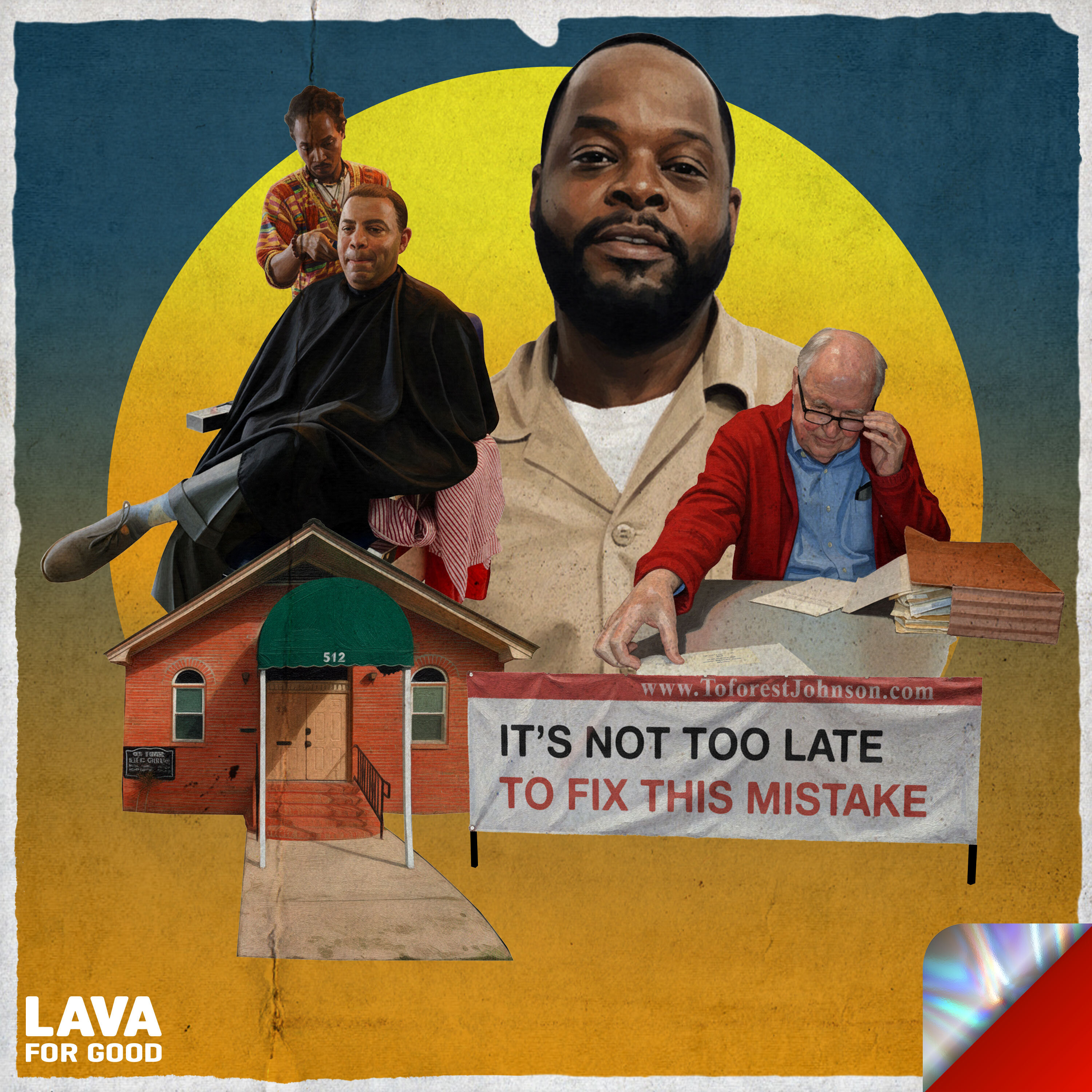
Near the intersection of Rosa Parks Avenue and Liberty street in Montgomery, Alabama is a tiny red brick church outside St. Peter AME. A large white banner is stretched 25ft across the church's front lawn. The words it's not too late to fix this mistake are written across the banner in black and red letters. The mistake is to Forrest Johnson's conviction.
- [03:34]
Danny Carr
Oh, Lord God. We've been carrying that banner, Lord God. For several weeks. Lord God, we're just bringing that.
- [03:43]
Beth Shelburne
The banner was created by an organization called Greater Birmingham Ministries. This year, it has traveled to eight different churches across Alabama to help raise awareness about Taforest's case. Awareness that is growing. Holy cow.
- [04:01]
Jeff Wallace
That's just ridiculous.
- [04:03]
Beth Shelburne
This case is shameful.
- [04:06]
Danny Carr
My name is Lindsey Boney. I'm a lawyer at the law firm Bradley A. Rant Bolt Cummings. When I think about this case, it's.
- [04:14]
Beth Shelburne
Mind blowing to me. My name is Carla Crowder. I'm a lawyer and executive director at Alabama Appleseed center for Law and Justice. This case is stunning, and this case is heartbreaking.
- [04:30]
Danny Carr
My name is Nick Gady.
- [04:31]
Jeff Wallace
I have been an active lawyer in Birmingham since 1964. We can do better, and we need to do better.
- [04:40]
Beth Shelburne
Lots of people have known for a very long time that this man is innocent and he's still on death row. Why does it take 25 years? These are just a few in the chorus of powerful voices calling on the state to to fix this. Lawyers from all sides of the political spectrum are lending their support, along with former prosecutors and judges, as well as Alabama churches and faith leaders like Sister Helen Prejean.
- [05:14]
Danny Carr
Please God with these efforts and people hearing this about to forest his life will be saved.
- [05:23]
Beth Shelburne
Even death penalty supporter Bill Baxley, Alabama's former attorney general, has joined the fight.
- [05:32]
Jeff Wallace
I will add my voice or anything I can do because this is a situation that shouldn't be allowed to exist another minute.
- [05:45]
Beth Shelburne
When Baxley reviewed Taforest's case, he was so outraged, he wrote an op ed in the Washington Post that said an innocent man is trapped on Alabama's death row.
- [05:59]
Jeff Wallace
The only thing that I can see as to why this kind of thing happened was the victim was a law enforcement officer.
- [06:15]
Beth Shelburne
Taforest Johnson now has unprecedented support. And it's not just from all these people who believe he's innocent. The current district attorney of Jefferson county, along with the original prosecutor who sent him to death row, both now say Taforest Johnson deserves a new trial. So why is the state of Alabama still trying to kill him?
- [07:09]
Jenna Kim Jones
Do you hear my manners? Laughter hides my fears.
- [07:25]
Beth Shelburne
Sorrows deps are endless.
- [07:31]
Jenna Kim Jones
In this valley.
- [07:35]
Danny Carr
Of tears.
- [07:39]
Jenna Kim Jones
I want to see a revelation I want to know who you are I'm reaching out in desperation to the one who's holding the stars. To the one who's holding the star.
- [08:20]
Beth Shelburne
I'm Beth Shelburne. This is is Ear Witness, Chapter eight, Bondage to the Law.
- [08:30]
Jenna Kim Jones
Why have we asked our contractor we found on Angie.com to be our kid's legal guardian? Because he took such good care when redoing our basement that we knew we.
- [08:38]
Beth Shelburne
Could trust him to care for our.
- [08:39]
Jenna Kim Jones
Kids, all eight of them, should something happen to us.
- [08:43]
Beth Shelburne
Are you my dad now?
- [08:46]
Danny Carr
No, sorry. I do basements. Connecting homeowners with skilled pros for over 30 years. Angie, the one you trust. Define the ones you trust. Find pros for all your home projects@angie.com.
- [08:59]
Jenna Kim Jones
Breaking news, everybody. Not everything is terrible. I repeat, not everything is terrible. The Ripple Effect with Jenna Kim Jones is proof that the Internet, it hasn't ruined humanity entirely. Author and member of the church, Dave Butler, looked at what had happened and realized that there were other victims in this tragedy and did something completely unexpected. He set up a fundraiser for the family of the shooter, who had left behind a wife and a child.
- [09:28]
Danny Carr
I think what people recognized is that the 10 year old son of the shooter is also a victim. The widow is also a victim. So it is 9,500 people and a lot of them are giving $5, $10, $20.
- [09:42]
Jenna Kim Jones
It's like magic, you guys. So put down your doom scroller and pick up your faith in humanity and join me, Jenna, for the Ripple Effect. It's a reminder that you can start a ripple that changes everything.
- [09:54]
Beth Shelburne
You really can.
- [09:55]
Jenna Kim Jones
Listen to the Ripple Effect with Jenna Kim Jones on the iHeartRadio app, Apple Podcasts, or wherever you get your podcasts.
- [10:05]
Danny Carr
Oh.
- [10:05]
Jenna Kim Jones
Could this vintage store be any cuter?
- [10:08]
Beth Shelburne
Right? And the best part, they accept Discover.
- [10:11]
Jenna Kim Jones
Accept discovery in a little place like this? I don't think so, Jennifer.
- [10:15]
Beth Shelburne
Oh, yeah, huh? Discover is accepted where I like to shop. Come on, baby, get with the times.
- [10:21]
Jenna Kim Jones
Right.
- [10:21]
Beth Shelburne
So we shouldn't get the parachute pants. These are making a comeback, I think.
- [10:28]
Danny Carr
Discover is accepted at 99% of places that take credit cards nationwide.
- [10:32]
Beth Shelburne
Based on the February 2025 Nielsen report.
- [10:37]
Danny Carr
Hey.
- [10:37]
Beth Shelburne
Hey.
- [10:38]
Jeff Wallace
What's going on?
- [10:39]
Jenna Kim Jones
How are you?
- [10:40]
Danny Carr
I'm all right. You doing okay?
- [10:41]
Beth Shelburne
I'm good. Yeah.
- [10:42]
Danny Carr
Good.
- [10:44]
Beth Shelburne
I'm meeting with District Attorney Danny Carr, but not at his office in the courthouse. We're at the barbershop he owns in Birmingham's Inslee community, where he grew up.
- [10:55]
Danny Carr
From the Inslee community, where we are today. I matriculated through the Birmingham city school.
- [11:02]
Beth Shelburne
System and then attended Alabama, the barbershop is old school. Tile floors, posters of hairstyles on the walls, and a sign advertising $10 haircuts. Can you talk while he's buzzing?
- [11:16]
Danny Carr
Oh, yeah.
- [11:19]
Beth Shelburne
I don't normally interview prosecutors while they're getting a haircut, but Danny Carr is a busy man. In 2018, when he was elected District Attorney of Jefferson county, he became the first black man to hold the position. He now runs the same office that argued for Taforest Johnson to be sentenced to death for Deputy Bill Hardy's murder. But Danny Carr wasn't part of Taforest's prosecution. He wasn't even a lawyer yet when it happened. Danny Carr is different from other DAs in a number of ways. He ran as a change maker. He put together the first Conviction review unit in Jefferson County. The unit's job is to review cases where the DA's office might have made some mistakes. He's one of only three black DAs among the 42 across Alabama. He grew up in a community that's been impacted by crime and mass incarceration. His family has also been a victim of violence. The year he was hired as a young prosecutor, Danny's younger brother Jaxton was murdered. Danny named his barbershop D and J in his brother's memory. D for Danny, J for Jaxton. Can you kind of walk me through your involvement in the Taforis Johnson case? When did you first become aware of it?
- [12:52]
Danny Carr
I became aware of it when I was an assistant da. Conversations about it, but I didn't know truly the facts of it. I just overheard different conversations, varying opinions about it. And then what happened?
- [13:06]
Beth Shelburne
Once Danny was elected as da, he started hearing more about Taforest's case as a possible wrongful conviction. And the year after Danny was elected to Forest's case was back in court. This was the hearing I covered the first. First time I reported on Tafor's case, where his attorneys argued that Violet Ellison testified in pursuit of the reward money and the state hid it. I saw Danny Carr at the hearing, but he told me he wasn't ready yet to comment on the case.
- [13:39]
Danny Carr
When it sat in. I didn't know, you know, who was telling the truth, who, what was right, what was wrong. I just listened. And it was apparent that if some of that stuff was true, then it was concerning.
- [13:52]
Beth Shelburne
So after the hearing, Danny decided to conduct a full review of Taforest's conviction. For nine months, he read through the trial transcripts as well as the documents that prosecutors had claimed were misfiled. He was troubled by the $5,000 reward. Payment given to Violet Ellison that the jury didn't even know was a possibility.
- [14:17]
Danny Carr
Well, if that information was not disclosed, then the process was flawed. And if the process was flawed, then the end result is not truly the end result, because to get to that end result, the process has to be fair.
- [14:33]
Beth Shelburne
Danny also talked to people involved, including alibi witnesses. But perhaps the most significant person, Danny Carr, consulted the original prosecutor, Jeff Wallace, the same prosecutor who asked two juries to sentence to forest to death. It turns out Jeff Wallace had his own questions about the credibility of his star witness, Violet ellison. Going back 15 years.
- [15:05]
Jeff Wallace
I observed something that triggered in my mind the need to report this to the defense. I don't know if you know about that or not. What did you observe after the conviction and sentence?
- [15:19]
Beth Shelburne
Several years after Taforest was convicted, Jeff said he was passing through a courtroom during a trial of a drug dealer. Jeff Wallace wasn't prosecuting the case. He just needed to ask the bailiff a question.
- [15:35]
Jeff Wallace
And as I left the bailiff station, which, of course is in front of the courtroom, I'm walking out and happened to notice in the spectators area on the front row, the defendant's wife being consoled by our chief witness in the Johnson case.
- [15:55]
Beth Shelburne
Violet Ellison.
- [15:56]
Jeff Wallace
Ms. Ellison. That's right. In my mind, that conduct was inconsistent with the picture that I had of Ms. Ellison at the time of trial. She seemed to me to be only a mother trying to do the best thing for her daughter and happened to overhear a telephone conversation. And that record that. The notes that she made of that telephone conversation became important in the trial of Mr. Johnson, as you know. So her credibility as the citizen she was, I think, was important because she was the case. She is the case.
- [16:41]
Beth Shelburne
To be clear, I'm not sure what consoling a suspected drug dealer's wife has to do with Violet Ellison's credibility in Taforest's case. But Jeff said it left him with an unsettling impression about his star witness, a realization that there were things about her he didn't know.
- [17:10]
Jeff Wallace
So seeing her being so close to the wife of a man that everybody knew was a major drug dealer disturbed that image in my mind. I thought, well, I'm going to report that to the other side, to the defense.
- [17:28]
Beth Shelburne
And he did. In 2007, Jeff Wallace talked to Taforest's legal team about what he saw. They looked into the information, but so far, it hasn't led to any new legal claims for taforest. Fast forward 13 years, and Danny Carr calls on Jeff Wallace to talk about the conviction of to Forest Johnson. Jeff shares his concerns about Violet Ellison's credibility. And then he does something that makes a major impression on Danny. Jeff Wallace says he believes Taforest should be granted a new trial. This incredible development pushes Danny to take public action.
- [18:14]
Danny Carr
Your job is not to get convictions. Your job is to seek the truth.
- [18:18]
Beth Shelburne
But Danny has one more important call to make. To deputy Bill Hardy's family. He braces himself. It's never easy for a prosecutor to talk to a victim's family about unsettling the conviction and their loved one's murder. But he picks up the phone and calls Deputy Hardy's widow, Patricia Diane Hardy.
- [18:41]
Danny Carr
You know, when I called her, she said, look, she said, I know your mom. I know you. I've been knowing you since you was a little boy. She said, you know, I trust you, and whatever decision you make, I'm fine with it. But I trust you. And you can't get any better than that. And that's what you want from people, Period.
- [19:02]
Beth Shelburne
And then Danny Carr does something extraordinary, something that almost never happens. He files a brief with the Jefferson county court writing that his duty to seek justice requires intervention. In the case of Taforest Johnson, he asks judge Pulliam to throw out to Forest's conviction and order a new trial. And he includes that the original prosecutor, Jeff Wallace, supports this call for a new trial. Of all the capitol murder cases that you've looked at, you've tried, you've been familiar with as DA how does. How do you see this case? How would you describe it in the context of all the cases you've seen?
- [19:51]
Danny Carr
I think it's the worst case.
- [19:54]
Beth Shelburne
I spoke with Jeff Wallace about his support for a new trial. I think you joining the district attorney is a powerful statement from a former prosecutor in a capital case. I can't remember in my reporting of over 20 years ever seeing that or hearing about it.
- [20:17]
Jeff Wallace
Oh, I'm sure I'm not the first.
- [20:20]
Beth Shelburne
Jeff seemed to want to downplay the significance of his support for a new trial, but this is seriously rare. I looked for other cases like this and reached out to experts who study wrongful convictions. Nobody could remember a death penalty case in any state where the original trial prosecutor called for a new trial. I interviewed Jeff Wallace three different times with four hours of on the record conversations. Jeff was accessible and generous with his time, but he was also careful with his words.
- [20:59]
Jeff Wallace
I still am personally satisfied that the evidence showed Tafarres Johnson to be guilty. Of course, my opinion is based in large part on the testimony of The Violet Ellison that I saw at trial. But there's a. In my opinion, there's a reason to look at it again.
- [21:20]
Beth Shelburne
Again, this is what I mean by careful. He says the evidence at trial showed to Forest to be guilty based on Violet Ellison's testimony. But he also says the concern he had about Violet Ellison's credibility is why he supports the call for a new trial. After my first conversation with Jeff Wallace In 2021, I did a lot more investigating into Violet Ellison. I asked to speak with Jeff again because I wanted to share everything that I learned. We also found that in addition to being a witness in this case, Violet Ellison has been a witness in four other criminal cases in Jefferson County. After the Johnson case, before, during, and after. I tell Jeff about the other cases where Violet Ellison was a witness for the state and that the defense accused her of lying to police. And under oath, he listens politely. But what I really want is for Jeff Wallace to hear some clips of what people are saying about Violet Ellison, the star witness he put on the stand. The same witness he now has questions about. Do you have any interest in. In listening to what we found?
- [22:50]
Jeff Wallace
No.
- [22:51]
Beth Shelburne
You don't? I. I find that, like, astonishing. I don't know. Can you please. Can you explain why you don't want to hear what we found?
- [23:02]
Jeff Wallace
I'm not the prosecuting attorney in the case, or for that matter, the defending attorney. Of course, I couldn't. Couldn't be, but.
- [23:12]
Beth Shelburne
Yeah, but, Jeff, I mean, you tried this case and you asked the jury to sentence him to death, and he's on death row.
- [23:23]
Jeff Wallace
That was the state of the evidence when I was standing in the courtroom.
- [23:29]
Beth Shelburne
The evidence hasn't changed in your mind after what we've told you?
- [23:35]
Jeff Wallace
No, I think the evidence has changed, but it's no longer my responsibility.
- [23:44]
Beth Shelburne
In a way, he's right. The responsibility of all death row cases after conviction falls to Alabama's Attorney general, an elected position that represents the entire state. Unlike district attorneys who represent a single county, the current Attorney general in Alabama is Steve Marshall. He could listen to Danny Carr and Jeff Wallace and allow a new trial for Taforis Johnson. But instead, the AG's office calls this a subjective opinion that does not raise an issue of extraordinary public importance or any compelling circumstances. Marshall's office is still actively and aggressively fighting to Forrest's appeals and seeking his execution. These conflicting positions make me think of those big metal grain silos that you see in the Midwest. With each party in our criminal justice system in its own silo, isolated from the Opposing view trapped in their official position. I talk with Jeff Wallace about this dynamic. It does seem like there are a lot of silos that people are in. In the system, and they stay in those silos. Does that make sense?
- [25:20]
Jeff Wallace
It does. And if a silo is a thing that you cannot climb out of, then that's where I am. I've told you what I think. If it were legal and it were presented to me, would you or would you not order a new trial? Mr. Wallace? I would sign it today and order a new trial. But the thing you're calling a silo, my silo, is a retired former prosecutor who happened to have been in charge of this case at one time.
- [25:48]
Beth Shelburne
So why can't you climb out of the silo?
- [25:52]
Jeff Wallace
What silo would I climb into? I can't be an appellate judge. I can't be the defendant's attorney. I can't be a juror, can't be the defendant.
- [26:05]
Beth Shelburne
What if we just all climb out of our silos and nobody's in a silo anymore? If we're all just kind of out in the open?
- [26:13]
Jeff Wallace
Well, the law has set up these silos, and the law is still in effect.
- [26:19]
Beth Shelburne
Yeah. There's this quote on the outside of the Jefferson county courthouse that we are.
- [26:24]
Jeff Wallace
In bondage to the law in order that we may be free.
- [26:27]
Beth Shelburne
That's it. We are in bondage to the law in order that we may be free. It's a quote from Roman philosopher Cicero. Why do we have to be in bondage to something to be free?
- [26:41]
Jeff Wallace
Either we have laws or. Or we don't. Which way do you want it?
- [26:47]
Beth Shelburne
I guess one thing that we've been thinking about is, like, what is the cost of that bondage? And is it that sometimes you end up with situations like this?
- [27:01]
Jeff Wallace
I sure hope not. But the law is the law. No one willing to present me that piece of paper and ask me whether I would order a new trial. I'm in bondage to the law.
- [27:25]
Beth Shelburne
You may see Jeff Wallace's support for a new trial as a half measure. He could call the case an injustice and take more accountability for his role in Taforest's conviction. But a trial prosecutor saying anything that calls a conviction into question is exceptional. There's no incentive for Jeff Wallace to say a word, no framework for prosecutors to voice doubt or space for regrets to count. And yet Jeff Wallace still chose to speak up when he didn't have to say anything at all. In this project, we tried to answer the question of how an innocent man ended up on Death row. We laid bare an investigation that was rushed to conclusion by tunnel vision and pressure to convict someone, anyone, for the murder of a deputy sheriff. This case shows us how young, marginalized people like Yolanda Chambers can be exploited and how money is wielded as an incentive for vulnerable people to become ensnared with law enforcement. It also demonstrates the terrible consequences for people who. Who can't afford to pay for the best criminal defense. So far, the courts have said there was nothing illegal about what the state did, presenting five different theories about who committed the murder and paying the key witness behind closed doors, only admitting to this payment 17 years later. This is how our system works. According to the courts that have examined DeForest Johnson's conviction. It's not broken. It's working exactly as designed.
- [29:36]
Jeff Wallace
They say that you presumed innocent until proven guilty, and that is the law.
- [29:42]
Beth Shelburne
Former Attorney General Bill Baxley.
- [29:45]
Jeff Wallace
But deep down, people don't believe somebody is innocent until they prove them guilty beyond reasonable doubt. They think that they had to do something or they wouldn't have been arrested and wouldn't have been indicted and wouldn't be there. Not only do they presume people guilty, but they look at these people as expendable.
- [30:09]
Beth Shelburne
Richard Jaffe, who represented Ardragas Ford when.
- [30:13]
Jeff Wallace
The system failed Tavares Johnson, it betrayed all of us. Tavares Johnson is as innocent as anyone could possibly be.
- [30:25]
Danny Carr
Deputy Hardy would never want the wrong.
- [30:31]
Jeff Wallace
Person to be convicted for his murder.
- [30:34]
Beth Shelburne
After Jaffe's client, Ardragas Ford was acquitted, he lived a quiet life, mostly in Atlanta. His mother, Joyce Ford said to Forest's conviction weighed on her son.
- [30:49]
Danny Carr
He never talk about it.
- [30:50]
Jenna Kim Jones
He was strong. He never talked about it.
- [30:52]
Danny Carr
But you know, you know, he would.
- [30:55]
Jenna Kim Jones
Get quiet at times.
- [30:56]
Danny Carr
He would be rolling in a wheelchair.
- [30:58]
Jenna Kim Jones
Go sit quiet with his head down.
- [31:01]
Danny Carr
You know, it took him a while.
- [31:04]
Jenna Kim Jones
To try to overcome it.
- [31:05]
Danny Carr
You never overcome it. But so, you know, he had his days, you know, through it all, through the grace of God. It was a long, hard battle, but I would never wish that on a mother.
- [31:27]
Beth Shelburne
Ardragas died from health issues issues in 2021. His mom, Joyce Ford, died less than a year after we recorded this interview. I've been reporting on taforest's case since 2019. I've interviewed dozens of people, but the one person I'd still most like to talk to is the very person I can't reach. Alabama's prison system doesn't allow people on death row to talk to journalists. Taforest's family has shared dozens of digital photos with me that I've kept in a folder on my laptop. There's Taforest as a baby wearing a tiny suit, as a skinny kid wearing a bow tie. And so many photos from visits at Holman Prison with his arms around his family. And I know the closest I can get to him is through the people he loves the most. His kids.
- [32:59]
Jenna Kim Jones
Why have I asked my h vac.
- [33:00]
Beth Shelburne
Guy I found on Angie.com to change.
- [33:02]
Jenna Kim Jones
My grandpa's trachea tube?
- [33:03]
Beth Shelburne
Because I was so amazed by how quickly he replaced our air ducts. I knew I could trust him to change Pop Pop's tube while I was on vacation.
- [33:11]
Danny Carr
Make it quick, young man.
- [33:14]
Beth Shelburne
Aw.
- [33:14]
Jenna Kim Jones
See?
- [33:15]
Beth Shelburne
Pop up trusts you.
- [33:17]
Danny Carr
I think we should call a doctor. Connecting homeowners with skilled Pros for over 30 years, Angie, the one you trust to find the ones you trust. Find pros for all your home projects@angie.com Breaking news, everybody.
- [33:30]
Jenna Kim Jones
Not everything is terrible. I repeat, not everything is terrible. The ripple effect with Jenna Kim Jones is proof that the Internet, it hasn't ruined humanity entirely. Author and member of the church, Dave Butler, looked at what had happened and realized that there were other victims in this tragedy and did something completely unexpected. He set up a fundraiser for the family of the shooter, who had left behind a wife and a child.
- [33:57]
Danny Carr
I think what people recognized is that the 10 year old son of the shooter is also a victim. The widow is also a victim. So it is 9,500 people and a lot of them are giving four. $5, $10, $20.
- [34:12]
Jenna Kim Jones
It's like magic, you guys. So put down your doom scroller and pick up your faith in humanity and join me, Jenna, for the ripple effect. It's a reminder that you can start a ripple that changes everything. You really can. Listen to the ripple effect with Jenna Kim Jones on the iHeartRadio app, Apple Podcasts, or wherever you get your po.
- [34:34]
Beth Shelburne
Thy ticket, lady Jennifer of Coolidge.
- [34:37]
Jenna Kim Jones
Well, many thanks, good sir.
- [34:39]
Beth Shelburne
Here is my Discover card. They accept Discover at Renaissance fairs? Yeah, they do here. Discover is accepted at the places I love to shop. Get it with the times, with the tines. You're playing the loot. Yeah, and it sounds pretty good, right?
- [34:57]
Danny Carr
Discover is accepted at 99% of places that take credit cards nationwide, based on.
- [35:02]
Beth Shelburne
The February 2025 Nielsen report. You know, writing about your dad's case for about two years now. So I'm so happy to finally see y' all and meet y' all and get to hang out with you. In October of 2021, I asked Taforest's kids if we could all get together and talk. So we meet up on a Saturday afternoon at his oldest daughter Shanae Poole's place. It's a light filled condo in downtown Birmingham. Her golden doodle named Banks meanders around wagging his tail at everyone. And his kids immediately start to share memories of their dad.
- [36:04]
Danny Carr
I remember going and realizing how short he was though. He's so short when we took a picture on side of each other. Yes, he's so short.
- [36:13]
Jenna Kim Jones
Maurice, you like tower Omar, Daddy. And I'm his same height. I'm Shanae Poole. I am the oldest daughter of Tafares.
- [36:23]
Beth Shelburne
Shanae has his smile.
- [36:26]
Danny Carr
I'm Maurice Myers and I'm the fourth oldest of Tafaris.
- [36:33]
Beth Shelburne
His son Maurice Meyers has his eyes and nose.
- [36:38]
Danny Carr
I'm trying Perry. I'm the oldest cub.
- [36:43]
Beth Shelburne
His oldest child, Tremaine Perry has his voice and laugh.
- [36:48]
Jenna Kim Jones
And I'm Akira Lala and I'm the baby cub.
- [36:52]
Beth Shelburne
And a' Keria who goes by Muffin, his youngest looks like she could be a twin to Taforest in his younger years. Taforest has one other son named Robbie Foster, but he was unable to join us for this gathering because he was living in Colorado at the time. He also looks like his father's twin. An inside joke is these siblings all share a common attribute from their dad.
- [37:21]
Danny Carr
My head. Man, we all got these big heads. If you haven't noticed.
- [37:24]
Jenna Kim Jones
Look at the forehead.
- [37:25]
Danny Carr
That's what's really big. It's the forehead. He blessed us all with that. That's why I grew my hair. So I know I was the oldest so I saw maybe a lot more than they did, you know what I mean? But it, I knew what was going on like when I stopped seeing them, you know what I'm saying? Because they told me like right off the bat.
- [38:00]
Beth Shelburne
So how old were you when he.
- [38:01]
Danny Carr
About six or seven.
- [38:03]
Beth Shelburne
This is Tremaine, the oldest cub.
- [38:07]
Danny Carr
I was getting ready to ask my mom to take me to my pops out. Like I want to go. I want to go with my daddy this weekend. And she's like, you won't be able to go this weekend because you want. He's not going to be there. So what you mean? Well, yeah, I wait on to come back. She like no, it might be a minute before he come. And that's when I ended up calling my grandma and she just let me know what was going on. Just right in. And that, that kid kind of killed my spirits, you know what I'm saying? I'M thinking, like, if he did nothing wrong, then why he gone? I could never get an answer for that. Nobody could ever answer that. You know what I'm saying? So just knowing that this man is sitting behind bars 20 plus years for something that he didn't do, like, that's heartbreaking.
- [38:59]
Beth Shelburne
Yeah.
- [39:00]
Danny Carr
The other thing you ought to think about how life would be if it hadn't happened. If things can be reversed. You. You think about a lot of stuff, but you can never get that. You know what I'm. Saying?
- [39:19]
Beth Shelburne
Shanae also remembers trying to put the pieces together about why she had to go to the prison to see her dad.
- [39:27]
Jenna Kim Jones
So I'm home with my mom and then I go visit my dad. But I didn't realize that that wasn't normal until we get into grade school and I see children with their two parents home. And so now I'm like, okay, something is not. This is not adding up. Something is not right. So, you know, help me understand what's happening. And then it's a like, okay, well, he's away, but he's innocent. So what does innocent mean? I'm a kid. I don't understand what that means. He's there for something that he didn't do. Okay, well, why can't he just come home then? And so then I began to get frustrated with him because I'm like, okay, well, if you didn't do it, then you could just come home. But clearly it doesn't work that way. And then as I got older, even.
- [40:05]
Beth Shelburne
Though their father wasn't at home, Taforest's kids didn't stop seeing him. They would get in the car with their grandmother Donna to Forrest's mother to make the 210 mile drive from Birmingham to Holman Prison. Three hours each way.
- [40:24]
Jenna Kim Jones
I just remember always riding that long ride that is all my. And I was so young and I was like, oh my, this is the longest car ride.
- [40:33]
Danny Carr
It's almost like you driving to Florida, going down there. It's in the middle of nowhere. There's really no road like to lead to anywhere out there, I believe. Yeah, we took those trips in Alabama.
- [40:48]
Beth Shelburne
Visits with men on death row are done in the visiting yard, the same area Taforest met with his attorney, Ty. It's called the yard, but it's indoors, like a big cafeteria lined with vending.
- [41:01]
Jenna Kim Jones
Machines and of course, grandma. So what I remember is quarters. Grandma used to have a stack.
- [41:07]
Danny Carr
Yeah, full of quarters. The freezer bags you use, we had those full of quarters and nickels. All the change we can get.
- [41:19]
Beth Shelburne
But before they got into the prison to see their dad with the big bag of quarters so everyone could get their favorite snacks and candy from the prison yard vending machines to Forest's, kids had to go through prison security where guards searched them and patted them down.
- [41:38]
Jenna Kim Jones
Look at. Thinking back on a muffin. I didn't really think about this until now. Just kind of how violating it kind of was with them searching because they had to search us like the same way. Very violent. I was like, I didn't even want to go in.
- [41:51]
Danny Carr
Like, you finna go in.
- [41:52]
Jenna Kim Jones
Yeah. And we were children, basically touching all over you. And I. I was just like, this is a little weird. I'm not comfortable with you touching me. I mean, I'm just a kid. I'm not bringing nothing in here. So it was just real violating. I was like, I really don't want to come back, but I want to so I can see my dad. I just don't want you to touch me. But. And we couldn't, you know, touch him whenever we were in there. So of course, you know, you want to sit on your dad's lap, you want to lay on them and hug on them, and you can't do that. You have to keep your distance from each other. And like Tremaine said, there's never enough time. It always seems like it's just, we just got here and you gotta turn back around and get on the road trip again.
- [42:33]
Beth Shelburne
The visits were just a few hours, once a month at most. But it's where and how they got to know their father. Their relationships with their father are marked by both his absence and his presence. They admire his strength, the way he loves to hear about their lives when they talk on the phone and how he never makes them feel like their problems are small when he calls you.
- [43:06]
Jenna Kim Jones
And you just want to talk about the good things. And he's lived this life too, so he's all right. So now what's really going on? Like, I can hear it in your voice. Okay, princess? No, I'm not right. And I never like to tell him anything bad because he's just. He's. There's nothing that he could do. But he's like, this is my way of being a father to you. This is how I can parent you. So allow me to do that. And then you feel so much better after you talk to him about it.
- [43:31]
Danny Carr
Because he's gonna make you laugh.
- [43:32]
Jenna Kim Jones
Oh, he's gonna make you laugh. He gonna make you laugh.
- [43:34]
Danny Carr
He'll keep you laughing.
- [43:36]
Jenna Kim Jones
I'll be like, okay, I'm not mad anymore. Yeah, thank you. Right. And then it's hard to be mad. You know, it is hard to be angry or mad or kind of self sulk because.
- [43:47]
Beth Shelburne
And you think about his situation.
- [43:49]
Jenna Kim Jones
Right. And he always asks, so, what'd you eat? I never want to tell him what I ate for dinner.
- [43:53]
Jeff Wallace
Never.
- [43:54]
Jenna Kim Jones
Because it's just.
- [43:55]
Danny Carr
I don't either.
- [43:56]
Jenna Kim Jones
I hate telling.
- [43:57]
Danny Carr
I know he can't eat the same. You know what I'm saying?
- [44:00]
Beth Shelburne
Yeah, but he wants to know what you ate.
- [44:02]
Jenna Kim Jones
He wants to know or he wants, like, what we did today. Like, if he. If he would be on the phone with Tremaine and Maurice. Yeah. I talked to T.R. maurice the other day, and they were out somewhere, but he won't say they were. He, like, we were so, like, he's living through my brothers. Like, whatever they do, he thinks, like, he's out with them.
- [44:19]
Danny Carr
Yeah.
- [44:33]
Jenna Kim Jones
We're human bodies. Like, we have been affected. These are men that missed out on their father raising them. He's missed the birth of multiple grandchildren. He's missed milestones. Us completing college and getting our first big girl jobs and purchasing our first homes. These are really important things that he has missed out on. And so you have space and you have time between all of us that we literally cannot get back. Like, there's nothing that we could do about it. And so at. The least that you could do is take. Be accountable for what was done. And I think that that's all we're asking for at this point. We're not trying to point the finger at anybody. We just. We want true justice to be served, and we just want him to come home and for there to be some type of. Of accountability held. And it's frustrating, it's disheartening, but it's like, well, we just got to keep fighting because we got to fight for Daddy. We got to fight to get daddy home. I think we've bypassed a point of pointing the finger. And, you know, we're still hurting. We're still angry, we're still confused, upset. We have a lot of emotions, but we just want him to come home.
- [45:43]
Beth Shelburne
Why is Taforest Johnson still on Alabama's death row? Why is he still locked in a cell when so many people, including the prosecutor who argued to put him there, are calling for a new trial? In early October 2023, the United States Supreme Court announced it would not review Taforest Johnson's case. But DeForest's legal team continues to fight for him. They have Appeals pending in both state and federal courts. This is where we find ourselves unable to tell you how this story ends. I plan to stay here with DeForest, his family, his children, his lawyers, and everyone else who believes in him. We'll continue to hold him in the light of truth.
- [46:43]
Danny Carr
This is a free call from Seor.
- [46:46]
Beth Shelburne
Chest, an incarcerated individual at Alabama Department of Corrections.
- [46:51]
Jenna Kim Jones
This call is not private. It will be recorded and may be monitored.
- [46:55]
Beth Shelburne
You may start the conversation now.
- [46:59]
Jenna Kim Jones
Hey, Daddy.
- [47:00]
Danny Carr
Hey, princess.
- [47:02]
Jeff Wallace
Hi.
- [47:03]
Jenna Kim Jones
What you doing?
- [47:04]
Jeff Wallace
I'm good.
- [47:05]
Danny Carr
How was your time?
- [47:07]
Jenna Kim Jones
It was good. Long today. Still trying to get used to Dallas.
- [47:13]
Jeff Wallace
Territory, but it's been good.
- [47:19]
Beth Shelburne
Taforest calls his family from prison whenever he can, but his oldest daughter, Shanae, also keeps his cards and letters in a K Swiss shoebox under her bed.
- [47:34]
Jenna Kim Jones
If I had to describe this card, there is a beehive on the front with a few bees buzzing around and it's dated January 5, 2003.
- [47:49]
Beth Shelburne
Like all the people who love to Forest Johnson, his five kids and 15 grandkids, his mother Donna, his aunts, uncles and cousins. They read the words he sent them over the years when they need to hold him close.
- [48:08]
Jenna Kim Jones
It reads, I love you and can't wait to see you and hold you in my arms again. You underlined are the reason Daddy has a spirit to get up every day and has hope that there would be a better day up ahead for me. And he says, shanae, Daddy wants you to be a good young lady and do what your mother asks of you. I love you and I hope to see you again real soon.
- [48:40]
Beth Shelburne
Be good.
- [48:41]
Jenna Kim Jones
All right.
- [48:58]
Beth Shelburne
To learn more about the fight to Free to Forest Johnson, sign up. For updates and learn how you can help, visit the website created by Greater Birmingham Ministries. For TA Forest, it's ta'forestjohnson.com and a special thanks to the family of TA Forest Johnson who have generously shared so much for this series. Ear Witness is a production of Lava for Good Podcasts in association with Signal Co. No. 1. Executive producers are Jason Flom, Jeff Kempler, Kevin Wardes and me, Beth Shelburne. The investigative reporting for this series was done by me and Mara McNamara. Producers are Mara McNamara, Hannah Beal and Jackie Polley. Kara Kornhaber is our senior producer. Britt Spangler is our sound designer. Additional story editing from Marie Sutton. Fact check help from Katherine Newhan and special thanks to Taforest Johnson's legal defense team. You can follow the show on Instagram, TikTok, Facebook and Twitteravor. Good to see behind the scenes content from our investigation, visit lavaforgood.com earwick Witness.
- [50:52]
Danny Carr
It never happens at a good time. The pipe bursts at midnight. The heater quits on the coldest night. Suddenly you're overwhelmed. That's when home service here for $4.99 a month. You're never alone. Just call their 24. 7 hotline and a local pro is on the way. Trusted by millions, Homeserve delivers peace of mind when you need it most. For plans starting at just 4.99amonth, go to homeserve.com that's homeserve.com not available everywhere. Most plans range between $4.99 to $11.99 a month. Your first year terms apply on covered repairs. I'm here with Spinquest, where you can play and win from the comfort of your own home with hundreds of slot games and all of the table games you love with real cash prizes. Right now, $30 coin packs are on sale for $10. For new users, it's all@spinquest.com that's S-P I N Q U-T.com SpinQuest is a free to play social casino void where prohibited. Visit spinquest.com for more details. It's football season and now you can get anything you need for game day delivered with Uber Eats. Well, almost.
- [51:58]
Beth Shelburne
Almost anything.
- [52:00]
Danny Carr
You can't get a running back, but baby back ribs? Yes, Uber Eats official on demand food delivery partner of the NFL.