Podcast Summary: Brain Science with Ginger Campbell, MD
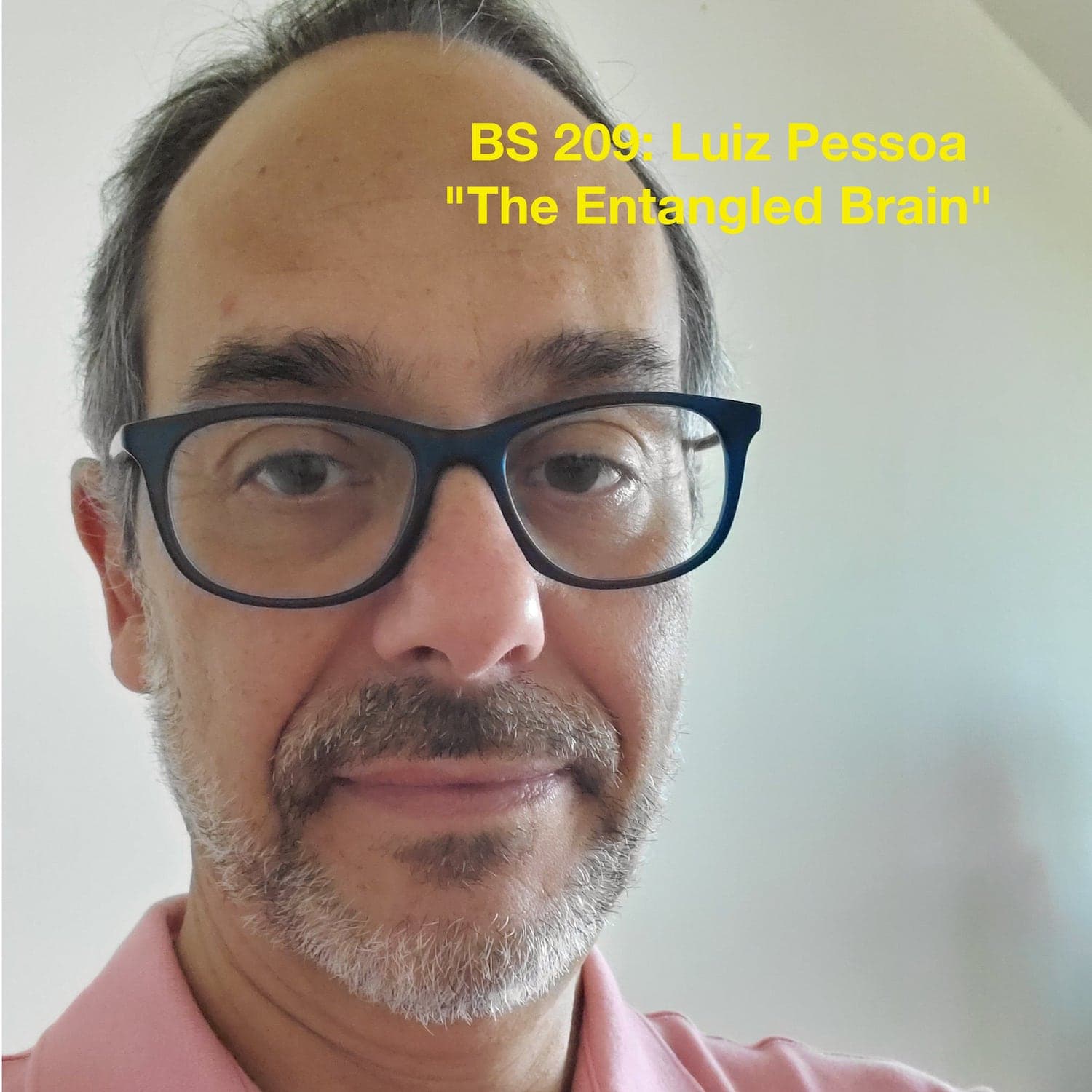
Episode 209: Dr. Luiz Pessoa – "The Entangled Brain"
Date: June 23, 2023
Host: Dr. Ginger Campbell
Guest: Dr. Luiz Pessoa, neuroscientist and author ("The Entangled Brain")
Episode Overview
In this episode, Dr. Ginger Campbell revisits the work of Dr. Luiz Pessoa to discuss his latest book, The Entangled Brain: How Perception, Cognition, and Emotion Are Woven Together. The conversation offers an accessible, up-to-date look at how neuroscience is moving beyond the traditional view of the brain as a modular, reductionist machine, and instead embraces a dynamic, network-based, and entangled perspective. Campbell and Pessoa trace the history of neuroscience thinking, critique outdated notions such as the limbic system, discuss the limits and promise of modern brain imaging, and advocate for a more interdisciplinary, humble, and pluralistic approach to the science of the brain.
Key Discussion Points & Insights
1. Motivation and Purpose of the Book
[02:32] Dr. Luiz Pessoa
-
The Entangled Brain distills complex neuroscientific ideas for a general audience.
-
Moves away from a specialist-only audience to make key concepts accessible.
-
Central thesis: Brain function is highly distributed and entangled across regions; we must move beyond the "modular" view.
"The idea... is that to a large extent, we need to understand the interactions of many parts of the brain working together simultaneously in the generation of behaviors."
— Dr. Pessoa [03:06]
2. Progress in Brain Imaging and Limitations
[04:57] Dr. Luiz Pessoa
- fMRI studies have improved slightly in resolution, but remain limited: signals reflect activity of millions of neurons (macro-level rather than micro).
- Non-invasive techniques let us study humans, but always offer a "broad macro picture."
- Dream scenario: Access to individual neurons in real time in living brains—still science fiction.
3. Challenging Traditional Modular and Hierarchical Models
[07:25] Dr. Pessoa & [09:55] Dr. Campbell
-
Traditional reductionism (“divide and conquer”) breaks the brain into parts, assuming each has a discrete function.
-
Campbell notes that popular science and education reinforce this oversimplification ("where is the wrong question").
-
Hierarchical models echo societal attitudes from the Victorian era that influenced early neuroscience.
"I really think that we really need to move to a more collective way of thinking, collective computation, collective functioning... if we're going to make progress in understanding the really hard problems..."
— Dr. Pessoa [10:59]
4. The Importance of Studying the Brain in Naturalistic Contexts
[12:23] Dr. Pessoa
-
Laboratory experiments with controlled settings give incomplete understanding; real behaviors are context-rich and dynamic.
-
There's a movement (especially among younger neuroscientists) pushing for more naturalistic studies of animals and humans.
"We end up doing that too much... it's a little bit like looking for the keys under the light."
— Dr. Pessoa [12:23]
5. Technology Shapes Understanding
[13:41] Dr. Campbell
- The types of neurons we can record and the methods we use strongly influence the conclusions we draw.
[13:41] Dr. Pessoa
- New techniques that record thousands of neurons simultaneously show that brain activity is much more context and state-dependent than once thought.
6. Embracing Uncertainty: What We Don't Know
[14:39] Dr. Pessoa
-
Open admission: We know much less than public perception implies.
-
Neuroscience is a work in progress—knowledge is always evolving.
-
Wants readers to appreciate the dynamic, tentative nature of science.
"...it's not in any way, by any means a finished product. It's very much a growing body of knowledge that is always morphing..."
— Dr. Pessoa [15:19]
7. The Limits of the Modular View: Case Study of the Amygdala
[17:14] Dr. Pessoa & [21:09] Dr. Campbell
-
The amygdala, often labeled the "fear center," is involved in many functions: reward, decision-making, attention, social interactions.
-
Assigning single functions to brain regions distorts the reality of multifunctionality.
"...it's fascinating... the range of its functions is astounding... we're really distorting things to the extent that we just characterize something that is really multifunctional..."
— Dr. Pessoa [20:03]
-
Historical shifts: The hypothalamus was formerly considered the center of emotion; the "limbic system" concept arose from this tradition.
8. Debunking the "Limbic System"
[22:38] Dr. Pessoa
-
The outdated idea of the "limbic system" as a discrete emotional system persists in education.
-
Most brain regions involved in emotion do many other things; emotions are not localized.
-
Ambiguity of the term (used differently by different people) causes scientific confusion.
"...if everyone is using it slightly differently, we don't know what we mean."
— Dr. Pessoa [24:42]
-
The myth of a neat emotional "box" is unfounded.
9. The Demise of the "Standard Hypothesis"
[26:26] Dr. Campbell & Dr. Pessoa
-
The "standard hypothesis" posited a dedicated emotional circuit, notably involving the amygdala, functioning autonomously from cognition and other factors.
-
Pessoa (with Ralph Adolphs) showed evidence that emotion processing is embedded, dynamic, and context-dependent—overturning the idea of a separate emotion system.
"We need to let go of these separate islands of specialization... and think more... that multiple regions engage in functional circuits such that jointly they're able to solve tasks..."
— Dr. Pessoa [27:20]
10. Rethinking the Cortex: Network Approaches
[33:53] Dr. Pessoa
- The best alternative to modular thinking: Network theory and systems thinking.
- Brain function arises from complex, overlapping networks of interacting regions—much like social or technological networks.
- Testing these models mechanistically is still a challenge, but advancements in multi-site recordings make this increasingly feasible.
11. "Small World" vs "Tiny World" Networks
[36:52] Dr. Pessoa
-
"Small world" architecture: Most connections are local, but a few long-range links efficiently connect disparate areas.
-
New evidence: The brain's wiring is even more densely interconnected than needed for "small world" properties—it’s a "tiny world," offering a high level of integration and context sensitivity.
"...the anatomical highway system... is really dense... signals have much more power... giving a remarkable ability of context dependence and flexibility of computation..."
— Dr. Pessoa [39:26]
12. Overlapping and Dynamic Networks
[40:45] Dr. Campbell & Dr. Pessoa
-
Functional networks form dynamically, not as fixed, isolated circuits.
-
Any brain area can be part of multiple networks, depending on the context, enabling multifunctionality.
"...the way that I think is important to think about the brain is as a functional system... highly dependent on the specific context."
— Dr. Pessoa [42:03]
13. The Need for Complex Systems Theory
[43:25] Dr. Campbell & Dr. Pessoa
-
Networks theories offer intuition, but complex systems theory (from ecology, mathematics, physics) is needed to model causal webs and nonlinear dynamics.
-
Brain (like ecosystems) shows cascades of indirect, often unpredictable effects—beyond simple cause/effect chains.
"...tools that are being developed in complex systems...try to understand these systems that have these really dense causal webs..."
— Dr. Pessoa [44:49]
14. The Debate Over "Emergence"
[48:44] Dr. Campbell & Dr. Pessoa
-
Some scientists resist the term "emergence," viewing it as a placeholder for ignorance.
-
Pessoa distinguishes between legitimate emergent properties (arising predictably from complex interactions) and "filler words."
-
Neuroscience abounds in such terms ("encode," "represent"), often hiding a lack of detailed mechanistic understanding.
"In neuroscience is very rich in filler words because we don't understand the mechanism very precisely..."
— Dr. Pessoa [51:53]
15. Interdisciplinary Contributions to Neuroscience
[52:15] Dr. Campbell & Dr. Pessoa
- Neuroscience welcomes skills from chemistry, physics, engineering, computer science, mathematics, and beyond.
- AI and neural networks increasingly cross with neuroscience, opening opportunities for diverse backgrounds.
- Multi-disciplinary teamwork is essential for progress.
16. The Importance of Pluralism and Humility in Science
[54:42] Dr. Campbell & Dr. Pessoa
-
Scientists often talk past each other, insisting on a single "right" view.
-
Pessoa argues for a more pluralistic, perspectival science, especially in complex fields like neuroscience.
-
Advocates friendly debate and appreciation of complementary viewpoints rather than combative exclusion.
"A view of science from a more multi perspective viewpoint I think is a richer one and is one that I would like to be able to engage more effectively..."
— Dr. Pessoa [55:14]
17. Final Reflections
[59:12] Dr. Campbell & Dr. Pessoa
- Humans, and thus scientists, have a bias for simple, "either/or" thinking—but realities like the brain require nuance and both/and perspectives.
Notable Quotes and Memorable Moments
- On the modular view—"We tend to put all the intelligence in little pieces of the brain... it's probably... a lot more distributed than we have been thinking about..."
— Dr. Pessoa [03:24]
- "We know very little still... I didn't want to over promise and say, look, this is how the brain works. We know all of this."
— Dr. Pessoa [14:46]
- "The amygdala is this obviously fascinating structure... associated with fear... but... it has been shown to be important for economic decision making, for decisions involving social interactions... the range of its functions is astounding."
— Dr. Pessoa [17:14–20:03]
- "If everyone is using [the limbic system] slightly differently, we don't know what we mean."
— Dr. Pessoa [24:42]
- "We have to let go of that way of thinking, of putting things inside of boxes."
— Dr. Pessoa [25:43]
- "Networks of neurons... form dynamically... can overlap... areas can participate in multiple processes depending on the interactions..."
— Dr. Pessoa [42:03]
- "I think we need to encourage a more perspectival type of approach that... I'm coming to appreciate more and more."
— Dr. Pessoa [55:14]
Timestamps of Important Segments
- 02:07 — Conversation begins; overview of The Entangled Brain
- 04:22 — fMRI progress, limitations of current technology
- 07:12 — Divergence from traditional (modular/hierarchical) thinking
- 13:41 — How recording technology changes our understanding
- 14:39 — Admitting the limits of neuroscientific knowledge
- 17:14 — The amygdala as a case against modularity
- 22:38 — The problem with the "limbic system"
- 26:26 — The "standard hypothesis" and its demise
- 33:53 — Network theory as a new organizing principle
- 36:52 — "Small world" vs "tiny world" (dense interconnectivity)
- 40:45 — Dynamic, overlapping functional networks
- 43:25 — Why complex systems theory is needed
- 48:44 — The debate over the term "emergence"
- 52:15 — Advice for interdisciplinary students
- 54:42 — The need for pluralism and humility in neuroscience
- 57:37 — Reflection on "either/or" thinking vs nuance in science
Conclusion
This episode offers an in-depth yet approachable discussion of how neuroscience is moving past the myth of the brain as a patchwork of specialized modules. Dr. Luiz Pessoa and Dr. Ginger Campbell advocate for seeing the brain as a dynamic, context-sensitive network—a truly entangled system where perception, cognition, and emotion cannot be neatly separated. Listeners are encouraged to embrace complexity, value perspectives from multiple disciplines, and retain humility about what science knows and does not know about the brain.
Recommended for anyone curious about neurobiology, the philosophy of science, or the future of interdisciplinary research.