← Brain Science with Ginger Campbell, MD: Neuroscience for Everyone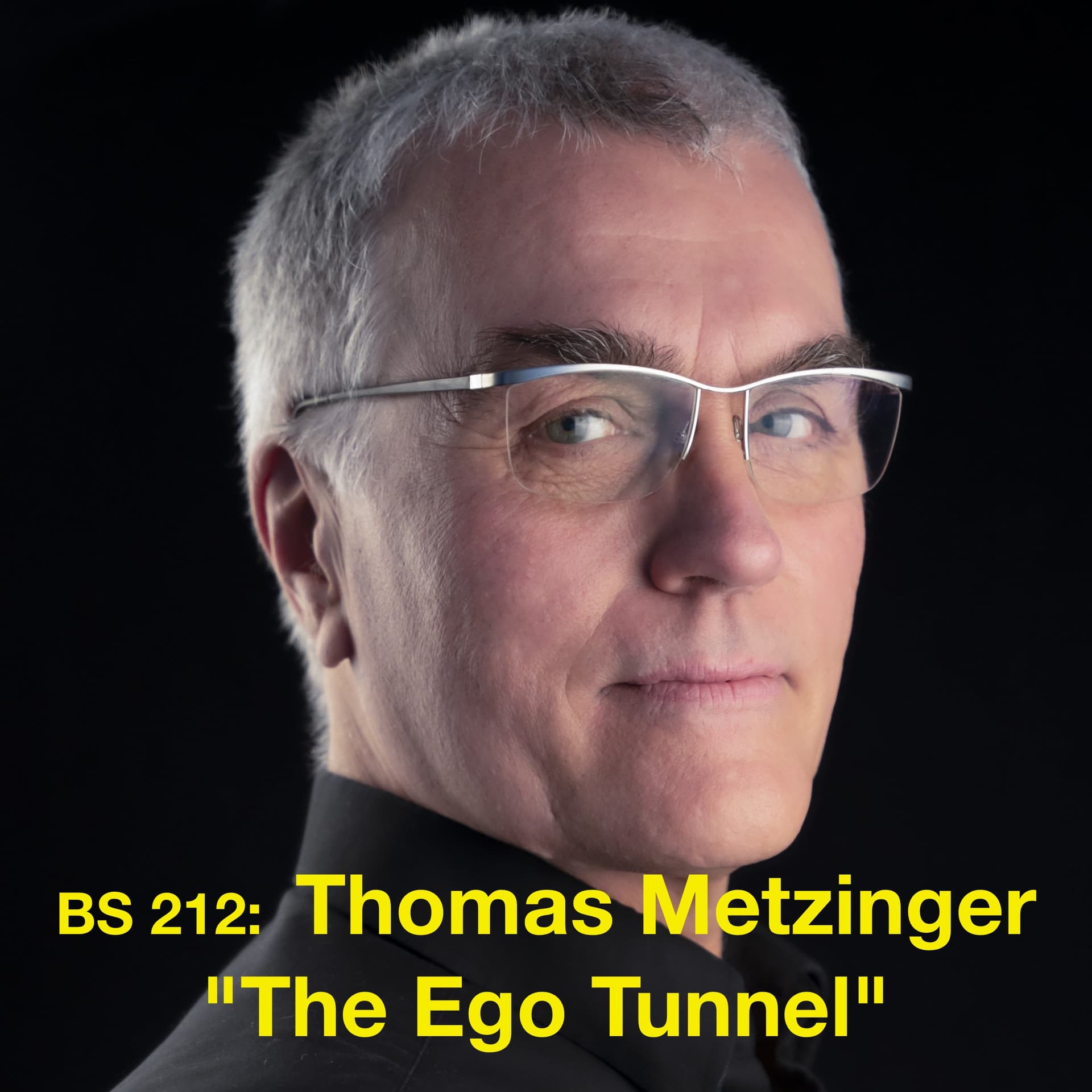
Brain Science with Ginger Campbell, MD: Neuroscience for Everyone
BS 212 Thomas Metzinger on "The Ego Tunnel" (Encore)
01:06:36
Loading summary
Transcript46 lines
- [00:00]
T-Mobile Advertiser
Introducing Family Freedom from T Mobile. We'll pay off four phones up to $3200 and give you four free phones, all on America's largest 5G network. Visit t mobile.com familyfreedom up to $800 per line via virtual prepaid card typically takes 15 days. Free phone via 24 monthly bill credits with finance agreement. Example Apple iPhone 16128 gigs $829.99 Eligible trade in example iPhone 11 Pro for well qualified credits end and balance due if you pay off early or cancel.
- [00:28]
Dr. Thomas Metzinger
Contact Us.
- [00:30]
Dr. Ginger Campbell
Welcome to Brain Science, the podcast that explores how recent discoveries in neuroscience are unraveling the mystery of how our brain makes us human. This is episode 212 and I'm your host, Dr. Ginger Campbell. Before I tell you about today's episode, I want to remind you that you can find complete show notes and episode transcripts@brainsciencepodcast.com and you can send me feedbackrainsciencepodcastmail.com today I am sharing an interview with Thomas Metzinger, author of the Ego Tunnel. This episode was extremely popular when it was originally released back in 2010 and I've been looking for an opportunity to replay it, and I chose this month because it will get you ready for next month's interview with Kevin Mitchell about free will. Before we jump into the interview, I want to remind you that you can get episode show notes automatically every month if you sign up for the free Brain Science newsletter@ either brainsciencepodcast.com or by texting Brain Science, all one word to 55444. That's Brain Science, all one word to 55444. When you sign up, you'll get a free gift entitled 5 things you need to know about your brain. Also, the Brain Science mobile app is now called Brain Science Podcast. This update has fixed the problem of the app crash all mobile devices and is a great way to access both free and premium content. Brain Science relies on the financial support of listeners like you. You can learn more@brainsciencepodcast.com Premium. I'll be back after the interview to review the key ideas and to give you an update on my move to New Zealand.
- [02:21]
My guest today is Dr. Thomas Metzinger, author of the Ego Tunnel. Thomas, I'm very pleased to have you on the Brain Science podcast today.
- [02:29]
Dr. Thomas Metzinger
It's a pleasure.
- [02:30]
Dr. Ginger Campbell
I think you're the first guest that I've had from Germany. I did interview Dr. Robert Schleip from Ulm for my other show books and ideas. Where in Germany are You?
- [02:41]
Dr. Thomas Metzinger
Well, I'm at the University of Mainz, where I teach in the philosophy department, but I'm also a permanent fellow at the Frankfurt Institute for Advanced Study, which is modeled after the Princeton Institute for Advanced Study.
- [02:55]
Dr. Ginger Campbell
I would love to get to go to Germany someday. I have lots of ancestors from there. Before we talk about your book, I was wondering if you would share a little bit of your background and then tell us why you wrote this book.
- [03:08]
Dr. Thomas Metzinger
Well, I studied philosophy in Frankfurt, actually a very simple biography in a city where I also was born. Took my PhD there. I've taught all in all at eight different universities in Germany. I spent a year at UC San Diego and I now hold a chair for theoretical philosophy, that's mostly philosophy of mind and epistemology at the philosophy department in Mainz. And I also coordinate a research group there which deals with cognitive enhancers and neuroethics, a brand new discipline that looks into the applied ethical issues with new technologies coming out of neuroscience. So I've always had a strong focus in an area we call analytical philosophy of mind, something that is also very prominent and very good in the United States. But my contribution has been to try and open this pure philosophy of mind to interdisciplinary cooperation. That is, I am also sort of a cognitive scientist. I have for more than two decades intensely talked to neuroscientists. It has got to the point that I actually designed experiments myself. So I cooperate very strongly with people also researching the mind, but in empirical fields, also in artificial intelligence and so forth. I try to build a bridge between these philosophy of mind issues and ethical issues. That's where I come from. And this popular book. I basically got bored a couple of years ago and thought, you should do something else. And I tried new things. One of them was to create a three volume textbook for students, which two volumes are out. The third one is coming in April. And I wanted to try if I can write a book that is accessible to normal people, to an interested, educated, lay audience, which combines just those issues in the field of consciousness research, of which I think these are the important issues everybody should know about. So it's a combination of ethical and anthropological questions with these general issues like what is a conscious self, what is consciousness in the first place, what is the relationship to the brain, and so forth. I mean, we scientists, professors, tenured professors, we live off taxpayers money. We also have something like an obligation to explain to those people that pay our salary what actually is perhaps critical or dangerous or what is especially interesting about all this new research that's happening in this field. And it's just an attempt to communicate some of these results.
- [05:57]
Dr. Ginger Campbell
In a way, what I'm doing is very similar, although I'm not doing it on the taxpayers money. But I agree that there's a need for scientists to communicate with the public. And that's one of the things I try to do with my podcast, is make an avenue to promote that communication. Some of my listeners will buy your book, some of them will just listen to the podcast, but at least those people will get the main ideas, even if they don't read the book, right?
- [06:22]
Dr. Thomas Metzinger
Hopefully.
- [06:23]
Dr. Ginger Campbell
Thomas, since your book is about the nature of consciousness, I would like to start out by asking you the same question that I've asked many of my guests. And that is what is your definition of consciousness?
- [06:37]
Dr. Thomas Metzinger
Well, that is a big question and it has many answers. In philosophy of mind, there are three major problems. One is the mind body problem. What is the relationship, the causal relationship perhaps of the mind to the brain? Then something we call intentionality. That is the question, how do brain states, mental states manage to refer to something? How can they get this mysterious property of aboutness, of being about something else? What does it mean that our mental states have a meaning? And then the hottest topic in the last 15 years is the problem of consciousness. Why does this feel like anything at all? From an inward perspective, how does all this subjective quality in our conscious lives come about? And is that a natural phenomenon? Is this pure subjective inner way what it is like to go through conscious experiences? Is that something that is open to scientific research or is it not? And I've always been a big fan of this problem of consciousness. It got to the point that I actually founded the first scientific society, the association for the Scientific Study of consciousness in California 13 years ago with a number of friends. And this society is now flowering. I even presently have the burden to be the president of this society for a year. So what we have now is a historically new situation. About 15 years ago, the problem of consciousness was slowly rising, got more and more attention in science. The first people had the idea, now we can tackle this in a rigorous and systematic, no nonsense way. But still many of the prominent neuroscientists thought this is something they don't want to be associated with. I learned new words from my American friends. One word was flaky. I didn't know what that was. Another word I learned was a clm, a career limiting move. Now it is just the opposite. Every neuroscientist who wants to participate in the debate, they all need something on consciousness in Their research profile, it's all the rage. It was about in the mid-90s when the first prominent neuroscientists, people like Boyf Singer or Christoph Koch, Francis Crick at UC San Diego, accepted this as a target for research that was now ripe for attack. And of course, this was greeted and observed with great interest in the philosophical community. Because it's actually our problem. And we've been thinking about it for centuries. And now we have this very interesting new situation that there is this mixed research community. Cognitive scientists, neuroscientists trying to tackle the problem, and philosophers trying to make a contribution by laying conceptual foundations and so forth. So the answer to your question is it is not one problem. It's a whole bundle of problems. One is, for instance, what philosophers call the unity of consciousness, the problem of global integration. If you wake up in the morning and you become conscious, then one single world appears to you. Why is it one? If the unity of consciousness, experience gets lost, you usually have a serious psychiatric illness. It's an achievement in its own right that we live in one world when we're conscious in one unified situation. This problem is so simple that most people overlook it. Another example is what is a lived moment, this experiential fact that you are now present. There's not only this multimodal scene, the room you're in, the sounds you're listening to, but there is a representation not only of space and objects, but of time. You are located in a temporal order. There is a past and there is a future, but consciousness is always now, the nowness of it all. That's another problem that needs to be solved. I'm of course, as a philosopher, I'm a fan of the biggest of them all. I think the most difficult problem is why is this subjective? What does that mean? It means that as a target phenomenon for scientific research, consciousness is unique because it is always tied to an individual first person perspective. It is you who are experiencing all this. It is tied to a subjective point of view. Chemical states, physical states, neurobiological states, neurocomputational states. In your brain, they don't have that property. They can be described from the outside, as philosophers say. From the third person perspective. We can do objective science about them, about neurocomputational properties of the conscious brain and so forth. That's not a principled problem. But then there's this mystery that there are always someone's experiences. And in the moment you say that, you flip from the third person perspective into the first person perspective. We want to know what my experience actually is. And that is something we haven't properly understood. You know, science always deals with publicly observable objects. But my very own sensation of green, or my very own feeling of happiness and relaxation is not a public object. It is, in a sense, which we haven't fully understood, subjective. That's the problem I'm interested in.
- [12:34]
Dr. Ginger Campbell
I guess that I was really wanting to start with the working definition that you gave in your book. Why in the book did you pick the phrase consciousness is the appearance of a world as your working definition? I'm going to assume it's a working definition, since that's the way you defined it in the book.
- [12:52]
Dr. Thomas Metzinger
Well, for a popular, accessible book, I needed a simple working definition. And the appearance of a world is just that. It happens when you wake up in the morning. A world appears to you. It happens when from a phase of dreamless deep sleep, you enter a REM phase and you start dreaming. A dream world appears to you. If you have fainted and you wake up again, or if you wake up from anesthesia, the world appears again. If you're not conscious, you do not know that there has ever been a world, that there is anything like a world, or even yourself. This term appearance, especially important. It's not only that being conscious means to live in a world, to live in a unified situation. The core of the problem is what philosophers call phenomenal consciousness. And the word phenomenal exactly means that how it appears to you from a subjective point of view. So the problem of consciousness is imagine you see a red apple lying in front of you. It appears to you as if there is a red apple on the table in front of you. Now take exactly the same subjective feeling, but you're hallucinating. There is no apple on the table. What we need to understand in consciousness is what a veridical perception and what a hallucination have in common. That common element, the redness, the roundness. How the apple appears to you, how the world appears to you. That is the actual question. Not if the world is out there or if you have proper knowledge of your environment. The core of the problem is the appearance as such.
- [14:43]
Dr. Ginger Campbell
So even if you're hallucinating, that's still a form of consciousness. So that's what you're really interested in, is how that's happening, not what's out there.
- [14:51]
Dr. Thomas Metzinger
Right? Right. So of course our mental states give us knowledge. If our perception is a correct perception of the outside, then we are somehow in contact with the world. But we can have exactly the same Conscious feel the same appearance, even if we're dreaming or if we're hallucinating. The problem of consciousness is about disappearing the feeliness, the qualitative content of it, not if it's veridical.
- [15:23]
Dr. Ginger Campbell
Thomas, what sets the ego tunnel apart.
- [15:25]
From other attempts to explain consciousness besides the fact that it's aimed at a general audience?
- [15:32]
Dr. Thomas Metzinger
Well, the first thing I have done is I have put a focus on the self. And I've argued that there is no such thing as a self. And I try to show this by some philosophical considerations and by some experiments I have actually conducted with friends from the neurosciences myself. But then in the end of the book, I try also to do something else. I try to widen the horizon and look at the cultural and social consequences all of this may have in the next 20 to 50 years. I try to build a bridge into the ethical issues that are connected to this now booming field of consciousness research. So actually I try to do a number of things at the same time.
- [16:18]
Dr. Ginger Campbell
I also noticed that you put some emphasis on the fact that consciousness is a biological process. Also you talked about, again, as you just mentioned, the subjectivity. So it seems like sometimes people try to separate those two issues and act like subjectivity can't be biological. But what else can it be?
- [16:39]
Dr. Thomas Metzinger
Well, what else can it be is of course no good argument. Maybe we would just have a lack of imagination today. The general trend, of course, is everybody thinks consciousness maybe cannot be reductively explained, but it is strongly determined from below. Many philosophers, even if they vary in their opinions, would subscribe to is the idea that if all the facts about your brain are fixed at a given instant, then your conscious experience is fixed as well. So there's a strong upward determination. There's a strong dependence of the conscious mind on its biological, functional, physical underpinnings. But then again, the big problem is what is the functional role? What was consciousness good for? If you want to have a fully scientific, naturalized story about consciousness and we don't have it at this point in time, our future is open. The question would be, why should this have evolved in evolution? Why should animals have something like conscious color vision? Couldn't they have acted like machines that analyze wavelength spectra? Why should it feel like anything at all? What was the purpose of it? And you just asked about subjectivity, Ginger. And the question would be, what use could it have had for a biological organism to develop a conscious first person perspective? What would the causal difference be of a system that has that and a system that doesn't have that? And that's of course a difficult question. I think it has to do with the history of the conscious self. It was good to have a model of yourself as a whole. So in the very beginning, in early animals, it was good if you had a model of your body as a whole. Not many animals probably have that. So you could imagine animals that work like insects, just like robots, that have no coherent model of the world as a whole, and that have no coherent model of the own body. And then you could imagine a more advanced class of biosystems that actually have an as yet unconscious, but an inner image of how tall am I? How fast can I run? What will happen if I fall down from that branch? What will happen if I bounce into that wall? Should I pick a fight with this guy? Or rather not. Can I impress this female? Or rather not. So of course it was useful to have knowledge about your own body, and it was useful to have knowledge about global properties of your own body, like the overall shape. If you wanted to control this in jumping, fighting, running, then you needed an inner image of your body as a whole. Okay, we can still imagine that. But then the question is, why should it have been conscious? What is the difference between an unconscious representation of the body and one that really subjectively appears? One difference seems to be everything that is conscious is something that you can attend to. You cannot direct your attention to unconscious things. It's just impossible. So animals that would have had a conscious body image could for the first time have directed their attention, say to a wound they had or an itch or something like that. Also, conscious information is all that information we can form concepts about. We can start to think about our bodies, properties of ourselves. You cannot form concepts about things that do not appear to you, that are just not available on this level, where all your faculties can access this information, say about your body or your memory at once. And another very important thing is what scientists call selective motor control. You can very clearly show that being conscious makes you more context sensitive, but it also allows you to control your own movement, your behavior in a much more flexible and fine grained way. You can react to errors or to challenges of the situation in a better way. Say, take a sleepwalker, a sleepwalker, a human being that is unconscious, very likely has an unconscious body schema, a body model and walks around. Many people think they are safe. As long as you don't wake them up, nothing happens to them. If they are up on the roof, a sleepwalker, the worst thing you can do is shout at them and wake them up. It's actually not true. Sleepwalkers hurt themselves. Sleepwalkers do run into furniture and into walls. Sleepwalkers do fall downstairs. They are not completely safe like a little child. Why? Because they are not very context sensitive. They are more like a simple robot. They walk ahead. Turning a corner is already quite difficult for a sleepwalker. Reacting to obstacles and stuff like that doesn't work as well. And if you compare a walking sleepwalker or an unconscious human patient during an epileptic absence seizure to a conscious human being, then you see exactly what the difference is which consciousness makes. It's a certain fluidity, a flexibility, a context sensitivity. That could have been one of the advantages in evolution to develop a conscious image of yourself.
- [22:19]
Dr. Ginger Campbell
That's an excellent example. I really appreciate that. Would you like to talk a little bit about the idea of the ego tunnel? Is that meant to be really a metaphor or do you consider that to be a theory?
- [22:33]
Dr. Thomas Metzinger
I do, of course, have a big theory about consciousness and the self in the background. For instance, in English, it's in an MIT Press book called Being no one. But for this accessible, easy to read book, I needed something like a metaphor that captures the spirit of the general idea. So I used this idea of the ego tunnel. So I think conscious experience, as opposed to what we think is an exclusively internal affair. I already said the subjective appearance is just exactly what is common between an apple which you hallucinate, and an apple that looks the same, but is really there. A veridical perception now that shows that the colors, the sounds, the smells, all these qualities, they are just determined internally by something scientists call the neural correlate of consciousness. That is the physical counterpiece. The idea is, to everything you experience right now, the whole room, your memories, your mood, there is a counterpiece in your brain. And there's also a minimally sufficient counterpiece, a very small set of neurofunctional properties of which it is true. If you have that, then you will have exactly that experience. And the idea is also for elements in conscious experience, like the specific redness of the apple or the weight sensation in your body right now, everything will have a neural correlate. So metaphysically speaking, consciousness is an internal affair. It is what you see and feel is like the inner surface of a space that is opened by your brain. This does not mean that I'm saying there is no outside world. There is an outside world. But as your physics teacher, for instance, already told you in high school, there are no colored objects out there. There are just wavelength mixtures. The green and the Red and all the colors you experience, they are properties of the models, the internal models your brain creates of reality. I mean, it gets even worse. If you ask physicists and philosophers of physics, they will tell you there aren't even objects on any level of reality. If you start thinking about this, then you realize you are actually moving through a model of reality. And conscious experience is, so to speak, Mother Nature's own virtual reality. Much better than anything we create right now with large computers and VR technology. It was developed millions of years ago. It is a simulated internal space. Now the big trick about it, I mean the really fantastic invention, is that we don't have the feeling to move inside and purely internal space. We all have the feeling that we are not in our brains like in a lucid dream, walking through ourselves, as it were. We have the feeling of being present in the real world. And that is actually a major achievement. You could describe it as a specific illusion, but it is a major neurocomputational achievement of the human brain. The sense of presence as a self in a conscious scene. I call this a tunnel. Just to draw attention to the fact that the consciousness of it all, the appearance itself, is an exclusively internal affair. You don't need eyes to have the experience of being sighted. We all know that in dreams we can have the experience of seeing. In principle, you could create all this experience for an old philosopher's story. A brain in a vet that was appropriately stimulated from the outside. All of this doesn't mean that there is no knowledge about the outside world. Of course we have knowledge and of course there is causal contact to the outside world. But just this one aspect of it, the subjective feeling, is actually an internal affair. Now if you look at consciousness as a whole, and you describe it as a tunnel, a dynamic high dimensional tunnel, and all the sensory qualities are actually something like paint on the inner surface. Just that that surface is not like a normal tunnel, which you have known before, but it's a high dimensional tunnel. It has a sound surface and it has a gut feeling surface, and it has even an emotional surface. It has smells and tast. This is also to speak the very, very thin inner surface of this dynamic process that is going on in your brain while you're conscious. But the most striking characteristic in this ego tunnel, that's why I coined this metaphor of an ego tunnel, is that there's almost, not always, but almost always somebody there who lives through the experience. Somebody who has these gut feelings, somebody who sees these colors. That I guess is the second great invention of Mother Nature. It didn't only create these internal models of reality which organisms could use to successfully navigate the world, but it also created something like a user illusion. One way to look at consciousness is as our nervous system got so complex, much too complex to control. The brain got too complex to control itself. So what it needed was something like your Windows desktop. It needed a user surface, a simplified model of what is going on there and what can be done. What can be controlled. Now, the ego, your conscious self, is the mouse pointer on that desktop. It is the one part of the overall model that tells the animal, you are here and now, you are this and you are in control. That is how the sense of self emerged. And that's, of course, another fantastic invention to portray not only reality as consisting of objects and colors, but as something that is seen by a self. I tried to capture this idea by the metaphor of an ego tunnel.
- [29:19]
Dr. Ginger Campbell
Thomas, what do you mean in your.
- [29:21]
Book when you say a biological organism is not a self?
- [29:26]
Dr. Thomas Metzinger
All I'm saying, and many people have said that before, is that what we refer to as a self or the self is certainly not a thing. It's not a thing in the head, and it's also not a thing outside the physical world. In some metaphysical dimension. There is no such thing as what philosophers call a substance. That is, something that could hold itself in existence just by its own power, something that could stay in existence, even, say, if the physical organism vanished. Many philosophers have said that. Derek Parfitt has said that. David Hume has said that. Buddhists have had that point 2,500 years ago, but we are now approaching a deeper and more detailed understanding. Of course we have a conscious self. I don't deny that we have the conscious experience of being someone, but the idea is that we can explain and predict everything we want to explain and predict about human beings without using the concept of a self. Just as scientific psychology has long stopped using the notion of a psyche and a soul as a theoretical entity, it's just not needed. You can predict everything you want to predict about human beings with simpler theories, with simpler concepts. In the same way, we don't need the assumption of a substantial self anymore. We can explain the emergence of self consciousness, but also intelligent behavior, cognition, all these things, without assuming that there is a thing, a self. The self, in a first approximation, we can say what we have called the self, or our self in the past is not a thing, but it's a process. And it's a process that's not always there. Sometimes the process is switched on, for instance, when you wake up in the morning, then the system which you are in my way of speaking, so to speak, boots its phenomenal self model. That is, it activates a conscious image of itself as a whole. You suddenly realize, ah, there's a body as a whole and I can control it. I can get up. There is global control over this entity. I'm aware now. And that is the earliest emergence of the sense of selfhood, this availability for global control. If an animal discovers that about itself, that it can exert global control over its body. That sense of control is one very important building block for the conscious sense of self. That was of course, helpful. But it doesn't mean that there is a thing. There's a certain functional property that comes about in the nervous system. There's a certain image, a representation of yourself as a whole. And that in the case of human beings, that's certainly not only the body, it's also social relationships. You know, there are not only neural correlates of consciousness, there are of course social correlates as well. It has to do with the past. There is an autobiographical self model in most of us, an image of our history, of our past, our childhood, our experiences. Then there is something that's, so to speak, cast ahead into the future. We have plans, desires, needs, goals. They are part of this self model as well. As this gets richer and complex, you get the human variety of an ego, but the whole thing is just an intermittent process in dreamless deep sleep. There is no such thing as a consciously experienced self. And in the dream state, the conscious self is very different from the self in the waking state. So I think we can explain and understand everything we want to understand about ourselves with much simpler conceptual tools. For instance, the notion of a representation in the nervous system.
- [33:44]
Dr. Ginger Campbell
So basically saying that there's no such thing as a self is basically saying there's no thing separate from what our brain and body creates through its processes. No non physical self.
- [33:56]
Dr. Thomas Metzinger
That's true. I mean, one has to make a very clear distinction here. The existence of a non physical substantial self always remains logically possible. And it also remains logically possible that we have two selves. And it also remains logically possible that we have two non physical selves and a doo doo and a Dada. The question is, what is the minimal set of assumptions we need to make? That's the rational approach, the scientific approach, to understand what we want to understand. All I'm saying is we don't need the assumption of a non physical self for that. It Always remains a logical possibility, of course.
- [34:41]
Dr. Ginger Campbell
Well, that makes sense to me. I think I was a little bit confused about what you were getting at when I was reading the book. So I thought maybe some other people might be too. You yourself have a lot of interest in experiences that neuroscientists as a whole have tended to want to ignore. Things like out of body experiences and dreaming. I got the impression from your book that you feel any good theory of consciousness really has to take into account these kinds of phenomena, right?
- [35:09]
Yes.
- [35:09]
Dr. Thomas Metzinger
I think if we want to do research about consciousness, we have to take the target phenomenon serious. And human consciousness is a very rich phenomenon. It has many special cases. We have spiritual experiences, deep mystical experiences. We have spectra of serious psychiatric disorders where people, for instance, will claim that they don't even exist themselves. Where living people will claim that they are dead in the so called Kota syndrome. That is something that is very interesting for philosophers because we have for instance, Descartes, who claimed in the seventh century that he knew with certainty about his own existence. And if then there are conscious human beings who claim with certainty to know that they do not exist. That's of course interesting. Anybody who has a serious interest in the human mind will take all sources of information. So many of these naturally occurring altered states of consciousness, but also many psychiatric syndromes are important for philosophy of mind because we can learn something from them. We can learn what is necessary and what is perhaps only sufficient. If we know A and B usually occur together, and then we can show there are cases where B occurs without A and A occurs without B, then we know something. We know something about the architecture of the human mind. That is why I have for many years used what I call neuro phenomenological case studies. I've looked at simple cases where after a certain brain lesion, or in a psychiatric condition, or under the influence of some psychoactive substance, specific contents of consciousness are missing, amplified and so on. We can learn about the human mind if we take these phenomena serious and if we interpret them and analyze them in a sober way. Here we come to the CLM point again to the career limiting move. Of course, most people that have an interest in altered states have an interest because they're pushing some metaphysical agenda or they have some ideology they want to defend, or they think these states prove something they have always wanted to believe in. That's not what I'm interested in. I'm interested in what can be separated. And in this context I've also thought that out of body experiences about which we have Reports from all cultures over the centuries would be very interesting if we want to understand the process by which we experience ourselves as an embodied self, not only as a subject, but as something that is deeply tied also into physical interactions with the physical world around it. We don't experience ourselves as pure egos. We are human beings with emotions. And we fill a certain volume in space. So there is this bodily sense of selfhood. I occupy a volume in space. But then there is another aspect of selfhood. I am like a little point behind my forehead. I am like between my eyes, the origin of the visual perspective. I have this feeling as if I was a little man sitting behind the windows of the eyes and peeping out into the world. We know that's an illusion. We know we find no little man there. But these are, for instance, two aspects of selfhood. The felt self location and the position from which you see. Normally, that's almost always integrated. But just in 2007, some Dutch neuroscientists, with direct stimulation of electrodes in the brain, have shown that you can actually move the sense of self about 50cm to the back and to the left out of the physical body, while the visual perspective remains constant. That is, you create a conscious experience where the patient looks out of his eyes, but has the feeling he is located outside of his physical body. For philosophers, such experiments are conceptually very interesting. Because then we know two the feeling, the bodily self and the seeing self, which are normally all in one, as it were, can be separated. There must be two different functional processes. That's why soul travel and all these reports about out of body experiences are also very interesting. If you could understand how it is possible that somebody sees their own body from above in an operation theater, after a serious accident, during a marathon run, or at night from a perceptually impossible position. You see your body from the outside, but still have the feeling you, the self, the locus of thinking and attending is up there, hovering above. If we could understand this mechanism, we would learn something about the different layers of the conscious self. I have had some of these experiences spontaneously as a young man a quarter century ago. So I had an interest in it. But I saw that almost all of the literature was terrible crap. There were some three very solid psychological studies by John Palmer in America, Susan Blackmore in England, and Harvey Irvin in Australia. And all the rest was just New Age nonsense, just people who wanted a proof for the afterlife.
- [41:10]
Dr. Ginger Campbell
That was before Olaf Blanc came along.
- [41:13]
Dr. Thomas Metzinger
That's right. So I had written about out of body experiences, ruining my reputation in this MIT book, for instance, being no. 1. Why? I thought they were important on theoretical grounds. To understand what a first person perspective is, you have to understand what the simplest form of selfhood is. And then Olaf, for the first time, he made a big splash in 2006, caused something very much like an obeid in a young patient in Geneva in the hospital preparing for surgery. You have to test some things out with an electrode in the awake patient. Then, for the first time, a number of us had the feeling. Now we have a grip on the phenomenon. Now we know it can be caused by an electrode in the brain with a very local stimulation. And then we set up a research program together. So I'm in there as a philosopher and they have a fantastic lab and there are other groups in Sweden and England who are doing all this. I said, listen, there is this famous rubber hand illusion which all your listeners can try immediately at home. If they have a rubber glove or a rubber hand, they can put on a table and put the corresponding hand under the table. And can you explain this to people on the show how to make that experiment so that I don't explain it?
- [42:38]
Dr. Ginger Campbell
Sure. You have a great explanation of this in your book.
- [42:41]
I think around page four.
- [42:43]
Basically the idea is that your real hand is hidden and all you can see is the rubber hand. The rubber hand and the real hand are stroked by a brush or Q tip simultaneously. Within a few strokes, you begin to have the illusion that you can feel the rubber hand being stroked instead of your real hand.
- [43:06]
Dr. Thomas Metzinger
I just take it from this. In 1998, the famous rubber hand illusion was discovered. Here you have a typical example of a philosopher talking to neuroscientists. I went to my friends and said, listen, we need a whole body analog of this. We need a whole body misidentification, just like the rubberhead illusion. And as usual, it's the tragedy of my life. My friends in the neurosciences say, ah, that's a good idea, Thomas, but it's technically not feasible. Sorry, we can't do that experiment because you never see yourself from the outside. Then I mumbled something complicated, philosophical and said, you just go one meta representational level above must be possible. You have something like a simulated body. And then they said, wait a minute, we have a very good virtual reality lab at our university. So what we did is you get goggles on, you are in a virtual reality, you see a simulated room and a camera films you from behind. Then something called a 3D encoder takes that camera image and inserts it into the virtual reality you see through your goggles. So you have an experience you've never had before. You see yourself standing three yards in front of you. Then the PhD student comes, just like in the rubber hand illusion, and strokes your back, synchronously your whole back. And you see, because you're standing behind yourself, how this avatar, this virtual other self in the simulated reality is being stroked in real time. What happens, what we discovered for many people is that they suddenly, they get a strong sense of awkwardness. Then you get a sense of drift. You get the feeling of being pulled towards that avatar. And some people actually, so to speak, jump into that computer generated model of your own body. That is, they suddenly go wah. And identify themselves with that virtual body they see in front of themselves, their own body. Now, it's important philosophers are the conceptual police to understand that this is not an out of body experience. Because during that experience you don't see through the eyes of an avatar. You keep seeing, so to speak, as if you were seeing out of your goggles. Of course, it's more complicated.
- [45:25]
Dr. Ginger Campbell
Would this be more like what happens when you learn to use a tool and you begin to feel the tool's extension of your body? Would it be closer to that?
- [45:34]
Dr. Thomas Metzinger
Well, that's an interesting point you're bringing up. We know a number of things. We know the rubber hand illusion. We know that every healthy person, everybody of your listeners can try this out. If you take a cane, a stick, and you blindfold your eyes and you just try to walk with the stick like a blind person, after less than 30 minutes, you get tactile sensations in the tip of the stick you're using. And experiments in monkeys have shown that when they use a rake to reach for a food pellet, a raisin or something that is out of reach for them. To simplify things, the representation of the rake, of the instrument is embedded into the representation of their body in the brain. That is, we have the self model. And when we use a tool, we can do this because we embed it into a control hierarchy, so to speak. We fuse those two images in our brains. That's, by the way, it's a very important point about the evolution of tool use. You needed, at least I claim, a specific kind of self model to be able to use tools. That is why we humans are so much better than chimpanzees. It's not the genome, it's the self model that makes the difference from the ape to the human being. In any case, in that line, the point you just brought Up. You could say the avatar we are offering to our subjects in cyberspace is something like an opportunity for something to identify yourself with, but it's not a tool, although we're doing experiments like that as well that you actively use. In the original experiments, you were just passive. A passive observer watching his own back being stroked. And that's of course, a value of these experiments because it's a very simple, as neuroscientists say, bottom up process. It's a multi sensory integration process that leads to this sudden experience, oh, I am this, this experience of identification, so to speak, this bodily gut level identification of I'm not here, I'm there, I'm in the avatar in cyberspace. But an out of body experience would be something different. An out of body experience would mean that you could see out of the eyes of the avatar and it would mean that you could also control this second body model. So what we have created, technically speaking, is just a full body illusion. It's a new kind of illusion where you identify with another body. So now, of course, the world press was hunting us for 48 hours after this was published. We all had to fly to a press conference in London. And then all those journalists overstated the case and everybody thought, ah, these guys have got it. We're going to enter cyberspace. We're going like through the screen into an avatar. We're finally going to have good video games. This is all a lot of nonsense. You know, this is an exaggeration. Why? What you can of course do is a setup where with the motion of your own body, you control a virtual body. So you would wear something like a diving suit and you have these little light sensors everywhere and you have 18 infrared cameras filming you. It all goes into the computer. And then you can walk around and you can move one or 16 or 256 body images in a virtual world. That's not the problem. The problem is that you cannot jump into any of these bodies because I'm putting it simply now, your own gut feelings, your own movement sensations, they hold, so to speak, they hold the soul back. They anchor it in the physical body. You understand the point? In a totally passive condition, you can briefly create this effect of jumping over and identifying with something else. As soon as you start to physically move, you're locked in the physical body again. Now, if we think back to these naturally occurring out of body experiences that yogis have or some epileptics have during a seizure or people after an accident, in these situations, the body is typically paralyzed like in sleep paralysis or under anesthesia and the brain is cut off from somatosensory input. You are just body blind in that situation. If your body model is activated, it's not constrained by all these terrible, often painful inputs from the physical body. That is why you can control it freely. You can control it in a lucid dream or in a willful out of body experience. You have volitional control over that conscious self model because this high bandwidth input from the physical body doesn't constrain it. There are even sound neurologists who have very interesting speculative hypotheses. They say that it could be something good about an out of body experience. That is, people say in combat or mountaineering who've had that in an emergency situation, always report an exquisite mental clarity in the out of body state. So the idea is you could have something like a division of labor in the brain. You push away all these terrible stress signals, the pain signals from your body into one unconscious corner and you collect all these higher faculties, conscious thoughts, memory, attention, in some confabulated self model that is pain free and is constructed as if it was hovering above. So maybe that's even some kind of a healthy emergency reaction in some cases. When you have an out of body experience.
- [51:27]
Dr. Ginger Campbell
It sounds like your experiments indicate that our sense of. You were talking about your sense of yourself as your body. That it's related to both our sensory inputs and our movement, our motor inputs. Because both of those are usually missing when you have an out of body experience.
- [51:44]
Dr. Thomas Metzinger
That is absolutely correct, Ginger. One thing many people overlook is we don't only have colors and sounds and everything from the outside. But there is one perceptual object from which the human brain can never run away, whatever it tries to do. You can look the other way and not see this red apple on the table, but your body is a very special perceptual object. It always bombards the brain with a lot of information from the muscles, from the tendons, from your gut's blood pressure, body temperature, weight, sensation. A very important aspect is also in out of body experiences. The vestibular organ, you know, the sense of balance, all these things feed automatically into your body model and they hold it firmly, tie it to that input source. The body model is also philosophically interesting because it's the only image in our mind of which you know, the object of reference is always there. You may have a distorted representation of your body, but that thing is certainly not a hallucination. It is as if it had intrinsic meaning. As philosophers sometimes Say it has a guaranteed reference. Your body is always there. Now, if one looks at scientific research about the human self model, one sees that loops, sensory motor loops play a very important role. For instance, if we reach for an apple, we need something scientists and philosophers call a body emulator. If you were to wait until you see the visual input, you see your hand moving towards the apple on the table. If you were to wait, that would be much too late. You have to have an internal model that gives you a simulated feedback of how would my arm feel, what tactile sensations would I get if I move like that. So in having fast, efficient and flexible body movements, it turns out we need something like an efference copy, a body emulation, something that tells the brain ahead of time if this is the correct movement and what kind of feedback to expect. So this also gives us the capacity to correct a hand movement online. If we see we don't move absolutely right and we have to correct this line of reaching. We do this unconsciously through a body model we already have. We don't wait for the conscious visual input. Many things show us that waiting for conscious experience in many situations wouldn't be such a good idea. For instance, hundred yard sprinters, if they wait for the conscious experience of the shot in the starter's pistols, the other guys would already be one and a half yards out. You react to an unconscious sensation that can be shown. Expert tennis players cannot play by conscious vision. These balls are just much too fast. So there is something like a much larger unconscious body model in us, and it guides us in a lot of our unconscious behavior. A good goalkeeper is exactly somebody who has trained certain moves so many, ten, thousands of times that he doesn't have to rely on conscious experience anymore. That's what makes a good athlete, you know, that he has trained his unconscious body model. And all this plays into the very special role of the body as a perceptual object. Now, there are some situations where we are body blind. We have no body information. For instance, if we wake up from anesthesia after surgery. I have tried this. For me, it hasn't worked. But in the scientific literature you find many people have out of body experiences in the wake up phase after anesthesia. They have experiences of floating of a second body. Some have experiences of looking down, somebody lying on the street after an accident. You have exactly the same situation. You are cut off from this perceptual object, the body. The brain is trying to figure out what is going on and it confabulates a second body which has exactly the same shape often, but for instance, it has no weight sensations because there are no weight sensations. So the very natural conclusion is, wow, I'm light. Just think of flying dreams, right? Yeah, I must be able to fly. And so on and so forth.
- [56:25]
Dr. Ginger Campbell
We are just about out of time. You've got so many great ideas in your book that we haven't even got to. You could probably have a whole conversation on the ethical aspects in the last part of your book. Is there anything that you really want to tell my listeners that we haven't had a chance to talk about?
- [56:43]
Dr. Thomas Metzinger
So one thing I think we have to take care of is that we're living in a historical epoch. There is something happening that many people like to repress. I call this the naturalistic turn in the image of man. That is, our image of ourselves is changing through all of this research, if we want it or not. And this image, this new image of man, is a departure from many traditional images of man. It looks like everything, even our mental psychological properties, are the result of an entirely natural, bottom up process of dynamical self organization. Over millennia. We must come to terms, for instance, with the insight that not only our genes and our bodies are results of a process that knew no foresight. Evolution was driven by chance events. Evolution is a process that has no direction and no goal. But now, through evolutionary psychology and neuroscience, we learn that even our mental properties are results of a process that had no direction, that pursued no goal. And if you think about this more deeply, it's hard to come to terms with. So one question is, we are going to gain a lot through all this new knowledge. For instance, there will be advances in psychiatric medicine. We will be able to heal mental illnesses better in 20 to 50 years. There's a lot of good things coming to us, but there's also a price to be paid. And the question is, what will be the psychosocial costs? How will the general population react to this new understanding of ourselves as entirely natural? Very likely, mortal beings. Will there be an escape back into fundamentalism? Or will there be something like vulgar materialism flowering in society, A primitive form of hedonism? We all have to think what we want to do with all this knowledge together and the new potentials for action. Because something that is coming out of neuroscience, and that's the last thing I actually want to draw your listeners attention to, is neurotechnology. We will gradually, but better and better, we will be able to influence not only the brain, but consciousness itself. Neurotechnology will slowly blend into consciousness technology and we will be able to control states of subjective experience in ever fine grained and reliable manners in the future. And there is no way around old fashioned philosophical questions. We have to ask not only what is a good action, but we have to ask what is a good state of consciousness? What states of consciousness do we want to show our children? What states of consciousness should be illegal in our societies, if any? What states of consciousness can we force upon animals, for instance in research? What states of consciousness is it that we want to foster and cultivate in our societies? And perhaps what is the state of consciousness I want to eventually die in? So there are not only scientific questions, there are also normative questions and they are not just what is a good action in applying new technology to the brain. In the end it is also the question what is a good life given all this new knowledge about ourselves and all these new potentials for action?
- [60:26]
Dr. Ginger Campbell
I'm going to share a few brief announcements before I review the key ideas from today's interview. First, please visit brainsciencepodcast.com for complete show notes and episode transcripts. And don't forget to email me feedbackrainsciencepodcastmail.com youm can also get the show notes automatically every month. If you sign up for the free Brain Science newsletter, just text Brain Science, all one word to 55444 that' Brain Science, all one word to 55444. You'll get a free gift five things you need to know about your brain and please do send me feedback. I try to answer all emails even though I may not be able to reply right away. The Brain Science Podcast app is now called Brain Science Podcast. This app is available for all mobile devices and it is a great way to access both free and premium content. Finally, I'm happy to announce that I arrived in Auckland, New Zealand on August 10, 2023 and I'm now working at the Totara Hospice in South Auckland. Over the years I've talked a lot about the value of learning new things for promoting and maintaining our brain plasticity. But I have to admit that moving to a new country has been challenging. At first I was overwhelmed by driving on the left. I still feel like a teenager who just got their license because nothing is automatic. But the people here are wonderful and things are gradually getting easier. Eventually, I hope to have some meetups with listeners in both Australia and New Zealand, so please email me if you live down under and I appreciate all of you who have already reached out. Okay, let's get into our episode review, but First, I have to apologize for accidentally omitting the review from last month's rather technical episode. Normally I would have corrected this, but as I just mentioned, I've had my hands full of just to my big move. This omission will be corrected in the year end review episode, which will also have a free transcript. I want to begin my review by thanking Thomas Metzinger for taking the time to talk to me. Since our original conversation back in 2010, I have talked to numerous philosophers and neuroscientists about consciousness, but Metzinger still stands out for his original thinking. When we first talked, the key idea that stood out for me was his claim that any valid theory of consciousness should include an explanation of altered states like dreaming and even drug experiences. He emphasized that consciousness is a biological process and this includes the experience of selfhood. The ego tunnel is a metaphor for the fact that our conscious experience is internally generated by the brain and it's limited to a small portion of what's actually going on. Metzinger also touched on the question of the function of consciousness, but here he agrees with many others who assume that consciousness allows for more flexible behavior. As I read through the episode transcript, I discovered a new appreciation for the depth of our conversation. Over the years I've become very interested in the role of embodiment, so that aspect of our discussion now stands out for me. For example, in describing virtual reality and out of body experiences, Metzinger emphasized the role of the body. He pointed out that during the typical out of body experience, one is usually body blind and how moving can rapidly end the out of body sensation during a virtual reality experiment. If you are interested in learning more about recent experiments with virtual reality, I highly Recommend episode of 188 with neuroscientist Anil Seth. We talk about his book Being a New Science of Consciousness. Near the end of the interview, Metzinger expressed concern about how the general population will react to what he called this new understanding of ourselves as entirely natural, very likely mortal beings. End quote. He asks, will there be an escape back into fundamentalism or will there be something like vulgar materialism flowering in society, a primitive form of hedonism? We all have to think about what we want to do with all this knowledge. I hope this interview has stimulated your interest. As Metzinger mentioned, there was a time when trying to study consciousness scientifically was considered a career limiting move. Thankfully, this is no longer the case. Next month we will be talking with Kevin Mitchell about another fundamental question. Does what we have learned about our brain mean free will is an illusion Many scientists and philosophers say yes, but Mitchell makes a convincing argument that free will, the ability to make real choices, is a fundamental part of our evolutionary heritage. You won't want to miss this conversation, so be sure to sign up for the free Brain Science newsletter so that you will get the show notes automatically. I want to close by thanking those of you who support the show financially via MyLibson Premium, Patreon, or individual donations. If you go to brainsciencepodcast.com premium, you will find a table to help you determine which option fits your needs. And even if you can't contribute financially, you can help by sharing the show with others. And don't forget that you can find Brain Science anywhere that you listen to audio, even on YouTube. Thanks again for listening. Until next month, please check out my other podcasts, Books and Ideas, and Graying Rainbows. I look forward to talking with you again very soon. Brain Science is copyrighted to Virginia Campbell, MD. You may copy this episode to share it with others, but for any other uses or derivatives, please contact me at Brainsciencepodcast@gmail com. The theme music for Brain Science is Mindfire, written and performed by Tony Katraccia. You can find his work at syncopationnow.
- [67:04]
Dr. Thomas Metzinger
Com.