
Podcast
Breaking News To Trading Moves
Hosted by Shirish Agarwal · EN
Breaking News to Trading Moves delivers fast, actionable trading ideas straight from the headlines. Each episode cuts through the noise of daily news and translates it into clear short- and long-term trade setups you can actually use. Whether it’s earnings surprises, policy shifts, or market-moving events, you’ll get sharp insights on which stocks, sectors, and themes to watch.
Perfect for traders who want to stay ahead of the market without wasting time, this podcast gives you the edge to turn breaking news into smart trading moves.
150episodes
Episodes
Newest firstAll episodes
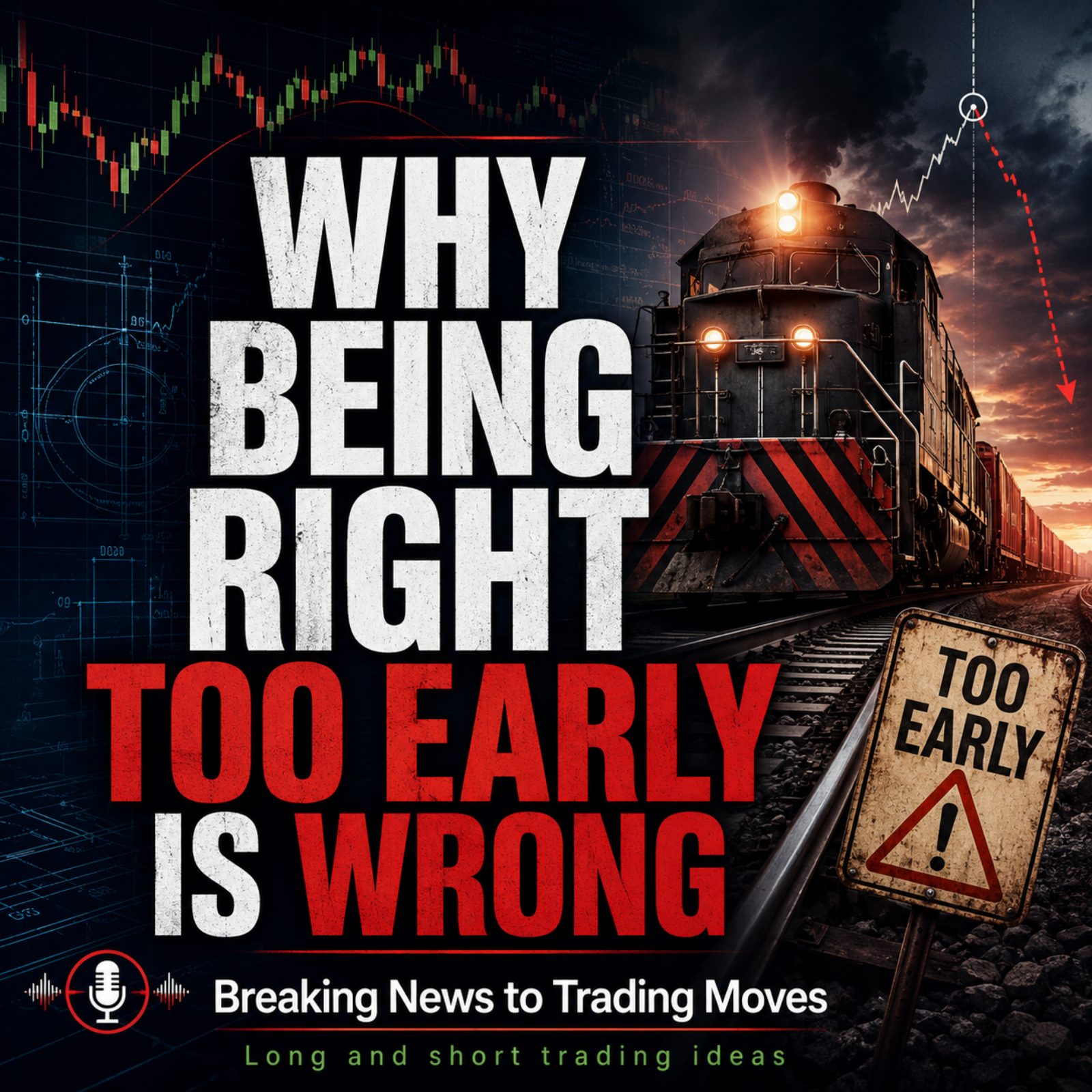
Why Being Right Too Early Is Wrong
May 1400:20:05Tap to summarizeIn this episode of Breaking News to Trading Moves, we explore one of the most painful truths in markets: a strong thesis can still become a losing trade if the timing is wrong. Being right about the destination is not enough if the market moves against you long enough to force you out before the outcome arrives.The discussion starts with a simple image: standing on train tracks with a blueprint proving the train will eventually stop. The analysis may be correct, but if you are crushed before the train stops, the correctness no longer matters. That is the core lesson behind Christopher Ailman’s warning that being right too early can be indistinguishable from being wrong.Key ideas covered:Timing can invalidate a good thesisA trader may correctly identify a bubble, stretched valuation, weak balance sheet, or unsustainable trend. But if the position is too early, too large, or too leveraged, the market can punish the trade before the thesis has time to work. Margin calls, option decay, client pressure, and benchmark underperformance can turn an accurate view into a realised loss.Reflexivity means markets can change realityThe episode examines George Soros’ theory of reflexivity, where market prices do not simply reflect reality; they can help create it. Rising asset prices can improve collateral values, expand credit, boost confidence, and make an overextended market appear healthier for longer. This is why shorting a bubble too early can be dangerous.Price and intrinsic value are not the sameThe debate also looks at the opposite view: price and intrinsic value are different. A trader can be early without being analytically wrong. The Royal Dutch and Shell anomaly showed that mathematically clear mispricings can persist because of noise traders, leverage constraints, and limits to arbitrage. The market can be wrong for a long time, but surviving that period is the challenge.Options, leverage, and tracking error create a clockThe conversation explains why professional investors cannot always wait patiently for the market to agree with them. Put options lose value through time decay. Leveraged trades can be closed by prime brokers. Fund managers can lose clients if their portfolio badly trails the benchmark. Timing is not a minor detail; it is part of the trade itself.Contrarian investing requires survival firstThe episode connects historic examples with modern themes such as the Magnificent Seven, AI hyperscalers, Michael Burry, meme stocks, sovereign debt cycles, and the conglomerate boom. The message is not that traders should abandon fundamental analysis. Conviction must be paired with position sizing, diversification, liquidity control, and humility.Main trading lessons:Being early is only useful if you can survive being early.A good thesis needs a risk plan, not just confidence.The market can stay irrational longer than your capital can stay intact.Leverage can turn a temporary dislocation into permanent damage.Options can be correct in direction but wrong in timing.Position sizing decides whether you get to see the end of the trade.The best traders separate the “what” from the “when”. They may believe a market is overvalued, but they still respect momentum, liquidity, volatility, and risk limits. They do not stand in front of the train just because they know the brakes will eventually fail.#StockMarket #Trading #Investing #DayTrading #SwingTrading #TradingPsychology #RiskManagement #MarketTiming #ContrarianInvesting #ValueInvesting #OptionsTrading #Leverage #Reflexivity #MichaelBurry #AIStocks #TradeDiscipline
Transcribe →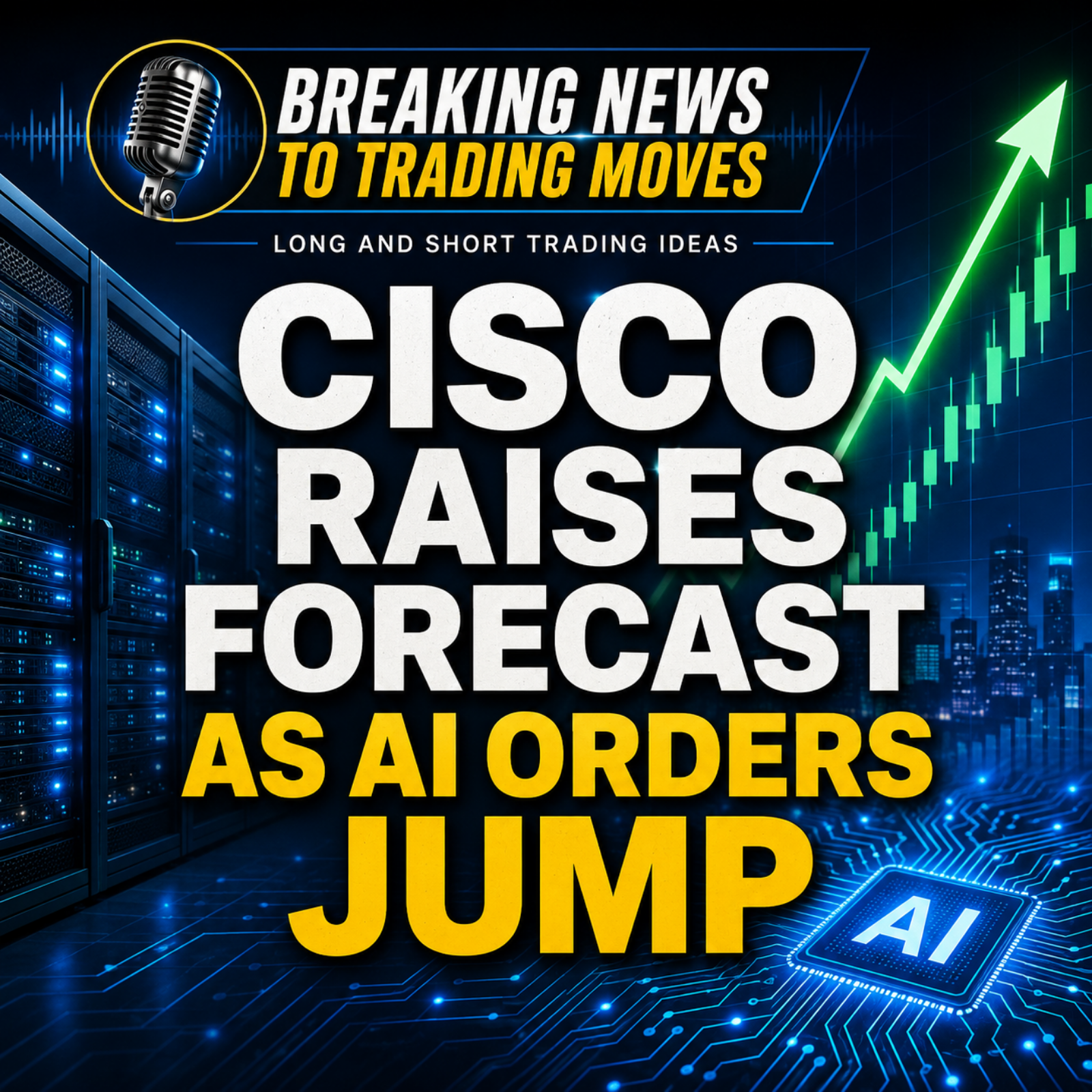
The Cisco Blueprint: Mapping the AI Infrastructure Trade
May 1400:11:31Tap to summarizeCisco raises forecast as AI infrastructure orders jumpCisco is today’s key AI infrastructure story after raising its annual revenue outlook and pointing to stronger hyperscaler demand. The company now expects AI infrastructure orders from hyperscalers to reach around $9 billion in fiscal 2026, up from its earlier $5 billion target. Networking product orders rose more than 50%, while data-centre switching orders rose more than 40%.WinnersAI networking and data-centre switchingThis group could benefit because AI clusters need huge amounts of data to move quickly between GPUs, servers and storage systems. That makes high-speed networking, switching and routing more important. $CSCO is the direct winner because the news validates its AI infrastructure push. $ANET could benefit as a leading AI data-centre networking name. $HPE could attract interest as enterprise networking and AI infrastructure become bigger parts of tech budgets.Names: $CSCO (Cisco), $ANET (Arista Networks), $HPE (Hewlett Packard Enterprise)Optical networking, interconnects and custom siliconThis group could benefit because AI data centres need faster connections, stronger bandwidth, lower latency and better optical transport. Cisco’s focus on silicon and optics supports the idea that AI demand is moving deeper into the supply chain. $MRVL has exposure to data-centre connectivity and custom silicon. $AVGO is tied to networking chips and custom AI infrastructure. $CIEN could benefit as AI traffic increases optical networking demand.Names: $MRVL (Marvell Technology), $AVGO (Broadcom), $CIEN Ciena)Cybersecurity and enterprise AI infrastructureThis group could benefit because more AI workloads, cloud traffic and data-centre activity can create more security risks. As companies modernise networks, they need stronger protection across endpoints, cloud workloads, identity and traffic. $PANW could benefit from security consolidation. $CRWD could gain from workload protection demand. $ZS could benefit from zero-trust security adoption.Names: $PANW (Palo Alto Networks), $CRWD (CrowdStrike), $ZS (Zscaler)LosersSlower-growth enterprise hardware and storageThis group could face pressure if traders rotate toward companies with clearer AI infrastructure momentum. $HPQ is more exposed to PCs and printing, which may look less exciting than AI networking. $NTAP and $WDC need to prove that AI storage demand can become stronger growth and margins.Names: $HPQ (HP Inc.), $NTAP (NetApp), $WDC (Western Digital)IT services and consulting namesCisco is cutting jobs while shifting investment toward AI. That could make investors question whether large enterprises are redirecting budgets from labour-heavy services toward automation, infrastructure and platforms. $ACN, $CTSH and $IBM have AI strategies, but the market may separate AI infrastructure sellers from traditional consulting models.Names: $ACN (Accenture), $CTSH (Cognizant), $IBM (IBM)AI software names with less direct infrastructure exposureThese companies are not necessarily weak, but traders may favour physical AI infrastructure names in the short term. Cisco’s update is about demand for networking, switching, optics and security. Software names need to prove that AI features are turning into paid adoption and revenue growth.Names: $CRM (Salesforce), $ADBE (Adobe), $NOW (ServiceNow)Final takeaway: Cisco’s update suggests the AI trade is moving into a second phase beyond GPUs, into switches, routers, optics, custom silicon, cybersecurity, storage, cooling and full data-centre architecture.#StockMarket #Trading #Investing #DayTrading #SwingTrading #Cisco #AIStocks #DataCenters
Transcribe →
The GMR IPO: A Valuation Reset for Healthcare Private Equity
May 1300:17:09Tap to summarizeGMR Solutions IPO Prices Low: What It Says About Healthcare and Private EquityToday’s story is GMR Solutions, the KKR-backed ambulance and emergency medical services company, listing on the NYSE under $GMRS. It raised $479 million by selling 31.9 million shares at $15 each. The detail is the discount. GMR had earlier aimed for $22 to $25 per share, so this IPO shows the market is open, but only when investors get the price they want.Investors are willing to fund healthcare infrastructure and private equity-backed listings, but they are demanding safety when a company has heavy debt, modest growth and reimbursement exposure.WinnersIPO underwriters and capital markets banksEven though GMR priced below expectations, the deal still got completed. IPO activity creates underwriting fees, advisory revenue and follow-on financing opportunities. If more private companies accept realistic valuations, banks with strong capital markets desks could see better deal flow.Names: $JPM (JPMorgan Chase), $BAC (Bank of America)Alternative asset managersFor private equity firms, the exit window is not fully closed. $KKR may have accepted a lower public valuation for GMR, but listing a major portfolio company still matters. It gives sponsors a way to monetise older investments, return capital and show that exits are possible again.Names: $KKR (KKR), $APO (Apollo Global Management)Emergency care infrastructure suppliersGMR operates ground ambulance and air medical services, so it sits inside a wider emergency response supply chain. Public market access may support future fleet spending, refinancing flexibility and investment in vehicles, aircraft and maintenance.Names: $F (Ford), $TXT (Textron)LosersDebt-heavy healthcare service companiesThe discounted IPO shows that investors are cautious when healthcare service companies carry leverage or face margin pressure. Size alone is not enough. The market wants cleaner balance sheets, predictable cash flow and a clearer growth path. That could weigh on stocks where debt, labour costs or reimbursement risk are part of the story.Names: $EVH (Evolent Health), $ACHC (Acadia Healthcare)Private equity-backed IPO candidates and recent listingsWhen a large sponsor-backed IPO prices far below its original range, it resets expectations for other new listings. Investors may still buy IPOs, but they want discounts and visible upside. Recent IPO names and future private equity exits could face more valuation discipline.Names: $CAVA (Cava), $BIRK (Birkenstock)Managed care and healthcare payorsEmergency medical transport is part of the wider healthcare cost chain. If investors focus more on ambulance pricing, reimbursement and transport margins, managed care companies could come back into the debate. Stronger provider economics may pressure payors, while tighter reimbursement could pressure providers.Names: $UNH (UnitedHealth), $HUM (Humana)Trading Takeaway:The $GMRS IPO is bigger than one listing. It tells us the IPO market is functioning, but not forgiving. Bulls can say public investors are still funding essential healthcare services. Bears can say the lower price proves investors are pushing back against debt-heavy private equity stories. If $GMRS holds above issue price, it could support healthcare IPO sentiment. If it breaks lower, the new-listing market may still be fragile.#StockMarket #Trading #Investing #DayTrading #SwingTrading #IPO #HealthcareStocks #PrivateEquity #CapitalMarkets #AmbulanceServices #HealthcareInvesting #KKR #GMRS #InvestmentBanking #MarketSentiment #HealthcareSector #NewListings #WallStreet #StockMarketNews
Transcribe →
Most traders do not need more knowledge, they need more courage
May 1200:21:54Tap to summarizeIn this episode of Breaking News to Trading Moves, we explore one of the hardest truths in trading psychology: many traders already know what they should do, but struggle to do it when real money, fear and uncertainty are involved.A trader may understand risk management, stop losses, position sizing, probability and market structure, yet still hesitate, panic, hold losers too long or exit winners too early when the screen turns red.This debate asks whether performance comes from neutralising emotion and adopting a purely probabilistic mindset, or whether emotions should be used as diagnostic feedback to improve routines, discipline and execution.The Knowing-Doing GapMany traders do not fail because they lack information. They fail because they cannot execute what they already know under pressure. The episode looks at the gap between knowledge and real-time behaviour, especially when a trade moves against you and your brain reacts as if the loss is a physical threat.Mark Douglas And The Probability MindsetOne side of the debate draws from Mark Douglas’s framework around accepting risk and understanding that every market moment is unique. From this view, the trader’s job is to stop expecting certainty and start thinking in probabilities.Key ideas include: One trade does not define your edge Wins and losses arrive in random sequences Risk must be accepted before entering the trade A losing trade is not a personal failure Discipline comes from trusting a defined processThis approach argues that once a trader truly accepts risk, the emotional threat of the market becomes weaker. Each trade becomes one outcome in a wider probability distribution, rather than a personal judgement on the trader.Brett Steenbarger And Emotional FeedbackThe opposing side argues that emotion cannot be deleted and should not be ignored. Drawing on Brett Steenbarger’s approach, emotions are framed as feedback. Fear, frustration, overconfidence and hesitation can reveal problems in position sizing, market selection, timing or personal stress.A structured process can help: Plan the trade before emotion takes overAct according to predefined rules Review emotional and behavioural responses Refine the process based on evidence Build routines that protect decisionsFrom this view, courage does not mean being emotionless. It means noticing the emotion, understanding what it signals and still acting in line with the plan.The Disposition EffectA key part of the discussion focuses on why traders sell winners too early and hold losers too long. This behavioural bias, known as the disposition effect, is linked to loss aversion and mental accounting.A paper loss feels less painful than a realised loss, so traders delay taking action. They hope the market will rescue them. But courage often means doing the uncomfortable thing early: accepting the loss, following the stop and protecting capital.#StockMarket #Trading #Investing #DayTrading #SwingTrading #TradingPsychology #RiskManagement #TradingMindset
Transcribe →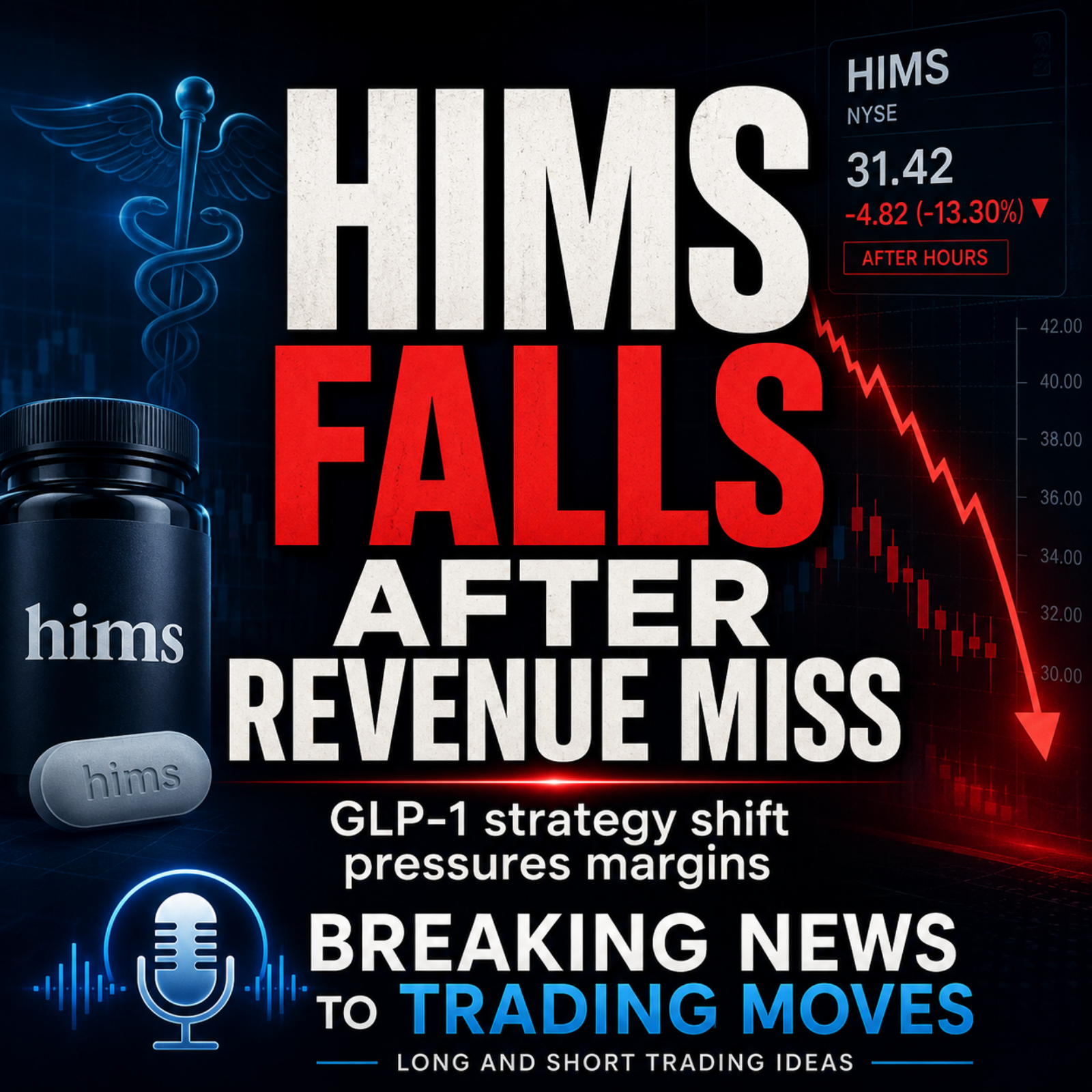
The GLP-1 Shift: Hims & Hers Market Evolution
May 1200:16:35Tap to summarizeHims and Hers misses revenue estimates as GLP-1 strategy shift pressures marginsHims and Hers Health is back in focus after missing first-quarter revenue estimates and posting a surprise loss, even though the company raised its full-year revenue forecast. The key issue is not simply demand. The bigger story is the business model shift. Hims is moving away from lower-cost compounded GLP-1 weight-loss drugs and toward branded, FDA-approved treatments such as Wegovy through its partnership with Novo Nordisk. That shift may support long-term credibility, but it also brings margin pressure, legal costs, restructuring costs and a tougher path to profitability.WinnersBranded obesity drug leadersHims shifting toward branded GLP-1 drugs strengthens the position of large pharmaceutical companies that own the approved obesity treatments. If platforms like Hims need to partner with drugmakers instead of relying on compounded alternatives, pricing power and product control stay with the branded manufacturers. Names: $NVO (Novo Nordisk), $LLY (Eli Lilly)Large healthcare and pharmacy distribution platformsIf regulatory pressure makes compounded GLP-1 models less attractive, the market may move toward more established distribution channels. Pharmacies, online pharmacy platforms and healthcare delivery networks could benefit as patients look for legitimate access to FDA-approved obesity treatments. Names: $CVS (CVS Health), $WBA (Walgreens Boots Alliance), $AMZN (Amazon)Established managed-care and healthcare service companiesAs the GLP-1 market becomes more formal, expensive and regulated, insurers and pharmacy benefit managers become more important gatekeepers. Coverage decisions, pricing negotiations, prior authorisation, and long-term cost management could become major themes. Names: $UNH (UnitedHealth Group), $ELV (Elevance Health), $CI (Cigna)LosersDigital health platforms with margin pressure riskHims is the direct loser in the short term because the market is questioning whether high growth can translate into strong profitability. The surprise loss and lower revenue per subscriber raise concerns around customer economics. Other digital health names may also face pressure if investors become more sceptical about telehealth companies that need heavy marketing spend, expensive fulfilment, or third-party drug partnerships to grow.Names: $HIMS (Hims and Hers Health), $TDOC (Teladoc Health), $AMWL (American Well)Consumer weight-loss and wellness platformsThe Hims result shows how difficult the weight-loss platform model can become when regulatory scrutiny increases and branded drug costs rise. Companies that rely on consumer weight-loss demand, subscription models, telehealth access, or obesity-treatment positioning may face tougher questions around margins, retention, and whether they can compete with larger pharmacy and healthcare networks.Names: $WW (WW International), $LFMD (LifeMD)High-growth healthcare stocks with profitability concernsWhen a fast-growing healthcare company raises revenue guidance but still sells off sharply, it tells the market that growth alone may not be enough. Investors may rotate away from healthcare names where profitability is delayed, margins are uncertain, or the business model depends on regulatory changes. Companies with high growth expectations but uneven earnings could face more scrutiny.Names: $OSCR (Oscar Health), $CLOV (Clover Health)#StockMarket #Trading #Investing #DayTrading #SwingTrading #HIMS #HimsAndHers #Telehealth #DigitalHealth #HealthcareStocks #GLP1 #WeightLossDrugs #ObesityDrugs #NovoNordisk #EliLilly #PharmaStocks #BiotechStocks #HealthTech #Earnings #GrowthStocks #MarketNews
Transcribe →
The Obsession With 1:2 Risk Reward Is Misleading
May 1100:24:38Tap to summarizeIn this episode of Breaking News to Trading Moves, we debate one of trading’s most repeated rules: that a 1:2 or 1:3 risk-reward ratio is automatically superior. On paper, the logic looks powerful. A trader can lose more often than they win and still stay profitable if the winners are large enough. But live markets are rarely that clean.This discussion looks at the tension between expectancy, market structure, trading psychology and real execution. One side argues that asymmetric reward protects capital, absorbs losing streaks and gives traders a structural edge. The opposing side argues fixed ratios can mislead traders when the market is noisy and price never realistically offers the target.Main DebateIt begins with the classic high win-rate trap. A trader may win 80% of trades, feel in control, and still lose money if the few losing trades are much larger than the wins. This is why expectancy matters more than win rate alone. A system is only profitable if the average winner, average loser and win rate work together.The pro 1:2 argument focuses on asymmetry. If one winning trade can cover multiple losses, the trader does not need to be right all the time. This frames small losses as part of business.The opposing view challenges the idea that a fixed reward multiple should dictate every exit. Markets do not move in straight lines. Intraday noise, liquidity sweeps and session timing can interrupt a trade before it reaches a distant target.Key Points CoveredExpectancy matters more than win rate or risk-reward in isolation.A 1:2 strategy can survive with a lower win rate, but it may create long losing streaks.A 1:1 strategy needs a higher win rate, but it may feel more executable for some traders.High win-rate systems can become dangerous if losses are allowed to grow too large.Fixed 1:2 or 1:3 targets can cause traders to ignore exhaustion, reversal signals and fading momentum.Market structure, volume and liquidity can be more useful than arbitrary targets.Why This MattersThere is no universal best ratio. A 1:2 risk-reward model is not automatically smart, and a 1:1 model is not automatically weak. The real question is whether the system has positive expectancy and whether the trader can follow it during losing streaks, drawdowns and changing market conditions.For some traders, letting winners run is the key to long-term profitability. For others, taking realistic profits based on structure and momentum may produce better discipline and more consistent execution. The mistake is copying a ratio because it sounds professional, instead of testing whether it fits the market, timeframe and personality of the trader.Practical TakeawayPull your last 100 trades and study the real numbers. What is your actual win rate? What is your average winner? What is your average loser? Do your trades usually reach 1:2, or do they often reverse after 1:1? Are your losses controlled, or do you hold them too long because you want to protect your win rate?The answer is found in your own trading journal. Risk-reward only becomes useful when it reflects live market behaviour, not when it is treated as a rigid target that every trade must obey.#StockMarket #Trading #Investing #DayTrading #SwingTrading #RiskReward #TradingPsychology #RiskManagement #TradingStrategy #TraderMindset #TradingDiscipline #TradingPodcast #BreakingNewsToTradingMoves
Transcribe →
The Great Wall of Protection: Chinese EVs and US Markets
May 1100:15:42Tap to summarizeChinese EV Access Fight: What It Means For US Auto StocksUS automakers, suppliers, steelmakers, unions and lawmakers are warning President Trump not to give Chinese automakers easier access to the US car market ahead of his meeting with Chinese President Xi Jinping.The concern is simple: Chinese EV makers have lower-cost models, huge scale, state support and growing market share in places like Europe and Mexico. If Chinese brands are allowed into the US market through investment, partnerships or dealership access, it could reshape competition for American automakers, EV startups, auto suppliers and even steel companies.For traders, this is not just an auto story. It is a policy, EV, manufacturing, supply chain and national security story.WinnersUS Legacy AutomakersIf Washington keeps Chinese automakers out of the US market, legacy automakers get protection from lower-cost Chinese EV competition. General Motors and Ford are already dealing with margin pressure, high EV investment costs, pricing competition and slower consumer affordability.Names: $GM (General Motors), $F (Ford)US EV And Electric Truck MakersTesla, Rivian and Lucid could all face a much tougher pricing environment if Chinese EV brands enter the US market. Chinese EV makers are already gaining share in overseas markets with cheaper models, and that could challenge both mass-market and premium EV pricing in the US.Names: $TSLA (Tesla), $RIVN (Rivian), $LCID (Lucid)US Auto Suppliers, Dealers And Steel-Linked NamesIf Chinese automakers are blocked from gaining major US market access, domestic auto suppliers and steel producers could avoid losing share to imported or Chinese-backed supply chains. US dealers could also benefit if Chinese-brand vehicles are kept out of showrooms, limiting competition from cheaper models.Names: $APTV (Aptiv), $BWA (BorgWarner), $GPC (Genuine Parts), $NUE (Nucor), $STLD (Steel Dynamics)LosersChinese-Exposed Global Automakers And Low-Cost EV Expansion PlaysAlthough these companies are China-based, they trade on US exchanges and are directly exposed to investor sentiment around Chinese EV expansion. If US policy becomes even more restrictive, it limits the long-term idea that Chinese EV makers can eventually access the American market.Names: $NIO (Nio), $LI (Li Auto), $XPEV (XPeng)Companies Depending On China-US Auto PartnershipsThis is where the trade is more complicated. While US automakers may benefit from protection at home, tighter China-US auto rules could also make partnerships, supply chains and China-related operations more politically sensitive.Names: $GM (General Motors), $F (Ford), $TSLA (Tesla)Consumer Auto Affordability And Online Auto Retail NamesThe US vehicle affordability problem remains a major issue. If lower-cost Chinese vehicles are blocked, US consumers may continue facing higher prices for new and used vehicles. That could weigh on demand across auto retail, financing and used-car sales.Names: $CVNA (Carvana), $KMX (CarMax), $AN (AutoNation)#StockMarket #Trading #Investing #DayTrading #SwingTrading #EVStocks #AutoStocks #ElectricVehicles #Tesla #GeneralMotors #Ford #ChinaStocks #ChineseEVs #TradePolicy #Tariffs #Manufacturing #SupplyChain #AutoIndustry #MarketNews
Transcribe →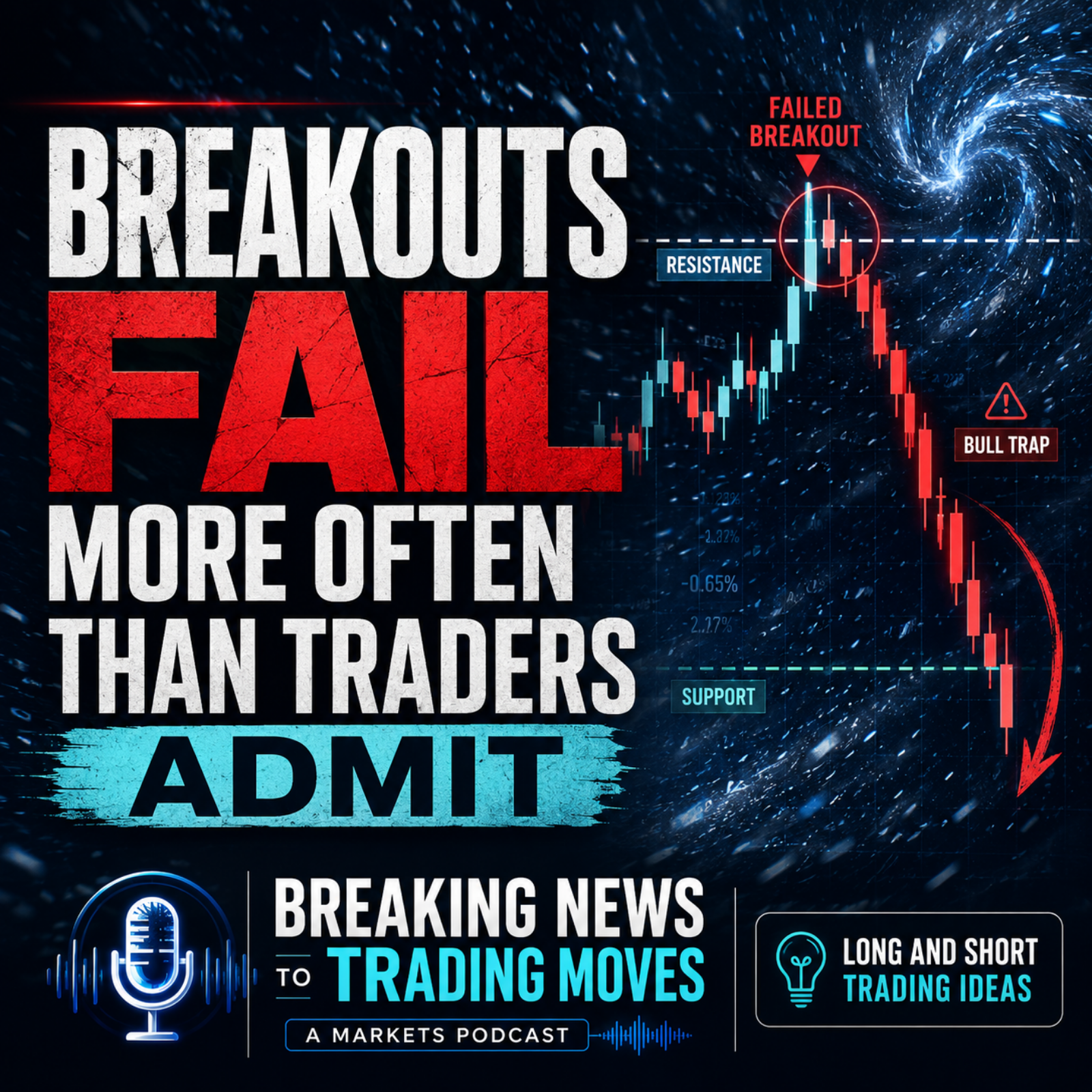
Breakouts Fail More Often Than Traders Admit
May 900:21:28Tap to summarizeIn this episode of Breaking News to Trading Moves, we debate whether traditional technical analysis still works in today’s algorithm-driven markets, or whether many breakout traders are being trapped by noise, false signals and flawed backtesting.The discussion starts with a simple idea: chart patterns used to feel like footprints in the snow. Traders looked for signs of institutional buying and selling, then tried to follow the trail. But modern markets now operate more like a blizzard, with high-frequency trading, millisecond data feeds, stop-loss hunting and algorithmic liquidity traps making those footprints much harder to read.One side argues that breakouts are not dead, but they need stronger confirmation. Basic chart patterns, simple trendlines and textbook support levels may be dangerous on their own, but volume-confirmed setups can still reveal genuine institutional activity. The key argument is that large funds cannot hide completely. When big money accumulates or distributes shares, it still leaves evidence through volume, price behaviour and the relationship between effort and result.The other side argues that this confidence is dangerous. Breakout failure rates have risen sharply over time, and many patterns that once looked reliable now stall, reverse or chop sideways. The market may look like it is forming clean structures, but in many cases those structures are shaped by algorithms designed to trigger retail entries and stop-losses.Key Points Discussed1. Why simple breakout trading can be riskyA breakout above resistance or below support can look convincing, but the first move is often the bait. Price may trigger traders into positions before reversing quickly, leaving late buyers or sellers trapped. The episode explores why raw price geometry is no longer enough in a market filled with automated execution and liquidity hunting.2. Volume confirmation mattersThe debate looks at whether extreme volume can separate genuine institutional demand from fake movement. A breakout with unusually high volume may carry more information than a breakout based only on price. The argument is that volume acts as a filter, helping traders identify whether real commitment is behind the move.3. Wyckoff theory and institutional footprintsThe episode explores Wyckoff concepts such as accumulation, distribution, springs and the law of effort versus result. When heavy volume appears but price refuses to move lower, it may suggest selling pressure is being absorbed. However, the debate questions whether these structures are still natural, or whether modern algorithms can create patterns that mimic classic Wyckoff signals.4. High-frequency trading and stop-loss trapsA major theme is how high-frequency trading firms may exploit predictable retail behaviour. Traders often place stops around obvious support and resistance levels. Algorithms can drive price into those zones, trigger orders, absorb liquidity, and then let price snap back. What looks like a valid breakout or breakdown may actually be a liquidity trap.5. The problem with backtestingThe episode also highlights survivorship bias. Many traders test strategies only on companies that still exist today, ignoring stocks that failed, delisted or were removed from indexes. This can make breakout systems appear stronger than they really are. 6. Are breakouts useless?The debate does not say every breakout is worthless. Instead, it argues that traders need to be more selective. Breakouts without volume, structure, context and realistic testing can be dangerous. #StockMarket #Trading #Investing #DayTrading #SwingTrading #BreakoutTrading #TechnicalAnalysis #TradingPsychology #RiskManagement #VolumeAnalysis #Wyckoff
Transcribe →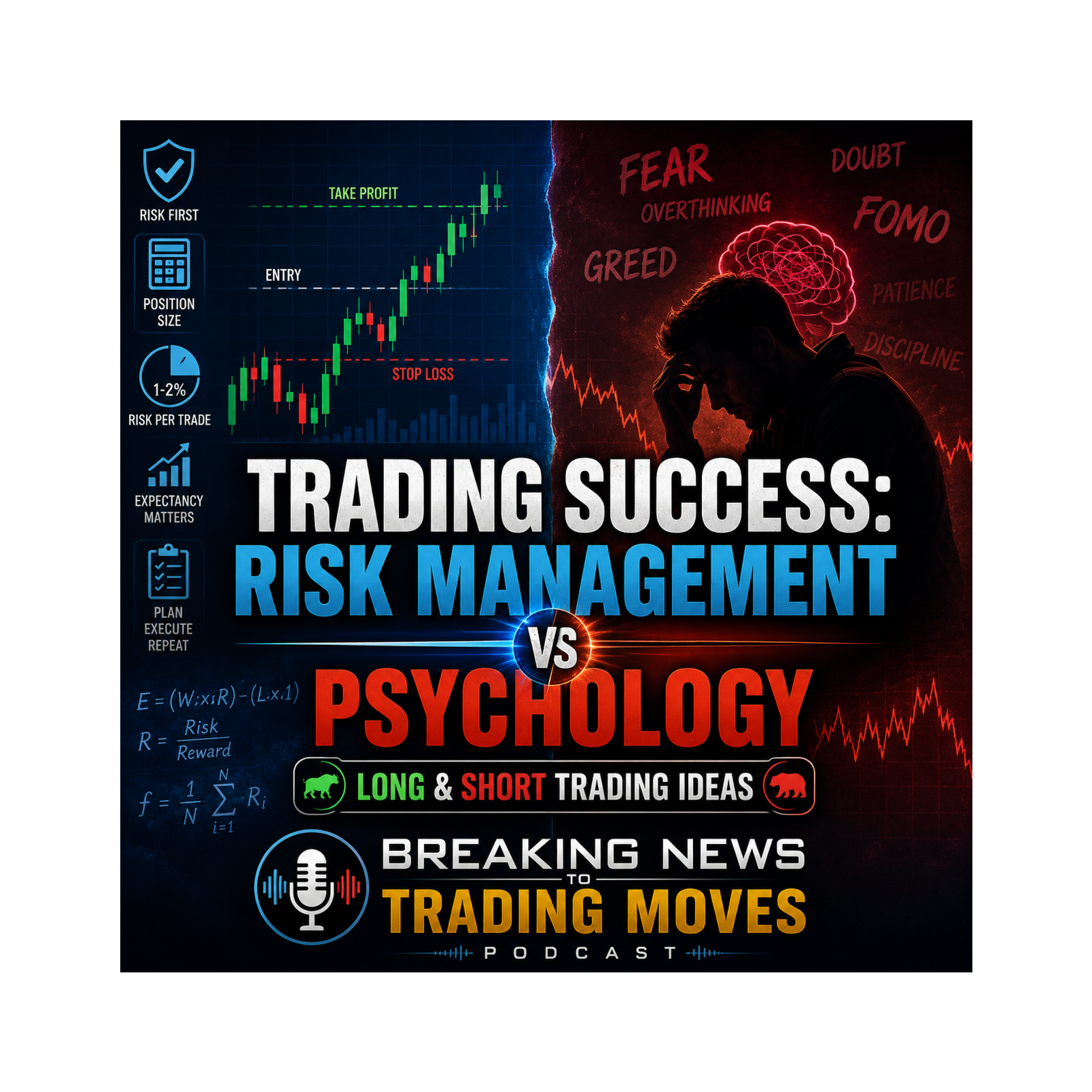
Trading Success: Risk Management vs Psychology
May 600:19:03Tap to summarizeIn this episode of Breaking News to Trading Moves, we debate one of the biggest questions every trader faces: is long-term success built on strict mathematical risk management, or does everything depend on psychological discipline when pressure hits?The debate starts with a Formula One analogy. A perfect car can still crash if the driver panics. In the same way, a trader can have the best strategy, indicators, stop losses and position sizing rules, but still destroy an account if fear, greed or desperation takes over. On the other side, discipline without hard risk limits can leave a trader exposed.Why capital preservation matters more than chasing fast profits Drawdowns are dangerous. A 10% loss needs an 11.1% gain to recover, but a 50% loss needs a 100% gain just to get back to break-even. This is why professional traders focus on defence first.The case for mechanical risk management Strict rules such as risking 1-2% per trade, using hard stop losses, positive reward-to-risk ratios and volatility-adjusted stops can protect traders from emotional decision-making. Maths can act as a survival framework when markets get noisy.Why psychology can break even the best system A risk rule only works if the trader actually follows it. The debate looks at loss aversion, revenge trading, fear of realising losses and moving stop losses when a trade goes wrong. A perfect trading plan means little if the trader overrides it.Reward-to-risk and win rate explained The episode breaks down how a trader can still be profitable without winning most trades. With a 3-to-1 reward-to-risk ratio, a trader does not need a high win rate to build a strong equity curve, as long as losses stay small and the system is followed consistently.Volatility-adjusted stops and ATR Instead of placing random stops, the discussion explains how the Average True Range can help traders place stops outside normal market noise. This reduces the chance of being shaken out by ordinary price movement, while still protecting capital if the trade thesis fails.Prop firm challenges and psychological pressure The debate also looks at funded account challenges, where profit targets, trailing drawdowns and strict time limits can push traders into forced trades. Even mathematical rules can create pressure if the trader becomes obsessed with passing the challenge rather than executing quality setups.Process vs P&L One of the strongest parts of the debate is whether traders should judge success by daily profit and loss or by process quality. A trader can make money from a bad trade and reinforce dangerous behaviour, while another trader can lose money while executing a solid setup correctly. Short-term P&L can be misleading because markets include randomness, variance and unexpected events.Why defensive trading matters Both sides agree on one thing: amateur traders often fail because they focus too much on offensive profit chasing and not enough on survival. The market does not care about your bills, goals, deadlines or need to win back losses. The trader who survives longest is usually the one who respects risk first.This episode is for traders who want to think more deeply about position sizing, stop losses, drawdown recovery, trading psychology, revenge trading, process discipline and capital preservation. It asks a simple but uncomfortable question: when the pressure is highest, do you trust the maths of your system, or the calmness of your own mind?#StockMarket #Trading #Investing #DayTrading #SwingTrading #TradingPsychology #RiskManagement #CapitalPreservation #PositionSizing #StopLoss #Drawdown
Transcribe →
The DuPont Effect: Pricing Power and Sectoral Shifts
May 600:17:39Tap to summarizeDuPont raises outlook as pricing power offsets higher input costsDuPont raised its 2026 sales and profit forecast after stronger Q1 results, with price increases helping offset higher input costs linked to Middle East disruption. The trading signal is pricing power. If DuPont can protect margins while costs rise, investors may start looking for other US-listed companies that can pass higher costs through to customers without damaging demand.Winners:Specialty chemicals and higher-margin materialsDuPont’s update suggests the market may reward chemical companies with differentiated products, stronger customer relationships and better pricing power. Specialty chemical names are usually less exposed to pure commodity pricing than basic chemical producers, which can make margins more resilient when input costs rise.Names: $DD (DuPont), $CE (Celanese), $ALB (Albemarle)Water technology and healthcare materialsDuPont’s healthcare and water technologies exposure gives investors a positive read-through for companies tied to medical materials, lab tools, biopharma demand and water treatment. These areas can be more defensive because demand is often linked to healthcare, infrastructure and regulation rather than short-term consumer spending.Names: $DHR (Danaher), $A (Agilent Technologies)Industrial companies with strong cost pass-through abilityThe bigger story is margin protection. Industrial companies with strong backlogs, mission-critical products and long-term customer relationships may be better placed to pass on higher costs. DuPont’s guidance raise could support the idea that selected industrial names can keep earnings strong even in a higher-cost environment.Names: $ETN (Eaton), $EMR (Emerson Electric), $HON (Honeywell)Losers:Commodity chemical producersCommodity chemical companies are often more exposed to feedstock costs, energy prices and cyclical demand. If costs rise and pricing power is weaker, margins can come under pressure. DuPont’s strength could highlight the gap between specialty chemicals and lower-margin commodity chemical businesses.Names: $DOW (Dow), $LYB (LyondellBasell), $WLK (Westlake)Packaging and plastics usersIf resin, plastics and packaging material costs rise, companies that rely on these inputs may face margin pressure. They may try to raise prices, but if demand is soft, customers may push back. That makes earnings more sensitive to cost inflation.Names: $AMCR (Amcor), $BALL (Ball), $SEE (Sealed Air)Consumer staples with packaging exposureConsumer staples companies use large amounts of packaging, chemicals and logistics. If input costs rise, they either need to raise prices again or absorb the pressure. In a cautious consumer environment, price increases can be harder to push through.Names: $PG (Procter and Gamble), $CL (Colgate-Palmolive), $KMB (Kimberly-Clark)#StockMarket #Trading #Investing #DayTrading #SwingTrading #DuPont #DD #ChemicalStocks #IndustrialStocks #MaterialsStocks #PricingPower #Earnings #Guidance #MarginPressure #Packaging #ConsumerStaples #MarketNews
Transcribe →