← Bred To Lead | With Dr. Jake Tayler Jacobs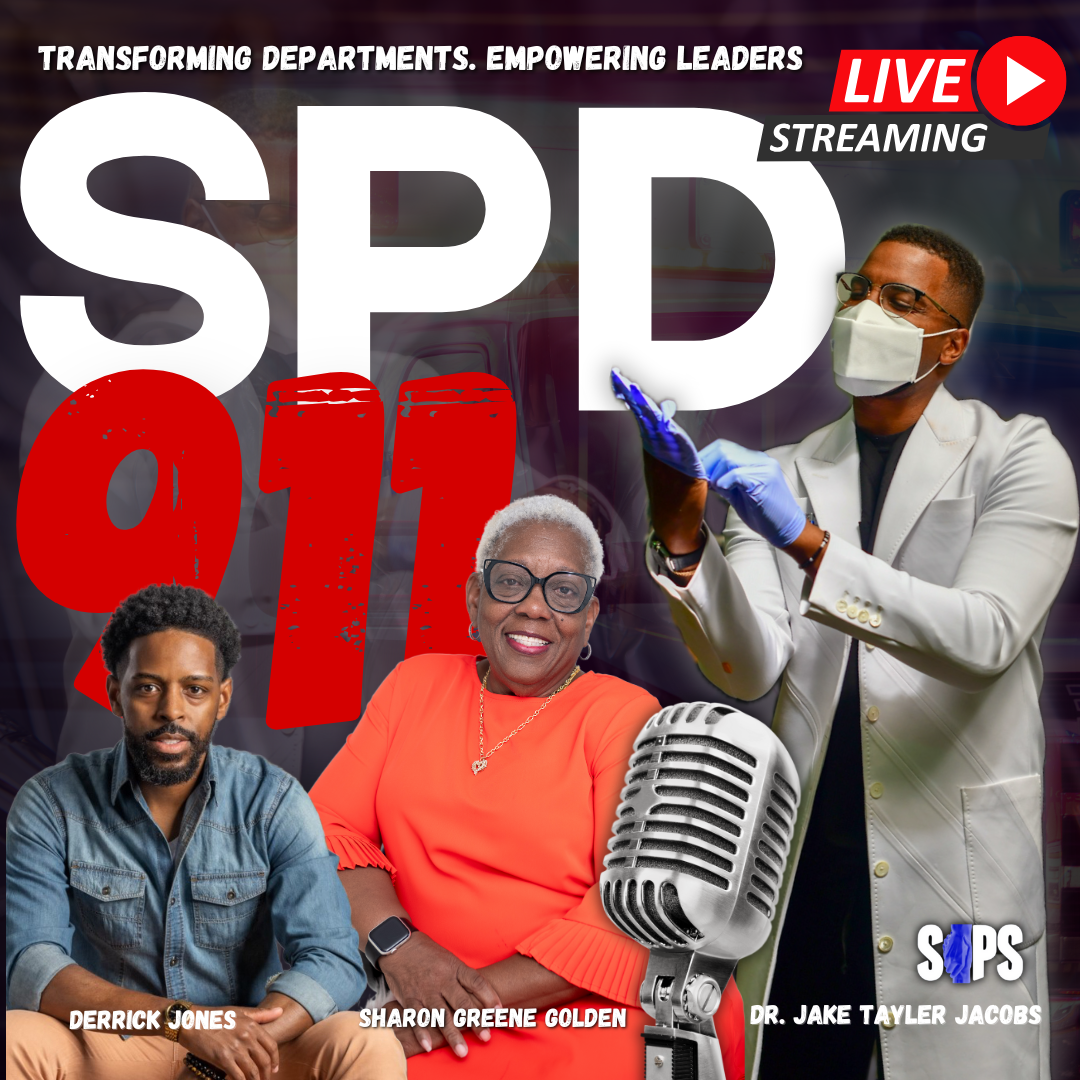
Loading summary
Transcript170 lines
- [00:31]
Dr. Jake Taylor Jacobs
Welcome. Welcome. Welcome to SPD911. I'm your host, Dr. Jake Taylor Jacobs, President and CEO of Sips Healthcare. And this show is all about tackling the toughest challenges in sterile processing. Whether you're on the front lines or making high level decisions, we're here to equip you with the real solutions to rescue and elevate your department. Each episode I'm joined by our Director of Clinical Compliance, Sharon Green Golden, a leader in compliance and regulatory standards, and our Director of Clinical Operations, Derrick Jones, a specialist in operational efficiency and team development. Together, we'll be breaking down the critical issues affecting CSPD departments and provide actionable strategies to help you stay ahead. SPD911 isn't just a show. It's your emergency response team for Sterile Processing. We tackle compliance concerns, streamline operations and help you grow as a leader in your field. If you want to participate live and ask your questions to the great Sarah Green golden and Derrick Jones, join the Executive Edge community. It's free and the only way to engage with us directly. So you can go to SPD911.com to learn how to join the SIPs Executive Edge community where we have so much information to give you. And lastly, join us live every week on Wednesday at 12pm Central Standard Time to catch the greatest CSP live show on earth. Now, Sharon Green golden, come on onto the stage. Come on up here because I cannot wait. For those that don't know you will bring Derek up here soon. But for those that don't know you, can you please let us know who you are, where you've been and what qualifies you to be on this show Talking about SPD needs.
- [02:25]
Sharon Green Golden
Okay. Good afternoon.
- [02:27]
Dr. Jake Taylor Jacobs
Hey.
- [02:28]
Sharon Green Golden
I am Sharon Green Golden. I am a sterile processing professional. I've been in the field of sterile processing for 40 years. I started sterile processing as a basic assistant, who became a technician, who became a team leader, who became a supervisor, who became a manager. I have been doing this work as my passion for all of those 40 years. I am also past president of ISHM, which is HSPA now. I was in the presidency as Vice President President, I think from 2012 to 2015. I was a former president of the foundation. I served on the board. I have served on many boards within the profession. 3M ASP steris halliard. As a subject matter expert, I have helped to write information for the national test that you take. I am a international presenter in the field of sterile processing. I've spoken all over the world. New Zealand, Australia, Brussels, Italy, Japan, Turkey. I've been Everywhere. But I've done mission work in Bangladesh and Tanzania in the field of sterile processing, teaching cleaning techniques. And so what I do know is thorough processing. I know you, I know your people. I know your issues. I've been there in the trenches. I got a T shirt, a hat, and some chips somewhere around here that say I do know. And that's Sharon Green. Golden.
- [04:16]
Dr. Jake Taylor Jacobs
All righty. And the most beautiful thing I love about you, sgg, is your no nonsense demeanor mentality. And I think it's important because truth, sometimes it's hard to digest. And the only way that you can actually get truth and really create change is by being honest. And honesty sometimes is ripping that band aid off. So I'm so excited that you are on the show with us. And last but not least, we have Derek Jones, our director of clinical operation. He hits the ground running. Derek, come on up here onto the stage and let everybody know who you are, how long you've been in the game, where you come from, and why they should be listening to you.
- [05:02]
Derrick Jones
Well, I'm a little bit disappointed because you would bring me on after her. You should have let me go first. You know what I mean? I Brussels. You know, I mean, look, I'm trying to think. I'm googling, but no, I'm Derrick Jones, everybody, and I appreciate this invite. We got over 12 years of SPD experience from entry level as a technician all the way up to clinical director. Now I often do consulting all over the country and this is a true passion for mine on many levels as it's a life changing career that I chose to get into at a, at an age and time where I was undecided and looking for a career path. So this industry has allowed me to become a subject matter expert as well, and it also has opened a pathway for opportunities for me to do teaching and mentoring and developing departments and that pretty much meet the standards of quality care to serve patients throughout the country. So I'm excited to be joining this platform because it's needed. We need more people like us with the experience that can really give people a true depiction on spd. The career choice, the career path and opportunities, as well as some of the challenges that hospitals are having outpatient facilities are facing. So I appreciate you and I'm. I'm ready to get started.
- [06:27]
Dr. Jake Taylor Jacobs
Listen, and, and, and, and I. You missed something. You see, I'm here.
- [06:32]
Sharon Green Golden
The.
- [06:32]
Dr. Jake Taylor Jacobs
The reason why I love being the host of this show is one, I can be a student and I can just ask you a whole bunch of questions and try to Poke SGG to get her just to go off. I'm just, I'm. I'm just po. But I. I love Derek for his, His. His gratitude and how honest and humble he is. He's never going to. He's not Dr. Jake. See Dr. Jake and Sharon Green Golden. We're going to tell you. Yeah. Our value. And then Derrick Jones going DJ gonna be like, listen, I am whoever you say I am. I'm all right.
- [07:11]
Derrick Jones
And so I did what you needed me to do.
- [07:13]
Dr. Jake Taylor Jacobs
Right.
- [07:14]
Derrick Jones
Right.
- [07:14]
Dr. Jake Taylor Jacobs
That's right. But what I want, what I do want to show or to talk about before we even get into the show. Can you talk about the initiative that you started getting people who maybe messed up in their past want to change their ways, getting right out of jail and then the pathway to. Pathway to career through sterile processing that you're doing there in St. Louis leading that?
- [07:40]
Derrick Jones
Absolutely. So we all know someone who suffer from mental health and substance use disorder. Myself have family members and loved ones that is suffering through it. Now what I do, we have an organization called Live Recovery, my wife and I. And what we do is provide a foundation with wraparound services where someone can come and receive that initial support, whether it's therapy services, medical assistant, treatment for mat, whether it's just housing. You know, this is a much needed resource for our communities. Our program stretch almost 100 miles within the state of Missouri offering these services for men and women. And it is also an avenue that once many of the clients conquer addiction and they now have some stability in their life and they're ready to put things back on track. This is where other resources like sterile processing and career opportunities can really provide access or it can be accessible to them to get back, acclimated and give back.
- [08:45]
Dr. Jake Taylor Jacobs
Listen, y'all see that? Y'all see how great he is talking about? He had to Google. Yeah. Google himself. That's what he had to do. But the whole purpose of this show, again, like we said, we're talking about compliance, regulatory leadership issues inside of SPD and only spd. And as you guys have all the experience running, managing, turning around SPD departments, I think it's very cool for us to have this conversation. And I want it to be in a way. And the whole purpose of this is for it to be in a way to where we can literally connect with our fellow brothers and sisters that are in the SPD streets front line. And sometimes, you know, speaking proper and saying the right thing isn't always the best way to kind of get through to somebody. So we want to make sure that we keep it lively and non stuffy. So if anyone right now, do not hesitate to put something nice in the comments because we do like to put it on the screen right under sgg. It's a beautiful look right there. And then. And then again, if you want to ask live, if you have a real scenario that you want Derek and Sharon Green golden to break down, join our community in the SPD911.com. When you go there, you will join the SIPs Executive Edge community and you'll be inside of the SPD911 group. That's the best place to ask scenarios. And we'll answer your scenarios on air without your name so we can make sure that you're getting your answers and also helping other people. So y'all, let's get into it and. And I want to hear what you got to say. So we have a scenario. Our executive producer, Ignacio, our head of marketing here at sips, found a whole bunch of questions from communities in Facebook as we continue to build up our community and them asking questions directly to us. And so this first scenario I have up is that SPD techs are overwhelmed due to chronic understaffing leading to rush processing, increased errors and burnout. That's the situation. So the techs are overwhelmed, chronic understaffing leading to rush processing, increased errors and burnout. The question I have for you two is how can SPD leaders advocate for better staffing levels while maintaining quality and avoiding burnout? So ladies first.
- [11:01]
Sharon Green Golden
Ladies first. So, sterile processing. Once we actually realized that the profession was very important and what we did actually mattered, we started realizing the importance of not having errors. Because if you have an error, you impact the patient. Lots of sterile processing departments are understaffed. They've always been understaffed, but we get the work done. What I want to say is that you cannot rush the process. It's not fair to the patient. I don't care who your boss is, you cannot rush the process. See, when I'm on the surgical table, I need my tray to be clean, all the instruments working for my case. So therefore I have to do it for everyone's case. They can come and say, hurry, hurry. The reason we have instructions for use available is so that we can say, can't hurry. Can't hurry. I've had to tell doctors, I'm sorry, but it said it had to soak for five minutes, sir. So I can't miss the soaking step because you need it. I have to soak it. And I'm sure if it was your family member on the table, you would want me to follow all the instructions and they're like, yes. So the bottom line is that you're going to be understaffed, but that should not make you have errors.
- [12:21]
Dr. Jake Taylor Jacobs
That's right.
- [12:22]
Sharon Green Golden
There's no excuse for your error. You know, I didn't put the indicator in the trade because they was rushing me. No.
- [12:28]
Dr. Jake Taylor Jacobs
Boo.
- [12:28]
Sharon Green Golden
No. No. That was the first step. So you couldn't have forgot the indicator because that was the first step.
- [12:35]
Dr. Jake Taylor Jacobs
That's right.
- [12:35]
Sharon Green Golden
So for a tech to say I'm understaffed, that's why I have these errors, it's not acceptable. Let me just say that. Go ahead, Derek. It's not acceptable.
- [12:44]
Derrick Jones
No. So as a leader and. And I. I totally agree with all that. And I would add to that, since you are the guru and you taught me so much, so.
- [12:53]
Dr. Jake Taylor Jacobs
But she said no flowers this show. I'm sorry. No flowers.
- [12:57]
Derrick Jones
No flowers.
- [12:58]
Dr. Jake Taylor Jacobs
No flowers.
- [12:59]
Derrick Jones
Right, right, right. So as an SBD leader, we now have to apply our experience, our in a moment experience, and provide and provide metrics to measure and to show our upline leaderships the challenges we're faced with. It's so easy to do a complaint daily as to why we're understaffed and how we're not. We're having burnout. But if everything is going right and the OR gets all their trades on times, no defects, no errors, there would be no initiative to make the changes or adjustments because to them, to the upline leadership or the hospital leadership, they may understand that, hey, it seems like things are going great. So we have to show instances where there are near misses, where there are opportunities where we could delay a case, where equipment failures can challenge opportunities for not reprocessing trays or the amount of trays needed for the next day's volume. So with research with us being leaders, we apply the metrics, we give hard data with hardcore facts to show where we're going or what the possibilities. Without us being proactive, I think there's an opportunity for us to justify the need to add additional staff and support.
- [14:15]
Sharon Green Golden
So I will agree. I will agree. I will tell you this. As the leader, it's my job to make sure that the C suite knows where we are. I invite the C suite to the sterile process.
- [14:27]
Dr. Jake Taylor Jacobs
That's good.
- [14:28]
Sharon Green Golden
I tell my sterile processing tech, stop standing in front of me telling me what you don't have and what you don't like and how you so sad. He is the president of the hospital. Tell him. I will tell you. He's heard it from me. And they will say, Ms. Golden told us y'all need more money. Ms. Golden told us y'all don't have enough people. But it's better when it comes from you. As a leader, I support my staff. As a leader, I support my staff. But my staff has to do the right thing every day for me to support them. Because when you have an error, I'm standing on the other side with the other people with the gun shooting at you too, because I don't understand. So having errors has nothing to do with you being understaffed. What I have to do is try to make it work so that you feel comfortable enough to do quality work, even though we need two more people.
- [15:27]
Dr. Jake Taylor Jacobs
Got it. And I actually want to ask this question specifically, Derek, to kind of veggie back on what you and SGG have been saying. What about for that SPD leader that isn't as bold? They're newer to the position of leadership management. They maybe were an educator, a lead tech supervisor educator. They're under their first three years of management. Usually after 10 years of management you kind of get comfortable, you know, your stuff, you know, not Dr. John, you know, John like John, stop playing. Right. Hey, you know, you know, I get it. But they're newer and a lot of that first three years of leadership will and can make or break that person's future in leadership, even past just managing as in a CSPD space. So what about for those that are not as bold to just to go up and talk to their senior leadership in order to get them to move or see something their way? What would you say to them?
- [16:33]
Derrick Jones
Well, number one, I believe in you have to being in a leadership position, you need to have someone to springboard thoughts and ideas off of whether it's a mentor or someone within that hospital, whether it's your direct manager or whomever. You have to build up the courage. If you cannot go up and generate the conversation with the C Sweden leadership, at some point your team is going to begin to feel that you're not supporting them and it may put you in a further difficult situation as to where your team will begin to turn on you. So I would encourage them to. If you can't have a direct conversation, start with an email thread. You know, start with just some sort of communication to get your thoughts out to start the discussion and then schedule a meeting with your upline leader to further just, you know, engage in. Hey, here are some of the struggles I'm facing. Here are some of the challenges I'm having difficulty working through and then just start the conversation. And as you begin, as you get comfortable with the direction you're going in and the way the conversation is moving, that is your opportunity to engage and also think of some strategies or implement some of your thoughts and ideas to correct some of the challenges and the problems.
- [17:52]
Dr. Jake Taylor Jacobs
And one thing I want to say.
- [17:55]
Derrick Jones
I got a smile.
- [17:58]
Dr. Jake Taylor Jacobs
Yeah, he got it. A smile. Didn't much. You said it right. You did good. Oh one, one thing I want to say though is leadership is by committee. Especially when you're building in an organization when it's not your company, leadership is by committee. So when you go you newer to that leadership role, within your first three years, your first five years of leadership, you want to build a like, almost like a committee board with, with, with cross departmental leaders. Yeah, they're in the same space that you're in that are equal to your level or maybe even one notch above and start building out that committee. And if you are the one who, who, who starts the initiative even in a lesser, you know, leadership position, as far as tenure, if you're the one who can kind of put the group together and get people to kind of talk, you can be considered the influencer of the group that has influence because you're the one bringing the committee together. The biggest difficulties of departments being able to communicate with each other is the breakup in communication. So if you can actually bridge the communication where the people who are leading these departments are all working together, when you have a problem saying, hey man, surgeries are high, you know, we're understaffed here. And you built a rapport with that committee, the committee as a group, you guys will come up with solutions. And as a group, take them up to senior leadership. Because when senior leadership is trying to get things approved, they go across the departments anyway, right? They, they, they talk to the other leaders of departments that will be affected by whatever they provide you. Because resources and funding and whatever for getting extra staff doesn't just come from one budget. It also comes from maybe taking from, or taking a little bit from materials management. We got a little emergency fund budget. Let's take a little money here. It's just moving the cheese around. New money is not created. And so with that building that committee and building that task force is almost like a leadership task force where you guys once a month, once a quarter can come together once a week if you really love each other. Where you can come together 15 minutes to 30 minutes, boom. Here, any nuts, anything, boom. You got everything cool. The same way you do your Huddles can be the same way. You can do a huddle with the other department heads that can kind of work together.
- [20:14]
Sharon Green Golden
Yes. And with sterile processing, when you're new, I want to. I want to challenge new leaders, use the resources that are there. You have infection control.
- [20:26]
Dr. Jake Taylor Jacobs
That's right.
- [20:27]
Sharon Green Golden
Bring them down. Tell them what your problems are.
- [20:29]
Dr. Jake Taylor Jacobs
That's right.
- [20:30]
Sharon Green Golden
Because infection control has a straight line to administration. As Dr. Jake said, Talk to the OR director, say, this is what we need in order to help you do the surgical cases. You should be part of the surgical staff meeting anyway. Go to surgical staff and sit with the physicians and say, Dr. Booty Boo, we can't do five knee cases. We got one fork. Can you help us to get some more forks? Because, see, Dr. Booty Boo will go to administration and say. They say they got one fork in the SPD and we need that. And I'm going to take my cases across the street because they have four forks. So use the resources that are there. Everyone is not as bold as me, and I wasn't born really, really bold. I got bold as I grew and got out. But I was outspoken since I was young. But the bottom line is I believe that if you are a leader, you should lead. And you lead by example, and you lead with facts. You make sure you know what you're talking about when you go to talking and you tell them what you need. I was thinking about six, triple eight. When she was out there and she told them who she was and what she wanted them to do, they followed her because she said, I'm the chief. And they followed her and they did what she said. But when she stood up for them in front of that general and said, not over my dead body, they realized she had their best interest in at heart and that she would go to the end with them. Your team needs to know that you will go to the end with them. And you need to impart into your team that what they do matters every day. Because we take care of patients who do not have the opportunity to see us, to know us, or to even say thank you for putting. Having an error. What you do matters. And we do not have the right to impact a patient's surgery.
- [22:45]
Dr. Jake Taylor Jacobs
That's good. That's good. Hold on. I got something for that. Hold on.
- [22:49]
Derrick Jones
Beautiful. Beautiful.
- [22:54]
Dr. Jake Taylor Jacobs
Did y'all hear that? Did y'all hear the applause? Did y'all hear the applause?
- [22:58]
Derrick Jones
Yeah, I heard it. Hey, I heard it. Yeah. Oh, I lost you.
- [23:08]
Dr. Jake Taylor Jacobs
Questions are. We're on those answers. So we want to move to the next scenario, we have a situation where the OR sends urgent requests for instruments they never put in the case card. Expecting SPD to work miracles. The question I have for you, how can SPD teams improve communication with Wall and set realistic expectations?
- [23:33]
Derrick Jones
Odin, you ready?
- [23:35]
Sharon Green Golden
Yeah. Well, you know, communication is about talking, but talking without accountability gets you nowhere. So if I'm communicating that the OR is sending me an incomplete set, I first have to have the facts, all the facts. Nowadays we all got cell phones in our pocket. Take the picture of the tray, it came back without the instrument, and go immediately to the OR team and say, we didn't get this particular item back.
- [24:10]
Dr. Jake Taylor Jacobs
Why is immediate important?
- [24:12]
Sharon Green Golden
Because you cannot come four hours later because everybody's memory is skewed. They will remember sending you the instrument. They will have witnesses that remember sending you the instrument, and the instrument is by then probably in the trash and gone. Immediate means that we called it right now. What I always say is, SPD team members understand this. We understand we need the instrument to complete the tray. My question is always when I say something is missing, what is our motivation to say we don't have the instrument when we can't put the tray up without it? If I come to you, I don't have the instrument. Now, I would say to spd, you need to be sure you did look and you were sure that that set was missing the instrument. Because there's been plenty of times that we go back and we find it in SPD. So we need to be sure and immediately. Dr. Jake means that I looked right now it's not here. So now we can go back to the OR and look in the room. They can pull the trash, whatever is needed. But communication. There should be a. You should have a. A process where you automatically. We had a process where we automatically call to the front desk and say, room 7, 7:30, Trey came down, it's missing the spoon right now. And they would call the team that did the case. Come out of the lounge, drinking your coffee, go. They say they don't have spoon. Go and help them find the spoon. It's going to happen, but we have to be able to talk to each other and say what is missing and what I need.
- [25:54]
Dr. Jake Taylor Jacobs
That's good. That's good now.
- [25:57]
Derrick Jones
Yes. So just to speak to that briefly, because she hit all the key points. What I will say as an SVD technician or leader, unfortunately, when we took this role to work in healthcare, the patient is first. So if the OR calls down and say they need 8,000 trays and they got a patient in the room that need it. We're part of the miracle. We're part of ensuring that that patient gets the necessary equipment needed. It is not up to us to determine what happened, why it wasn't selected for the case, why it wasn't on the case card. So we first serve that patient so that the OR and that patient can have successful outcomes. Secondly, this is where our leadership and our teams learn how to start the communication by documenting some of the challenges that are reoccurring. We can't, like Ms. Golden stated, it can't be two or three hours later and we don't have the facts to support it. So strong leaders, strong technicians that are able to capture real time challenges that we're being faced with, we gotta be able to track that and then communicate that with our leadership so that we can start the communication to fix and resolve some of the problems. Or it can be something as simple as a pick ticket issue, a location scan issue, it can be whatever. But it all starts with, number one, serving that patient and then number two, tracking information so that we can have something to support our concerns.
- [27:24]
Dr. Jake Taylor Jacobs
It sounds like even though in most cases we're reacting spd, it sounds like you still have to have the spirit of proactiveness, like being proactive, while it's kind of like, it's like that thing.
- [27:39]
Sharon Green Golden
Yes, I know, I know that every time they do a hit, the mallet doesn't come back. We know that the mallet's missing every day. So proactively, when that case comes in, the first thing we do is go to the cart and see that we get the mallet.
- [27:56]
Dr. Jake Taylor Jacobs
That's good.
- [27:56]
Sharon Green Golden
We don't wait, we go right away. The other thing we do is, as we've gotten professional, we have liaisons from SPD that sometimes in some ORs you say, go to room 7, their case is ending and help them to put those instruments back together. Because we know they trying to turn over the room, go in there and help them so that we get the mallet back. So you learn this. We know as professionals in SPD technicians, you all know what isn't coming back. You already know what they put in the wrong place after you do it a while, you know, so we're on the lookout. And because we're on the lookout, we can catch these things. I've had them pull the trash at one hospital I was at. They had to put the room number and the time of the case. And we would say, do not dump 7:30, room 8. Put that trash to the side until we tell you we okay. Because we wanted to be sure we got all of our instruments before that trash went outside. But it's going to happen. But it's. It as, as Dr. Jake and Derek say, it's all about being able to talk to one another.
- [29:07]
Dr. Jake Taylor Jacobs
That's good.
- [29:08]
Sharon Green Golden
Talking is the answer. We don't like to talk. Talking is the answer. Not, not, not accusing.
- [29:15]
Derrick Jones
Right.
- [29:17]
Dr. Jake Taylor Jacobs
Well, they say, can we talk for a minute?
- [29:25]
Sharon Green Golden
You know, it's about talking and not accusing and saying, look, this is what we've noticed. We've been taking some notes and we noticed that every time you all do this case, the sponge force have done come back. Now, this is not accusing. I'm just saying for the last 15 times, we haven't been able to find the sponge force. We don't know what's going on. So we thought what we would do is, as you begin to close, call me in spd. I'm coming over and I'm going to help you because my only job is to find the sponge force to see what happens. Sponge forcer. And then what we found is that it was still hooked to the wrap, and when they wrapped up the wrap, they threw it away. So now we're able to go back and say we know what happens to the sponge forcer. And so now before you start doing anything back table tech, ask them to hand you that sponge forcer because you don't get a raise either if we're buying every day. We are a team. So we all would like to get a raise. None of us are volunteering here, including the president of the hospital. And he won't get a bonus if all the bonus is buying instruments. So everybody has a vested interest in us not throwing the instruments away. And I'm not accusing you. I'm just saying help me help you help the patient's next case by us having the instruments. And as you talk, you become associates. Hopefully you can become communicate to where you're friends, but you become associates on the same plane going to the same place. We all want to get there alive. This is what it's going to take. And so we, we work towards that.
- [31:03]
Dr. Jake Taylor Jacobs
That's right. And I'm glad that you brought up a raise. We'll talk about that maybe on another episode of. Of the Importance of the Organization, the department working together to help everybody get a raise. It's kind of like when the tide rises, all boats rise. Yeah. And so that's kind of the effect that's, that's needed in order to truly be able to get everybody in the organization to be eligible for raises. But let's talk about this lack of respect coming into the industry. I talked to tons of leaders and technicians one on one in a group speaking on the stage, and it's the same thing. Everyone talks about this proverbial lack of respect that they feel that central, sterile process and techs have to deal with. So here's the situation. There's an SPD worker that often feels like the invisible backbone of the hospital with little appreciation from surgical teams and hospital leadership. The question is, what strategies can SPD leaders use to elevate their department's visibility and value within the hospital? I'm a chime in on this one. Go ahead, sdg. Let's Derek go first. Derek go first. Let's let what strategies use.
- [32:24]
Derrick Jones
Yeah, so they are unfortunately, it's still they are considered invisible backbone of the hospital, unfortunately. However, it's up to leaders like me to show their worth and the value of the department and what they're actually doing well to elevate visibility. I think there are so many opportunities because of how complex the SPD department is and the numerous changes in IFUs and understanding the complexity of the instruments. There is so much room and opportunity to create ownership for each technician, whether it's a process, whether it's a service line, or whether it's an opportunity to become a preceptor and then elevate and become a lead tech. Those type of things bring support and shows number one appreciation because we're recognizing that they are evolving and they have strengths in different areas and we believe that they can be accountable for crucial areas within the department. So the first thing you do is acknowledgement, of course, and offer them opportunities to not only take on different roles and ownership in processes or services within sbd, but create opportunities for them to grow so that they can stay engaged and connected with the outcomes of the department.
- [33:49]
Dr. Jake Taylor Jacobs
Okay, Sharon Green, golden what strategies can SPD leaders use to elevate their department's visibility and value within the hospital?
- [33:57]
Sharon Green Golden
I think first of all, as spd, we have to understand who we are, where we are. Nobody knows we exist until 2012. When I did the Today show piece, patients didn't even know there was a group of folks cleaning something somewhere. Some patients, including doctors, thought instruments flew in on a plane ready to go and you came to the room. So I often say it's a sad frog that doesn't croak in his own pond. You have to be willing to stand up for what you do and tell people what you do. How many of you all are Willing to say, hey, I'm an SPD tech. This is what I do. You know, I meet. I meet patients in the hall because patients think everybody in the scrub is a doctor or a nurse.
- [34:42]
Dr. Jake Taylor Jacobs
That's a fact. No, this. This is no lie.
- [34:47]
Sharon Green Golden
It's like, they'd be like, hey, I'll be like. They were like, I'm going so and so. I'm like, okay. I do what we call aided. I'm a Sharon Green Golden. I work in Stell processing. Do you know what that is? They be like, no. I said, have you ever had surgery? Your family had surgery? Yes. We're the department that takes care of the instruments that are going in your body, and you need for us to get it right every day. And patients like, what? Yes. This is a department that works. You don't see us, you don't hear us. But when you look at Grey's Anatomy and they say, pass the scalpel, we in the movie, because the scalpel didn't get there without us putting it in the tray. So it's all about being willing to promote yourself, our person. Ignacio would say, market yourself. Respect comes from respecting yourself first.
- [35:35]
Dr. Jake Taylor Jacobs
That's right.
- [35:36]
Sharon Green Golden
And being sure of who you are. And then when your boss, your team leader comes and says, hey, we need a person to take over ortho specialty in the OR so that we can help them keep up with the instruments, raise your hand and say, I'd like to do that. Because if you do that, you get to meet the OR team. And as you meet the OR team and you teach them, they get to know you. They get to respect you. Respect, to a certain point, is earned. And respect has nothing to do with how many pizzas the OR get. It's not about pizzas in the or. It's about doing your job, meeting the need of that or, that surgeon, that patient every day, and, you know, promoting yourself, SPD week, whatever comes up. I had everything ready. I wanted people to know who we were, where we were, and why we were. I was at surgical staff meetings. I let the physicians know. The OR team is very important, sir. But they can't explain to you why the indicator wasn't in the tray. That's my department. I'm going to work on that, sir. The scissors are not sharp. That's my department. Take ownership for what you don't do. That's right. Let them know you're there to make it right, and you will earn their respect. My doctors. I had a doctor that said he had never seen an SPD manager in the or. As much as me, I said my job is to come and see what's going on with the instruments that you use.
- [37:01]
Dr. Jake Taylor Jacobs
Right? That's right.
- [37:02]
Sharon Green Golden
And to be sure you have what you need. So that. That's just. That's just part of what I believe.
- [37:07]
Dr. Jake Taylor Jacobs
And. And let me just add this. Each of you that are running a department, you're running a business. You have a business. You have a set of employees. And your. And your customer is the. Or is the surgeon. These are your customers. These are. These are your customers that you're serving. They send down. You get your. You get your budget. Your budget increases when your customer is able and wants more surgeries. This is just how it works. And Iggy has this saying. He says. He says silent agents never get recognized. And. And when he first told me that, I was like, what do you mean? Because just for me, for myself, I used to get so upset. I was so good at what I did. But everyone else in my industry was getting all the accolades and all the names and all the stuff. But people cannot respect who they do not know. They cannot respect who they do not see. And so it's your job as the leader of your department to market your business. Baby, you got to market your business. Who's your business? Spence pd.
- [38:15]
Sharon Green Golden
Yeah.
- [38:16]
Dr. Jake Taylor Jacobs
And what do we do? Hey, we get the instruments ready for the surgeries. You have to have pride. And there are a lot of secret agents in spd. I'm a healthcare professional. I made such and such. When you generalize who you are and what you do, that takes away the pride that people can see that you have. And then what it does, it internalizes inside of yourself, and it makes you at the hospital quiet. And then when we go to the conferences, HSPA and the ORN and all the other stuff, we get together and be like, nobody knows us. But the question is, how much time do we spend getting seen and known? The people that get promoted are not always the best people promoted. It's the people that was visibly seen the most.
- [39:05]
Sharon Green Golden
Right. Right.
- [39:07]
Dr. Jake Taylor Jacobs
And so if I want proactiveness, if I want to be seen at the table, sometimes you got to kick that. You got to kick through the door.
- [39:15]
Sharon Green Golden
Yes.
- [39:16]
Dr. Jake Taylor Jacobs
Sometimes you got to kick through that door and say, why is SPD not at this table? Now, here's the deal. Let's go back to the very first scenario. But you cannot kick through the door if you can't control your own floor.
- [39:26]
Sharon Green Golden
Oh, all right, all right.
- [39:30]
Dr. Jake Taylor Jacobs
You can't kick through the door if your stuff is messed up at home.
- [39:33]
Sharon Green Golden
That's Right.
- [39:34]
Dr. Jake Taylor Jacobs
That is your home, your business. What's your business? Your department. Yes, but if you run it clean, you run it good, and you go up there and you start building relationships versus being, and I say this, versus being dependent. Like where you only come to mommy and daddy when there's an issue. You only go up there when you need funding. You only go up there when you need something. It's always complaints. Eventually they're not even going to want you around. Right. But if you go up there and your. And your business is done. Right? That's right. Beth. Beth is over there in Indiana. She said or scream really loud, but your job and SGG said it right, Your team will rally around you when they see that you're willing to rally for them.
- [40:21]
Sharon Green Golden
Yes.
- [40:22]
Dr. Jake Taylor Jacobs
So you have to market. You got to go up there, you got to talk. You have to have pride. You have to tell everybody that you're in sterile process. And you have to tell everybody you're a technician. You have to love what you do so much that it forces everyone else to respect you. But if they don't know you, they don't see you, and we stay quiet, they can make any assumption of the group that's unseen. That's all I got to say. Well, is that do good, sgg? That do good?
- [40:47]
Sharon Green Golden
That's good. That's good. I mean, that's it.
- [40:50]
Dr. Jake Taylor Jacobs
You can't control your flow. Okay.
- [40:52]
Sharon Green Golden
That's it in a nutshell. You know, I. I told my people all the time, they'd say, nobody. This is what they said. They don't respect us. They brought the or 10 pizzas. And I said, what's pizzas got to do with respect? So I said, what we need to do is we need to let the physicians know that we exist. So I went to surgical staff and said, doctors, you know, when you all bring 10 pizzas to the or, SPD did the trades. Could you send five to SPD so that we can eat some pizza, too? Because my team, feeling some kind of way, they think y'all just like the or. But, you know, if we don't bring you the tray, you just a man with gloves on, right? They be like, Ms. Golden. But you know what? They started sending pizzas to spd.
- [41:38]
Dr. Jake Taylor Jacobs
Come on now.
- [41:39]
Sharon Green Golden
Then when we became a team, I was at a hospital where we all had the same lounge. You know, we say, they said, we got pizzas. Spd, Go tip it in there. I don't want to. I don't want no pizza. They didn't bring it for us. I said, you Easy. Go get your piece of pizza. Sit down and eat your piece of pizza. Because they brought it for everybody. The physicians really don't care. They're just bringing in the. Sending the pizza. They're sending the chicken wings. Go get yours and sit down. Because let me tell you, you're there because this is your job. This is your profession, not to get pizza. The patient wants you to be putting the tray together when. Without pizza grease and whatever in it and making sure you do it right. So the pizza is an extra. But that's not why you came to work this morning. You came to work this morning to put a tray together, to clean a tray, to do a process, whatever. Your assignment was to make sure that the patients at this hospital get quality care.
- [42:39]
Dr. Jake Taylor Jacobs
That's right.
- [42:40]
Sharon Green Golden
And they're going to pay you for that. And let me just say this. They paying you what you signed on, that you would work for. That's another story. But they gave you an offer letter and you said you would do it for $2. And now you mad because you say I'm only getting $2, but that's what you signed up for. So do it for $2 until I can get you to 3. But please do the job and do it right, because it could impact me. It could impact you.
- [43:08]
Dr. Jake Taylor Jacobs
Come on. Come on.
- [43:10]
Sharon Green Golden
And then I'm going to respect you for doing your job right every day. You going to respect me for being sure I got your back. And respect grows. Ooh, this is a good show. This is a good show.
- [43:24]
Dr. Jake Taylor Jacobs
This is a good show. Hey, listen, I want y'all to put one in the. Put one in the comments right now. Put one in the comments right now. If you think that this show's amazing, we got a little bit of a delay, so they will come on now. You got them say amen, Sharon. They going to church. We should have called this SPD. 911. Baptist missionary missionary Baptist Church.
- [43:48]
Sharon Green Golden
Yeah. Yes, Anita. Yes.
- [43:50]
Derrick Jones
That's right.
- [43:50]
Dr. Jake Taylor Jacobs
That's right.
- [43:51]
Sharon Green Golden
And I tell people. Nita wrote in here. I tell people, SPD is not the end. If you like spd, do the job, do it, and love it. I loved it. But I bring. I brought in young people and said, you know what? You can be an SPD tech. Learn the instruments, work for three years, go to tech school, become a surgical tech, do surgical tech for 3, 4, 5 years, move on up to a first assistant. You get happy being the first assistant. You think you can actually be the surgeon, Go to medical school. Don't let it be your stop gap. Unless that's what you want to do. You can grow as you go?
- [44:26]
Dr. Jake Taylor Jacobs
You better grow as you go? You better grow as you go. Hey.
- [44:32]
Derrick Jones
Hey.
- [44:33]
Dr. Jake Taylor Jacobs
This is a good episode. I don't know. This is a great way to start our show. Listen. And you're right, because it is my belief that the best way entry into healthcare is through sterile processing. If you know those instruments, you learn supply chain, you learn materials management, you learn people, you learn your instruments, you learn you built the relationship with the or, you learn. You understand admin, you start writing reports, you understand scheduling of cases and scheduling of surgeries in a way that most people that graduate from college coming into healthcare will never get to experience. Will never. And when I talk to someone, Kenneth, who runs, who's the COO of a hospital in Dallas. Talk to Kenneth. He's a COO of a hospital and he started off in CSPD and in organizations. When you're running your department, if you want your team to get more out of it, speak life over the career they could have, right? See, See if people only. People only cause ruckus where they are when they know that they have nowhere else to go. In our nature, at our core, we're called to have dominion. We're called to. We, we're. We're called to control. We're called to continue to thrive and grow. We're.
- [45:57]
Derrick Jones
We're.
- [45:57]
Dr. Jake Taylor Jacobs
We're in that space. And when you're in that space where you can't elevate and no one's talking to you about career pathways besides tech 1, tech 2, tech 3, supervisor, you start looking at your org chart and saying there can only be three supervisors and none of them are retiring or leaving. There's a manager here that's been here 20 years. So as a manager, if you know your top level leadership within your department is not leaving anytime soon and you're getting new texts within your organization, you have to do a great job as a leader of pouring life and speaking vision over those technicians to say, maybe there's not a supervisor role available now, but we can put a task force together. Not only that, you can become a liaison, you can help with education, you can run a shift, and then you can look at other things. What about being a surg tech? We always talk about bringing people down, but we never talk about taking our team up.
- [46:55]
Sharon Green Golden
Come on. Yes, I'm talking today. I believe that I have several people that will tell you I worked with Ms. Golden. I'm an RN now. I work with Ms. Golden. I'm a surgical first assistant because I encourage them. What I tell you is that some things you do for yourself.
- [47:13]
Dr. Jake Taylor Jacobs
That's right.
- [47:14]
Sharon Green Golden
You want to go up the ladder, you got to take the first step. And then the second step, stop waiting on me. Now, I may see your potential and I may impart information into you to help you to grow, but you've got to want to go.
- [47:28]
Dr. Jake Taylor Jacobs
That's right.
- [47:29]
Sharon Green Golden
You have to want to do better. And sometimes you do better on your own. I remember I got certified. Not because my hospital was paying me any more money for certification, because they didn't. I did it for me because I wanted to have the letters behind my name.
- [47:44]
Dr. Jake Taylor Jacobs
Come on.
- [47:45]
Sharon Green Golden
I decided that I wanted to be somebody for me.
- [47:49]
Dr. Jake Taylor Jacobs
Come on.
- [47:49]
Sharon Green Golden
And I worked towards that end. I tell people if you. He who fails to plan, plans to fail. You didn't plan to be a leader. You're not certified. You don't take no classes. You don't go to any meetings. You not trying to be a leader. And now you mad because Lucy got the position.
- [48:07]
Dr. Jake Taylor Jacobs
That's right.
- [48:07]
Sharon Green Golden
Well, Lucy went to meetings. Lucy got certifications. Lucy comes back and brings information. She's a leader.
- [48:15]
Dr. Jake Taylor Jacobs
That's right.
- [48:16]
Sharon Green Golden
So you can't be mad at where you are, but when someone reaches down to try to help, pull you up, grab their hand and start climbing. And it's not always easy. As Dr. Jake said, there might not be a position there for you. We've got to work on it. But this is what I want to tell you. I'm an equal opportunity person. I'mma help you be prepared. Because you know what? You may not get the position here, but I heard there's one at Walter Reed and.
- [48:41]
Dr. Jake Taylor Jacobs
Come on.
- [48:41]
Sharon Green Golden
I think you're ready.
- [48:42]
Dr. Jake Taylor Jacobs
Come on.
- [48:43]
Sharon Green Golden
Apply to Walter Reed to be.
- [48:45]
Dr. Jake Taylor Jacobs
Come on.
- [48:46]
Sharon Green Golden
That I have trained you to be.
- [48:48]
Dr. Jake Taylor Jacobs
That's right.
- [48:48]
Sharon Green Golden
Ready to be. See, you can't be one here because I'm not. That I'm not retiring this month.
- [48:53]
Dr. Jake Taylor Jacobs
That's right.
- [48:53]
Sharon Green Golden
Go over to Walter Reed because they got to open it. Go over to Joe's hospital because he got to open it. Oh, yeah, we gonna be short here, but we'll be all right because I'm going to prepare somebody else for your spot. So, you know, everybody's not like me. They don't like to see people grow. But I do. And I've sent people. Go. You know, nobody dying over here this year. Everybody said they're going to live the whole year. So you need. You need more money and you need a better job. Let me help you find one. What? I will not tolerate is you trying to poison the staff we have with your negativity.
- [49:26]
Dr. Jake Taylor Jacobs
That's right. And I think. And I think one thing is. And I love Beth's analogy. Ignacio, can you bring up Beth Rayfield's analogy right under Nita? She said, I bring them all in as students, knowing they will only be here for a short time. But if it helps the hospital, it's still a win.
- [49:45]
Sharon Green Golden
Always.
- [49:46]
Dr. Jake Taylor Jacobs
When you're building your organization, not saying they're all going to be with me for 10, 20 years, that is selfish. As a leader, you need to say, hey, I want them to be great, whether here or somewhere else, because it doesn't take the shine from your son. If you help others shine, too, it actually makes your department brighter. Hello.
- [50:09]
Sharon Green Golden
Be willing to leave yourself when it's time. You know, when I said goodbye.
- [50:13]
Dr. Jake Taylor Jacobs
No, no. Can you talk about that? Can you talk about that?
- [50:17]
Sharon Green Golden
I tried to prepare people to be able to step into my shoes. And what I realized is at the place I was at, there was nobody that was really ready to step in as a manager. I had people that I made team leaders. I had people that I made supervisor, but they weren't ready. But I want you to understand this. To you, managers that have been there for 95 years, there's a time to go. You got to know when to hold them, fold. You got to know when to walk away. And you want to walk away at the top of your game, you. You don't ever want nobody to send you out to pastor. You have to go to the pastor on your own accord. So training people. You should always be training people to take your spot. See, sometimes we're scared to let everybody know all the secrets because they might get my job. What I told my team was, you can't get my position until I give it up.
- [51:06]
Dr. Jake Taylor Jacobs
That's right.
- [51:07]
Sharon Green Golden
So any secret I got, I will tell you. You want to know how to cut the sterilizer on from the back? Let me show you. Let me help you. Let me train you. Because while I'm on vacation, I need y'all not to bother me. I need you to be able to say, she showed me.
- [51:21]
Dr. Jake Taylor Jacobs
I can't talk about it.
- [51:22]
Sharon Green Golden
You have to be secure managers in who you are and your position so that you can impart wisdom into other people to be secure in who they are and to be ready to take over.
- [51:35]
Dr. Jake Taylor Jacobs
That's right.
- [51:36]
Sharon Green Golden
Everybody has a time limit. I know some people stay to the very, very end, but everybody has a time limit. Muhammad Ali fought one fight too many. Let it go.
- [51:47]
Dr. Jake Taylor Jacobs
That's right.
- [51:48]
Sharon Green Golden
And do what I do, be willing to share and mentor people. I have people that call me at home right now all the time. Ms. Golden, this happened, what I'm going to do. I'm willing to impart facts to you at any time. But it didn't mean I had to stay at that particular hospital to the very, very end. I told them I'd be there for three years and I stayed seven. And I said goodbye because it was over.
- [52:12]
Dr. Jake Taylor Jacobs
Yep. And. And I got a question. We gotta move on. Got one more question because I want, I want to hear Derek on this. We're not gonna let you see Derek. He'll try to stay quiet.
- [52:22]
Derrick Jones
Well, I was gonna say something to that, but go ahead. No, I was just gonna say finalize. For all my young people watching. You never know who's you're training now that's gonna. You're gonna need to pull you up later on. So just remember that.
- [52:39]
Dr. Jake Taylor Jacobs
Okay? Okay. Okay. Hey, scg, you know when somebody, especially a brother, say something code to go.
- [52:48]
Derrick Jones
You know, I'll go off mute. Go ahead, carry on.
- [52:52]
Sharon Green Golden
Yes, yes, yes, yes.
- [52:55]
Dr. Jake Taylor Jacobs
So I, I do have one more and then we have to, we have to go. This has been a fun time, but I do want to talk about. We talked about leadership and what leaders should be doing and all the things that are happening. But we do have situations where you're literally in a toxic environment. It is. It is toxic at its core. And you have to work because you got to provide for your children, your family. And you've been looking for jobs. There's no jobs that are open or hiring, whatever in your area. And you don't want to travel because you don't want to be away from your kids. So this is the space that we're in. Right. So with this scenario, there is a. There's a group of SPD techs that are dealing with toxic leadership favoritism and a lack of support from their manager. The question is, how can SPD professionals navigate toxic work environments while staying motivated in professional scenario? 10 Ignacio. So, so how can SPD professionals navigate toxic work environments while staying motivated and professional?
- [53:58]
Sharon Green Golden
I think first of all, and I have been in toxic environments. You have to be sure of why you're there. Can I say that? I go. I went to the hospital as an SPD tech every day to do my job according to my job description. My job description never said I needed to have any friends. It didn't say I need. Me and Boo Boo need to be eating lunch together. It didn't say none of that. It said, these are what we want you to do every day. What I did when I was in a toxic environment was make sure that I had my job description front and center. And I followed it. And every day I went in, Dr. Jake did. Before we had this meeting, I'd have to pray just to make it that day. And I would go in and put the toxicity of the relationship in my locker. And I'd have to go in and say, today I'm going to be professional and I'm going to do what I have been asked to do. And I'm not buying into any of this negativity from Lucy, none from Susie. I'm going to do my job. Now. I made complaints as necessary to leadership, as necessary to say, this is what's going on, this is what's happening, and this is what I'm doing. I made sure that I was always doing what I was supposed to do, because you can't complain if you're doing wrong. And then I kept my notes like most SPD techs do. Y'all know y'all got them notebooks in your locker. I kept my notes as to what I was doing, as to what I thought was wrong. And I tried to do right every day. And I kept looking and waiting for my out. I didn't go singing every day, but I'm a quit, y'all. This is a terrible place. Nobody knew what was in my heart and what I was trying to do. They only could say, sharon is doing her job. My manager likes Lucy better than she likes me. And Lucy don't do no DaVinci trades. Okay? I just kept the facts. I do all the Da Vinci trades. Lucy does all the Myron Gottmans. When it was time to talk about it, I came with facts and said, this is what's going on and this is how it's happening. But sometimes in a toxic relationship, in a SPD, Dr. Jake, there's no way to go. Nowhere to go. As you said, nowhere to go. You got to stay. But you can stay and do your job and not be part of the problem. You can stay and do your job and not be part of the problem.
- [56:33]
Dr. Jake Taylor Jacobs
That's good.
- [56:34]
Sharon Green Golden
And that means you have to know what your job is. What does my job description say I'm supposed to be doing and stay out of other people's business.
- [56:42]
Dr. Jake Taylor Jacobs
That's good. That's good. Dj.
- [56:45]
Derrick Jones
Yes. So since we taking the gloves off and this is the last question or last topic, unfortunately, the best thing, an SPD professional, if they're experiencing that, it's probably best to just leave because you don't want to take any of that home to your families and personal work life balance is extremely important. I can't do my job if I feel like I'm in an environment that isn't conducive to not only me providing the best outcomes of my job, but it becomes a health concern for me with the stress, with the mental health challenges that I'm absorbing. However, like Ms. Green, golden stated that we gotta look at opportunities to see where we could change. Where I can change by leading by example. Who can I talk to? How can I identify some of the challenges and bring it forward to leadership so that we can correct some of the challenges. Favoritism among staff and teams, that's something that starts with the leadership, unfortunately. Who are the supervisors or the leaders that are allowing this to continue? So if there are nothing, no one holding them accountable, or if there isn't a safe space for an individual to express their concerns or their challenges with favoritism or the lack of support, then the best thing to do is probably find another opportunity when you can.
- [58:12]
Dr. Jake Taylor Jacobs
And I'm going as a leader.
- [58:14]
Sharon Green Golden
As a leader, I spent a lot of time making sure that my team knew I did not favor anybody. I was an equal opportunity pariah. I'd eat everybody. And they knew that. She eat everybody, she don't. Nobody's special. If you did it wrong, you get eaten. And I worked hard at that because I did not want anybody to say, looks like you always giving Derek the easy assignment. Nope, Nope. Go ask Derek. Is that how he feels? He'll tell you he thought you had the easy assignment. So the bottom line is that people in spd, for whatever reason, we're a small department, we spend a lot of time and we waste a lot of energy looking at what so and so had to do against what I had to do. Instead of saying what we do. And I can't stress it enough, what we do matters. It's important to the patient. Please put that da Vinci tray together. That's your assignment today. Please do it. It was your assignment yesterday. Please do it now. The question I often ask people when they come to me while I'm trying to work out toxicity and what they think is, did we pay you yesterday for doing the da Vinci track? Yes. Okay, we're going to pay you today too. Go do the da Vinci track. We're going to pay you today. So as long as we're paying you, which is our obligation, and we're not Asking you to paint walls and strip floors because that's not in your job description. Do what you're asked to do. And I'm going to look into it with human resources wherever I need to, to see if I can help you. Sometimes toxicity requires you send people to eap. Don't be scared. Sign them up and send them. Sometimes it means you have to take off the low hanging fruit and let people go. You have to do all the paperwork, much as you don't want to, to get rid of Sharon, because Sharon is ruining the whole barrel of apples. And no matter how good Sharon is, she can put a da Vinci trade together with her eyes closed. But when she gets her eyes open, she causes everybody else not to do their job. Let Sharon go. Teach somebody else to do the da Vinci track. But as a leader, you have to be willing to let people go. And sometimes in spd, we don't want to be short, so we keep the low hanging fruit. Let it go. You're gonna get more work done when they're gone because the other people will step up.
- [60:44]
Dr. Jake Taylor Jacobs
Yep, yep. And, and I'll, and I'll, I'll finish with this. I'm going to challenge a little bit. I don't believe that for those that have the only for this, this, this response is only for people who are truly trying to be a leader. Leadership is the hardest position in the world. It's the hardest position in the world. That's why it's the highest paid positions in the world. Doesn't matter how great of a technician or subject matter expert you are, you will never get paid more than a leader that can move, mobilize and turn around an organization. No matter how much you know about the industry, you will never get paid more than someone who can turn around an unproductive organization. And what I will push back and say is if you desire to be a leader, stay and help figure out how you can turn that organization around. Because most people that are in what we call subordinate roles, subordinate to a leader that have an upline, never for one second put themselves in that leader's shoes. Not one second did you have a conversation with that leader. You got the toxic clique. You think it's toxicity. You think that they're. You've already made up in your mind who that leader was and who they are without you having a conversation with them yourself. And I'm going to tell you this. Y'all know we talk to leaders all the time, including CEOs of hospitals and most leaders. Most leaders are scared. Most Leaders are scared to death having to figure out the budget, then, then, then having to learn how to talk business. Most leaders have never even been taught truly how to lead because most of the certifications and the trainings that you get help you memorize leadership on paper. But walking leadership out in the real world is a total different concept.
- [62:49]
Sharon Green Golden
Yes.
- [62:50]
Dr. Jake Taylor Jacobs
And that is something what we do with our next step leadership, when we build it inside of hospitals, we're developing talented leaders, the leaders and talented people that could be leaders in walking lockstep with them in practice, not just in memory. And so if I am someone who wants to be a leader, I'm going to stay and, and try my best to solve the problem and to take a load off of that said leader. You don't do that crying, you don't do that complaining. You don't do that prying. Like SGG said in the beginning of this conversation, you said yes to the job if you didn't ask your qualifying questions. Can I, Can I, Can I, can I observe the facility for two days? Can I? Can I? If, you know, if you don't have those questions or observation periods and you're going into a job blind, guess what? You get what you got. Because if you want to get paid the big bucks, you're going to want to go to places that need the biggest help.
- [63:55]
Sharon Green Golden
Yes.
- [63:56]
Dr. Jake Taylor Jacobs
If you want to stay somewhere long time, go to a place that needs you to turn it around, they're never going to want to let you go.
- [64:02]
Sharon Green Golden
Yeah.
- [64:02]
Dr. Jake Taylor Jacobs
And you can learn that stuff in a subordinate position without the weight of leadership. See, there's something that, there's something that my mentor told me. He said, you don't wait to become a leader once the position is granted to you.
- [64:16]
Sharon Green Golden
That's right.
- [64:17]
Dr. Jake Taylor Jacobs
You become the leader of the position before the position is given.
- [64:21]
Sharon Green Golden
That's right.
- [64:21]
Dr. Jake Taylor Jacobs
David before becoming king, David was given the position that he would be next to be king when he was a young kid. But he embodied what a king would be in every minor role that he had. When he was, when he was a sheep herder, he was the best at doing it. When he was playing the harp for King Saul, he was allowed to see and observe the weight of leadership, which is why he was okay, waiting. Sometimes we want the paycheck of leadership, but not the weight of leadership.
- [64:52]
Sharon Green Golden
Right.
- [64:53]
Dr. Jake Taylor Jacobs
Sometimes we want to get paid like a big dog, but don't want the responsibilities that come with being a big dog. And that starts with practicing big dog behavior when you're a kid. Last thing we can Go. My son, he's going to grow up. My son is going to grow up. He going to be a big boy and he always finds himself in my shoes. He puts his feet in my shoes and he tried to walk. Black size 14 shoe on a 3 year old. It looks absolutely crazy, but. But he can't fill my shoes yet. But he will. Mm. He's not the king of the family now, but he will be one day. And it's my job to make sure I train him now how to be a leader. Now, my expectations of my 3 year old is higher than some people's expectations for their 18 year old. So if I truly want to become a leader and I want to be a manager, and you're calling yourself man, I can do a better job. Well, do a better job in the tech role, being a manager. Well, how can I do that, Dr. Jake? I don't have power. Yes, you have influence. Win the department over. Don't participate in toxicity, don't participate in negativity. Don't participate in anything that will cause a mark or put a scarlet letter on your name. When you do elevate, they're going to remember what you were doing when you were a technician. Then when you do get in position and you talk crap the whole way, now everyone else is going to talk crap around you because that's exactly what you did. So I will push back just to say when you can't change it. Derek, you're right. Leave. Leave. Sometimes going to er, going to employee relations, going to hr, going to your senior leadership, sometimes it works and other times it doesn't because senior leadership. Been best friends with your manager for 10 years, employee relations, been best friends with your manager and HR for 10 years. And you can yell to the moon up, but if the moon up are silent to your ears, that's when you can decide to start to move. But as long as you got movement in your body, there is not one position that can control leadership. Moses was given position, wasn't given position, but he was the leader of a group of people that changed the game. He didn't have power, but he had pool. And I don't want power, I want pool. I want to be so good at what I do and so pristine in my ability that it pulls people to me and retracts people that don't want to be held accountable. That's what we need. And then in the interviewing process, as a leader, you have to do more work, really vetting who you're bringing in your organization and not just hiring because you have a dire need. Sometimes you have to live in the fire to ensure that it never comes back. So that's what I got to say. Does anybody. It's a great show. Does anybody. SGG Derrick Jones, do you have any final things you want to say before we wrap it up?
- [68:13]
Sharon Green Golden
I'm done.
- [68:14]
Dr. Jake Taylor Jacobs
You good?
- [68:16]
Derrick Jones
Hey, if she's done, I'm done. If she's done, I'm done.
- [68:20]
Dr. Jake Taylor Jacobs
So good. Until next time, this is SPD911 again until next time. Every Wednesday at 12:00pm Central Standard Time. You're going to catch us three right here talking shop about all things SPD. Not only that, if you want to actually ask us questions and you want us to use your scenario and get one of our experts here to answer it, join our community at SPD911.com. Join our SIPs Executive Edge in that Executive Edge. You can join our SP, SPD911 community and the other communities that we have. We'll talk about that at another time. But SPD911, join the community, ask questions, engage. Because it's time for us to put not only read the books but to put it into practice. And sometimes you need a little bit of belt to bottom, a little tough love, a little, a little laughter and a little joy in order to be able to get you to move in the direction that you know you've been called to move to. And last but not least, we want to give a shout out to our company CIPS Healthcare Solutions. We were voted the number one provider by BlackBook Market Research and for central sterile processing and perioperative solutions and services. If you're in a hospital and you need our solutions and our support and you want leaders like this right these two right here to come and impart wisdom and to guide your department to be healthy. Do not hesitate to reach out to us@simpshealthcare.com and find us or find kcprew on LinkedIn. You can find kcprul on LinkedIn and she will get you there. And then lastly let's not have this party next year next week just with the group we have here. We've having a good time but share the information. This is the live is the funniest the most brass we want to talk to you how you would talk to us on regular day basis other than that Dr. Jake Taylor, Sharon Green golden and Derrick Jones we are out. We'll see you next Wednesday at 12:00pm Central Standard Time. Peace. We love you.
- [70:34]
Sharon Green Golden
Listen every time I add on you hadn't.