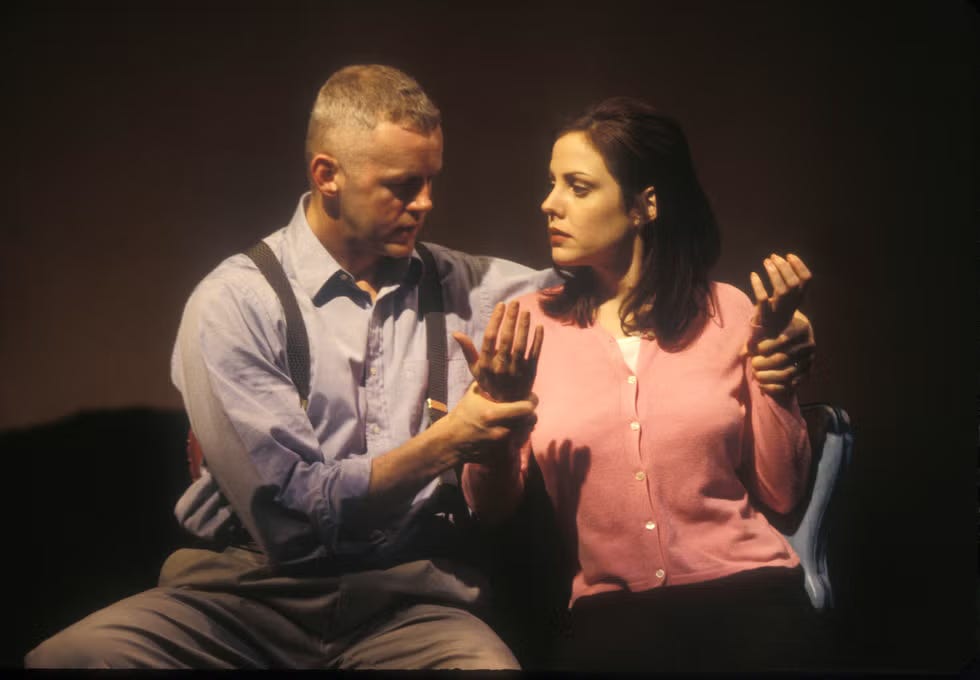
Loading summary
Transcript388 lines
- [00:00]
A
Sa. Hello all you theater lovers both out and proud and on the DL. And welcome back to Broadway Breakdown, a podcast discussing the history and legacy of American theater's most exclusive address, Broadway. This series is called Max Picks and it is covering shows that you all suggested that I did not pick out of a bowl, but I wanted to cover anyway. Our guest today is a friend of the pod. I believe this is her third. Third time on. Maybe fourth, I think.
- [01:00]
B
Third official.
- [01:02]
A
Third official. Third official. Although she has definitely contributed some information to me on some of my researches, so. But that's strictly off the record. I suppose you would best know her from her work as a writer on Playbill. You would also know her from her work on Life and Lessons from Berdue and Beyond. Or also a more recent work where she was co editor of Blood, Sweat and Queers. A vampiric. Sorry, I have the full title here. Vampiric Love Stories. She's also a according to her website, and I don't know why she would lie about this, but she is the youngest known nominator in the history of the Drama Desk Awards.
- [01:37]
B
I got bullied by Peter Felicia into putting that on my website. It is true. It feels hokey to state, but it's true.
- [01:44]
A
I mean, facts are facts and you can't argue with the facts. However, let's be real. You best know her from her appearances on this podcast. It is Margaret Hall. Hi, Margaret. Hi, Maggie.
- [01:56]
B
Hi.
- [01:58]
A
How have you been since I last saw you?
- [02:01]
B
Since you last saw me? Well, I did laundry, I meal prepped. I got very excited about some casting news we're gonna get at midnight.
- [02:12]
A
Mm. Mm. I'm very excited about that too. I realized I've actually now seen you twice in two weeks, which is such.
- [02:19]
B
A luxury for us.
- [02:20]
A
So wonderful. Yeah. Because we try to see each other, but tends to be more that we see each other by accident because we're both so busy, but our paths cross all the time. But we had two times in two weeks where we, like, made a point to see each other and we did.
- [02:32]
B
It every once in a while. The industry will allow you to see your friends. It is not often, but sometimes you get that moment.
- [02:41]
A
It's true. I will be grateful for the industry that it has not forced me into rooms with people I didn't want to see again. But maybe that's because I'm not going into all those rooms all that much.
- [02:53]
B
Fair. It's happened to me occasionally, but it's not regular.
- [02:57]
A
Yeah. Yeah. I find that I'm more pleasantly surprised to see people at things than finding someone there and going, oh, God, this person. Although, in my defense, the number of people that I would be happy to see in a room is a lot longer of a list than the people I would not be happy to see.
- [03:15]
B
100% agreed. Yes.
- [03:17]
A
I hope that everyone feels the same about me. Maybe I'm that person. Like, I keep running into goddamn Coplick. What am I gonna do by.
- [03:26]
B
Did you see my reaction when I ran into you at that reading this summer? I almost jumped out of my skin. I was so happy.
- [03:31]
A
You were like ponyo huggin Sosuke. It was great. It was great.
- [03:36]
B
Lovely. What a good surprise.
- [03:38]
A
Yes. And that was the reading that I was in. Everybody never forget that he sometimes goes on stage, which is a good reminder for everyone that there will be a link to tickets for Sondheim Webber. A Birthday Threesome at Greenroom 42 March 6th at 7pm Woohoo. Woohoo. Very exciting stuff. Margaret, Maggie, Matthew, what are we discussing today?
- [04:01]
B
We are discussing Paula Vogel's How I Learned to Drive.
- [04:05]
A
Mm. The Pulitzer Prize winning How I Learned to Drive. I will do a quick recap of this for everyone, and then we'll get into the deepest of dives for it. I should probably put a warning now for anyone that this is a play that deals with very complicated and very traumatic issues. It's a very dark subject matter, and it's one that I'm personally very excited to finally tackle. But if you have any triggers when it comes to sexual assault, sexual abuse, grooming, gaslighting, motor vehicles, incest. Yeah, incest. That'll that old chestnut. But in fairness to this play, it's not Aspects of Love. So the incest is a little more meant to be grossing you out and not meant to sort of be like Romeo and Juliet.
- [05:00]
B
No, not at all.
- [05:02]
A
No. But yeah. So if this is anything that troubles you or that you really don't think you can handle listening to, I understand and would recommend that maybe you wait for the next week's episode. Please know that Margaret and I are very empathetic people who come to this with our own baggage and journeys. And we will be dealing with this, I hope, in a tasteful manner on my end. I know you will, but I can't speak for myself.
- [05:29]
B
But also you on a short leash.
- [05:31]
A
Thank you. But also, this is Broadway Breakdown, so this is not going to be trauma dumping. This is not a therapy session. It's sort of a. It's a mix of the both, which I think is emblematic of the plate itself. This is a play that is surprisingly funny, surprisingly tender, and surprisingly even. Is it even keeled or even peeled? I never even keeled. Even keeled. Thank you. So, with that in mind, let's jump into the synopsis. As per stage agent, Paula Vogel's groundbreaking and controversial play, How I Learned to Drive, tells the story of a young girl who grows up in a complex and sexually abusive relationship with her uncle in 1960s Maryland. The play follows the young girl a little bit from her adolescence through college years and ends with her as a 30 something adult. Although Lil Bit and her uncle share a mutual understanding and care deeply for one another, the years of manipulation and sexual confusion eventually drive them apart and wreak havoc on both of their psyches. I would say that that's relatively accurate. Without giving too much of the plot.
- [06:31]
B
Away, I'd give it an 8.5 out of 10.
- [06:35]
A
Yeah. I'm not sure how I would do a better job, but I'm sure that there's one that could be done.
- [06:42]
B
I'd be interested to see how Paula would write a nut graph for it at this point in her life.
- [06:48]
A
Sure. Well, her. Her pitch at the time, her elevator pitch, when she was sort of sending this play out all over New York, was that it was Lolita. From the perspective of Lolita.
- [06:59]
B
Mm.
- [07:00]
A
Which I think that's a very good elevator pitch.
- [07:02]
B
And in the 90s especially.
- [07:04]
A
Oh, for sure. Before, you know, this play premiered in New York City in 1997. And when you read it and watch it now, knowing all the conversations that we've had since then, it's surprising how in depth this play goes when this was something that wasn't discussed at all in the 90s. So it's really masterful how well it's held up in that. In that respect.
- [07:30]
B
She's a master of her craft.
- [07:32]
A
Yeah. I mean, I won't lie. I've been very open about my dislike for Mother Play, but I also was. I was talking to a friend about this today. Hey, Wyatt, if you're listening, I think I'm so hard on Mother Play because I like Vogel so much. This is. I've said many times, this is one of my favorite plays. Top three plays for me. I also really enjoy Indecent. I've only gotten to read Baltimore Waltz. We read it in college, but I never got to see it staged. I would imagine it's very good staged, but with Mother Play, I was like, oh, my God. Vogel, Landau, Silay, Keenan, Bolger, even Lang and Parsons. And I was like, ready for it to be my personality. Twas not. And I got very angry. That tends to be my pattern. When I want something to be amazing. When I think it's going to really, like, blow my socks off, and it doesn't, I get resentful.
- [08:20]
B
I get it. I won't name names, but I have a couple of artists that are very important to me, and I have a lot more leeway. I think it's the writer in me. I have a lot more leeway for someone writing a project that isn't necessarily for me, but I know it's something they needed to get out of themselves. That's kind of how I approach Mother Play of. I think that's a story Vogel needed to tell, and therefore I am glad Vogel told it. When I get, like, not resentful, but, like, I get mad. And specifically, some of the people I'm thinking of are artists that I am lucky enough to know personally, I will send an email and be like, hey. Is when I can tell they're telling something that isn't true to who they are and their perspective on the world. That's the stuff that will really rankle me if I think it's honest and I just don't happen to like it. I respect it much more than if I think it's dishonest.
- [09:15]
A
Oh, for sure. For sure. And I also feel like I've been very good about talking about works and recognizing if it's not for me, but seeing the craft, seeing the expertise.
- [09:25]
B
You are very good at that.
- [09:27]
A
Thank you. I see. And that's a professional drama desk nominator. Everybody. She knows of what she speak.
- [09:33]
B
Oh, boy.
- [09:35]
A
So, Maggie, how did this show. How did. How I Learned to Drive Enter your.
- [09:39]
B
Chat so properly college. I was aware of it in high school, but this is not exactly the kind of script you get at your public library in suburban Ohio. But I was, like, aware of the concept of it. I'd probably, like, read some kind of a reference to it in, like, a Pulitzer compendium or something. But in college, a friend of mine did a scene from it in scene study class, and that led me down the rabbit hole, which I think is true for a lot of BFA students is they find a lot of material through the stuff their friends are doing.
- [10:21]
A
That's absolutely true. Do you remember which scene it was?
- [10:25]
B
The photography scene.
- [10:27]
A
Interesting. Okay. Okay. I would have thought it would be the hotel scene, but, yeah, the photography scene makes a lot of sense.
- [10:34]
B
She was exploring a very specific part of herself that she had not yet been able to engage with. And it was really captivating to watch. And knowing what little I did know about the play and then watching that scene, it was such a dichotomy of, like, I don't know how these two things I know about this piece now fit together. I need to read the full thing to see how these link.
- [10:55]
A
Yeah, absolutely. And then do you remember when you finally got to see it performed?
- [11:00]
B
So I've never actually seen it fully live. My engagement with the revival was through this beautiful, beautiful company that I know. We are both fans of this program called the Theater on Film and Tape Archive. I love Toft. I love you, Steve. I love you, Brandon.
- [11:20]
A
Hey, guys.
- [11:21]
B
They're the best. Matt and I actually just went and watched the 1997 production. To both be on the same page about that original as well. Going into this. Toft is great. We love Toft. And so that was the first time I watched a staging of. It was the recording of the revival.
- [11:39]
A
Right. And do you remember when you watched that? Was that for this, or was that a while ago?
- [11:45]
B
It was a couple years ago. So I do the My Life in the Theater series Playbill, and if I am doing a playwright or a composer, lyricist, if I'm not already very familiar with their work, I didn't really need to brush up on Stephen Schwartz. But if, for whatever reason, I'm like, oh, I feel like there's a gap in my knowledge before I do the interview, I will go to Toft and I'll watch what I can. And we did one with Paula, so I watched as much as I could.
- [12:12]
A
Amazing. So you watched the revival of How I Learned to Drive. What were the other things you watched?
- [12:17]
B
I watched Indecent, and they didn't have a full recording, but they had, like.
- [12:24]
A
Pieces of Baltimore Waltz with Cherry Jones.
- [12:27]
B
Yeah.
- [12:28]
A
Mm. I would like to go and see some of those pieces. How did you find the pieces?
- [12:32]
B
I love Indecent. I have no.
- [12:35]
A
Sorry. Not Indecent. The Pieces of Baltimore Waltz.
- [12:37]
B
Oh, the Pieces of Baltimore Waltz. I liked it. I feel like I cannot, in any direction, make a formal declaration until I've seen it in full.
- [12:47]
A
Sure.
- [12:47]
B
But having read the piece and seen the bits that I saw, I enjoyed.
- [12:51]
A
Yeah. You can't make a full declaration? What are you, a professional or something?
- [12:55]
B
How dare I have ethics?
- [12:57]
A
Oh, my God. And not in this community. My God. Oh, my God. I also first became aware of this play in college, not through any classes. No one that I know ever did scenes from it. Maybe someone in the acting class, in the bfa acting program did it, but we never shared many classes with them. So it's. It's just. I wouldn't know for sure, but I'd always heard about, and particularly had always heard about Mary Louise Parker and David Morse's performances from the original Vineyard production. That's something that growing up in New York City and being a theater fan and trying to get to know as many people as I could who had been around longer than I had and had theater going memories, a lot of the. So when I was in high school, I was taking acting classes and was getting coached on college auditions by professionals who were working on Broadway at that time who were about 10 to 15 years older than me. And this was one of those things that was talked a lot about to me of like, to them, Mary Louise Parker and David Morris in the Vineyard premiere of How I Learned to Drive to Them was like the gold standard. It very much reminded me of Broadway, the golden age of all of those legends. All sang Laurette Taylor and the Glass Menagerie one after the other.
- [14:19]
B
Every teacher has that performance that they just become evangelicals for. I'm notorious amongst my students. I never shut up about Michael Cerverus. And in the next room, surprise, surprise, there she is. Everyone has that performance that will never.
- [14:35]
A
Leave their brain 1000%. I will say I've got a few. My Michael Cervis performance is Fun Home, but also Michael Cervis brings it to every ball. So I don't feel like there's any actor alive.
- [14:47]
B
And I will fight anyone who says otherwise. There are other incredibly talented performers. He has a kaleidoscope.
- [14:54]
A
Yeah. He's actually somebody. Part of me was like, oh, he could maybe play Uncle Peck. But in a way he sort of did in Fun Home, a version of Uncle Peck.
- [15:02]
B
I would say this is absolutely the kind of role he could play. One of my big takeaways after having just seen him play Scrooge in A Christmas Carol is I want him to get to play happy more because it was so joyous watching him play Scrooge. Like post Revelation, when he's just so happy running around and enjoying Christmas. I would like to see him play happy next.
- [15:24]
A
Sure. Well, I think that's sort of what makes Peck such an interesting role, is that for all the monstrous things that he is, the key to him is that he's quite charming. And that was something that Ben Bramley couldn't get over in his initial review at the Vineyard. It's fascinating you read that review and it's a total love Letter to David Morrison. Like, very positive about Mary Louise Parker, but he, like, can't get over David Morse.
- [15:48]
B
It's wild, but it also. It reminds me not to invoke a name no one wants to hear, but it reminds me of everything around American Beauty and people talking about Kevin Spacey, although, I mean, as far as I know, David is a lovely person. There's something that captivates people when they see people they perceive to be good playing bad. Really, really well.
- [16:14]
A
Yeah. I think with American Beauty at the time, it was viewed as such, like, a tortive force narrative for Spacey, and it took a few years for the rest of the world to be like. And Annette Bening is also very amazing in that movie.
- [16:29]
B
Annette's here, too. Can we play it?
- [16:32]
A
Yeah. Annette probably should have won that year, and now she may never. So it sucks. But anyway, yeah, I. I knew about it. I had heard about it. And then in college, we had a teacher who mentioned an encounter he'd had with Paula Vogel in a car on their way to, I think, doing a show together, like, at a theater company, and her talking a bit about her process about writing this play, which we'll talk about in a second. And I never knew what the subject matter of the play was, so when he was discussing it to us in class, I was like, oh, shit. Oh, oh, oh, shit. So that's what the title means. And I finally got to see it live in 2012, 2013 at second stage.
- [17:17]
B
Okay.
- [17:17]
A
Yeah, yeah. That was with Elizabeth Reaser as Lil Bit and Norbert Leo Butz as Peck. And that was kind of an American Beauty narrative where that production, all everyone could talk about was Norbert Leo Butts, this tour de force for him as Peck, and it actually really unbalanced the production.
- [17:40]
B
I love Elizabeth, but Norbert, his entire career has been a force of charisma. It's just who he is. It's what makes him a star, is he has that energy that you can't not watch. And that's a really tricky thing to play with in a show like this, where you're having to watch someone who just has such an inherently likable energy play, someone that truly is doing abhorrent things, but in a way that isn't like horror movie, grotesque.
- [18:11]
A
Yeah. Because the way that the play is written, in the way that it's usually staged, it's all very hyper theatrical, stylized, abstract. So you. Only on one occasion, we'll get to that occasion. Do you see the horrors literally happen. Everything else is done in a way that it's kind of to our comfort.
- [18:32]
B
And Paula does a masterful job of it. She takes a topic that. This is the kind of play. I think trigger warnings in theater in general are a good thing. I think it's always better for people to have information if they need it. This is the kind of play that I would not take someone to if I did not talk to them about it beforehand to make sure they were good.
- [18:53]
A
Yeah. I would not tell them what the plot was, but I would. Similar to what we did at the top of, like, these are the themes it's going to cover.
- [19:01]
B
Is this something you can handle right now?
- [19:03]
A
Exactly. And I'm not. I've always been a huge champion of. Of, you know, going outside of your comfort zone a little bit and really kind of confronting some difficult things that we. That you need to do. And I. And I practice what I preach because in 2022, I saw the revival with my mother, and that was very much an experience. And we will talk about it. I swear. This play to me is. It's a memory play. It's a play about understanding and absolvement. It's sort of. It's like a. It's a memory play and a therapy session all in one without it actually being so on the nose about either. Because. Jumps around with. With the chronology of events a little bit. But mostly what it does is it just sort of goes back. It goes mostly backwards in time with one or two jump forward again. And the purpose of that is Vogel wants us to get the shock of Lil bit and Peck's relationship over and done with as soon as possible. And the way she does that is when we see them for the first time. They've been. They've been in this dynamic for a few years now, and it's kind of become routine for them. And because they're so casual about it, we kind of get sucked into the casualness very quickly. And then as it keeps going backwards in time, part of us is we're trying to piece together sort of the narrative here, but we're also going like, okay, but then when did this start and how did it start? And like, God damn. Like, how early does it go? Because we first meet them when she's 17, and then it's 16 and it's happening and 15 is happening. It's like, how early did this begin? And we eventually get the answer. And it's terrible, but because it's the brilliance of the play, of suckering you into the charm of this man and what we think is the independence of Little Bit, as much as she can have throughout all of this. And they're very complicated feelings for each other. And then when you see what the inciting incident is at the very end of the play that started this whole thing, it's like, oh, no, no, no, no, no. This always was awful. This always was assault. It's. But everything. But it's. But it also tackles the complicated feelings one can have for the person who damaged them in many ways, but also gave them so much at the same time.
- [21:34]
B
It's the kind of play that I've been talking a lot about issue plays today, actually, and it's what I wish that term actually meant of someone taking a really well rounded, thoughtful approach to presenting something to an audience of, like, this is what it is like to be inside this. You can stand outside it and judge it from all angles. And I'm not saying those judgments are wrong, but when you are inside it, this is what it feels like.
- [22:08]
A
Yeah.
- [22:09]
B
I think that's the best way to coax an audience into an empathetic experience.
- [22:15]
A
Absolutely. And I think what helps is this is a situation that Vogel had real life experience with, and so she was able to put in her truth and put in all of the complicated feelings and thoughts she had about it that had been living within. Within her for decades. She had a lot of time to stew on this subject matter and her story in particular. And so when she all came out on the page, in a lot of ways, it was very easy for her to write because she kind of went with what happened, and then she used her dramatist brain to make it compelling theater. And then the smart, nuanced side of her made sure to give both characters their due and their barbs, because Little Bit is not a perfect victim in the way that, you know, people always complain about when stories of sexual violence occur. She has her own. She's done her own damage. Not necessarily in her. In her grooming, but post Peck, she has done damage to others. We. We learned there's a story of her. Um, you know, she paints it as seducing a young man. We never really know the age of the young man. It can. It could possibly be considered legally assault and statutory rape, but we don't ever know. And she connects it to her time with Peck, and it's. It. It keeps you having to constantly think and work about how you feel about both these characters all the time. And that's what makes this play, in my opinion, so brilliant.
- [23:58]
B
Yeah, I really. Sorry. I really do think it is one of, if not the best depictions of childhood sexual assault on stage. I think it's a really difficult conversation and thing that, like, I have friends with social work degrees and they still really struggle to talk about recidivism and cycles. And when it comes to this stuff, it's a really icky, uncomfortable thing that most well adjusted human beings do not love to discuss. It's not, I guess, flashy would be the term for it. It just. If it is not something you yourself has experienced, it is not a place you want to go in your psyche.
- [24:49]
A
Right.
- [24:50]
B
And even if you have experience, you don't necessarily want to go there. You just know where it is.
- [24:55]
A
Yeah. You know where the body was married.
- [24:57]
B
Yeah. And this is just such. Even Kiel, that phrase you used earlier, I think is a good term for it, of she doesn't pull a single punch. But that is true for every character in the piece. It would be very easy and probably would have been easier for her to write just a straight up here's why My uncle is the Devil piece. He does not come out of this good by any means. But. And I think it's one of the benefits of this not being like the first play Vogel sat down to write, and not even the first semi autobiographical piece that Vogel sat down to write. I go back, I talk to a lot of young dramatists in every flavor, and we talk a lot about sort of putting yourself in your work and when should you and when shouldn't you? I am all for artists pulling from their own life when it is something they feel they need to do. I always think you need to have written at least one thing that's not about you first, because I think it teaches you the tools you need to safely mine your own life. I can't imagine how difficult the experience of this play winning a Pulitzer and going on to become internationally acclaimed would have been if Vogel had not known where her own lines of boundary were with this. And if she just straight up poured it out diaristically, she finds just the right line between this is a real story and this is everyone's story. And I think that's what makes it a true masterpiece.
- [26:45]
A
Yeah. Well, it's a very well rounded take on Lilibet's experience. And I think it also helps that it is the character looking back on it all rather than living through it in real time. I think we can go in a little bit sort of the how we got here and then go a bit more into the depths of this play. So Vogel, by this point had made a big splash in Baltimore Waltz, which was done in New York, I think, at the Atlantic Theater Company.
- [27:14]
B
Sounds right.
- [27:15]
A
Sounds right. She became the artist in residence for Perseverance Theater, which is in Juneau, Alaska, and she was going to write a play. So this. You can hear all about this, by the way, through Ms. Maggie Hall's wonderful work with my Life in theater, there's a giant section on how I learned to drive. When Vogel talks about it, and I shit. You notice when she says, okay, here's how I learned to drive happened. She spends six minutes talking about the story of Farinelli, this castrati, you know, counter tenor, and his. And his experience with the King of Spain. Yes. Which would go on to become the play Farinelli and the King with Mark Rylance. But she goes on the entire journey of this story.
- [28:00]
B
Give me the script, Paula.
- [28:05]
A
It was just so funny. She's going on about. Because, I mean, she had done like three years of research on this. It was something really interested her. And it was gonna be because it was the moment of where Farinelli became sort of this confidant and muse and inspiration and reason for living for the gang of Spain and became one of the few people who could tell him what to do because his singing voice was so beautiful. But then his voice started to fail him and so he went back to Italy to sort of retrain his voice. And that was where the play was gonna start and it was gonna. Star Cherry Jones is going to be workshopped with her.
- [28:32]
B
Yeah, look, castrati people, that's just another, like, incredibly complex, difficult, people don't like to talk about it thing. People need to get on the castrati train right now because they are adapting Anne Rice's Cry to Heaven and it's going to star Nicholas Hoult and Aaron Taylor Johnson and it's going to change your life.
- [28:50]
A
I mean, I think that this is where Ariana Grande comes in and helps people because she famously had a sketch a year ago on SNL that was all about the personality.
- [29:04]
B
Sandberg and Maya Rudolph. Insane.
- [29:07]
A
And the great wig and facial expression of Ariana Grande, I'm convinced that that's what's got her. Her Oscar nomination a year ago was Wicked came out and then everyone saw that sketch and like, oh, maybe the girl has range.
- [29:18]
B
My slack profile photo for a significant length of time was a photo of Ariana Grande in that fuck ass wig with the kata.
- [29:27]
A
But so Vogel, I don't know if she had fully written it yet or she was. Or they were it was going to be developed when Cherry and she got to Perseverance Theater Company, but she gets to the airport and gets a phone call from Cherry Jones, and she says, paula, I'm in such a dilemma. I don't know what to do. I auditioned for the Heiress at Lincoln Center. I didn't think I was going to get it, but I got it. What do I do? And Paula's like, you're going to do the Heiress on Broadway? Screw my play.
- [29:54]
B
I love Cherry.
- [29:55]
A
Yeah. And like, it was the show that changed Cherry's life forever. Me, too.
- [29:58]
B
But also, what a good friend on both sides of Cherry going to Paula with this, and Paula saying, nah, I'm stepping in as a friend and telling you, you need to do this 1000%.
- [30:10]
A
Like, cherry wanting to do the right thing by her friend and trying to be honorable, and Paula being like, thank you so much for that. But, like, no, no, no, no. This is the obvious answer. And it ended up being the right choice for both of them. Because then what happened was Paula gets on the plane going, fuck, I have no play. And Cherry's not coming. And so she decides in that moment that she's going to write this play. Now, in articles leading up to the premiere at the Vineyard, the story goes that she'd had the idea in her head. And she talks about this a bit in my life in the theater. She really loves the novel Lolita, which I appreciate because I also love that novel. And I get very mad when I listen to people talk about that novel on interviews and don't understand what that novel is doing and then. And then try to drag said novel. What there. I really enjoyed Nicole Byers podcast why Won't yout Date Me? But she has an interview with Jamila Jamil from the Good Place, and it's a really good interview, but they get into Lolita for a hot second. And to be fair, they're mostly talking about the Lolita fashion pop culture element, which was ha. Which was having a resurgence at that time with the baby doll dresses and baby boys. But they also talk about the novel a little bit, and they're like, that novel's so weird. I was like, yeah, it's meant to be. It is. It is. Nabokov literally manipulating us into sympathizing with a child predator.
- [31:36]
B
Congrats. You are supposed to be uncomfortable.
- [31:38]
A
Absolutely. I remember reading it because it's like the most such beautiful, flowery poetry as you're reading it. And every three pages, I would just go, wait a second. And I'm like, you stop it right now. And on top of that, you. You're. It's an unreliable narrator. And you have to sort of read between the lines of what is actually happening in Dolores Brain that he, Humbert Humbert, cannot understand. And so she wanted with that in mind. And I think part of the reason why she connected to that was her own personal history with her uncle. And so she wanted to write a piece that gives Dolores a voice and also would kind of exorcise some of her demons. And she gets off the plane and everyone says, where's Cherry? She goes, so, funny story. Cherries booked and blessed, but not to worry, I think I got something. And she said she wrote it pretty quickly, that it was the summer in Alaska, so there was almost no nighttime. So she was like, I basically took power naps throughout the day. And I would write 20 hours a day for two weeks. And the play was fully formed. They do a reading. It goes incredibly well. She sends it to her agent, who sends it all over New York. And literally every nonprofit in New York City tells them, ooh, girl, you might want to workshop this one. It's not ready yet. I don't think you know who these characters are. And Paula Vogel had said, in my life in the theater, she's like, it's one of the few times in my life where I stood my ground. And I. She said, I think it would help that I had seen it done in Juno. And so I knew that it worked. And one last person they sent it to was the artistic director at Vineyard. He read it, called her up. This was like November, I guess. And he says, we're going to do it in March. We would like to do a reading in January. Not because we think you need any. Not because we want to try out some casting options. And they had her meet the director, Mark Brokaw. She loved him. They do the reading with Mary Louise Parker and David Morse at that point. Mary Louise Parker was best known for her breakthrough in Prelude to a Kiss on Broadway about six, seven years prior, and then had done quite a few sizable movies that she had large parts in. But she wasn't really like a movie star yet.
- [33:42]
B
No.
- [33:43]
A
Yeah. The best way I would describe it, like, you know how when they talk about sex in the city and how big of a deal it was that Sarah Jessica Parker was doing TV because she was a movie star, I'm like, okay, Sarah Jessica Parker was a well known movie actress. I don't know if I would call her a movie star. You know what I mean?
- [34:01]
B
I Won't tell. Matthew, you said that he was more.
- [34:04]
A
Famous than she was at the time.
- [34:06]
B
He undeniably was. No, it's. It's his favorite little gripe. Whenever anyone asks him about Sex and the City, he loves to tell the story about how he told Sarah to say no. And I'm like, why are we still telling the story, Matthew?
- [34:20]
A
You don't look good in this story, Matthew.
- [34:22]
B
You don't.
- [34:23]
A
No, but it's okay because that show paid for all of their homes. But so. But this is to say there's. There's. I feel like people are more understanding of what I mean by this with Mary Louise Parker now, because we have so few movie stars now. What? We have known movie actors. Yeah, Right. And so Mary Louise Parker had become a known movie actor and had done a little bit of theater post Prelude to a Kiss, did the terrible Bus Stop revival where she met Billy Crudup. Yeah, yeah. But she hadn't really paid out the theater check that was written to her when she did Prelude, because Prelude was very much like a. Who is this girl? This is going to be one of our great ladies of the stage. And then she runs immediately off to Hollywood and does, like, two bad shows in New York, and everyone's like, oh, God. Yeah, I understand Nell. Once Nell Carter won that Tony for aimless behavior, she was like, and I'm out tv, which you can't miss now. Don't we all miss Nell? But, like, you can't begrudge someone for wanting that exposure. And as Carrie Coon said, you need more exposure like that in order to do the projects you want to do.
- [35:27]
B
It's only gotten harder.
- [35:29]
A
Only gotten harder, but. So she and David Morse do it at the Vineyard, where it's an immediate success, and they transfer it to theater called Century Theater, which I don't know if that exists anymore.
- [35:39]
B
Not really.
- [35:41]
A
They said it's across the street from where Vineyard was. Slash is. Has Vineyard been in the same location since its impetus?
- [35:49]
B
I don't think since Impetus, but I think since 97. Yeah.
- [35:52]
A
Okay. Okay. So then I wonder, maybe it's where the Daryl Roth Theater now is.
- [35:59]
B
Or maybe the thing that's tricky about that whole sort of triangle between the Villages and Washington Square park and Union Square, just like that's sort of part of Manhattan that used to be the theater district. That whole area around Astor Place was one of the original theater districts.
- [36:21]
A
Yeah.
- [36:21]
B
And while a lot of it has now been converted into office space and shops and things like that, the bones are still there. That A lot of those buildings could revert back into theaters if they so chose. I don't think 90% of them are going to. But, like, there could be. I'm not entirely sure where Century was on that block, but it. The bones of it are probably still there.
- [36:48]
A
Probably. Yeah. I mean, listen, that. That Petco is going to remain a Petco. It's not going to become the Union Square Theater ever again. People like. People like their Petco. But it's fine. It's okay. It's all right. It's whatever. But, yeah, the show does run for a year. Vogel wins the Pulitzer for it, and Morse and Parker get massive acclaim. They win basically every award I think they could have won for their Off Broadway run. I think there might have. There's only. The only thing they didn't win was, like, the Drama League, which. I don't even know if that was even happening yet at that point. I have it written down somewhere. It's because they won the Lortel. They won. Parker and Morse won the Lortel and the Drama Desk. Oh, they didn't win the Outer Critics Circle, but Vogel did. Vogel did, and she won the New York Drama Critics Awards. I think Morrison Parker got an honorary award at the Outer Critics Circle. Or maybe one. Or maybe it was the New York Drama Critics. There's one awards group where, like, they didn't win a competitive award. They jointly received an honorary award.
- [37:50]
B
That is like a nominator's way of guaranteeing you get something because they feel that strongly.
- [37:54]
A
Yeah. And it's sort of like, we want to. We want to be fair to everyone else who isn't you. So you're gonna get a separate thing to know that we think that highly of you. But, yeah, this was, like, this show really kind of made a huge splash at a time when you still could with Off Broadway. But the fact that it became as huge as it was and never transferred to Broadway, I think is.
- [38:15]
B
Yeah, that's why it's like, you still can become a big deal off Broadway, but then you're almost, like, expected to then come in, and it's the Omar effect.
- [38:25]
A
Yeah, I think.
- [38:26]
B
Sorry, I just. There was, like, a very, I think, conscious decision made very early in the journey in the 90s of, like, this is an Off Broadway play. We are not looking for that scale of commercial that comes with Broadway.
- [38:42]
A
Yeah, there were. There weren't a lot of Broadway theaters at the time in 1997 that were intimate enough to accommodate this production.
- [38:53]
B
There had been. I don't know if the culture of Broadway. I mean, late 90s, we're looking at the Disney proliferation beginning to kick off on Broadway. There's some interesting work happening, for sure, but I don't necessarily know if a Broadway audience would have come running to this piece.
- [39:13]
A
I don't know if they would. You look at what was winning Best play in the 90s, and the ones that are the toughest subject matters are things like Angels in America, which is, you know, dealing with the AIDS crisis. But also, that is something on a more epic scale.
- [39:29]
B
Sure.
- [39:30]
A
And it's. And for a lot of audiences, it is something that maybe is a little more over there and. And. And is, again, a play that feels massively important, that they're doing the work by seeing. Right. And then you have plays like.
- [39:41]
B
Feels like a Greek epic.
- [39:43]
A
Yeah. And then even, like Love, Valor, Compassion, which is technically a more intimate piece, is also done in a highly theatrical style. It's three and a half hours long. It has that grandeur about it. How I Learned to drive is 90 to 100 minutes, depending on your tempo. And it is unrelenting. It's not trauma porn, but it is unrelenting.
- [40:02]
B
And the more bells and whistles you add to it, the worse it is. It's the kind of play that thrives if you strip it down to its nervous system.
- [40:10]
A
Yeah. If this had transferred directly to Broadway, like, immediately after opening, I think it would have been up against the Last Night of Ballyhoo. I want to say. What was it, 1997 Tony Awards? Which is, you know, a good play. But it's. Yeah. Last night I. I love my brain. I love me. It is absolutely the Last Night of Valley who by Alfred Urie. But that would have been if, like, they opened, got the reviews they got, and we're like, okay, so we're gonna go into the. Actually, they couldn't go into the haze because last night at Ballyhoo was in the Hayes with one. They're like, we're going into the booth in a week, everybody. See you there. But the Last Night of Ballyhoo, also, it's. You know, it deals with anti Semitism. It also has a lot of comedic elements to it. It's also done in the past, but in a more literal sense. It's. You know, it's. I think it's the 40s, maybe.
- [40:56]
B
And it's also Alfred Urie, who was having a moment in the 90s.
- [41:00]
A
Yeah. He had his Pulitzer from Drive him as Daisy. Then eventually his Oscar, like, it was. He was more of A known quantity than Paula Vogel was. Vogel was more on the rise at that point. And then even if that had come in the following year. You want to know what won best play in 1998? Art. That is what won best play.
- [41:18]
B
Oh, that could be a whole other conversation.
- [41:22]
A
I. I've already had it with myself when I reviewed the revival. And I gotta tell you, Maggie hall, there is no weirder conversation than with yourself about art. Just saying.
- [41:35]
B
Yeah.
- [41:36]
A
Yes.
- [41:36]
B
But probably up there.
- [41:37]
A
Yeah. We have a couple of major productions with How I Learned to Drive and a couple of notable replacements. Off Broadway. Jane Atkinson, Molly Ringwald. And Molly Ringwald.
- [41:48]
B
I would have loved to have seen Molly do this, because the thing that. So Mary Louise is perfect for this part. I think it's a career best performance. What she gives in this play. Molly Ringwald brings such a specific cultural baggage with her, especially in the late 90s. Having come off her, like, pop culture dominating run of the 80s, playing like the girl next door. It girl. Her in this role must have been crazy.
- [42:23]
A
Oh, yeah, I. From all accounts, she was successful in the role. And when she took over, she. I mean, she brought it over to la, which must have been its own kind of moment. But yeah, it's sort of, as you said, it's. It's that meta commentary of the ultimate girl next door playing a role where you don't want to know what's been happening next door. And Mary Louise Parker. What makes Mary Louise Parker such a fascinating actress is she has this unknowable quality about her. It's like this sort of ghostly mask. And it's not that she's hiding anything. It's almost that she is such an intelligent woman, obviously. But I feel like her characters often are so intelligent that they are navigating these complicated feelings in real time. And they're always kind of stepping back for a second to figure it all out. And you're watching her grapple with it in real time. And that is not necessarily cutesy girl next Door Y like of Ringwald, but it allows a character like Lil bit who is hyper, intelligent and analytical. It marries those qualities together in a really beautiful way. It's what made her such a perfect favor. Something like Prelude to a Kiss, that sort of otherworldly quality about her, that etherealness, if you will, that etherealness.
- [43:43]
B
But also she is one of the only performers of any gender that I have ever seen really be able to grasp and not just touch, but hold onto that particular flavor that can come with grooming of that. You're so mature for your age, where you see the child believing and internalizing that while also somehow still seeing them as the child. They are not playing up the kid thing so much that it gets hokey, but also not straight up playing them like an adult. It's a really fine line. And Mary Louise finds it, and she lives on that balance beam in this play. And she also finds a way to make disassociation on stage captivating 1000%. I think that's incredibly difficult because, I mean, when you're on stage and the lights are in your eyes, and especially when you have extended monologues like Little Bit has, your instinct is going to be to want to try and figure out fill with life in some way. And she had, like, this sense of self, and she worked things out with Mark Brokaw and David Morse that she had, like, the space and the silence and like, you could feel the air around her in some scenes. And I don't know if maybe for someone who's never experienced disassociation, if they wouldn't clock it, but as someone who has, you immediately know when she's tapping out in these interactions and she's like, okay, now I have to let him do his thing. I'm gonna go somewhere else.
- [45:22]
A
Yeah. There's something that I did not get the first time I saw the play in 2012. And part of this was the production. Part of this was grappling myself with my own baggage was I did not get that disassociation and that negotiation and that gaslighting between Peck and Lil Bit when I returned to it in 2022, the manipulation of Peck and the negotiation with herself. A little bit of every scene. Because there are scenes where Lilbit is unaware of what Peck is doing to her because simply, she's too young. The thing about you're so mature for your age is even with someone like Lilbit, where that might be true, she is still her age.
- [46:12]
B
Yep.
- [46:13]
A
And that is something that Mary Louise Parker does really well in both versions of the. Of the play, of having physical tics that are very teenagery without it being broad. It's just like, it's. It's sort of like with each age a little bit, as she gets younger and younger, she finds a new thing that A Little Bit does that probably got smoothed out as she got older and started to get a little more worn down by her relationship with Peck. And it's less cutesy, but it is. It reminds you that even if Little Bit is perceptive, even if she does have a Good vocabulary. She's a good learner. She is still a kid in so many ways. And she is trying to navigate weird waters with a man who has had so many, so many more years of experience than her and has done this before and, and has confused her into thinking that she is in control. So when he makes requests, she can feel like, I'm, I'm letting him do this. This is a favor to him. He's not doing anything to me. They're always talking about how she draws the line, she makes the rules. That's something that is repeated all the time and it's just simply not true.
- [47:29]
B
But he's done an incredibly good job of making her think it is so. And that's how it can go on for so long. The scene that I think exemplifies both of what we're talking about here, the martini scene and when she's throwing back the drawing martinis. And you watch Mary Louise as depicting a teen get drunker and drunker, not falling into drunk actor stereotypes either. But you watch her find the difference between disassociation, drunken, like, lack of awareness, dulled sensation, and then also real fear. And that really struck me when we were watching the 97 recording together, just the way that it was filmed. You could really see that moment in the car when he goes to get the blanket. You watch her almost come out of this stupor that he's worked her into with the alcohol and the years of grooming. You watch her almost be like, wait, this isn't right. And then you watch him put her back under. And it's. It's so insidious, but it's such delicate, well placed acting.
- [49:01]
A
Yeah, it is. There are times when there's a crack in the veneer of what Peck has built with Lil bit throughout the relationship where you see a little bit clock what may not be right or why not when I. What might not be safe or healthy for her, but then also genuine fear or genuine confusion, like when he goes to get the blanket. The fear she has for a quick second of not knowing what he's about to do it is just a gen. It's a genuine impulse. And when he comes back to bring her a blanket, she's relaxed a bit more. But that doesn't take away from the fact that there's a part of her that always feels like he could do something to her. Because I guess, you know, we, we're beating around the bush here, but I want, I'm not. I don't want to talk about it too much right now, because I want to get into it later because it was interesting for me watching the 97 video with you and watching it live in 2022 and the years of difference between the productions and the performances of the very first time that Peck assaulted Lil Bit. And that always, you see when you know that that's the moment that started it all. You see the trauma that still lives in her bones come out every now and then when they have interactions.
- [50:23]
B
Mm.
- [50:25]
A
Yeah. And one of the. I would. So the martini scene is one thing, which is when Lil bid turns 16, she gets. She goes for her driver's license, she aces the test, and she and Peck, to celebrate, do a long drive to a very historic inn where they go for seafood, and he lets her drink martinis. Because Peck, we learn, is an alcoholic, suffers from alcoholism. And part of the deal that she has with him ever since she was 13, was once a week we'll get together, but you can't drink when we're together. And so that has become a ritual of when they're together, he doesn't drink. Which is another thing that she has put on her shoulders of, well, if I don't keep this up, what's he going to do? Which is, again, another form of abuse and manipulation. It is not her. It is not this child's job to make. To help this man heal.
- [51:19]
B
She is 100% internalized that it is.
- [51:22]
A
Yes. Well, also, because the inciting incident to this relationship, the mother says the worst thing you could say to your child, which is, if anything happens, I am holding you responsible. Worse. Woof, woof, woof, woof, woof.
- [51:37]
B
Oh, and then get back to mother play.
- [51:42]
A
Well, so Lil Bit has a better relationship with her mother than either child does in Mother Play. It's not. It's not a great relationship, but it's a better relationship.
- [51:53]
B
It's a better relationship. I do wonder how much of that depends on the status of Vogel's own mother at the time each piece was written.
- [52:08]
A
It's possible. It's also possible that my feelings on the relationship are due to Joanna Day's performance as the mother.
- [52:16]
B
Yeah, Joanna Day is incredible.
- [52:17]
A
Yes. And Joanna. And so in this play, outside of Lil Bit and Peck, there are three other performers. An actress who plays the female chorus, an actor who plays the male chorus, and an actress who plays the teen chorus. And they play multiple roles. They play Lilbit's family. Her, her mother, her aunt, her grandfather, her grandmother, kids at school, a guy that Little Bit seduces on the bus, and so on. And so forth. And first of all, I did not realize that in the original Off Broadway production, we had Joanna Day, who would go on to be a Tony nominee for Sweat and would do the production again in 2022. We also had Carrie O' Malley as the teen chorus. Many would remember Kerry O' Malley as the Baker's Wife and the Vanessa Williams into the woods, but among other things. And then Michael Showal is the male chorus.
- [53:06]
B
Wild, wild, right? Who the fuck is that?
- [53:10]
A
I'm like, okay. Stacked cast. But the Joanna they plays both Lilibet's mother and her aunt. Her Aunt Mary is married to Peck, so Peck is her uncle through marriage. But he has known Lilibet ever since she was born. There is a line of, she was so small that she fit in his hand. He held her on the very first day she was born. Which adds a whole other level to all of this. But, yes, there's the. We have a conversation with Lil Bit, her mother and her grandmother about sex. And her mother is much more honest and forthcoming. And she is more open to the idea of her daughter being sexually active and trying to give her all the right information, which I think is always the correct thing to do. And then we have her aunt who.
- [53:56]
B
Her grandmother. Right.
- [53:57]
A
Well, sorry. Yeah, her grandmother in that scene. But her aunt, who's married to Peck, has a monologue in the last third of the show. I think it's right before the hotel scene. And I didn't realize this, but I definitely internalized this monologue when I wrote my own play and wrote. Yeah. And wrote the monologue for Aaron, which anyone who watched yours truly knows. The monologue I'm talking about, which is a character who is tied to somebody. And it's a whole monologue of denial. And it is a monologue that is perfectly crafted to, again, say things that are probably true and lead up front with all of the positives that they feel and that they think can be proven correct about the person they're talking about. And then any sympathy we might have had for this person twists Aunt Mary, who we are all going, oh, my God, this poor woman. She doesn't know who she's married to. She doesn't know the monster that she has. And she thinks she's got this great husband. And then we find out that she's known all along. And not only that, but has known about Peck's troubles. Lilibet is absolutely not the first person. And the play makes this abundantly clear. Cause he has a monologue with a nephew of his when he goes back home because, again, Peck is not of Lilibet's actual blood family. He's from further down south, and he only goes home occasionally. He doesn't visit his family very often. And the implication is that his family is embarrassed by him because they don't feel like that he lived up to his potential. And maybe part of that is true, but there is definitely an argument to be made that they don't want him there because he's dangerous.
- [55:40]
B
That's what I always think.
- [55:41]
A
Yeah. And that is made very clear when he had. When we watch again, what should be a kind moment between uncle and nephew turn into the beginnings of a horror scene.
- [55:55]
B
Oh, my God. When he brings up the treehouse.
- [55:57]
A
When he brings up the treehouse, it's. The scene we're talking about is there's a monologue that Peck has with his young nephew, little Bobby bb, when he goes back home for a little bit, and they're fishing, and we never see little Bobby. He's.
- [56:11]
B
You know, he's very intentionally just someone Peck is speaking to. There is no actual young boy on stage.
- [56:18]
A
Exactly. And Peck is showing him how to fish and telling him his memories of being a boy in that same area. And Bobby starts to cry once the fish is caught because he's afraid that the fish is in pain. And so Peck takes it off and throws it back. And first he tries to say, oh, you know, you don't want the other boys to laugh at you, Maybe toughen up a bit. And when he realizes that that's not the way to go, he goes the other way, takes the fish off, and he comforts him and tells him, you know, it's okay. Men have feelings. We cry. We cry all the time. And there's nothing wrong with that. Don't let anyone tell you different. So, like, how are you feeling? You feeling okay? Great. He goes, hey, listen, there's a treehouse around here that I used to go to a lot as a kid. I think it's still around. I would love to show it to you, but this is our special thing. You can't. Don't tell your mom, don't tell your sisters, don't tell your aunt. And you just know what's about to happen. He even brings up, like, them sharing a beer together. And we don't know how young little Bobby is, but he's not 18.
- [57:18]
B
I always picture, like, five or six.
- [57:21]
A
Yeah, I. I think when I'm trying to be less traumatized, I picture about 10.
- [57:28]
B
But the way he react to the fish and not knowing if the fish is. It just reads as so kindergarten to me.
- [57:36]
A
Yeah, it does. But also, I was a very sensitive kid and cried pretty much all the time until I was 12, so that's me projecting, but. So there could be a. It could be 5, it could be 10, could be 7. Again, the one thing we both can say, he ain't 18.
- [57:51]
B
No.
- [57:52]
A
And so Little Bit is not this isolated incident. Not that it would make it any better if she were. But Aunt Mary is very aware of Peck's quote unquote troubles, and she ties it to his time in the army. He fought in World War II, and he won't talk about what happened, but she knows that something did. He has moods. He has waves of melancholy on we. And she thinks that it's her job to bring him back. And she views his relationship with Lil Bit as a manipulation on Lil B's part. She blames her and says she knows what she's doing. And I'm counting the days till she goes to college because I would like my husband back. And again, any sympathy we might have had for this woman goes out the window. And unfortunately, this is a very realistic monologue.
- [58:39]
B
Very.
- [58:41]
A
Yeah. I was just listening to my friend Patrick's true crime podcast called the Secrets We Bury or something like that. And it's this family where they always thought that their father had left when they were kids and their mother remarried this really abusive man. And many, many years later, they learned that their father actually didn't leave them. He was murdered and buried in their basement. And one of the things is, the stepfather started to abuse the two daughters in the family sexually into their teens. And the mother didn't believe the daughters when they were. When they told her about this when they were younger. But then as time goes by and the stepfather dies and all this stuff, the mother's on her dying bed. She's on her deathbed, and she's dying of cancer. And she turns to the daughter, one of the daughters, the one who's still around, and asks her was she in love with the stepfather or not? And when you hear that, you go, oh, oh, your psychosis was in deep. That this is where your brain went, that it wasn't abuse, that it was an affair. No.
- [59:49]
B
Yeah. It's an. We're not going to linger on this for too long. But it is a really devastating statistic, the number of women that will stay with men that abuse their children.
- [60:06]
A
Mm.
- [60:07]
B
It's a really quite horrifying thing. There are many psychology books written about it. I have a weird journey with this particular monologue of Lilibet's Ants, where I think it's kind of like a masterpiece. And I would immediately be mad at anyone who brought it in for an audition.
- [60:35]
A
Yeah.
- [60:36]
B
Unless you're like specifically auditioning for this play.
- [60:43]
A
It's a hard one to grapple with out of context.
- [60:48]
B
And it's also. It's the kind of thing that like, if you just like brought it in for like your master's audition or whatever, you have killed that room for every single person who's coming in after you. Because unless you have like the hardest hearted audition person in front of you, and maybe you do, but hopefully you have someone who still has feeling in their chest, it's not going to leave their mind by the time the next person comes in for their 90 seconds of. It's so well written. It's so the comparison I have made before when talking about this monologue is the song the Ballad of Booth from Assassins. And the ways in which you're lulled into believing this narrative about a person that they are telling you about themselves. And then just at the right moment when they know they've got you on the hook fish style, you're pulled up and thrust into the reality that is dark and is bad. And it's incredibly effective. It's startling, it's shocking, it's upsetting and it's supposed to be. And it's really very easy to get sort of lost in talking about how brilliant Mary Louise and David were. Bringing back Joanna for the revival was a brilliant stroke. Because what she does with that piece, I feel like I would need decompression therapy after every show.
- [62:22]
A
Well, famously with the revival, Mary Louise Parker did not stage door. She. She had it under contract that she would go straight from Bows out the stage door into a car and head home. Because that's what she needed to do at eight times a week.
- [62:34]
B
Yeah.
- [62:34]
A
Which I highly respect. Let's actually talk a little bit about sort of our views on both productions and the time in between them. First of all, this 1997 video. Who do we have to thank for this video? Margaret Hall.
- [62:47]
B
Oh, I love you, Paul Newman.
- [62:50]
A
Thank you, Paul Newman. Maggie, walk our listeners through this. You and I sit down at Taft and we begin the video.
- [62:59]
B
No. It's a freezing day in New York. It's one of those true cold winter days. We're bundled up. We both make our way during our lunch hours to the theater on Film and Tape Archive. We say hello to Steve. We make our way in we sit down at our Tandem computers. We press play. We have our headphones on. We're locked in. This presentation is presented to you by Newman Zone. And I pause and I rewind and we watch.
- [63:30]
A
It doesn't even consult me either. She felt so harshly about it, she instinctively went and rewound it.
- [63:38]
B
Wait a second. Let's go back 10 seconds. Play it back. Presented to you by Newman's Own. I am glad the salad dressing contributed to some theater.
- [63:50]
A
Absolutely.
- [63:51]
B
And the lemonade, the fact that it's Newman's Own, it's not Paul Newman. It's not his foundation which exists. It's Newman's Own. That truly, I'm gonna cherish that fact for the rest of my life. It's gonna come up regularly. I'm also now going to be very annoying and try and figure out every single Toft recording that Newman Zone underwrote. I want to know what they picked.
- [64:24]
A
If only more shows could be preserved because of Salad Dressing and lemonade, you.
- [64:28]
B
Know, Give me the Dead Outlaw recording brought to you by Heinz.
- [64:32]
A
Listen, if K Pop had appealed to Newman's Own, we would have a K Pop recording at Toft.
- [64:39]
B
Come on, Paul, get on the ghost of your board.
- [64:43]
A
Literally. Joanne Woodard. Come on. Just like, get on in there. Haunt.
- [64:47]
B
That's what haunting is for.
- [64:51]
A
Exactly.
- [64:52]
B
Haunts his theater until a show comes along that he likes. Do it with the Newman's Own board.
- [65:01]
A
Haunt your chairman's bedroom every night.
- [65:06]
B
The idea of them, like, Christmas caroling it. But it's just Paul, Joanna, and like, I don't know, Paul's bestie, Robert. It can be Robert Redford. Robert Redford's dead.
- [65:16]
A
Now.
- [65:16]
B
The three of them show up and they're just like, we are going to wheel you into taking all of this money you've made. Yes, I know. Most of it goes to the children's charities. What about a play about child sexual assault? Goodbye. It killed me. It. Oh, it took a lot of self control to not get really loud in that screening room. And if it had just been us and Steve, I would have. But there were a couple other people watching, like Jelly's Last Jam that I was like, we cannot interrupt their experience right now. But the second time I played, I remember turning and I just went, is that the same Newman? Is there a different Newman Zone I don't know about?
- [65:58]
A
And you were like, I don't. I don't think so. I think that's the only one. And you know, that's now a third use I've had for Newman's Own in this world.
- [66:11]
B
It's like, I don't love corporatism in theater. I do love that Newman's Own is the reason we have a record of the original Off Broadway production of How I Learned to Drive that. If corporations want to get involved in theater, that is the way to do it. Don't fuss with the creation of it. Let artists make what they want to make and then just give them money.
- [66:35]
A
No, one 1000%. Just like the. The money, please. And then we will be on our very merry way.
- [66:42]
B
But give her a check.
- [66:43]
A
Yeah. It's like this recording of Slave Play is made possible by Jelly Belly.
- [66:52]
B
The one that someone suggested is like a joke a while ago. And I was like. But like, do you realize that's real? Like, you don't actually know that this is real. Someone made a joke a couple weeks ago about how, like, Ford should sponsor the Ragtime Tony performance. And I was like, do you. Do you realize where Ragtime premiered? On Broadway.
- [67:13]
A
Yes. Has no one told you about the birth name of the Lyric Theater?
- [67:17]
B
Not the birth name. Not the dead name of the Lyric.
- [67:21]
A
I'm happy. I think there are a few things that we are allowed to dead name. One is Twitter.
- [67:26]
B
Yes.
- [67:26]
A
And the other is Broadway theaters. I'm allowed to dead name the Ella Hirschfeltons and call it the Martin Beck from time to time. When I so choose.
- [67:33]
B
Yes. When it makes sense. No. I had to explain the concept of the Ford Performing Arts center to this person, and I watched the light go out in their eyes a little bit. And I'm like, I mean, yeah. Why do you think Terrence McNally of all people, was kind of this gentle on Henry Ford? Why do you think he does not reappear when J.P. morgan does?
- [67:59]
A
We're just saying. We're just saying, follow the money.
- [68:02]
B
Follow the money, baby.
- [68:05]
A
So what is something that sticks out to you between 97 and 2022?
- [68:11]
B
Oh, Mary Louise. Mary Louise. I truly cannot imagine what Mary Louise had to go through mentally to get herself back in that headspace. Now, as a mother, it's one thing to be playing little bit like she's nowhere. She's not actually little bits 8. She's not 11, but she was like, what, like early 30s?
- [68:44]
A
Yeah, she's about 32, 33. When she did the show the first time.
- [68:47]
B
She's. And she's very much an adult, but she's close enough that you're still shedding some of that coming of age skin by the time she comes back to it. Children of her Own. She and Paula have known each other longer than everything that went down with Uncle Peck and Little Bit Happened. She's lived through the MeToo movement and witnessed that. I just, I. I think a lot about actors who have to play abused children after raising children themselves, because I think it changes your relationship with that dynamic when you are playing from the perspective of, I have been a child, so I know what it is to play a child versus I have been a parent, and I am playing this child while also understanding something much more intrinsically deep about the person who is abusing me. It's so messy, but in like, a dramatically rich kind of way.
- [70:05]
A
Yeah. It's the thing that is burned in my brain. So when comparing the two, I swear to God, I did not mean to go down this road when I asked you this question. And I do want to talk more about sort of the back and forth, but I think now is a good time, if I may take the floor for a second.
- [70:21]
B
Go for it.
- [70:21]
A
To talk a little bit more about the bagage that I've always sort of made light of and hinted at on this podcast before, which is to say that when I was in high school and going to school in New York City and technically speaking, living in Jersey, either with my parents in Jersey or with my grandmother in Manhattan, but I spent a lot of time on my own in Manhattan. And one of the things I started doing was taking voice lessons in New York. And I'd been doing that for a while with one specific teacher throughout middle school. But then I began high school with a different one, so meaning this much older man. When I was 14, probably like 30 years my senior, and over the course of my five years with him, things took a turn for the sexual. And it was slow and it was deliberate. And when you're young, you don't. And you're me, by the way. So the other thing is, people, these. These predators have a sick sense for recognizing the children who are not with the flock. And that is something that's very important. Lil bit as well, right. Is like, she has friends, but she doesn't really have confidants. She, like, she has kids who she goes to school with, who she talks to, but she doesn't have kids who she does sleepovers with. She doesn't have anyone she can really confide in. She's a lot smarter than the other kids. But also it's the fact that she's more physically developed and that has ostracized her from a lot of the other kids. And Uncle Peck has found that in her and exploits it both for his own personal gain, but then also to build up her own ego and confidence of. They don't recognize how special you are. They don't recognize how much better you are than them, how smarter you are than them. And I do. And I'm here. I'm. He's basically using the phrase it gets better for his own personal gain and using that to gaslight her. And even if it could be possibly true, it's now tied to this very toxic thing, which is 1,000% what was going on with me with my voice teacher. It was like, buy the book. Textbook grooming of a year or two, of gaining trust, of being more of a mentor figure. Let me tell you about these amazing older movies, these actors, these writers. Like, I want to expand your brain. You're so smart for your age. Let me make you smarter. And then eventually, once there's been trust established, then it becomes, oh, it's so weird. I had a dream about you the other night, and I never thought about this before, but it just. It. Oh, my God, it's testing the waters. And recognizing that I. As a teenager, while I was out of the closet, I went to a school that was, like, very gay. I had said to him, I said to people all the time, I did not date in high school because I went to a school that was primarily dancers, and they all dated each other. So even though I was like a little string bean, I thought I was the fat, ugly friend and spent most of my high school years feeling such a way. And then, like, would go to Stage Door Manor and still couldn't get any Maggie. I couldn't. I couldn't give it away till my last year. And I was like, now I'm going off to college. I was like, where was this experience is when I wanted it, when I needed it.
- [73:32]
B
I get it. I was an interlocking kid. Same flavor, different type of tree.
- [73:37]
A
Ger gur. We're in the canoe together, paddling in a lake that no one else is occupying. Yes. You turned the paddling into a dance, and I appreciate that. That's taking your pain and making it art.
- [73:49]
B
Oh, the only way to survive.
- [73:51]
A
Only way to survive. But, you know, obviously you. You. You keep sort of stepping further and further in. And the way that it was pitched to me when I was a teenager was like, this is our sexy little secret. Like, we're. This is forbidden, but, like, not in a way that's illegal. In a way that's, like, hot. And I just can't resist myself. You're just so special. And it wasn't until I went off to college, and I remember the exact moment when everything turned in my brain about what was going on, because I was at a gathering where we were all drinking and doing sort of like a truth or dare, whatever, all this other stuff. And I had let slip what had happened with me and my voice teacher thinking, like, oh, my God, it's my sexy little secret. And everyone just looked at me like, are you okay? And I was like, oh, yeah. Totally fun. Then I. I flipped it off, and I didn't bring it up again. And I would make up lies surrounding it to kind of barricade that truth.
- [74:43]
B
Yep.
- [74:44]
A
And I didn't really come to terms with it until I left college. And then me too happened, and I wanted to talk about it with people, but it wasn't the. The atmosphere was not one that was open to male victims at the moment. We had to wait a little bit longer for that. And then Covid hit and he died. And that was when I felt okay to talk about it, mostly because there was a part of me that was like, I don't want to go public. I don't desire to ruin this guy's life. For all I know, I was the only one. This is like, what's going on in my brain. And so many people thought so highly of him. He was, you know, a major advocate for all these other things. And in my brain, I'm like, maybe I was the fluke. Who knows? I'm sure I wasn't. But, like, it was. It took a long time for me to grapple with what exactly I had gone through, what it was that it. It had done to me. And the other thing is that. And I talked about this in the downstate episode with itai. When somebody is telling you that you are special, that you are smart, that you are attractive, that you are all these exceptional things, you don't want to think that they were all lies to get you to do what they wanted you to do. You wanted to believe 1000%. You wanted to believe it was genuine. And the irony is that this. This is twice this has been used against me. The other was many years later. But there was less of a. Of a power dynamic there and an age discrepancy. But it was the same thing of, like, you tell me you care about me, you tell me I'm special, you tell me I'm smart. Is it just that you recognize what I needed to hear to let you do the things you did. And you don't want to believe that's true. And I think what makes it complicated, what makes it even worse, is, like, there's a world in which all the things they said were true. They just took the truth to manipulate you, which shouldn't rob you of your intelligence, which shouldn't rob you of thinking you're attractive, but it can do a number on you kind of forever.
- [77:03]
B
Yep, it's forever.
- [77:05]
A
And I tell my mother all of this, spring of 2021. And I think I eventually tell my father. And they're rightfully devastated, especially because they were so hypersensitive about me being openly gay at such a young age. And in New York, they were constantly on the lookout for, like, who is going to attack my baby? And this was something where, like, it was. It was a long time coming. It was a very long process. It was a long game. And I never said anything at the time because I didn't think it was abuse. And I. By the time I recognized that it was abuse, it had been so long since it had happened. How do you begin that conversation with your parents about that? But I have the conversation with her and with him and all this time, and then a year later, my mother and I go to see how I learned to drive together.
- [77:58]
B
You're braver than me.
- [78:00]
A
I mean, we're also. Let me tell you another story. IC Brokeback Mountain with my parents three months after coming out of the closet. Like, this is. In a lot of ways.
- [78:09]
B
No, I have. I've sat through some wild stuff with my mother. But I mean, like, Fun Home is one.
- [78:17]
A
Oh, that. That's. That's easy potatoes for me. My mom and I sat together and watched Saltburn alone in her apartment.
- [78:24]
B
No Fun Home is particularly resident for specific reasons in our family. But there are certain traumas that I have lived through that my mother is aware that I have lived through, that I will never witness a piece of art next to her about.
- [78:43]
A
Sure, sure.
- [78:44]
B
Because I know the amount of guilt she carries, and I know that neither of us would be able to process the piece of art in front of each other because we would become hyper vigilant of the other.
- [78:56]
A
Yeah, I will say it was. This is sort of, I think, the power of this play and the power of theater. And this was actually one of the earlier sentences in the New York Times review for this revival was this particular scene, which was the hotel scene, which is once Lil Bit goes off to college. She's getting letters and gifts from Peck almost daily. And each letter has a number on it. And the number gets lower. And what you realize is he is counting down the days till she turns 18. And she confronts him in a hotel room near her college. And they have this. It's not even a battle. It is her with the time apart from him. Once she has had a significant amount of space and time alone from him and engaging with other people closer to her age and sort of seeing what her life is supposed to be right now she is coming to terms with in real time, the toxicity of her relationship with him, the. The family dynamics aside, the age gap aside, just what their relationship is, what the foundation it is built on. And she doesn't really have the words yet to express why she needs to take flight, but it's just the fight or flight, but she just knows that it's flight. And she is going over and over again the flight. And he once again is trying to use his manipulations on her. And he's using some truths of saying to her again, because he's like, he is aiming to get into bed with her as well as trying to endear himself to her again. But he says to her, your family has made you fearful of men and of sex, and it's just not the truth. Like, men don't have to be the enemy to you. And he's not wrong. We watched the scene with her and her mother and her grandmother, and her grandmother just says over and over again, hurts like hell. Men are the enemy. You don't do it before marriage. Like, it's the worst.
- [81:01]
B
Yeah.
- [81:02]
A
And so he's using that truth against her. And my mom and I are watching the scene together, and we're watching, you know, him. Just the simple request, will you just lay here with me? Our clothes will be on. And you're watching him sink into bliss in this moment. And watching her tense up and. And fly out of her head and out of her body and figure out, disassociate. And in a way, you think, oh, maybe this is the first time she's really fully disassociated. Not so. That scene gave me anxiety watching, but it was great to see the thing that will stick in my brain forever. And I will talk about this scene now, and then we'll sort of talk about the rest of it. Because this ties back into the earlier question of the difference between 97 and 2022, which is the first time that Peck assaults Lil bit.
- [81:53]
B
Yeah.
- [81:54]
A
Now, why is the play called How I Learned to Drive? If you want to. If you want to answer for the.
- [82:01]
B
For the sorry Sorry, that was.
- [82:04]
A
That was. That was a genuine question. Set up, Maggie.
- [82:06]
B
Sorry. My brain went to the scene and was replaying it.
- [82:09]
A
Yeah.
- [82:10]
B
It is called How I Learned to Drive. Because the way Peck gets alone time with Littlebit, the way he normalizes the amount of time they are spending together, just the two of them, with no one else paying attention to them, is by teaching her how to drive, theoretically promising to give her independence while making her dependent on him.
- [82:35]
A
Yes. And what makes it complicated is there are moments where it's an excuse to be alone. That's the very first scene we see of them together. But then you also see a scene where he is genuinely teaching her, and she is resistant at first, partly because her brain is switching to, like, oh, is this sexy time? While also kind of needling at him about all the ways in which he's not really a good man. When he's like, well, you got. He's like, first you lock the doors. And she's like, but then I'd be locked in here with you. And she's saying it in a joking manner. But all jokes have a little nugget of truth in them, you know? And this all comes back to the first time they're alone together, which is she's 11, and through circumstances, she wants to ride back home in the car with Uncle Peck. I guess she wants to stay at the beach longer than the rest of the family. And the only way to do that is if she goes home with Peck. And her mother says, no, I don't like the way your uncle looks at you. He spends too much time paying attention to you a little bit, fights back. I don't. You know, my dad left. I deserve a father figure. I can handle Uncle Peck. And that's where her mother says, well, if anything does happen, I hold you responsible. They get in the car, and Mary Louise Parker doesn't speak. The actress playing the teen chorus speaks and does all of Littlebit's lines in.
- [84:01]
B
The, like, the only moment of vague caricature in the entire play of, like, a true little girl voice.
- [84:07]
A
Yep. Intent. Yes. And intentionally so. And it's the. It is the only time someone speaks as lil bit as well, by the way, because, yes, as we were saying earlier, throughout the entire play, it's always been Mary Louise Parker, whether she's 33 or 53. And even when she's acting as Lilibet throughout the ages, you still have in the back of your brain hearing the mature woman voice of Mary Louise Parker. And now, yes, as Maggie said, we have the Teenage chorus actress voicing 11 year old little Bit in a genuine childlike manner to really emphasize just how young she is. And they're driving back and it's late and he takes off the highway and goes on the scenic route. And he says, hey, what do you want to drive for a little bit? I can't drive, it's not legal. And he goes, oh, it's fine. No one's around. You know, you just grab your hands on the wheel and guide for a little bit. She goes with my feet can't reach the pedals. Again, just how young she is. And he goes, I'll put my feet on the pedals. You sit in my lap and just hold. And he does. She does. And he does. And as she has her hands on the wheel and he says, just stare at the, at the road. We're gonna do it for just a minute. That is when he, he grabs her, her from, from the. Above the shirt at first and then underneath the shirt. And you hear the teenage chorus trying to protest very weakly and then saying, this isn't happening. And the entire time that this scene is happening, you just watch Mary Louise Parker remember it all sort of in real time as she's living through it. And what was fascinating to me when watching it in 97 was watching Mary Louise Parker with David Morse molesting her. Her face was gone, but it was also like not affectionate but almost kind of longing. Do you remember like her face like got very close to his and it wasn't, it wasn't romantic, it wasn't sexy, but it was, it was more sort of like she was trying to remember what he looked like in that moment. It was not absolutely.
- [86:17]
B
It felt like that to me. It also felt like, I mean, I have some trauma related memory stuff and it reminded me of the look that I know I get on my face when I am trying really hard to remember something I have repressed.
- [86:34]
A
Yeah.
- [86:35]
B
Of like when you're going so deep inside yourself, you're suddenly inside it. Specifically in the 97, that scene really felt to me like we are watching Adult Little Bit. Go back to that scene almost telephone wire, Fun home style. And we hear the voice. She knows what's actually happening. But with her adult brain, she sits in this moment and registers it in a real way.
- [87:12]
A
Yeah. That is, that is how I felt watching it in 2022.
- [87:18]
B
Okay.
- [87:19]
A
That is because the way for me, what I got from Anna Louise Parker that second time was it was everything you were saying, but it was more isolated. It was, it felt like, and. And this. And the revival is actually a little bit longer than the original production by like about five to 10 minutes. And there's no changes. They didn't add material. But there are things where they take a bit more time with. And the revival was still funny and it was still engaging and it was still theatrical. But there were certain scenes where Mary Louise Parker and David Morse allowed more uncomfortable air to happen. And that scene, I remember that scene in the car being twice as long as it was in the 97 video. And part of it was making. Making the audience have to sit in it as well with her, but also watching Mary Louise Parker just sit in this memory. And her whole body, her whole face was sort of a shot shell of itself as it was happening because she was reliving it, but she also wasn't. She was in it and she wasn't a part of it at the same time. And it was just. It's an image I will never forget. It is burned in my brain. Her face, the. The actress voicing her, all of it is just. It just stuck with me. And that was something where. Because with my situation when I was a teenager, it wasn't quite the. Our. The inciting incident wasn't that. It was. It was a slower process and then a longer tease of like maybe yes, maybe no. And no one's. No one's journey with grooming and gaslighting is equally the same. But that is a moment I think a lot of people can relate to of an experience when you. Before you're ready for it or even if you're. Even if you have had experiences and like another moment happens that you didn't want. Whatever. And the disassociation, this is we could also just call how I learned to drive or disassociation brought to you by Newman's Own or Jelly Belly, depending on. Depending on the year. But you, You're. You're as you. You said this earlier of sort of like the. I'm going to live outside of myself right now while they do what they need to do. So this can just end.
- [89:38]
B
Yeah.
- [89:39]
A
And it is a form of survival that I don't think a lot of people would look at on the surface as a genuine fight, but it is its own way of fighting.
- [89:49]
B
It is a life or death, teeth in the skin fight. In the moment when you are living it, it looks like submission. In reality, it is the exact opposite.
- [90:03]
A
Absolutely. Because no one knows what they would do until it happens.
- [90:11]
B
And no one knows what they would do in any specific situation. The way you might react to Peck is different than she might have reacted to any other man in her life.
- [90:22]
A
Mm. And she has a great deal of sympathy for him the many years later. And I think part of that is needing to forgive him and recognizing the things about herself today that she likes that are possibly helped by knowing him in the past, such as driving, such as her knowledge of literature and her skill at analyzing literature and teaching courses on literature. You know, he. The thing about Peck that is true is he is the only one in her immediate family who supports her dream of going to college and. And doing something. And again, it is unfortunately tied to this very toxic give and take dynamic that they have. But in order for her to survive and eventually thrive, she has to be able to forgive him, to let go of the monstrous ties that the good things she has about herself are tied to.
- [91:32]
B
You know, it's the double edged sword of the title. He set her free, but he irreparably scarred her in the process.
- [91:41]
A
Yes, 1,000%. And that is something that I think unfortunately too many of us can identify with.
- [91:48]
B
Yeah.
- [91:49]
A
Yeah. And do you think that the play, I don't say provides tools because the play isn't interested in answers and it isn't interested in being a survivalist guide. But do you think people who maybe have their own little bit stories can watch How I Learned to Drive and find some recognition in moving on and forgiving and not forgetting, but forgiving.
- [92:15]
B
I think we are the proof that is true.
- [92:19]
A
Another Mary Louise Parker show. Thank you so much. It all ties together. It's one big old conspiracy. What else can we talk about? I mean, I feel like we talked about so much and yet I feel like we haven't talked about nearly enough.
- [92:36]
B
Ask me whatever you want to ask me, baby. I don't know.
- [92:39]
A
What's something that is on your brain? What's something that we haven't discussed that you really want to talk about? Anything.
- [92:49]
B
I want to talk about the direction a bit.
- [92:51]
A
Go for it. Floor is yours.
- [92:53]
B
I think this is the kind of play that can die a fast death if it is over directed, if you're scared of that awkward dead air. And one of the things that I think is just so smart about Mark Brokaw and he isn't spoken about in the way I wish he was in terms of his sort of almost scalpel like precision when he really locks in on a script, the space he gave everything both in terms of speed and verbalization, but also not putting all the bells. Vineyard is not like the richest Off Broadway company in the world, especially in the 90s, but like, they could have theoretically had more set than they did. They could have beefed things up in different ways. He had the forethought. And I'm sure this was also a conversation between him and Paula that. No, it's a memory play. And her memories often are fuzzy at best. We are not doing a kitchen sink drama where you're seeing a perfectly rendered. They are literally getting into a car. No, they are on chairs that are moved as needed. It makes it, I think, kind of the perfect play for little bits to find in college and because it's like, not intimidating to grab onto for scene study. Because if you load up, there are other people in this play. But it is like, psychologically it's a two hander. If you're doing stuff in scene study, you need two people. You don't really. Unless you're like, really committed to doing the scene with the mother and the grandmother, which would be an interesting choice, but not necessarily a choice I've seen done in scene study.
- [94:54]
A
And don't forget that grandpa shows up for a little bit too.
- [94:57]
B
Oh, yeah, Grandpa's got to walk in, be an asshole and walk out.
- [94:59]
A
Yeah. Classic Gramps.
- [95:02]
B
Yeah. But if you, like, just look up like a photo of this production, it doesn't look intimidating. It allows you to laser focus in on the words, and it also then makes the audience laser focus in on the words when you don't give them any other distractions. Your words better be damn good. And Vogel is damn good.
- [95:30]
A
Yeah. It's interesting because the play begins in a far more poetic, perfumey vernacular than it continues on to be. And I think part of that is Vogel as a writer as well as a little bit as a storyteller, trying to disarm us by painting a much more luscious picture than the story really deserves. Because we need kind of to be set into a theatrical mindset and a storytelling mindset before we get that first jolt, which is Lil bit and Peck in the car necking, and then her saying, we gotta get back. She goes, uncle Peck. And that's when the audience goes, oh, shit.
- [96:10]
B
Yep.
- [96:11]
A
This goes deeper than we realized.
- [96:13]
B
In the recording of the revival, you can hear someone make like a full body gasp when she says it. And I'm like, that's so fascinating to me to be coming to this, like, highly acclaimed revival with the original stars of this play and have no idea what you're in for.
- [96:29]
A
Yeah. I mean, that sort of when. When you are able to See something with very little knowledge about it. I'm a big proponent of. Yeah, don't do any more research. Just go in. I mean, again, sort of maybe ask around, like, hey, here are my triggers. I don't do well when I see things like this, but otherwise, try to go on blind. Because, yeah, like, I. Then I remember when we saw it, there were people in the audience who didn't know. And I think that was sort of. I don't call it a double edged sword because it's not. It's. It's. It's a great thing. But, like, Manhattan Theater Club subscribers who know Mary Louise Parker, know David Morris, have probably had heard of the play but didn't really know what it was about. Or. Or like Weeds fans just go to see Mary Louise park and like, oh, my God, I'm gonna go see. I'm gonna go see my favorite Weeds girl. And then they realize what the play is about. It was. It was like seeing Rachel McAdams and Mary Jane.
- [97:17]
B
Yeah, that. Great comparison.
- [97:20]
A
Yeah, there was. I mean, there was some asshole who was drunk and shouted, I love you, Rachel McAdams and got escorted out. But it was a very respectful audience. Same theater, too, but the.
- [97:30]
B
Also MTC again. We're living it right now with Carrie.
- [97:33]
A
Coon and Bug of Gilded Age and White Lotus people going, yeah, a whole.
- [97:38]
B
Bunch of White Lotus people are showing up and getting a really confronting play about conspiracy theories and mental health.
- [97:45]
A
Thank you, Manhattan Theater Club, for taking the wine moms into the theater and pulling the rug out from underneath them.
- [97:52]
B
Thank you, Lynn. We are grateful for your service.
- [97:54]
A
Yes. Well, and now Nikki. Nikki's the new one.
- [97:57]
B
Yeah. But I think Bug is, like, the last thing.
- [98:00]
A
Oh, no, it is, it is, it is. But we want to say thank you to both ladies because one's not taking over.
- [98:06]
B
Thank you for your service, Lynn and Nikki, I am so excited to see where you go.
- [98:11]
A
Absolutely. Maybe next season we do Baltimore Waltz, maybe.
- [98:15]
B
Oh.
- [98:17]
A
Get Cherry back.
- [98:19]
B
Can we just get all the Vogels? Can we have a vocal renaissance? Do you remember how, like, there was a couple years where just, like every single play that Stop Art had ever written suddenly was running at the same time?
- [98:32]
A
Yeah.
- [98:33]
B
Can we just have a Vogel renaissance? I think she deserves it.
- [98:37]
A
Yeah, I think we do a Vogel renaissance. I think roundabout does a McNally festival. I think. Yeah, that. That would be nice. I would enjoy that immensely.
- [98:49]
B
And then I will hold a sit in at Signature Theater center, and every theater will be playing a different Sarah Rule play, and you can all come and cry with me, and it'll be great.
- [99:00]
A
And I will hold a salon, and we will do about five hours worth of Durang one acts. Thank you so much.
- [99:07]
B
Oh, love. Beautiful.
- [99:09]
A
And this is where Amy Jo Jackson and I will finally get to do For Whom the Southern Bell Tolls together.
- [99:13]
B
Oh, please give me a ticket.
- [99:16]
A
It's so good. My God. Mary Louise Parker needs to do For Whom the Southern Bell Tolls. That bitch is funny. Let's have her be funny again.
- [99:23]
B
She's. She's so funny. This is like, a total, like, side thing, but just thinking about the unknowing people and how I learned to drive up at all every once in a while, it does enter my brain that, like, 911 and Paula Vogel being assaulted as a child is the reason we have that really pretty boy in the Godspell revival singing Beautiful City.
- [99:50]
A
Hunter Parrish.
- [99:51]
B
Yes, that guy. Every once in a while, like, the things that had to converge for this song to be written, not for Godspell and for this boy to get famous. Being on Weeds with Mary Louise Barker to be famous at just the right time to be cast in this revival. And Willie Peace cast. He needs, like, a song. Beautiful City.
- [100:14]
A
Wait, Beautiful City was written for the revival post 9 11. I thought it was written for the movie.
- [100:20]
B
Oh, you're right. It was written for the movie. And then he tweaked the lyrics for 9 11.
- [100:25]
A
Got it. Okay. So sorry. I also just want to say, you've seen Arrested Development?
- [100:31]
B
Yes, I've seen, like, bits and pieces.
- [100:34]
A
Okay. David Cross on Arrested Development. He's talking about his marriage to Lindsay, played by Portia de Rossi. And Jason Bateman's like, okay, so when did the trouble start? And Cross goes, well, I don't want to blame everything on 9 11, but that certainly didn't help. And just like you taking a beat and saying, if I may pivot for a second and just opening with 9 11, it was like, maggie, where this going? Where is she going?
- [101:00]
B
One day? We should do a series where we just cover the season after 9 11. Because I'm currently going through it with one of my classes right now, where I feel like a broken record whenever they ask anything about dance in New York City. And my answer to every single one of their question is, well, aids.
- [101:17]
A
Yeah.
- [101:20]
B
It's also true of the theater industry. It's like, well, 9 11.
- [101:23]
A
Yeah, well, so you mean the 2001-2002 Broadway season? That one specifically.
- [101:28]
B
I mean, specifically from September 12th.
- [101:34]
A
Yeah.
- [101:35]
B
To September 12th.
- [101:36]
A
Got it. So. Well, I have I have covered a couple of shows from that season on here separately. I've covered Millie and you're in Town and Mamma Mia. And the Goat. Duh Goat. Or who is da Goat? But yeah, it would be. I mean, I would love to kind of do a couple of seasons in general. And not because. Not just deep dives on the shows, but like talking about the culture that year.
- [102:02]
B
Maybe my favorite season of all time. And yes, I have partial nostalgic goggles, but also I legitimately believe it is some of the most concise, best theater on Broadway in my lifetime. 2015, 2016. Like the season before when Hamilton came roaring in. So was that 2014-2015-2014-2015. The fun home year that year. Even just 2015, if we isolate it out, impeccable year.
- [102:31]
A
Yeah, I do really. I do really love that 2015 Tonys. I love fun home. I have a soft spot for something rotten. I need to give. I know it's behind you. I need to give American in Paris another go. Because I saw it. I saw it from the balcony of the palace and I think I was. I was a little too far. I had respect for the visitors. Really enjoyed Curious Incident. Fucking love. Hand to God, it was a good year. She was a good year. And that was also the king and I, 20th century on the town year. Also good revival.
- [102:58]
B
And it was also the King Charles III year. A play that no one talks about anymore, but now that we're living in it, I think about it all the time.
- [103:03]
A
And King Charles III. That was the end of 2015. Into Hamilton. Tony's. Yes, yes, yes, yes, yes, yes. There we go. That's what I'm thinking of. Because Curious Incident was November, December of 2014, but it was the 2015 Tony Awards.
- [103:15]
B
Have you done an episode on Curious Incident?
- [103:17]
A
No, I probably should.
- [103:19]
B
Call me when you're ready.
- [103:20]
A
I. I will, I will. Has that been recorded at Toft National?
- [103:27]
B
Sorry, I laughed as I drink. Yes, it has.
- [103:32]
A
Okay, fantastic. Because I feel the National, I think, did a national live for it in London as well. Correct.
- [103:38]
B
Yeah, that might be the recording that I've seen at Toft, but just as an autistic person, I've got notes as.
- [103:44]
A
As well you should. That's a full Toft recording. That's not a Newman's Own that Toft has.
- [103:50]
B
I didn't notice Paul Newman's name on it. I will. I'm not joking. I will investigate and I will get this data back to you and you can disseminate it to your readers. However, you want. I am dying to know if this is the only time they ever did this or if there is just a period of time where Newman's Own underwrote a bunch of Off Broadway recordings.
- [104:11]
A
I like to think that there's some person working at Newman's own in the 90s who's like, the cultural attach. To quote the birdcage. The cultural attache for Newman's Own, who's going around New York City at all Off Broadway and Off Off Broadway theaters and then reporting back to Newman and saying, this is the thing we need to give money to to make sure it gets preserved.
- [104:35]
B
It's just like, of all the plays.
- [104:41]
A
I mean, props to them. It's one of the. It's one of the best ones.
- [104:44]
B
Major props to them. But I'm trying to think, like, is there a company right now that is not about survivors in any way that you think would be like, yeah, let me, like, throw my name on that.
- [104:57]
A
Uh, I don't know. I don't have answers for you much. Like how I learned to drive. I don't have answers.
- [105:04]
B
Different world.
- [105:05]
A
Yeah. I was looking through my notes here. We covered most of the stuff. The oyster dinner, the bus scene.
- [105:13]
B
Let's see a note on the bus scene. One line that I think just encapsulates such an interesting facet of who both Littlebit and Paula are as, like, playwright speaking through character when she's talking about who did it to him.
- [105:36]
A
Yeah.
- [105:37]
B
Of like, trying to follow back the chain. Cause, I mean, we have no evidence that it was done to him. It could have originated with him. But we here in the 21st century know the statistics enough to know how likely it is that it is a cycle.
- [105:53]
A
Yeah. And that is. That is sort of the beauty, the frustration and the brilliance of this play, again, of how few answers actually there are. Because Uncle Peck is this sort of unknowable being in a lot of ways. We get hints at his past, of his war past, of his family dynamic, how he's treated in the. In little bits. Family. Like the. The scene that we think. The scene that we think starts their relationship is when she's 13 and it's Christmas and Peck is in the kitchen washing the dishes, and he is desolate. He is. He is just very down. And before that, we get the Aunt Mary monologue where we learn that he gets these waves of melancholy due to that are triggers from his ptsd. And we think that might be it. And we hear from a little bit that, like, Uncle Peck is also kind of retreating. He was Most likely the butt of a lot of jokes with the family, specifically Grandpa. And that is when a little bit extends the courtesy of, let's meet up once a week. You won't drink, and, you know, you can talk to me about all the things that are troubling you and all this stuff. And it's this false promise from Vogel of like, oh, maybe this was when it all began and it just. And his manipulation took it in the terrible direction. And then, of course, it goes one scene further, like, no, no, no, no. It started far worse than that. But the thing about him is it could have started because of the PTSD from the war. It could be that this was a way for him to feel like he had some sort of control again, that he had some way to feel like a man and smart again. It could have been that something that someone did it to him when he was younger and it manifested as such. We don't fully know. And people could choose their own adventure. Vogel gives us enough clues about who he is and who and where he's coming from that you can make that choice for yourself. I do believe that it was done to him.
- [108:04]
B
I do, too.
- [108:05]
A
Yeah.
- [108:05]
B
Specifically the way he talks about the treehouse of like, oh, this. It's this place I used to go to when I was a kid. It's our special secret place.
- [108:13]
A
Yeah.
- [108:14]
B
Felt like maybe taking that little boy back to wherever he had something done to him when he was little.
- [108:21]
A
Yeah. And the way that he manipulates Lil bit, it's not through this animalistic urge that overcomes him because of his. Of his ptsd, of his depression or anything like that. You're watching him constantly shift the conversation over and over and over again, spinning it round and round until you don't even know where you are. For example, the photography scene, which we didn't really get much in depth of, but it is sort of once again, similar to, you know, the oyster scene or the. Or when they're driving, a necking scene of he's taking photos of her in his dark room while the family is out. And under the guise of. These are photos just for me, which little bit claims that she's okay to do. And he's setting the mood, he's playing music, and he's having her. You know, he's. She's fully clothed, but he is slightly suggesting that she show cleavage, that she shows some shoulder. You've. You're more well developed than women. 10, you know, 10 years older than you, and you're better than all the boys in school. And they'll figure they'll come around at some point, but for now, like, I get to enjoy. And when he lets slip, like, oh, maybe this will be a portfolio to send to playboy when you're 18. And she doesn't like this. And then he starts spinning it again and making it seem like we're not doing anything wrong. And I take it back and everything's fine and this is all good. And then says I love you in hopes that she will keep going. And that's when she unbuttons her blouse and it becomes. You're watching him try to smooth over all of her fears through language she either doesn't understand or an overabundance of information that she can't fully file all at once. And then sweeping it all away with the big headline of I love you, I care about you, to make her feel safe and to feel like she is doing something just for him. We are in this safe space together and you are with someone who loves you more than anyone else in this world. And that is when she gives him ultimately what he wants the entire time.
- [110:26]
B
Yep.
- [110:27]
A
Under the guise of this is your choice, which is just. And again, it. You. He doesn't. He is not written. He hasn't performed as like this Mr. Burns of like. Excellent. Because that would be too easy.
- [110:40]
B
Yep. But it is still insidious.
- [110:42]
A
Oh, 1,000%. It's very rare that you see a child or so they're. Sorry. It's. It's very rare that you see that kind of gaslighting and abuse happen a way that's so obvious. It's actually what I really loved about that scene in Stereophonic towards the end of act one between Peter and what's her face, the CV Nix. Stand in. Because he is. Yeah, he is gaslighting her the entire time, but he earnestly believes what he is saying and is using facts that aren't full true but are enough of the truth that it can confuse her into believing his narrative. And that is the same thing that Peck does, because he genuinely believes what he's doing. Have you ever watched Anna Kendrick's interviews, either on Call Her Daddy or Armchair Expert, where she talked about her relationship?
- [111:30]
B
I haven't watched those interviews, but I am familiar.
- [111:33]
A
Yes, she talked about the. The man she had been with for like six years and specifically says that it really was until the last year that it shifted. And she said it was this really kind of, you know, major light switch. But she talked about how what made it so confusing was that when they would Argue and he would gaslight her. She's like you. You hear about it in these terms and you see it on TV and in movies, or rather bad TV and movies in a way where it's so obviously being done. She said you aren't prepared for when it's done more realistically, which is like the person telling it to you genuinely believes what they're telling you, or at least wants you to believe that they genuinely believe it. And that is what confuses you. When someone is crying in your face of like, I love you and nothing is and we're not doing anything wrong, it fucks with your sense of reality of like, well, am I actually the problem? You don't want. You don't want to be the problem. But you also don't know if your instincts, it makes you question your instincts. And that is ultimately what gaslighting does perfectly. Yeah. Yeah. I don't have anything else to say. I'm kind of spent. Fair. Do you feel like we spoke a lot about this play?
- [112:42]
B
I feel like we have started a journey that I hope a lot of your readers go down.
- [112:48]
A
Readers?
- [112:48]
B
People reading out here, you have listeners. I have readers. They're close.
- [112:53]
A
But yeah, well, I do. I do have people who join the sub stack because we do sort of like article recaps of episodes now because not everybody enjoys the podcast format, but they like. But they do like the content I produce. So we're trying to produce more. Yeah, we're trying to produce more episode written recaps of stuff. So people read some of this stuff. But yeah, I hope that in the world, I hope that people seek out this play and absorb all of its richness and magnificence for themselves and I.
- [113:25]
B
Hope they give themselves grace with it. You are allowed to make it through a couple scenes, then need to put it down for a day and then come back 1000%.
- [113:33]
A
And I hope that people can forgive themselves for their past traumas, their own mistakes, the mistakes that were done onto them, the hardships that were done onto them, that maybe they wish they could have done differently. We, we can only learn and move forward and let go as much of what we can.
- [113:53]
B
It is not a failure to survive.
- [113:56]
A
I agree with that. I can't say it any better than that, Ms. Writer. So I'm gonna let you close us out with that one. Maggie Hall. Where can people find you if you want them to find you?
- [114:07]
B
Www.margaret-hall.com has links to everything on Playbill. If you search my name, you'll see like 20 articles a day. I'm a busy bee over there. Blood, Sweat and Queers, which Matt was so sweet to plug at the beginning. That is my newest book project. I am the co editor and I wrote the foreword for it. It's out of Brooklyn's Contrarian publishing. Portion of the proceeds go to the Trevor Project to help prevent trans suicide here in the United States. It's a bunch of really beautiful queer vampire love stories from every stripe of the rainbow. It's wonderful. It's incredibly gay. I love it. Also, we got Jim and Yanni. Just hit five years since I first met Paul, which is crazy. Five years of Jim and life and lessons from Broadway and beyond. It's craziness. And then keep an eye on my socials. I'm It's Margaret hall on all socials. There is some really exciting stuff coming down the pipeline this year. Bunch of announcements that are coming in the spring and I am excited to connect with more people through it.
- [115:14]
A
We're very excited for you, my love. If you want to follow me, I'm on Instagram only at Matt Copley Usual spelling. If you want to, you know, promote the podcast, give us a nice 5 star rating or review. We got a couple of new ones since I was in London. I will read those on a future episode. We're going long as it is here. Make sure to join our substack if you haven't. Especially join our Discord channel if you haven't so you can talk about the podcast. Correct me on anything I got wrong or anything I said. That was just the worst.
- [115:42]
B
If you know where the Century is, let us know.
- [115:45]
A
Yeah, where the that theater was, please let us know. And then also if you are in the city and are available March 6th at 7pm, make sure to buy your ticket for Sondheim Weber Copliga birthday threesome. It'll be a lot of fun if you aren't going to be in the city, but you have an hour and a half free the following week. Buy a ticket to the live Stream. Green Room 42 allows you to view the live stream up into up until a week after the show goes up. So that'll be exciting, Margaret. We close out with a Broadway diva who closes us out on this one.
- [116:16]
B
Oh my mother, the love of my life, my spirit angel. Let's go for Elaine Stretch.
- [116:24]
A
Absolutely. I love it. I love it so much. All right, thank you so much guys. We'll see you for whatever when the next one is. We'll see you then. Take it away, Elaine. Bye.
- [116:33]
B
Found in 42nd street to be in a show oh, Broadway, baby Learning how to sing and dance Waiting for that one big chance to be in a show.