← Building AI Boston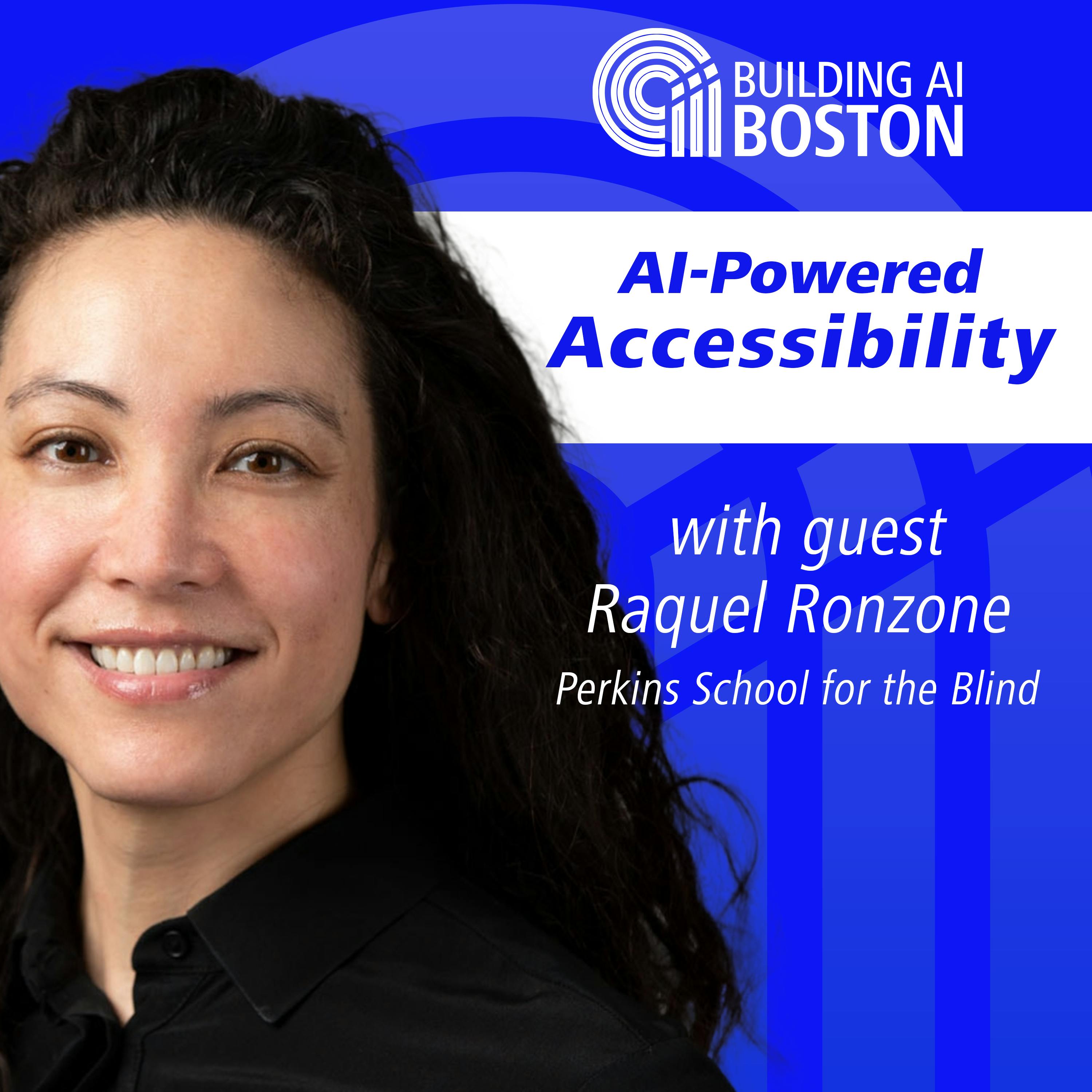
Building AI Boston
AI-Powered Accessibility with Raquel Ronzone, Perkins School for the Blind
00:23:55
Loading summary
Transcript59 lines
- [00:01]
A
At the heart of an industrial revolution is an innovation that changes everything. Building AI Boston sees artificial intelligence as a renaissance from the heart of innovation and the Mecca of tech learning. We bring you AI for real people. A conversation for everyone. Raquel Ronzoni is the Associate Director of Strategy and Partnerships at the Howe Innovation center at Perkins School for the Blind. She builds and strengthens collaboration in the disability innovation ecosystem by engaging with businesses, universities and thought leaders. Raquel is an incredible leader herself in the disability tech revolution with a long standing career in social impact. Today we talk a little bit about her why and how she brings her own experience to this AI evolution. Welcome to the show, Raquel.
- [00:55]
B
Thank you so much, Anna. Chris, appreciate it.
- [00:58]
C
Nice to see you.
- [00:59]
A
Yeah, really nice to see you. Chris and I have enjoyed getting to know you and learning some of your backstory. I'm wondering if you can kick us off right out of the, right off the bat with a little bit about your own background. You have a condition that started from birth. Was it from birth?
- [01:17]
B
Yes. Yes. Happy to kick us off. First, I'll give a visual description of myself. These are visual descriptions for context, are, are useful for blind and low vision guests, but also in a podcast contest. This might be useful to all of our audio listeners as well as a visual description. I am a 36 year old mixed Filipino woman with short, black, curly hair and today I am wearing a black sweater with red roses on it and headphones.
- [01:42]
A
I love it and I love that you give that. I love keeping our audience in mind. I'm a redhead and Chris is, you
- [01:48]
C
know, I don't know what I am. Yeah, some days it's a little more blonde, some days it's a little more like light brown. Who knows?
- [01:55]
A
No, but I appreciate the context. This is why you're great at what you do. Chris and I have learned a little bit about your beginning, if you don't mind, kind of taking us through.
- [02:06]
B
Yeah, absolutely.
- [02:07]
A
What was your condition at birth?
- [02:09]
B
Absolutely. So I was born four months premature and I have a condition called retinopathy of prematurity. That means that my retinas didn't develop typically. So for me that meant having around 10 eye surgeries to date over the course of my life, an experimental surgery that was one of my first surgeries when I was born, all the way up to sort of maintenance surgeries, if you will, over the course of my life to ensure that my retinas stay attached and to preserve the vision that I have.
- [02:37]
A
And I understand from talking to you previously that maybe the outcomes were not exactly what they planned. Is that true?
- [02:44]
B
Yes, that's right. So for context. So I was born four months premature. Stevie Wonder, I looked up, also has retinopathy, prematurity, and he was born six weeks premature in 1950. So the outcomes are very different. Right. Not only does he have gifts of music that I do not have, but we are different in terms of our functional vision. So my parents prepared for a lot of outcomes, including a lifetime of raising a child with multiple complex disabilities. That didn't happen in the sense that I did not have the outcomes that were forecast for me, among them cerebral palsy, learning disabilities, neurocognitive conditions, blindness, and more. But in doing this work, I want to make sure that people have access to the same opportunities, regardless of outcome, to make sure that they have equal opportunities in employment, education, social life, and overall, their experience of living in the world and participating in the world. And I'm thrilled to do that work at how.
- [03:46]
A
And you're passionate about it. I know that about you. You've had several positions where impact was kind of your signature on everything you do.
- [03:55]
B
I know that it's been a pleasure. It's been a pleasure, and it's been one of the great through lines that I've had the pleasure of working in throughout my career. It's only at Perkins, though, that it's the first time that it's been focused specifically on disability. Whereas other jobs have focused on racial justice, immigrant rights, LGBTQ rights, and more. This focuses on disability, and that's new for me. It's also raised really interesting questions about whether I have a disability. And it's the first time that I've confronted it. It's the first time I've been asked after not having been asked this before. I'm still working on the answer. And it's a good question. It's a very good question.
- [04:39]
A
It is a good question, and I know. So. So what is your ability to see? Like, exactly? How can you gauge, like, right now, are you able to see us on the screen or.
- [04:53]
B
Yeah. So right now, Yes, I can, by one metric, the text of our names underneath. And certainly the titles or names are harder for me to see other than that I'm trying to think. Vision is so subjective, and it's always so interesting when I have these conversations with people who ask, rightfully so, understandably, what do you see? What is your vision like? There are so many people who, colleagues of mine included, who face these kinds of questions. It's interesting because if vision weren't subjective, then we wouldn't have the experience of say, optical illusions. Right. Because we would all be seeing the same, the same thing and be able to communicate that. But for me, I would say in practice, it means probably having text on my phone, on my computer, a little bit bigger than some other people do, probably using dark mode a little bit more than other people do. Asking friends to read restaurant menus for me when it's a little bit too dark in the restaurants, things like that, things like that, that make life a little bit easier for me.
- [06:00]
C
So let me ask you about. Part of your job is community outreach. Could you tell me something about how you engage these communities so that they can understand better what you're trying to achieve in terms of accessibility?
- [06:16]
B
Yeah, yeah, it's a good question. So I'll contextualize it with what the how innovation center does overall. We're trying to connect the disability community and the innovation community to make for more accessible products and make for a more accessible world. And community outreach and partnership engagement is a key part of that. I have the pleasure of working with people who are at all places of their accessibility journey, people who are very new all the way up through, people who have dedicated their entire lives for it. And it makes for a really interesting mix of ideas and perspectives and passion. And it means that I get to talk to people who have worked at corporates for this for 50 plus years, all the way to 10 year olds who just started thinking about this, who realized that their friend who is blind might not be able to play basketball in the way that that innovator is used to playing it. And so the 10 year olds come to us and, and ask, how can we make our favorite game, basketball, more accessible? How can we make board games more accessible? And it's really amazing to see this drive and this passion and this mix of ideas coming from all angles. People with professional experience, lived experience and more.
- [07:35]
A
Yeah, go ahead, Chris.
- [07:36]
C
No, I was just gonna say so in terms of innovations, I think that people hear that and they're thinking some gigantic, huge development. And at times I'm sure it could be, but there are a lot of like really subtle innovations in like day to day life that we take for granted that fall into this fall under this umbrella. I mean, could you talk a little bit about that?
- [07:59]
B
Absolutely. So one of the more surprising ones that I've learned in the course of doing this job is that touch screens on our phones, on our point of sales machines, on our computers, that is a form of disability tech. Touch screens originated from a grad Student who had carpal tunnel syndrome and wanted to find a way to complete his thesis without putting as much strain on his hands. He started this innovation journey that then became the touchscreens that we interact with dozens, if not hundreds of times a day, benefiting people far beyond the carpal tunnel syndrome community. And we think about the incredible innovation that's come from the disability community, and that's just one example, and how far reaching it is and how it goes beyond accessibility to really speaking, to allowing people to participate fully in life, have independence, agency, safety, and more. Another incredible example, the audiobooks that we know and love originated from the blind community as talking books. And in one incredible example of how far that has gone, I was biking to Perkins once, and I heard a man pushing a baby in a stroller listening to an audiobook, and I thought, this is incredible. I'm going to Perkins School for the Blind, and I'm hearing someone use disability tech in a way that's so far removed from the original use case. And it's still incredible and valid and important. And it almost doesn't matter that the use case has changed. And arguably, it's an even more compelling use case because it's an additional use case. Right. It shows breadth beyond the original audience.
- [09:46]
A
Oh, I'm sorry. Keep going.
- [09:47]
B
Yeah, yeah. So whether we're thinking about people who are blind on vision, accessing books, people who are doing something where they want to be hands free, where they need to be hands free. Audiobooks fit the bill for that. So thinking about how incredible it is that the technology has grown beyond original use cases is amazing.
- [10:09]
A
I think one of the things I'm impressed with is that you are able to engage an audience. And then can you tell me a little bit about that story where you talked to a group of students and it was really an unexpected group that really understood accessibility from the sports side.
- [10:27]
B
Oh, sure, sure. So when I have the pleasure of chatting with students often, and I went to my alma mater, Villanova University, and chatted with students there about disability tech, as I always do, I ask them if they have any proximity to disability or accessibility in the form of lived experience, loved ones, experience, classes, courses, and none of them raised their hands. A group of about 100. And afterwards, after we talked about what accessibility is, what disability could be, the many ways it could take shape, several students came up to me and they said, of course we know about accessibility. We're student athletes, and when we get injured, we are sent to the one dorm on campus that's accessible, and we know exactly what it's like to navigate campus and what's accessible and what's not because we are now for the first time maybe using crutches or braces or wheelchairs and we have to look for where the elevators are, considerations that they might not have made before. And it was this really perspective shifting moment for them. But it also had this ripple effect because they then became empowered to advocate for themselves, to say, tell their professors that they needed maybe 10 extra minutes of time to get to class across a large campus and to educate their professors about what this means.
- [11:49]
A
I think that's great and I understand that's a big part of why you do what you do is that self advocacy for people and challenging the way people look at it. But I'm glad that you're in a position to make this so inclusive.
- [12:03]
C
Yeah, I was going to say sometimes I think that that's, there's a real value to what you just talked about because I, that's a great example. I don't think that a lot of people realize that those things like elevators, touch screens, things, we take them so for granted because they're part of everyday life. And I think that there's a good and a bad side to that. The good side being that it's so inclusive that anybody can use it. The bad side is that I think that people, when they hear that something has to be accessible, they think that it has to be changed and, and it's going to impact their lives in a negative way. I'm talking about able bodied people.
- [12:45]
B
Sure, sure, sure. Yeah. I mean we talk about the concept of human centered design and that means designing for humans and the richness of conditions that they have or abilities that they have. And that means whether say someone is using a wheelchair, whether someone is carrying a lot of groceries, whether someone is carrying a bike, whether someone is pushing a stroller. We want to design spaces and products and services that meet their needs and make it just as easily for them, just easy for them to say, get from point A to B, get through the airport, all, all equally.
- [13:22]
A
It's a great way to look at things. And I'm glad, I mean we've, I've learned that this is a huge opportunity, especially for people in the Boston or Massachusetts ecosystem. You're looking to be, I'm not saying you particularly, but the word on word on the street is this is a $40 billion opportunity and Massachusetts has some unique benefit to being in that. And, and certainly at Perkins you're leading the way. Can you, can you Go to the beginning of the HOW Institute, because it wasn't always there. Perkins is a 200 year old institution.
- [13:59]
B
Right.
- [13:59]
A
We should say some pretty famous people were students there, including Helen Keller. Yes. There you go.
- [14:08]
B
Right.
- [14:08]
A
Thanks for name dropping. We always appreciate, we always appreciate that. I mean, Chris and I have had a. We've, we've sent you a million questions. I even wanted to know how many people learned about, actually still learn braille. It's fascinating this. We can talk a little more about the school, but what I'm really curious about is why did the Howe Institute come about? Because this is relatively new.
- [14:30]
B
Yes, yes. So we're about three years old, situated, as you said, in a 200 year old organization. And we originated because we saw a gap between the innovation community and the disability community in the sense that companies and startups were coming to Perkins and asking, can you test a product? What's your feedback on this product? Rather than say asking what product would you want us to build? So we want to help close that gap. We know that the innovation community can and does build incredibly and we want to amplify in our work at the Howe Innovation center, the real world disability accessibility opportunities from the disability community. So for example, in our work at Howe, we have seen and heard about hundreds of products and services that are innovating in the wayfinding space. That's how blind and low vision people can get from A to B, whether that's indoors or outdoors. And yet there are zero accessible pregnancy tests on the market. Zero. Wow.
- [15:33]
C
I would have never thought of that. That's the wow.
- [15:36]
B
Exactly, exactly. And it's a disconnect. It's not because this need doesn't exist. It's because the innovation community doesn't yet know about it. So part of our work is to amplify the real world innovation opportunities from the disability community and source them and embed them in the innovation community. So we imagine if we solve for at home pregnancy tests, accessible at home pregnancy tests, we can solve for all at home tests. Increasingly in an age of telehealth or as amid the aging population growth. Right. And we want to make sure that healthcare is accessible to all people at all stages of life. So it's that kind of work that really, really inspired our growth.
- [16:20]
C
No, go ahead, Anna.
- [16:22]
A
No, go ahead.
- [16:24]
C
I was just gonna say like, so, I mean, I think we've learned a few things today that we might not have known as listeners, in terms of things that need some accessibility brought to them or things that were developed for accessibility needs in the first place, do you have a favorite innovation that applies to accessibility?
- [16:43]
B
Ooh, it's hard to pick just one.
- [16:47]
C
One of the favorites somewhere in the top 10. How about that?
- [16:50]
B
One of the favorites. Oh my gosh, there are so many. I think by and large thinking about the multiple end users of a product. We talked earlier about say talking books, AKA audiobooks and the user base being blind and low vision people, as well as say that man in the park pushing a stroller, listening to an audiobook. But also, I think when we think about innovation overall and what's to come, I'm really excited about innovation that meets multiple users needs. As in any innovation that helps blind and low vision people interpret body language. So in this context, for example, I'm seeing both of you nod your head, smile, lean forward, you're really engaged, right? And I'm taking in that feedback and it's making me respond differently. But blind and low vision people don't have access to that. So thinking about tools that would describe that, the sort of emotional reactions through body language that you're having would also be really helpful to people with autism people, anyone who has difficulty interpreting or processing emotions, whether that's because they're blind in low vision, whether that's because their Internet connection doesn't work and their camera is unstable, they can't be on camera right now. Right, right. Or whether they have autism and can't don't have the access to the, to sort of understanding the emotion.
- [18:14]
C
And it could help just random socially awkward people as well down the road.
- [18:19]
B
Across, across the board. Across the board. I love that.
- [18:23]
A
Yeah, no, I love that. You know, I've. You have been so generous in providing a lot of links. We're going to drop some of those links in our, in our podcast notes just because I think that when people truly get to experience what we're talking about, see the applications, I think how is working with about 2,500 innovations currently? Is that 7?
- [18:44]
B
Did I make that? Yeah, yeah, yeah, Good question. So we, we have identified 2,500 disability tech companies globally. Okay. We've identified them by the end user community they serve, whether that's blind and low vision community, visual community, auditory community, mobility community, or neurocognitive community or some combination of those. Identified them by what kind of technology they're using, whether it's AI, ML, robotics, or more the format that it takes, whether it's a wearable software beyond. So if anyone is interested in taking a peek at that, we invite you to join our email list I would love it.
- [19:21]
A
I would also encourage anybody just naturally that's naturally curious to check out some of the videos in the links below. I want to talk about one that really kind of choked me up. It's called Vocable.
- [19:33]
B
Vocable.
- [19:34]
A
It's a free app, first of all. That's what's incredible, is it's free. It really serves the nonverbal community. People that have had strokes, ASL or somebody that's intubated. And you talked about body language. I think about a very famous case, Stephen Hawkins, and, And. And what we perceive as his story. But I want to say that this mobile app, something that's available to your phone, became the intermediary between caregivers who are classically overburdened. Right. And then gave context to people that can, you know, actually use the app with just head movements and eyeline. And then. But this was the incredible thing. We're a show about AI, and this is what I found so compelling about that, was that AI became this bridge to help come up with actual, like, for a caregiver, actual questions that were helpful. And then context and having the context, you know, this is. I know. I'm just touching on and on. We're going to put this link up for Vocable. When you see that in action, when you experience that and learn that story, I feel like that just opens your mind to what's possible and what's truly a miracle about AI. I mean, are you. What gives you hope today in this environment of, you know, change and stories like that? I just think nobody can argue that that's a valuable, beautiful, viable product.
- [21:00]
B
Right, Right. I would say, in line with that, I am very hopeful about the number of people who come to us at the HOW Innovation center and say, I want to make disability tech a career. I want. I am an innovator. I am a tech person by trade. I have never heard about accessibility before, except for now, and I want to dedicate my life to this. It's incredible. And I think it doesn't take any of us long to find people who have a personal connection to disability, whether that's our loved one, ourselves, whether that's as a caretaker, as a teacher or friend or loved one, or more. And we think about broad definitions of disability, about, say, someone who might have lost their voice right from stroke or might have laryngitis. And it might be temporary, might be a couple months long, but it doesn't mean that they can put their life on hold for those months. There are ways of communicating that don't involve the voice. And it's about using technology to really work in service of advancing accessibility. And why? Because accessibility means agency independence, control over our lives, the agency to do what we want to, how we want to and when we want to.
- [22:19]
C
Yeah. And just being able, I would just think being able to do things that some people just entirely take for granted in their day to day lives.
- [22:26]
B
Yeah, for sure.
- [22:28]
A
Well, you know, you've, you've brought in my perspective. I'm sure this is part of the joy of your job is just opening people's minds. And I want to just reiterate, part of the, the why for the Howe Institute is that it's that disability is the largest. And also there's, you guys are really bridging this gap. It is the, the one place in our minority, let's say, where anybody can be added to that list at any time. And it's like you say, can be temporary, can be late onset. And so, you know, thanks for opening this bridge to, you know, why our innovative minds matter at this moment. Do you have any final words on this matter or.
- [23:13]
B
Oh, yeah, good question. I would say, you know, we're happy to continue the conversation for anyone who is interested, anyone who's curious or intrigued or moved about what you learned today, come talk to us. Find us@perkins.org innovation yay.
- [23:30]
A
And if you're local, check out Raquel. She's on the move. There's lots to learn from her. And we appreciate you bringing your own experience to the mix. This has been a great conversation.
- [23:41]
B
Thank you so much, Anna and Chris, for the opportunity.
- [23:43]
C
Thank you, Raquel. It was a pleasure talking with you.
- [23:46]
A
Thank you for joining us on Building AI Boston. Stay tuned for more enlightening episodes that put you at the forefront of the conversations shaping our future.