← Building AI Boston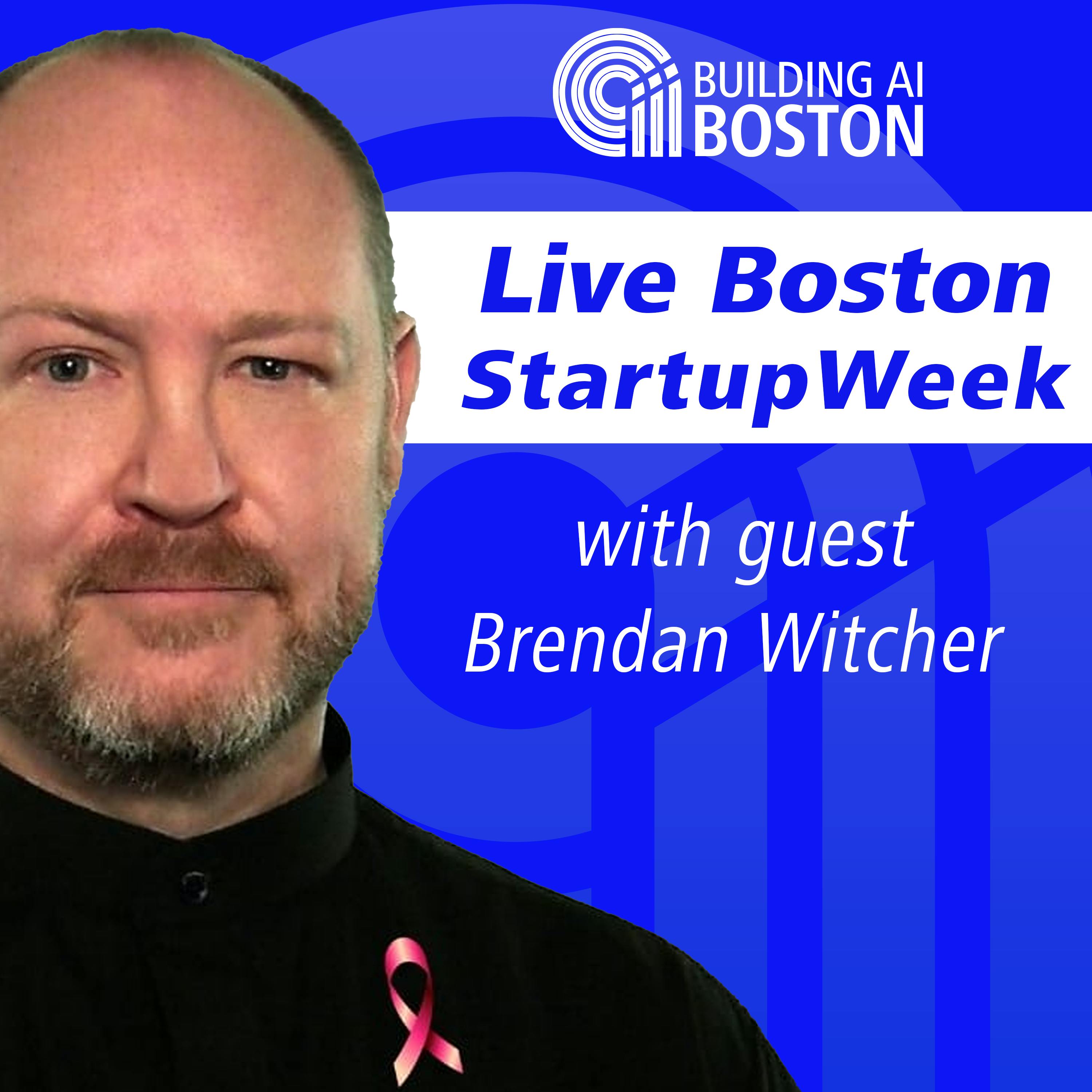
Building AI Boston
Building AI Boston | Live from Boston Startup Week at Suffolk University with Brendan Witcher
00:40:14
Loading summary
Transcript209 lines
- [00:01]
Host
At the heart of an industrial revolution is an innovation that changes everything. Building AI Boston sees artificial intelligence as a renaissance from the heart of innovation and the mecca of tech learning. We bring you AI for Real people, A conversation for everyone.
- [00:20]
Interviewer
Hi, welcome to Building AI Boston, where we are broadcasting live from Startup Boston Week. And today we have Brendan Witcher joining us, coming back for the second time. Hey, Brendan.
- [00:30]
Brendan Witcher
Hey, nice to see you again.
- [00:31]
Interviewer
Nice to see you. See you. How you doing?
- [00:33]
Brendan Witcher
Doing good, Doing good. It's nice to get downtown.
- [00:35]
Interviewer
Yeah, it is. You know, it's funny, back in the day, I used to work in this building and I have to say, I miss downtown Crossing. I really do.
- [00:42]
Brendan Witcher
Boston downtown's such a fun place to be. It's a. It's a great place to spend the day, hang out. And this is a beautiful building. It's a great conference we're at here today, so really enjoying it.
- [00:52]
Interviewer
That's great. And have you had a chance to go to any sessions today?
- [00:55]
Brendan Witcher
Yeah, I popped into a few of them, taking a look at what was going on, what people were talking about. Obviously, AI is the big, you know, theme of startups, these, so no shortage of those conversations. But of course, the conference focuses on leadership and other things of that nature, which is really nice as well. So, yeah, it's a nice mix here. And, you know, if you missed it this year, I suggest people come down next.
- [01:18]
Interviewer
Yeah, definitely. And it does seem to be pretty much you can wake up every morning and go to an AI event right now in Boston. It feels that way. Like, we know we have started Boston Week, and then in a few weeks we have AI Week, Boston AI Week. But this is the first time ever they've done that in Boston.
- [01:34]
Brendan Witcher
Yeah, no shortage, no shortage, no shortage of conversations about technology innovations in AI here in Boston these days. But you'd expect it, right, with Harvard, MIT and all these colleges. Plus you've got all these big already baked in AI companies already out here. IRobots out here as an example. And then you got Boston Dynamics is out here. So it's a town. It's a town built for AI innovation.
- [02:02]
Interviewer
It is. And, you know, we definitely are trying to make sure we're on the map and, you know, not being forgot between the other sort of coastal cities out there. Right. So when you think about AI and you think about AI in Boston in particular, and we think about our ecosystem and what makes it special. So aside from the sort of the universities and things like that, do you think that we're doing anything unique here? In terms of how we approach AI, in terms of how we're building, I
- [02:28]
Brendan Witcher
think one of the things. I would say, let me start with the younger generation first on this topic, which I think is really important. I mean, with the schooling that we have and the schools that we have. I mean, when you're going to attend one of these universities, that's really at the forefront of some of this. You have to be someone who loves to think, right? You know, you have to be someone who has intellectual curiosity that is baked into your DNA, right. 24 7. You want to know what's going on, you want to understand new innovations, excite you, right? This is different than the older generations, where it's like, I don't want things to change because I make a lot of money because of the way things are, and if I've got to learn something new, then I don't really want to do that. So the natural state of Boston's great, very vibrant college communities really is a nice sort of bedrock for innovation and things that are going on here. And this is why you see companies opening up locations here, even if they're not headquartered here, because we have so much of that curiosity, that intellectual curiosity that's either here already or that's coming in, transferring in as students, both graduate and undergraduate. And so I think it's a great place to find that talent, and especially that talent that is born with AI. And I wouldn't say born, obviously, because they're not born in the sense of coming into the world that way, but they're coming into their continuing education with AI already being part of the competition conversation, which is a little different. You know, like, if you. If you grew up. Give me an example. If you grew up in a household where they speak both Spanish and English, you don't think twice about the idea of speaking Spanish and language and swapping off back and forth. And like, you know, it's a very natural thing for you if you are. If you are, you know, in your fourth year of college, your school, or even in a continuing graduate program, you. You would have needed to adjust your thinking, right, throughout your education about how AI is going to impact some things, right? Which is this generation now coming in already has a very sort of. There's been a. There's a fairly mature, in the world of tech, a fairly mature conversation already going on about AI. And so I think they're coming into the education with it as part of the story arc, and that just gives them, quite frankly, an advantage. And so I think companies recognize that and say, well, where are these people going to get their education? And a lot of times it's. It's right here.
- [04:52]
Interviewer
Boston. Right. And we had some pretty big news in Boston about global company relocating here as Hasbro.
- [04:58]
Brendan Witcher
Yeah.
- [04:59]
Interviewer
Mr. And Mrs. Potato Head.
- [05:00]
Brendan Witcher
Yeah, yeah.
- [05:01]
Interviewer
They're coming to Boston.
- [05:02]
Brendan Witcher
Yeah. You know, I see Mr. And Mrs. Potato Head being very AI driven in the future.
- [05:06]
Interviewer
I see.
- [05:07]
Brendan Witcher
You know, just. I have nightmares about Mr. Potato Head coming in my room and talking to me like it's an Alexa device. But hey, you know, to each its own.
- [05:16]
Interviewer
Hey, you know, if it could happen, we'll build it here. Right?
- [05:18]
Brendan Witcher
That's right.
- [05:19]
Interviewer
Exactly. But it's interesting what you say about it. Thinking. Right. Because in our last episode, you made the great observation that people pay you to think. Like, that's your job. Right. And so I know we dug into that in the last episode, but that's a pretty cool job, right, to think. So tell us more about that. And how the heck do you keep one step ahead of this stuff when everything's changing so fast?
- [05:47]
Brendan Witcher
Yeah. Quite frankly, the secret sauce to this is access to great industry professionals that are out there. I like to say I don't have an original thought. I don't have an opinion. There is no Brendan's day. No, no. I'm telling you, like, the reality is, is that as an analyst, right. And I. And I. I mean, if you went to BrennanWitcher.com you would see this posted on my website. Is that I don't have an opinion about things. Like, my job is to communicate in truth without a Brendan sort of filter on it. What is it that's going on? What's the truth that's going on? Like, if everybody was dropping AI and going back to analog things, I would say everyone's going back to analog because that's my job.
- [06:28]
Interviewer
So the data would be telling you that's what's happening. You would tell us what the data told you, whether or not we thought that was what we wanted to hear.
- [06:36]
Brendan Witcher
It's one of the reasons I like being an industry analyst and being a industry pro is that. Or someone who is, you know, is paid to create thought leadership.
- [06:46]
Interviewer
Right.
- [06:46]
Brendan Witcher
The reason I like it, and it's the reason I got out of the industries I was in, is that I. I can put my head down on the pillow at night and say, I told the truth all day today. I told people the truth. I allowed them. Now, whether they accepted that truth or not, that's up to them. Right. Like, I don't own whether or not people listen to what I have to say and then do it, like, that's up to them. It's a free country. It's a free world, and do whatever you want. But my job is to communicate truth, and that comes from the people that are out there doing it day in and day out. So, you know, I think that there are some people that believe, you know, because I'm well known, then what I say is important. And I'm not of that mindset. I'm more of the mindset, like, because I'm well known, I have the luxury and the benefit and the privilege of communicating from a huge network of people, industry leaders, you know, Fortune 500 companies. I've worked with, you know, over the last 12 years, I've worked with 59 out of the top Fortune 100 companies, you know, on their strategies, and eight of the top 10. And that is. That is something that drives what I tell other people. And what is going on out there in the industry. It's not, you know, I saw something on cnbc, and now I'm just parroting that out to the market. It's, you know, a CEO at a top 10 Fortune 10 company told me, these are my real struggles. And this is how I'm addressing it. And this is that right now I'm under NDA with everyone on the planet.
- [08:17]
Interviewer
So I can't be like, you can't talk to anybody.
- [08:20]
Brendan Witcher
I'm not gossip central, that's for sure. But it's nice because, you know, I don't know that some people love that I say this, but, you know, I'm kind of like legalized espionage, right? You know, it's like, I know what everyone's. When I walk through malls or, like, downtown or whatever, I'm like, oh, I know what they're doing. I know what they're doing. I know what they're doing. I can't even tell my wife what it is that they're working on, right? Because I'm under NDA with everyone. But it's nice because I can communicate in an aggregated fashion, right? Like, what comes out of my mouth or what I write on paper is the aggregate conversations of the people that I'm talking to day in and day out who are living it. Not people who have written books on it and thought about it or tried to teach it in a school, but actually the people doing it day in and day out.
- [09:04]
Interviewer
And that's so important, so refreshing in this environment where so much of the information we get is just Biased, right. So it's, and we know, like we're seeped in that like from the minute we wake up to the minute we
- [09:16]
Brendan Witcher
go to bed at night.
- [09:16]
Interviewer
And so to have that kind of interpretation of just truth, they're not even interpretation that reporting of truth is like so rare. And why, you know, companies like Forrester are so valuable, right. To people because they help them understand. And the minute you stop being independent and you read those tea leaves wrong, like, that's the end of it, right? Because you have to build that credibility. And, and we all know how easy it is to misinterpret data, right? What it's telling you.
- [09:43]
Brendan Witcher
Oh, yeah. It's so simple. And the thing of it is, like, if you're going to be a trusted asset, I like, you know, I went through an exercise a few years ago where I kind of said, you know, who am I to the people that I serve and I want to be a trusted asset. And both of those words mean a lot to me. Right. An asset is something you value. An asset is something that's a benefit to you. It is something that creates, you know, sort of serve equity for you. Right. But trusted is a big word, right. What do you do not only to create trusted assets, you have to build that trust, you have to keep that trust.
- [10:15]
Interviewer
Right?
- [10:15]
Brendan Witcher
Right. And so trusted is an ongoing word. It's an ongoing sort of thing. And so to maintain that, you really do have to have some level of integrity. And you can't just say whatever you feel like saying. You know, I sometimes have known to say, like, I think this is really interesting because the truth of the matter is life is interesting enough.
- [10:35]
Interviewer
Right.
- [10:35]
Brendan Witcher
You don't actually have to make stuff up to make it interesting. I think what happens is people will say, oh, look at this headline that's in the news and da, da, da. And that's good. But that's for generating clicks. That's for distracting you from the next headline that's going to be just as dramatic or have a bunch of hyperbole attached to it or whatever it is. That to me is where I'm not competing with that. Right. My job is to help companies actually get business outcomes.
- [11:04]
Interviewer
Right.
- [11:05]
Brendan Witcher
My job is to help them not make poor business decisions. Especially in a world where the headlines might be suggesting that you should make certain decisions.
- [11:16]
Interviewer
Right.
- [11:16]
Brendan Witcher
A number of years ago in the retail industry, as an example, there was a lot of talk about, you know, these companies like JCPenney and others were closing their stores and they're like, there was this huge Sort of retail apocalypse story about, like, stores are dead, blah, blah, blah. That was absolutely not the truth. The truth was we were shopping in stores more than we like, like 75% of our sales still were in physical stores. The companies that were shutting down were brands that had brand problems.
- [11:44]
Interviewer
Right, right.
- [11:45]
Brendan Witcher
They were the, the radio shacks, the JCPenney's, the Kmarts, the Sears. These are brands that had launched us with customers and had nothing to do with physical stores. It's just physical stores is where you can save the most money. So they were shutting down stores and the media picked it up as this story. Now the danger of that, of course, is that other people who are in retail, they go, oh, look, stores are irrelevant. And we saw a huge slowdown in investments in physical stores simply because of the media story, not because of the truth.
- [12:15]
Interviewer
Right.
- [12:16]
Brendan Witcher
And so, you know, it's, it's, it's, it's really quite, quite something to be in the spot that I'm in because I'm lucky in that way because I get to say what it is. And it may sound contrarian at times, but that's because the point of why I say things, which is for helping clients get to the truth and to make smart business decisions, is different than me trying to get as many likes or views or clicks.
- [12:40]
Interviewer
Right.
- [12:40]
Brendan Witcher
You're not on my story.
- [12:41]
Interviewer
You're not just trying to be this like, you know, talking head, getting, you know, all the attention for that. It's like you want your what your. So it's back to the data. Right. So now. And one thing you said last time we talked was really stuck with me, was how we have now a whole new trove of data that was useless before. And I think it was it the Oracle person. Yeah, yeah, yeah.
- [13:02]
Brendan Witcher
Mark her.
- [13:03]
Interviewer
Mark. So thinking about what do we do now and who's going to win and lose, not that it has to be that black and white, but when we open up now, access to all this data that we didn't used to be able to understand or mine or use or whatever, what is, what does that change? And where are the smartest sort of like people who are thinking about this in the right way, sort of grasping that opportunity.
- [13:25]
Brendan Witcher
I think the very tip top, the very smartest people that I know in industry are starting to realize that in a world where AI, I think, you know, one of the other guests that you've talked to in the past talked about how we don't know the real impact of AI to the extent. Right. Could be everything, could be nothing, could Be somewhere in between, I think, was her statement. And I like that statement because I don't think we do know that fact yet. But I think that one of the things that the smartest companies I know are doing is that they are absolutely rethinking what I would call their data strategy. A data strategy is not data sharing. It's not data sourcing, it's not data security, it's not data storage. It's a lot of alliterations. I know. You know, a data strategy is this idea of understanding, you know, if we knew X, we could do Y. Like just that basic understanding of saying, you know, if I had a certain knowledge of certain pieces of information, then I could do certain things for the people I'm trying to serve. And that's in a B2B or B2C scenario. Tech buying, tech, tech, tech purchasing, test selling, whatever it is, you know, the, the idea is that if I, if I can learn more, then I can do more. Companies today are not getting beat because they have better products, better assortment, better services. This is a huge thing that's different from was 10 years ago. I kind of caution people that are just getting into business now, like your elders lived in a different world. They lived in a world where if I wanted a screwdriver, you know, like a, like a screwdriver or hammer, my options were people that were in a few miles from me. In this world, I can get anything I want anywhere.
- [15:04]
Interviewer
Right?
- [15:04]
Brendan Witcher
Right. Assortment used to be how you win consumers. Consumers today don't say, I can get a hammer at five places. They say I can get it at 50 places. And so that becomes something that's not good for business. Strategy is thinking we'll win with great products. Everybody's got great products. Right? That's, that's not a, that's not a. It's not a thing that's going to win. What's going to win is your ability to understand those customers better. And that's where I'm seeing the best of the best out there, is they're thinking about an unstructured data strategy. That's the one thing that I see a commonality across all these companies is they're not just using AI for the data that they have. And they're certainly not just using it on structured data. They're using it on unstructured data to create those net new capabilities, those net new experiences that make consumers go or even companies are trying to serve go. That was different. That served my needs. That was something that created convenience, simplicity, ease, cost savings. Whatever it is, I have a benefit by having a relationship with you. And in fact, not only do I see you as a supplier of something for me, I see you as someone that it makes strategic sense for me to have a relationship with you. And it sounds like I'm talking about business, but I'm also talking about life and people's personal lives. Like, I don't mean to, like, turn life into this soulless sort of entity. You know, I'm going to sound that way for a second. I'm going to. I'm going to sound like a soulless human being here for a minute. But you need a strategy for life.
- [16:33]
Interviewer
Right.
- [16:33]
Brendan Witcher
If you're really going to get through it without having to be medicated constantly, you need to have some kind of strategy for life. And it's about finding the companies that help you get through life the way you want and that can do this. So you've got all these people at Startup Boston. Right. And when I'm listening to their pitches or I'm listening to what they have to say, I'm wondering to myself, okay, but are you actually creating something that people would say, I really couldn't live without that. Like, I really need that. I'm gonna share something with your audience that I haven't shared broadly. Okay. And it's. This is a big one.
- [17:02]
Interviewer
All right.
- [17:03]
Brendan Witcher
Okay. Now I'm under NDA with Amazon. I'm about. I'm under like seven of them.
- [17:07]
Interviewer
Okay.
- [17:08]
Brendan Witcher
So I. But I work with them constantly.
- [17:09]
Interviewer
Yes.
- [17:10]
Brendan Witcher
And when I ask people, you know, what is it? What do you think Amazon's primary mission statement is? This is a couple years ago, so maybe they've changed it, but I don't think they have. You know, what is their mission statement? And I get answers all the time, like, oh, supply chain, or, you know, customer experience for all these kinds of things. And it's none of those things. I was at their offices in 2017, and they asked me to come out and bang on their Amazon go Store.
- [17:39]
Interviewer
Okay.
- [17:39]
Brendan Witcher
Right. Which was that. The automated checkout, and they were just launching it to the public. They had had their employees be able to use it, but they were launching the public. So they had me come out and try to, like, steal from it and what my thoughts were on.
- [17:50]
Interviewer
Okay, that sounds like a fun job.
- [17:51]
Brendan Witcher
Yeah, that was. That was fun. They flew me out to Seattle.
- [17:53]
Interviewer
It was a lot of fun to go shoplifting.
- [17:56]
Brendan Witcher
Had to go shoplifting.
- [17:57]
Interviewer
I like that. Yeah.
- [17:58]
Brendan Witcher
You know, this job's very interesting. So. But. But anyway, we're upstairs in the offices talking. And they made a statement that I couldn't believe. They said, but I asked them, I said, please, please, please, will you give me permission to say that out loud someday? And they did. They said it would be okay. So here's what Amazon's primary mission is. And I would say to anybody that's doing a B2C business, this is what you're competing against. Amazon's mission is to get you to say the word Amazon every day of your life.
- [18:27]
Interviewer
Wow.
- [18:27]
Brendan Witcher
That is the scariest mission statement I've ever said.
- [18:30]
Interviewer
Because this is like written down. Like they're written down. No, this is just.
- [18:34]
Brendan Witcher
This was their goal. This is what they communicated to me. They said, they said, our goal is to get the consumer to say Amazon every day of their life. Now think about what's not. Think about what's not in that statement. The word buy. That's a big difference. And this is why, like, sure, you've got millions, and I mean millions of Alexa devices out there and maybe nobody is buying on them, but so what, right? People are saying the word Amazon every day, right? When they're talking to their device, when they're watching Amazon prime, when they're storing their photos and videos, when they're using Audible, when they're using their ring doorbell, when they're, you know, when they're buying actually on Amazon.com or going to a Fresh Shop store or going to a Whole Foods, right? Like they, they wanted to at the time. And I think they've kind of accomplished it. So maybe it's not their mission anymore. They wanted customers, they wanted to be seen as a utility. I'm using their words, right? As a utility in people's lives. A utility like your water and your
- [19:32]
Interviewer
electric, like you can't live without, like you.
- [19:34]
Brendan Witcher
Something you wouldn't even think twice about taking out of your life. That's what you're up against.
- [19:39]
Interviewer
Okay? So that's amazing. And also intimidating, right? So we're at an event with, for startups, so people are either wanting to start something, they want to fund something, they're interested in the space, right? So what lesson can someone all the way on the other side of the scale from Amazon take from that, right? Because you're not going to go be Amazon. But what can you learn from that kind of mindset as an entrepreneur?
- [20:05]
Brendan Witcher
Yeah, the mistake would be to focus on the monetary requirements for doing something like that. Because Amazon has the balance sheet of a small country, Right? And most people here do not have that. Right. I mean, there's some money here. But they're, you know, maybe not a small country.
- [20:20]
Interviewer
Medium. Medium.
- [20:21]
Brendan Witcher
A medium sized country that competes in the Olympics.
- [20:24]
Interviewer
There you go.
- [20:24]
Brendan Witcher
Right, Okay. I think that, I think though, what to take away from that is that what is your mission statement? How, you know, like, is it to solve a problem or is it to be a strategic partner in people's lives?
- [20:36]
Interviewer
Right.
- [20:37]
Brendan Witcher
Even in a niche sort of way. Right. Something that is like, I have to have this in my life. If you're a B2C thing. Right. If you're B2B, it would be more of like, do I fit into the ecosystem of what they're trying to accomplish, right. As a business in a way that again, they can't really live without me sort of thing. The thing that I find most people starting businesses today miss is they fail to understand that if they don't create this sort of strategic level partnership with their, with their customers or their, with their buyers or whoever it is, then they are wildly replaceable.
- [21:14]
Interviewer
Right.
- [21:15]
Brendan Witcher
Easily replaceable. You know, and it's not just like, people are going to love our product. People fall in and out of love with products. Like, look at Furby's, Rubik's Cubes. People falling in love with products all the time.
- [21:27]
Interviewer
All the time. And then what was super hot was super cold. Like, you know, you were in restaurants. That's in bars. That's what happens.
- [21:34]
Brendan Witcher
Yeah, yeah.
- [21:35]
Interviewer
The next day.
- [21:35]
Brendan Witcher
Yeah, exactly. So, you know, I, you know, I still think about like how Facebook. What was that company before Facebook? That.
- [21:46]
Interviewer
MySpace.
- [21:46]
Brendan Witcher
MySpace, yeah. Right. I still have my, I still have my MySpace for Dummies, you know, book.
- [21:51]
Interviewer
That's probably right.
- [21:53]
Brendan Witcher
But, but like, think about it. Like, like we moved from MySpace to Facebook very quickly. We moved from Blockbuster to Netflix very quickly. Right? And that's not just consumerism. That's just that those same consumers are in the B2B seats buying tech and buying things. And so they bring that with them to the office and they have that same sort of short term mindset. And it's not a, it's not a memory problem. It's more of just like, I have permission to move on. I have permission to change brands. I have permission to not be the Kmart shopper or the whatever, right? Like back in the day we used to build those, like, I'm on Lucky Strike guy, right? Like for those cigarette companies. Like these were the, the elements of creating loyalty. And that's just not present anymore because consumers are like, I don't have the luxury of being inconvenienced to shop with you or buy from you. I don't have that luxury because my kids in 17 different sports, they're now taking after school activities. You know, my wife and I are both working, blah, blah, blah, you know, to make ends meet and all this kind of stuff. Right. Our lives are just, they're not designed for us to have a lot of time to do things. This is why people use, you know, dating apps, because no one's got time to go to a bar and hit on someone for three hours to try to get a date. Now you got to go to Tinder and swipe left, swipe right for 10 minutes so I can get a few dates.
- [23:11]
Interviewer
Right, exactly. It's transactional.
- [23:13]
Brendan Witcher
Right. But it's all shortened. Everything's like, you know, condensed and that's that.
- [23:18]
Interviewer
And I love that idea of like the, the closing, well, not necessarily closing window, but the shrinking sort of space to think about these things. Right. And so when we take that back, like, your decision is faster, everything's faster, you get stuff faster, you know, you're going to, you're going to move brands faster, all that. But when you think about it from like the entrepreneurial side, again, straight up, yes or no, do entrepreneurs, no matter what they're doing, no matter what field they're interested in, do they have a choice about using AI or not?
- [23:48]
Brendan Witcher
Yes, they have a choice.
- [23:49]
Interviewer
Okay, so tell me why they do
- [23:50]
Brendan Witcher
have a choice, because I think that it has to make. I was just having this conversation with our producer here, Dan, just a minute ago, about this.
- [23:57]
Interviewer
Hey, Dan.
- [23:59]
Brendan Witcher
You know, I think what, what you need to do when you're starting a business is you have to understand where to use automation versus human humanization. So. And I think I'm making that word
- [24:10]
Interviewer
up, but I like it. It's a good word.
- [24:12]
Brendan Witcher
Let's put it in the mixer.
- [24:14]
Interviewer
All right.
- [24:14]
Brendan Witcher
I'm going to coin it. So here's the thing. What, what I see startups doing, that's a mistake, is they automate touch points or automate moments in the journey for the customer that would be better served by having a human being involved. Right. They try to go all in on AI on every single moment, and that's a mistake. It's over swinging on the pendulum, Right? Okay. So what I would say is, like, evaluate that thing. So what I'm seeing existing small businesses do. Like, I had a small business owner come up to me the other day, we were talking about his strategy, and he said, I call 10 customers a day. I don't want to lose that by having AI do it for me. And I go, I would tell you that it would. If you did that, it would be the biggest mistake of your career to do that. You should not have AI call 10 customers. But are there other parts of the way you do business that I could reduce the amount of time you spend there? So now you can call 20 customers a day.
- [25:14]
Interviewer
I see. Yes.
- [25:15]
Brendan Witcher
This is the mistake people make is they start to say, I can apply AI to this thing. Check. No, you need to first do an evaluative statement to say, but is this what's keeping people buying from me?
- [25:27]
Interviewer
Right.
- [25:27]
Brendan Witcher
Is this the thing that a customer say, I need this to be a human being or else it's not going to work for me sort of thing?
- [25:34]
Interviewer
Right.
- [25:35]
Brendan Witcher
Or I need this to be more personalized, less sterile, less automated, less sort of, shall we say, inauthentic sort of way. Right. Can I create that sort of experience? And then looking at the customer journey and whether it's a journey for customers or buyers, right? If it's a B2B world, if we're looking at that buyer journey and saying, well, you know, like at this moment, is it. They can go to the website and self serve, or are they talking to an outside sales rep? Are they talking to me, the founder of the company? Right. Is it like, who's the right person to have that moment? Because if you're gonna. If there is a moment in the buying journey when someone is absolutely gonna make the decision whether or not to buy from you, it should be the highest quality touch point. The mistake would be, let's make it as easy and convenient and simple as possible. So they can, they can do this within two seconds. That would be. That's a, that's a UX mindset, right? Rather than a business strategy mindset. Right. It's better to take five minutes and make a person feel like this is special than it is to have it take five seconds. And they're like, eh, I'll drop this next week if I don't feel like doing this. Right? And I'll give you a great example of this in the real world. Have you ever signed up for Stitch fix?
- [26:49]
Interviewer
No.
- [26:49]
Brendan Witcher
Okay.
- [26:50]
Interviewer
But I know it.
- [26:50]
Brendan Witcher
Okay. You know Stitch fix, right? So has anybody, has anybody here ever signed up for stitch fix? Can you hear me? Do you know Stitch fix? Yeah. Okay, you do, right? Okay. There's a person here in the audience that's listening to us.
- [27:01]
Interviewer
Good.
- [27:02]
Brendan Witcher
You sign up for Stitch fix, That's like a 20 minute signup process, right? Yeah, Right. You need to bring a sandwich to this signup process to get through it, I'm telling you. Right. But you know that 80% of people finish that process.
- [27:13]
Interviewer
Why?
- [27:14]
Brendan Witcher
Because they know there's going to be value at the end of it for it. And that tells you all you need to know about consumers today. No, they don't want to spend a lot of time doing things unless they believe they're going to get a lot of value out of something. What they don't want to do is look at your advertisements for 20 minutes, which are in your best interest, not in the consumer's best interest. Right. If I'm getting value out of something, I will absolutely spend more time doing it. And that's the mistake I think a lot of startups make is they try to make everything too short. They try to say, we're going to simplify everything to the point where it becomes like indistinguishable from what my customers do. And it feels like it's just a robot. And I have. There's no law of reciprocity that people feel towards AI machines yet.
- [27:56]
Interviewer
Right.
- [27:56]
Brendan Witcher
And for those that don't know what the law of reciprocity is, if you're old enough, you remember that there was a company, and I forget what it's called, March of Dimes or somebody that use Ziggy, which is the old cartoon character, and they used to send you those return mailing labels. Right. When we did mail.
- [28:10]
Interviewer
I remember. And I remember Ziggy from the cartoon.
- [28:12]
Brendan Witcher
Yeah. And they used to send you these return labels in the mail. And the law of reciprocity says, I felt guilty about you giving me these five cents worth of. Of things. So I'm going to give you a dollar.
- [28:23]
Interviewer
Right?
- [28:23]
Brendan Witcher
Right. Sort of thing. That's the law of reciprocity.
- [28:25]
Interviewer
Right.
- [28:25]
Brendan Witcher
You do not create any reciprocity with a consumer when they feel like something on the other end took no effort for someone to do.
- [28:33]
Interviewer
Oh, that's super interesting.
- [28:36]
Brendan Witcher
When you are dealing with a company and it seems like they didn't really make any effort to add value to your life, then I may sign up with you, buy from you, whatever. But my commitment to you is way low.
- [28:49]
Interviewer
Right.
- [28:49]
Brendan Witcher
And the next thing that comes along, I'm totally willing to move on to it. Right. So think about what MySpace did. Right. MySpace was doing all these things which were great, but how did Facebook really exceed MySpace the way that it did? It was what Facebook did is, is it took that process of me having to take photos, print them out at Walgreens, put them in an envelope, send them to my family members or to my friends. Right. It took all that and said, simplify. It still gave me value. And it looked like somebody worked on making that work for me. Right. Not in their best interest, but in my best interest. Right. And it created real value. And so this is why you saw this huge shift over to Facebook, because it really did help someone in their lives take. And the majority of people already did this anyway, Right. Whether it's friends or family or whatever it was, it allowed the consumer to say, I don't have to do this in my life anymore. Great, check. I'm going to move on to this. Right. And then we move on to the next thing. All right, now I got to get a taxi. Am I going to stand on the corner and get a taxi or am I going to use Uber? Right. And so, like, whether it's doctor's appointments, dating, yoga classes, doesn't matter what it is. If we can find something in our lives that can be replaced, then with. With digital, as long as it looks like that, there's two things accomplished. One, I'll adopt it. Two, I'll stay with it because it looks like somebody built it for me.
- [30:10]
Interviewer
Right, right. And so when the budding entrepreneurs, you know, they're here today, like, what they should be looking for then is more the problem. Not starting with AI as a solution and trying to find a problem to fit to it. How would you.
- [30:22]
Brendan Witcher
Well said. I think that more. More people. I think what people forget is that there are perceivable problems in people's lives and there are unperceivable problems. And so what I mean is that there are. There's. I think what entrepreneurs fail at sometimes is they fail to understand that pain points live on a scale.
- [30:42]
Interviewer
Right.
- [30:44]
Brendan Witcher
This is a customer pain point. Yeah. But it's a pain point no one really cares about.
- [30:48]
Interviewer
Yeah.
- [30:48]
Brendan Witcher
You know what I mean? It's like. Yeah, that's interesting. Like, think of dash buttons.
- [30:53]
Interviewer
Okay.
- [30:54]
Brendan Witcher
Dash buttons. Remember Amazon dash buttons? No. Okay. Dash buttons were. You could buy a dash button and you put it. It'd, like, be for a specific item, like Tide or Clorox, and you'd put it around your house, and when you need it tied, you'd push the button and T would come to your house.
- [31:08]
Interviewer
Oh, wow. I missed that whole thing.
- [31:10]
Brendan Witcher
Right? Sounds cool. Right? Sounds cool. Here's the problem. It didn't really solve a consumer problem because I have to walk right by Tide when I go to the grocery store.
- [31:19]
Interviewer
Oh, right.
- [31:19]
Brendan Witcher
Like all you did was save me from bending down. You know, like, that was the big solve. That was the big solve that. The technology.
- [31:28]
Interviewer
They must have put a lot of money into building that too.
- [31:30]
Brendan Witcher
Well, sure, but they only, you know, like, I don't remember the numbers, but the numbers for Amazon, we're very low as far as sales. Right. And so what people forget is that there are scales of those business problems or consumer problems or even business problems. Right. Where it's like, you can, you can call something a pain point, but if the customer's like, yeah, but that's not that big of a deal. Bending down to pick up tide from the bottom shelf or getting. Reaching over to grab Clorox and put it in my cart while I'm at the grocery store. Really not a big problem.
- [31:59]
Interviewer
Probably not something to build. Build a, Build a startup around. Right, right. Well, that makes sense.
- [32:04]
Brendan Witcher
But, but the technology was there. The capabilities were there. The broad, you know, the, the, the being able to have mobile devices that could be powered, you know, lightweight powered, lightly powered, that can stick anywhere, that could have branding on them, that could be digitally connected to the, to the wi fi, blah, blah, blah. All this stuff. The tech was all there.
- [32:25]
Interviewer
Yeah.
- [32:25]
Brendan Witcher
What was missing was the real consumer problem.
- [32:29]
Interviewer
Right, right.
- [32:30]
Brendan Witcher
You know, and it's like, you know, I know when you're a startup founder, you're like, I want to call this a consumer problem.
- [32:35]
Interviewer
Yeah. Doesn't mean it is, though. And do you think there's a risk? I mean, you can't talk about AI without talking about bubbles. Right. We know how this goes. So do you think that there's an over correction or an over, I don't know, pendulum going too far that way, that we're just trying to solve every problem with AI, People are inventing problems that aren't really problems and solving them. Or do you think we're kind of being rational?
- [32:57]
Brendan Witcher
My, my thoughts on that are going to be much different than most people you'd probably speak to.
- [33:01]
Interviewer
That's good. I want to hear it.
- [33:03]
Brendan Witcher
So my, my answer to that is no. I think we're. We're not in a bubble. We're in a stage where people have opportunities and God bless them for trying. Yeah, like, I'm a big fan of that. Like, I think to get to 10 great ideas, you need to develop a thousand.
- [33:20]
Interviewer
Right, right, right.
- [33:22]
Brendan Witcher
So good. I'm glad we're doing a. I'm glad everybody's working on AI. I'm glad everyone thinks AI is going to, like, you've got this like overabundance of people working on AI, because what it will result in is 10 great ideas.
- [33:35]
Interviewer
Exactly.
- [33:36]
Brendan Witcher
If we had, you know, if the, if, if you could control the world with a snap of your fingers, right. And make it so that only 100 companies are working on AI, then maybe you get one great idea out of it.
- [33:46]
Interviewer
So scale matters.
- [33:48]
Brendan Witcher
There's nothing wrong with it. Right. So this is what I mean by my statement to that would be. A lot of people would say, yes, we're in a bubble, we're overcorrecting, we're doing blah, we're doing this right sort of thing. But I think people forget about the process of innovation has a certain framework to it, and it is about learning and trying and understanding. Right. I mean, yes, the Wright brothers was the one that created the plane, but there were hundreds of other people trying to create ways of flying at the same time that we don't know about anymore because they didn't work out. But the Wright brothers, you know, was one of those hundreds. Right, right. And what people forget is if the Wright brothers had made the decision go like, oh, there's 100 other people already working on that, we're not going to bother, then maybe I've been sure at some point we would have gotten off the ground, but maybe not as soon as we did.
- [34:35]
Interviewer
That's right. And we built, and we build upon the shoulders of the past. Like even Leonardo da Vinci was like, designing things that could fly. I don't think they ever did.
- [34:43]
Brendan Witcher
Right. So I would say, like, if you're, if you're a startup and working on AI, be proud of the community. I would even call it the collective that you're a part of that's working on advancing this for humanity. Because I think that it takes you. You're part of something very special. And you may not be the solution that people end up using, but you're gonna gain so much experience, you're gonna learn so much about AI, that even if your company goes belly up and you gotta give up on it, you're way more prepared to work for the companies that actually do become successful than somebody who didn't do it. Right. So I think that you have to just extend the timeline of success, failure. And success is to determine whether or not your company makes it failure. And success is determined by what you do with it after you hit one of those points.
- [35:29]
Interviewer
Wow.
- [35:30]
Brendan Witcher
Right?
- [35:30]
Interviewer
Yeah.
- [35:31]
Brendan Witcher
And I think that that is where I love entrepreneurship. And this is why I believe that entrepreneurs are the heart and soul of this country because of the fact that they are the ones who build the collective that allow us to have the great ideas, and then they are the people that are experienced that go into those companies that succeed and even create faster innovation because they're already experienced in that technology.
- [35:54]
Interviewer
Right. So check your data. Make sure you're getting your information from a neutral source. Right. That has. That has a sense of what's going on and is not going to be call.
- [36:03]
Brendan Witcher
I'm on LinkedIn.
- [36:03]
Interviewer
Okay, there you go. Fine. Brendan, not gonna BS you, right? Not gonna spin it and then jump
- [36:09]
Brendan Witcher
in, jump in, jump in, jump in. I'm a huge fan of jumping in and learn about it and understand it and find people who are excited about it, like you are. Like I said, if you're. If you're an individual that's intellectually curious by your nature, and I think I used the word DNA earlier. If it's in your DNA to be intellectually curious, then it would be a crime for you to never try to open your own business and a crime to not try to do something innovative with the amazing things that are going on with AI right now. And I am not one of these sort of like, analysty people that very quickly say words like that. I'm usually. People usually say I'm the most boring, practical analyst on the planet. Right.
- [36:45]
Interviewer
Seems like a good thing to be.
- [36:46]
Brendan Witcher
I normally am.
- [36:47]
Interviewer
Yeah.
- [36:47]
Brendan Witcher
But I just have to say, like, what's going on right now is, I think, you know, and you and I could talk for hours about just the examples of what's going on out there as far as the way people are replacing just very mundane things. I just saw an example of a solution where you could hold up an avocado to a device and it could tell you if it's ready to eat or not.
- [37:11]
Interviewer
Okay. I've never invented that. Thank you. Because, like, seriously.
- [37:15]
Brendan Witcher
Right, right.
- [37:16]
Interviewer
That's a pain point for some people.
- [37:18]
Brendan Witcher
Right. For avocado eaters, I guess it's a
- [37:20]
Interviewer
pain point if you like avocados.
- [37:22]
Brendan Witcher
But like, that to me is like, this is what I mean. Like, I just took the. The stupidest little thing.
- [37:27]
Interviewer
Yeah.
- [37:28]
Brendan Witcher
And said, this is what's happening now. Blow that out to everything.
- [37:32]
Interviewer
Yeah.
- [37:32]
Brendan Witcher
Right. And that, to me is such a fun space to be in right now. It's almost like the world is your. Is your. Is your playground.
- [37:40]
Interviewer
Yeah.
- [37:40]
Brendan Witcher
Right. And so, you know, the other thing I would say is after working with a lot of startup people and a lot of investors and a lot of people who've done this, I would say Just do not. I'm gonna kind of quote Stephen King here, like, be willing to kill your darlings.
- [37:54]
Interviewer
Yeah, right.
- [37:55]
Brendan Witcher
And be willing to say this was a good idea at the time, but actually I'm gonna let it mature into what it needs to be without defining it and forcing it to be something that I wanted to be when I first wrote that business plan.
- [38:09]
Interviewer
Oh, God. It changes like every day. Right. When you're, when you're really building something, you have to be open minded because it could change. It could change.
- [38:16]
Brendan Witcher
It not only could change, it probably will change because you don't know enough yet.
- [38:20]
Interviewer
Yeah.
- [38:20]
Brendan Witcher
You know, you don't know enough to do what it is you want to do. Exactly. And so, like, this is what I see. Exact example of what I see in people that are doing things in the fractional world. Right. We talked about this earlier.
- [38:30]
Interviewer
Yeah.
- [38:30]
Brendan Witcher
It's like I see more and more people are building fractional careers because it gives them access to so much more than working for one company.
- [38:37]
Interviewer
That's right. And you don't have to necessarily build your own thing. You can be a fractional and you can go in and learn that way and just really kind of get deep into it.
- [38:45]
Brendan Witcher
Yeah. And you probably make more money doing it too. But the reality is get more sleep. Get more sleep. Right. I think the fractional world is something that's kind of blowing up too. And that's helpful with AI because a lot of people can self serve on these AI tools to help them do the fractional work, to have the amount of productivity time that allows you to work for 1, 2, 3 companies, plus be on a board here or a board there or a nonprofit or whatever. Right. And. Or run a podcast. Right. Or something like that. The ability to do all those things, they're not going to take as much time because all AI can be applied to all the elements of doing those things.
- [39:18]
Interviewer
Exactly.
- [39:19]
Brendan Witcher
And you're going to gain more experience generally by doing more things for more people. And I think that what I like what entrepreneurs, a lot of entrepreneurs that I've talked to have actually like crafted their career to not just work for one company for 10 years, but to work for an assortment of them and pick up things along the way that help them start a business collectively in aggregate.
- [39:42]
Interviewer
Fail on someone else's time.
- [39:43]
Brendan Witcher
Yeah, fail on someone else's time.
- [39:45]
Interviewer
Right, Good. Well, that's, that's a great place.
- [39:47]
Brendan Witcher
My clients are not little like me saying that. But let's leave it at.
- [39:51]
Interviewer
Let's leave it at that. But yeah, so. Well, it's so great to see you again. It's always a pleasure. And we know we're gonna have you back because you're part of the crew. So thank you so much for coming down to Suffolk today. And it was really fun chatting.
- [40:03]
Brendan Witcher
Yeah. Thanks for having me. Appreciate it.
- [40:04]
Interviewer
Thanks, Fred.
- [40:05]
Host
Thank you for joining us on Building AI Boston. Stay tuned for more enlightening episodes that put you at the forefront of the conversations shaping our future.