← Building One with Tomer Cohen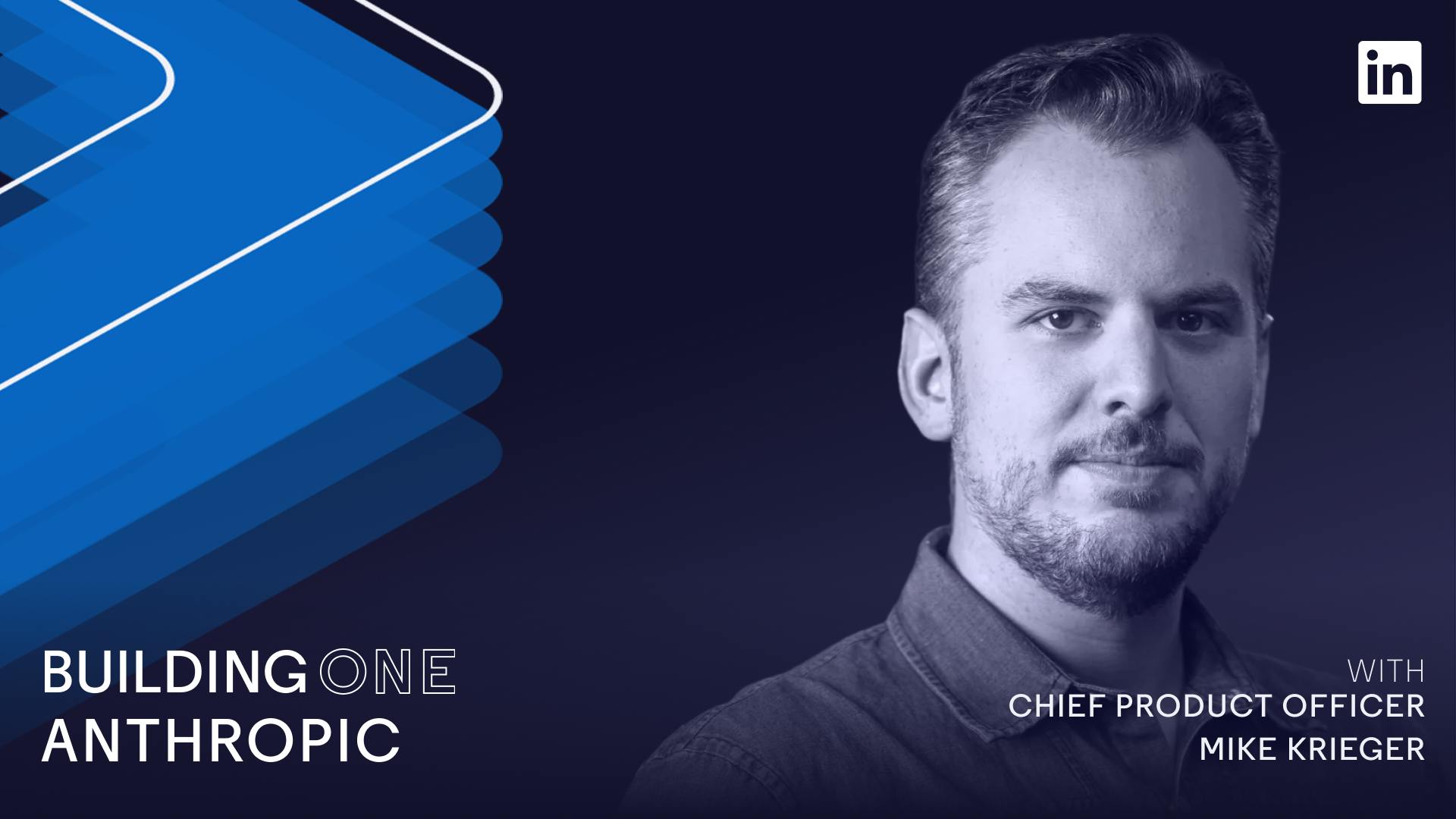
Building One with Tomer Cohen
Building Anthropic with Mike Krieger: Product Playbooks In The Age Of AI, Why Memory Is Key, And Instagram Lessons
00:28:06
Loading summary
Transcript42 lines
- [00:00]
A
When I think about your role as a tropic, I do want to connect it to Instagram.
- [00:04]
B
Let's say you were posting a photo. It was very clear. Oh, there's a list of filters. Oh, I tapped one of my photo looks different. Or oh, there's this thing called, you know, boomerang. Oh, I tried it once and I can see what it does. That sort of like building of mastery is I think more complicated in AI. But I think the thing I've most changed my mind on is when I got here I was like, I can't believe we're still using chat boxes like that. Feels like we should be in a completely different thing. It's actually a very useful way of expressing like an open ended problem. The thing that needs to change though is what happens after you hit enter.
- [00:40]
A
What does building Instagram, one of the most influential social networks in the world with over 3 billion users, have to do with building one of the best AI assistants in the world? As it turns out, quite a lot. My guest today on Building One is Mike Krieger. He's the co founder of Instagram and he's the chief product officer at one of the most interesting AI companies in the world, Anthropic. And in this conversation we cover a lot of ground. What made Instagram such a breakout success, why Mike decided to shut down Artifact, his second startup after Instagram, and the key lesson he would share with founders about when to stop or when to persevere. The surprising similarities between building Instagram and building Anthropic and why since joining Anthropic, he has completely changed his mind on how to build great products. And we actually spent quite a bit of time on, on this part. How Anthropic, an AI native company, is completely rewriting the playbook for how you build great products with AI. Here's my conversation with Mike Krieger.
- [01:44]
Mike, it's a pleasure to have you on the show and thank you so much for joining me.
- [01:48]
B
It's great to be here. Thanks so much for having me.
- [01:51]
A
So, you know, we'll start right from the start. So you co founded Instagram just two years after studying symbolic systems at Stanford. Now for our listeners, they might have heard this program, but this is a special program that blends computer science, linguistics, philosophy, psychology. I'm curious just why you chose that program. I think you came from Brazil for that program.
- [02:13]
B
I grew up in Sao Paulo and you know, it's funny, you have to rewind your memory of social networks. I was graduating high school and the biggest Thing out there was Orcut in Brazil. This is like a network. I don't know if it started inside Google or whether Google, but it was a social network that was basically.
- [02:28]
A
I think it was Brazil and India. Orcut was massive.
- [02:31]
B
Exactly. And it was huge. And the summer before I went to Stanford, I was really curious to connect with other people. And this is what Facebook would barely emerge, Right. So I think we maybe had our first Facebook accounts. But I went on Orca and I searched for Stanford and I was like, is there anybody out there? And there was a very small Stanford page, but there was also a Stanford Symbolic Systems page, and it had like six people in it. And I had never heard of this program before. And I clicked through and, you know, sort of you see your life reflected in front of you. Like, this is all the things I'm interested in. I was already interested in programming. I liked thinking about, like, language. I was a big reader at the time. I was interested in psychology and linguistics. It was like, in some ways the perfect degree if you want to do, you know, be an entrepreneur or be a builder or really combining how to build, but also who you're building for and how people think and how machines think. And it was even some early AI in that program too. So I feel very lucky that I found that program at the right part of my life.
- [03:28]
A
What part of that was kind of instrumental or important for founding Instagram literally two years after college?
- [03:36]
B
I think there were probably three pieces. One was the design thinking and human centered interaction piece. So Stanford D School, the design school was just starting to kind of emerge my third year at Stanford, and they didn't take undergrads, but I basically kept showing up until they couldn't kick me out anymore in these classes because I really wanted to take them. I was so interested in kind of the ideo sort of design thinking, HCI field. And I got to take classes and really do the whole process of what's the problem you're solving, what's the user need, what are the range of ideas around how you can solve it, and then how do you go through that process of discovery? So that piece was really, really important. The second part was knowing enough to build. And the last piece was there was a program called the Mayfield Fellows program, where it's nine months. You do three months of case studies and learning about startups and how they succeed and failed, and then three months interning at a startup, and then three months of debriefing and writing your own case study on what you learned that summer. Which was accelerated. It's a very fast, you know, sort of timeline. But I loved it. And even. And Kevin, who ended up being my Instagram co founder, did the same program a couple of years prior. It ended up making us have this shared language around some really difficult moments and we were able to sort of look back and say, hey, that reminds me of that case study.
- [04:51]
A
Just hard for me to think about going and learning something for three to four years and a curriculum based on something that somebody designed, you know, if you're lucky, six years ago, right. And then waiting for the job market to wait for you on something that you took your, you know, six plus years for the could own four policies to learn, and then expecting that your skill set will match what the market needs versus being able to learn something that is mostly, you know, based on market needs. Right now, going and actually getting your hands dirty, doing some work, coming back, potentially refining. But that model needs to evolve. So you mentioned Instagram. It's hard to talk to you, not to talk about Instagram. You know, back in the day, Instagram grew from 0 to 1 million in users in two months. Today, even today, that's not easy in today's craziness. But back then it was one of those rarefied air, simply incredible kind of unbelievable moments. And today obviously needs no introduction, one of the most used loved consumer apps in the world. I'm curious when you reflect that on those early days, you mentioned the conversation you and Kevin, your co founder, had, what was one of your key learnings, when you reflect back, that actually had that incredible product market fit that got you to that incredible milestone.
- [06:07]
B
I think the first key is that it didn't, it didn't get there sort of in a narrow or sort of one like linear way like we were initially building. You know, you have to remind yourself to 2009. You know, we were initially building a like check in app for exploring cities and making, you know, plans with your friends. And I think what was interesting, and this is like the first lesson learned was it's very rare that a product succeeds because of the incremental N plus 1 feature if the core is not actually working. And so what we were finding is that some people really liked the product, but it wasn't growing enough and it wasn't really sort of lighting the world on fire. And we would do our planning every week, it was just Kevin and I, and we'd say, all right, what else could we add? And it's funny because I just mentioned the Mayfield Fellows program, one of the Things that we had sort of emerged from there was like, this idea of, like, really simplifying and distilling down to, like, your core elements. I still carry that all the way through to through anthropic. When we have a product where we're figuring out, like, all right, this initial part works in this way, but it's not growing as much as we'd like. It's always tempting to say, and then this, and then this without, like, sort of rethinking the core. And so that was one big lesson. And with Instagram, kind of hit this kind of crisis moment where we'd been going at it for probably six months at the time with Bourbon, which was our check in app, and we had an investor check in. I remember walking up to, you know, afterwards, and we had seen on the investor's face that they had given up on us. Like, it was, okay, I'm doing this because I have to, but it's not gonna work. And so that was a good moment to say, right, if not even they believe in us, like, what should we be doing differently? And that was a really good moment of then, like, pairing it all the way back. We had a really good conversation where there were two things that I think were kind of working with Bourbon. One was the photos part. The other one was making plans with your friends. And my pitch to come was like, let's do. Let's break off and each of us prototype one of those and then come back in two weeks. And he said, well, it's better if we put our heads together and do one thing really well, and then if that doesn't work, we'll try the next. I think it was totally right, actually. It was actually much better to have both of our attention on one problem rather than sort of doing this divide and conquer. And we chose Photos, which within a week of having a better prototype of a sort of photo sharing app, it was clear that that was going to be more intuitive, exciting, you know, clearer for people than all of what we had built before with Bourbon.
- [08:26]
A
So you felt that the core was just strong with kind of the Instagram and photos and filters. And before it was, the core felt meh. And you were iterating trying to make the numbers look better.
- [08:39]
B
Like the same way as if you pick up a tool or you pick up a coffee mug in front of me, you would know how to hold it and what to use it. I think what Bourbon had become was you could kind of intuit how you might use it, but there were a lot of questions like, well, how does this fit into my life versus you? Open up to a feed of photos, which at the time was novel. There was not really any other product that was actually just doing that even. And they're like, oh, okay. It's photos from people that I know and maybe some people that I don't know. And here's a big plus button. We spent a lot of time on that. The thing ended up getting like, became a UI pattern for a couple of years where it was the bottom tab bar with the big, you know, sort of bump in the middle. Like, here's how you share. And you know, it was very optimized.
- [09:17]
A
Towards that, you know, when Instagram joined Facebook. And even think about the core of the Facebook product when Zuck did it, there was that initial insane product market fit and then there was all the incrementality and iterations on top of that. Do you see this as almost like two different schools of art?
- [09:34]
B
So it's kind of like three types of builders. It's like the ones that can do the initial core, the ones that can do the initial core and then scale it up and actually iterate and continue to evolve it. We could talk about that for a second because that's interesting too. And the third people that don't ever ask the question of do we just need to simplify down to some other deeper core?
- [09:53]
A
I think you have an amazing case study with Artifact, which was an AI news app that you started and you decided to shut it down. And if I recall, it was actually had a pretty strong core base when you started to shut it down. And this is really hard for entrepreneurs. What advice would you give entrepreneurs on like, when to persist and when to stop?
- [10:13]
B
So the leading indicator for me was, and I can't quantify this, but it's something around like the energy in the system. Like with Artifact especially, by the end, it felt like we would put in, you know, 10 units of effort and get one to two units of output. What I mean by that is, you know, we would completely revamp how the social features worked on a whole new commenting system that was like actually like reputation based and had some like novel ideas around how to sort of track and rank reputation over time. And like some people used it, but it wasn't like even within the core of people we had, it wasn't the. It didn't really change the dynamic or bring in new people or we would try like a completely new way of ranking. And it was just sort of this, this feeling of like, oh yeah, there's a lot of things that go in and it doesn't feel like it's really like tilting. Whereas I've had the experience at Instagram and the times here at Anthropic as well, where you're kind of layering things on and you're almost in this almost jazz like back and forth with your customer or user base for like, oh, that's cool.
- [11:13]
A
Oh yeah.
- [11:13]
B
Oh, look what they build with that. Like, that's really exciting. Like all this like energy and it's very different feeling. So that's number one, which is, are you feeling like, yes, startups are hard, but it still should feel if things are working, you feel that kind of engagement back and forth doesn't have to be with a million people, but at least with some people that have that engagement. The second piece, which was how do you even go about doing that in a way that minimizes regret? We wrote down the list of things that we would feel dumb not having tried before shutting it down because there's some point where you realize, okay, is this working? And that was sort of mid 2023. Kind of gave ourselves to the end of 2023 to say, all right, what are all the things that we, you know, we won't, we will feel dumb having not done this at least. And we tried them all basically and we kind of like shipped the last one in mid December and that kind of let us enter 2024 and say, all right, it wasn't that we didn't try the things that we were going to try. We've checked it off. Yes, we could generate another list. But like it's also time to call it now.
- [12:11]
A
So when I think about your role in the tropic and I do want to connect it to Instagram, Instagram launched, very simple, right? It was like just photo sharing and filters and simplicity was the key of the app. And you mentioned a few of those aspects. And Entropic, you are building this AI that can do everything potentially. But the user interaction model, the UX is also very simple, right? It's still that chat interface, at least on the kind of the experience side. Is this for you the same kind of principle of simplicity between the kind of non AI feature based model of Instagram versus this new way of working? Is this the same kind of. It's still the same chat, right? Or are you thinking of very different in similar ways?
- [12:56]
B
You know, we were talking about the sort of intuitive shape of something like see a text box, you kind of know how to ask it. But it is interesting how many people still will ask a almost sort of search query type thing into, you know, cloud AI because that's what you're used to when you see a vox or you don't know the full potential of it. And so a lot of what we've tried and we're still iterating on is how do you keep the sort of basic interaction simple? And also for two reasons. One for that intuitive nature of it, but also because the more sort of extra UI you put on top, the less you're letting the model just do what it wants to do and kind of solve the problem in its own way. So you want to provide a fair amount of room to run, but at the same time also express the full list of potential or capabilities that exist there. And ideas that we've tried that I don't think have worked very well are things like suggestion chips, like, did you know you can use this to answer a question about your calendar? And the problem is if you're not hitting somebody at exactly the moment where they have that need, it's like cool, but I came here to do this other thing and maybe I'll remember or forget. So I think a big piece of what we're trying to do now is can you get Claude itself to be better at knowing its own capabilities so that in the conversation, you know, if it has a skill that it can pull off the shelf, it will do that. Or if it can suggest that, you know, actually you might want to, you know, incorporate this additional piece or I need this additional data. Can you connect your Gmail so I can actually answer this question for you? So the product can still remain simple on the surface, but there's like this progressive disclosure, but I think sort of AI and more conversational eyes really need to do that because there is that sort of progressive disclosure of capabilities as well. That sort of like building of mastery is I think more complicated in AI. But I think the thing I've most changed my mind on is when I got here I was like, I can't believe we're still using chat boxes like that. Feels like we should be in a completely different thing. We should be, you know, and I think my meme of like, you know, you have an opinion, you have like the other opinion, then you come back to your original model. I'm like, actually it's, it's actually a very useful way of expressing like an open ended problem. The thing that needs to change though is what happens after you hit Enter, you know, is it just the model answers your question or is it the model's guiding you, connecting the right sources, doing some work independently, showing its state. And it's much more of a collaboration than it is a sort of question answer situation.
- [15:17]
A
I think when it comes to building AI products, when you think about this fundamentally different way of working, what other things come to mind for you?
- [15:24]
B
So when you think about Instagram, we were generally on like a, you know, two halves a year, high level plan and then sort of quarterly kind of roadmaps and sometimes those had blank space in them sort of. We're not sure exactly how we're going to solve this question of how to get people to share more informally, but we know that is a problem we're going to solve and there's a method towards it. And it was sort of, you know, within product development that, you know, convergence divergence, but still towards, you know, a fairly set set of goals. And it was rare that we didn't ship something. And if it was, it was because in, maybe in testing it didn't work well, but not because there was some underlying capability that we didn't know about. Whereas at Anthropic, what I learned is I actually started with that process and it kind of runs into this very natural sort of mismatch, which is the model not only is not deterministic, the model research process is not deterministic and it was a lot of flexibility. So I think it's a few different things. And by the way, this feels different in API and platform land, where there is more, sometimes they'll align some feature release with the model capabilities, but it's less like this API is going to look totally different depending on the model, but very much so. On the first party app side, I think it's a few things. It's preserving space in the roadmaps for prototyping experimentation. We used to do that by having sort of a dedicated prototyping team and we still have some efforts explicitly carved out for that. But even from our sort of core roadmap, there's more room now than definitely there was at Instagram around experimentation, prototyping, not just doing hackathons, but using them as inputs for what we did. We shipped Cloud skills a couple of weeks ago that was seeded by first internal prototype, then a hackathon, then the desire to actually build it, and then that became a roadmap item that we were able to pull together.
- [17:12]
A
When you go and you think about, sorry for the lack of a better word, agent, you know, when I think about maybe I go to assistant for a bit when I think about what would it take to win in building the ultimate assistant. And maybe I am primarily thinking about consumer. It's hard for me to not think about. You have to win the relationship. Like it has to be an intimate relationship with the user, but the user has to feel you're establishing something which is more than transactional. It's more than I asked for something and you gave me something. There is a sense of I'm going to invest in you and you invest in me back and we're going to build this amazing thing forever. Which is hard in enterprise because the moment I'm out, I'm losing that relationship. But let's put it aside. That's just complexity. I'm just curious, do you see that similarly and then how do you build for that relationship? Because that is whether it's enterprise or consumer, that is kind of the notion of me coming investing. We've seen internally that when somebody invests in the experience and products we build in the agentic sphere, they stick around. The result is like we love the product, it's amazing. But when they don't, it's literally the opposite response. So ultimately it's about that time spent, that investment, but investment in making it yours. I'm curious how you see it.
- [18:30]
B
They will learn a lot about you. And there are these memories and I think that those are really important to developing that sort of trust and long horizon kind of relationship with even an agent. But using that judiciously rather than yes, I know you know that about me. And now actually I feel creeped out that you know that about me rather than. It feels empowering overall.
- [18:51]
A
The memory unlock, do you see it as a, a tech problem right now or this is like a product thing you're thinking about how to orchestrate that, like what type of memories you look at or is this almost like the original models? Let's just wait for that to be better and then we can build something incredible on top of it. Is this a layer you are waiting for or is this a layer you are shaping as well?
- [19:12]
B
I think of it as essential to everything we're doing right. There's the in context memory, there's the kind of user level memory of like who you are, what you know. There's procedural memory which we're solving with skills. Then the thing that we don't talk about as much is the organization organizational memory around who knows what. Who should I talk to for this aspect? What have we learned about this for previous agents? What kind of instructions have they gotten so that whole layer I think is. I completely agree with you. It's a big unlock around really feeling like it's a kind of trusted collaborator over long time periods.
- [19:43]
A
It's hard to talk about product without talking about metrics. So I'm going to ask you one metric question.
- [19:49]
I think of the true north as a relationship, but that's duomorphic or abstract. So then I kind of bring it back to like retention. You come back to the thing, you're using it, but that's also more of a long term way to do it. What is your proxy? How do you think, Is it like the depth of the conversation? I've seen this with many labs. Is it the first conversation, the first five conversations? It feels like, is it that you're still like, hey, we're still iterating, we're going to figure this out as part of this. How do you think about the proxy for that true north?
- [20:25]
B
I think there's two things I look at a lot. One is, are the conditions met and then are the sort of features you've built not being used? So are the conditions met? We look at a lot of have people connected their Google Drive if they want to use their mcp, have they used memory? Have they enabled this? Do we even have enough context and state and connectivity with this person to be able to do useful things for them? There's an organization level here which is, has your organization enabled these features too? Because now it's an enterprise product. So there's kind of two layers right there and then there's the other side which is now, are people actually engaging with it? And so at Instagram we looked a lot at participation rate. I look a lot at participation right.
- [21:02]
A
Here and I'm assuming the first informs the ladders or is a causal driver.
- [21:07]
B
Exactly. Or it's sort of like, yeah, it's the top of that funnel as well. Like if you don't know and you know to our earlier conversation, engaging with a feature that then requires some connectivity might be a moment where you can upsell that so they can have that interplay as well. But we look a lot at if we're really pushing forward the ability of Claude to actually generate professional looking office documents. Well, are people using it to generate professional quality office documents? Do they then stick around and retain on that feature as well? That's probably the best proxy we have for now. Beyond evals, which are the thing that I didn't have at Instagram, which is upstream of all of this, how are we doing on the things that we do and how much can we we actually sort of tailor evals even more so to the problems that people are hitting in the real world. Right. So if it's generating really professional looking PowerPoints, how do we actually either bet that with real people or incorporate that judgment in the model so that we can actually do that better over time? Those are the two best I found. And then we have our more classic growth team that if you squint your eyes it looks like any general product with retention, activation, resurrection, all of those different pieces. But when I think about the more AI pilled features that there's very much in the like are people discovering it? Are they using it? Do they have the necessary conditions and do they kept coming back to it too?
- [22:24]
A
What is your favorite non software, non digital product?
- [22:28]
B
Oh I don't know if the eight sleep counts as a non software because there's definitely software in there in there as well. You know what it is actually it's this is a very funny thing because I shared this with another co founder that we or another founder that I've talked to a bunch. It's a good self massaging like back things like such a life changer because you're like, you know, you're tense at the end of the day having a really, really good like body back buddy like $15 on Amazon but high quality.
- [22:51]
A
If you're going to get retargeted with an ad after this we are not sharing any information. No PIIs are shared here out of this conversation. And then lastly folks listening saying hey like I, I want to be my click Mike. I want to learn a lot. I want to build. I want to build, you know, at the frontier of what does it mean to actually build amazing products right now? What would be your advice for them?
- [23:14]
B
I think just being constantly, always experimenting with anything that you see out there. Like I am a both for our, I'm like notorious in our team because I will add myself to the internal feature flag for features that are not even half baked, like the 10th baked and the team's always like it's not ready. I'm like I don't care. I just want to experience the early promise of it and see what it is. And it's the same for basically any product. I love trying out anything new, whether it's a conversational AI thing, whether it's something around nutrition that I'm really interested in like anything and so remaining absolutely curious. You obviously can't just be chasing trends. But you know, even if there's not an obvious thing that you learn from that sim like single product, it'll probably recur in some other way later. So remaining absolutely curious and engaged I think is the way to do it.
- [24:00]
A
Wonderful, Mike. This was super insightful and inspiring. Thank you so much for doing this and I'm excited for everybody listening to this to learn a lot from their experience.
- [24:10]
B
Thanks Thermal. That was a lot of fun.
- [24:12]
A
I love my conversation with Mike. He had so many great insights, not just about product principles and philosophy, but also about the day to day practicality of making great product decisions. Here are just a few of my takeaways on the conversation. First, when you're searching for product market fit, Mike had a very unique and concrete way to help you know when to keep going and when to stop. The success with Instagram came after many iterations, but he also went for many iterations with Artifact, which they eventually decided to shut down. So his way of knowing isn't about metrics, it's actually energy. Imagine you're putting in 10 units of effort on every iteration, but only getting back one to two units of meaningful response from users. It means you're not getting closer to product market fit. Instead you want to write down a concrete list of all the stuff you want to try before you shut it down. Give yourself a clear time box and systematically shut down. Keep everything on that list and if after that the energy is still not there, you're still getting 2010% return, you actually shut it down and you don't wonder about the what ifs in the future. Second, building products in the AI era requires a very different kind of roadmap discipline. At Anthropic, Mike realized that the classic planning of half year roadmaps with fixed outcomes actually breaks down when the model research is non deterministic and capabilities can actually tip overnight. So instead of over committing to a fixed plan, his approach was to keep more irons in the fire, maintaining multiple internal prototypes, testing scrappy experiments right off the bat as real inputs to the roadmap, and staying ready to turn an emerging model capability into a product the moment it crosses a threshold. Roadmaps essentially becomes hypothesis, not contracts. So for example, at Instagram it was rare for things on the half year roadmap to not ship but anthropic. Some bets only make sense if the model is ready. What does this force? It forces a more flexible portfolio style roadmap where you're continuously reevaluating what the model can do based on what it is today. Third, the importance of getting memory right when it comes to AI products. Memory isn't just a model feature. It's actually a foundational capability that would largely dictate your success. And Mike breaks it down into several layers. The first one is what is in the core in conversation, what's called in context memory. The second one is what does the system know about you? That's the user level memory. The third one is about how does it perform certain tasks which are reoccurring. That's procedural memory or skills memory. And lastly, if it works about an organizational capability, what does the organization know as a whole, who does what, who to ask and what past agents have done. That's called organizational memory. At Anthropic, memory is co developed with the research team. Instead of being treated as a one way deliverable that the product team just consumes. So you have research and product teams work together on use cases and capabilities. So memory actually becomes a primary lever for trust, relationship and long term collaboration with your AI assistant. Now we are still unlocking how human memory actually works. So imagine doing it for AI. That's probably one of the coolest problems to work on. I'm Tomer Coyne. Thank you for watching. I learned a lot and I hope you did as well.
- [27:40]
B
You've been watching Building One. Our show is hosted by Tomer Cohen, LinkedIn's Chief Product Officer. Building One is produced and edited by Mason Cohn and the team at Coastal Production Works. This episode was mixed by Tim Boland at LinkedIn. Our team includes Rachel Karp, Sarah Storm, Dave Pond and Alicia Mann with support from Alex Kuznetsova and Mujeeb Mehrdad.