Loading summary
Transcript35 lines
- [00:00]
A
Hello everyone. This is JVL here with my Bulwark colleague Andrew Egger. And in the aftermath of the no Kings protest, MAGA is having a lot of cope a lot of feelings about what they just saw. Andrew, how are they getting through this very difficult time?
- [00:17]
B
Well, the weird thing is they're doing it a lot of different ways. There are, it turns out there are a lot of different ways that you can process, you know, these five stages in the streets. A little bit like that, a little bit like that, or like a choose your own adventure sort of thing. I mean, you could tell that what they were really gearing up for going in was let's see some violence, let's see some violence. Let's see a lot of arrests. We've been talking about this Hate America march. We've been talking about the antifa insurgents and the terrorist sympathizers and the Hamas people that are gonna be out in force this weekend. So let's see some of that. And in some of the initial MAGA coverage, that was kind of the timbre of the thing. I mean, like, if you went to Fox News's sort of like live blog of the no Kings protests, it was basically just like a running list of anywhere there happened to be arrests in the vicinity of a no Kings protest, which was primarily where there have been clashes before. You know, Portland and the Chicago suburb where that ICE facility has seen some arrests outside. But we didn't get a lot of that right. Like they were overwhelmingly, I mean, like Republicans like to clown on the mostly peaceful thing. But these weren't mostly peaceful protests. These were overwhelmingly peaceful protests with like, I mean, even more so than the one back in June, which saw a couple of like sporadic outbreaks of sort of random violence and things like that. But so there have been, I mean, should we just go down the list? I mean, there's a few different ways that you can cope with this stuff. Okay, so you could be the president, right? You could be the President of the United States. You have a lot of resources at your disposal. You have a lot of people around you at all times to kind of whisper sweet nothings to you and tell you how things aren't that bad. So here was Donald Trump, I think it was last night, sort of reacting while talking to reporters to some of this. He said, I think it's a joke. I looked at all the people, they are not representative of this country. And I looked at all the brand new signs, I guess paid for by Soros and other radical left lunatics. It looks like it was. We're checking it out. The demonstrations were very small, very ineffective, and the people were whacked out. One thing that's funny about this is, I don't know if you saw Trump's own, like that Truth Social AI video, the insane one that he put out where he was wearing the crown and he had King Trump on the fighter jet and he was dumping literal feces on crowds of protesters. It was kind of striking that it was still giant crowds of protesters who are getting it dumped on in that video. You know, I mean, not really a very small and ineffective crowd. It was like time dissonance. Yeah, yeah, yeah. But, but I mean, so there's. That's the President's line. Right. I mean, first of all, on the one hand, totally small, totally ineffective. On the other hand, you know, paid for by Soros, still sort of alarming and, and sort of the sort of veiled threat of we're checking it out, which is what they've been saying all along, that they think these are things are paid for by these, you know, dissident left wing groups and these activists, and that they're going to root out those networks, those financial networks. But they didn't get to sort of put that into effect to the, to the extent that they seemed to want to as far as like actual on the ground stuff, because there wasn't any chaos to, to crack down on. So that's the President. What do you think? I don't know. Should we, should we keep going?
- [03:20]
A
Yeah, give me more.
- [03:21]
B
All right, all right. So there's a few others. If you're another kind of lawmaker, if you're not the president, if you are just sort of like an old school GOP guy, maybe you're Steve Scalise, House Majority Leader Steve Scalise, obviously Congressional Republicans have spent a lot of time doing the hate America stuff the last few days. Not a whole lot of that, unfortunately, in the actual crowd to be able to go off of.
- [03:43]
A
Did they have any, any screenshots they could share of people holding up signs saying I hate America? Because I didn't see a lot of those. I saw a lot of like, declarations of independence, a lot of American flags.
- [03:55]
B
Yeah. So the one Bible verses. Yeah. The thing that, that Scalise fixated on, which we have this is also sort of a callback to news cycles of the past was he said he had seen a lot of signs that said 8647. Right. And maybe you remember a few months ago, Jim Comey posted like rocks in the sand, in the shape of the words 8647 Maga. Media went crazy saying that this was a assassination threat against the President because as everyone knows now, because they keep saying it is this way. 86 is not a sort of diner phrase that means just sort of like get it off the menu, but it actually means kill. Because that's what criminals.
- [04:37]
A
Well, that's what I know actually. I know that this is true because at one of my favorite Italian places near where I live in the city, they keep an 86 list on a chalkboard and they put up the dishes which they are now sold out of. But what they really mean is like they say the ossobuco that they've murdered and assassinated the ossobuco or that they've murdered the, the chicken parm.
- [05:01]
B
Right, right, right, exactly. I could murder a chicken parm right now. It is. So here's, here's, here's Scalise. Over and over again you would see signs like 8647, where are the Chuck Schumer's of the world calling that out? It's insanity. So that's, you know, again, this is like basically these are all radical left lunatics. They want to kill the President. And I don't know, I feel like if there were 8 million people out in the street that actually all actively wanted to kill the President, you would be able to find some signs somewhere a lot more explicit than 86 47. One might think there was one. So there were also a few clips that went somewhat viral on the right that were actual sort of like bad rhetoric or something like that. Right. And the one that stands out to me is there was a five second clip posted by this account, End Wokeness, I think it was. Yeah, I know they do great work. It was this woman in Chicago. There were like some MAGA people driving past and filming and there was sort of a little confrontation and she seemed to be like miming like a bullet in the neck, which was obviously what happened to Charlie Kirk a few weeks ago. There's been a lot of, you know, rhetoric around that. A lot of talk about sort of the speech crackdown of violent rhetoric and not so violent rhetoric expressed in the wake of Charlie Kirk's assassination. So that went very viral. That woman, they sort of tracked her, her down and figure out she wasn't.
- [06:20]
A
Just saying that her heart goes out to you.
- [06:22]
B
That was not. Well, we haven't heard her side of the story or so.
- [06:25]
A
I mean, because I've been told that gestures that People believe to commonly mean one thing can often actually be intended with a different message behind it.
- [06:36]
B
That's true, that's true.
- [06:37]
A
So maybe what she was suggesting is. I mean, I, I don't even know what she was. But, but again, if Nazi salutes can be misconstrued, I don't see why that can't be misconstrued.
- [06:46]
B
Also. Yeah, there are, there are, there are gestures. I don't know, there, I was say there are gestures that are more straightforward and there are gestures that are less straightforward. The Nazi straight salute, also pretty straightforward. When I saw this clip of this woman, I was like, yeah, she's like miming getting shot through the neck. So that is.
- [07:00]
A
Which would be bad.
- [07:01]
B
Don't do it. Don't, don't, don't do it. Don't do the hand symbol, hand gesture at people. But again, like, the other thing that struck me watching this is, this is the clip that's going viral today after protests of 8 million people. Not 8 million, it could be 8. We found 1 million. Yeah, exactly. We found one.
- [07:18]
A
We found one person doing the wrong thing.
- [07:21]
B
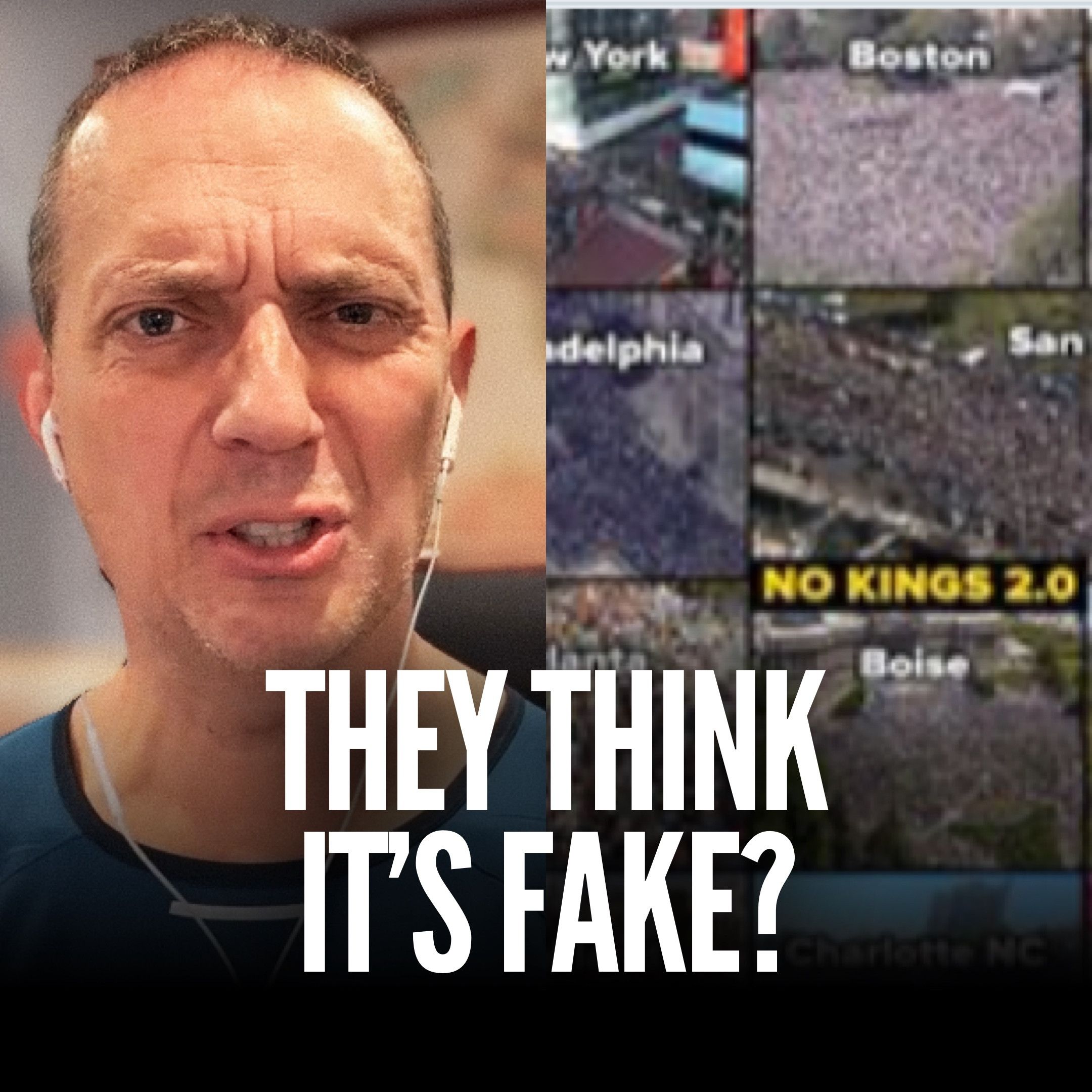
Yeah, yeah. And it was like, like if there were. Again, everyone's got a camera phone everywhere now. We were out there doing, doing video at all these protests, so were a bunch of other people. These are like in the middle of public streets. If there were like worse things than this happening or like a lot of things this bad happening, they would be all over the Internet. Because I mean, the social media and especially sort of like the function of MAGA social media in moments like this is to surface the stuff to get mad at and then getting mad at it and running, running, you know, running these people's information down and administering professional consequences, things like that. So that was one thing that appears actually to have happened. But the last thing that I wanted to talk about is stuff that didn't happen, which was just completely fabricated, made up out of whole cloth. And this stuff went very viral. I saw a lot of claims specifically, I don't know why. It was this specific aerial shot of the no Kings crowd in Boston, Massachusetts. It was just like this one very striking sort of like you have a drone going overhead and it's just like a giant park, city park full of people. I don't have like official numbers on how many people were at that particular protest, but for some reason this particular shot, which was played on MSNBC and which was sort of sent out in official no Kings sort of like social media rapid response stuff, became the subject of a lot of conspiracy Theories. You had a lot of accounts. Our good buddies, like Cat Turd was posting this person, the red headed libertarian Liz Wheeler. There's an account called the Older Millennial with like half a million subscribers on X. Followers on X, I should say, all of whom were essentially saying this is fake footage or repurposed footage from older, earlier marches, from the Women's march maybe, or from a free speech rally that happened in Boston a couple of years ago. You know, a couple different things like that. They were basically saying these. All of which was basically to say, right, these claims of a giant, you know, a giant, millions of people in the street movement that you're being told are fabrications. They're lies. And you can tell they're fabrications because look, we've caught them lying about this one there. That, that, this, this particular footage that they're showing as like evidence of overwhelming turnout. This Boston shot is actually repurposed footage from before. It was very quickly, very obviously clear that wasn't the case. People dug up old footage of those old marches and you know, the trees are bare in one and they're in a completely different part of the park in another. And also this is just live footage that's happening on the news, right? I mean, these shots didn't exist before yesterday. Nobody's been able to surface actual posts, including these things before yesterday. Not to mention that you would need like this unbelievable conspiracy to get everybody in on it, to fabricate these things in real time. But all that stuff basically doesn't matter. Not only does the footage go viral and these claims go viral, but also a claim goes viral that MSNBC has already pulled the footage and apologized for it. Again, just totally made up out of whole cloth, but has found a way to sort of become received wisdom in certain parts of sort of MAGA social media since yesterday. So I think that like, that kind of gives you a sense of the various ways you can, if you are inclined, say to, to be more contemptuous toward these sorts of things. It's very, you've been given sort of this buffet of options and you can select from that buffet, ah, these protests were insignificant and they were small and they were just sort of retirees and boomers and jokers and who cares about it? If you are more inclined to be paranoid and fearful, you can go the other direction and you can be like, first of all, yeah, first of all, yeah, the streets are full of antifa terrorists and people making these death threats and also the news media and these people are carrying out these, these dastardly schemes to sort of legitimize it and to make it seem much bigger than it was. So it's, it doesn't all add up to like one narrative, right.
- [11:12]
A
Or then it's all fake.
- [11:14]
B
Yeah.
- [11:14]
A
Yeah. Well, isn't this Trump's superpower? Maybe it's not really Trump's superpower. This is a superpower of having the kind of coalition with the cognitive characteristics to it that Donald Trump possesses, where these very fine people are able to seamlessly move from. What's happening at the Capitol is terrible. And it's the work of antifa and FBI agitators to. Nothing happened actually. It was all totally peaceful. They were being welcomed as liberators to actually the people who were there trying to take our country back by force were the real patriots who were doing what was needed and that you could just slide from one of these to the other with no trouble whatsoever. Right. There is no need for internal consistency and, you know, it's okay actually for various parts of the coalition to each settle on a contradictory explanation for things they don't like. And that's fine, right? Like there's, there is no. I, I don't think the other side has that ability. Maybe I'm wrong. Like, I don't think. Well, maybe I'm, maybe that's crazy, right? Maybe it's, maybe the Democrats can believe that like Obamacare is the greatest thing ever. And also it was terrible and maybe you could find an example of it, but not like this, like this is a weird Trumpian thing and it's post truth. And I think the genesis of this is that everything just becomes a loyalty test. Right? It's all, you know, the question isn't actually, is the thing I'm saying true? The question is you're loyal to the cause, right? And the way you demonstrate that you're loyal to the cause, you just agree with whatever the line is at the moment.
- [13:09]
B
Some of this is a relatively new innovation in the form. Right. Because I think back in, back in Trump's first term, he had already settled on a certain social media strategy that was, that was basically predicated on the fact that for a, for a critical mass of the country, there were no more trustworthy outside institutions that were reliable sources of information about anything. And that in that environment you could just play this hyper partisan game where everybody who opposes you is a liar and a cheat and in on it and, you know, skimming off the top and probably violent and probably antifa and whatever. And meanwhile, you, you and your people were the only Pure ones, the only true ones, the only patriots. And that actually it wouldn't convince everybody, it wouldn't even convince a majority of the country, but it could in theory assemble a durable political coalition. Right. And I think that what we have seen that's new now is that you, you just gestured at it a minute ago. It's not just that there's a loyalty test, because there's not one test. Right. It's, it's all of these disparate.
- [14:09]
A
The entire movement is just loyalty tests. Yeah, yeah, but loyalty test is the ideology.
- [14:14]
B
Right. But also like individualized and personalized to like each individual person in this kind of algorithmic way. And I think that this, that the no Kings protest is kind of like a good example of this, because in broad strokes, it's impossible to deny what happened on Saturday. If you are outside, if you're like in the world and you're like getting normal information from normal sources. There are millions of people marching in the streets all over the place. And that's just a fact. Right?
- [14:40]
A
Yeah.
- [14:41]
B
But for Trump, and I think he is not, not stupid to realize this, or maybe he doesn't realize it, maybe it's more of like a lizard brain intuition. But it's definitely become kind of a part of this whole sort of emergent social media strategy for these guys. There are a lot of people who just aren't outside, they aren't getting any other sources of information. And the information that they do get is this sort of ever changing chimera of just sort of like algorithmically delivered Internet content. Right. And so of something like a no Kings protest actually is pretty easy to chip away at if that's the case, because all you have to do is, is say, okay, you're seeing crowd footage of like big groups of people or whatever. But that's fake. They made that up. And here are the reasons why you should think that that's fake and that they made that up. And meanwhile, let's zero in on the six or seven, like, most inflammatory and most sort of like indefensible moments again nationwide in all of this that happened. And then let me just suggest to you, the viewer, that that was basically everybody who was there. Right. And then again, you can make one sort of argument that one sort of person will find persuasive in their feed and you'll, you can make another sort of argument that another sort of person will find persuasive in their feed. And it's not like there's like some eye in the sky figuring all this out this is just emergent properties of distributed social media networks. Right? Different people are following the kinds of influencers that they find interesting and provocative and persuasive. And those sorts of influencers are the sorts of influencers who are going to distribute the right argument to their correct audience. I mean, I think it's, it is, it is a really remarkably kind of durable and, and difficult to fight sort of social distributed disinformation. God help me for saying that word, bad word, horrible word. I My skin is crawling. But disinformation machine and matrix and, and I genuinely don't know what you do about it, but I guess it's kind of fun to laugh at it.
- [16:35]
A
Well, from the outside, it's not just the fault of the influencers. Andrew, by any chance did you pick up a dead tree copy of the New York Times on Sunday? Are you a New York Times Sunday guy? Like to grab the physical newspaper, get your fingers dirty and leaf through it?
- [16:50]
B
You know, I aspire to be a dead tree guy. I It's not the guy I am at this stage in my life.
- [16:56]
A
Let me share with you the front page of the Sunday morning New York Times. Again, keep in mind these protests all happen midday on Saturday. So it's not like this was late breaking at 11:45 Saturday night after the paper had been put to bed, we had the largest single day protests in American history. And here is the front page of the New York Times. You can see a quarter of the space, three quarters of the space given up to Syrians who were lost or imprisoned during the Assad regime. Very pressing story, which by God bless the New York Times for covering it. Great work. Not sure it was urgent. Not sure it needs to be on the front page this Sunday. Next piece above the fold, little urgency from Trump on shutdown. The piece basically arguing, actually Trump is winning the shutdown. He's able to do what he wants. Anyway, next to that, a story about how the Democrats are in disarray. They're using a same old pitch about stopping Trump. Some see it as a missed chance to advance a positive message.
- [17:59]
B
I did see that piece. That was a good piece.
- [18:02]
A
Then you go down and you have a link to a story about the Obama list and the Barack Obama Presidential center being constructed in Chicago. There's a piece about in Italy they serve Italian food now and then there are two small pictures below the fold and the caption on it is no Kings rallies oppose Trump. Demonstrators gathered on an overpass in Golden, Colorado. Left, in Boise, Idaho. Right. And in cities around The Nation Saturday, page 23. So, you know, not just the influencers spreading disinformation. It is like the paper of record making an editorial decision which I simply cannot justify in any way. Like, I can't even steel, man, this editorial decision. Can you?
- [18:58]
B
Yeah, it. It is strange. I mean, like, the only thing I can think of is that they were kind of like, ah, we had one of these a couple of months ago and we covered it then and it's the same one again the second time. But. But I. Maybe it was not, like, guaranteed that this one was going to be, like, significantly larger than the first one, but it seemed like a pretty good bet. There was so much more, like, coverage and argument about. I mean, like, this was one of the. We talked about this on the live stream on Saturday. Like, the fact that Republicans spent so much time talking about the Hate America rally and all that stuff really does seem to have been a big, like. It's been like. It was like rocket fuel on these protests in terms of people being like, well, I don't really like what the President's up to, and I'm not Hamas and I'm not antifa, so I'm gonna grab my American flag and I'm gonna write up my, like, you know, First Amendment, we love the First Amendment protest sign and I'm going to get out there. And there were, like, a lot of people who did that. So. So yeah, I don't know. Biggest. Biggest in history. That seems significant. That seems like the kind of like, you know, and peaceful.
- [19:54]
A
Right. And all. Again, all these things were obvious by 2pm so by 2pm we were getting reports about the sizes.
- [19:59]
B
Do you think that would have been the way they let off with it? If they're like. If it had devolved into riots in like, three or four cities. Right.
- [20:05]
A
Probably, Andrew. They probably also would have put it on page 23. Yeah. All right, guys, we'll be back with more soon. Good luck, America.