← Bulwark Takes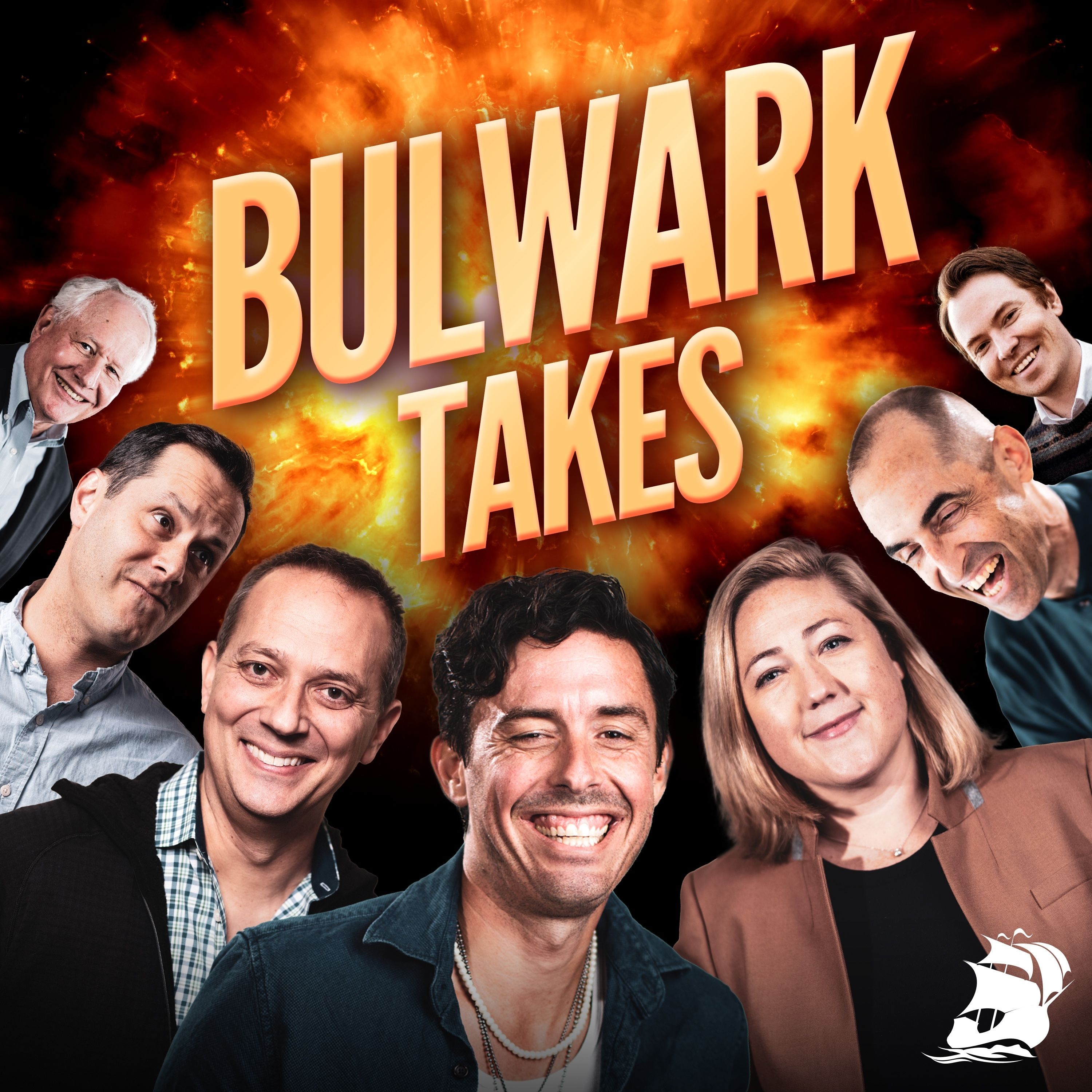
Loading summary
Transcript52 lines
- [00:00]
A
Hi, I'm Alastair Campbell from the Rest is Politics.
- [00:02]
B
Anish Kumar here from podsafe the UK.
- [00:04]
C
And Cristiana Figueres from Outrage and Optimism.
- [00:07]
A
Rising inequality, conflict, climate, disaster. It's very hard to find reasons to be hopeful about the future.
- [00:12]
B
That's why we're teaming up this September during the 80th General assembly of the United nations.
- [00:17]
C
Along with political currency Pod, Save the World, the Week Junior and more.
- [00:22]
B
We'll discuss the stories that give us hope and answer the question, how does hope turn into action?
- [00:27]
A
Look out for the B Hope takeover. This September, a BetterHelp ad. Louis Capaldi partnered with BetterHelp to get word out about how important therapy can be. And I struggle most weeks to, like, get up, get myself up and ready and go to therapy or whatever. Like, even like opening the laptop to talk to my therapist sometimes can be really difficult. But I do it because I realize how important it is for me to continue to feel good. I felt the best I felt in a long time through therapy. Learn more about online therapy@betterhelp.com hey, it's.
- [01:00]
C
Will Salitan from the Bulwark. So we gotta talk about this crackdown on free speech by the Republican Party. You probably saw that last night Donald Trump turned up the heat on ABC to get rid of Jimmy Kimmel. So what I want to do here is step back and show you how Trump and his party have turned against free speech since Charlie Kirk got shot. It's been a total about face and it's very, very dangerous. First, let me show you what Kimmel said last week that pissed off Republicans.
- [01:35]
D
We had some new lows over the weekend with the MAGA gang desperately trying to characterize this kid who murdered Charlie Kirk as anything other than one of them.
- [01:44]
C
So that's not great. What Kimmel said. He was wrong to say that in a way that that implied that the shooter was maga. But the response from the right was off the wall. They tried to force Kimmel off the air and they succeeded. They threatened abc, and ABC suspended Kimmel. So that's what they're doing now. But let me take you back and show you what they were saying a year ago. I want to show you a Holocaust denier, Daryl Cooper. On Tucker Carlson's podcast last September, this guy said the Nazis didn't plan to kill Jews. It just sort of happened by accident.
- [02:27]
E
They launched a war where they were completely unprepared to deal with the millions and millions of prisoners of war, of local political prisoners and so forth that they were going to have to handle. They went in with no plan for that, and they just threw these people into camps, and millions of people ended up dead there.
- [02:47]
C
And here's what Carlson said to Cooper on that podcast. I just want to say, I think you are the most important popular historian.
- [02:54]
D
Working in the United States today.
- [02:56]
C
Okay? So I think we can agree that what this guy said and Carlson defending him is way, way worse than anything Jimmy Kimmel said, right? But J.D. vance, who at that time was the Republican nominee for Vice president, just blew it off. A couple of weeks after that podcast, Vance appeared as a featured guest at a reception to promote Carlson's show and help him sell VIP tickets. And when reporters asked about the Holocaust denial, Vance's office said he wasn't going to bow to cancel Culture. And here's how Vance himself defended Carlson.
- [03:38]
E
Agree or disagree with anything that Tucker Carlson or his guests say. We believe in free speech.
- [03:42]
D
We believe if you don't like an.
- [03:44]
E
Idea, and obviously, you know, the Holocaust was a terrible tragedy, the best way to ensure that doesn't happen is to debate and push back against bad ideas. It's not to try to censor and suppress them.
- [03:56]
C
Okay, so it's wrong to try to suppress bad ideas. So what advance do you. When ABC suspended Kimmel, he went on social media and made fun of the, quote, bellyaching from the left over free speech. So apparently free speech is a legitimate defense for Holocaust denial, but not for Kimmel. And check out what Vance said about Charlie Kirk's enemies.
- [04:26]
E
So when you see someone celebrating Charlie's murder, call them out and, hell, call their employer.
- [04:31]
C
Call their employer. Isn't that what Vance used to call cancel Culture? So Kimmel should be fired. But if you promote Holocaust denial, Vance will help you sell tickets. And let's not pretend ABC decided on its own to punish Kimmel. They got a big push from the Trump administration, specifically from Brendan Carr, the chairman of the Federal Communications Commission, which regulates TV stations. Carr used to advocate for free speech. Here's what he said about it last year.
- [05:06]
D
Americans have been living through an unprecedented surge in censorship the last couple of years. We need to return to free speech. Diversity of opinions. Does it mean that everybody has to see speech they don't like? No, not at all. My view is let's empower individual users that are participating in these digital town squares. You can mute people, you can block people, but let's put those decisions back in the hands of everyday Americans and not have them centralized in Silicon Valley.
- [05:29]
C
So that was Carr's attitude when he Thought free speech was being targeted by the left. But after Kirk got shot, here's what Carr said about Kimmel.
- [05:41]
D
I mean, look, we can do this the easy way or the hard way. These companies can find ways to change conduct, to take action, frankly, on Kimmel, or, you know, there's going to be additional work for the FCC ahead.
- [05:54]
C
In fact, Carr suggested explicitly that ABC should suspend Kimmel.
- [06:00]
D
There's calls for Kimmel to be fired. I think, you know, you could certainly see a path forward for suspension over this. And again, you know, the FCC is going to have remedies that we could.
- [06:12]
C
Look at that was a direct threat. We can do this the easy way or the hard way. If ABC doesn't act, we have remedies. And just hours after Carr said that, ABC suspended Kimmel. Now, Republicans used to say that if a company did that, if it suppressed content to satisfy the government, that that was censorship and it was wrong. That's what Mike Johnson, who's now the speaker of the House, said four years ago when he thought the censorship was on the left. Here's what Johnson wrote in a letter to Mark Zuckerberg. Johnson argued that Facebook was, quote, making content moderation decisions to align with certain government favored policies and positions. And therefore, even though Facebook was a private company, it was guilty of, of censorship. But watch what Johnson said last week when Bret Baier asked him about Kimmel.
- [07:15]
F
What do you say to Democrats or folks on the left who say that there is now this effort to go after free speech on the left? You have just last night, ABC suspending Jimmy Kimmel.
- [07:25]
C
Here's how Johnson responded. ABC is a private company. You've heard a lot of consternation about private companies firing or reprimanding employees for going online and glorifying the tragic death of a young father and young husband. And it's detestable. So in the private employer space, you have all the right in the world to have standards for your company, standards for your broadcast brand, and you know, they get to make that decision. Suddenly, Johnson doesn't seem to care that the company is acting under pressure from the government. And let's not forget Trump. Here's what he told Congress in March.
- [08:03]
F
And I have stopped all government censorship and brought back free speech in America.
- [08:10]
C
It's back. But when ABC suspended Kimmel under pressure from Brendan Carr, Trump said it was great. In fact, he named other late night hosts that he said should be fired. And then Trump said TV networks that reported negatively about him should be taken off the air. Are you going to ask Brendan Carr, to weigh in on other late night hosts that you have apps that should be on the air.
- [08:38]
F
Late host is on network television. There is a license. I'll give you an example. I read someplace that the networks were 97% against me. I get 97% negative. They're getting a license. I, I would think maybe their license should be taken away. It will be up to Brendan Carr.
- [08:58]
C
And then last night, Trump attacked ABC for putting Kimmel back on the air. Trump said ABC had promised the White House that Kimmel's whole show would be canceled. That is direct collusion between the government and the censors. Trump literally wrote that Kimmel's criticism of him was illegal. And Trump implied that he would sue the network. And taking down the networks is just the beginning. Trump also says that private citizens who protest against him are agitators and they should be put in jail.
- [09:37]
F
You can see they're professional agitators. I had one the other night. I had four the other night, all in one group, total phonies. I started to scream when I got into a restaurant, oh, you know, something with Palestine. But a woman just stood up and starts screaming and she got booed out of the place too. The people, there were a lot of people in the restaurant. I went there to show how safe and it was safe. I mean, the woman is just a mouthpiece. All she was, she was a paid, she was a paid agitator. And you have a lot of them. And I've asked Pam to look into that in terms of RICO bringing RICO cases against the criminal RICO because they should be put in jail. What they're doing is to this country is really subversive.
- [10:16]
C
Look, this is deadly serious. Trump's Republican Party was never sincere about free speech. What they wanted to protect was their speech. When somebody like Kimmel or a woman in a restaurant tries to speak out against Trump, Trump and his party are willing to use the power of the government to get that person fired or jailed. So assuming Trump and his goons don't take down this channel, I'll see you next time.
- [10:50]
A
I'm Alastair Campbell from the Rest Is Politics.
- [10:52]
B
Anish Kumar here from pod, Save the.
- [10:54]
C
UK and Cristiana Figueres from outrage and optimism.
- [10:57]
A
Rising inequality, conflict, climate disaster is very hard to find reasons to be hopeful about the future.
- [11:02]
B
That's why we're teaming up this September during the 80th General assembly of the United Nations.
- [11:07]
C
Along with political currency, podcast, the World, the Weak, Junior and more, we'll discuss.
- [11:13]
B
The stories that give us hope and answer the question how does hope turn into action?
- [11:17]
A
Look out for the B Hope takeover this September.
- [11:21]
E
If you've been thinking about getting serious with your money, like actually serious, now's the time. The Motley fool is offering new members 50% off their iconic stock recommendation service, Stock Advisor. This is the same service that's crushed the market with recommendations that have returned 1,057% since inception compared to the S&P 500's 180% over that same period. This isn't guesswork. The Motley fool has a track record of finding companies before they become household names. So if you want to invest smarter and you like saving money while doing it, go to fool.com listen to claim your 50% off discount off a one year term of stock advisor. Again, that's fool.com listen returns of 1057% are from the Motley Fool's product stock advisor and measured against S&P 500 returns of 180% as of July 10, 2025. Past performance is not an indicator of future results. All investing involves a risk of loss. Individual investment results may vary.
- [12:13]
A
Hi, I'm Alastair Campbell from the Rest.
- [12:14]
B
Is Politics, Anish Kumar here from podsafe.
- [12:16]
C
The uk and Cristiana Figueres from Outrage and Optimism.
- [12:19]
A
Rising inequality, conflict, climate disaster. It's very hard to find reasons to be hopeful about the future.
- [12:25]
B
That's why we're teaming up this September during the 80th General assembly of the United nations.
- [12:30]
C
Along with political currency pod, Save the World, the Week Junior and more.
- [12:35]
B
We'll discuss the stories that give us hope and answer the question how does hope turn into action?
- [12:40]
A
Look out for the B Hope takeover this September.