Podcast
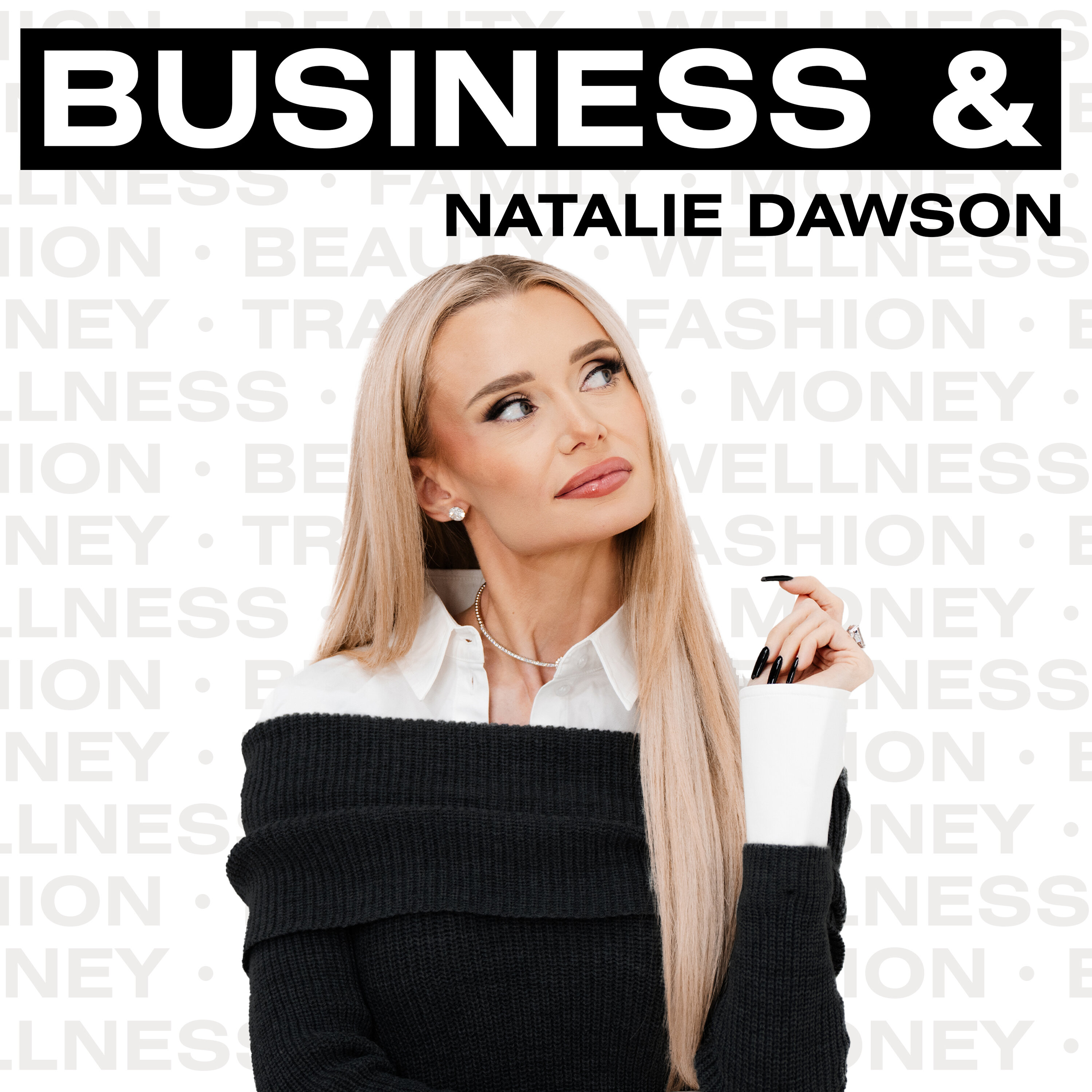
Business &... with Natalie Dawson
Hosted by Natalie Dawson · EN
Welcome to Business &—the podcast for people making it all happen.
Running a successful business takes over your life, but there’s still room for the ‘ands’—the things that keep you sharp, confident, and ahead of the game. Because success isn’t just about what you build—it’s about how you show up.
I’ve helped business owners scale to nine figures, and on this podcast, I’m sharing what’s working—real strategies, data-driven insights, and the inside track on what’s next in business, health, wealth, beauty, and fashion.
If you’re here to grow, scale, and dominate in every room you walk into—you’re in the right place.
It's time to stop dreaming and start doing.
22episodes
Episodes
Newest firstAll episodes
S2/E63 Interview Secrets That Make YOU The Top Candidate
May 1500:17:11Tap to summarizeIn this episode, I share four interview “secrets” I’ve learned from hiring, training, and firing over a thousand people. First, employers want to feel chosen, so I explain why you should stop mass-applying and instead research and pursue your top 10 companies with clear personal, professional, and financial goals. Second, I break down how employers hire the person who lowers their doubt by demonstrating competence and problem-solving, not desperation, including what I’d say in interviews today, and an example of a standout core values presentation. Third, I explain how tiny details in your setup, materials, and brand alignment signal professionalism and reduce perceived risk. Fourth, I show why employers learn as much from follow-up as from your answers, and how personalized, thoughtful follow-ups prove initiative and work ethic.See omnystudio.com/listener for privacy information.
Transcribe →S2/E62 How Your Interests Determine If You Level Up in Your Career
May 800:14:50Tap to summarizeIn this episode, I argue that being “multi-passionate” is usually a distraction, not a strength, and explain why specialists tend to earn more than generalists and why distractions and context switching erode performance. I break down six steps to pick your one thing: audit every interest and the time you’re giving it, study famous success stories as evidence of focus (including Buffett’s “circle of competence” and Jobs cutting Apple down to four core products), and reframe passion as a byproduct of mastery using Cal Newport’s research and self-determination theory. I share how I chose an unclaimed operations lane at Cardone Ventures, warn against splitting focus with a side business, then outline how to build your lane by solving real market problems, producing measurable results, and becoming known for one clear expertise.See omnystudio.com/listener for privacy information.
Transcribe →S2/E61 How To Use This 3-Step Money System To Build Wealth
May 100:20:17Tap to summarizeIn this episode, I break down the core reason many businesses struggle to build real value: misaligned incentives and unclear paths that leave employees disengaged. I share a three-step system I’ve used across thousands of businesses to align individual goals with organizational goals by having one-on-one conversations about each team member’s one-, three-, and five-year Personal, Professional, and Financial (PPF) goals. I explain why personal goals create the strongest connection, how professional goals should be unpacked and reverse-engineered into a real career path, and why financial goals must be specific and quantified to drive motivation and performance. I reference Gallup’s 2026 engagement data and Deloitte’s 2025 Gen Z/Millennial survey, and I illustrate the framework with examples of team members who grew into higher-impact, higher-income roles by aligning their ambition with business needs.See omnystudio.com/listener for privacy information.
Transcribe →S2/E60 How To Build Wealth in Your 30s (Even If You’re Starting Late)
Apr 2400:16:33Tap to summarizeIn this episode, I explain why your thirties are the most powerful financial window, because you have experience, connections, and urgency, and why believing it’s “too late” keeps most people stuck. I share four strategies I’ve seen create real wealth: first, stop comparing yourself to others and reframe success as staying “in line” long enough to get your turn. Second, develop one high-income money skill, especially marketing and sales, because money flows to people who solve problems and drive revenue, not to degrees or expense-side roles. Third, avoid lifestyle creep by resisting social-media-driven spending and using raises, bonuses, and promotions to save and invest instead. Fourth, repeat the cycle of skill-building, earning, and investing to build discipline, confidence, and long-term financial freedom.See omnystudio.com/listener for privacy information.
Transcribe →S2/E59 Business is Hard Until You Design it Like This
Apr 1700:18:48Tap to summarizeIn this episode, I break down six structural and human traps I’ve seen quietly kill businesses after studying over a thousand of them…and the fixes that prevent failure. First, I explain how founders become trapped by control because they never replace themselves in the roles they actually perform, and I share a method for documenting functions, setting targets, and hiring to duplicate yourself. Next, I cover hiring based on pressure instead of fit, why ignoring interview red flags destroys teams, and the standard I use after interviewing over 1,000 people and building a 350-person organization. I then outline how scaling fails without clear ownership of roles, responsibilities, and core metrics across marketing, sales, accounting, and fulfillment. I also warn against adding complexity and distractions after hitting $1M, show why numbers reveal the real problem you should solve, and explain why culture (built through expectations, onboarding, incentives, and coaching) determines whether you can scale past $10M.See omnystudio.com/listener for privacy information.
Transcribe →S2/E58 How To Think About Money Like The Top 1%
Apr 1000:15:14Tap to summarizeIn this episode, I break down why anxiety around money doesn’t mean you’re bad with it—it often comes from an inherited belief system—and I share the steps I’ve seen top entrepreneurs use to rewire how they think about wealth. I start by identifying your “money story” from childhood and how scarcity scripts shape decisions, then explain why treating money like a scorecard leads to comparison-driven, emotional choices. I explain how to shift from scarcity to strategic abundance by asking whether decisions are fear-based or strategy-based, and how to treat money as a tool with a job rather than a reward (including the impact of mental accounting). I argue the highest ROI is investing in your own skills and network, and close with building automated financial systems—like recurring investing and dollar-cost averaging—so progress doesn’t depend on daily willpower.See omnystudio.com/listener for privacy information.
Transcribe →S2/E57 7 Strategies Every Business Should Implement in the Next 90 Days
Apr 300:22:59Tap to summarizeIn this episode, I lay out a 90-day plan built on seven strategies to scale any business without burnout. I start by identifying the real growth constraint—leads, conversions, capacity, talent, or cash—using the last 90 days of data so you stop wasting money on the wrong problem. Next, I focus on fixing margins before scaling by auditing true profitability per offer, restructuring pricing, and eliminating money-losing products. Then I show how to make your offer undeniable through better packaging, risk reversal, clearer ROI, improved terms, and optimizing for customer lifetime value. I cover removing yourself as the bottleneck by documenting revenue-driving processes, implementing SOPs, and using AI for repeatable work. Finally, I explain how to hire with clear scorecards and KPIs, install accountability rhythms with measurable metrics, and evaluate what worked so you can cut distractions and double down, then reassess constraints every 90 days.See omnystudio.com/listener for privacy information.
Transcribe →S2/E53 Ultimate 2026 Glow-Up Guide
Mar 2700:15:08Tap to summarizeIn this episode, I share a six-step blueprint to glow up by changing from the inside out, starting with stopping the chase for external validation, and realizing transformation must be rooted in self-respect. I don’t wait to become my future identity. I operate as her now. I don’t wait to become my future identity, I operate as her now, and that shift is what took me from being seen as a people ops executor to growing into the person who is asked to speak on women’s financial literacy; I focus on three things: control your environment because small daily organization signals standards and eliminates noise, build self-trust because discipline isn’t optional and if you don’t keep promises to yourself nothing scales, and use appearance as a tool because people make decisions fast and a 2014 Yale negotiation study showed suits outperform sweatpants, which isn’t opinion, it’s leverage; nothing is casual, every detail is either compounding for you or working against you.See omnystudio.com/listener for privacy information.
Transcribe →S2/E56 Girl Talk...Discipline Is What's Missing From Your Life
Mar 2000:16:36Tap to summarizeI share how I transformed my life after realizing the 1% build discipline differently, moving from making $55,000 a year to running a $250 million a year business and building a life I love. I explain that discipline is about your relationship with yourself, others, and the world, then walk through six steps: create a “counter version” of yourself to avoid a fake-life trajectory, build self-trust by doing what you say you’ll do, fully commit and then overdeliver without under-promising, practice discipline with others to increase trust and reputation, let your results reveal where your discipline is lacking, and rebrand discipline to associate hard work with positive feelings and rewards. I close by noting that time misuse can break even disciplined people and point to managing time like a CEO.See omnystudio.com/listener for privacy information.
Transcribe →S2/E55 How To Show Up For Yourself EVERY Day and Stop Feeling Stuck Overthinking
Mar 1300:15:56Tap to summarizeIn this episode, I share six steps that helped me stop relying on daily motivation and start showing up consistently. I explain why your appearance is an “opportunity-ready” signal, how to act like your future self before you feel ready, and why you have to prioritize showing up for yourself before others. I also cover building an environment that reduces friction by controlling clutter and distractions, developing discipline by doing the one thing you keep avoiding and repeating it daily, and focusing on consistency over perfection by using simple reward systems to reinforce kept promises. I end by connecting these steps to identity change and invite you to listen the next episode on communicating with respect.See omnystudio.com/listener for privacy information.
Transcribe →