Loading summary
Transcript41 lines
- [00:00]
A
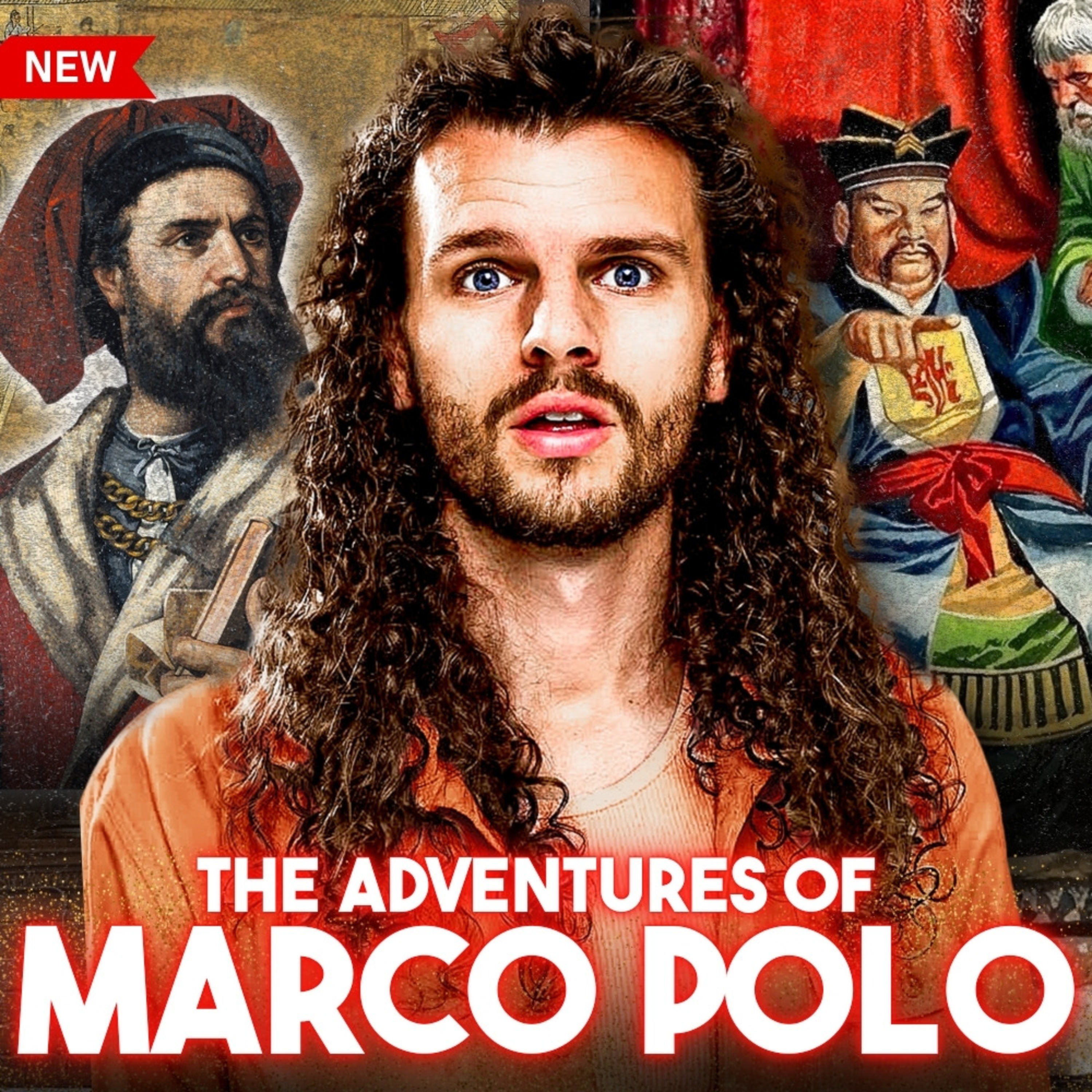
The most famous explorer in history. Never planned to be an explorer. He was a 17 year old kid who got dragged on the ultimate family business trip and ended up spending 20 years in places that Europeans thought were fairy tales. He walked to China when most people never left. He became the favorite foreigner to the grandson of Genghis Khan and came home to Venice so rich and unrecognizable that his own family didn't believe who he was. This is the story of Marco Polo, the teenager who walked to China and accidentally changed history. So sit back, relax, and welcome to History Camp. What's up, people? And welcome to History Camp. My name is Mark Gagnon and thank you for joining me in my tent where every single week we explore the most interesting, fascinating and controversial stories from all history. From all time, forever. Yes, we are doing it. This is my attempt to try to understand everything that's ever happened. And there's been, oh boy, a whole lot of stuff going on. I mean, every day that goes by, there's more history getting made. So I'm just trying to keep up now, of course, this episode and this show is not possible without you watching at home. Thank you so much for tuning in. It's also not possible without my dear pal Christos being in the corner in his sweet little tent, curled up in a tree, making this whole thing possible. Christos, can I get a Marco Polo? That's so corny and dumb. I can't even believe you convinced me to do that. No, that was quite cute and I think actually very, very apt for this episode. Guys, it's late at night, we're here in the tent talking about Marco Polo. It's probably something you've heard about, right? You play the game as a kid. You're like, marco Polo. Like you've all. Everyone knows who Marco Polo. Can we get a picture of Marco Polo up on the screen? Because I'll be honest, I don't even really know what this dude looked like until today. Like, if you had a, like, gun to your head, what does Marco Polo look like? Would you even have a guess? I bet you most people don't even really know. I didn't know until I actually did this episode. I was like, who is Marco Polo? I mean, look at this guy. Regal, handsome, nice beard. I mean, not the best hairdo in that one, but generally speaking, you see why he keeps a hat on. Marco Polo is a fascinating guy. In order to understand Marco Polo and how he ended up changing the world, bringing noodles all over the place, you got to start with his papa. All right. Now, Marco was born 1254 in Venice, Italy, to a woman named Nicole and Defusa and Nicolo Polo. Now, at the age of six, his father Niccolo and his uncle Mafeo were, you know, small time Venetian merchants. They were selling a little bit of how you doing? You know, just making it work the Italian way, all right? And they decided to try their luck trading along the Silk Road. Now, the Silk Road was popping off. This was this new way to make money trading to the East. It was a big deal. But from the jump, their whole journey gets interrupted. So they start in Constantinople, they get caught up in a little civil war. You know, it happens. They have to flee to the north, and they somehow end up deeper in Central Asia than any Europeans had really gone at the time. Like, people weren't really going that way. And neither were they. They weren't exactly exploring. They were just literally running from, you know, a human calamity. But then around the year 1266, they meet some Mongol officials who are just shocked that they're alive. Like, these little Italian, you know, Venetian kids are. They made it. They're just shocked and they're like, this is so crazy. So because they're so shocked that they meet a European guy in the middle of Central Asia, they decide the Mongols literally escort them all, all the way to the court of Kublai Khan in China. Now, if you don't know who Kublai Khan is, he's the grandson of Genghis Khan. Yes, that Genghis Khan, Chinggis Khan, as he's referred to in some circles. Genghis Khan, but I'm going to say Genghis, but also I think I'm related to Genghis Khan. So are you. So is most people watching? There's hundreds of thousands of people related to this guy.
- [03:41]
B
I don't appreciate the insinuation.
- [03:42]
A
No, that is true. You are Asian. But also the fact that this guy's literally like the actual grandson. So Kublai Khan, for reasons that are still unknown, decides that he likes them. They meet in the courts, and he meets these like, swag little Italian dudes. And he's like, you know what? I like this. And he rocks with them. So he's curious about Christianity, he's curious about Europe. And so he gives them a mission. He goes, go back to your Pope. Ask him to send 100 educated Christian scholars in holy oil from Jerusalem and come back and tell me all about it. So in 1269, after nine years away, Niccolo and Maffeo return to Venice. But they come back stupid wealthy. The Mongols ran the Silk Road, right? And Kublai Khan controlled the trade across Asia. So when he sent the brothers back west, he sent them as official envoys that meant safe passage, escorts, and, more importantly, valuable gifts meant to signal, like, status and authority wherever they went, wherever they would go. People like, oh, these guys are, you know, from. From the con. We can't mess with them. And these gifts aren't just souvenirs. They're, you know, likely gold and silver and precious gems and, you know, Bitcoin and all sorts of stuff that these brothers could then freely exchange on the Silk Road, which they did. So by the time they reached Venice in 1269, they weren't just returning as travelers. They were men with gifts from the Mongol Emperor. They were fluent enough in a bunch of different languages and had rare knowledge of the outside world that made them just instantly rich and interesting by European standards. So when his father returns, Marco is now 15 years old. His mother had actually died shortly after Nicolo left. So Marco had been raised by relatives who probably figured his dad was dead in, like, a ditch somewhere in Asia. And now this stranger shows up, claiming to be his father, speaking a bunch of languages, and basically says, hey, son, I haven't seen you in nine years. Pack your bags. We're going to China. Now, this is literally how Marco Polo's story begins. Not with, like, a plan to explore, but with a father who had just spent a decade in Asia and decided that his teenage son needed to come along for round two. So by 1271, Marco, his father, and his Uncle Maffeo left Venice carrying letters from the Pope, two Dominican friars who were supposed to be the first two of these hundred scholars to go to Kublai Khan. Now, the friars turn back immediately. They realize that they're gonna have to go back through war zones and deserts and years of travel without guarantees, and they're basically just like, hey, we're good. But the Polos, they keep going. And what they're attempting is insane by medieval standards. They're literally going to walk from Venice to Beijing. We should get a map for this. Venice to Beijing, 5,600 miles through deserts, mountains, and bandits and war zones and territories controlled by people who might kill them just for being foreigners. They cross the Mediterranean. They travel through what is now Turkey, Iran, Afghanistan. They spend months crossing the Pamirs, which are mountains so high that Marco later wrote. He literally writes about how fire doesn't burn properly and food takes forever to cook because of the thin air. They're still not in China yet. They got to go through the Gobi Desert, which Marco describes as one of the most psychologically terrifying places of the journey. He claims when night comes on, travelers hear spirits talking. And sometimes the sound of musical instruments, and sometimes the spirits will call the travelers by name. And he, following the voice, is led astray and perishes. I mean, this is just an insane trek. It's like, truly mind blowing, especially at the time. But finally, in 1274, after three years of traveling, they reach the court of Kublai Khan. Now, when the Polos arrive at, you know, Kublai Khan's court, they're meeting the ruler of the largest bordering empire in human history, right? Like, the guy literally controls territory from Eastern Europe to the Pacific Ocean, commanding armies larger than like the entire countries in Europe. And somehow 20 year old Marco Polo catches the attention of the most powerful man on earth. Kublai Khan is just impressed by Marco's adaptability and his intelligence. You know, he speaks Persian fluently, he learns Mongolian, and quickly understands just how the empire works, something that most foreigners never can even grasp at all. So when Kublai Khan sees this, he starts sending Marco on imperial missions across Asia, basically making him like, like an attache or like an inspector for the Mongol Empire. Now, Marco claims that while serving Kublai Khan, he wasn't just traveling, he was working. He says he's handling tax matters and carrying out diplomatic missions and even spent several years in Yangzhou in like an administrative role. But why? Like, this is the thing that I didn't understand. Why would Kublai Khan trust this random foreign rich kid with these important responsibilities? Well, the thing about the Mongol Empire is that it was incredibly meritocratic, meaning that if you were useful, your ethnicity didn't really matter. So Kublai Khan used Chinese advisors, Persian administrators, Arab engineers, and apparently some diplomatic inspectors from Venice. But Marco was different from others because he was genuinely curious about everything, which made him the perfect guy to go and gather intelligence. Meanwhile, Niccolo and Maffeo, they weren't just sitting around, they were running their own operations for the khan. Niccolo handled commercial ventures and trade negotiations, while Maffeo focused on diplomatic communications between the Mongol court and all the foreign merchants trying to bring money in. But it was Marco's youth and curiosity that ultimately caught Kublai Ka's attention. And along with gaining intelligence from around this empire, Marco was also exposed to a brand new world. Perhaps the most uncomfortable thing Marco describes is just how advanced Mongol civilization actually is. Europeans think of Mongols as like These savage horsemen that are just destroying everything they touch. They hear stories and myths of Genghis Khan, but Marco describes this empire that is religiously tolerant and merit based and technologically advanced, and in many ways better organized than anything in Europe. Also, remember, Khan's court include people from different types of cultures all working together. But then compare this to Europe where like, you know, people are killing each other for being the wrong type of Christian. And religious tolerance isn't really in vogue, and he's shocked by this. The Mongols also promote people based on ability rather than birth. So in Europe, if your father's a peasant, you're probably going to die a peasant. However, in the Mongol Empire, if you're useful, you can rise to the highest levels of government, something that Marco was not familiar with at all. And so as a result, this is really uncomfortable for Europeans that are hearing this because it just shows that these people that they considered as barbarians are actually running a more efficient and more advanced civilization in many instances. I mean, one example is paper money. So in Europe, money was gold or silver coins when the Mongols were already using tree bark to make paper. Marco also describes coal and gunpowder and spices and these like advanced silk techniques and even medical practices that are just completely unknown to the Europeans. But one of the most surprising things that he witnessed was inside the city. He writes about Chinese cities so large and so organized that they make European cities look tiny in comparison. At the time, London had like under 100,000 people, and Paris maybe had like a couple hundred thousand. But Marco was describing cities that felt impossibly big by medieval standards, and they even had a postal system. Across the Mongol Empire, messages could be relayed thousands of miles in weeks using these organized networks of stations and horses. While in Europe, communication was still moving at the speed of kind of whoever was willing to walk or ride from point A to point B. It wasn't any type of centralized post. But the new discoveries take us to the next chapter of Marco's life, the story that becomes the foundation of the word assassin. As the Polos travel through Persia in 1270, they pass through a region where people are talking about this secretive Islamic sect known in the west as Hash Hashin. And if you've ever played Assassin's Creed, you've definitely heard of these guys. Now, Marco never claims to meet them face to face. By this point, their mountain fortress, Alamut, had already been destroyed by the Mongols. But the stories were everywhere, and Marcoh wrote them down as he heard them. According to these accounts, the Hashashin were led by A figure called Hasan y Sabah, also known as the Old man of the Mountain. He supposedly recruited young men and subjected them to a ritual meant to convince them that they had seen paradise. The recruits were said to be drugged, maybe, and taken into a hidden garden filled with luxury, which had flowing water and music and food and beautiful women. And when they woke up, they believed that for a brief moment, they entered the afterlife. And then they were drugged again and returned to the real world, where they were told the paradise they had seen was real and that they could return there forever, but only if they obeyed the orders of the section. Now, we don't know if this whole garden and afterlife thing is true, but the Hashishin themselves were very real. They were members of the Nizari Ismaili sect, a group that essentially mastered political assassination centuries before it became common. Their attacks were public, and they didn't escape because death was expected. But sometimes they didn't even have to attack. There's rumors of rulers reportedly waking up and finding daggers left on their pillows to just as warnings. For Europeans reading Marco Polo's account, this was shocking. And even though the Hashashin were already gone by the time Marco passed through Persia, their legend lived on through his writings. Now, after 17 years in Asia, the Polos decided it's time to go back to Venice. But Kublai Khan has become dependent on their services, and he doesn't want them to leave. What's up, guys? We're going to take a break really quick because I got to tell you a story. Imagine you're sitting in your house. It's cold outside. It's a little snowy. And you're like, man, I just want a panini. So you go and you order it, you know, from a. From doordash or something like that. And it never gets to you. You're looking at the app, you're like, dude, it's been four hours. Where's my panini? You're calling? No one answers. Well, this is a true story that happened. There was a woman, a client, that was working as a doordash driver, and she slipped and fell on an icy walkway outside of a Panera Bread. And Fort Wayne, Indiana, she breaks her elbow, which leads to surgery and hardware having to get inserted into her arm. She can't work. And originally, you know, she sues Panera. And Panera's like, okay, we'll give you like 125,000. But then the good people over at Morgan and Morgan fought for her and got her the million dollar verdict that she deserved. Yes, if you never heard of them? Morgan and Morgan is America's largest injury law firm. Yes, and they are that way for a reason. They've been fighting for the people for over 35 years. Now, I'll be honest. If I ordered, you know, a panini and the woman gets paid a million bucks because she slipped, I mean, it's a tragic thing to happen, of course, but I deserve a little bit of that. I. I should get a cut at least, right? As I'm the one to order the panini. If I never ordered that panini, she never would have slipped, never got a million bucks, which obviously she deserves. You know what I mean? But maybe next time she gets a million and million point one. I can get a cool a hundred thousand out of that. Regardless. All I'm saying is if you're ever injured and you are looking to get the money that you deserved, the compensation that is entitled to you, your injuries, Morgan and Morgan could be the way to go. Hiring the wrong law firm can be disastrous. I mean, you can be locked up in litigate. It's a nightmare. But hiring the right law firm could substantially increase your settlement. And with Morgan and Morgan, it's easy to get started. Their fee is $0 unless they win. That's right. Their fee is free. Unless they win your case. You don't pay a zero. You pay zero cents. Unless they win your case. You can visit forthepeople.com gagnon g a g n o n that is f o r the people.com gag or dial pound law. That's pound 529 from your cell phone. That's for the people.com gagnon or click the link in the description below. And thank you so much to the good folks over at Morgan and Morgan for sponsoring this program and making this show possible with this paid advertisement. Let's get back to the show. At this time, there's a Mongol princess named Kokachin who needed to be transported to Persia to marry another Mongol khan. But the route was completely blocked by wars, and the Mongol court didn't trust their naval capabilities for such an important mission. But the Polos had proven their skill and they know the sea routes from their Venice background. So Kublai Khan makes them an escort, the princess to Persia by sea, and then you can continue home to Venice. So the Polos take the deal and they head on their way. But there are issues once again. From the very beginning, this expedition was not small. It starts with 600 people. The princess, her royal court, the Mongol officials, and a fleet of of ships, but only 18 people survive the trip. They're at sea for two years. They're fighting storms and disease and starvation. Ships are lost, people die of illness, and at several points, the entire expedition nearly fails. But thankfully, somehow the princess survives and the mission is technically successful despite losing, you know, over 500 crew members and royal courtesans and stuff like that. Regardless, the princess survives. So when they finally reach Persia, the most unexpected thing happens. They discover that the Khan the princess was supposed to marry has died while they were at sea. Now, despite this, there's no turning back. The journey has already cost hundreds of lives, and the alliance still needs to happen. So the marriage is redirected, and the princess marries the dead Khan's son instead. Marcoh doesn't describe a wedding or a ceremony. He simply acts as if the mission was complete and. And the voyage is over and they can go home. And now they finally can. So in 1295, after 24 years away, the Polos finally return to Venice. But there's an issue. Nobody recognizes them. And this is where legend takes over. So, according to later accounts, Marco hosts a dinner for his skeptical relatives and shows up wearing the same rough travel clothes that he's worn for years. But halfway through the meal, he takes a knife and cuts open the seam of his garment and jewels spill out onto the table. I mean, we're talking rubies and sapphires and diamonds, precious stones that are sewn into his clothing for safekeeping. Now, whether this exact scene happened exactly or not, the idea is true that the Polos returned extraordinarily wealthy, and once their identity is accepted, Marco starts talking and he begins telling people of the craziness that he saw paper money and cities and gunpowder, and he even tells them about Kublai Khan and how he rules this massive empire. However, most Venetians think that he's either lying or that he's gone crazy. Now, Venice eventually gives him a nickname, Marco Milione, or Marco the Millionaire, which sounds like a compliment, but it's actually an insult. They were making fun of these crazy stories and these wild claims, saying that he was just inflating this tale to sound cooler than he actually was. Now the Polos are settling back into their life in Venice, and. And three years goes by, and the unexpected happens. The Battle of Corzola. Now, Venice goes to war with Genoa, and Marco Polo ends up commanding a ship in a naval battle. At some point during the battle, Marco's ship is boarded and many of his crew get killed. But Marco himself gets captured simply because he's the captain and can be used for ransom. This single act is literally why we know about Marco Polo today. Once captured, Marco is thrown into a cell with a man named Rustichello of Pisa and a writer who specializes in romance literature. Rustichello hears Marco telling stories about his travels and realizes that these adventures are crazier and more fantastic than anything that he could conceive. And so he convinces Marco to tell his entire life story. So, sitting in this prison in Genoa, Marco Polo recounts 24 years of experiences from memory, and Rustichello writes it all down in French. The result becomes the Travels of Marco Polo, one of the most copied, translated and influential books of the medieval period. It became so popular that even Christopher Columbus carried a copy on his voyages to the Americas. And we can tell that Christopher Columbus was reading this because it was heavily annotated. Columbus was actually going through and writing down his own thoughts. And the annotations showed that Columbus didn't just read it, but he was studying this. And it's so influential that European mapmakers used Marco's descriptions of regions that they'd never seen, and merchants were using his routes to plan their own trading expeditions. But if Marco hadn't been captured in that naval battle, or if he just had a different cellmate, this book might have never existed. Now, for centuries, historians and readers have accused Marco Polo of lying or exaggerating his adventures. The main criticisms are that he doesn't mention certain things that Europeans expect. Right? The Great Wall of China or foot binding or tea drinking or chopsticks. None of this is brought up. But modern historians point out that these things don't necessarily prove that he's lying. They prove that Europeans didn't understand what China was like. In the 13th century, when Marco traveled through China, the Great Wall wasn't the massive stone structure that people imagine today. Earlier dynasties had built walls made of wood and dirt, but the wall that we see now was actually constructed by the Ming dynasty in the 15th and 16th centuries, roughly 200 years after Marco's journey. And just a little fun fact. To make the Great Wall, the Ming Dynasty actually mixed sticky rice porridge into lime mortar because the starch in the rice basically like, acted like a cement. So in part, the Great Wall of China is made by rice, but regardless, the other things like foot binding, tea drinking, chopsticks, they're also not widespread yet. And we're limited to specific social classes and regions that Marco just didn't really interact with. Meanwhile, Marco's descriptions of things like paper money and coal and Postal systems are so accurate that he had to have actually seen them. Now Marco lives for 25 years after returning to Venice, working as a merchant and dealing with people who thought that he was just making everything up. And on his deathbed in 1324, friends and family are just asking him to retell his stories or maybe to admit that he was making things up. But his response is legendary. He simply just says, I didn't tell them half of what I saw. Think about that. After decades of being called a liar, his final statement isn't some apology or hedging or just, like, confirming that he lied. He basically just said that what he actually witnessed was even crazier than what was in the book. And after, you know, following centuries, as European explorations expanded and more travelers actually went to Asia, Marco's descriptions were just repeatedly confirmed. The cities he described were real, and the trade routes were real, and the political structures were real. Marco and his book did something that no European text had really ever done before. It described a world that was larger and more complex in a lot of ways more advanced than what the Europeans were used to. Before Marco, European maps showed Europe, North Africa, and maybe some vague regions with, like, a dragon on it or something. But after Marco, Europeans had detailed descriptions of India, China, Southeast Asia, and islands in the Pacific. His descriptions inspired generations of explorers and merchants. We mentioned Columbus having a copy of Marco's book, but it's important to note that Columbus was also trying to reach the places that Marco was describing when he accidentally discovered the Americas. And perhaps more importantly, Marco's book just challenged European assumptions about civilization itself. Right? He described these societies that were more tolerant and more advanced and more efficient than a lot of these European kingdoms. And this really planted the idea that maybe Europe wasn't the center of the world in the way that Parisians or Londoners thought. And maybe there were things that Europeans could actually learn from other cultures. Ew. I mean, that shift in perspective, I mean, going from thinking that your civilization is the only one that matters to realizing that you're actually a part of this global ecosystem, and people over. They're actually doing crazy stuff. It's one of the foundations of the modern era, and Marco Polo really ushered it in. Now, Polo didn't set out to be an explorer, right? He was just a kid whose daddy dragged him on this, you know, business trip. But by accurately describing what he saw, he gave Europeans the first realistic picture of the world beyond their own. And that, ladies and gentlemen, is the story of Marco Polo. I mean, what an awesome Life. I mean, how sick would that be, right? Like, I always think about, like, how travel is like distilled in a lot of ways. Like, it's kind of like it's. The world is so globalized and we kind of know so much. Like you, you know, you go to London and it's not like you're in like a different country. You're kind of just in like a different America a little. Like, yeah, there's things that are different, but like, it doesn't have that feeling of like even going to Paris. And you know, the early 1900s must have just been a mind blowing experience. And for him to go to China in the, what, 13th century, like, that's cr. It must have been so crazy. Like, you don't even have any reference for anything. Like, I'm like even thinking about this. Like, yeah, he, you know, learned a bunch of languages. It's like he had to. He was there for years and it was the only way for him to communicate. And I couldn't imagine he's the only dude that you would ever meet that would ever travel here. It's like he's an astronaut or something. But instead of going to the moon, he actually went to like a different country with people that. And talk to him and was like, yeah, they're doing crazy stuff over there. Now. There's a myth that Marco Polo introduced noodles to the Italians. Have you heard this before? Not true. Apparently that was a campaign that was made up in like the 1920s to sound like historic, but like they had noodles going all the way back before, like, Marco Polo. Pretty interesting. They think he like introduced a bunch of stuff, but really the things that he introduced was like, you know, like, they think like, oh, he brought gunpowder, da da da. Didn't really import it. Like, the thing that he introduced was like just this idea of like paper money, you know, postal system, mega cities, and maybe above all, perspective for the Europeans to be like, whoa, this is a big old world out here. And if that's just over there, I mean, what else is brewing? You know what I mean? They didn't have any idea of the Inca or the Aztecs or anything going on. I mean, that's just. It's crazy, right? I mean, what was your takeaway from this?
- [26:03]
B
I'm a little disappointed that there's no direct link between Marco Polo the person and Marco Polo the game.
- [26:09]
A
What is that link?
- [26:10]
B
It. Apparently it's. There's no on. There's no direct connection to it. The game itself is a variation of Blind man's Bluff, a land based game from the 16th century. And then they just applied it to Marco Polo for like pools and water.
- [26:25]
A
I mean, that must be connected to him. Like, like I. The whole game is like, hey, close your eyes and go around the water and try to find someone.
- [26:33]
B
It just directly. The only link is him being an explorer.
- [26:38]
A
I mean, I'll take that. What else would the link be? Like, he invented the game in China.
- [26:41]
B
He played it with Kublai Khan. I also didn't know.
- [26:44]
A
Come on. He was connected to. Yeah, bro, he's connected. That's my granddaddy you're talking. All right, be careful when you talk about Kublai Khan, okay? I mean, that's crazy. I mean, it's. I mean, I'm like. Again, I don't know, but I'm assuming it's connected to him, right? Like there's like. The game is you go around water, you try to find people. That's what Marco Polo was doing. He's with the princess. You think he smashed. Guys, this is. We got to be serious, okay? This is a serious historical channel. We can't just be talking about all these craziness, all this crazy riffing we're doing, you know? This is wild.
- [27:11]
B
Could you imagine Marco Polo and Kublai Khan playing Marco Polo in a pool?
- [27:15]
A
Oh, that sounds crazy. I could. I wonder how much swimming they were doing.
- [27:20]
B
New merch idea.
- [27:21]
A
That's a great idea. Absolutely. We should. Oh, we should patent our own version of Marco Polo.
- [27:27]
B
How is it our own?
- [27:28]
A
I don't know. We're gonna find Marco Gagnon. AD doesn't really roll. I don't know. We'll figure out a way. But I mean, it's just. I mean, what an awesome life. I always think about this, like, who. Who are the people in. In history that live the craziest lives? Warner von Braun was up there.
- [27:41]
B
Yep.
- [27:42]
A
Right. Chilling with Hitty one day and all of a sudden he's with jfk. The next, like crazy. I mean, who else? Haile Selassie becomes the, you know, the, the. The king. And then is the king in absentia or whatever. He's away and then comes back and then is worshiped as a God.
- [28:01]
B
Yep.
- [28:02]
A
That's pretty cool.
- [28:03]
B
Mark Agnon.
- [28:04]
A
Me? Yep. I'm maybe in the top, you know, 20 billion living in a church. Yeah.
- [28:11]
B
That's a comedian.
- [28:12]
A
That's something. Yeah. But compared to Marco Polo. Tales of comparison. I mean, it's just crazy. I mean, Marco Polo had a crazy life. So cool. I mean, that line is Baller. They didn't even hear the half of it. That's sick as hell. I mean, just an all time legend. I mean, what a. What an awesome life. Oh, man, being an explorer back in the day, nothing better. Being on your boat, you and the boys escorting princesses. I mean, that is crazy. They consider the mission successful even though she died. She doesn't die. Everyone else dies. Oh, and then she shows up and then the king she's supposed to marry is dead. And. But that's just so crazy. Like how these like, alliance marriages worked. Like these kingdom marriages being like, well, you gotta marry someone. Like, I wonder if she got a pick. Or if she just showed up and they were like, you gotta take this guy. I wonder if she was like the Bachelorette. It was like, who? I have seven cons to pick from. This one has a nice jawline. You know, that's what I would have done.
- [29:04]
B
Something tells me she didn't have a.
- [29:05]
A
Choice in the matter. Yeah, probably not. But in my heart of hearts, I want it to be that way. But just a crazy story. I mean, what did you guys think? I mean, tell me, is there anything you took away from this episode? Anything that you didn't know that you learned? Or is there anything I got wrong? Maybe you're a historian that studies Marco Polo. Maybe you read the Travels of Marco Polo, which I haven't read, but I deeply want to, especially now. I mean, that. That thing would blow my whole mind. There definitely was some embellishment. Like, I. I don't know this for a fact, but, like, what dude goes on a story for I. I go for two nights out with my buddies and I'm. I'm coming back with embellished stories, you know what I mean? He absolutely had a little something. I wonder how much of what he didn't share was, like, the illicit illegal families. Okay, he had some families over there for sure. Yeah, 100% right. I need to see if there's some Italian looking Mongolian people that are popping around and they're like, yeah, I'm the descendant of Genghis Khan. They're like, I think you're the descendant of Marco Polo.
- [30:05]
B
Actually doesn't count if you're in a different zip code.
- [30:09]
A
Is that. Is that your rule?
- [30:11]
B
Not mine.
- [30:12]
A
I'll keep this in mind, Christos. All right. Now that I know that you're a flandering womanizer. All right. Anyway, guys, this has been another episode of History Camp. Thank you so much for tuning in and making this show possible. It truly means the world to me that you guys would be campers and hang in my tent. And you are welcome anytime. All right. We also do religion camp, if you like religious deep dives. We also do Camp Gagnon, the main channel, where I do interviews with all sorts of interesting people and go through all sorts of crazy wormholes on all sorts of miscellaneous stuff. But if you just like this, that's fine, too. This is history camp. Subscribe. Thank you so much, and I'll see you in the future to talk about the past. Peace. What's up, people? We're gonna take a break really quick because I have amazing news. I'm coming on the road. That's right. My very first headlining tour, where I'm going to every city that will possibly allow me to go there. I'm going to Salt Lake City. I'm going to Washington, D.C. and Charlotte, North Carolina, in February. Those tickets will be announced soon. You can get all the tickets at Mark Yagnon Live, and I'll see you guys there. What's up, people? We're gonna take a break real quick because this episode is sponsored by me. Yes. Camp R D. That is the merch. That is the threads that we'd be wearing around here at the campsite. And we got all sorts of cool stuff. My buddy Zach just cooked up a sick UFO collection. You can go check it out there at Camp R D. I really appreciate you guys. We had so many people that came through for the holidays and picked up their threads. It's awesome. We got hats, hoodies, T shirts, all that. And if you're still listening to this and you didn't skip through, congrats. You got a promo code. All right, what do we do, Christos? 5% more.
- [31:36]
B
How much five more?
- [31:38]
A
10%. 10%. Final offer.
- [31:41]
B
You won't go higher?
- [31:43]
A
You tell me. What? What do we give them?
- [31:45]
B
12%.
- [31:46]
A
All right, we're doing 12% off. Should we go more?
- [31:50]
B
Hey, it's your world. I'm just living in it.
- [31:52]
A
Let's round up 10%. No, 15%. If you use the promo code, Camp 15, you're gonna be getting 15% off. Yes. I think we should also do Camp 10. Just if someone doesn't want to take too much. Camp 10 or Camp 15, those are the only two that are available.
- [32:10]
B
And then maybe we send a little something extra to the ones that do 10.
- [32:13]
A
If you do Camp 10, maybe there's something extra. No promises, but it's an interesting experiment. I just am curious to see what you guys do. Camp 10 or Camp 15 at Camp R and D, when you check out, you're gonna be getting those discounts. Thank you so much for rocking with us and wearing the threads. It keeps the lights on. It keeps the fire burning.