Loading summary
Transcript18 lines
- [00:00]
Mark Gagnon
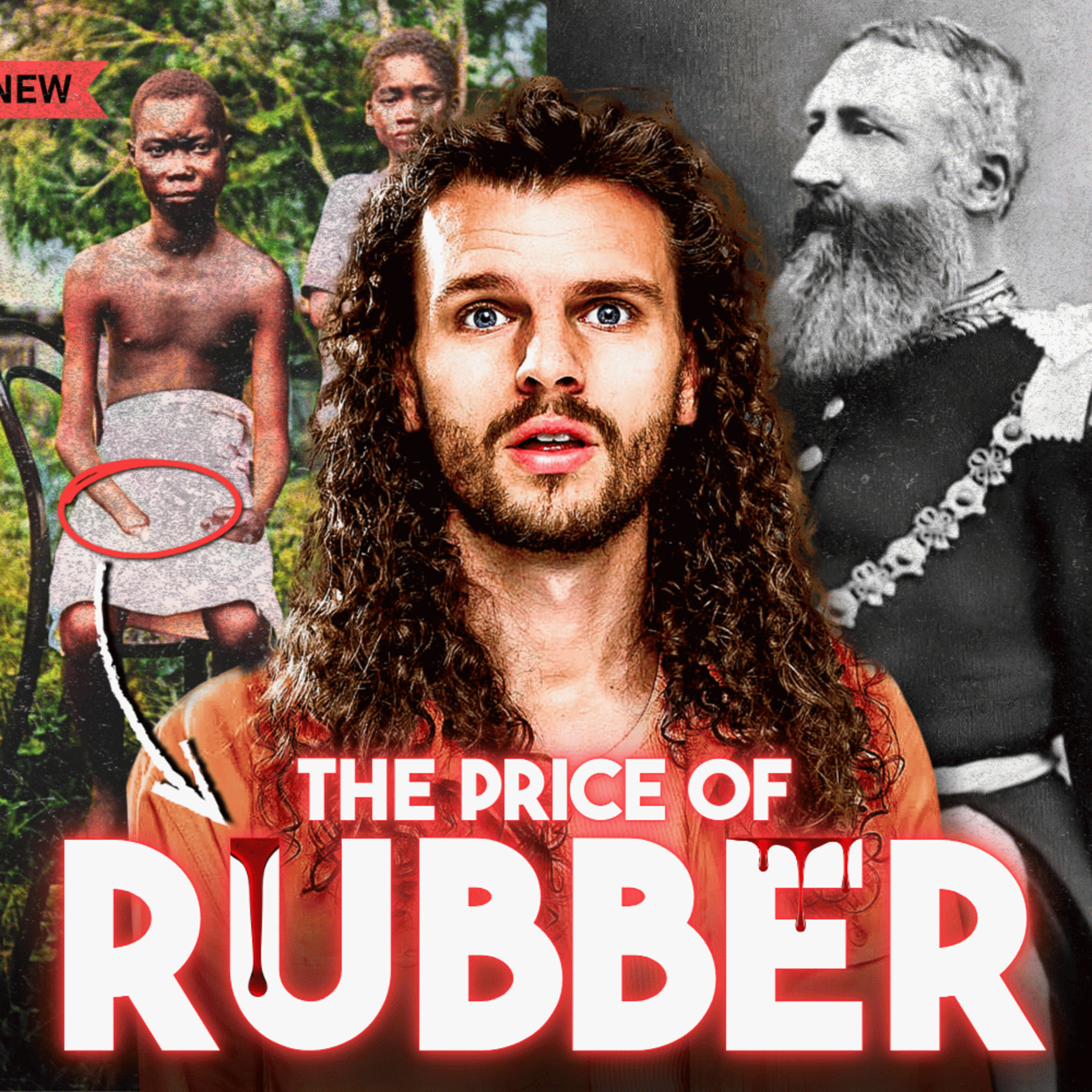
May 14, 1904. In the village of Baringa in the Congo, a missionary took a photo that would break the hearts and open the eyes of leaders around the world. Sitting before her is a man named Insala, staring at the only remains of his five year old daughter. A tiny hand and a foot wrapped in leaves. His wife was also killed. Dozens in the village had died that month for failing to meet the king's rubber quotas. Insala brought those remains to a nearby mission group because he needed someone, anyone, to believe the nightmare that he was living. And that single photograph Europe and America to confront the truth that they had been ignoring. Because while King Leopold II appeared to be this polite constitutional monarch, sitting in a nice palace in Brussels in Central Africa, he ruled a private empire nearly 80 times the size of Belgium. But it was built on forced labor, terror quotas and death. And today, we're breaking down the dark history of how King Leopold gained control, how the Congo Free State was created, and how a system this brutal was allowed to exist at all. This is a disturbing and brutal episode, but a really important one to examine history and understand how empires can lead to so much atrocity. So with that out of the way, ladies and gentlemen, welcome to History Camp.
- [01:21]
LifeLock Advertiser
The holidays mean more travel, more shopping, more time online and more personal info in more places that could expose you more to identity theft. But LifeLock monitors millions of data points per second. If your identity is stolen, our US based restoration specialists will fix it, guaranteed or your money back. Don't face drained accounts, fraudulent loans or financial losses alone. Get more holiday fun and less holiday worry with LifeLock. Save up to 40% your first year. Visit LifeLock.com podcast terms apply.
- [01:51]
Mark Gagnon
Your planet is now marked for death.
- [01:55]
Marvel Studios Advertiser
Marvel Studios the Fantastic Four First Steps is now streaming on Disney.
- [01:59]
Mark Gagnon
We will protect you as a family. Light em up, Joe.
- [02:03]
Marvel Studios Advertiser
Marvel's first family is certified fresh on Rotten Tomatoes.
- [02:06]
Mark Gagnon
That is fantastic.
- [02:08]
Marvel Studios Advertiser
And critics say it's one of the best superhero movies of all time. Marvel Studios the Fantastic Four first steps now streaming on Disney Plus. Rated PG 13. What time has it been? It's clobber time.
- [02:21]
Mark Gagnon
What's up, people? And welcome back to History Camp. My name is Mark Gagnon and thank you for joining me in my tent where every single week we explore the most interesting, fascinating and morbid stories of from all history, from around the world, from all time. Yes, we look at leaders, we look at historical events and we go down into all the details. Now, of course, this episode wouldn't be possible without you. And of course without my Friend Christos, sitting on the ones and twos. How are you, pal? Doing great. All right, Christos, now is not the time for you to interject, okay? Because we got a very serious and sad story to dive into. All right, now let me just preface this by saying, look, I understand that not all of, you know, Central African history is sad, but this particular one, I think is a global atrocity, a just an infringement on. On what it means to be human. And it's not something that I feel like people talk about that often. And this is basically King Leopold and his occupation, genocide, enslavement of the Congolese people. So let me just say trigger warning up top. There's going to be some morbid parts of this story, and I just want to give that as a preface. But in the interest of, you know, doing an actual deep dive and through all the details, I'm going to share all of the details that are pertinent to this story, even the really disturbing ones, because I don't think you can sanitize this. This is one of the atrocities of African colonialism. So we're going to break down who King Leopold was, what this Congo Free State was, how it actually functioned, and why it was able to persist for so long, and why this photograph taken by Alice Harris really changed the world and how it really brought a lot of people together to say what is actually happening here? This needs to end. So we'll be going through all the details now before we get into who King Leopold was himself and why he did what he did and how he was able to do it, we need to zoom out for a moment to look at what Europe was doing in general in the 1880s. Okay, the entire continent was basically going on this empire building spree. So the Berlin Conference of 1884, 85, basically made the Scramble for Africa official. And yes, that is the actual term, the scramble for Africa. Africa, which I always felt like was a little blase. You know what I mean? Like, they're like, yeah, it's a scramble for Africa. I'm like, I think it was a colonial occupation that killed millions of people. Like that. It was a scramble, but that's technically what historians call it. This is the scramble for Africa. And of course, not a single African was asked what they thought. It was basically just a bunch of European powers coming together to divide up this continent that they didn't own, but recognized that it was full of resources. So by the 1870s and the early 1880s, industrial nations suddenly saw Africa as a gold mine. And the second Industrial revolution had created a massive demand for all sorts of raw materials like rubber and ivory. And this is a region that had been mostly ignored, you know, beyond a few coastal stops and, you know, ports and stuff like that. But now they saw this entire place as just easy money. So at this conference, Europe introduced the rule of effective occupation. So you couldn't claim land unless you were actually running it. So they opened the Congo and the Niger rivers to free navigation. And most importantly for King Leopold ii, they recognized the International association of the Congo as the authority over this massive region known as the Congo basin. Now, Belgium itself was young and didn't really have any colonies. And King Leopold I had tried and actually failed to grab territory. Even a planned settlement in Guatemala basically went nowhere. And his son, King Leopold II, pushed way harder. So when the conference ended in 1885, Europe controlled about 10% of Africa. And by 1914, that number shot up to 90%. And controlling the region of the Congo played a major part in speeding up that rush. So literally, all these European countries and their monarchs were like, all right, guys, let's stop fighting each other. Let's just go to Africa, steal all their resources, and everyone wins. We're just. Yeah, it's just ours for the taken. They're not doing anything with it. This is literally what they thought at the time. So with that out of the way, let's talk about King Leopold. All right, now, Leopold Louis Philippe Marie Victor was born in Brussels on April 9, 1835. He is the second son of Leopold the First. And his childhood wasn't particularly great. Okay. His mother said he had, like, a big nose and was, like, deformed and stuff. His father called him the little tyrant, which is fitting. And his siblings were by far the favorites. So, you know, Philippe was outgoing. Charlotte was, you know, really sweet and charming, and Leopold was just the opposite. He was really shy. He was sort of awkward. He had, like, a limp. And he really grew up in the shadow of his father, who was this, you know, really well respected monarch throughout Europe and within Belgium was really loved. So a lot of these early insecurities turned into a lifelong obsession with trying to prove himself worthy to his family, to his parents, and to his people at large. So where his father failed to get a colony, he was determined to succeed. So if Belgium, it was the small, sort of unimportant kind of European empire, he was going to make it an actual imperial force on the world stage. And this ambition was as much political as it was personal. So throughout his, you know, late childhood, early Adolescence, he was studying colonial expansion and was trying everything. He was looking at territories in Mozambique, he was trying to buy Borneo from the Dutch. He tried at least three times to literally rent the Philippines from Spain and was chasing possibilities in China, Japan, Argentina, Vietnam, Senegal, anything that he could to get his hands on to prove that Belgium was a colonial empirical force. But inevitably, every plan collapsed. All the bigger powers in Europe at the time had really no interest in helping Belgium get a colony. They were trying to get all their own colonies. So Leopold needed a different approach. He basically was avoiding direct competition and hid his real goals behind something noble. So Leopold needed a different approach and his strategy was to avoid direct competition because if you're going up against the French or the Spanish, they're just going to take the land from you. Now you're battling them, which again is not the point of this whole colonial Africa project. It's just to go get resources. So he decides to hide his actual goals behind like a noble philanthropic sort of veil. So by 1876, he hosted the Brussels Geographical Conference and he presented himself as a philanthropist that was focused on exploring and ending the Arab slave trade in Central Africa. This was sort of the, the picture that he had painted, right? And then he created the International African Association. And this was supposed to be like a neutral, humanitarian group of explorers and geographers. But the reality was that Leopold was trying to control everything and was secretly funding it through intermediaries like Colonel Maximilian Strach. Now, this disguise and sort of the veil that he put on by being a philanthropist actually worked. Leopold II was basically pretending to be like Europe's great humanitarian while quietly building the machinery for this private empire. And he understood the moment. In an era that was obsessed with moral reform and looking benevolent and civilizing these people in far off lands, he wanted to create this facade and was able to do that. And basically through that, you know, lens was just conquering land. So Leopold was ambitious and wanted to prove to everyone that he was, you know, a great leader like his dad. But grabbing a territory the size of Western Europe, you know, takes a lot more than just ambition. So what does he do? The answer involves a lot of lying and sort of clever strategy. And one very famous explorer, this man was Henry Morton Stanley. This was a Welsh born journalist who eventually became famous for finding a guy named David Livingstone. And David eventually became Leopold II's main man in Africa. Between 1874 and 1877, Stanley was crossing the continent from east to west and exploring Lake Victoria and Lake Tanganyika. And he was Traveling on the congo rivers and was covering, at this point, like, 7,000 miles. And by then, he was Europe's top expert on central africa. So stanley first tried to get britain to colonize congo, but they weren't really interested. They had their hands full with other interests in the region. And that's when leopold stepped in and offered a mix of exploration with sort of these commercial plans. And after signing a contract with Leopold in 1878, Stanley returned in 79 as Leopold's representative to start building what would become the congo free State. Now 1878-1885. Stanley set up trading posts and roads and most importantly, Collected treaties from local leaders. Now, these documents supposedly gave leopold legal control, but many were obtained through pressure or through trickery by having them sign things. But they didn't really understand what they were signing. Or just straight up threats like, sign this or we'll kill everyone in your village. So most of these local chiefs, they couldn't even read the agreements. And the idea of, like, permanently giving up land didn't really exist in their political system at the time. And a lot of them just signed it because there was literally a gun pointed at them. So leopold pushed for even more. He told his administrators he wanted clauses ensuring local leaders basically delegate to us their sovereign rights, AKA give us everything. What if you're the chief of your town, you, are signing away your rights as leader and as chief to us in belgium, and we're just going to take everything we have, right to everything. And now they insisted that these treaties Must give everything that you have and be very short and very clear. Other powers eventually noticed. So france sent pierre de braza, who raised stanley, to the upper Congo in 1879-1880, and actually reached stanley pool first and founded Brazzaville in October 1880. Now, Portugal, using old ties to the kingdom of congo, Made a deal with Britain in 1884 to try to block leopold's route to the atlantic. Now, ironically, these rival claims actually helped leopold. He kind of used the tension to pressure european governments into recognizing his authority. Before the berlin conference, his agents were lobbying really hard. Henry shelton sanford, A former u. S. Ambassador to belgium, actually convinced president chester arthur to recognize the international association of the Congo in April 1884. And then, once the united states agreed, Europe eventually followed. Now, just get that for a second. Literally, these different powers Are kind of convening on this place. They start to recognize that there might actually be resources. And they see that the belgians are going to get it. And they say, actually, we want a piece and they start to kind of, like, politic amongst each other. And then Leopold just starts sending his representatives to just kind of petition on his behalf, and he eventually gets his way. Now, Leopold then stayed away from the Berlin conference on purpose to kind of keep up this illusion conclusion that he didn't have a personal interest in the Congo. He just wanted to help the people. He wanted to give them infrastructure and, you know, help this sort of fractured state of different tribes and chiefs into becoming an actual country, which, again, is a lie. Now, on August 1, 1885, right after the conference wrapped up, Leopold officially announced the creation of this Congo free state. And here's the key part. He didn't take it as the king of Belgium. He took it for himself. Now, legally, the entire Congo became his personal property, not Belgium's. Literally, Leopold's property. Now, that might seem like a weird distinction, but he was acting as the king, as the monarch of Belgium at that time. But when he actually did all the paperwork and all these sort of political enterprising, he just said, no, no, this is in my name. This is for me personally. You can imagine the uproar There was none. So now Leopold got his private empire, and no one really knew any of the wiser. They go, yeah, that's Belgium's. It's not. It's just his. But owning the Congo wasn't enough for him. He wanted to squeeze all the wealth out of it. What's the purpose of having, you know, a despotic, you know, colony if you can't actually take all the resources? And that's when things went from already bad to maybe the worst human rights atrocity of the 20th century. So at first, the Congo free State was focused on ivory, but then everything changed after John Boyd Dunlop invented the inflatable rubber tire in 1887. Now, for the people, this was the worst kind of news ever. For the actual people living in the Congo, this was like a nightmare. But for the king, this was a dream. Rubber demand across Europe and America exploded, and the Congo's forests were full of wild rubber vines. And these vines are called landolfia, and they couldn't be farmed at the time. And so workers had to basically slash them open and drain out the actual parts, like the literal latex. And it usually involved killing the plant. So by 1891-1892, Leopold issued three decrees that completely reshaped the entire state that he was controlling. All vacant land. Basically, anything not being actively farmed became state property. And Congolese communities were forced to deliver ivory and Rubber to government posts at fixed prices. So overnight, the entire population became like a forced labor organization for Leopold's empire. Overnight, all these people were now forced to go cut rubber and bring it to these posts where they were given just, you know, a fixed small rate. Now, Leopold then divided the Congo into giant concession zones and handed them to private companies. The biggest Abir and the anversois company got 30 year exclusive rights to harvest this rubber. And these zones quickly became centers of extreme violence and exploitation. Everything in this new state was ran on quotas. Every village had to bring in a set amount of rubber every two weeks. Chiefs were forced to basically enforce this system on their own. People and men spent days deep in the jungle scraping latex, Often staying out for two week cycles because nearby vines were already destroyed. So if the vines near your village were destroyed, you had to go even farther and farther. And at this point, you were gone for weeks at a time. Now, the punishments for missing these quotas was brutal. People were jailed and then burned or whipped basically with these, like, just like there were these whips made of like hippo hide. And they had these super sharp edges. And they would just cut people open. And 20 lashes would literally knock someone out. They would just be unconscious. A hundred were typically fatal. And even if you survived, you were scarred for life. Now, company agents were paid based off of the rubber output. So if they missed the targets, the lost value was then deducted from their pay. So violence became the easiest way to stay profitable. So you had these, like, armed soldiers, often recruited from other ethnic groups that were enforced to keep these quotas and were rewarded or punished based off of the production. So literally setting up a, like a Gestapo state where you had your own people or people from nearby towns that were enforcing this because they were paid. And if the, you know, person in charge didn't hit their quota, then they would be punished. And it just went all the way down. So of course, the people at the bottom were the ones being punished the hardest. So when villages resisted or they fell short, there would be these raids. Settlements were burned. Women and children were taken as hostages. Many were starved completely. Sexual violence was extremely common at this point. And some communities were just destroyed completely because they weren't meeting these quotas for the rubber that the king demanded. The most infamous practice is maybe the most disturbing. And there's. I think it affects me more because there's just pictures of it, like so many, you know, atrocities that happened, you know, 600, 700 years ago. You can't really see it. You just Hear about it, you read it in books. This, there's photographs, and this was the practice of cutting off hands. So the force publique, which is kind of the militia force that was, you know, enforcing all of this. And we'll talk about them later. Their soldiers and the company sort of agents had to prove every bullet they fired killed someone. So they were each required to bring back human hands for giving each shot because they didn't want to waste these bullets. So they said, if you're going to fire, it has to kill someone. And they needed proof that these people were actually being punished. It's just so brutal and beyond humane. But this was basically leading to soldiers cutting hands from living victims or using them to settle debts. So hands almost became like a currency. And sometimes European officers were literally given baskets of hands as reports like, okay, we didn't hit our rubber quotas, but this is how many people were punished. I mean, think about that. A basket of human hands. It's like. It's beyond vile. But by the early 1900s, missionaries were starting to step in and starting to actually go into these villages because they started hearing about what happening. So one named William Henry shepherd actually saw the aftermath of one of these raids by Zappo zap, mercenaries, warriors hired by the Congo free state to enforce this brutal system. And he counted 81 severed hands drying over a fire. Now, the Zappo zaps bragged that they had destroyed 14 villages and killed 90 people. Shepherd also found 60 women held as hostages, still alive, put into completely unethical, inhumane conditions. And some of the victims survived. Many pretended to be dead and then crawled away after the soldiers had left. Missionaries like Alice Harris photographed the survivors, the children and the adults that were missing hands, trying to create evidence against King Leopold II and his regime that he could never erase. Now, this rubber boom made Leopold incredibly rich. And again, he's the private owner. So it's going to the Belgian, but it's really going to him. And by the late 1890s, the Congo Free state was earning profits equal to about $1 billion in modern currency. And that money funded Leopold's fancy projects in Belgium and all of these, you know, beautiful monuments and a very lavish lifestyle. Now, let's talk about how the system was actually running, right? The force Publique. And now this is King Leopold's private army, built on this organized, relentless violence. And it was the backbone of Leopold's rule in the Congo. Its officers were white Europeans, mostly Belgians with some foreign mercenaries. And the regular soldiers were African recruits taken from ethnic groups far from home so that they wouldn't actually sympathize with the people that they controlled. Now, recruitment was often forced. Some men were drafted from regions that were recently pacified is, you know, how the europeans would call it during campaigns against the arab slave traders. Others were literally taken as children during the raids and then raised to basically become soldiers under harsh conditions. They were basically slave like, and in some type of, like, twisted contradiction. Leopold often allowed arab slave traders to supply recruits, despite claiming to be fighting the slave trade in general. Now, certain groups became extremely prominent. The bengala formed a big part of the army and helped spread the lingala language. The zapozaps, a subgroup group of sonja, Became infamous for their brutality and destroying villages and enslaving people and terrorizing all these communities with basically no restraint. And so by 1900, the Force Publique had almost 20,000 men. The Force publique's role changed over time. It started as a force that was, you, know, meant to fight slave traders and, you know, suppress uprising so that people didn't rebel and maintain order, and then eventually just turned into a tool for enforcing these rubber quotas. And they had modern rifles and these whips, and they became the everyday face of king leopold's terror. They were taking hostages and torturing and killing families of anyone who resisted. And just burning villages that failed to bring in enough rubber soldiers could also be executed for not being brutal enough so the chief of a village would be killed if their people missed the quotas. Workers could just be mutilated individually. And the violence wasn't chaotic. It was policy pushed all the way from the king himself. What's up, people? We're gonna take. We got new merch. That's right. It is the holiday season, and the good folks over at camp r D have been cooking up in the lab. We got the christmas sweaters with the aliens. We got the Christmas sweaters with the conspiracy vibes you already know. I mean, this one might be my favorite one. A Christmas tree full of aliens. Full christmas sweater energy. And then, of course, if you just want something simple, you, know, you bust out the camp logo tea with the little Christmas lights on it. Come on, bro. Get cute for christmas, okay? It is a holiday season, all right? We're celebrating the birth of the savior, okay? And what better way to do it Than and cop a couple threads for the person in your life that you know that loves a campsite, that loves hanging with us every single week. And right now, we're running a promo through the Holidays. That's right. Use the promo code. Christmas camp for 15% off. I just made that up on the spot, but I think we can do it right. I'll call some people. Christmas camp for 20 for 15% off. Sure, 16% off. Whatever you say, Mark. Should we give them More? More? One more 17 off, people, we don't. I think this is gonna work. I'm not positive we're gonna see if we can do it, but I'll. Yeah. Check it out, guys. We got all the camp stuff going until the end of the year. Check it out. Thank you guys so much for supporting the show. I love you all. God bless and merry Christmas. What's up, people? We're gonna take a break really quick because I have amazing news. I'm coming on the road. That's right. My very first headlining tour. Where I'm going to every city that will possibly allow me to go there. Hoboken, New Jersey. I'm going to Salt Lake City. I'm going to Washington, D.C. and Charlotte, North Carolina, in February. Those tickets will be announced soon. And of course, I'm doing my monthly show at Mary Lou in New York City on December 16th. The best comics in the city will be coming out, and I'll be working out some new material. It is a grand old time. You can get all the tickets at Mark Yagnon Live, and I'll see you guys there. Let's get back to the.
- [24:29]
Kelly Clarkson (Wayfair Advertiser)
Hey, what's up, y'?
- [24:30]
Mark Gagnon
All?
- [24:30]
Kelly Clarkson (Wayfair Advertiser)
Kelly Clarkson with Wayfair. My favorite thing about the holidays, Decking out my whole house. It's not a competition. But if it was, what? Well, I'd win the season with Wayfair Outdoor inflatable Santa.
- [24:41]
Mark Gagnon
Got it on Wayfair.
- [24:42]
Kelly Clarkson (Wayfair Advertiser)
Trees, lights and ornaments. Wayfair hosting must haves like dining, sets, beds, sheets and towels. Wayfair for everything in your style, delivered with fast and free shipping. Visit Wayfair.com or the Wayfair app to win the season. But again, it's not a competition. Wayfair every style, every home.
- [25:00]
Marvel Studios Advertiser
Monster Energy. Everybody knows White Monster, Zero Ultra. That's the OG it kicked off this whole zero sugar energy drink thing. But Ultra Ultra is a whole lineup now. You've got Strawberry Dreams, Blue Hawaiian Sunrise, and Vice Guava. And they all bring the Monster Energy punch. So if you've been living in the White can branch out. Ultra's got a flavor for every vibe, and every single one is Zero Sugar. Tap the banner to learn more.
- [25:29]
Mark Gagnon
Now, what the Belgians didn't calculate at this point is that with the advent of film and, you know, recorders and cameras, you can't really hide atrocities at this scale forever. Eventually the truth will start to get out. And when it did, a few brave people decided that they weren't going to stay quiet. So George Washington Williams, an African American historian and journalist, was one of the first major international voices to basically call out King Leopold. After visiting the Congo in 1890, he wrote an open letter to Leopold describing what he had seen, and later told the US Secretary of State that the situation amounted to crimes against humanity. It was the first recorded use of that phrase which would later shape international law. I mean, just think about that for a second. That is the scale of the brutality. You have this guy, George Washington Williams, a black dude in America that was dealing with racism in America that went to the Congo and saw what was happening and was like, now this is a crime against humanity. Like, it's a different scale of brutality that's really, I think, unsettling to even really think about. And the bigger sustained campaign against Leopold actually really took off in the early 1900s and was led by a small group of reformers whose work is now considered the first modern international human rights movement. The central figure was Edmund Dean Morrell. This was a British shipping clerk that was working in Antwerp. While checking cargo logs, he noticed something was weird. He saw ships going to the Congo carrying guns and chains and ammunition and explosives, which was not normal trade goods that he had seen going to other places. But the ships coming back were loaded with rubber and with ivory. So to him, the conclusion was obvious that the Congo wasn't trading with the Belgians, it was being looted by force. So by 1901, he quit his job to become a full time journalist. And by 1903, he launched the West African Mail and really started to expose the system through articles and books like red rubber. In 1903, Roger Casement, a British consul in Boma, was sent to investigate the growing accusations. He traveled through the rubber regions, gathering testimony and documenting the atrocities. And his report in 1904 to the British Parliament confirmed everything that the missionaries and the reformers had been saying for decades. Casement pointed to four main causes of mass indiscriminate warfare, starvation, falling birth rates and disease. The Casement report caused a political storm in Britain. In Belgium, reactions were split. Socialists and liberals were condemning Leopold, while a lot of leaders in the church denied everything and even pushed back against foreign criticism. Belgium eventually launched its own Commission of inquiry in 1904. And despite Leopold II's attempts to interfere, its 1905 report essentially backed everything that Casement had found. So together, Morel and Casement actually met in 1904 and realized that they could do much more good together. Casement provided official credibility, while Morell had the organizational skills and the media platform. And together they created the Congo Reform association in March of 1904. Now the CRA became the model for future human rights campaigns. It was using lectures and pamphlets and photographs and famous writers to apply pressure. So Mark Twain actually wrote King Leopold's Soliloquy, a scathing satire. And then Arthur Conan Doyle published the Crime of the Congo. Joseph Conrad wrote the Heart of Darkness, based on his time as a Congo riverboat captain. And this gave many Europeans a literary way to actually grasp the brutality. And many missionaries were really key too. American Presbyterians William Morrison and William Henry Shepard provided detailed eyewitness accounts. Shepherd carefully documented names and dates and locations that the Commission of Inquiry couldn't dismiss. Alice and John Harris of the Baptist Congo Bololo Mission took the campaign straight to the public. During a massive lecture tour in 1905-1906. They showed Alice's photographs, including the infamous image of Insala, giving a actual human face to these terrible statistics that people were used to reading in pamphlets. The CRA grew quickly, building branches across Britain and the US and supporters included a lot of really high ranking people. Nobel laureates like John Galsworth and Booker T. Washington, and a bunch of politicians and clergy and business leaders. It became a broad and diverse movement that demanded that Leopold II finally be held accountable. Now Leopold wasn't just sitting around hoping that no one would notice. He was pushing back aggressively and he had something powerful on his side. He had a massive, well funded propaganda machine built to control the story before anyone else could. He created entire operations whose job was to control the narrative in Europe and the United States. And he actually attacked the problem from a bunch of different angles. So Leopold's agents would pay journalists and newspapers to print stories and bury negative ones for King Leopold and the Belgians. Papers like the Times were quietly pressured not to cover the atrocities. Friendly reporters were sent on these tours of the Congo that showed only what King Leopold wanted them to see. Now publicly, Leopold kept on repeating the same line. He was said that he was fighting the slave trade and bringing civilization to Central Africa. And he was showing all the schools that were being built and all the clinics while ignoring that they were tiny in in number and barely accessible to the people that were suffering under his rule. He even funded academics to write books and studies praising his Government and giving the regime this sort of intellectual, sort of academic cover. Now when Protestant missionaries exposed the abuses, Leopold's supporters said that they were just anti Belgian and anti Catholic and they wanted to take us down. And then when British activists spoke up, they claimed that Britain was just jealous and wanted the Congo for itself. Now before Belgium took over, Leopold ordered huge parts of the Congo Free State archives burned in eight days. Key documents and orders and financial records and the entire paper trail was destroyed. This intentional erasure is one of the main reasons that historians still struggle to piece together the full picture of Leopold's atrocities. Now Leopold went on the offensive once again and started to actually sue his critics for lies Bible and he almost never won. But the threat of these expensive trials really scared off a lot of potential whistleblowers. In late 1904, King Leopold hired Henry Kowalski, a San Francisco lobbyist to basically influence US politicians and actually like plant pro Leopold stories in American papers. And when King Leopold eventually cut him off, Kowalski went public in December of 1906, revealing how far the King had gone to manipulate public opinion. And that hurt, hurt King Leopold's reputation even more. Now as evidence was starting to pile up in the court of public opinion, Leopold's defenders insisted that the reports were exaggerated and blamed a few rogue agents that were doing inhumane things and claimed that reforms were already underway. And now this strategy was just a way of sowing doubt, very similar to modern disinformation campaigns and really slowed this real reaction for years. Now together these efforts formed one of the earliest large scale propaganda systems built specifically for hiding mass atrocities. King Leopold's playbook, you know, control access and pay media and attack the critics and destroy evidence, became a model for many authoritarian regimes that came later. Now in 1905, Leopold could no longer pretend his rule in Congo was humanitarian or philanthropic in any way. Even the tightly controlled Commission of Inquiry admitted major abuses. And the international pressure kept on rising. In Britain, public outrage pushed the government to call for a review of whether Leopold had violated the Berlin acts of humanitarian promises. Several forces finally made his position impossible to defend. The evidence was just overwhelming. Missionary reports, eyewitness accounts, and ultimately, and maybe most importantly, the photographs of mutilated victims made it impossible for propaganda to cover anything up. The economy was also collapsing. Wild rubber supplies were dying out because all the vines had been destroyed. And new rubber plantations in Southeast Asia were about to take over the global market, exposing just how fragile Leopold's entire system really was. Inside Belgium, political pressure was also growing as you had many leaders like Emile Vanderbilt demanding intervention. And even the Catholic party, usually loyal to Leopold, realized that it was becoming a diplomatic embarrassment. Meanwhile, European governments that once backed him now viewed the Congo as a moral disaster, thanks to the Congo Reform association and their constant campaigning. I mean, you know you're doing something terrible when other colonial empires are like, well, you're gone too far at this point. Other high ranking Belgian royals and other people within the Belgian government saw that this was a massive atrocity. And so they tried to gain some control over this Congo Free State. But remember, this state is not a colonial project in the traditional sense. This is a private enterprise owned by one man, King Leopold ii. So now you basically have the Belgian government negotiating with its king to try to get possession over this land and actually create a formal colony. Like, that's just how messed up this entire situation is. And King Leopold dragged this process out for two years. He said, all right, I understand you guys want this colony for the Belgian people or whatever, but you're gonna take it from me, and I'm willing to sell it to to for 110 million francs for the debt, and then 45 million for construction projects in Belgium funded with Congo money. And then I want another 50 million francs from future Congo revenues. He even secured private ownership of huge land concessions so that he could keep profiting long after the colony officially changed hands. So By November of 1908, the Belgian Parliament officially annexed the Congo Free State from Leopold, turning it into an official colony of the Belgian Congo. Now, Leopold died a year later, in December of 1909, at age 74. He got a state funeral, but the public reaction was very cold. Crowds reportedly booed as his coffin passed by. And just before he died, he secretly married Caroline Lacroix, his longtime mistress, whom he had met when she was 16 and was working as a sex worker in Paris, and left her a massive fortune that immediately caused this massive dispute within the royal family. But that is its own crazy sort of saga. Now, just keep this in mind. This guy literally was acting as the king, took this entire land for himself, and then sold it back to his own people, to his own country and its own government. It's like, psychotic. Not only is it psychotic to just be a colonial power, but to be a colonial power and be like, I'm keeping this for myself, is just a different level of twisted. So when Belgium finally took the Congo From Leopold in 1908, things didn't just magically improve. The worst rubber quotas kind of went away, but the forced labor didn't. And it just Kind of came back under new names. So most of the officials stayed in power, and the same basic system remained in place. Europeans controlled all the resources, and the Congolese people did the work with basically nothing in return. Now, Belgian rule over this region continued until 1960. And even without Leopold's personal brutality, the colonies still existed mainly to serve Belgium's interests. Roads and rail lines were built to move copper and rubber and minerals, not to connect Congolese communities or help open up free market trade. Within this country, education was kept extremely limited, and by independence, the entire country had only a handful of university graduates. Political organizing was really restricted, and almost no effort actually went into building African led institutions. Violence, famine, trauma, and family separation broke down these villages and really weakened any social ties that had held these communities together for generations. So when independence arrived in 1960, the Congo stepped into a nation that was deeply wounded and had very little support. A crisis erupted almost immediately, followed by Mobutu's long dictatorship and later the wars of the 90s and 2000s that killed even millions more. At the time, Belgium had struggled with this legacy and in many ways still continues to struggle with it. For decades. The official story painted colonialism as a civilizing mission and, you know, praise Leopold as this builder king that was trying to, you know, pacify these, you know, savage tribes. And records were destroyed and locked away and really slowed a lot of the honest research and accountability. Only slowly has the country actually faced the truth of what their once leader had done. Leopold statues would spark debate. Some people saw them as history. Others saw them as monuments to a man that was responsible for this immense suffering. A few were actually removed, while others were, you know, just stayed, but had added context. In 2020, King Philippe expressed a deep regret for colonial violence, but stopped short of a full apology, keeping questions about responsibility and reparations still alive. All of this still echoes in the DRC today. Many of the country's current challenges and political instability and the weak institutions and development issues and cycles of conflict and bribery and corruption all have roots in these early decades when exploitation replaced investment and generations were denied the chance to actually build stability. But the Congo Free State story isn't only about destruction. This is also a story about the people who refuse to stay silent. Williams, Morell Casement, the Harris's shepherd, and the hundreds of Congolese people who actually came together to build the world's first modern human rights movement. They gathered evidence and photography and organized across continents and proved that ordinary people could actually change the ways of an empire. And today, the Congo Free State remains one of the clearest examples of what can happen when greed and unchecked power go unchallenged and how determined people can actually still force the world to confront a truth that it so badly wanted to ignore. And that is a brief synopsis of King Leopold II and his atrocity known as the Congo Free State. Pretty heavy. That's. It's like, I mean, again, I think most of these, you know, colonial empire projects are pretty evil. You know, that's, you know, not controversial to say, but, you know you're doing bad when other colonial powers are like, dude, you effed up. Like, the fact that this dude was taking this for himself, signing it in his own name, like, oh, no, this doesn't belong to the king. This belongs to your boy is just crazy. And then literally was negotiating with his own people and his own parliament to try to sell them this land that he basically used his state power to control. Like, it's just, like, beyond, like, corruption and greed. And I'm glad that even at the time, like, again, people look at history with, like, a different perspective, and I think that's probably good because, you know, as people say, history is a different country. But even at the time, people were like, this is effed up. Like, you have guys like Mark Twain like, dude, this is crazy. Like, like, even at the time you had people being like, this is beyond atrocious. Which, I mean, yeah, it's pretty hard to ignore just how vile it was. Like, the. The image. And maybe it's just because I'm a dad now. I don't know. The image of seeing this guy looking at the hand of his daughter that was killed because his village didn't meet these rubber quotas is just like, oh, my gosh. And the fact that King Leopold knew that this was happening, ordered it to happen, and at no point stepped in, offered any type of remorse, ever felt bad about it. Like, it is just a good lesson in greed and unchecked power from, like, a government level. And hearing all the people that came together even at that time to basically start a wide scale human rights campaign is, like, pretty sick. Like, it's very brave. Like, at the time, I don't doubt that the Belgians would have been like, we should just kill all these people. And yet they still did it. Really cool. I don't know. What do you think, Chris? Did you learn anything? Yeah, I don't think he put up the numbers that a lot of these more famous dictators and bad guys put. But as far as brutality goes, it's Right up there. Yeah. Especially because, like, it's not like a colonial project, like, or like a war where you're like, okay, we're going to, you know, take out these people for this reason. It's like literally just greed. It's like we're going to kill these people just because we want more money. And he's already making a. He's making a bill. He's also the king. It's not like he needs more money. Like, he's literally the king. He has an entire piece of land in the middle of Europe and still is continuing this. I don't know. It's not something you hear about. You hear a lot about, like, British colonialism and stuff like that, but the Belgians, for whatever reason, get left out. I mean, yeah, it's just. It's just brutal. I would actually, I'd be curious to ask a Belgian dude, like, is this taught in school? Is this something if you're Belgian again, I got nothing against you if you're just a Belgian guy today, but is this something that's talked about to people? It seems like there's a debate that goes on in Belgium now. People are trying to get rid of, you know, statues and stuff. But I'm curious, like, what the conversation. Is it, like, how America feels about slavery? Like, what is the actual connection? I don't know. What do you guys think? Is there anything I skipped? If you're historian, someone that's read a great book is King Leopold's ghost. I haven't read it, but I've heard wonderful things. If. And by wonderful things, I mean morbid terrible things. But it's well written. You know what I mean? Anyway, if you read the book or you know more about this than me, please comment. If I missed anything, I just want to say as a disclaimer, I want to do more episodes on African history. And not only highlighting the atrocious bad parts, but also just highlighting the really cool stuff, because I think both are important. But like Mansa Musa, we got to talk about him. Very rich guy. I don't really know anything about him. Like the West African King of Molly, apparently the richest man to ever live. So we got to dive into all sorts of stuff, and if you want to be a part of it, make sure you subscribe, make sure you like. And I appreciate you guys so much. You can see me on the road. Mark Yagnon live. I'll be doing standup comedy. It's gonna be much funnier than this, I promise. Okay, this is kind of sad and dark, but important. All right. And you can check out Camp R D if you want to get the merch. And check out our other channels. We got Camp Gagnon, where I do a bunch of interviews and talk about all sorts of stuff. And then, of course, religion. Camp. Camp. And I appreciate you guys for being here. Thank you, Christos. You guys are great. Anyway, I'll see you in the future to talk about the past. Peace.
- [43:56]
Marvel Studios Advertiser
And, Doug, here we have the Limu.
- [43:59]
Mark Gagnon
Imu in its natural habitat, helping people customize their car insurance and save hundreds with Liberty Mutual. Fascinating. It's accompanied by his natural ally, Doug Lima. Is that guy with the binoculars watching us? Cut the camera. They see us. Only pay for what you need@libertymutual.com Liberty. Liberty. Liberty. Liberty Savings. Very underwritten by Liberty Mutual Insurance Company affiliates. Excludes Massachusetts.