Loading summary
Transcript22 lines
- [00:00]
Mark Cagnon
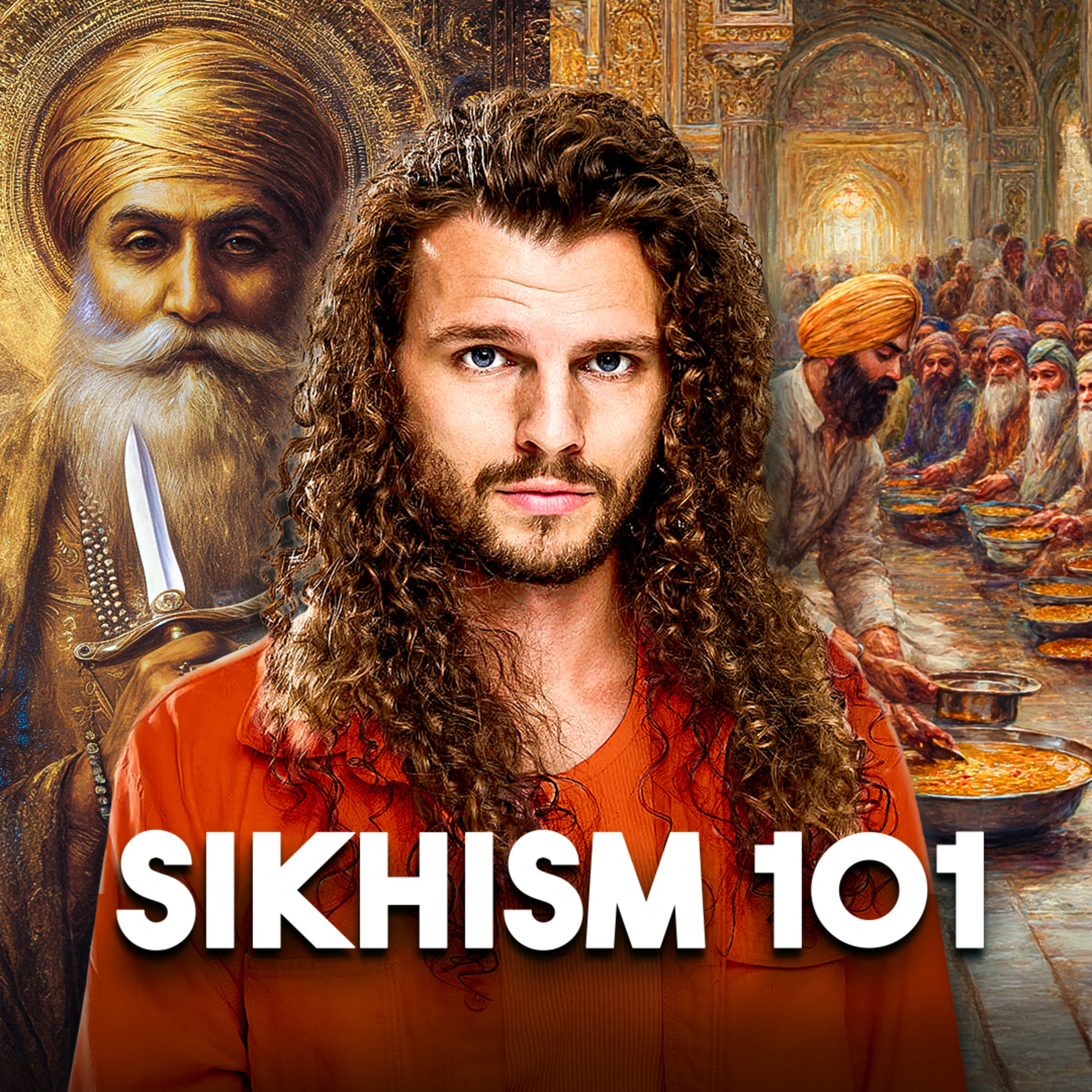
Today, we're diving in deep into Sikhism. The most important Sikh gurdwara in the world is the Golden Temple. Its communal meal, the Langar, serves free meals to about 100,000 people every day. Guru Nanak was working as a storekeeper, and one morning, Nanak vanished. And when he returned and his first words were this, there is no Hindu, there is no Muslim. Guru Amar Das. He continued to reinforce the Sikh tradition of these communal meals by requiring that everyone, including the emperor of the time, Emperor Akbar, to sit and eat together before meeting him, sending a powerful message of equality. In 1699, Guru Gobind assembles Sikhs and dramatically calls for human sacrifice. What actually do Sikhs believe and how do they conduct their life? What are the core beliefs of the faith? So today we're going to go through all the history, where it comes from, where on earth it's derived, who the gurus are that actually created this way of life, and really what it's all about.
- [01:08]
Lowe's Advertisement
Member week is here at Lowe's. Don't miss your chance to get up to 40% off hundreds of items like paint, outdoor and home essentials, and more. Shop our exclusive deals happening in store and online now through May 14th. Not a rewards member. Join for free today and get ready to save more Lowes. We help you save loyalty programs subject to terms and conditions. Details@lowe's.com Terms subject to change.
- [01:38]
Kaley Cuoco
Hey there, travelers. Kaley Cuoco here. Sorry to interrupt your music, great artist, BT Dubs, but wouldn't you rather be there to hear it live? With Priceline, you can get out of your dreams and into your dream concert. They've got millions of travel deals to get you to that festival, gig, rave, sound bath or sonic experience you've been dreaming of. Download the Priceline app today and you can save up to 60% off hotels and up to 50% off flights. So don't just dream about that trip. Book it with Priceline.
- [02:03]
Mark Cagnon
Go to your happy price. Priceline. What's up, people? And welcome back to Religion Camp. My name is Mark Cagnon, and this is my tent, where we explore the most interesting, fascinating, controversial stories and theories from all religions from around the world, from all time. And today, we're diving in deep into Sikhism. Oftentimes, people in the west will call it Sikhism, which is a, you know, a reasonable misunderstanding. Throughout most of my life, I always thought it was Sikhism, but to my, my Sikh friends and my Punjabi friends, they will say Sikhism. I didn't know this. This is apparently the original name given by the Guru. It's not even Sikhism, it's Sikhi. And this was basically what was described as the. The way of life for Sikhs. Now, Sikh Sikhism or Sikhism, rather, was a label created by Europeans. It's kind of like a. Like a colonial term, you could say. But Sikhism or Sikhism isn't really found anywhere in Sikh history, culture, you know, any of that stuff. So these words don't even really mean the same thing. So Sikhi and Sikhism aren't necessarily the exact parallels. And I think this is just like an important kind of discerning point. Sikhi means to learn. It is basically the universal path, you could say. And the bastardized term Sikhism means the religion of the Sikhs, and it sort of reduces Sikhi to just a religion where many, you know, Sikhs would not see it as religion. They would see this more as a way, way of life. So this term has just persisted, you know, for, you know, many, many six in the United States, just kind of accepting more or less what the term is. And it makes it a little bit easier because now people know more or less what you're talking about. But what is it? Right. I think oftentimes people will see, you know, a guy with like a. Like a kata, like a, you know, a bracelet around their wrist. You've probably seen people wearing these, or even maybe like wearing a pug or like a turban, as we describe it. And oftentimes people are like, are you Hindu? Are you Buddhist? Are you Muslim? People don't really know what it is. I didn't, that's for sure, until right now. So today we're going to go through all the history, where it comes from, where on Earth it's derived, who the gurus are that actually created this way of life and really what it's all about. So where do we start? We're going over to Punjab. About 500 years ago. This is right where modern day India and Pakistan meet. You can see it here on the map. And the name Punjab literally means the land of five rivers. It's one of the most historically diverse crossroads on Earth. The region was once home to the ancient Indus Valley civilization, one of the earliest urban societies in human history ever. And over the centuries, everyone from the Persians to the Greeks, yeah, Christos, the Greeks to Central Asian nomads, Muggle emperors, and eventually even the British all rolled through the area. And all that mixing left a deep cultural imprint, as you can imagine. So religions like Hinduism, Buddhism, Islam, Jainism were already woven into daily life. And that blend of ideas helped shape what would eventually become Sikhism. So what is the gurdwara? I've been to a gurdwara for Aakash's wedding. Matter of fact, Sikhs basically go to this place. They gather in places known as gurdwaras. Also, I just want to apologize in general to all the Sikhs that are watching this. I don't know, have great pronunciation. I am just a guy from Florida trying my best. So if I mispronounce anything dropped in the comments, my apologies in advance. So the gurdwara literally means the doorway to the guru, or the guru, if you were to pronounce it correctly. I'm going to say guru. And this building becomes a gurdwara by housing a copy of the Guru Granth Sahib. This is the Sikh holy book. Now, in this place, men and women of all castes and social backgrounds come together for communal meals. PRAYER SINGING these meals are interesting. They're actually known as langar. Anyone can visit these gurdwaras and participate in services and the meals followed by, you know, basic etiquette, right? They have to cover their head, remove their shoes, wash their hands upon entering, and they may not bring any drugs, even tobacco. Inside the gurdwara, it was actually really beautiful. I was told, even at the wedding that I went to, that anyone can go to this place and receive a meal, no matter who you are, where you are on earth. So that's something to note if you're ever just, you know, lost somewhere, maybe you're in Houston or something. You're like, man, I'm starving. I don't have solid footing beneath me. These folks, the very kind people at the gurdwara, the Sikhs will take care of you. So the most important Sikh gurdwara in the world is the Harmandir Sahib, better known as the Golden Temple. You can see a picture of it here. It's beautiful. It was completed in 1604 under Guru Arjun in Armistar India, and it still houses the original copy of the Guru Granth Sahib. Remember, this is the holy text, and this temple specifically has fascinating architecture. I think it's actually interesting and important to start sometimes with the actual communal place of a people, to really understand who the people are and what they value. And the temple's architecture in this case is no different. So you have the four doors opening in all directions to welcome people from every background, from all walks of life. And while multiple entrances exist, only one path leads to the inner sanctum, representing how all spiritual paths ultimately lead to the one God. Today, the golden temple draws around 6 million visitors every year, making it one of the most visited religious sites in the world. Its communal meal, the langar, serves free meals to about 100,000 people every day, regardless of your background, whatever your belief is, and it is the largest free communal kitchen meal meeting place on earth. And it's all run on volunteer support. I mean, like, that's awesome. Like, how cool is that that anyone can go to this place and receive a meal? 100,000 people a day. That's crazy. And so Today, there are 25 million Sikhs around the world. Most of them live in India, as you can imagine, and in Punjab. But here's something interesting. While Sikhs make up only about 2% of India's total population, they account for 60% of the people in Punjab, where the religion begins. So I think that's important to note. Not all Punjabis are sick and not all Sikh people are punjabi, but again, 60% of the people in Punjab are Sikh. And so, yeah, they. Punjab exists sort of as the heart of Sikhism. And there's a video here showing some of the communal meals. I mean, how cool is this that all people can go in and receive a meal? Even some white dude looking like me, right? And you can see he has his head covered and I'm assuming went through all the necessary steps, took off his shoes, no tobacco, nothing like that. I mean, that's so cool. I would love to go see that. It's also important to note that Sikhs are everywhere. Big communities have taken root in places like the United Kingdom, U.S. australia, Malaysia, East Africa, in particular, Canada. So actually, if you go to Canada, specifically Toronto, you'll find many Sikhs there. In fact, Canada has the second highest Sikh population outside of India, and they make up nearly 1.5% of the entire country. So in order to really understand the tenants of Sikhism and what it really means, you have to understand the guru. So the word Sikh in and of itself literally means learner or student, which is fitting since the whole faith is rooted in the idea of learning from the teachings of the gurus. So many Sikhs refer to the tradition as Sikhi or gursikhi or gurmat, which all tie back to the path of the guru. It's central to basically everything, the entire philosophy and the entire way of life. The word guru means teacher or a spiritual guide. I think oftentimes people see it today and they're like, you know, if you're a business guru, it's like, oh, you're the, you know, of genius of business or something like that. And that is Basically, you know, kind of an appropriated term or a bastardized term from the faith, literally just meaning a spiritual guide. And so this is just someone that shows the way. And remember, Sikh means student. So it's literally a student teacher dynamic at the core of the faith. So you have the guru that is the teacher that guides the way, and you have the Sikh, which is the student, you know, the. The. The one that's on the path to reaching some type of enlightenment. And it wasn't done overnight. This has been shaped by many different gurus, specifically 10 that have kind of forged the path of, you know, what it means to be. To be sick. Each guru has effectively passed the torch on to the next, adding more wisdom and structure and direction to the growing community. I think this is what, like, almost like a lot of people think the Pope is like. I think a lot of people see the Pope and they're like, oh, that's the guy that, like, decides what Catholicism is. It's not really the same thing, because the Popes are sort of given more or less, you know, the Bible, and there's much more dogma and ritual, I think, that goes into the faith that the Popes are typically upholding, where it seems like the gurus are kind of working collaboratively across generations to contribute. And what's interesting is that many of these gurus weren't just these religious, you know, enlightened folks. Some of them were poets, warriors, philosophers, social advocates, and reformers who push for equality, and they have a long history. So let's just go through the ten gurus of Sikhism and learn kind of what they're all about. So it starts with Guru Nanak, and this guy was born around 1469. You can see a photo of him here, or a painting, rather. So again, this is around, you know, 1400s time, right? And Guru Nanak was the founder of Sikhism and its most honored teacher. He was born in 1469 in a tiny little village known as Talwandi. It's now a part of Pakistan. And even as a baby, people knew that there was something I guess, different or unique about him. And again, this goes back to sort of like Sikh, you know, ethos or the mythology. You could say that there's a legend that he even had, like, an adult, like, laugh as an infant. Like he was already on some type of, you know, a more mature, enlightened path. So from the start, Nanak was not the same as other people, while many other kids of the region, you know, might be, you know, doing kid stuff, playing Games or, you know, maybe even the upper level were, you know, studious and thoughtful and chasing, you know, you know, religious rituals and trying to be, you know, you know, sort of, you know, like having status within their own faith. Nanak was different. He was interested in sitting under trees and sort of asking big questions like, why are we here? Why are we fighting over religion? If God is real, why do we treat other people so badly? Why does evil exist? All of these kinds of questions. And so even as a kid, Guru Nanak wasn't impressed by these empty rules. He even was questioning the caste system which at the time was very much cemented into the society that they were living in. And he didn't buy into these religious divisions or he didn't think that the truth needed to be locked inside some type of strict ritual structure or a title or a hierarchy. He was much more, I guess you could describe it in modern terms, spiritual, but not so much into the structured, strict dogma and the labels that go along with that. And then something wild happened in his life. Guru Nanak was working as a storekeeper in the granary of Dalot Khan Lodi. And this was the local governor of Sultanpar Lodi. This is now in present day Punjab. And there was a moment that changed everything. One morning while taking a bath in a nearby river, Nanak vanished. And for three days he was gone. People feared that maybe he had drowned, maybe something worse had happened to him. But he returned. And when he returned, he was calm and filled with purpose and just seemed like he was radiating this wisdom. And his first words were this. There is no Hindu, there is no Muslim. In other words, there are no labels. There is only one God. And under that God we are all equal. Which as you can imagine, in that time and in that place, that was a very controversial thing to say. Alrighty, don't skip forward guys, because I am on the road. World's fastest ad read coming at you. I'm going to be at Hoboken, Indianapolis, Buffalo, Raleigh, Poughkeepsie, Portland, Oregon, Fort Worth, Texas, Austin, Texas, Stanford, Philly, Levittown, Chandler, Arizona, San Diego. I'm also going to be adding Toronto, Montreal, as well as Washington D.C. and a bunch of other dates. You can get all that@the markagnon.com dates are in the description, also in probably the comments of this episode. Go see me on the road. Come hang out. I'll be hanging out with everyone after the show. Come shake my hand, call me an idiot, whatever you want to do, I will be there. Additionally, I will Be doing my one hour of standup comedy. I'm very proud of this hour. I'm really excited to share with you guys and it would mean the world if everyone could come on out. And what do you wear to a show on the road? That's a great question. You can go to Camp Goods Co. That's right. We got merch. We got Camp Merch. We got hats, hoodies, T shirts. A lot of stuff is out of stock. Things have been selling like hotcakes. But we're going to be restocking everything in all the sizes. So you can go there right now, get all the merch, get all the coolest clothing in the podcast game. We're going to be updating that site regularly. And if you come out to a show, I'd love to see you sporting some of the threads that we got up online. I'll see you guys there. Get back to the show. What's up, guys? We're gonna take a quick break because I have great news. Religion Camp has merch. That's right. We have amazing T shirts like this one you see here. And this one we got hats. All sorts of very interesting designs, not only for Christianity, the one I was raised in, but for all religions. Hinduism, Sikhism, Islam, Judaism, Mormonism. I actually don't know if we have a Mormonism shirt, but maybe we can work on that if we got any, you know, Latter Day Saints trying to cop. Anyway, you can catch it all here at this link. We'll also have it in the description as well as the comments. Get that right now. Lonzo ball for Buzzballs. Ready to go. Cocktails take 12.
- [16:17]
Lowe's Advertisement
Buzz balls just dropped their biggest blue balls.
- [16:19]
Mark Cagnon
Script says Biggie's blue balls. Lonzo, take 13.
- [16:22]
Lowe's Advertisement
Blue balls just dropped their biggest buzz balls.
- [16:26]
Mark Cagnon
Let's try a vocal exercise.
- [16:27]
Lowe's Advertisement
Buzz Balls.
- [16:28]
Mark Cagnon
Biggies.
- [16:29]
Lowe's Advertisement
Blue balls. Buzz Balls. Biggies. Blue balls.
- [16:31]
Mark Cagnon
Big balls. Just drop. Get balls. This season with Buzzball.
- [16:37]
Today in History Advertisement
Please read responsibly. Buzzball's available in spirit, wine and malt.
- [16:40]
Mark Cagnon
15% alcohol by volume. Buzzballs LLC, Carrollton, Texas.
- [16:43]
Shopify Advertisement
Starting a business can seem like a daunting task unless you have a partner like Shopify. They have the tools you need to start and grow your business. From designing a website, to marketing, to selling and beyond, Shopify can help with everything you need. There's a reason millions of companies like Mattel, Heinz and Allbirds continue to trust and use them. With Shopify on your side, turn your big business idea into sign up for your $1 per month trial@shopify.com specialoffer.
- [17:11]
Mark Cagnon
Peace be with you. So from that point, Nanak dedicated his life to spreading this message of divine unity and human equality. He traveled everywhere. He even reached places like Mecca, Tibet, Sri Lanka. And he would engage in this spiritual dialogue with the leaders of that region and of the religions of. Of those places that he would go to. So along the way, he was composing hymns and poems that basically captured the belief that he had about the world and about the divine. And these writings later became a part of the holy book known as Guru Granth Sahib. And again, this is the book that belongs inside every Gurdwara. Eventually, he settles in a place known as Kartapur, where he founded the first Sikh community and established a way of life based on shared labor, shared meals, and devotional singing. He taught that all humans were the same and that we're all equal and famously even said, accept all humans as your equals and let them be your only sect. Kind of a beautiful way of just seeing the world, right? Like, hey, we are all human beings. Especially, I think it's important to contextualize in the time and in the place. You had so much religious infighting, you had holy wars breaking out, not only amongst, you know, Christians, Muslims, but Hindus and every other religious group that existed in that place. So for him to come out and say, we're all students of the of God was pretty remarkable. So before his death, Guru Nanak chose one of his followers, Bhai Lena, to succeed him and renamed him Guru Angad. Basically meaning part of me. Angad, meaning, you know, you are. You are one of me. You are an enlightened one, like I am. And Guru Angad standardize, you could say, the script. It's known as the Gurmukhi script, to make Sikh teachings easier to read and easier to teach and more accessible to just everyday regular people like you and me. He opened schools that promoted literacy and compiled Guru Nanak's hymns and helped preserve the early teachings of the faith that then went on to be the holy book in Sikhism. He also formalized the communal meal system, the langar meal. And he also encouraged the physical fitness amongst Sikhs through activities like wrestling. Even today, I think it's important to point out there's a few sick guys that go to my gym, and you can tell them, typically they'll have long hair. Oftentimes they'll be wearing the pug or they'll just have the shut the on. And these guys are jacked. They're diesel, dude. It's crazy. Like, matter of fact, I actually, we did a show in Toronto, and all the security guards were Sikh. And maybe it's just because they knew someone or they, you know, like, they just kind of hired people that they were tight with in their community. But I think there's also a component of strength and, like, a warrior mentality amongst many sick people that they still hold on to to this day. Matter of fact, Christos just pulled something up that is fascinating. The great Kali. He's a professional wrestler. Can you pull up an image of him real fast? Because I think everyone's seen with this guy. I mean, this is one of the scariest dudes in the world. What movie was in. Was he in the Longest Yard? Feel like it was one of the Fast and Furiouses. He's probably in Fast and Furious. I think he was in the Longest Yard. But basically, this dude was also. I mean, he was raised Sikh or Sikh, I'm assuming. Yeah, but he is. He's Punjabi, right? So his real name is Dalip Singh Rana, and he's of Punjab Punjabi descent and therefore likely Sikh. And. Wow. I mean. I mean, this dude's a beast. I mean, that's. That's wild. I don't know if he was necessarily raised in that religion, but you can even see a picture of him, I'm assuming, at a. At a gurdwara here. I mean, yeah, this guy was a diesel as hell. I mean, scary guy. So after the second guru, now we have Guru Amar Das, and this was the third Sikh guru. He becomes a spiritual leader in his 70s and spends his final decades basically transforming this way of life into a more socially progressive and kind of organized movement. He expands the community into 22 regions known as manjis, and appointed both men and women as leaders, which, again, nowadays you're like, okay, who cares? Men and women. This was a radical move for the 1500s, and he continued to reinforce the Sikh tradition of these communal meals by requiring that everyone, including the emperor of the time, Emperor Akbar, to sit and eat together before meeting him, sending a powerful message of equality. So Guru Amar Das was super oppositional to the social injustices that he was seeing around him. He condemned the practice of sati, which is known as widow burning. So literally, you know, someone whose, you know, husband dies is now, you know, not able to. I guess it wouldn't necessarily be valued in the society in the same way. And so as a result, they've maybe. Maybe gotten rid of. And he was condemning this practice in the 1500s, which, again, nowadays you're like, whatever. Back then, that was commonplace. And he stood against it and upheld kind of a moral code that all of us sort of respect and appreciate today. So he supported this widow remarriage and actively tried to break these caste barriers. He was also a prolific spiritual writer. He contributed many hymns to the sixth scripture and even founded the holy city of Goindval, establishing basically a central hub for this growing faith. And then you have the Guru Ram Dass, which might be a little bit more of a familiar name. He's the fourth guru and the son in law of Guru Amar Das. He founded the city of Amritsar in 1577. The name literally means pool of nectar, referring to the sacred pool that he began to excavate, which would later become the site of this, the holy temple that many Sikhs will go and meet at today. And he also composed the Lavan, which is a set of four hymns still used in Sikh marriage ceremonies today. So under his guidance, Amritsar becomes the spiritual and cultural heart of the Sikh community. He also introduces a system where Sikhs are kind of encouraged to contribute their wealth in some capacity towards the community and to religious causes. Roughly a tenth of their earnings, which is similar because Christianity has a very similar amount of money. The, the tithe that we use in, in Christianity is about a tenth, is what most people would recommend. And as a result of this, this really helped the Sikh institution and the charitable efforts of the, you know, way of life and kind of helped it grow. There's also a story that's not in the text, but it's told in some of the oral traditions, not all, but this is what some people say is that Guru Ram Dass, as he was growing in fame for his humility and spiritual insight, Mughal royalty began hearing about him. So the Mughal emperor, likely Akbar, or someone within his close court, sent a royal robe as a gift to Guru Ramdas, this luxurious garment that was meant for the kings. So instead of wearing it, though, Guru Ramdas basically does something that no one saw coming. Again, if you're getting a gift from the emperor, you're going to, you're going to wear it, you're going to hang it up, you're going to treat it with, you know, severe reverence. But instead he cuts up the robe and uses the fabric to make clothes for a poor man. I mean, that's pretty profound. You can imagine, right? And naturally, people were shocked. They were like, why would you disrespect the royalty? Like, this guy sends you a gift and you're just going to cut it up and give it away? But this one action said Everything about him, it wasn't a rejection of the great honor. It was, I guess you could say, like a higher honor which was serving other people, specifically the disenfranchised and the poor at all times. And then you have Guru Arjuna and, you know, building on the work of the predecessors, this is the fifth Guru who brings major developments to Sikhism, both politically but also spiritually. And he oversees the construction of the Harmandir Sahib and also emphasizes the Sikh openness to all faiths. And he even invites the Muslim Sufi saint Mian Mir to lay the foundation stone. Guru Arjun also compiled the Adi Granth. This is the official version of the Sikh scripture that's accepted by many Sikhs. And it's not only the hymns of these Sikh gurus, but also the writings from Hindus and Muslim saints whose teachings aligned with the Sikh values of devotion and humility. But as Sikhism grows, so does the political tension. So this Mughal Emperor Jahanjir saw Guru Arjan's influence as a threat. As you can imagine, you have the political power in a place and the religious power, especially if it's growing, you can see that as a threat because as an emperor, all people need to show reverence, potentially even worship me. But now if there's this other guy who has all this influence and able to tell people what to do, what to believe, who they should support, that's a problem. So he calls for his arrest. Guru Arjun is arrested and ordered to convert to Islam. But he refuses. And after days of brutal torture, he's executed, becoming the first Sikh martyr. His death marks a turning point in Sikh history, shifting the community from this sort of peaceful religious group towards one that would soon adopt a stronger, more organized, almost like a militaristic stance for self defense and survival. So after his execution, his son, the sixth Guru, Guru Hargobind, takes a new direction. You could say, I mean, he just saw his father get executed. So he introduces the concept of Miri Piri. I'm assuming that's how you pronounce it again, I'm not. I'm not an expert here, but the. This Miri Piri, or the Miri Piri, holds a balance of spiritual and worldly power. Again, this. To symbolize this, he wore two swords, one for the spiritual authority, and then also one for the temporal, earthly authority. And again, this guru builds the Akal Takht. This is basically the throne of the timeless one, and it's directly across from the Golden Temple. And it becomes the seat of the Sikh political leadership and justice, basically complementing the spiritual role of the temple itself. Right. Again, you have this duality of the spiritual sort of cosmic relationship, but then also the political, earthly relationship. And he actually organizes a standing army and then starts to lead several successful defensive battles against the Mughals of the region. And even while preparing for conflict, Guru Hargobind didn't abandon the core values. Again, I'm sure you're thinking like, okay, you have this religion of peace and tolerance and all people are welcome and accepted, but then some type of militaristic aim to defend themselves. How do. How are these compatible? So what he does to promote this religious tolerance, he builds a mosque for local Muslims who didn't have a place to worship as just an example or a token of his commitment to justice and equality for all faiths. And then you have Guru Hargobind's grandson. And again, I'm sure that I'm skirting over a lot of this. This is just a general summary of all the gurus and all the major things that they did. And then that brings us to Guru Har Rai, and he becomes the seventh Guru and continues this balance of strength, but also compassion. So while he upholds the sort of military traditions of his grandfather, he places a greater focus on peace and service. He actually establishes an herbal medicine center that offers treatment to anyone in need, not only Sikhs, but anyone regardless of their gender or their religion or their social status. So during this time, there's a smallpox outbreak, and his remedies were used to treat the son of the Mughal Emperor. Again, the Mughals typically were not. Were not Sikh, but still he's helping the people that are affected with smallpox. This act of compassion stands out. And given the political tension between the Sikh community and the Mughal rulers, it creates more peace and harmony amongst them. And then after his leadership, it takes us to the youngest guru. This is Guru Har Krishan, and he becomes the eighth Guru at just five years old. And despite his young age, he was known for his compassion and insight. So during his brief guruship, a smallpox epidemic sweeps through Delhi. And instead of staying, you know, distant from the smallpox or, you know, trying to get away from it and stay safe, the Guru chooses to serve the sick himself, literally, the people that are infected with smallpox. He moved amongst the people, offers them water and blessings, and treats everyone the same, regardless of their caste or their religion. But his selfless act comes at a cost. And Guru Har Krishan contracts smallpox during his time and dies in 1664 at just 8 years old. Before his death, he simply just says, Baba Bakala, pointing to the village where his grand uncle, the next guru, was living, setting the stage for a significant moment in Sikh history. What's up, people? Quick announcement. If you are a fan of Camp Gagnon, or Religion Camp, I have great news, because we are dropping History Camp. That's right. This is the channel. We're going to be exploring the most interesting, fascinating, controversial topics from all time throughout all history. Right. You probably know about Benjamin Franklin, I don't know, Thomas Jefferson, Nikola Tesla, interesting figures from history and you probably learned about in school and they were pretty boring, but not here. Now, as you know, I was raised by a conspiracy theorist. So I'm going to be diving deep into all of the interesting, strange, occult and secretive societal relationships that all of these famous, influential men from our shared past have. So if you're interested, please go ahead and subscribe to the YouTube channel. It will be pinned in the description as well as the comments. And if you're on Spotify, this doesn't really apply to you, but these episodes will be dropping as well. Just go ahead and give us a high rating because it really helps the show. Imagine this.
- [31:05]
Today in History Advertisement
You're 30ft underground, digging through frozen earth with spoons and mess hall plates. Nazi guards patrol overhead. One wrong move, move one loose pebble, and it's over. But on this night in 1944, 76 Allied prisoners would attempt the impossible, tunneling their way to freedom in the largest prisoner of war escape of World War II. And centuries earlier, in a cold stone chamber, a teenage girl in armor stood before her accusers. Her crime, Leading armies, speaking to angels, and daring to challenge the most powerful men in Europe. Joan of Arc's trial would become one of history's most infamous moments. These are just two stories from Today in History, the newsletter that brings you the most fascinating events from the past, delivered fresh to your inbox. From epic wars to religious rebellions, ancient mysteries to modern marvels, don't miss another piece of history. Scan the QR code now or click the link in the description to sign up for Today in History.
- [32:05]
Mark Cagnon
So after Guru Har Krishan's death, there was uncertainty about who would succeed him. I mean, what happens next? His final words, Baba Bakala, didn't name a person, but hinted that the next guru was in the village of Bacala. Many stepped forward, each claiming to be the true successor. And confusion basically ended when a devoted Sikh, Makan Shah Lubana, arrives during a dangerous sea voyage. He had prayed for safety and promised to offer 500 gold coins to the true guru if he survived. And miraculously, he did. But when back in Bacala, he tested each claimant by offering them just two coins, none said a word until Guru Tegh Bahadur, a quiet, spiritual man, reminded him of the full vow of 500 coins. The moment confirmed Teg Bahadur as the true ninth guru. Which is fascinating story. I mean, kind of crazy if he knew this. I mean, somehow he must have known. I guess perhaps it is truly the. The spiritual path. But also, it's funny to being like, yeah, you said 500, right? The dude's like, yo, like, please, like, if I, you know, God, if I. If I make it, I'll give my money to the guru. And then he was telling everyone, yeah, here's two books. And this guy was like, come on now, I need all that. But it also proved that he was truly in contact and truly enlightened. So this new guru, he was the youngest son of Guru Hargobind. And this was the guru that was known for carrying the two swords. And although he had lived a quiet, sort of ascetic, meditative life up until then, he stepped into leadership at a critical time. He traveled across India spreading the core Sikh values of service and equality. And his leadership was tested during the reign of the Mughal emperor, who launched a campaign to forcibly convert all non Muslims to Islam, starting with the place known as Kashmir. When a group of Kashmiri pundits, these are basically Hindu scholars, were threatened with death or conversion, they turned to this guru and they asked for help. And the guru told the Mughal authorities, if you can convert me, they will follow. Which is, I mean, remarkable leadership that, you know, you have to understand these. These Mughal emperors are saying, hey, convert everyone. And they're going after the, you know, Hindu scholars. And this guy says, hey, come for me. You don't want them. If you can get me, you can get them. And so this public challenge leads to his arrest. And then, given the choice between conversion or death, he refuses to abandon his principles and was publicly executed in Delhi in 1675. Guru Tegh Bahadur becomes a martyr for this religious freedom, not just for Sikhs, but for all people. He died really on behalf of Hindus, people that are of a different faith than him altogether. And his death would leave a deep impact on his own son, who would go on to lead the Sikh community into a new era. So that brings us into the 10th and the final human guru. And you'll understand why I'm saying human guru in just a second. So Guru Gobind was only nine years old when he witnessed his father's execution and the followers of him abandoning his body after the execution because they weren't visibly identifiable as six. And this created a distinction. You know, it created a problem within the Sikh community. And so what does he do? He basically creates a stronger identity within his people that would basically compel followers to uphold their values even in dangerous situations. So in 1699, Guru Gobind assembles Sikhs and dramatically calls for human sacrifice. After the initial shock, one volunteer entered the guru's tent, followed by the guru. Moments later, the guru emerged. He walks out of the tent with a bloodied sword and calls for another volunteer. The scene repeats until five volunteers have now entered the tent. Each time he comes out with a sword, covered in blood. And then finally, the guru emerges with all five volunteers alive, dressed in these beautiful saffron robes. And he proclaimed them the Panj Payer. These are the five beloved ones. They would become the core of the new Sikh community, known as the Khalsa. The guru offered these five volunteers Amrit, which is basically the Sikh holy water. All five, representing different castes, drank from the same bowl, an act that again went in the face of this caste segregation that was so common in the region at that time. And this ritual basically symbolized their joining of this new casteless family, the Khalsa. You can see an image here of what their robes actually look like. And these robes are pretty indicative of what Ryan Reynolds here from Mint Mobile. I don't know if you knew this, but anyone can get the same Premium Wireless for $15 a month plan that I've been enjoying. It's not just for celebrities. So do like I did and have one of your assistant's assistants switch you to Mint Mobile today. I'm told it's super easy to do@mintmobile.com.
- [37:22]
Shopify Advertisement
Switch upfront payment of $45 for 3 month plan equivalent to DOL per month required intro rate first 3 months only, then full price plan options available, taxes and fees extra. See full terms@mintmobile.com did you know that parents rank financial literacy as the number one most difficult life skill to teach? Meet Greenlight, the debit card and money app for families. With greenlight, you can send money to kids quickly, set up chores, automate allowance and keep an eye on your kids spending. With real time notifications, kids learn to earn, save and spend wisely. And parents can rest easy knowing their kids are learning about money with guardrails and place. Try Greenlight risk free today@greenlight.com Spotify.
- [38:04]
Mark Cagnon
A lot of Sikhs will wear today at different, you know, festivals or, you know, special holy days, things like that. So each volunteer adopted the surname Singh, meaning lion, from the Sanskrit Simha. I'm assuming where you get Simba from, it's gotta be right for the Lion King. Simba, I actually don't know that to be a fact. That's just what I've. What I've sort of deduced from my research. You can fact check that, because that's crazy. And as a result of taking on this new name of Singh, they abandoned their previous caste. Identifying names. Remarkably, the Guru then requested permission to join the Khalsa himself, which again, is just another token of humility. This guy is the enlightened one, the leader of the worldview and of the faith. And he himself is asking for permission to join the Khalsa, the five beloved ones then administer Amrit to him and he becomes Guru Gobind Singh. Now, did you. Did you pull this up? Simba comes from Swahili. Come on, dude, there's no way. What are the odds? What are the odds that in Sanskrit it's Simbha and in Swahili it's Simba? I've refused to believe that. Those are disconnected. I mean, what are. The coincidence is too crazy. Indians created the Lion King, right? They did Aladdin, then they did the Lion King. That's your world. I'm just living in it. It's a whole new world. Anyway. Surprisingly, the women were equally welcomed into the Khalsa, receiving the surname Khor, which literally means princess, after the partaking of the Amrit. And today, many Sikhs still undergo the Amrit ceremony and adopt the surname of Singh or Khor. And members of the Khalsa follow distinctive practices, including wearing the Panj khakar, also known as the 5Ks. And here are the Ks, it's. There's Kes or Kesh. And this is uncut hair, symbolizing the acceptance of God's will, spiritual discipline, and respect for the perfection of creation. Sikhs don't cut their hair from any part of their body. So oftentimes you'll see six with super long hair, typically worn into a pug, which we'll get to. And then you have the kanga. This is a small wooden comb usually tucked into the hair underneath the turban, symbolizing cleanliness and order. It reminds the Sikhs to keep their bodies and minds tidy, organized and disciplined. And then you have the kirpan. And this is a ceremonial sword symbolizing the Sikh's duty to uphold justice, protect the innocent, and fight oppression. So while this is historically used in defense, today it's generally worn in a small sheathed form and is not intended for violence. It's mostly symbolic, but it is used as a last resort in the defense of others. Could you actually grab a picture of the Kirpan? I'd love to see what that looks like. So we have an image of it here. Wow, that's so interesting. And I wonder how many of them would. Would wear this. I feel like they'd probably wear this in, like, you know, holy days and different. Different types of spiritual processions. But wow, I mean, that's just badass. Like, what are the religion. It's like you got to have that thing on you. You know what I mean? You got to stay strapped. That's sick as hell. And then you have the kachera, or known as the. The kacha. And this is a modest, you know, cotton undergarment, basically, like almost like an underwear, like a boxer short. And this represents this modesty and moral character, especially in terms of, you know, sexual restraint and commitment. And then perhaps most famously, you have the. The Kara. And this is a steel bracelet worn on the wrist. Its circular shape symbolizes the eternal nature of God without beginning or end. Right. It has this perfect, you know, circle, almost like an infinity. And it serves as this daily reminder to act with integrity and restraint. I actually heard, I think maybe it was Scholza told me this, that, like, the. The kata is. It's. It's. It's like a sheath or something for like a sword, like protection or something like that. It used to be your whole arm. Is that what it is? I think that's what Schultz said. Can you, can you look that up? I don't want to fact check my boy here, but, I mean, in the interest of learning about, you know, Sikhism, I think it's probably. Probably worth finding out. Oh, wow. Yeah, I mean, that's exactly right. It looks like from here, from Again, Dictionary.com it says that it symbolizes unity with go. And it was originally worn as a wrist guard by swordsmen. So again, like that sort of like a militant, like, you know, warrior element of the. Of the faith is present. Right. You have like the. You have the Kirpan, and then you also have the Kata, which is, you know, symbolizing God, but also a, you know, a wrist guard in some. Some capacity. And then you have the Pug, also known as the Dastar, also known as the Panjkakar. There's, I guess, many different names. I don't know what all the different names mean. I would actually be curious to know. But what's interesting is that, you know, we know it in the west as a turban, and the turban isn't one of the 5Ks, but it is worn to cover and protect this uncut hair. And although it's, you know, a common misconception, turbans are primarily worn by Sikhs and not Muslims. You know, Muslims will have, you know, different headdress and things like that. But in the west, you know, specifically, probably after 9, 11, we were just like anyone with any type of headdress. You're. You're Muslim, which is obviously not the case at all, that if you see a dude on a plane with, like, a long beard and a turban, that guy is sick. And Guru Gobind Singh, the last of the 10 gurus, lost all four of his sons, two in battle and two executed by Mughal authorities while they were still children. And despite this, he never lost his spiritual path or commitment to justice. He composed many powerful hymns and wrote the Dasam Granth. And this was a collection of writings separate from but complementary to the Guru Granth Sahib, again the holy book in Sikhism. And before his death in 1708, Guru Gobind Singh declared an end to the line of human gurus bestowing the guruship on the Adi Granth, the scripture written by Guru Arjan and the Sikh community itself, known as the Guru pantheon. And the Guru Granth Sahib is unique compared to other scriptures or other holy texts because it contains writing not only from the Sikh founders, composed during their. Their lifetimes rather than posthumously, but also, like I said, from the Hindu and Muslim saints. And the texts include references to Judaism and Buddhism and Christianity as well. His final instruction established the scripture as the eternal living guru for all six. This made it, you know, function simultaneously as both like a sacred text, kind of like the Bible, but also a living spiritual guide. The title combines guru teacher with granth meaning book and sahib meaning lord. So basically the teaching book of the Lord. Since that moment, Sikhs have revered the Guru Granth Sahib as their living guru, treating it with profound respect and care. Also, the Granth isn't read, but sung full of thousands of hymns. That would actually be interesting. Could we get, like, a video of them singing from the Guru Granth Sahib? And so while he pulls that up, I think it's also interesting to note that rather than formal services, these Sikhs gather for krtan, which is communal singing, typically accompanied by traditional instruments from the region in Punjab or in India. So Chrisos just pulled up an excerpt from the Guru Granth Sahib. And this is, again, it's not meant to necessarily be read, but ideally to be sung. I mean, it's beautiful. I wish I knew what they were saying, but I don't. But it sounds wonderful. I mean, I could imagine being inside, like, a gurdwara, and you're with all these other Sikhs and people of different backgrounds and religious. And religious affiliations all singing together is a pretty powerful experience. And so the singing is typically accompanied by classic Indian traditional musical instruments found in India and Punjab. So now that we understand more or less what the temple looks like, their place of worship, as well as the gurus that ultimately set the faith and the worldview in motion and how all of them contributed to it, where does that leave us now? What actually do Sikhs believe and how do they conduct their life? What are the core beliefs of the faith? So in order to understand that, again, go to the living or the written guru. Right now, The Guru Granth Sahib. And in the opening line, it's just two words, Ik on Kar, meaning one God. Basically, there is only one God, emphasis on the one. And again, ik specifically represents the numeral one, not the concept of oneness. It is a finite, monotheistic belief. And this belief forms the foundation of Sikhism, but with a distinctive understanding. 6 conceptualized God as formless, genderless, and universal. Since no image or idol could represent this divine essence, six used the sacred symbol Ik Ankar instead. Many refer to this one God as Waheguru, meaning the wondrous Lord. And you can actually see an image here of the Ik Unkar symbol. And again, I'm sure my pronunciation is off on that, so my apologies again to any of the six that are watching. But this symbol here, I've actually never really seen. I don't ever see that. I haven't seen it depicted in that many places. Have you. Have you seen this, Christos? I have not. But it looks dope. I mean, yeah, it looks sick as hell. And again, this just symbolizes the oneness of God. And there's no. Which is kind of interesting. There's no symbol to indicate this. So they just use the writing from the holy book as the symbol. So Guru Nanak made it clear that this divine presence isn't owned by any one religion. He taught that the same truth could be seen through different lenses. Some may call it Allah or Vishnu or Yahweh or even the Tao. But ultimately, the idea is simple. No single religion has a monopoly on the truth. For Nanak, what mattered was not the label, but the humility and the intentionality and the devotion behind it. This view cuts straight through basically the root of all the religious conflict. If all sincere paths lead to ultimately the same divine source, then what is the point of all this fighting? What are we arguing about? Like your symbol versus my symbol, your ritual, or my ritual? Ultimately, they are all going towards the same place. So Guru Gobind Singh taught. Recognize all mankind as one, whether Hindus or Muslim. The same Lord is the creator and nourisher of all. Recognize no distinctions between them. The monastery and the mosque are the same. So is Hindu worship and Muslim prayer. Men are all one. And it doesn't just stop at religious parody. It goes even into gender equality. So this is another major key idea of Sikhism, and this is similar to the one God in that God is genderless, that God exists beyond the binary of maleness or femaleness. And this concept isn't just theological. It sets the foundation for equality between men and women, right? Like, if God is a man, then perhaps men have some type of superiority to women. But in Sikhism, that's not the case. So when it first emerged, this was a radical idea in a world dominated by very strict gender rules. But because of this belief, Sikh women have always been seen as spiritually equal. So historically, they played a big role, not just in the community or the home, but as warriors in battle, religious teachers, and even leaders of Sikh institutions. Equality isn't just a value in Sikhism. It's in the core. It's in very much the identity of what it actually means to be sick. And it also takes a different approach to the afterlife. So it doesn't focus on earning a spot in heaven or doing good things, so you don't go to hell. Instead, it teaches that being disconnected from divine truth can make life in and of itself feel like hell. Think about that for a second, right? Christianity and Islam are saying, you know, oftentimes, like, follow God, and by following God, you'll be, you know, you will be allowed to enter into communion with him. Whereas in Sikhism, it's sort of saying that by being disconnected from God, you're, you know, life on earth is hell. The soul stuck in ego and illusion keeps getting reborn until it breaks free. So like Hindus, Buddhists and Jains, Sikhs believe in reincarnation and karma. But Sikhism adds something unique, this idea of divine grace. So if you are not familiar, we've done a few different episodes on karma and dharma as it exists within Hinduism. Karma shapes your starting point, your birth, your situation, but God's grace in Sikhi gives everyone the chance to wake up spiritually, no matter what their past actions are. So the ultimate goal in Sikhism is this idea of mukti. And again, this is found in Buddhism as well as Hinduism. And this is this spiritual liberation that means escaping the cycle of birth and death and realizing that your soul is already a part of the divine. So once the ego dissolves and the person lives in full awareness of this truth, the soul can merge back with God, becoming infinite and timeless and blissful where it always was supposed to be. And that's the closest that Sikhism will get to, I guess, the Western or Christian idea of heaven. And because of this idea of sort of this loop that then we're trying to escape from, to actually reach mukti, you have this idea of the five thieves or spiritual obstacles that get in the way. One of those is Maya. This is the illusion and that is what gets people stuck in this cycle of rebirth. So in Sikhi, the answer is Maya. And this illusion is significant. Maya is anything that distracts us from divine truth, material wealth, ego, our own carnal desires. It's not that the world in and of itself is evil. It's that people get caught up in these temporary things that we can see and touch like money and or status or fame, that they forget that they themselves are eternal. So Guru Nanak taught that the wall of Maya is constructed from five spiritual thieves. You have lust, anger, greed, attachment and pride. And these five thieves emerge from what's known as humai, literally meaning the eye of myself or the ego. And humai causes full separation through these sort of attachments, like I am this or I am that. And it blocks the recognition of this divine oneness. And the ego drives people towards this self centered living. In Sikhi, right, you have this negativity and this craving of wealth and power. And this can attach you to the world and make you forget that you yourself are eternal. This is what the Sikhi believe. Someone dominated by these tendencies is called the Man Muk, meaning facing towards their desire. This is someone that has given in to all their desires while here on earth, whether it's, you know, the pursuit of fame or money or sex or whatever that is. Guru Nanak identified worldly conflict, whether it's religious or ethnic or cultural, as stemming from the ego. And Maya alternative to becoming manmuk is to become gurmukh, meaning facing towards the guru. And this transformation happens by cultivating these sort of five truths. This is known as compassion, or an orientation towards truth itself, or contentment, humility and Love combined with divine meditation, these virtues can help someone overcome the ego, overcome this wall, these thieves. So with this, you might be wondering, how am I supposed to actually live like this? How do you actually implement compassion and truth and contentment and humility and love into your everyday life? Well, Sikhism has a structured path for this transformation known as the Three Pillars. Now, the Three Pillars are a spiritual practice that centers on these fundamental principles. So you have the first Nam Japo. And this means meditating on God by repeating and reflecting the divine name Waheguru. Now, this practice, or this meditation is usually done in the morning and the evening. But it's more than just saying a word over and over. It's about staying mindful of God's presence and the qualities of this one God throughout daily life. And then you have the karat karni. And this is about earning an honest living through integrity and hard work. So Guru Nanak put it simply as this. Only he who earns his living by the sweat of his brow and shares his earnings with others has discovered the path of righteousness. And then you have wand chakna. And this means sharing what you have with others. So this includes feeding the hungry or helping those that are in need or supporting your local community. And the Sikh practice of langar, which is these free meals served at every gurdwara, is a living example of this value in action. So the langar serves free vegetarian food to all visitors, regardless of their faith or background. Again, we looked at the holy temple, which serves a hundred thousand people a day. And this vegetarian menu ensures that all people with all dietary restrictions can participate. So during Guru Nanak's time, people from different castes would eat together on the floor. And this was seen as revolutionary. And beyond these pillars, you have this selfless service known as seva. And this forms another vital Sikh practice. And the seva may include cleaning the gurdwara, preparing the meals, washing dishes, volunteering for community projects, or really any other form of assistance to other people that might need it. And throughout practicing these principles and avoiding these five thieves, the Sikhs can work towards eliminating the ego and ultimately achieving this mukti, this liberation from the cycle of rebirth. And there you have it. That is basically Sikhism in a nutshell. Of course, we don't have enough time to go over everything and all the gurus and all the details of what makes Sikhism so interesting and beautiful. I mean, again, this is a way of life. This is hundreds of years, 500 years, to be exact, of development within this worldview. But that is, I Think a brief summary to get a lot of people like myself that didn't really know anything about these people or what they believe about the world. And it's come a long way, as you can imagine, right? Started by effectively one person in Punjab that now has communities all over the world. And what I think makes Sikhism so cool is just. Just how straightforward the core ideas are, right? One God for all people, regardless of who they are or where they work. And basically to come together and work hard and help each other. It's pretty simple. And the Sikhs have managed to stick to these principles through some pretty tough times. I mean, their tradition of feeding anyone who shows up to the gurdwara, no questions asked, show how they put their beliefs into practice. So whether it's, you know, the guy with a pug or a turban helping out after a natural disaster or, you know, your local gurdwara opening its doors during a community emergency, Sikhs continue to live by the values that the gurus taught, even the guru today the main holy text. So at the end of the day, Guru Nanak's message was pretty simple. We're all here on earth, we're all going to die, and while we're here, we might as well work together. So there you have it. I mean, I found that enlightening, to be honest. I might be sick, dude. I might follow the way of the Sikhi. I mean, that is just, like, it's beautiful. I'd be so curious to talk to a sick person and be like, how do you deal with super technical moral philosophy? There's certain things that are not super black and white. Obviously, these overarching messages of just, let's all get together, work hard together and take care of everyone, specifically the poor and disenfranchised is the most beautiful and core message of, I think all faith, right? Like, I think Christianity at, like, its core, at the best. Like, the teachings of Christ would teach the same thing. And I'd be curious to know, like, how they deal with, you know, very specific, you know, like, moral hazards or political issues or things like that. But that gives. That gives me a profound respect for six. I think that's so cool. I always, you know, I thought it was an interesting faith, but I didn't know all the details in the background and, you know, a lot of, like, the codes and core values that they actually follow. I didn't really know where it came from. I was like, how old is this? Like, where does it. Where does it all start? But I think this, you know, this is it was a really interesting deep dive. I mean, Christos, did you. Did you learn anything about the. About the six? Was there anything that caught your eye? Yeah, I stupidly knew zero about it, and now I have a lot of respect for it. I want to go to a gurdwara soon and, you know, and join the communal meals. I mean, that sounds so cool. And I mean, anyone can do it anywhere on earth. I mean, look it up, Google a good water and just pull up and see. Yeah, and just see who you talk to and be open minded. I mean, I'm sure you could just ask questions, be like, yo, what do you guys believe? What do you guys think of Jesus? Like, what is the. How do I fit into this whole thing? And I'm sure they would be more than happy to explain their. Their worldview. I mean, my experience. I mean, six have been, you know, some of the coolest, chillest people I know. But now that I know about what they believe, I mean, I've, you know, I'm way more excited to learn more. So this was an awesome, an awesome deep dive. I hope you guys enjoyed it. I would love to know what you guys think. Again, I was not raised sick. I wasn't raised around that many sick people. So if I missed anything or if I left anything out or if I got something wrong, please let me know. Drop a comment below. I would love to hear from you. So, yeah, I'm curious to learn more. I'm excited to get into it and I think the words of Guru Nanak, I think all people can get on board with this and I think it's a great way to end us out. He says, accept all humans as your equal and let them be your only sect. There you have it, folks. Thank you so much for tuning in to another episode of Religion Camp. If you have a topic for a future video or something you would like to see on this channel again, I'm interested in exploring the greatness and the goodness of all faiths and all holy people from around the world, from all time. So I'd love to know, what do you guys want to learn about? Drop a comment. I will be reading all of them, so be nice to me, please, and I'll see you guys next time in my tent every Sunday for another episode of Religion Camp. Peace be with you. If you've made it to the end.
- [61:03]
Today in History Advertisement
Of this episode, you are clearly someone who understands that beneath every historical event lies a deeper truth waiting to be uncovered. You're the type of person who knows that real history is more fascinating than any fiction, and we deeply appreciate that about you. I'll be honest, that's exactly why I personally invite you to sign up for Today in History, our free newsletter that goes beyond the surface of historical events. We dive into the stories that textbooks never told you, the secrets that challenge the course of nations, and the forgotten tales that deserve to be remembered. Let's continue this journey of discovery together. Take the conversation from your headphones into your inbox. Sign up now through through the QR code or link in the description Today in History. Because every day holds a secret waiting to be revealed. Thank you for being part of our historical journey.
- [61:52]
Mark Cagnon
We'll see you next time.