Loading summary
Transcript108 lines
- [00:01]
A
Excuse me. Do you have a moment by any chance?
- [00:04]
B
Yes.
- [00:04]
A
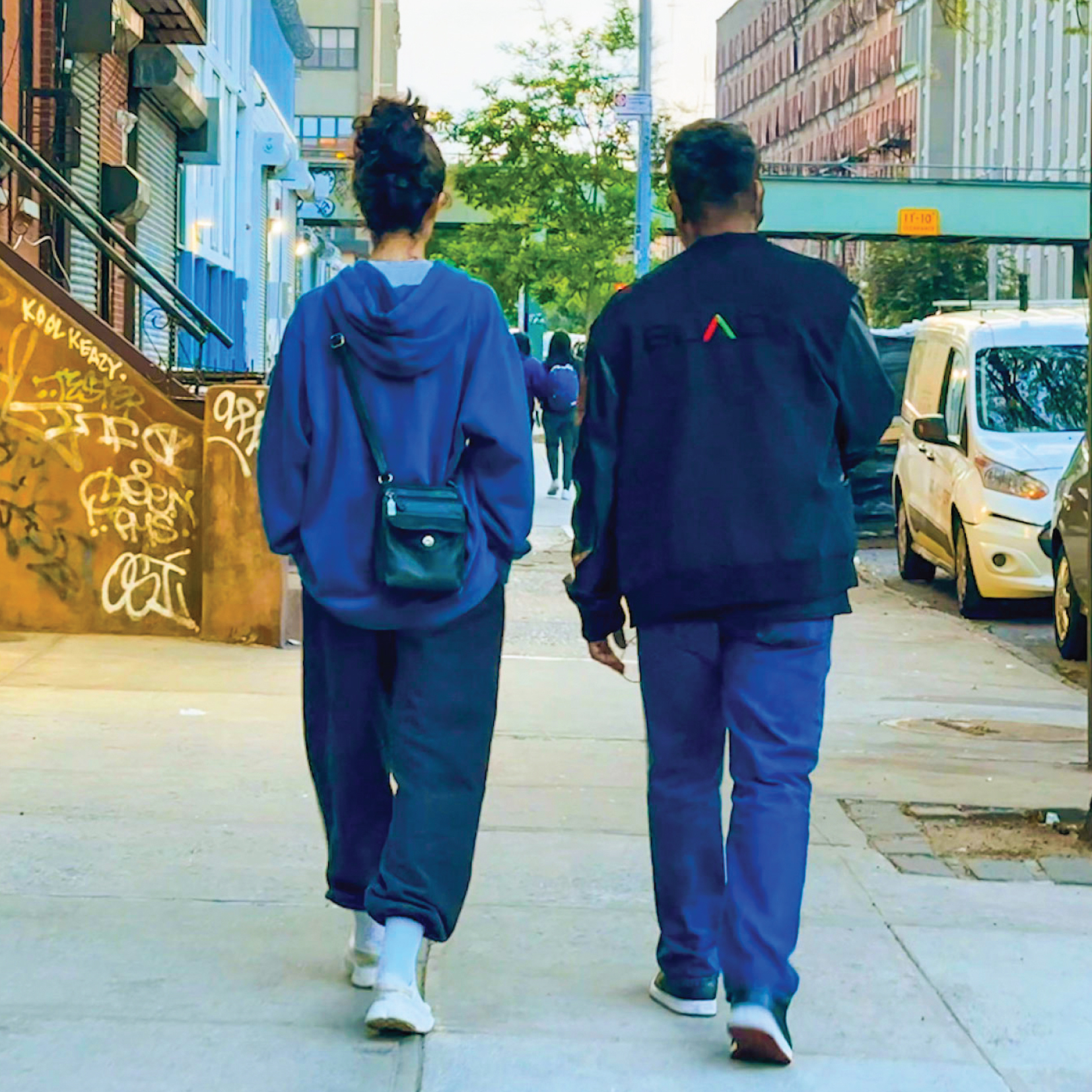
Okay. I do this podcast called Can I walk with you? I was wondering if I could walk with you.
- [00:11]
B
Sure. Actually, I think I saw it. Yeah.
- [00:14]
A
Oh, you've seen it?
- [00:17]
B
Yes.
- [00:17]
A
Yeah. You're down. Okay. Can I give you. Is it okay if it's recorded? And that's my cousin.
- [00:22]
B
What's happening, man?
- [00:24]
A
All right. Put this in a pocket.
- [00:26]
B
Oh, okay.
- [00:27]
A
And then would you be able to put this under your shirt? And then once it comes back out, I'll clip it on for you. That's cool that you saw it. That's crazy. I just started this too, and I feel like some people have been seeing it.
- [00:45]
B
Oh, no, no doubt. I've seen it.
- [00:47]
A
Okay.
- [00:49]
B
This is why I love the Internet. It's one of the gifts, right.
- [00:53]
A
When cool stuff happens on there.
- [00:55]
B
Oh, yes, no doubt.
- [00:57]
A
Yeah. What's your name?
- [00:58]
B
My name's Al.
- [01:00]
A
I'm Thuraya. Good to meet you. Thanks for doing this.
- [01:03]
B
No doubt, no doubt.
- [01:04]
A
Can you tell me a little bit about yourself?
- [01:09]
B
Just turned 59 Saturday. Do regular 9 to 5 work for a not for profit? I work for a not for profit. They're called services for the underserved. They help folks who are homeless, maybe with disabilities, things along that nature. So they help them find housing, other types of services as well, some in hr.
- [01:34]
A
Okay. And then aside from what you do, who are you?
- [01:43]
B
I'm someone who really appreciates the gift of life. I appreciate something like this. I appreciate. I'm about to go to a Nick watch party.
- [01:53]
A
Oh, what? Oh, Nick's game.
- [01:55]
B
Yeah. Yeah. So to be able to do something like that, you know, to have the means and so on and so forth, you see a lot of different levels of stuff going on out here, and I'm glad to be where I'm at and also experience everything else as well, like the.
- [02:10]
A
The simple things in life.
- [02:11]
B
Oh, my God. Seriously? As simple as just waking up in the morning.
- [02:16]
A
Right.
- [02:17]
B
Able to put my feet on the floor. We gotta have to hold up. Being able to put my feet on the floor, being cognizant, you know, stuff like that.
- [02:26]
A
I've been thinking a lot about that, like the past couple years when, I don't know, I was thinking to myself, what would my life be like if I was, like, filthy rich? And then I was like, I would still be doing what I'm doing.
- [02:37]
B
I would hope that I would be as well. Just all that would do is give me the opportunity to be doing this in an African country, in an African.
- [02:46]
A
Country, you know, so you would rather be somewhere else?
- [02:49]
B
Well, I just. As opposed to always saying Italy or, you know, being Ghana or Nigeria. But anyway. But that whole vibe, being able to just be able to do this somewhere else.
- [03:01]
A
Yeah.
- [03:02]
B
Comfortably, you know, not have to worry about the means.
- [03:06]
A
Yeah. Yeah.
- [03:07]
B
So that's the only thing that would change for me.
- [03:08]
A
Yeah. The. The part of, like, not having to worry about yourself or your family. That part would be nice when you were filthy rich. But it was like, it did help me reach a little bit more of contentment knowing that, like, you know what? I would still be doing this. Like, I like. I like my life there.
- [03:25]
B
See? And that's the point that I have tried to get to. I caught up to that a little bit later in life, but that's where I got to. It was like, you know something, maybe I didn't achieve the goals that I wanted to achieve, but that doesn't mean it's a bad journey. Still a great journey, you know? So that's what I try to embrace every day.
- [03:45]
A
When did you get to that realization?
- [03:47]
B
Oh, my God. I was about 50.
- [03:50]
A
Okay.
- [03:52]
B
I got laid off for my gig, had the summer to spend alone and quite honestly, shout out to my two daughters, Imani and Kenya. They held me down that summer, and it helped me realize the little things, just being with them. So from then, it came to a personal sort of thing where I was just like, okay, use this feeling with life. And of all things. Today I happened to find out that I lost my sister.
- [04:26]
A
Oh, man.
- [04:28]
B
So it's kind of weird. That's actually the reason why I'm out, because I didn't want to be home. I didn't want to sit home. But it, again, makes you appreciate stuff. And for me, time. Monique Green, she would always get on my case about time.
- [04:47]
A
Oh, really?
- [04:47]
B
She would be like, you can't always assume someone's going to be there, because we would. I was bad with calling her. So when we would talk, she was like, well, why didn't you call me? I was like, I was just thinking about you. Well, you have to call me when you're thinking about.
- [05:02]
A
Yeah.
- [05:02]
B
Because who knows? So I was talking to her son. He broke the news to me, and I was kind of laughing because I'm like, she's down. She's up in heaven, screaming on me, like, I told you, time isn't so anyway, but shout out to Monique.
- [05:21]
A
Yeah.
- [05:22]
B
Love you, big sis.
- [05:23]
A
She's watching us walking right now.
- [05:25]
B
No doubt. No doubt. And happy that I shouted her Out. Because she had probably been pissed that I didn't shout her out.
- [05:31]
A
Can you tell me a little bit more about her?
- [05:34]
B
It's crazy. I'm actually cutting to the left. Are you guys.
- [05:38]
A
That's okay.
- [05:42]
B
So we actually didn't connect until I was, I believe, 40. My. She's a half sister.
- [05:49]
A
Okay.
- [05:51]
B
On my pop side. So we really didn't meet until I was about 40. So we, you know, had a relationship, kind of. We're both adults, both have children, so it was just a matter of getting to know each other and all that stuff.
- [06:04]
A
Yeah.
- [06:05]
B
But she ended up having some health problems down at the. Toward the end.
- [06:13]
A
She's in a better place now.
- [06:15]
B
I believe so.
- [06:16]
A
Yeah.
- [06:16]
B
Because one of the things I learned. This would be a great. Well, hopefully it'll be a great story. So we met. I hadn't spoken to my father in about 30 years. About 30 years.
- [06:33]
A
Okay.
- [06:34]
B
So he reached out to me out of the booth. Actually reached out to my mom to get to me out of the blue. This is like November 2003. So we, you know, chop it up. Because I was like, yo, I'm a father now. Yeah, all that other stuff, I get it. You know, I'm adult. I get it. So we were able to chop it up. July 2004, he passes away. But before he does that, he introduces me to a brother and a sister. Oh, so. So I think he knew. Maybe. But either way, he ended up linking us all up. So that was crazy. But, yes. I've known her since, what, 2004? 2003. 2004.
- [07:21]
A
Do you believe in destiny? That all of that happened for a reason? Or do you think that life is just the coincidences?
- [07:29]
B
I don't think coincidences. Because a lot of stuff happens. It's hard to explain, but I don't think it's coincidence. It's hard for me to say destiny because I watch so much stuff. It's like, what controls destiny? Or what is destiny? You know what I mean? It's like, would this be considered destiny? You know, us linking up and, you know, so that's that. I don't know, but I know it's not coincidences. I think stuff happens for a reason, whether it's our own energy generating it or whatever.
- [08:08]
A
Yeah, it's hard for me not to believe in destiny, especially when, like, you're right, you make a good point. But I'm just like. To me, when I think, like, if I hadn't. If the person right before I asked you hadn't said no, I wouldn't have met you. And, I mean, I guess you could say that's a coincidence, but to me, that feels like destiny.
- [08:26]
B
Okay, okay, okay, okay, Okay. I can see where you're coming from with that. Yeah, but I can see where you're coming from with that.
- [08:35]
A
And I can see where you're coming from with yours. I think it just depends on what you choose to label, what you feel.
- [08:41]
B
You know, I have to stop watching so much sci fi. That's my issue. Some back and forth.
- [08:48]
A
You're back and forth with it. I have. You know, I am too, sometimes, but.
- [08:52]
B
It'S like, either way, you know, and I hate to keep harping on this, but it's like ultimately I'm just trying to enjoy the ride. So however that works, that's how it works. But I'm ultimately. Yeah, it's. It's. It's cool.
- [09:11]
A
Are you originally from New York?
- [09:13]
B
Born and bred in Brooklyn. This would be considered my neighborhood. Crown Heights. I was south. I grew up south from here. Went to school in here through middle school in Crown Heights. Yeah, this is my borough.
- [09:28]
A
This is your borough?
- [09:29]
B
This is my borough. No, actually, once I got married, we did the family thing and moved out to Long Island. Unfortunately, we weren't able to stay together. So once that dissolved, I came back into Brooklyn.
- [09:42]
A
Okay.
- [09:44]
B
I was here for a concert. Like, a little free concert one day and waiting for the train back home, I was sitting on Atlantic Avenue and there was this buzz that I missed. I was like, I gotta come back. I gotta come back.
- [09:58]
A
What do you want people to know about Brooklyn?
- [10:04]
B
It's a great place to live. You have things going on, gentrification that folks are not comfortable with. Stuff that messes up the neighborhood. It's like the. The whole. Again, the whole gift and the curse thing. The gift is we have better goods and services. The curse is prices are through the roof.
- [10:26]
A
Right.
- [10:26]
B
So it, you know, it always, for me, hurts. And like, why didn't we. Or why couldn't we get these goods and services way back when? Like, what was stopping that? What was preventing that? Ultimately, it happened.
- [10:40]
A
Yeah.
- [10:41]
B
You know, because folks were selling houses and moving down south. Folks were losing houses, folks for getting scammed, you know, it was a whole bunch of stuff.
- [10:48]
A
Yeah.
- [10:48]
B
And there's still folks here, so, I mean, you can't say that everyone is gone. The spot I seem to be looking for, you want me to put it.
- [10:56]
A
In my phone real quick?
- [10:57]
B
Well, I should have it.
- [10:58]
A
We're about 200ft away from it. All right. Bet it looks like, it's right. It's. Oh, that's weird. It's saying it's right there. But that's the school, right? Oh, no, no, it's down there.
- [11:10]
B
All right, cool.
- [11:12]
A
Can I get your. Your last thoughts? I like to.
- [11:15]
B
Sure. Definitely.
- [11:16]
A
I like to end it by asking people to leave my audience with one last message. If you could tell my audience one last thing, what would you want to tell them?
- [11:27]
B
Ultimately, it is really all about living and loving life. We were put here for a reason. Some of us are able to find that reason, able to pursue it, able to really maximize it. Some of us struggle to find it. Maybe ultimately do. Some of us just never find it. But I think the important thing is to try to enjoy the journey, but with a good heart, you know? I mean, these days and times, it's hard, it seems, to have a good heart, you know, have a unconditionally good heart. But I think it's possible, and we just have to figure out a way to make it happen. Once we are able to make it happen, then, you know, stuff will be a whole lot better.
- [12:11]
A
I agree. I wholeheartedly agree with that. And I want to thank you again for doing this. I'm sorry for your loss today, but I'm glad I got to talk to you.
- [12:21]
B
It's really, for a little bit, bananas. This has been a really bananas day.
- [12:26]
A
Than.
- [12:26]
B
Thank you.
- [12:27]
A
Thank you.
- [12:27]
B
I appreciate it.
- [12:28]
A
I appreciate you. Thank you.
- [12:30]
B
Have a great one, man.
- [12:31]
A
You, too, man.
- [12:32]
B
All right.