← Can I Walk With You?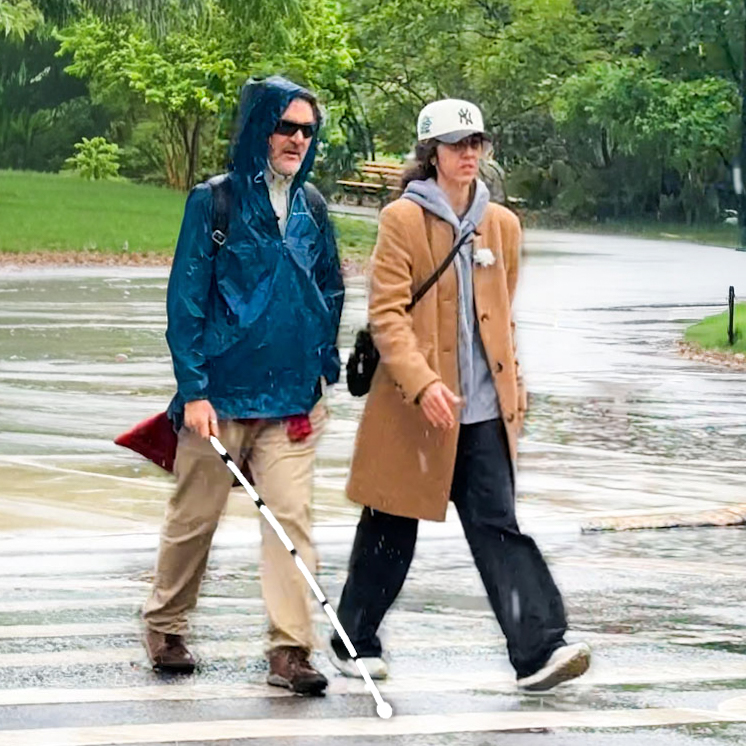
Can I Walk With You?
The Kindest Soul I've Walked With...
00:21:31
In this moving episode of Can I Walk With You?, Thoraya walks through the rain with José, a blind man visiting New York from Spain, and his friend Julio. José shares his perspective on living with vision loss, the daily realities of accessibility,...
Loading summary
Transcript151 lines
- [00:01]
A
Excuse me. Do you guys have a moment by any chance?
- [00:04]
B
Yeah.
- [00:05]
A
I filmed this online series called Can I walk with you? Where I asked people if I could walk with them and have a conversation. Would you guys be okay with if I walked with you to your destination?
- [00:17]
B
No, no, it's fine. We are looking for a place where to eat or something. So.
- [00:23]
A
I'm sorry, what was that?
- [00:27]
C
I don't speak English very well.
- [00:29]
B
Very Spanish. This is why it is gonna be a bit difficult because he doesn't speak English very well.
- [00:34]
A
So that's. That's okay with me if it's okay with you guys. So I do this podcast where I. I walk with people and I talk with them.
- [00:46]
C
For you, it's okay. For me, very difficult because my English is very poor.
- [00:52]
B
Do you want to eat something?
- [00:53]
A
I'll go with you wherever you're headed. Yeah, I'm down to do that.
- [00:56]
B
It would be lovely to chat with you.
- [00:58]
A
Okay, thank you. Can I have you say mic check one too?
- [01:00]
B
Mic check.
- [01:02]
A
Good. And it's mine. Good too. My cousin is across the street right now. He's the cameraman who's recording. He also does the audio. So I'm just checking with him to see if he could. If he could hear good. Okay.
- [01:13]
B
So Kanghee.
- [01:15]
A
Yeah, he said he's good. He said we're good. But do you want me to look for a coffee shop or did you guys have somewhere you wanted to go? Go.
- [01:21]
B
Now we look for a coffee shop.
- [01:23]
A
You want me to look for something? Okay, this looks like a good spot. It's about an eight minute walk there. We could grab coffees and then do. Am I holding you up from anything? Would you be open to walking for 30 minutes?
- [01:34]
B
We would be open to walk for 30 minutes.
- [01:37]
A
Okay. So we'll get coffee and then we'll keep walking. Let me just start this real quick. Yeah, we'll go ahead and walk straight.
- [01:42]
B
Okay, cool.
- [01:45]
A
Can you guys tell me a little bit about yourselves? Who you are, what you do?
- [01:51]
B
Okay. My name is Jose and I am a retired teacher.
- [01:57]
C
My name is Julio and I am a teacher.
- [02:00]
A
Okay.
- [02:02]
B
And we are in New York on holidays. My friend wanted to come to New York and asked me if I would like to come over with him and I said yes. So here we are. We are very much impressed.
- [02:20]
A
You're very much impressed?
- [02:22]
B
Yes.
- [02:23]
A
Yeah. There's something quite special about New York. I think the first time I came here I just thought it was a bit too much. But now I'm starting to realize that I think it might Be my favorite place in the world. You said you're a retired teacher and you're still teaching, right?
- [02:42]
B
Yeah.
- [02:42]
A
Is it nice that you're retired now?
- [02:44]
B
Oh, yes. But you see, I'm retired because of my eyes impairments. Because I'm blinder as I used to be. I've been always a bit blind. But now that I am becoming old or older, so that got worse. And for me, it was a bit difficult to go on working at the same level. I was. So in Spain, once you have worked for quite a long time and you have some kind of impairments, you can ask for an early retirement.
- [03:24]
A
Oh, I see.
- [03:25]
B
And that's what I did somewhere.
- [03:27]
C
Public system.
- [03:29]
A
Your public system is like that. How's life been navigating that?
- [03:34]
B
Difficult. Difficult. It's been difficult. We are talking about that quite a lot because he says, how do you feel being, you know, walking? Feeling that you have not the hundred percent of control in what there is around. And I say, I feel privileged that I can still follow you and have some autonomy. I value that quite a lot because maybe there will come a day where I can't see at all. So now that I can see a little bit, I have to move. And few places like New York. Some people ask me, well, if you don't see very well, you know, why? To go to places like New York for this. You can hear the city, you can feel the city, you can smell it.
- [04:39]
A
Yeah.
- [04:42]
B
And, yeah, I think.
- [04:44]
A
Sorry, let's wait for that for a second.
- [04:56]
B
I think it's important that we make a move. When I say we.
- [05:03]
A
As you were talking about how you could hear the city, it wouldn't have shown. Okay, keep going.
- [05:16]
B
Yeah, Nice. In New York. Yeah. I think it's important to. Not to remain stopped in your place, but to move, to make things and to experience in different ways. That's all.
- [05:33]
A
Like I said, I'm not from New York. And I did notice that there was a lot of people who were. I'm assuming that they're blind. You would think that New York would not be a good place for that. But then I looked it up and it was like, it's actually one of the best because of the public transportation or something about it. Would you agree?
- [05:54]
B
I would. And as a matter of fact, I would tell you that people are very nice or they have been very nice to us because of the cane or because they see that I cannot see. And yesterday, for example, we were in the Frick collection, and it was very surprising. It was nice to see how they are organized to accept people with impairments so that they offer a special fee to get in. And for the care partner, he could get in free and we didn't have to stand in the queue, for example. So, you know, there are little ticks that are very nice. Even a woman said to me, I commented that to Julio, too. I said to him, because there was a moment where I felt that I was in the way. There were a lot of people around me, so I just stuck against the wall and said sorry. And then a woman came to me and touched me and said, no problem. And that was so nice, you see, like somebody that I didn't knew that I didn't know sorry, and just was sort of giving me confidence because she was aware that I had problems, to know what was going on around me. And I don't know whether she was a New Yorker or not, but that what happened to me here in New York. So that's nice.
- [07:38]
C
But this city is representative from all the. All the country, right?
- [07:46]
B
Yeah.
- [07:46]
A
It's the most diverse place in America.
- [07:49]
B
You see, I thought and. Sorry, Julio, did you say something? We were speaking too. We were sort of paying attention to this diversity thing. Right. What we have seen since we arrived is that you see, for example, a difference between black and white people, and you see a lot of black people working in sectors and white people in other places. Like, for example, if you see guards in the museum, they were all black and men male. I said to Julio, I hope that if you go to a hospital or something like that, you see an Indian doctor or a black doctor in the same way you see a white one. Whereas if you go to London, they are very well integrated. So you don't see the diversity so much divided into economical gaps or differences. Right. And I think that's important in a society that they work truly to make this diversity equal and not so different. And in here in New York, I don't know, we've been too little to know, but we are observing that to see if that is right or on us.
- [09:17]
A
Is that. Is that what you were saying too? Like, there's. Yeah. The way it's diverse.
- [09:21]
C
Speak about politic.
- [09:23]
A
Yeah, you can talk about that.
- [09:25]
B
Yeah.
- [09:25]
C
For me, it's incredible that it's amazing that all these people have voted for Trump. I can understand it.
- [09:33]
A
New York didn't.
- [09:34]
C
New York.
- [09:34]
B
New York didn't. Yeah, that's right.
- [09:36]
A
New York did not. No.
- [09:37]
B
Okay.
- [09:38]
C
So it isn't representative for all the.
- [09:40]
A
Counting, I would say, depending on what city you're in, most People here that you come across did not vote for him. Most people, cities like la, San Francisco, New York City. There's a huge puddle here, so let's go over to the left more.
- [09:59]
B
Okay.
- [10:02]
A
There's still going to be a puddle there too, but.
- [10:05]
B
Okay.
- [10:06]
A
It's better.
- [10:06]
B
So you tell me when I have to step probably over that.
- [10:15]
A
Okay, let me just check the directions real quick, make sure we're going the right way. Yeah, so we're gonna go down this way. There's a coffee shop down there that looks good. What's been your guys's perspective from. From, I guess, the outside looking in?
- [10:32]
B
Well, it's difficult to have hope. Like it's not only the usa, but it's everywhere. I think that history doesn't have to repeat itself, but if we are directing ourselves to the same mistakes that we did in the past, then we will come to the same conclusions. So the same things will happen again. As a matter of fact, I think they are happening right now. Because I heard I've got a friend here that works in Washington and she says that it's difficult to talk about Palestina here. And why is it difficult to talk about what's going on in Palestina, I wonder. And I wonder why people in Europe, I mean, politicians in Europe, don't talk about what's happening in Palestina, but do talk about what's happening in Ukraine, for example. All these things worry me because. Because I think that the water is going very mad at a very high speed.
- [11:39]
A
That's the coffee shop right there. Okay, let me just see if. I think this might be it right here. Yeah, this is it.
- [11:51]
B
Okay. Oh, your wet, huge umbrella is small.
- [11:55]
A
It's okay. I don't mind the rain.
- [12:05]
B
I will have a cappuccino and how about. Do they have cheese?
- [12:10]
A
They do have teas. They have a matcha tea and I'm sure they have different flavors. We'll just have to ask them. Let me see.
- [12:20]
B
What are you drinking?
- [12:22]
A
I'm probably gonna get one of their signature drinks. I usually just ask what their most popular drink is and then I get that.
- [12:30]
C
Could we invite you?
- [12:32]
A
No, no, no. It's on me. Please, Please. No, no, no. Oh, it looks like it's on me. Oh. You guys ready to walk?
- [12:43]
B
So what's your name?
- [12:44]
A
Saha.
- [12:46]
B
Wow. What?
- [12:47]
A
Sa. Yeah.
- [12:51]
B
Wow. That's a nice name. Yeah, beautiful.
- [12:55]
C
In Spanish we say Soraya.
- [12:57]
B
Soraya.
- [12:58]
A
Wait, how did you guys meet? How did you guys know each other?
- [13:02]
B
Oh, we know each other from 30 years. He was the boyfriend of a friend of mine, we are gay. So he was. At that time, he was going out with me and I was in Madrid and they came to meet me. Ever since we've been friends. Yeah, I'm married now with a man, Pablo. Pablo couldn't come with us. Pablo is also a very good friend of Julio.
- [13:29]
C
And now in Spain, I feel.
- [13:34]
B
So.
- [13:34]
C
Confused because we are closer than ever to equality, but at the same time, we are so far.
- [13:45]
B
Yeah. I'm almost 60. Right. I'm 59. So I can tell you that things have changed quite a lot in these years. But when I was young, when I was 20, I must say that it was very difficult. We were speaking the other day about the importance of education and the importance of having your minds open. We have not to judge people, but to let them speak, speak and argue. So that I speak with arguments. And I use data, not feelings, data.
- [14:28]
C
And go slowly.
- [14:29]
B
Yeah. I remember that when I went to London, I was 19 years old and it was the first time I started speaking about my homosexuality. And it was very difficult for me to speak about homosexuality because I didn't do it before. As a matter of fact, I started doing it in English before I did it in Spanish. And then my mind was creating a space for that important issue in my life, but not before it was then and it was through speaking. Well, you can take that example for so many other things that are part of our daily life. You see, learn, speak freely, don't feel afraid of that, but with respect.
- [15:19]
A
Yeah, I think that's the part that a lot of people lack is the respect part.
- [15:25]
B
Yeah, yeah, yeah. Because we've got politicians that are insulting people continuously. And in our parliament now, I speak about Spain. It is gross what you have to hear every day over there. And they are the people that are governing us. So how can do that? Parliament. The word means parlare. You know, the Latin word of parliament means speaking.
- [15:57]
A
Oh, really?
- [15:57]
B
Yeah. So if we cannot speak, what's the parliament for? The product that you are working on has got to do with speaking. So you are probably fearful about it. But then fear does not stop you. And that's very important. Fear is okay. It's a feeling. And feelings are important. They put us alert. But it's important that they do not stop us from the important things.
- [16:36]
C
Important thing is, what are you doing with that?
- [16:38]
B
Yeah, exactly. And you are doing it. Good for you. Congratulations.
- [16:42]
A
Yeah.
- [16:43]
B
You see, life is dynamic and we have again to speak up and to show ourselves as we are. And time give us the truth. And the truth is that we are all different and that it doesn't matter. Yeah, well, the sexual orientation you may have, what matters is what you do with it. And if you are honest and respectful and all that kind of things, then people love you equally. So no problem for me. No problem.
- [17:14]
A
Let me. Give me one second.
- [17:16]
B
Okay.
- [17:17]
A
Are you sure you don't want the umbrella? Okay, I'm gonna grab it for myself. Which way? You don't have a certain direction you're going, right?
- [17:24]
B
We've got to take the tea.
- [17:26]
C
We've got to take the tea, which is our direction?
- [17:28]
B
The undergr say to take the underground subway. The subway. Got to take the subway.
- [17:33]
A
Do you want me to find somewhere for you to eat and then I could drop you up? Okay. What are you in the mood for?
- [17:38]
C
We have finish. We have.
- [17:40]
A
You have what? Finish with this. I mean, we could end whenever you want. Let's see how far where you're going to eat is. If it's super far, I'll let you guys go. But if it's short, then I'll walk you there and then I'll say. We'll say our goodbyes there.
- [17:52]
B
Okay. We. We are not very demanding, so don't worry. Anything will be a sandwich or Thai.
- [18:00]
A
Food and it's just a five minute walk, so that's perfect.
- [18:05]
B
Okay.
- [18:06]
A
Yeah, we'll walk there.
- [18:07]
C
Okay.
- [18:08]
A
We're going to go straight and then we're going to. Yeah, it's just a couple blocks away. I really enjoyed our conversation.
- [18:14]
C
Your umbrella.
- [18:15]
A
I know. I was thinking the same thing. That's going to be all the comments on the video, like why you get an umbrella once you were soaking wet. I've really enjoyed our conversation. Thank you. Thank you for walking with me.
- [18:28]
B
Thank you. Thank you for us. It's been very nice too.
- [18:33]
A
Okay, good.
- [18:34]
B
Thank you.
- [18:34]
A
I'm glad.
- [18:37]
B
What kind of an audience do you have or do you.
- [18:40]
A
I have mainly on YouTube. I have about 2 million followers on there.
- [18:46]
C
2 million?
- [18:47]
B
2 million. Wow, that's 2 million.
- [18:49]
A
I always like to tell people too. It's just about the walk and the conversation. If you decide you don't want me to put it up, I'm okay with that too.
- [18:58]
B
You can let me know you put it up. Of course, of course. It's important that those 2 million people listen to that. We have to open our minds and we have to work for that.
- [19:13]
A
Yeah. But my audience is. They're all very nice.
- [19:17]
B
I'm sure they're. I'm sure they are because you are Very nice. So your audience must be nice, too.
- [19:24]
A
I rarely see a mean comment, and when I do. And when I do, if there's like a mean comment on one of my videos, there's 10 comments underneath it telling them off. Like, how dare you say something great, great.
- [19:42]
C
How have you been in this bank?
- [19:44]
A
No, I really want to go.
- [19:45]
C
Yes, you must go.
- [19:47]
A
Which parts? Where should I visit first?
- [19:50]
B
Wow.
- [19:54]
A
Do you think people would want to walk with me there? If I went to Spain and asked them to walk with me? Do you think they'd do it or would it be really.
- [20:01]
B
Oh, for sure. In the south of Spain? Yeah, for sure. A lot of people. A lot of people would do that. Yeah, they are very much like they are New Yorkers, you know, Yesterday we were in the. In the underground, in the subway, and we were. Julio was looking at where to go, and we were in front of a stairs and there was a guy passing by. I said, where do you want to go? And that does not happen in England, for example. That never happens in France, but that happens in the south of Spain and it happens in New York. Yeah, so that's nice.
- [20:35]
A
I didn't realize that south of Spain. Spain was like that too. I would have never guessed that.
- [20:39]
B
Yeah, yeah, yeah. So if you come, you have to phone me and then I can. Yeah, yeah, I can show you the city. That would be very nice.
- [20:45]
A
I'd love that. I think this. This is it. Let me make sure.
- [20:49]
B
Okay. Okay, so I'll give you your stuff.
- [20:52]
A
Yes, I'll take the microphone and then let me. Oh, I want to get your informations too. So if I'm ever in Spain. It looks like a cute little restaurant, actually.
- [21:00]
B
Okay.
- [21:01]
A
Yeah.
- [21:03]
B
Soraya, will you give us your.
- [21:05]
A
Yes, I would love to. Let me.
- [21:08]
B
Yeah, write it down. My telephone number. And then if you come down to Spain, please. Okay, what's your phone number? Okay, I've got then your telephone number. Yes, perfect.
- [21:19]
A
Cool. Thank you guys so much.
- [21:20]
B
Thank you.
- [21:21]
A
That was a lot of fun. Bye.