← Capital Allocators – Inside the Institutional Investment Industry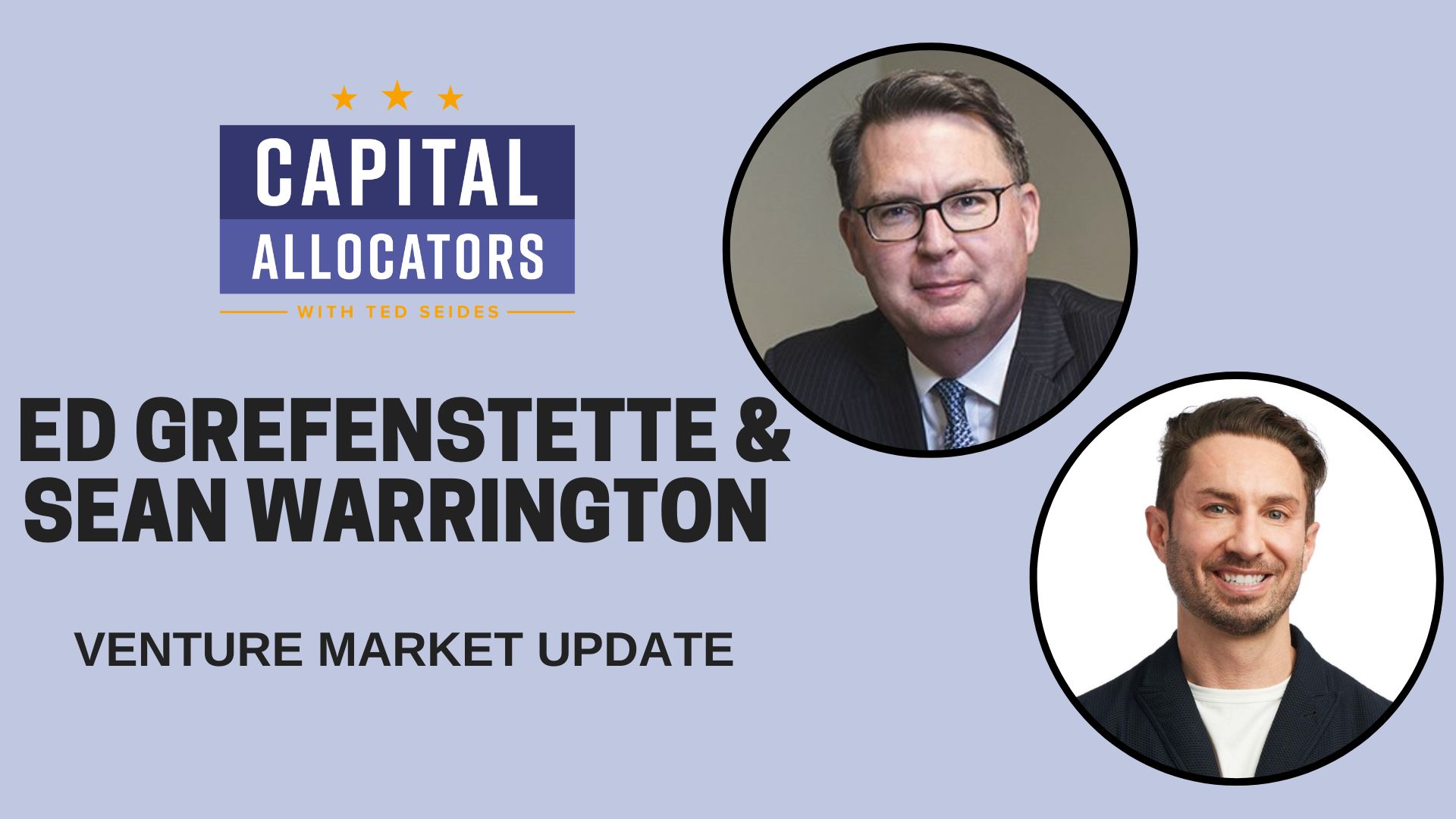
Capital Allocators – Inside the Institutional Investment Industry
Ed Grefenstette and Sean Warrington – Venture Market Update (EP.488)
01:05:15
Loading summary
Transcript133 lines
- [00:00]
Ed Grefenstedt
Is venture broken? Is this worth the effort? There are a lot of new entrants, new LPs who came into Venture in unfortunately, 20 and 21. These are going to be tough vintages. They're in front of their investment committees now saying, maybe we shouldn't have tried this. Some of those tourists are going to go to the sidelines for a while. That would be very healthy for the ecosystem. The good news for those of us who are sticking around and staying committed to it. I know Sean feels this way as well. We now have good data over the last six years of the behavior of some of the gps. So when we're doing our underwriting, it's hard to distinguish luck from skill when everything is up and to the right. But now you can look back and say, okay, what did you do in 20 and 21 and 22? How sensitive were you to these really high valuations? How disciplined were you in deploying the capital? Now you have things to look at and how they manage their portfolio over the last couple of years and you talk to the founders themselves. How supportive was this gp you haven't been able to rehet a down round here. How did they react? All this is important data now that helps us make better decisions about who we want to back going forward. I'm always looking for a silver lining. That's one of them. You now have more robust data to do your underwriting.
- [01:21]
Ted Seides
I'm Ted Seides and this is Capital Allocators. Today's show dives into the state of venture capital from the LP perspective. My guests are Sean Warrington and Ed Grefenstedt. Shawn is a partner on the private investments team at Gresham Partners, a $13 billion multifamily office. And Ed is the CEO and CIO of the Dietrich Foundation, a $1.6 billion foundation with an unusually large allocation to private markets and venture capital. Ed was a past guest on the show and that conversation is replayed in the feed. Our conversation covers the changing landscape of venture capital, including pricing distortions, power law, liquidity issues, GP behavior and scaled platforms. Throughout the insightful conversation, Ed and Sean share LP strategies to capture opportunities and navigate risks across stages sectors, mostly AI and geographies. Before we get going, Capital Allocators seems to reach a sufficiently large audience to create all kinds of serendipity. Here's my 16 year old son Eric, to share an example.
- [02:35]
Eric Seides
I was hanging out with my friend and his dad was super met at us for being so loud. He told us we should quiet down and learn something. He then asked me, do you listen to any podcasts? And I said no, but I probably should given who my dad is. He then goes, here's one the guy asked a lot of really cool, important questions. The podcast he was holding on his phone none other than Capital Allocators. I sighed in annoyance because this has happened before and I asked for his phone and started playing the Ben hunt episode from June 2024. If you don't rem, remember that's the last time I did the Spread the Word. The sound of my voice made his jaw fall completely to the floor. Even after showing off to my friend's dad, I'm still not gonna listen to this podcast. But you definitely should. Apparently all the rich smart dads are doing it. If you wanna be rich, you should too. If you already are rich, don't worry. Tell your poor friends about this podcast. They're gonna get a lot out of it. Thank you so much for spreading the word.
- [03:37]
Ted Seides
Capital Allocators is brought to you by AlphaSense. AlphaSense connects and accelerates every element of your research process, and I'm excited they chose to be our lead sponsor this year. One of the hardest parts of investing is seeing what's shifting before everyone else does. For decades, only the largest hedge funds could afford extensive channel research programs to spot inflection points before earnings and stay ahead of consensus. But channel checks are no longer the luxury they once were. They've become table stakes. And that's where AlphaSense comes in. AlphaSense is redefining channel research. AlphaSense channel checks deliver a continuously refreshed view of demand, pricing and competitive dynamics. Powered by interviews with operators across the value chain, thousands of consistent channel conversations every month help investors spot inflection points weeks before they show up in earnings or consensus estimates. And the best part? These proprietary channel checks integrate directly into AlphaSense's research platform, which is trusted by 75% of the world's top hedge funds. With access to over 500 million premium sources, from company filings and broker research to news trade journals and more than 240,000 expert call transcripts. That context turns raw signal into conviction. The first to see wins the rest. Follow check it out for yourself@alpha-sense.com Capital Capital Allocators is also brought to you by Morningstar. What if data wasn't just a bunch of raw numbers, but a clear and decisive language to help connect investment strategies with long term investor needs in a constantly evolving market landscape? Morningstar created that language, bringing order and utility to insight rich data so you can prepare for your next opportunity, no matter the asset class or Market. Visit wheredataspeaks.com to see what Morningstar Data can do for you. Please enjoy my conversation with Sean Warrington and Ed Grefenstedt.
- [05:49]
Sean, Ed, thanks so much for joining me.
- [05:51]
Thanks.
- [05:52]
Ed Grefenstedt
Delighted to be here.
- [05:53]
Ted Seides
Same Ed was on the show last year.
- [05:56]
So just for perspective, before we dive
- [05:59]
into what's going on in venture capital, why don't you share a little bit about Gresham and how venture fits into what you're doing.
- [06:05]
Sean Warrington
So GRESHAM, We're a $13 billion multifamily office. What that means in practice is we manage money for about 130 different folks. Think of these as people who generally made the money themselves. A lot of them are gps. The commonality across that subset is they all are worried about taxes. It's a very important component of our investment mandate. There's a lot of things we can do on estate planning, carry planning, things that are very valuable. They're also very astute investors. They're looking for a high class portfolio. What that means on my side is we're trying to build essentially an endowment portfolio that's tax customized the tax side on the public side, we have lots of strategies and privates generally a tax efficient part of the portfolio. If I think about venture specifically, we want venture to be the highest performing part of our portfolio. We lean into the risk like most LPs. We certainly have our multi stage funds. We have two folks we think are fantastic. They give us exposure, they give us alpha. Most importantly, they give us the confidence to think risk forward. What that means for us is the rest of the venture book looks early, it looks small. Most recent deal we did was a $15 million solo GP. We want to essentially be the first check into a company's life cycle. The real goal there is the last 20 years. It's been the best part of our client's portfolio. We're trying to design this book to remain that way as we look forward.
- [07:24]
Ted Seides
Ed, why don't you give a little refresher on the importance of venture to Dietrich?
- [07:29]
Ed Grefenstedt
Dietrich foundation is 1.6 billion in total assets. And we have pretty unusual allocation where about 90% of our assets are in private strategies. Venture capital alone is around 52% of the total nav right now, which is quite the outlier. But it's a huge part of our engine and it has been for some time and probably will remain so.
- [07:52]
Ted Seides
Sean, you started out saying as venture, as the core engine, you have these multi Stage and then early stage. Could you walk through your thought process on risk reward with that as the construct of your portfolio?
- [08:04]
Sean Warrington
First and foremost we have to put up at least benchmark results or what are we doing when we have our multi stage portfolio? I view those as the ballast of our book. It's about a third of what we do in venture. We expect that piece of the portfolio to give us the breadth, give us exposure in a big way to some cool companies, much like Ed. I'm sure he's seen it too. They've had some nice M and A exits coming out of those portfolios over the last couple of years, which we've been excited about. Importantly, they give us the confidence to lean into risk because we know the allocation is covered with those groups. As we build out the venture portfolio, we think there's smart risks that we can take. Like I noted the solo GP earlier, that's an advantage we can play into. The real goal is to build a venture book that covers the asset class, but then we think has meaningful levels of alpha that may come through some exciting results.
- [08:52]
Ted Seides
Ed, how do you do it similarly or differently?
- [08:55]
Ed Grefenstedt
We also try to have a core venture portfolio exposure through some of our more established and broader mandated gps and then look to have some satellite opportunities around that that we also put into that category. Like Sean, they're a little higher risk, higher return, more independent minded gps perhaps are doing some contrarian things. If we have enough of those, we can manage through the volume, good and bad there. But that's our approach as well.
- [09:24]
Ted Seides
With that as a backdrop, let's dive in on where you think is the most exciting place to play today. Ed, why don't you start?
- [09:32]
Ed Grefenstedt
We think about the global opportunity set in venture. From our prior conversations, Ted, we've talked about that, our focus on China and India. It's a big chunk of our 52% that's venture. If you're talking specifically within the US there's this AI thing I'm not sure if you've heard anything about. It's going to be really big. Obviously everyone is trying to figure out how dramatic this fundamental shift around AI is going to be and how that's going to play out not only in direct opportunities, but technology adjacent industries are going to be touched in some way, shape or form. That's creating all sorts of new underwriting on our end, trying to figure out how we can get exposure, whether it's through generalists or AI specialists, many of whom have popped up in the last five years. Then we also have some Traditional themes, whether it's health care or consumer that we're getting exposure to through generalists, that's going to remain a core going forward. In terms of stage, we are most excited about the truly early stage in the Seton NA and as our size is relatively modest at 1.6, we can actually get access that's meaningful in some of these smaller funds that can move the needle for us. That has been a theme across our venture book over the last 10 years. We've gone earlier and that's played out well because we have the brand to do that and we have the patience to do that.
- [10:59]
Ted Seides
Ed, if you put those two things
- [11:00]
together, AI isn't a mystery that people are participating in that. So there's a question of price, but then also early stage. How do you think about whether early stage is the right place to play a theme, say AI in this case?
- [11:14]
Ed Grefenstedt
That's the question we're all grappling with right now. The pricing is probably most distorted in the early stage about AI because you look at these companies and of course no one has a crystal ball, but you're looking at something and saying, hey, this could potentially be be a trillion dollar outcome. The bet is these are out of the money options. I'm going to buy as many of them as I can and long dated and one of them is going to hit. When that consensus drives a lot of capital to the early stage, you see some stupid behavior. That's the risk of an early stage focus for us. Right now we're trying to talk to our GPS to get them to articulate to us how they're thinking about the opportunity relative to the valuations. Hopefully we're picking the right folks who are separating the hype from real disciplined capital deployment. The risk return profile is profoundly different as you look out the stages in the later stage, you have more of a established understanding of a risk return profile of some of these companies because they have scale and they're building out the early stages is quite a challenge. But we think that in the end we had diversified enough portfolio, we'll be rewarded. Sean will probably have a better answer to that question.
- [12:28]
Ted Seides
Sean, you want to jump in?
- [12:29]
Sean Warrington
Stylistically, Ed and I have a lot in common here and echo a lot of the things he said. What I'd add, and my guess is Ed loves these kind of deals as well. A profile of a deal that we really like at the early stage today is when we're partnered with a GP who has a personal relationship with talented, special people. They may be at a large tech company. And what they can do is offer a small check to help that person gain the confidence to spin out and partner up with their friends and almost play the role of a cheerleader and the role of almost a fundraiser where they'll get a nice valuation upfront right in the first check. Usually that GP will then go talk to a bunch of smart, successful multi stage firms and potentially drum up a more sizable round even three months later at a much higher valuation. What we love is if we can get in early and get that first one. We still get to enjoy the valuation advantage of the early stage, but have the large capital behind us. It's almost a have your cake and eat it too type development. Hard to do, but we do love those when they come around.
- [13:31]
Ted Seides
How do you put together the idea of you want to be partners with the GP over time? And those types of situations sound like they're very finite. It's somebody with a relationship, maybe at a company they left, but after a couple people leave that company, those relationships get exhausted.
- [13:46]
Sean Warrington
We love operator funds. One thing my colleague and I talk about a lot is the shelf life of someone's experience. And experience really means network. There's not a single amount of time that everyone has in terms of shelf life. But we do think there's a time when someone has the most vibrant network that can come out of a certain node. So we do evaluate that and as someone gets further from it, we start to ask the question of okay, what are the new nodes? Where are the new places this person is finding? Entrepreneurs, what we love is when someone's day to day has them around these people. Sometimes that's the life these people live. But we have to be honest with ourselves. Someone's five years away, living in a different state, they probably don't have the same access to the Houston network as they once did.
- [14:24]
Ted Seides
Where are some of those nodes you're finding today?
- [14:26]
Sean Warrington
PayPal Mafia is the really epicenter of where this all started. It's moved into places like Palantir, Indurrel, SpaceX, you name the hot halo company. There will typically be some special startups that come out of those. We do love to partner with people that come out of special companies and even better if they had a special role within that company.
- [14:45]
Ted Seides
Sean, how do you wrestle with the valuation issue where the space you like to play? Except for maybe some of these one offs that are special deals, everyone's looking at the same space so pricing can get a little frothy.
- [14:58]
Sean Warrington
Ed touched on AI. We all know that AI is A special magical thing. It's going to change the world. The question we have is should your chips all be on the table right now, or is this opportunity really interesting today, but maybe the utility comes in five to 10 years. The way we're thinking about it is our job is to be exposed to the market. AI is special. We have to have some bets placed, but we do want to make sure that we can play each vintage have dollars that could still be thought of as five years from today. This is the wimpy answer, Ted, but we're putting part of the bet in today. But we're making sure to have at least some diversification to sectors that may not be as clearly vibrant but frankly have much better valuations.
- [15:38]
Ed Grefenstedt
Can't time venture capital no be steady and consistent? If anything, the last six, seven years of TODD has reminded us that vintage year diversification is critical. I know a lot of institutional VC portfolios are getting blown up by some, it's a great problem. But some extraordinary positions that are forcing institutions into overweight and some are trying to deal with that. Well, do I just slow down my deployment of fresh capital into venture if I'm already overallocated? Very few people want to do that because this is an exciting time. But you have to stay consistently deploying in order to have that kind of exposure over time.
- [16:17]
Ted Seides
Ed, how have you managed that situation where the winners are private for much longer, so it does take up capital that you would otherwise recycle?
- [16:26]
Ed Grefenstedt
We have fewer constraints because we'd have this unconventional approach and we're able to deal with a higher tolerance of illiquidity. The practical problem facing a lot of these endowments and foundations today is they're more constrained and have tighter guardrails around what they can do in the venture space. I like to think about your classic simple allocation of a multi billion dollar endowment. Do you use numbers? Assume multibillion dollar endowment is 50% allocated to alternatives, roughly illiquids. That includes real estate, private credit, buyout, growth venture and venture might be 20% of the total nav as a target. Well, the last couple of years they might have exposure to SpaceX, OpenAI, anthropic ramp stripe. Suddenly those exposures have driven the total venture from 20 to 25%. Maybe they have maybe 5% of the total nav is in SpaceX. And this is the actual case for some institutions out there. So what do you do? You look at your allocation, you're targeting 20, you're at 25.5percent SpaceX and oh, by the way, you're looking into the future here and there's a possibility that 5% could go to 10%. If SpaceX goes from 400 to 800 to a trillion six of it lists, who knows what the numbers will be? You're sitting there looking at this math problem and you only have a limited number of options. The first is go out and try to sell some of your venture book in the secondary market. Well, the pricing comes back on that and it's not really attractive and no one wants that. So like, okay, what's option two? Option two is you slow down your deployment, your commitment, pacing for the next couple of years into venture. As we spoke about a moment ago, that's not attractive. This is an exciting time. You want to be putting fresh capital out to fund these new and innovative and disruptive companies, many of which are AI driven. You're over two. What's the third option? Third option really has a couple of parts. One is you go back to your committee and you say, we have a 20% traditional prepared target for a venture. We're at 25, we could go to 30. Why don't we just expand our target range, permissible range for venture, and acknowledge the fact they're going to have some of these incredible companies, they're going to be unpredictable, the first class problem, and we just have to steal from other illiquid buckets. So we're going to do less in real estate, less in private credit, less in buyout. That's one option. A variant of that is you say, okay, we're going to take these special names and put them in a new category and we'll be creative, we'll say their dynamics are different because these are large companies. SpaceX, I don't know what their revenue was in 25. 16 billion or something like that, and profitable. This doesn't really look like a venture company. This is like a quasi public company. And if we really needed to sell, we could find a market for these shares. Let's put this aside and take it out of our venture allocation and continue to commit into the funds we've targeted in the past and just treat this differently. That's the debate going on in endowments and foundations around the US right now because these positions have become quite large. In fact, they could become liquid in the next 12 months if the IPO window is open, as we all hope it'll be this year. It's not a long term problem necessarily, but that's the debate going on internally. A lot of ICs, Sean, have you
- [19:59]
Ted Seides
guys Dealt with that same issue.
- [20:01]
Sean Warrington
Some similarities, the way Ed described it, I said the big difference between our profile, which look, these are families, we have humans, we don't have institutional committees behind this. The way we've thought about this is let's split up exposures and illiquidity. The first part of that equation is exposures, and using Ed's example, SpaceX or Stripe. The reality is those are not venture risk. The way we think of venture. We've taken the approach that it's fair to think of those as a different asset class. They're just almost equity risk is the way we think about it. We don't want to penalize our clients and their return potential for these assets doing a phenomenal job and having continued growth ahead of them. However, our clients are humans and humans make interesting decisions with their wealth. And maybe it's a shock or maybe it's not, but someone lives a somewhat simple life and they have a little money, they start buying houses and things come up. So the illiquidity part of the equation is very important for our families and the advisors that support them. We have to be thoughtful around the commitment sizes they make. The way we like to design it is let's change the exposures such that this is really equity. But let's make sure the illiquidity side is in a position where our clients are still in a nice position. We never want to be pulling from Publix to fund capital calls at the worst time. We think deeply about illiquidity, but like Ed, we do think about the exposures differently. With those special assets, let's say those
- [21:22]
Ted Seides
special assets are 5% and ED's made up example. Where are you funding that illiquidity budget from if it's not venture?
- [21:30]
Sean Warrington
In the case of our clients, when a capital call comes, it's going to come out of their equity or fixed income books, essentially their liquid portfolios. That's the reality of how we've positioned the portfolios in reality. For most investors in our position, however, we've got models that help make sure that our clients overall illiquidity, we think out multiple years, will be in a position where they do have a safety net. The most important thing to us is if there is a violent drop in equity prices, I mean public equities at that moment, we cannot be in a position where we're taking money out of the public book and sliding it into the private book, because that's the ultimate sin of our job. That's the worst trade you can make. As a limited partner. So we build buffers, we have parts of people's portfolios that would be more bond like ways that we could draw from and avoid those dynamics. As Ed alluded to, where it will be getting pulled from in this scenario, real estate might have to be a little lower, the buyout book might have to be a little lower. We will have to make some subtractions to account for that special position. These are high class problems. So we want to make sure we continue funding a great asset class and not detrimenting long term results.
- [22:35]
Ted Seides
So there's some possibility the IPO window opens. SpaceX, huge IPO. There's also a possibility that these companies don't go public. How do you think about scenario planning if in fact there is no surge of late stage privates that file and go public?
- [22:51]
Ed Grefenstedt
Sean? Sure.
- [22:53]
Sean Warrington
You know, I have two thoughts here.
- [22:55]
Ed Grefenstedt
Let's think good thoughts.
- [22:57]
Sean Warrington
Let's think good thoughts. For the positions like Stripe. Many of us have a lot of the same positions we're alluding to. I like to call them halo companies. We're less concerned because look, Stripe, SpaceX, these are special companies that there simply is liquidity and you may not want to take it right this second when you see value accretion coming your direction. The reality is if we needed to find liquidity, we certainly could. The concept that does worry us though is if these halo companies choose never to go public, what does that mean for the long term viability of an IPO? If you look at the last 12 odd months, about half the IPOs that have happened are below their last financing round. It hasn't been a bad market, it's been a mixed bag and there hasn't been that many. And one of our views or fears is that that's because the big guys, the halos, haven't really went out there and set the mark on what an IPO should look like. What worries me is if you're not a halo company and we don't have the classic typical IPO, what does that mean for the next 5 to 25 positions in our portfolio? Yes, the M and A market's been great, but that's very strategic from the buyer's perception. They want specific teams, specific products. We have a great answer to that one, Ted, is if the IPO window doesn't really open, what about the next 30 positions in our portfolio, the non halos? It keeps us up at night, but it's something we do think about regularly.
- [24:14]
Ed Grefenstedt
That's absolutely correct. The halo companies, they do have a market you can absolutely generate liquidity. And let's not forget that the GPS are part of this conversation. And they know that their LPs are anxious and impatient for some liquidity and probably have more than whispered into their ear, hey, you want us to put some dough into the next fund? We got to see some coin. The number I wrote down from an article yesterday. Since 2022, liquidity has been negative cash to LPs of about 200 billion capital calls in excess of distributions. That's a big hole. And GPS understand the math and they want to recycle back. The creativity is going to continue to grow in terms of providing some liquidity and the market's getting more efficient. At least in these halo companies you can get pricing that's not problematic. That is certainly the safety valve. But you're right, Sean. That next layer of unicorns out there, that's the question mark. It's 40% of the. Call it 1,000 private unicorns in the US have not raised capital since 2021, I think, or 22. That's like your Schrodinger's cat scenario. Venture capital is both dead and alive at the same time. Until you open the box, you'll know where the cat's alive or dead. And until some of these companies go out and try to raise more, it's going to be hard to know which ones are really viable. That is the thing that gives me some concern. Some of these companies, I'm referring to these unicorns from 2020 and 21, they may have continued to generate good operating metrics, but the SaaS multiples have gone down by 50% since they were last priced in a price round. So a lot of those have not yet been marked to what's probably an authentic value.
- [26:05]
Ted Seides
A lot of this has happened because of where you started, the increasing recognition that venture has been a really attractive high returning asset class and therefore more demand for venture funds and for the activity. Curious your thoughts on how the dramatic increase in interest in this space has affected the dynamics between GPs and LPs.
- [26:26]
Sean Warrington
We view this as the institutionalization of the asset class, which we're either there or we're in the process of. The parallel for us is the buyout market, which went through this many years ago. What we like about that institutionalization is there's a food chain where an asset starts at a small level of ebitda and there's a natural transition through the middle markets and upper markets that's made that asset class a very interesting risk and return potential for LPs. It's unclear to us if the institutionalization of venture will lead to the same outcome as we look at it today with where the businesses have gone in a capital intensity sense, there's a reward on the GP side of the equation to gain access to special companies that need to consume quite a bit of money and put that money to work, charge fees, go raise another pool of capital. Unlike the buyout market, we don't have a conveyor belt. Again, the IPO window, the end game is stopped. We're sort of looking at this and saying is this going to moderate the overall returns for the asset class or at least change the long term view? We have a model at our side that hopes to break that fear and get really early. The truth is we won't really know until the next five to 10 years if all this capital that's entered will be put out in such a way to where there still are special returns to be had at an asset class level. To us, it's a TBD situation.
- [27:46]
Ted Seides
Ed Thoughts?
- [27:48]
Ed Grefenstedt
Some historical perspective is always helpful. In 2012 the Kauffman foundation issued this blistering report criticizing venture capital and I think the name of the paper was we have Met the Enemy and he is Us. It was pointing a finger at LPs saying we have been undisciplined in funding GPs who never should have been funded. We've been partially responsible for short termism and these trailing 10 year returns, this is 2012 are horrible and they're going to stay horrible. I remember when getting that thing and reading it and I was like, this is great. I'm going to send this to every LP I know and it's going to scare the hell out of them and it's going to get all the tourists out of the market and then we can double down. We did that and I kind of feel like those same headlines are the ones we saw last year. Is Venture Broken? Is this worth the effort? There are a lot of new entrants, new LPs who came into Venture in unfortunately 20 and 21. These are going to be tough vintages. They're in front of their investment committees now saying maybe we shouldn't have tried this. Some of those tourists are going to go to the sidelines for a while. That would be very healthy for the ecosystem. The good news for those of us who are sticking around and staying committed to it. I know Sean feels this way as well. We now have good data over the last six years of the behavior of some of the gps. So when we're doing our underwriting. It's hard to distinguish luck from skill when everything is up and to the right. But now you can look back and say, okay, what did you do in 20 and 21 and 22? How sensitive were you to these really high valuations? How disciplined were you in deploying the capital? Now you have things to look at and how they manage their portfolio over the last couple of years. And you talk to the founders themselves. How supportive was this gp? You haven't been able to had a down round here. How did they react? All this is important data now that helps us make better decisions about who we want to back going forward. I'm always looking for a silver lining. That's one of them. You now have more robust data to do your underwriting.
- [29:55]
Ted Seides
What's the range of what you found from really good behavior to the other side of the spectrum?
- [30:02]
Ed Grefenstedt
Well, I'm sure Sean can share some stories as well. I'm not going to name any names, but I think there are some who have been really authentic. That's a word you use a lot, I think, when you're trying to pick a manager over 12 or 13 years. Just an authentic person and authentic approach to this craft. The ones who came back and said, we didn't do this right, we made a lot of mistakes and here's what we've learned from it and here's how we're adjusting our behavior going forward, that's okay. Some LPs won't give them a second chance. We have done that where we have said to a gp, okay, we all know this is what went wrong here and we can do the autopsy. And then we still supported them when they came back to the market because we think they're going to be a better investor going forward. That's one extreme. The other extreme is these folks know they aren't going to raise another fund and they've stuck their head in the sand and said, just going to wait and hope I get lucky. Some of these companies do recover somehow, some way, but they know deep down they're probably not going to raise another fund.
- [30:58]
Sean Warrington
If you've been doing this a while, it's not that hard to filter out of the truly bad cases, as I'd say. We get bombed with so many venture funds raising and all this scary stuff, you can push away 90% knowing there's not a chance you'd want to invest. I'm sure we've all seen on Twitter the multiple layers of anthropic and OpenAI. And my guess is that's some of the bad behavior that's going on today. Right or wrong. To Ed's point, when I remove the fabulous things that fortunately we've been able to avoid. Where we spend a lot of time is trying to understand the math of the funds that people are deploying. They had a check size they wanted to write coming in. There was an ownership dynamic, there was a vintage diversification of how they're going to deploy that money. The things that get us most nervous is when someone tells us they're on a three to four year clip. And look, everyone says three to four and in reality they mean two and a half. We accept that that's just the reality of venture today. But when someone puts all the money to work in months to us, there's a real issue in there in that we were sold something that we didn't really want to buy. That person saw whether it was a unique opportunity and that's the positive case, whether it was an opportunity to get back into market and raise more. The problem does start with the LPs in that sense of there are LPs who want money put out. And if you're paying someone to get money into companies, I can't blame the GP for doing it. We would say that's not the deal we wanted and we're not going to be a part of the next fund on the counter. There's a lot of people who told us one thing more or less did that version and are raising a similar size, slightly larger fun. That's the good side of the equation. So, Ted, there's been a lot of quick money out the door and those are the types of people we generally like to pass on. But there's been some really good actors too. It's a mixed bag.
- [32:36]
Ted Seides
We're going to take a quick break in the action to tell you about Ridgeline. Imagine starting your day with reconciliation. Already done. No spreadsheets, no breaks to chase, no duct tape holding systems together. Ridgeline is the first front to back system of record built for investment managers. One platform, one real time dataset. Embedded AI investment firms are replacing a patchwork of isolated and dated order management systems, accounting systems, reporting, add ons and client tools with this fundamentally new operating model, automating complex workflows, scaling personalized client experiences and unlocking the full value of AI. If this is the year your firm is ready to modernize operations and harness AI, you can learn more@ridgelineapps.com and now back to the show.
- [33:34]
Sean, you touched on the math of penciling out based on certain size, what someone needs to make. I know Paki McCormick recently put this piece out on a 16Z and when they raised their first four funds, people said, oh, if you do the math, you're going to have to generate 250 billion doll value. And it turned out they were 800 billion. How do you think about the importance in this power law business of being able to pencil out what you think could happen at a certain fund size?
- [34:02]
Sean Warrington
The hard part, as an lp, and if we look over time, we're always thinking about what's the exit market today? The exit market in 10 years is the one that generally matters. Maybe it's 15 to 20 years. And if you look over time, the company valuations have been much larger than anything any of us would have ever predicted, which is why returns have essentially gone up. Where we think about the math, it really boils down to the VC's right to win the check they're going to invest. What we mean by that is if someone's trying to own 20% of a company at the seed stage, they better have a good argument why that founder wants their money, why it's still a special company, and how they're going to box out the other great venture capitalists out there. When we say the math, a lot of times what we mean is this person is trying to own X percent of a company. Does their gravitas, their technical ability, their ability to help sell the next round of capital justify that check size, that ownership relative to the situation? And the rest of it's pretty simple. They want to do 25 deals that should equate out to an X size fund. That's how we think about the math. The exit valuation to us matters, but we do accept, again, 10 years forward, we're not really sure, but we want to make sure that initial math makes sense and then we're hopeful the rest of it plays out well in our favor.
- [35:14]
Ted Seides
Ed, how do you think about that?
- [35:16]
Ed Grefenstedt
Nothing substantively different. You are looking at a spreadsheet and making a bunch of assumptions which are silly in some respect because to Sean's point, you can't possibly predict the scope and scale of some of these ultimate market exits. But the value is walking through the thought process with the GP and saying, what are your assumptions and why do you think those are reasonable? Sometimes just that conversation alone is quite probative in terms of the maturity of the thinking. That part of the exercise is certainly as valuable as the actual numbers.
- [35:49]
Ted Seides
Sean touched on the right for a GP to win. You have a marketplace where in the last five or ten years you now have scaled venture players, maybe half a dozen of them, and they have the ability to acquire talent, much like we've seen in the hedge fund space with POD shops. How do you think about a solo GP or a smaller GP's ability to compete with someone that seems to have a war chest to acquire talent?
- [36:17]
Ed Grefenstedt
The weaponization of the balance sheet is something we're all trying to figure out. And that's where Sean's comment earlier about the personal connective tissue between the GP and the founder, the special founders, is why there will always be an advantage of the small early stage investor. Because, and I want to pick on anyone like Andreessen, but if they have that much capital they have to deploy in the early stages, just buying options for larger checks later. I just don't think the character of that relationship building with the founder is the same thing as a $15 million solo capitalist who is taking the calls late at night and going through that human journey of going from 0 to 1. There will always be an advantage for those who can build those authentic relationships. But the math is stunning when you think about how powerful these large entities can be and how they can influence and create their own weather as has been said, and I'm not sure how it's all going to play out. They may end up with returns that shock me, but those numbers are going to be staggeringly large in terms of exits to get 4 or 5x off of 15 billion.
- [37:33]
Ted Seides
Sean thoughts?
- [37:34]
Sean Warrington
Ed said it nicely around the mega firms and they do have an advantage. Some of those teams are fantastic. One thing we think a lot about is the person we're partnering with. Are they competing heads up with that team? There was a great profile written about the A16Z infra team and that team is just phenomenal. Well liked by founders and I wouldn't want to go heads up with them to lead a seed deal doesn't mean you can't win, but that's a good team. One thing we think a lot about though is are you heads up to win the round or is your goal just to be the second or third check on the cap table at the earlier stages the founder and the company are benefited by having multiple parties around the table. There are some advantages to come in with, maybe your complimentary check. Maybe you have a Switzerland size check. If it's a pre seed round and you're writing a $500,000 check, you can sit next to you name the mega firm as we Evaluate managers. Our first question is, what's the game they're playing? Are they playing for the complimentary check or are they planning to lead the round? And we evaluate from there. To Ed's point, there are some downsides for a founder at the early stage, taking from the mega firms. Once you take one of them, you're one of many, many companies. You may not get the same level of support. Who is your champion? Is it the GP on that team or is it really a mid level person? There are ways for seed funds and pre seed funds to compete, but we try to be honest. Those firms have very good teams and they have a lot of capital behind them. So you have to put the game in the field, so to speak.
- [38:59]
Ted Seides
How do you think about spinouts of larger firms?
- [39:02]
Ed Grefenstedt
The first question we try to figure out is the depth and quality of the personal brand of the individual. Because you have to discern early on in that underwriting, were they getting the flow previously because of the name on the card, the firm name, or them individually? That's why the solo capitalist phenomenon has taken some root, because people do tend to associate the relationship with the person and not the firm in many cases. And that is a portable personal brand. And that's always the first question we ask in terms of sourcing.
- [39:35]
Sean Warrington
Ed said it well, you have to understand who won, the firm or the person. I saw a tweet on this recently. The brands are becoming more powerful now at a lot of times. One way that we think about it is one we can reference these people out and figure out some of those questions. One thing we really leaned into our SoloVerse team is something we spend a lot of time on. Ted, there are a lot of LPs who have comfort in team decision making, which completely makes sense. And in other parts of our portfolio we do require it. Venture is an interesting one though, because if you're talking about the earliest stage, you're looking for exceptional people doing exceptional things. And one of our views Does a team decision making apparatus lead to exceptional decisions? We've taken the tack that a solo GP might be better for the game that we're playing at that stage. That tends to differentiate a lot of what we're doing. Many of the bigger firm spinouts tend to be teams of folks and maybe we're wrong here, but we tend to gravitate towards the solo decision makers.
- [40:32]
Ted Seides
How do you think about the evident risk of a solo GP that something happens to that person?
- [40:40]
Sean Warrington
It's something we think about every day. The hit by the bus wrist, the less polite version of that look, it's very vibrant, very real. It's probably more critical in other parts of our book. If someone's doing control buyouts, 80% ownership and they get hit by a bus, the LPs have a problem. We now have to take the keys of a company and none of us are equipped to do that. The positive adventure is you own a small percentage in these situations of a company that's hopefully going to get much larger backdoorly. Point is the power law game where it's only a handful of positions. While it wouldn't be fun, our belief is we could find a person, an entity that could manage the position and the tail because when we do a small early stage fund there is value add that they offer at the beginning of that company Once it's raised its
- [41:24]
Ed Grefenstedt
A and B, it's someone else's focus.
- [41:27]
Sean Warrington
Exactly. It's a little bit of a punting answer to you Ted, but it's probably less critical in this asset class in that stage.
- [41:33]
Ted Seides
Do you contingency plan that ahead of time?
- [41:35]
Sean Warrington
We have some thoughts around how to handle it. We're on the lpac. We always have one thing though in no fault divorce in these situations is mission critical. Every LPA should have a no fault. It's a very important clause. It's incredibly important in these situations. When the rubber meets the road is when we'll understand the burden of what we've been signing up to.
- [41:55]
Ted Seides
Ed, thoughts on solo GP risk?
- [41:57]
Ed Grefenstedt
It's a low probability but an enormous risk. The higher probability problem when solo capitalists is they don't always have another adult to challenge them. And that's a huge criticism of the model. But the more solo capitalists we've dealt with and even backed we found that they recognize that and they have a network of trusted other VCs that they can grab a coffee or beer with. And they do have that conversation informally and at least it gets you somewhere closer to mitigating that risk.
- [42:30]
Ted Seides
Ed mentioned earlier with the Kaufman research using as a tool to scare people out of the market and venture has always had this interesting blend of competition and cooperation.
- [42:41]
We'd love to hear in an increasingly
- [42:44]
crowded landscape for the things that you both like investing in, how do you make yourself valuable to a GP?
- [42:53]
Sean Warrington
What we're trying to be to these GPs is not necessarily a friend but we do want to be a thought partner as we look at the LP world it's not the most transparent industry in the way we communicate. There's a lot of ambiguous conversation what we try to bring to the table is we're straight shooters, we're quick decision makers. We'll offer our view of why it's good for Gresham. We're also pretty good about giving the overall perspective of how it's going to impact them and other LPs. We try to come at this as a thought partner and we try to be easy to communicate with. My colleagues and I are incredibly quick on email, so we just try to be the easiest LP they'll ever work with and such that we hope that they're going to connect with us when something goes wrong. The most important thing we do though is we spend a lot of time with these people in person. That's the one thing we learned post Covid is that you can meet someone on Zoom, but the relationship's built in person. And if you have a relationship, you tend to be early on that list of calls. That's the way we think about it. TED is straight shooters and do as much as we can in person.
- [43:49]
Ed Grefenstedt
We do the same and we try to make those contact points off cycle and pop in when we're in town. Sometimes we tell them we just happen to be in town, but it was designed entirely for the meeting just getting in, even if it's only half hour, 45 minutes. It's incredible how those touch points compound in terms of relationship and trust in one another. When we come in, we try to ask a few questions, of course relevant to the market or the portfolio, but we always at the end say, what can we do to be helpful? One of the most overused lines, but it's real. And we say, here's what we're seeing in the market and we share some insights. The GPS really appreciate that and they know that we are a partner that can call and bounce things off, good or bad. It's a safe space and they can rely on us being there. That comes with time. You can't build that relationship overnight. But you have to have the off cycle meetings to do that.
- [44:40]
Sean Warrington
That off cycle point is so important. All of these that do, Asia, China, we all tend to be there at the same time because there's a conference. There's the AGMs. They're always grouped around my colleague and I. We're going to China in June. There's nothing to do in June. That's the beauty of going in June. We'll get dinners, we'll get real conversations. They'll remember that meeting and so will we. So that off cycle point is so important.
- [45:01]
Ted Seides
I'd love to turn back to Ed Started and talking about India and China and get both of your thoughts on non US venture opportunities.
- [45:09]
Ed Grefenstedt
I'll start with China. China is always difficult to underwrite and it's been especially difficult with geopolitical tensions as another layer in the analysis. But I think most US LPs given that added complexity and given pressure from their investment committees to avoid headline risk, have just put pencils down. If you look at the hard numbers, it is capital starved right now. It's the least crowded trade in the world is China venture. The founders have gotten no less impressive. The opportunity set hasn't diminished. If anything, it's gotten more exciting. The entry valuations you talk about AI froth are not nearly as frothy. There is a lot to be excited about right now. If you look at China in the past, in our view, our joke is always the US might invent the ladder, but China is the first one to go up. And China was late to E commerce and then they blew past the us. China had no auto industry and then they jumped into EV and now they dominate control the EV supply chain. This is happening in some respects. If you look at, I think Andreessen came out recently and said 80% of the founders that come to them are using open source Chinese LLMs because it might be 70, 80% as effective, efficient, but it's a tenth the cost. You're seeing all of these things a movie you've seen before. Ignoring that market entirely for an imperpetuity pool of capital is not a good idea. But you have to be prepared for a lot of bumps in the road here, especially geopolitically. This is where the hard work I think can pay off if you go and find the right opportunities. I just don't think a lot of LPs want to do that.
- [46:55]
Ted Seides
How about India?
- [46:56]
Ed Grefenstedt
India is one where we have had experience going back to 07 and it was not a good experience. I brought on Lee Tillman on our team 10 years ago and I remember telling him when he walked in asking him, what do you know about India? He said, nothing. I said, you're perfect. I want you to clean the whiteboard and re underwrite the venture opportunity set there. He said, how long do I have? I said, you have 18 months, 24 months, whatever you need. And all of the things that was happening with the tech stack and what Modi was doing was to us quite exciting. And after a couple years he concluded as well, we should start to reallocate to India vc. And we've done that. And starting to build a nice portfolio for the last seven years. We're excited about India on a lot of ways and the biggest concern we're starting to see addressed is just the liquidity. Just as China, when we went in in 06, did not have any M and A market to speak of and had a lot of growing to do in the IPO front, now you're seeing maturation there. India will probably follow that path in the next 10 years and it'll be a robust exit market there as well.
- [48:03]
Ted Seides
Sean, how have you looked at China and India?
- [48:05]
Sean Warrington
Focus these conversations on China. That's where we spent more time. Gresham's had a wonderful successful run in China. In our early days we were part of many of the biggest positions and outcomes there. What I'd say about China is the first 15 to 20 years were phenomenal and there were some truly monster outcomes. More recently, PDD, you had Xiaomi Kuaishou monster positions, $100 billion companies where one VC end went on 10%. If you were part of that, it was special. Those days are over in the sense of there's a lot of things telling you that there's not really going to be the next $200 billion company or at least it's harder to get there. And there might be structural reasons why we shouldn't count on that. Now that doesn't mean there's not an interesting opportunity. That's our view today is it's less of our portfolio, it's still an active position, it's smaller. The potential is there in that there's talented people, they will have an ecosystem that looks different than the US and we generally think the world is the US and then China and a lot of the rest of it would fall into some version of those too. The question that the exciting opportunity to ask about China is if you ever saw a world in five to 10 years where the state owned entities were using their own software, their own AI and essentially their own version of enterprise, then the opportunity gets really interesting and there's a lot of AI that could just be wildly successful. To Ed's point, there's just not a lot of capital going in. The other thing that's interesting is robotics. They have a full supply chain. China will have a big advantage in robotics as they have the use cases right there ready to go. We're watching that closely. It's something we want to have our toe in the water. It won't be a huge bet if it doesn't work. It's not really going to hurt us. If it does work, it could be pretty exciting. So we're going two, three times a year. Have some money in the ground. We'll see if it ramps back up. Right now it's gone from very big to smaller, remaining interesting.
- [49:50]
Ted Seides
Why is it smaller today than it was several years ago?
- [49:54]
Sean Warrington
This is a personal view. Several years ago you had a really interesting opportunity to own a large chunk of special companies. The nuance today are there are fewer firms. The founders know who those firms are. When companies see success, you move into party round environments pretty quickly. To own 10, 15% of a company is hard. There might be structural aspects where maybe the VCs and founders don't want someone owning that much of a company. So we have to assume smaller ownership and we have to assume probably something of a governor in terms of max size. So we've adjusted ourself down. Now here's the one thing that's interesting, Ted. There really isn't a small fund market. The smaller funds in China are still a couple hundred million dollars. Yeah, there's some really small ones but you just don't have this solo capital world In a world where there were some interesting successful operators doing $25 billion vehicles we might be thinking of that doesn't exist. We are small fund investors and it's tough for us to do that in China. We've got a few bets placed but in reality is I don't know where else the money would go until the market restructures to some degree.
- [50:55]
Ted Seides
Ed, what's Sean missing?
- [50:56]
Ed Grefenstedt
Per usual, nothing. No, I think that's insightful. Back to the macro perspective, the percentage of capital being raised in China relative to the gdp, which is a crude metric, it's incredibly low. I'm not sure there's a more hardworking agile set of founders in any country than in China. Afraid about 996, seven days a week. I don't think you can bet against those founders.
- [51:24]
Ted Seides
Sean, are there other countries or frontiers that you have tried to find? Where you have the dynamic you describe of China several years ago where there may be a significant company created and a venture capital firm can own a lot of that company?
- [51:38]
Sean Warrington
You could make the case Brazil and Nubank Fintech is maybe the space I'd allude to as there's been some fintech examples of that. We've missed it and I think it was missing it in the sense that we have a small team. Many of LPs do so we have a four person team. We want to be really good at the spaces we cover, but we accept that we can't cover everything. We have not pushed hard to get outside of the us, at least in venture outside of China. We do think a lot of the startups, if you look at AI, the best AI founders generally find their way to the US Right now it feels like bandwidth cheat code to think harder here. But we accept we're going to miss some really special companies like a Nubank
- [52:14]
Ted Seides
Ed, any thoughts on that?
- [52:16]
Ed Grefenstedt
We've tried to spend time more in Europe, New Nordics trying to figure out if we are missing something fundamental in terms of opportunity sets. Sean's right. A lot of the conclusions we've reached is that you might be able to find some early stage GPS locally there. But as soon as the company hits the Series A those founders are looking for US firms. We kind of feel like we might have the exposure we want to those companies through our existing US managers.
- [52:43]
Ted Seides
Structurally for the industry we touched on innovation under the ability to get liquidity on companies that are mature. I'm curious on the other side how you thought about co investment activity money going into the ground differently than it may have in the past.
- [52:59]
Ed Grefenstedt
It's going to be a long time before the jury's out on whether all this co investment activity was ultimately a good idea. Adverse selection remains the first question. Anytime we get a call, I know we're charming, but why are you calling us for this co investment? In some cases we've gotten comfortable on that question and then we have done something alongside trusted partners. What I keep going back to is the power law Math. You have 30 positions in the VC fund and only a couple are going to outperform the entire fund. I know the GP isn't good enough to identify what those companies are at the point of first check. We sure aren't. So we've taken the view that maybe we should say yes to every single co investment opportunity once we get over the adverse selection threshold issue and start to build a book so we can have hopefully one or two of those breakout exposures as well. We've gotten lucky on a couple and maybe that's working. We continue to debate that internally whether we should do nothing or we should do every single CO investment that we're offered. These are all small dollars for us. Of our total portfolio, we probably have 34 co investments. We haven't done a lot of them, but we're debating it.
- [54:10]
Sean Warrington
Ed's last point around us doing them all. We have some version of that in our buyout book and the idea is if it's a partner we think highly of. It's no fee, no carry. It'd almost be crazy not to venture. However, we do a lot of these small funds and what we've recognized is a lot of them. If you have a $30 million fund, the fee revenue is quite de minimis. A lot of those GPs will also have a vibrant SPV model around it. We're a multifamily office. I think of ourselves more in the way Ed invests. A lot of family offices, they love co investing. We've came to the conclusion that to Ed's point, we're not sure that we're going to be able to pick them. Actually we know quite well we're not going to be the ones picking really good opportunities in someone's portfolio. While we have been offered some pretty cool chances from people we trust, we've taken the tack that at this moment we're going to keep our co investing for the private equity book and let some of our other family office friends I suppose lean in and take the co investment opportunities. With much of our gps, it's something we're sitting out. I hope it all works. It'll be good for all of us if it all works. Not losing sleep that we've missed out is maybe the way I'd put it
- [55:15]
Ted Seides
though what's changed in the way you approach the asset class and your investing in the last couple of years.
- [55:22]
Sean Warrington
We're better at accepting what we can and we can't evaluate. We're going to do a lot of early stage funds, people that have been investing for a few years at most. We can probably figure out how well someone can source what networks are they in and we can probably figure out whether they have that right to win. And what we've accepted is that their ability to pick. We probably don't have the data points to properly assess that. We may have a view but we probably can't assess it. The biggest thing that we've changed is putting a ton more effort on that going in sourcing ability. Will that person just see great deals and will it win it? Maybe that's a bit of a shift head in the way we evaluate where there's a bit of acceptance around the strategy we employ. That it's maybe good, can never be perfect. We will never have a crystal ball around picking until 10 years from today.
- [56:05]
Ed Grefenstedt
We've softened how we have been in the past, perhaps dogmatic about certain parameters for fund management. For instance, I think we were too hardlined about ownership in some early stage funds. If you don't get X percent in these deals. The math doesn't work. And this is what you said you're going to do. You only own 4% of this company. What are you doing now? I think we've softened a little bit where we said maybe the better approach is to say you have frameworks and you want to target these ranges of ownership, but you should be willing to make an exception as long as you're honest with yourself about why and when you're making that exception. Similarly, on opportunities for near term liquidity, some try to follow a formulaic, hey, if we have an opportunity to take our cost off in a later round, we might do that. I think having more guidelines and frameworks that allows you to say, here are the core principles of this behavior. But if it really makes sense, we're going to acknowledge, make the exception. It gives a little more latitude to the GP and that's the smarter way to do it. The other thing we have probably changed and this is a function of just the speed and acceleration of innovation. Like that old expression, you never step in the same river twice. Things are moving so fast that we prefer to understand if the GP has a philosophical framework around their pattern recognition and are they willing to adjust and re educate themselves if the market dynamics call for it. Sean made the comment earlier about whether there is a shelf life to networks. We do want to see the GPS not reinventing themselves, but doing that which is necessary to keep those networks fresh, what they read, who they're talking to. I don't think you can take a playbook and follow it exactly. Over three or four funds today, you have to adjust to market conditions and it's a tougher thing. That's part of our underwriting. We didn't do as aggressively in years past.
- [58:09]
Ted Seides
As you look out over the next couple of years, what do you have your eye on either as the biggest opportunity or the biggest risk in the space?
- [58:19]
Sean Warrington
Something we're thinking a lot about is capital intensity. There's been almost an acceptance in the marketplace that capital intensity is here and it's almost a good thing. We're not going to fully buy into that view and we'll make the exceptions where we think they deserve to be made. But we're not going to broadly focus on capital intensive areas because historically those haven't put out the venture scale returns we want. That's something we're avoiding. Ted, the other thing we're leaning into, and this is a little counterintuitive, the world went very sector specialized and I understand why? But one thing we've looked at our portfolio and said over time, the generalists spend the best funds. And we're making a concerted effort to make sure we have enough generalists. That way we capture that weird thing that. That doesn't fit in a bucket. That special founder that's doing something way over here. We want to make sure we have somebody that could find it sounds a little odd. It's like the least sexy thing you can say as a general's vc. But we do think there's a place,
- [59:11]
Ed Grefenstedt
it seems, on the areas of concern. Increasingly we've seen this pattern where there might be a targeted sector that we hadn't heard anyone spending a lot of time on. Then suddenly we get eight, nine people sending us decks highlighting this sector thesis. I want to pick on sports. There are a lot of maybe other examples when in truth, the best investments in that sector thesis were probably made four or five years ago. That's a signal that, hey, maybe this is something that's a little long in the tooth. When all the copycats come in, that seems to be happening with more frequency.
- [59:47]
Ted Seides
So before I ask you guys a couple of closing questions for me, I want to give you the opportunity to ask one another a key or pointed question that you really want to know about them. Ed, I'll let you go first and ask Sean.
- [60:01]
Ed Grefenstedt
I want to ask Sean because I respect him so much. What do you enjoy most about this career you've built? You get to travel the world like I do, and I'm sure when you come back, you occasionally reflect on your career and what strikes you as most gratifying.
- [60:19]
Sean Warrington
The thing that I still get giddy about all the time. And I was doing it this morning. We get to meet some special people. I was meeting one of the founders of a pretty important company, one that I use regularly just this morning. And we get to ask them questions and evaluate their answers and make a decision. This person across the table is going to be worth countless times more than me. But I get paid to ask this person questions to hear their founder journey. And we get to do it all around the world. The other piece is I can be thinking about Venture today. I could be dealing with the Permian Oil and Gas tomorrow. How cool is that? We're talking to the true best of the best, the titans of industry. And we get to do whatever we want, ask whatever we want. It's a pretty special place.
- [60:58]
Ted Seides
All right, Sean, you can pick. Ed, it doesn't have to be as much of a softball. You can really Dig in there if you want.
- [61:03]
Sean Warrington
Ed, I know your team pretty well and you've got a lot of smart, opinionated folks, which is a testament to the firm you've built. You have one of the more interesting allocations in the business that has done so well for so long. We're among friends here. I'd love to hear about the conversation you have with your team around. It could be the venture overweight allocation. It could be what is a very bold strategy. Help Steel man it for us. What are some of the things your team throws at you to question those things?
- [61:29]
Ed Grefenstedt
We try to go back to those key first principles. We always start with remembering this is an imperpetuity pool of capital. It was established by design by a man who wanted bold allocation and bold decision making. We try often to remind ourselves career risk aversion is a real thing and it's an insidious thing and it probably affects asset allocation and manager selection more than people are willing to admit. So believe it or not, with a very bold portfolio, I'm often asking, are we doing enough? Are we being too consensus here? Sometimes they look at me like, are you crazy? Look what we're doing. That's Bill on my shoulder, always pushing in that regard. The team is fantastic and I've lucked out Having a bunch of folks who like to work together and, and that comfort with one another propels pretty honest conversation. They are not shy in saying, ed, that's a horrible idea. Why don't we think about this differently? I always get something out of our little off sites we do frequently on premises. Off sites I call it, when there's not a real agenda other than are we doing the right things we should be doing? Yeah, it ends up being a pretty animated conversation usually.
- [62:45]
Ted Seides
So let's turn to a couple of closing questions. Before we get to the closing questions,
- [62:50]
I want to tell you about one of our strategic investments. We've made a few and each are working on a product or service we
- [62:57]
think will be valuable to our community.
- [63:00]
One is Oldwell Labs or Owl. Owl is the very best software I've seen for allocators to find and track managers.
- [63:08]
And I've seen a lot of them.
- [63:09]
Trust me, it'll be worth the look. There's a link in the show notes so you can learn more. And here are those closing questions.
- [63:16]
Sean, we'll start to what's your favorite hobby or activity outside of work and family?
- [63:21]
Sean Warrington
I'm learning Spanish for no particular reason. I'm doing it in an immersion based model, which means I Listen to people speaking Spanish. It's almost meditative. I'm slowly learning a language. It feels like magic. So that right now is my hobby.
- [63:33]
Ted Seides
Ed, we may have covered this one before, but you want to go ahead.
- [63:37]
Ed Grefenstedt
I've been spending more time cooking. How about that? I've always been focused on cooking outside, barbecue, smoking, all that good stuff. But. But I recently turned my attention to pasta and I found cooking to me is as relaxing as anything you can do. Spend time with my wife, open a bottle of wine and we know if we mess up the dish, we can disorder pizza. That's been something I've been enjoying more lately and my waistline probably shows it.
- [64:06]
Ted Seides
Ed, what's your biggest investment pet peeve?
- [64:09]
Ed Grefenstedt
In the podcast you and I did, I talked about the American waterfall. So I want. I won't go over that again. But I think the biggest frustration in the LP GP relationship is the quality and cadence of communication often is far short of what it should be. We have seen instances where some of our gps maybe didn't communicate. Change in team or maybe plans early enough to raise another type of fund, a follow on fund or growth fund. Haven't shared problems in the portfolio in a timely fashion. When we do learn about these things, I try to reach out gently to the GP and say this was a lost opportunity. You could have reached out to your LPs in a different fashion and probably cemented and built a stronger relationship. That's sort of an unforced error when there's an opportunity to communicate, even if it's. It could be a good news, but often it's, this is a challenge we're facing at the firm firm. You've turned something which could be a positive into why didn't you tell me that much earlier? That erodes a little bit of the partnership trust. That's sort of a frustration when they don't think about maybe communicating a little more effectively. We try to redress that.
- [65:26]
Ted Seides
Sean, biggest investment pet peeve, one that's
- [65:29]
Sean Warrington
really been biting us more and more of late. This pesky concept of a hard cap. They're not as hard as we might like as LPs. What I mean by that is just so many times now you're expecting a fund of this, let's say 300 million. I'm making the number up as the hard cap. Inevitably you almost expect the call. At this point you get the call of oh, I got this LP I have to add and do you mind if I go to 3:15 and look if it's a small Dollar amount, maybe. It's gotten so prevalent to where we almost never trust the hard cap. And that's almost perverting the word at this point. That's my current frustration, Ted. And we're fighting the good fight. Not sure all LPs do, but it's definitely a frustration.
- [66:07]
Ed Grefenstedt
As I was talking about this very topic, Sean, the other day to the team, I said, you know, now there are very few concrete decisions you can underwrite with the GP before you get into this long term relationship. One of them is clearly the fund size. When they say 300 is the right number, but we're willing to go to 400. Well, walk me through that. If the goal were to optimize net returns for your LPs, what would be the number that should be your hard cap? You end up really getting a chance to do some serious diligence on the quality and rigor of their thought process. On that topic. Fund size is your strategy, as often said, but I think your fund size decision says a lot about the quality of the team.
- [66:49]
Sean Warrington
Agreed.
- [66:50]
Ed Grefenstedt
All right, last one, guys.
- [66:51]
Ted Seides
Sean, if the next five years are a chapter in your life, what's that chapter about?
- [66:55]
Sean Warrington
I've been a player doing lots of deals. I had the luxury of doing it at two amazing institutions now, and fortunately we've built a great team. I'm moving into some version of player code. I love this job. I love those questions. I do think importantly, I'm going to spend a lot of time coaching my team, helping them get more in the front seat of making decisions. The tip of the spear. So I think there's a shift and an evolution into some version of player, coach, maybe leaning coach even.
- [67:18]
Ed Grefenstedt
I talked about this as well when we had our last conversation. Probably preparing for the direction and leadership of the foundation after I begin to step back. So Bill Dietrich told me on one of his final days, your most important decision is going to be helping the board find your successor. That's going to be something I'm going to spend more time on.
- [67:38]
Ted Seides
Well, Ed, Sean, thank you so much for this tour of venture capital.
- [67:42]
Ed Grefenstedt
Thank you.
- [67:43]
Sean Warrington
Thanks, Ed. Good to see you, Ed.
- [67:44]
Ted Seides
As always, thanks for listening to the show. If you like what you heard, hop on our website@capitalallocators.com where you can access past shows, join our mailing list and sign up for premium content. Have a good one and see you next time. All opinions expressed by Ted and podcast guests are solely their own opinions and
- [68:05]
Sean Warrington
do not reflect the opinion of capital
- [68:06]
Ted Seides
allocators or their firms. This podcast is for informational purposes only
- [68:10]
Sean Warrington
and should not be relied upon as a basis for investment decisions.
- [68:13]
Ted Seides
Clients of Capital Allocators or podcast guests may maintain positions in securities discussed on this podcast.