Podcast
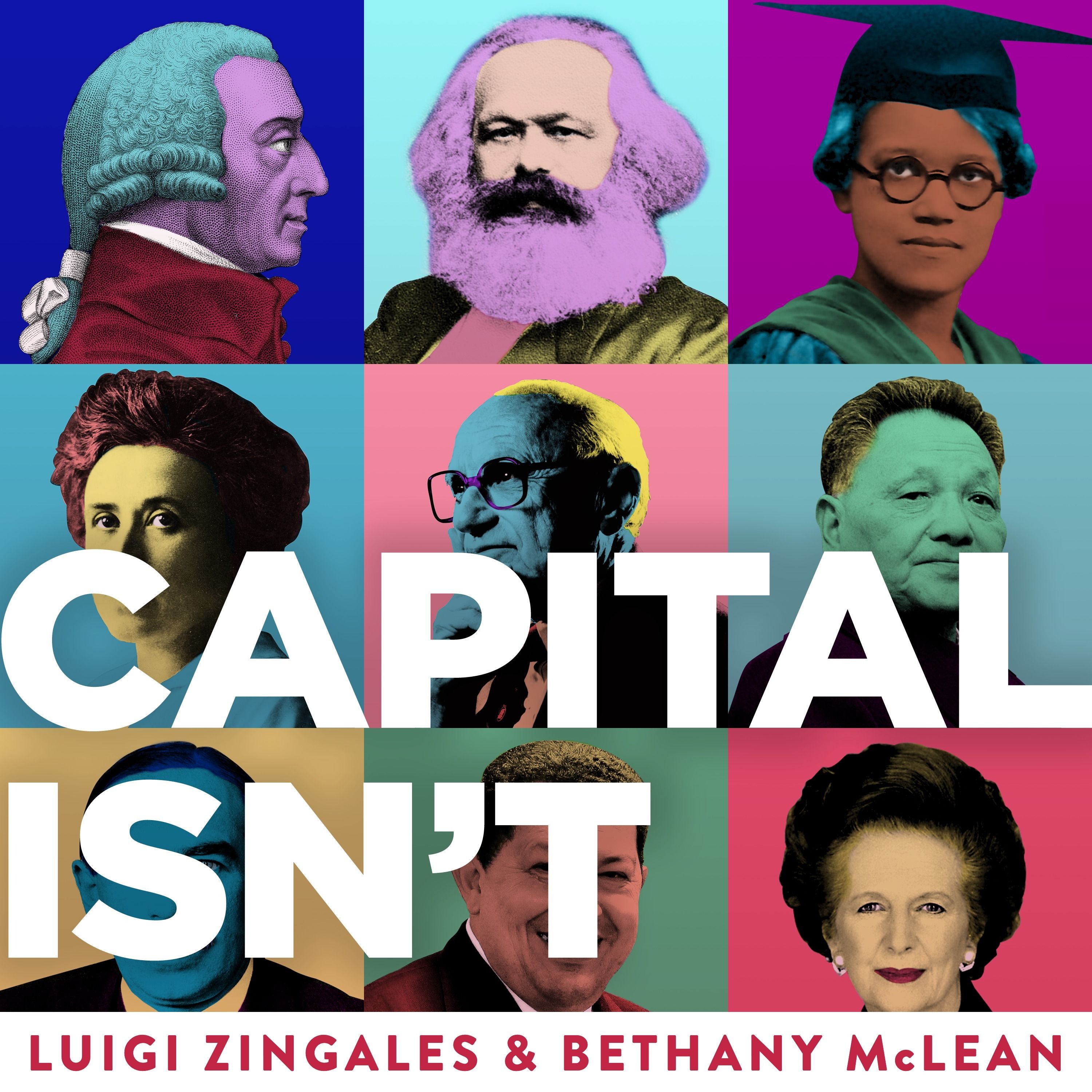
Capitalisn't
Hosted by University of Chicago Podcast Network · EN
We investigate how capitalism is—or more often isn’t—working in our world today.
Hosted by economist Luigi Zingales and business journalist Bethany McLean, our podcast explains why capitalism can go wrong and what we can do to fix it.
Send us your questions or comments by emailing capitalisntpod@gmail.com
Cover photo attributions: https://www.chicagobooth.edu/research/stigler/about/capitalisnt.
24episodes
Episodes
Newest firstAll episodes
How To Fix The American Tax System - ft. Ray Madoff
Jan 600:54:46Tap to summarizeIs the American tax code a fair engine for growth, or a "second estate" where the rich choose whether or not to pay? We are often told that the top 1% of earners already pay 40% of all taxes, while nearly half of Americans pay nothing at all. Legal scholar Ray Madoff argues that this statistic is a deliberate "bait-and-switch" designed to confuse the public. The reality is that the truly rich often have little to no income to tax, living instead on borrowed gains and tax-free inheritances. In this episode, Madoff joins Luigi Zingales and Bethany McLean to discuss her new book "The Second Estate: How The Tax Code Made An American Aristocracy" covering how and why our current tax system allowed the ultra-wealthy to opt out altogether. She argues that to fix the system, we shouldn't just raise rates, we need to bring inheritances and investment gains directly into the income tax system and eliminate the "cover" provided by a broken estate tax. Subscribe to our Youtube Channel Follow Capitalisn’t on Instagram & TikTok Send us your questions or comments by emailing capitalisntpod@gmail.com Hosted by Simplecast, an AdsWizz company. See pcm.adswizz.com for information about our collection and use of personal data for advertising.
Transcribe →How Capitalism Became Global ft. Sven Beckert
Dec 1800:52:52Tap to summarizeIs capitalism a force of nature, or a human-made order that we have the power to shape? In this episode, Luigi and Bethany sit down with Sven Beckert, a Harvard historian and author of the new book A Global History of Capitalism, to tackle a question that seems basic but remains surprisingly difficult to answer: what exactly is capitalism?Beckert argues that capitalism is not defined simply by the existence of markets—which are found in all human societies—but rather by a specific economic logic of privately owned capital productively invested to produce more capital. He challenges the popular narrative that capitalism and the state are antithetical, suggesting instead that the state has been constitutive of capitalism throughout its history, from the colonization of the Americas to the industrial expansion of the 19th century.Beckert also argues that capitalism is fundamentally "undogmatic", pointing out that it has thrived under radically different political systems from the British Empire and the slave plantations of the Caribbean to modern liberal democracies and authoritarian city-states. Rather than existing in opposition to the state, does capitalism actually rely on state power to construct markets and enforce the expansion of its logic? Hosted by Simplecast, an AdsWizz company. See pcm.adswizz.com for information about our collection and use of personal data for advertising.
Transcribe →How to Stop “Ensh*ttification” Before It Kills the Internet - ft. Cory Doctorow
Dec 1100:56:10Tap to summarizeThere’s a word that’s gained a lot of popularity in the last year: “ensh*ttification”. It refers to a trajectory many see with digital platforms: they initially offer immense value to users, only to systematically degrade that quality over time in order to extract maximum surplus for shareholders. We invited the coiner of this term, science fiction author and activist Cory Doctorow, on the podcast to discuss whether he thinks this decline is an inevitable feature of digital markets or a consequence of specific policy failures. And, most importantly, how he thinks it could be reversed.For Doctorow, "ensh*ttification" is not simply a result of "revealed preferences", where users tolerate worse service because they value the platform, but rather the outcome of a regulatory environment that has permitted the creation of high switching costs and the elimination of competitors. Doctorow also argues that historically, interoperability acted as an engine of dynamism, allowing new entrants to lower the barriers to entry. But current IP frameworks, such as anti-circumvention laws, have been "weaponized" to prevent this, effectively allowing firms to enforce cartels and engage in rent-seeking behavior.Finally, Doctorow offers a critical assessment of the current AI boom, arguing that the sector is creating "reverse centaurs", where human labor is conscripted to correct algorithmic errors, and warns of a potential asset bubble driven by inflated revenue attribution. Hosted by Simplecast, an AdsWizz company. See pcm.adswizz.com for information about our collection and use of personal data for advertising.
Transcribe →How Lobbying Led to Crony Capitalism, with Brody Mullins
Oct 24, 2024Tap to summarizeAs the United States elections draw near, everyone is wondering who will take control of Washington next. In this week’s Capitalisn’t episode, Pulitzer Prize-winning reporter Brody Mullins reveals how the real winner will be neither Democrats nor Republicans. Rather, it will be the lobbyists.Mullins is the co-author (along with his brother Luke, also an investigative reporter) of The Wolves of K Street: The Secret History of How Big Money Took Over Big Government. Brody joins Bethany and Luigi to discuss how corporations ranging from Genentech to Google participate in the invisible but massively influential lobbying industry to bend government policy toward their favor. Together, the three trace the roots and evolution of political lobbying from the 1970s to now and explore how it penetrates and leverages other spheres of society to abet its operations. How are academia and the media complicit in this ecosystem of influence operations? How has lobbying adapted to the changing attitudes of Americans towards Big Business? How might it change under either a Harris or Trump administration and beyond?Episode Notes: Luigi mentions the transformational work of one figure in American politics who fought back against lobbyists’ substantial influence: consumer advocate Ralph Nader. Revisit our prior conversation and episode with Mr. Nader. Hosted by Simplecast, an AdsWizz company. See pcm.adswizz.com for information about our collection and use of personal data for advertising.
Transcribe →