
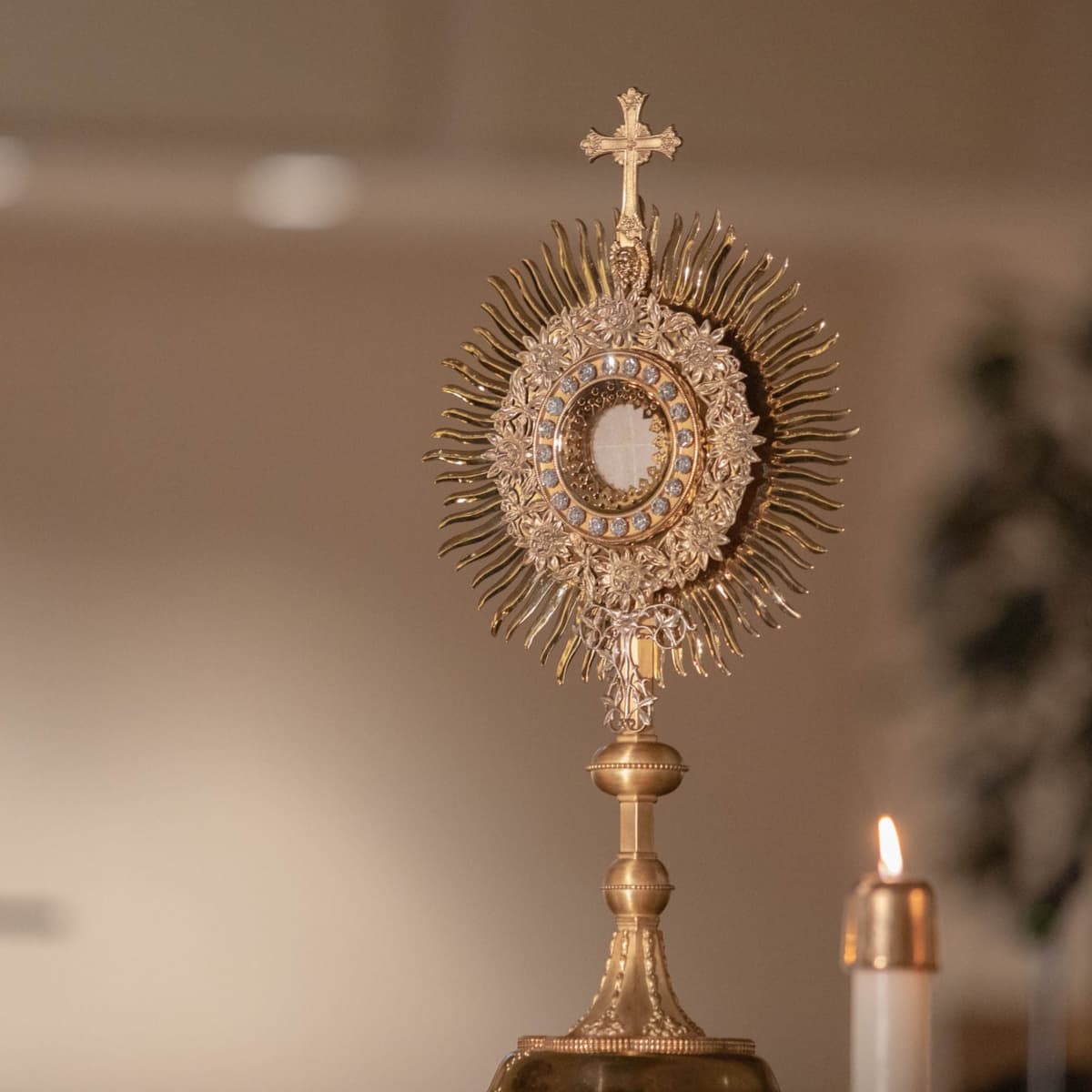

Catholic Answers Live #12480: Why Do We Believe in the Real Presence in the Eucharist?
Guest: Joe Heschmeyer
Host: Cy Kellett
Date: November 29, 2025
Overview
This episode features Catholic apologist Joe Heschmeyer responding to audience questions on the Catholic faith, centering primarily on the Real Presence in the Eucharist. The show also addresses theological topics on Mary, the Apostolic Fathers, baptism, indulgences, the priesthood, and ecclesial history—all in a spirited, friendly, and accessible style. Heschmeyer draws from Scripture, early Church writings, and personal scholarship to clarify Catholic doctrine and dispel common misconceptions.
Key Points & Discussion Highlights
1. The Role of Mary in Catholicism
Question: Why is Mary seen as more than just a saint in Catholicism?
- Speaker: Joe Heschmeyer
- Timestamps: [05:05] – [13:49]
- Main Ideas:
- Importance of distinguishing between Church teaching and individual practice.
- Recent Vatican clarifications emphasize Mary's unique role, without equating her to Christ or compromising His sole mediatorship.
- Scriptural Basis:
- Genesis 3:15: Protoevangelium prophesying a spiritual battle between the devil and the woman (ultimately Mary).
- Revelation 12: The woman crowned with twelve stars, giving birth to the Messiah and attacked by the dragon (Satan).
- The “woman to mother” motif, seen in both Genesis (Eve) and at the Cross (John 19:26-27), underscores Mary as spiritual mother to all believers.
- Notable Quote:
“From the beginning to the end of the Bible, we see there is a spiritual battle between the devil and the mother of Jesus.” —Joe Heschmeyer [11:52] - Summary: Mary's centrality is deeply rooted in Scripture; she’s both the mother of Jesus and the spiritual mother of all Christians, playing an integral, biblically-grounded role in salvation history.
2. The Apostolic Fathers and Apostolic Succession
Question: How do we know the Apostolic Fathers were taught by apostles?
- Speaker: Joe Heschmeyer
- Timestamps: [16:50] – [21:00]
- Main Ideas:
- Explains who the Apostolic Fathers are (Ignatius, Polycarp, Clement).
- Cites historical documents—like Irenaeus’ Against Heresies and the Martyrdom of Polycarp—that directly attest to these bishops’ relationships with the apostles.
- Polycarp’s connection to John and Irenaeus’ eyewitness account are viewed as robust historical evidence.
3. The Real Presence in the Eucharist
Question: Why do Catholics believe the Eucharist is the true body and blood of Jesus, not just a symbol?
- Speaker: Joe Heschmeyer
- Timestamps: [21:24] – [25:46]
- Main Ideas:
- Early Church figures like Ignatius of Antioch (disciple of John) took the Real Presence for granted:
They abstain from the Eucharist... because they confess not the Eucharist to be the flesh of our Savior Jesus Christ...” —Ignatius, as quoted by Heschmeyer [22:35]
- Scriptural basis: Parallels between the Old and New Covenant rites; Jesus’ explicit words at the Last Supper (“This is my body... this is my blood of the covenant”).
- Hebrews 9 and Exodus 24: Both covenants inaugurated through real blood—the New Covenant, through Christ’s actual blood in the Eucharist.
- Symbolism is insufficient; the fulfillment of the Old Covenant types requires a real, not just symbolic, offering.
- Early Church figures like Ignatius of Antioch (disciple of John) took the Real Presence for granted:
4. The Indelible Seal and Significance of Baptism
Question: Does the indelible seal of baptism have deeper significance than is often taught?
- Speaker: Joe Heschmeyer
- Timestamps: [29:34] – [36:02]
- Main Ideas:
- Baptism is transformative—cleansing sin, bestowing spiritual rebirth, imparting the Holy Spirit, and admitting believers into the Church.
- Scriptural roots: Ezekiel 36, Acts 22, John 3, Acts 2.
- Supported unanimously by early Christian writers.
- Quote:
“Baptism is something we receive more than something that we do. We allow ourselves to be transformed in a way that we cannot possibly do ourselves.” —Joe Heschmeyer [35:45] - Scholarly support referenced: Everett Ferguson’s Baptism in the Early Church (p. 854).
5. Wisdom as Feminine and Jesus as Divine Wisdom
Question: How do we reconcile Wisdom being referenced as feminine in the Old Testament with Jesus being called the “Wisdom of God”?
- Speaker: Joe Heschmeyer
- Timestamps: [37:16] – [38:12]
- Main Ideas:
- Old Testament “wisdom” is often personified as feminine due to grammar (“wisdom” is a feminine word in Hebrew and Greek).
- This is literary personification, not an incarnation; Jesus fully embodies divine wisdom, but the figure in Wisdom literature is not a separate divine female being.
6. Partial vs. Plenary Indulgences
Question: What’s the difference between plenary and partial indulgences?
- Speaker: Joe Heschmeyer
- Timestamps: [40:18] – [45:08]
- Main Ideas:
- Plenary: Complete removal of the temporal punishment due to sin.
- Partial: Partially removes temporal punishment.
- Scriptural precedents for praying for purification of others (Job 1:5; 1 John 5:16; 2 Maccabees 12).
- The theology of indulgences rests on the Christian responsibility to aid in the purification of others, including the dead.
7. The Priesthood in Catholicism vs. Protestant Views
Question: What is the Catholic response to “we don’t need priests because Jesus is our only priest”?
- Speaker: Joe Heschmeyer
- Timestamps: [45:59] – [51:07]
- Main Ideas:
- Scripture distinguishes between the “priesthood of all believers” (1 Peter 2, Exodus 19) and the ministerial priesthood (Isaiah 66:21).
- Not all sacrifices can be offered by every believer; some are reserved for ordained priests.
- The unique sacrifice of the New Covenant is the Eucharist, which only priests consecrate.
- Early Christians and St. Paul made clear analogies between Old Testament sacrifices and the Eucharist’s sacrificial nature (1 Corinthians 10).
8. Historical Removal of Anti-popes and Popes
Question: How were anti-popes and valid popes removed from office?
- Speaker: Joe Heschmeyer
- Timestamps: [51:28] – [54:18]
- Main Ideas:
- Historical context: The Papal Schism, multiple simultaneous papal claimants.
- True ecumenical councils (e.g., Council of Constance) can depose anti-popes, but not a valid reigning pope.
- Only a valid, properly convoked council—typically with papal cooperation—can resolve such crises.
Notable Quotes & Memorable Moments
-
On Mary in Salvation History:
“The devil hates Mary. Mary has some kind of important role to play in this whole story.” —Joe Heschmeyer [07:58] -
On the Eucharist and the Early Church:
“Both Ignatius and his readers take for granted that the Eucharist is in fact the flesh of our Savior Jesus Christ.” —Joe Heschmeyer [22:23] -
On Baptism’s Transformative Power:
“Baptism isn’t just this nice thing we do to show how much we believe in God. Baptism is this transformative spiritual event that God does for us.” —Joe Heschmeyer [35:13] -
Lighthearted Banter:
Host Cy Kellett’s playful interruptions and Heschmeyer’s good-natured responses highlight the energetic, accessible tone:- “Plenary is complete. Partial is partial. Come on, Brittany, that was in the—I'm just kidding... I assume more than that.” —Joe Heschmeyer [40:18]
Timestamps for Major Segments
| Segment | Topic | Timestamp | |---------|--------------------------------------------------|-------------| | 1 | Mary’s role and scriptural background | 05:05–13:49 | | 2 | Apostolic Fathers’ connection to apostles | 16:50–21:00 | | 3 | The Real Presence in the Eucharist explained | 21:24–25:46 | | 4 | Baptism’s significance and the indelible seal | 29:34–36:02 | | 5 | Wisdom as feminine and Jesus as Wisdom | 37:16–38:12 | | 6 | Partial vs. plenary indulgences | 40:18–45:08 | | 7 | The necessity of the Catholic priesthood | 45:59–51:07 | | 8 | Handling of anti-popes and valid popes | 51:28–54:18 |
Concluding Thoughts
Throughout the episode, Joe Heschmeyer offers robust, scripturally based answers with warmth and clarity, addressing misconceptions from both within and outside the Church. The Real Presence in the Eucharist is shown to be integral to the fabric of Catholic faith and practice—anchored in tradition, early Church authority, and the Bible. The episode balances deep theological exploration with a light, approachable style, making complex topics accessible to listeners of all backgrounds.