← Celebrity Jobber Podcast with Jeff Zito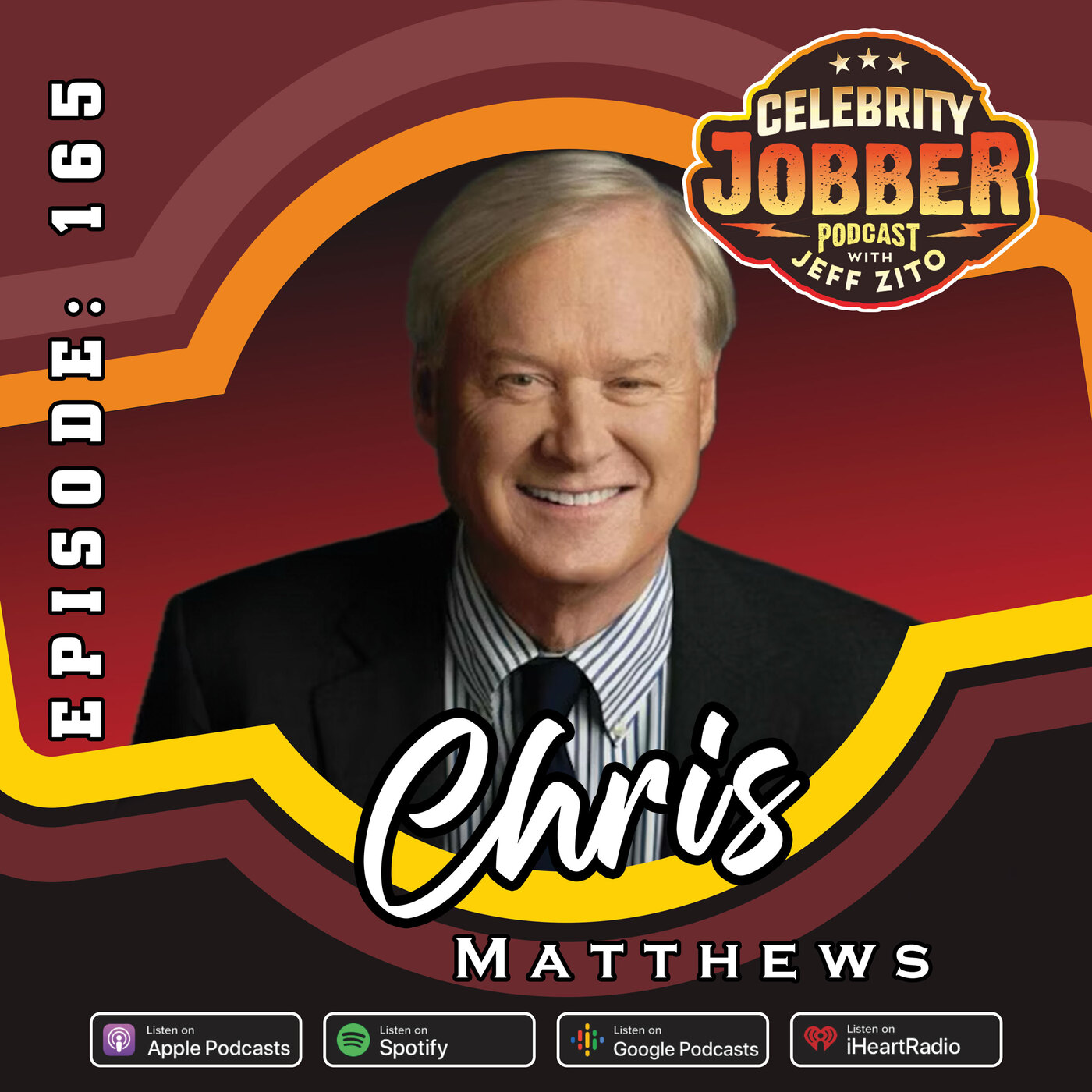
Loading summary
Transcript40 lines
- [00:00]
Jeff Zito
Foreign. Thanks for listening to another episode of the Celebrity Jobber podcast streaming on Apple Podcasts, Spotify, iHeart, wherever you listen to podcast. So please subscribe. Would love a five star rating and if you could please leave a review. If you want to check out past guests and episodes, you can do so by going to celebrityjobber.com and you can also follow on Instagram celebrityjobber, jobberpodcast or our YouTube channel which is YouTube.com theat signce celebrityjobber. What did these people do before they were famous? My guest today had a lot of jobs we're gonna discuss. He's widely respected for his in depth knowledge of politics. He's now retired. He was a nightly host, news anchor and political commentator on MSNBC. A Washington D.C. bureau chief for the newspaper the San Francisco Examiner. He was a chief of staff to longtime speaker of the House of Representatives, Tip o', Neill, a Carter era presidential speechwriter and penned a number of best selling books including his Latest lessons from 10 Reasons why Robert F. Kennedy Still Matters. Former host of MSNBC's Hardball with Chris Matthews. Here he is, Chris Matthews, my guest this week on Celebrity Jobber, the Celebrity.
- [01:33]
Podcast Announcer
Jobber Podcast with Jeff Zito. If you like what you hear, please subscribe, give a five star rating and leave a review. Check out all our past episodes on Apple Podcasts, Spotify or wherever you pod. What if these celebrities weren't famous? What would they have become? What was their first job? We're about to find out.
- [01:54]
Jeff Zito
Hey Chris, how are you?
- [01:56]
Chris Matthews
Good. Jeff. Jeff in Detroit. Detroit.
- [01:58]
Jeff Zito
That's right, man. Originally from New Jersey. Not too far from your old stomping grounds, Right?
- [02:04]
Chris Matthews
Well, Philly.
- [02:05]
Jeff Zito
Yeah. When's the last time you've been back to Philly?
- [02:08]
Chris Matthews
I'm going tomorrow. Tomorrow is Wednesday and I'm going to speak at the Philadelphia Free Library.
- [02:14]
Jeff Zito
That's a big. Okay.
- [02:15]
Chris Matthews
They have a big, A big show there. I always have a feeling when I'm in Philly, it's someplace. It's a real city like Detroit. I mean, it's. Washington isn't quite a city like that. Yeah.
- [02:29]
Jeff Zito
Why is that?
- [02:29]
Chris Matthews
Washington is a training place. It's a, it's a national government headquarters.
- [02:38]
Jeff Zito
Right.
- [02:38]
Chris Matthews
It doesn't have the ethnic diversity of a big city.
- [02:42]
Jeff Zito
When you got to Washington, I understand one of your very first jobs was as a Capitol policeman. Is that true?
- [02:51]
Chris Matthews
It's quite a job. I was, I worked with those guys. I love them. I like them because they're all working guys. They existed at a level a little bit below the congressmen and senators who sometimes looked down on them. But they were good guys. A lot of them were former MPs, former military guys, tough guys. They weren't tough. A lot of them. And one of them explained to me why the working guy cares about his country. He said, you know, he called me aside one day because I was the college kid. He knew I was a patriot appointment. And he said, why do you think the little man loves his country? And I paused and I said, I don't know. He said, it's because it's always God.
- [03:35]
Jeff Zito
That's a good. That's pretty cool.
- [03:37]
Chris Matthews
I thought that that was the story of the working guy and working woman in this country. And you better not mess with that.
- [03:44]
Jeff Zito
Sentiment if you're a Democrat and you got into politics. I mean, did you study politics in college? I know you studied economics in college. What, what was your thought when you were going to school, what you were going to do?
- [03:56]
Chris Matthews
You know? You know what I loved? I thought I loved economics. I didn't. I didn't love economics. I loved economic philosophy. I loved John Stuart Mill and Adam Smith, and I love the philosophy of the worldly philosophers, the guys who wrote about economics but were really writing about philosophy. I think the argument of left versus right is a good argument, you know, and do you want big government? Do you want smaller government? Do you want. Do you want more independence of. For the individual? Yeah, that's what I want at the grad school. And I realized, my God, I don't like economics. It's all economic, it's all math. It's driving me crazy. It's mathematics. And I. I was never that good at it, even though I got great grades in the graduate records at a 99. I don't know, I was very good at reading charts.
- [04:42]
Jeff Zito
Somehow it doesn't sound fun, though.
- [04:45]
Chris Matthews
Does. Was the guy Professor Org? He had gotten his PhD at Penn. He would just go in the Everyday. He'd come in and just put econometric model models, economic models on the wall. And I go, what is this about? I can't understand a thing you put on that back backboard. But he gave me an A.
- [05:09]
Podcast Announcer
So the Celebrity Jobber podcast with Jeff Zito. Celebrity jobber.
- [05:14]
Jeff Zito
What about mom and dad, Chris? What did they do for work? What kind of jobs did they hold?
- [05:18]
Chris Matthews
My dad was the guy that writes down in court what happens. He's the guy that writes down the dictation and delivers the. He was a senior court reporter in Philadelphia. He's the guy that writes the record of the trial. That was a very tough job. I mean some of these people in trial were screaming at each other a lot of ethnic attitudes about descriptions of life. And he would, he would write it down in English, you know, it's pretty strong stuff.
- [05:51]
Jeff Zito
Did he, did he influence you at all as far as what direction you wanted to get into in life?
- [05:58]
Chris Matthews
I think hard work, Jeff, hard work. I mean he worked. He'd come home from court and then he'd dictate all night and into the dictation machine and then he would type it. Her mom would type was. It was real brutal work, but it was, the pay was great. I mean that's what he liked, the salary. He had studied as an engineer, but he could make more money doing court reporting.
- [06:26]
Jeff Zito
So Chris, I mean obviously JFK has impacted your life and, and I'm not sure I didn't understand why back in the 60s it was important if you were Catholic, Irish or, you know, I didn't understand why it was such a big deal. So can you tell me a little bit about what got you so interested in jfk, the impact that he left on you and, and tell me about being Irish Catholic yourself and why, why that was a big deal when he became the president.
- [07:00]
Chris Matthews
Well, it hadn't happened before and it wasn't really in the, in the cards necessarily. Nixon, for example, a smart guy, thought that he was going to lose the nomination. He was not going to get was only when he won it in West Virginia and how knows how he did it in West Virginia? Not necessarily a clean thing. I mean there's a lot of money passed around and a lot of county chairmen involved in that. But he did win and, and once he won that, he knew he had the nomination, which means it was a one on one with Nixon. It was a very brutal campaign. I think that, I think that was it. I think my mom, very Irish Catholic, would be burning in the basement and just loving this experience, you know. But we go back, you're right about the ethnic thing. My mom would watch the McCarthy hearings back in the 1954 television. She's rooting for McCarthy, for the army, shouldn't root for the army shooting for McCarthy. So I think the ethnic piece of is real. Although I think the other ethnic groups, Polish Americans, Italian Americans, a lot of the other Catholic groups are, were stronger for Kennedy than the Irish were because the Irish had moved up to the middle class, into the middle class in many cases. So they were a little more esteemed.
- [08:25]
Podcast Announcer
The celebrity Jobber podcast with Jeff Szdo the Celebrity Jobber podcast with Jeff Szdo.
- [08:31]
Jeff Zito
You see a difference, Chris, between the way JFK Democrats were and the way the Democrats are today? I want to say it, I don't want. I don't know if it's flip flopped, but to me it almost seems like a lot of the working men and women out there have made of might have flipped and gone to the other side. Why is that?
- [08:57]
Chris Matthews
There's no doubt about it. I think the old. Well, it goes way back to divide between town and gown. Town of the town is the people live in the town around the colleges and the gown of the ones who go, the elite people that show up to go to college. There's. This is. Jack Kennedy once said when he was writing his memoirs as president, he was actually trying to write his memoirs. He talked about being from Harvard and he said the only time I lived in that district, the first district he was elected in, was when he went to Harvard. He said that wasn't a particularly popular thing to say. You went to Harvard, you were not popular in the district, you were not one of the people. And I think that's very real and I hate it because it's merged into our politics where the town people are Trumpies and the elite college kids coming into an elite world of university life are Democrats. That's not the way it should be. When Bobby was dead, his body was carried from New York City where he was at the mass celebrated at St. Patrick's Cathedral. And that train as it moved down to Washington Arlington Cemetery where he was buried next to his brother. That was a real statement of breaking that bond. I mean, people along the tracks were black people in Philadelphia, white working class people along the train route. It was really quite a multiracial display of devotion. Really remarkable. If you look at them. You can look at them today. YouTube.
- [10:35]
Jeff Zito
The the book is about RFK lessons from Bobby. Tell me about RFK's impact on you and tell me some of the lessons that you've learned from him in your new book.
- [10:48]
Chris Matthews
Well, there's so many. I mean, I've got 10. One of them is. He called it hanging a lantern on your problem. People make mistakes in public life. They do. Bobby said I never lost a lot of sleep over civil rights until he got the job of attorney general. And he lost a lot of slip over when he was attorney general. That's what he was focused on. He was on the side of the Cold War and fighting in Vietnam or fighting the Russians in the Cuban Missile Crisis. He changed his mind a number of times and admitted it and quite openly said, I've changed my mind. I think that's politicians, that's one thing they do. Also he accepted, accepted the fact that he lost primaries, he lost the Oregon primary and admitted it. And Pat Buchanan was there in the crowd and said that this was an extraordinary performance. To acknowledge your defeat. I think Donald Trump should have acknowledged his defeat in 2020 instead of storming the Capitol building. I think it's a very important thing to admit your mistakes and to admit when you lose. And that's one of the real messages.
- [11:59]
Podcast Announcer
Of Bobby Celebrity Jobber the Celebrity Jobber podcast with Jeff Szetto.
- [12:04]
Jeff Zito
Tell me Chris, what was your very first job, first paying job of all time?
- [12:12]
Chris Matthews
Paper boy, Philadelphia Bolton. Big afternoon newspaper, fat newspaper on Tuesday because Wednesday was shopping and that was the big fat paper and I had to get two baskets of newspapers. I had a big paper route, a tough paper route, but that was my first route and that was along the borderline between Bucks county and Philadelphia. I worked on that. I made five bucks a week. I didn't make a lot of money. I made five bucks a week. And that was a one tortuous effort on my bike. And then I worked at a drugstore. I worked as a stock boy in a drugstore. And then I in college I ran the, the news, the birthday cake concession. So when you had your birthday, about three weeks before your birthday, your parents would get a letter from me saying do you want a birthday cake for your son? And I would get them a birthday cake. Some of the parents took the thing too seriously. They said well you invite the coach from, from the basketball team. And I said I'm not having, I'm not a caterer. I was, I'm just getting your birthday cake. And that was a good job. And then it was a college RA resident assistant. It's a great job with a Carter kids to keep keep keep quiet.
- [13:34]
Jeff Zito
Like Lessons from Bobby, the new book from best selling author Chris Matthews. Real pleasure. Chris, thanks so much for talking to me today.
- [13:43]
Chris Matthews
Thanks so much. Thank you.
- [13:44]
Jeff Zito
Take care. Chris graduated from Holy Cross in Worcester, Massachusetts back in 1967. He did graduate work in economics at the University of North Carolina at Chapel Hill. Was also a visiting fellow at Harvard University's Institute of Politics. Served in the United States Peace Corps in Switzerland from 68 to 70 as a trade development advisor and holds 34 honor honorary degrees from numerous universities and colleges like Drexel, Quinnipiac, Fordham Temple, Ohio State, La Salle and a lot more. Man, if I could Just get one honorary degree. I would be more than content with that. His old man, Herb Matthews, was a court reporter. And I asked if his father had any influence over, you know, what direction Chris wanted to go into life. He, he mentioned that his father was just a really hard worker and that that influenced him. He said his dad studied engineering but apparently made a good living, made a good salary being a court reporter. Chris talked about when he first arrived to Washington D.C. he was an officer with the United States Capitol Police and had a lot of respect for those people. He also talked about his first job being a paper root, was a paper boy. It's like a lot of our first jobs, you know. You know, being a paperboy was also my very first job when I was probably 10, 11 years old. So he delivered papers for a number of years until he said he was a stock boy at a drugstore. And then when he got into college, he did something with, worked at the birthday cake concession. He would send a letter to all the students, parents like three months before their birthday and ask if they wanted to buy a birthday cake. Thought that was pretty cool. He said he liked that job. And he also was the RA at his school, the resident assistant or the resident aide, you know, in charge. It was a student hired to kind of police the dorms, makes make sure no girls were in guys rooms or vice versa. Nobody sneaking beer, smoking anything in their dorm room. And the author of a number of best selling books including his latest lessons from Bobby 10 Reasons why Robert F. Kennedy Still Matters. Chris Matthews, former host of MSNBC's Hardball with Chris Matthews. My guest this week on Celebrity Jobber. Thank you so much for checking out another episode. Like I said, streaming everywhere, whether it's Apple Podcast, Spotify, iHeart, wherever you listen to podcasts and I ask you to please subscribe. Subscribe. Very important. Also if you could give a five star rating, if you happen to like the podcast, leave a review. Also very helpful. And you can discover past guests and episodes online@celebrityjobber.com who knows what Chris Matthews would have turned into. It looked like he was going into an economics direction. Of course when he got to grad school he figured out economics for was all about math. I could have told you that. So have a great Thanksgiving everyone and I'll be back on Black Friday with another episode of the Celebrity Jobber podcast. So until then, have a great Thanksgiving. Once again, I'm Jeff Zito.