← Celebrity Jobber Podcast with Jeff Zito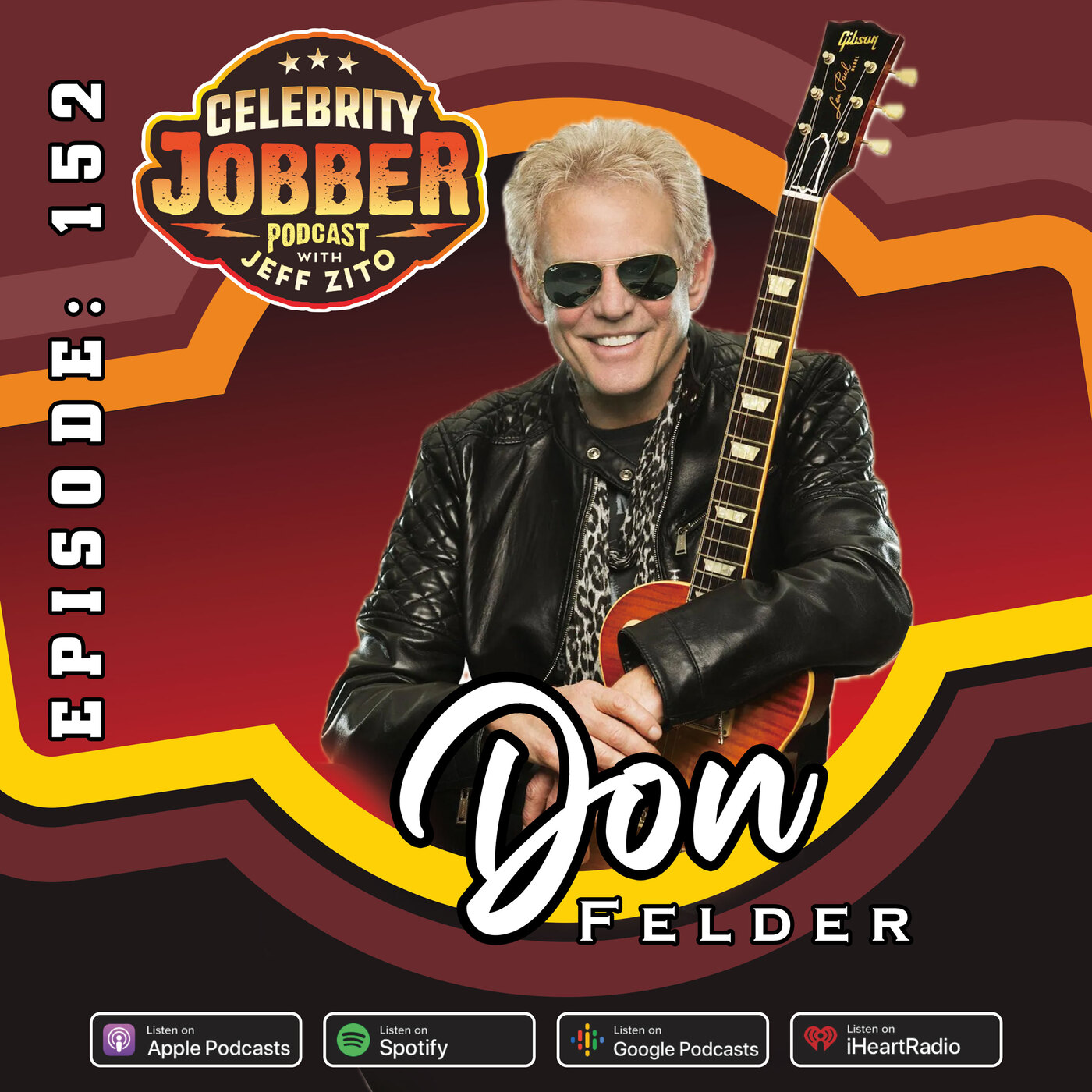
Celebrity Jobber Podcast with Jeff Zito
Celebrity Jobber with Jeff Zito - Don Felder formerly of the Eagles
00:32:26
Loading summary
Transcript70 lines
- [00:00]
Narrator/Intro Voice
Foreign.
- [00:04]
Jeff Zito
Thank you for checking out another episode of the Celebrity Jobber Podcast. I'm Jeff Zito and before these people were famous, what did they do? We talk about their first job and a little bit about how they grew up with their family. What kind of jobs did they have? You can follow on Instagram Celebrity Underscore jobber podcast or YouTube.com the@signce celebrity jobber past guests and episodes online celebrityjobber.com and streaming everywhere. Apple Podcasts, Spotify, Iheart, Wherever you listen to podcasts, please subscribe. Would love a five star rating and please leave a review. By the way, once again the number one podcast on the Apple Podcast music interviews chart. Thank you so much for your continued support. My next guest is an absolute legend in rock and roll. The number one selling album of all time, the Eagles Greatest hits. Don Felder, a member of the Eagles in their heyday and actually left the band in 2001, after which he filed lawsuits against his former bandmates alleging wrongful termination, breach of implied in fact contract and breach of fiduciary duty. He's published an autobiography detailing his tenure with the Eagles, Heaven and Hell My Life in the Eagles 1974-2001. And there's a great documentary, it's a two part documentary, it's about the Eagles and there's a pretty good part that shows you when they kicked Don Felder out of the band. So we're going to ask Don about that. We'll see if there's any chance of a reconciliation. We'll talk about his new album, some of the stuff that he's doing now with the St. Jude's Children's Hospital, which is really cool and growing up in Gain Gainesville, Florida. We'll talk about Don's first job, which I gotta tell you is a pretty great story. I'm not gonna give anything away, but there is definitely one thing you're going to hear and that would be his passion and love for music, period. Rock and Roll hall of Famer Don Felder, formerly of the Eagles, is my guest this week on Celebrity Jobber, the.
- [02:29]
Narrator/Intro Voice
Celebrity Jobber Podcast with Jeff Zito. If you like what you hear, subscribe, give a five star rating and leave a review. Check out all our past episodes on Apple Podcasts, Spotify or wherever you pod. What if these celebrities weren't famous? What would they have become? What was their first job? We're about to find out.
- [02:49]
Jeff Zito
Don, you. You got a new album? Reading the the title of the album is the vault 50 years of music. So is this vault are these songs that are 50 years old. Some of them are they stuff that just haven't made it out of the vault brand new. Tell me a little bit about it.
- [03:08]
Don Felder
Yeah, most of them were just basic music tracks. I was told by Bernie L. When I first joined the Eagles, if you want to write songs for the Eagles, don't write melody and don't write lyrics. Just write music beds in a. In a song format like intro, verse 1, verse 2, chorus, verse 3, chorus, solo, chorus, chorus out. And so I would write these music beds ideas with no lyrics, no vocals, no melody, no nothing. And, you know, I would put them on a cassette and I'd give them to Don and give them to Glenn when we were working on a record. And if they liked a couple of them, one became Hotel California, one became Victim of Love, another one became those Shoes, you know. So if they like those music beds, then they would write lyrics on top of it. So what I had was hundreds of basic song structure demos with no lyrics and no vocals. I went back and heard some of those, and I said, hell, I'll write the lyrics. I'll sing these things and finish them myself. And it turned out that it was so much fun to do that. And I like the way they turned out. I was able to write the songs and the lyrics myself. If I'd have had that freedom of the Eagles, they would have been on Eagles records. But I didn't really. The songwriting was really controlled by Don, and when.
- [04:32]
Jeff Zito
So don, the vault. 50 years of music. Can you take me back to the beginning? Can you take me back to, you know, 50 years ago or maybe even a little before that, you know, in Gainesville? Can you tell me what your very first job was? I mean, forget music. Was your very first job within music, or did you have another first gig?
- [04:54]
Don Felder
Well, I would say other than mowing lawns and washing cars as a kid, when they finally opened a music store in Gainesville, I went in and got hired after school to demonstrate guitars, help sell guitars, give guitar lessons there in their music store. And I think I got paid $10 an hour. I didn't get cash. I just got it put on credit so I could take and build up a credit and get some strings and build up credit, trade my amp for a better amp. And so it was the only way, my family, as poor as we were, I could get anything new or improved in the way of moving from a Sears guitar to a Stratocaster or a Les Paul or something, was to work for it. So that was my first gig was working in that music store.
- [05:44]
Jeff Zito
I'd say it's a 10 bucks an hour in those days. That's. That sounds like a lot of money. Is that. Is that music store also where you met Tom Petty and Duane Allman? Can you talk a little bit about those guys?
- [05:56]
Don Felder
That's correct. That that music store was called Lipham's Music and it was the most generous.
- [06:02]
They. He would give you credit if you.
- [06:04]
Needed a guitar or an amp. Even if you didn't have a credit card. As long as you came in and you paid him something every week or every couple of weeks to pay off what you had done. He would extend your credit.
- [06:17]
He.
- [06:18]
He funded the Allman Brothers band. He funded my band. He funded any and everybody in town to get musical instruments in the hand the musicians. And God bless us all for doing that or none of us would have been able to afford good instruments.
- [06:33]
Jeff Zito
I read about maybe you gave Tom Petty music lessons at that store when he was a young guy.
- [06:39]
Don Felder
Well, I didn't teach him at the store. I went over to his house and I showed him how to play some piano chords. He was playing bass in this band and he really wanted to be able to write songs. And it's hard to write songs playing bass. So I taught him some guitar chords. So pretty simple stuff and some piano chords in his house and helped him organize and arrange some of his band. He had two guys in the band that just plugged in, turned up as well as they could. Crashed on these guitars. Just annoying and stepping all over Tom's vocals. And so I kind of helped arrange some of their early band live arrangement. But yeah, that's where I met Betty was in that music store and I met Dwayne and Greg in Daytona Beach. Dwayne taught me how to play slides and it was just an interesting area down there between Gainesville High School had problem Petty, myself, Bernie Ledden and Stephen Stills all going to GHS at the same time.
- [07:43]
Wow. That's.
- [07:44]
We all knew each other and Stephen and I had a band when we were 14 and I taught Petty guitar. Bernie Leddon taught me bluegrass music and he didn't even have an electric guitar when he showed up in town. I took him down to my music store and got him an electric guitar on credit and we started a rock band. So he. He filled in for Stephen. When Stephen moved back to California, Bernie Layton took his place.
- [08:08]
Narrator/Intro Voice
The Celebrity Jobber Podcast with Jeff Zito.
- [08:12]
Jeff Zito
Celebrity Jobber I I heard that back when you were a child, you. You spent some time yourself in a children's hospital. Can you tell me a little bit about that?
- [08:21]
Don Felder
Yeah.
- [08:22]
I complained to my mom when I was about four and a half, five that I was just really tired. You know, most children at 5 years old, you can't slow them down. So they took me to the doctor and I was diagnosed with potentially having some pretty serious complications. They put me in a children's hospital ward, and There were about 12 beds in this big room. And in comes this kid who's just been put in an iron lung right next to my bed. And I was just terrified that that was going to be something that I may have to face in polio. When they told me that I may have polio, kids would come in with toxillectomies and they'd be laying there on a bloody pillow with blood coming out of their mouth. And I was just horrified for the two and a half months that I was there confronting all the reality of children in hospitals.
- [09:19]
Wow.
- [09:20]
So I decided with my girlfriend to put together this sweepstakes. It's called the Dawnfielder Rock and roll retreat sweepstakes. 100% of all donations go directly to St. Jude's Children's Research Hospital. They have done amazing work. They have raised the lymphoma rate of survival from when they started. In 1960, the survival rate was 4% of kids that came into that hospital with lymphoma. Today, it's over 96% survival.
- [09:54]
Jeff Zito
Unbelievable.
- [09:54]
Don Felder
Some amazing work saving kids. But when the overall cancer rate started at 20% survival, it's now up to over 80%. But they still have work to do to fix that last 20% and that last 4% for lymphoma so that every child that comes in there with cancer or lymphoma can survive.
- [10:16]
Jeff Zito
Don, you've got a sweepstakes where you're. You're actually trying to get somebody. You know, if you enter the sweepstakes, you'll give somebody a guitar lesson. Can you, can you tell me a little bit about the sweepstakes and how to get involved?
- [10:29]
Don Felder
This package is incredible. You're going to win round trip airfare for two people anywhere in the United States to Nashville, Tennessee. You're going to stay three nights in Nashville, Tennessee, at the biggest suite I think I've ever stayed in called the Broadway Suite at the Westin Hotel in Nashville. Fantastic hotel. You're going to win a white double neck guitar, 1275, just like I play every night on Hotel California. You're going to go on a tour at The Gibson garage with me, including going down into their legendary vault where they have stored all these historic Gibson guitars. The very first Les Paul that Les Paul developed, the very first acoustic guitar that they published, the very first explorer rock and roll guitar, Firebird. The very first original guitars that came out of that. The next day we're going to go back to the Gibson garage and I'm going to be speaking there and doing a public performance. You're going to be my special guest. I'm probably going to do a Q and A there. As well as playing maybe four or five songs to the crowd. You're going to get a one on one guitar lesson with me at the Gibson garage.
- [11:45]
Jeff Zito
Wow, that sounds incredible. How do you register to get in on the sweepstakes?
- [11:50]
Don Felder
You go to donfelder.com forward/contest or donfelder cup.com and look for the contest and click on it and it'll take you to the place where you can make donations right there.
- [12:02]
It'll give you all the rules, all.
- [12:03]
The list of everything that's in the prize package, and for every $50 that you donate, you'll win one entry ticket into the sweepstakes drawing. So the more you donate to save children's lives, the more chance you have of winning this thing@donfeller.com contest, such a great charity.
- [12:23]
Jeff Zito
I commend you for your involvement with St. Jude's Children's Hospital. What if music wasn't going to work out for you? What did your father do for work? What did your parents do for work when you were grown up in Gainesville?
- [12:39]
Don Felder
My mother and father barely finished the.
- [12:42]
Third grade before they had to go to work.
- [12:44]
They were the oldest of four children in both families. And their mother, one of them died and the other mother ran off and left four kids.
- [12:54]
So my mother was the oldest of four kids and they're her family. So they both went to work at the age of 10 years old. My father went to work in a factory where there was no child labor laws that was making telephone poles and the creosote and the OSHA didn't exist in, in those days. But he was 10 years old working in a plant that made telephone poles and would come home just exactly covered head to toe and black coveralls. And, you know, just he knew everything about that plant because he started there so young that when he finally retired at 65, before he retired, they had him come to the factory and describe underground where every pipe and every cable and for every steam line and everything that was buried because he was the only one that was there while it was being built and installed and improved on. And my mother worked in a dry cleaners cleaning people's clothes. So very humble. Both of them left, I think, their education in the third or fourth grade and had to go to work. And so I could understand how they did not want me to not get an education and not be able to work at a level unlike what they had to go through. I understand that. But the joy I got out of what I was doing and making. By the time I was 15, 16, I was making more money playing music at fraternity parties and bars than my dad was.
- [14:26]
Jeff Zito
Wow.
- [14:26]
Don Felder
So I bought my own car. And, you know, I thought, well, you know, if this is as bad as it gets, this is okay, right? That's right. You know, and it's not working in a plant or a factory or, you know. He was a brilliant mechanic. He taught me a lot about the automobile. He would fix on repair everything on the automobile that we had. I think if anything was wrong with it, he wouldn't take it to a garage. He would figure out what it was and go buy a part and fix it and put it back together, and off we go. So he developed a great deal of respect for me for his mechanical skill. He also taught me how to solder, because after I got my first electric guitar, I would step on the cord and break the wire that went into the guitar, and he would have to repair it. So probably after about the third or fourth time, he said, if you're going to keep breaking this cable, you're going to have to learn how to fix it. So he taught me how to solder, and I wound up buying a heath kit stereo. That was a kit with all the parts that you had to solder together to build so that I could have.
- [15:32]
Jeff Zito
Wow.
- [15:32]
Don Felder
Some way to play a record player and an amplifier. So he was a great help in teaching me how to. How to figure stuff out. And to this day, I appreciate his interest in teaching me how to look at something and understand how it works and how to fix it.
- [15:51]
A repair.
- [15:52]
Jeff Zito
That's cool.
- [15:52]
Narrator/Intro Voice
The celebrity job is Jobber podcast with Jeff Zito. The celebrity Jobber Podcast with Jeff Zito.
- [15:59]
Jeff Zito
Did mom or dad ever have a chat with you to say, don, look, I understand you've got dreams of being a musician, but what about a backup plan if it doesn't work out? Anybody have that talk with you?
- [16:11]
Don Felder
Yeah, my brother and my mother and father really wanted me to be more like the path that he was on because you know, he was a straight A student, got a scholarship to the University of Florida, academic scholarship, got a academic scholarship to the law school at University of Florida, graduated, went right into a law firm and you know, he.
- [16:32]
Was pretty much set for the rest of his life.
- [16:34]
And I was playing bars and playing places like Dub Steer Room and Gatorland and fraternity parties and I was a C student, maybe C plus student at the most. But my mine and focus wasn't on academics so much as it was on music. I just had music in my brain non stop. And my future happiness really came down to the love of playing music. And I didn't care if I was going to play in bars for the rest of my life or, you know, got to the point where, you know, back when I was growing up, there were no Rock and Roll hall of Fames, there were no Grammys, there were, were no platinum awards, there was none of that. It was just, I did it because I love playing music and nobody was going to talk me out of how happy it made me and how much joy I got out of playing music. So, you know, the consequences when you're really poor to begin with, the consequences of just continuing to be poor, but doing what you like, that makes you happy is really important. You know, that's, that looks better to me than, you know, just getting a regular job working in a gas station or doing something to just, you know, eat and stay alive. I needed to have love and enjoyment in my life from what I was doing and that's what propelled me all.
- [17:52]
The way to today.
- [17:54]
Jeff Zito
Don, is there, do you remember a moment when you were younger, maybe you just met up with, with the, with the guys and you started playing with the Eagles. Was there a moment that changed your life forever? Whether it was a phone call to join the band, whether it was getting signed to a record label, hearing your song on the radio for the first time, was there a moment in your life where you said, wow, I think, I think I, I think my life just changed forever?
- [18:25]
Don Felder
No, because music is a very flux involved business to be involved with. A lot of artists come out, they have a hit record, they're a one hit wonder. They go through the roof selling records and touring and then five years later their history, you know, so I never really accepted the fact that I had.
- [18:49]
Quote, unquote made it.
- [18:51]
And despite all the record sales and accolades and awards and all that stuff, I still don't care about so much about that or the money as much as I care about the music that I'm Making and that just driving force of the loving music. And walking into a studio completely dark, turn it on, have no idea what I'm gonna write and record and create a new song or a track, or like this album where I went back in and took old ideas and rebuilt them, ground up. It's just such a joyous, happy, fun, exciting thing for me to do. It's not a matter of how much money I'm gonna make from that. That's not the goal. It's how much joy and fun and excitement I get from doing what I do. Walking out on stage. I played just a couple of nights ago in a small theater that was a fundraiser for that theater I played there, man, maybe there was 500 people. Still small, but great old theater. Raised a lot of money to keep the doors of that theater open. We had a wonderful time. The show was fantastic. People loved it. Raised a lot of money. Keep those doors of that place open now. Tonight I'm going to play in Cincinnati and There'll be probably 15, 18,000 people here. It's the same feeling for me to walk out, whether it's a little venue like that or it's a big venue like this, or I've played stadiums, over a hundred thousand people with Elton John when the Eagles played there with him and Wembley Stadium. It doesn't matter the size of the venue. It's a matter of how much energy and fun and enthusiasm I get every time I walk on stage and play live or walk in the studio and. And start writing and recording. It's just, I. I love this life, and I've had blessings along the way that have enabled me to be able to continue doing this. Not for the money, not for the fame, not for the awards, but just for the sheer love and joy of doing it.
- [20:56]
Jeff Zito
Is there a particular moment with the Eagles a time frame, an album, an era that you fondly look back on as pretty satisfying time of your life?
- [21:08]
Don Felder
I think the work that I did with the different combination of the Eagles when I first joined with Bernie, and then when Bernie left and Joe came.
- [21:17]
In, and then when Randy left and.
- [21:19]
Timothy came in, whatever the formation was, it was an incredible amount of talent in that group of people. The singing was just spectacular. The harmonies were very identifiable. The guitar parts that Joe and I and Bernie and Glenn wrote just were just great. The whole package of the combination of those people's individual talents is what produced that. It wasn't one person, it was the combination of the whole band. And it was an honor to have been part of that creative process and writing like the bass part for One of these Nights. I wrote the bass part and the whole arrangement for Hotel California was one of those non vocal demos and we copied it almost verbatim. So it was a very creative time and a lot of talent. That band, it was probably one of the only bands that I know of that everybody in the band could write, sing and play. And so there was an abundance of material, abundance of vocals, abundance of guitars. It was just wonderful time to be in. That's not one specific day or song or album. It was the whole time we were together.
- [22:39]
Narrator/Intro Voice
The Celebrity Jobber podcast with Jeff Zito. Celebrity Jobber.
- [22:44]
Jeff Zito
Well, I saw the, the two part documentary and I, I'll just tell you, Don, I, I hope that the future you, you know, I, I hope they. That you guys come together in the future. I saw that two part documentary. I'm just telling you I'm on Team Don and I'm not. I'm talking about Team Don Felder, just so you know. So I really do hope that in due time everybody could get back together. Would that be something you'd be interested in or, or no. Have you moved on?
- [23:14]
Don Felder
I'm not sure. I don't need the money. I don't even need the money to be playing this tour that I'm out with now or I do it because I love to play music and there's a joy and a thrill and a happiness that's involved. When you have the freedom to play the music you want to play and you like to play, there's not that freedom and that thrill in working inside the Eagles there. It's a different. It's just a different feeling. And so I'm not certain that I would participate in that. If it were there, I would consider it lunch and talk with Don and Irving, find out what plan is and we kind of go from there. I take it cautiously into consideration.
- [23:57]
Jeff Zito
Yeah. You know, from an outsider looking in, Don, I'll just say it seems like you're having fun, you love the music and it looks like the Eagles is a business. From an outsider looking in, that's what it looks like.
- [24:09]
Don Felder
Well, that's the truth. I'm having a great time doing what I'm doing and, and you know, like I said, I walk on stage or walk in the studio, not because I want the money, because I want the adulation. I don't want awards. I just love doing what I'm doing and that's why I do it. And it's doesn't matter if I'm doing it in my band or in some other band or sitting in with sticks or whatnot. I just love to play and so I'm happy as can be doing what I'm doing.
- [24:36]
Jeff Zito
You know, I've read stuff about Glenn Frey's passing and how that affected you. Any chance of maybe you and the other Don. Don Henley getting together and shaking hands and moving forward?
- [24:49]
Don Felder
I never say never. I will say that I'm very happy doing what I'm doing as a solo artist right now and playing tours where there's no divas, there's no hissy fits, there's no drama. It's just a lot of fun guys enjoying what they do and making great music together. So I never say never, but so far. Wait, is that my phone ringing now? No. I'm sorry.
- [25:13]
Jeff Zito
Again, a pleasure. Thank you so much for your time. I know your time is valuable and for you to give me this extra time today, I'm grateful. Thank you so much.
- [25:23]
Don Felder
I appreciate it. I'll talk to you soon and I'll see you in Tampa next time I come through there.
- [25:27]
Jeff Zito
Will do. Thank you, Don. Take care now.
- [25:30]
Don Felder
All right, thanks.
- [25:31]
Jeff Zito
I mean, we're talking to a guy who really loves playing music. I mean, I think that's what I got out of this the most. The guy loves. It seems like he's really enjoying what he's doing right now. Did he catch when he said he's touring, he's having fun? No divas, no hissy fits. There's a two part Eagles documentary that came out a little bit ago. It's really good. But in my opinion, Don Felder was really mistreated by both Glenn Frey and Don Henley. And when I told Don Felder that it appears from an outsider looking in, the Eagles are a business and not playing music for the love of the music. I think Don tended to agree with me. You got to see this two part Eagles documentary. It's really good. And the way they kicked Don Felder out of the band, I think is really unfortunate. And it seems like Don Felder is taking the high road. I would like to see those two Dons shake hands at some point. Growing up in Gainesville, Florida, I had no idea that he was in a children's hospital at a very, very young age. And that's why he has such a closeness with the St. Jude's Children's Hospital and that incredible sweepstakes that he's involved with, giving away the same guitar that he played Hotel California and, you know, spending the day with him in Nashville. Round trip airfare, hotel accommodations, beautiful suite, and a one on one guitar lesson is a great sweepstakes. Donfelder.com contests is where you can find out more information about the St. Jude's Children's Hospital Sweepstakes. Mom and dad were poor growing up. His father worked on telephone poles and started working young like when he was 10 years old and his mom worked in a dry cleaners and really struggled as he was younger, as he says. But the coolest story is about his first job. You know, he's playing guitar. He's getting a job at a music store in Gainesville and talking about meeting Bernie Leddon from the Eagles, Stephen Stills, and giving guitar lessons to the late great Tom Petty and $10 an hour. Back then, I would imagine that was the 60s. That's, that was a lot of money. But it wasn't cash, it was store credit. Don's brother was a pretty smart guy, went to the University of Florida, full scholarship, went to law school, became an attorney. Seemed like everybody was kind of pushing Don in that direction because they didn't want him to continue to be poor. But Don wanted to be happy. And as he mentioned playing all these fraternity parties and local gigs in Gainesville for beer money and was able to buy a car, he thought to himself, well, if this is it, this isn't so bad. Legendary guitarist, formerly of the Eagles, the great Don Felder. And thank you so much for listening to another episode of the Celebrity Jobber podcast. Number one again, 10 on the Apple Podcast music interviews chart. Streaming everywhere you listen to podcasts, whether it's Apple Podcasts, Spotify, Iheart, we're on all of them. So please don't forget to subscribe. Would love a five star rating and please leave a review, past guests and episodes you can check out on celebrityjobber.com some great guests lined up in the very near future like Chris Demaik's from Less Than Jake and the legendary John Fogarty. That's all coming up here in the very near future on the Celebrity Jobber podcast. Again, thanks for listening. Until next week, I'm Jeff Zito.
- [29:27]
Electronic Payments Coalition Spokesperson
D.C. politicians want to enact harmful credit card mandates that could take away your cash back and rewards points perks that stretch your budget and make life a little easier. Losing these benefits means less money for your family's everyday essentials like gas and groceries. The perks you rely on could disappear, leaving you with higher costs and fewer options. Tell Congress to guard your card and oppose the Durbin Marshall credit card mandates.
- [29:54]
Narrator/Intro Voice
Paid for by Electronic Payments Coalition.