← CHANEL Connects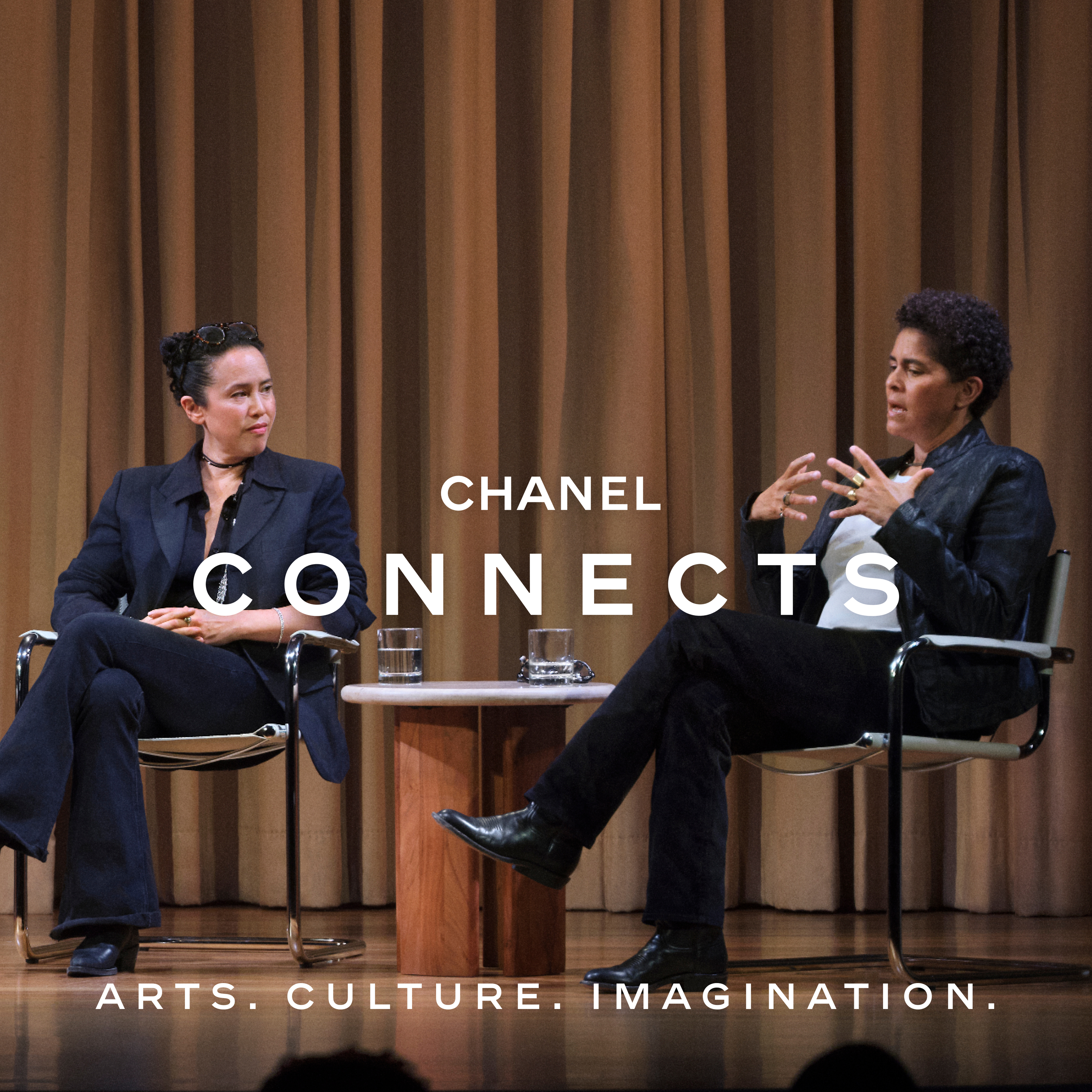
Loading summary
Transcript61 lines
- [00:06]
A
Welcome to Chanel Connects. I'm Jana Peel, president of Arts, Culture and Heritage. In season five, we invited artists and innovators to La Pausa, Gabrielle Chanel's home on the French Riviera to explore ideas of home generosity and the freedom of creation. In this special bonus episode, I had the pleasure of hosting a conversation with artists Julie Morettu and Sarah Z. Live at the Guggenheim Museum in New York.
- [00:43]
B
Julie? Sarah, thank you so much for being here with us today. This is our fifth season of Chanel Connects, and we've been thinking about the home, so. So we thought we'd start here in New York City, a place that you have chosen to make yours from very early on. Can you talk to us as young artists, how the city shaped your experience as artists and which institutions in New York were central to your lives. Sarah, do you want to give it a start?
- [01:09]
C
Sure.
- [01:09]
D
You know, when I moved here in the 90s, it was just incredible. I mean, it was the cornucopia of music, dance, culture, talks. I remember my young artist friends, we would find out like, which museum was open for free, and we'd go to every free night, you know, with the gallery spaces. It was amazing that you could just walk into any gallery space for free. You know, I had been working for five years in a full time job when I came. And so for me, I went to graduate school here. It was such a gift. And it was something I hadn't thought I could do because as an undergrad, I remember going to.
- [01:43]
B
This was in New Haven.
- [01:44]
D
Yes. I went to the room, I went into career services and it's like a library. And I pulled out like the card catalogs. It was like medicine, being a lawyer, law school, business. And then I pulled out the art one and it was like, hello, Hello.
- [02:00]
C
Nothing.
- [02:00]
D
There were no cards in it. So I was like, okay, I don't know how I'm going to do that. So I just decided after my full time job, I say this to my students, that I think that if you go into the arts, fundamentally art saved your life somehow. And when I was doing other work that was really important, I was painting every night and I was just yearning for it.
- [02:21]
B
I'll turn to your institutional influences in a moment because I know there was a show very early on for you at a New York museum. Julie, maybe you could tell us when you came to the city and how that shaped your times.
- [02:31]
C
I also came in the early 90s, and coming to New York was transformative in my understanding of contemporary art. Basically, I realized really Quickly, how little I knew and how. I mean, when I first moved to New York, I didn't even know you could go to galleries for free. Like, I didn't even know that that ecosystem existed in that way. The Whitney was a really important museum when I was young, outside of, like, the Modern or the Met. The Whitney offered this very. It was a very different energy happening there. 93 was a year after I came. We had the 93 biennial. You had the Black Male show. That was. That Thelma curated. That was in.
- [03:09]
B
At the Whitney.
- [03:09]
C
Thelma golden at the Studio, director of the Studio Museum. Her first major kind of show at the Whitney. So this was a really kind of incredible time. And I remember those markers, and I remember being like, I need to get my ass back in school quick. Because I knew nothing, really, when it came down to it. Like, I learned a lot about the world. But where I went to school, I went to a small liberal arts school in Michigan, but we didn't have the MCA in Chicago at that time. There was no mocat in Detroit. There wasn't a contemporary art institution in Grand Rapids. And there definitely wasn't a broad museum by Zaha Hadid in Michigan State, which there is now. So, like, it is such a different world. And I think in the early 90s, you had to come to a city like New York or in Los Angeles, I think, in a very different way. But even here, it was like there wasn't a professional kind of ecosystem or way to get involved in that that we knew of. You were either, like. And I realized quickly, being here, you were born into that. You grew up as families that introduced you to this space, or you came into that in the cities that you were from. And somehow from el, you could tap into that in terms of publications and stuff, but you didn't have the kind of interconnectivity you have now. So it was such a different environment. And it's where I realized right away, I was waiting tables at this place called Coffee Shop on Union Square. And it was there that I started.
- [04:27]
B
I see some nods of recognition. Yeah, yeah, yeah. Shout out.
- [04:34]
C
And then from that, waiting tables into painting and working hard and just being so inspired by everything that we would do. I would see, even to this moment, like, you know, there's a million things happening in the city tonight, especially with the U.N. you have this, you have MOMA, you have all these different events. That's what the city. You feel it every day. And the kind of drive people come to the city with. There's this contagion in that energy. And I became addicted to it right away.
- [04:57]
B
I love Full circle because in 97, when you came for your MFA, you said you didn't even know that free museums existed. And then more recently, as a board member of the Whitney, Scott Rothkopf yesterday told me that you did something very generous to make sure that the next generation could enjoy free art. Do you want to tell the audience a little bit about that moment?
- [05:15]
D
Yeah.
- [05:15]
C
So actually, when I moved here, you could go to the Met for free. You did not have to pay what you. I guess there was the pay what you will thing. Maybe I don't really remember, but none of us paid to ever go to the Met. Like, it wasn't something that you just could go. Anyone could go to the Met, and then it was like, oh, you could make a donation. It was more that kind of a structure. It's now become a different. Where you can request to go in, if you're a New Yorker, for free. But it's. You go through. You have to go through something. And the Whitney had something like that. Coming from a family that, you know. Both of my parents were teachers. My father was a professor at Michigan State. My mother was a high school teacher. I mean, sorry, toddler teacher. Very different. No, but Montessori. But my point is that they didn't have the kind of resources that could afford to take us to a museum on the weekend for $125 or whatever it is. They're $30 ahead, $25 a head. So it's only very particular people, college students, and those who get that culture a little bit. And so fundamentally, I think it's somewhat of a classist structure. And if you're really trying to open up institutions, when I was growing up, you go to the DIA for free. You could go to the Art Institute, go, like I said, to the Met. And I think culture, if you really want that to evolve and grow, we have to have. Young people need to be in these institutions, and not just until you're done with school, because when you're done with school, you're not earning a lot of money. And if you want to learn what's happening and you want to contribute and participate in that, having access to those institutions is crucial.
- [06:42]
B
So tell us how you opened up access for those people at the Whitney very recently.
- [06:46]
C
Well, I, along with some other people, gave a contribution to the museum to be able to pay for free 26 and under, no matter where you're from in the world at the Whitney Museum. Thank you.
- [06:59]
B
Thank You, Sarah, you two have been so generous with your teaching, with your public work across the city and around the world. Which of the institutions here in this city have really had that marked significance in your artistic practice?
- [07:12]
D
So my first show was actually put together. It was a group show of women by Cindy Sherman and Laurie Simmons. So they saw my work, they put it in. I was asked by a bunch of galleries. I think this is a good lesson for young artists to do a show or a show with them. And a couple of the artists that were in the show who were older than me, the women said, don't join a gallery right away. I was still in grad school, and they said, do a show at White Columns. And it was a great idea to slow it down. And then I did a show at PS1 for the reopening of PS1. I was super shy. I remember the curator called and called and called, and I ghosted them. Ghosted? Ghosted.
- [07:49]
B
That's really hard to imagine.
- [07:50]
C
30 years old.
- [07:51]
D
And then they showed up, and it was great. I did the opening of PS1, and then Klaus Wiesenbach did it. And Hans Zulrich, who you've worked with, asked me to do something Paris. That was the first time I'd ever done anything.
- [08:03]
B
And then, of course, the retrospective here. It's really extraordinary. I love that idea that Sarah said she wanted every painting to be bigger than life size. And that ambition is something that you can see in the scale of your studios. And so I'd love to ask you about that personal environment for you, about the studio. And what would we see if we walked into your studio right now?
- [08:22]
D
My studio has video, it has sculpture, it has paintings, has two stories, so the paintings can be separate. It has enough space to throw gatherings, which I really like. I like to think it's like Bauhausian in that. Like, there's the sculpture area, there's the painting area, there's the video area, there's the public art area, as we do a lot of public art projects. So there's like, engineering.
- [08:42]
B
And is it a space where things come together or things fall apart?
- [08:45]
D
This is a good question, because the way I see the world is much more as an exploded and fragmented place, and the work is much more about constructing a world out of all of those fragments.
- [08:56]
B
How about your space, Julie?
- [08:57]
D
Yeah, well, the.
- [08:58]
C
Where is it?
- [08:59]
B
Both in Chelsea.
- [08:59]
C
Just give us a Mine is in the Sta. Lehigh Building in Chelsea. This is my 15th year in that building. I feel so fortunate and lucky to be able to have that Sunset. Because every other space I had was some dark basement or, like, garage space or Harlem. Well, the church in Harlem was better, but it was still a construction yard in the background. You know, it's like the eight. It hadn't. This is this magical view of the Hudson River. And it's been very, very kind of formative for me in many ways, like, of new work.
- [09:33]
B
We'll get to that in a minute. We're hearing a lot of similarities. There's also so many differences in your practices. But what does unite you is the scale of architecture that you've both tackled. And so I think of Storm King and I think of LaGuardia, and I think of Goldman Sachs, and I think of SF Moma Howl. I remember in 2017, going to see Neil Benezra, and Julie was on this epic crane. You were just doing something so monumental. And I wanted to ask you about the challenges of conquering such extraordinary architectural spaces. And what excites you about it? Because you keep doing it time and time again.
- [10:10]
C
I mean, for me, I think the moment, and it doesn't change whether it's a small painting or the moment. I'm really face to face with the work that I'm getting involved with myself. There's always this moment of, like, it feels like the ground is falling out from under you. It's like that description of Pip in Moby Dick, when the boat falls and Pip is in the water and he's, like, just there, and all he sees is the ocean for as long as you could imagine. That's almost what it feels like at that beginning. I always have that kind of experience. And I think being in front of these really big paintings at that scale, there was this, like, yeah, okay, this is insane. And yet there's this thing that starts to happen where it's one thing leads to another, and then the minute that that starts, there's this, like, you know, losing the thread and then finding oneself back. So when that can happen again, then. And when the conditions can do that.
- [11:06]
B
Then you're chasing that.
- [11:07]
C
Yeah, it's like, that's the dragon, in a sense.
- [11:09]
B
That's the dragon. Does that resonate with you, Sarah, chasing that dragon?
- [11:12]
D
Absolutely. Absolutely. I mean, I think the scale thing is interesting to me because as Julie said, I can make something small as well. But when something's big, you have this ability to shift scale from the minute to the grand. And for something that's like a sculpture or a painting that's really large, that's public, it's this idea of Trying to create a kind of intimacy and a kind of fragility against the monumentality. So, like the LaGuardia piece, I wanted it to be like a mirage. You don't usually see public art as being anything but these sort of large, permanent structures. So this idea of impermanence and something that's supposed to be permanent and that tension on that scale, I think can be really interesting.
- [11:50]
B
Can you tell us how that manifested here at the Guggenheim with your retrospective several years back?
- [11:55]
D
I mean, everything's about when you do a building like this, it's a conversation with the building. Right. And I wanted each bay to be an entirely different experience. So I was thinking about how it would be this kind of intimate, almost filmic experience where you turned a corner. It was subtle, but the way that you walked into a bay was different in each bay. So sometimes you had to go around the bay and look back out at the oculus and. Or sometimes you had to move to the left and move over to see a painting. So the circulation actually made you understand the scale differently. It's something that Japanese landscaping does a lot. There's a lot of scale shifts in this idea of wandering and discovering.
- [12:31]
B
What I'd love to do is eventually move out into the community, but just really hone in for another moment on your individual practices. And, of course, you've both incorporated history, politics, architecture, Western and non Western influences that you've just mentioned. And I wanted to check in with Julie about how you've made abstract such a powerful tool for your discourse.
- [12:52]
C
I think abstraction has always. It comes from a place of radicality to begin with, in what it tries, in what it does. And I think in culture, whether it's in music, whether it's in visual arts or theater in any form. I think abstraction has been this space of, like, trying to make sense of the world very differently, but also has been this place of kind of radical invention. I think a lot of making art is really. It is this mixture of, like, radical. Radical imaginatory and being able to be exploratory in that space, but also liberation and freedom is something that we all want. And to be able to actually find a space where you can invent in a way that can generate more and more of that. Like, abstraction does that and offers that space for me. And I also just want to clarify. I don't believe really in this full binary between any form of representation and abstraction. I feel like they're much more intertwined. And so some of the most incredible painters of our time, you'll look at a Rembrandt, and it fully falls apart into abstraction when you're looking at the clothing or when you're looking at how the face is painted or the eyes, the expression. And yet, you know, this is portraiture.
- [14:11]
D
I think a painting in the age of an image is a sculpture. We have so many images, and you could say they're more realistic than Rembrandt because they tell you, I'm paint, I'm a pencil, you know, and that's realism. But for me, I think we are in a place where images and objects are alive and create memory and in conflict with one another in a way that never operated in our life before. So I'm really interested in how we construct memory, how it gets destructed, how we dream, how we imagine in ways that are digital and physical, in new ways that we actually really don't know. Because we're so in the middle of the storm.
- [14:48]
B
Frank Lloyd Wright had this idea of compression and release. And so I'd love to move from the confines of your studio and your practice into the community. And to that end, you're so generous to your communities, both of you. And I'd love to start by asking Julie about Denniston Hill.
- [15:01]
C
Yeah. So Denison Hill is arts organization and residency project that I was a founder of with Paul Pfeiffer, Lawrence Trois, and a group of others. Jessica Rankin, Carol Lynch. There was a group of about eight of us, I think. But the co founders that really ended up sticking it out were Paul, myself, and Lawrence. And I think we all made work up in the Catskills, in this house and the barn. Neighboring barn, and in the kind of landscape that is up there that. That we're fortunate enough to now be the custodians of. But what it is mostly for me is a way of studying and building, like, outside of the studio. Because the studio project is. Even though I work with a really beautiful team of artists and people, that is still. So much of it is a very isolated kind of internal project. Painting is so much this internal process and. And the working on Denison Hill is not that. It's this collaborative collective project of arguing and debating and trying things out and succeeding really well at some parts and failing wildly at others, and then being able to reinvent something else. And so it's just been this really slow, collective project, communal project. And we are lucky to be in the Catskills and to be able to be surrounded. We're honored to be surrounded. Blessed, really, to be surrounded by that environment.
- [16:25]
B
Sarah, is that Collective experience as important to you?
- [16:29]
D
I'm working on a foundation. That's what Julie was like. Don't tell everybody that we're supporting everything, because everybody else should be too. But, you know, I think as an artist, you get a point.
- [16:36]
B
This is groundbreaking because yesterday I said, sarah, can we talk about the foundation? She says, absolutely not. I'm doing everything not to talk about the foundation reveal.
- [16:44]
D
No, no, no. I can talk about it, but I'm not the idea. I think about certain point. I was with Kiki Smith the other day, and she just said, you know, we're so lucky to be artists. We're so lucky to do that every day. And I think you get to a point where you're so. You feel so blessed that you're able to do that every day. And you're like, how do I give back? For me, I was thinking about what was really liberating. For me, it's the world as a studio. I did a bunch of amazing residencies. But for me, I really learned about how to make my work from travel and being in the world. And we were talking about Michael Craig Martin saying, school is not about the school. It's about what happens in the hallway. You're senses are heightened when you're in another country. All the language, all the food, everything. And that kind of heightening of sensing your senses of being slightly more aware of how something tastes, smells, sounds, is actually something I'm really interested in doing in the work. And when I was in school, you know, having an immigrant family, they were like, if you leave school, you're never coming back. And so I had to apply for grants. They wouldn't pay for me to go. And I waitressed and raised the money. Noah in a place called Scoozies in New Haven. But not there with her. I took her job. No, I'm just kidding. And I traveled. And so I want to do that. I want, you know, no strings attached. You apply for whatever you want for no particular reason. You don't have to make art. Yeah, travel.
- [18:05]
B
That's amazing. I have to ask the really quick question. New York is the epicenter of the art market. The mayor of Deboit here points to how expensive the city is. Does New York still offer that kind of serendipity, that surprise that you referenced? What's exciting you about the city at the moment? And what's making you a little bit nervous?
- [18:22]
C
That's a good question. I think we all understand what's making us nervous about not just the city, but the world that we're living in at the moment. And the tyranny, I guess you will. Of like not just leaders, but in. In essence, a form of high capitalism that's exposed. Like, we see that New York City is especially somewhere where you really can feel. Where you have a neighborhood like mine, where you have people who don't know where their next meal is coming and can't. There is no way they live under the poverty level, which is not even. That doesn't even mean anything in this city. And at the same time, you have the kind of enormous wealth in this city. And I think we're seeing the contradictions of that and the complexity of that and the kind of problems of that at full scale kind of moment right now. Like in terms of, you know, even this Meryl Race is really articulating that. And I think we need to really come up with drastic new solutions. I think the arts are a place for that. But I also think. And I think young artists are in a really amazing position right now. Because in many ways, the art world as we know it is not holding together in the way that it used to. I think you have, like, young galleries or middle area galleries that could really show all kind of innovative new stuff. And artists were making for other artists. So much of that has fallen apart in the ecosystem of how we're thinking of making for one another. I go out to see what other artists are doing because I'm like, who's putting that gauntlet down? Like, what is really interesting and who is really playing, like Dizzy would say about somebody else really playing with their chops? And I think you're seeing that. You're seeing the kind of new inventions happening in the art world. And those inventions are where the possibilities lie, where possibilities for new forms of creative work are being made, where new language is emerging, where a new form of criticism is emerging. And I think that's the intention. That's the most radical and interesting possibilities of what's happening. Not what us older artists are doing on like this. We're still trying to do something. And I think I believe in the importance of art. I deeply believe in painting. I think it's as crucial to culture as other forms of invention and sculpture. But I do think where the radical potential lies is not in following paths that we took, but inventing new paths. And the whole ecosystem is much more part of the kind of dynamic that's happening in this room as opposed to what's happening on the street, what's happening in these clubs, what's happening in, like, Neighborhoods with like shows roving between people's apartments or in other forms of venues. The more and more we see that, the more and more, and the more and more this kind of divide happens, the more and more you're seeing these kind of interesting new inventions take place. And that happened when we were coming up. Hip hop was like, we were raised on that.
- [21:19]
B
You're all sampling, right?
- [21:20]
C
Yeah, it was, it was. You see that happening right now, like just in terms of language alone, like what our children are, how they talk and how they think about invention is off the chart.
- [21:33]
B
I was with two young artists on the High Line. We launched a public project yesterday and I was trying to ask them about the angst in the world. And they're like, we're just making art. Right? So I guess I want to ask Sarah, what excites you at the moment? And you've talked about the anxieties and the possibilities of AI. Maybe you can pick up where Julie left off.
- [21:52]
D
So I think AI already happens. It's deeply ingrained and woven into our everyday. My own thought on it is not that I'm an expert, but the language and the knowledge of AI is predictive. For things that can be tested with a prediction model is incredible. I mean, if you can do 25 tests on whatever a cell going malignant or not, AI can do something that takes seven years and seven minutes, no doubt that's great. The threat to creativity, I think it's like we are the thing that's not predictive. The hand is. That's why painting is interesting now, because painting is the hand. Painting is texture. And I think we see it live events, seeing people in person. I thought that after Covid, we were not gonna have art fairs, but people go to see each other and to see things in the moment and to talk about it in this way that you can't have in any other way. So I think the things that make us human and not AI are actually only more valuable.
- [22:52]
B
That beautifully takes us to our final topic. And a thank you to everyone who has made that pilgrimage to be here with us in person, to everyone who's listening digitally who can't be here with us in person at the Guggenheim. But I actually wanted to talk about this epic scale on which you've been functioning in such male dominated spaces at LaGuardia, in the world's most impressive institutions and investment bank. And I'd love to end in a hopeful place for women who may take your bravery as a model. You know, at Chanel, We're a private company among our 40,000 people, 70% of our people are women. On an executive team with our president here, Stephane Blanchard, who's a brilliant and benevolent president in America, and our CEO is magnificent woman. And so we are really committed to the foundation, which empowers women and girls and is probably one of the largest of its size in the world that is focused on economic and social autonomy and climate resilience. Others are rolling back. We are rolling forward. We are leaning in. And so I wanted to check if you had any advice that you would love to give young women, particularly working today.
- [23:59]
D
I'll start by just thank the women who paved the way for me. Like I told you, Cindy and Lori put me in a show right away. When Julia. When I met Julia, we immediately became friends. We supported each other. Women supporting each other. It's so important. Ursula Van Ridenswaard, Jackie Windsor, Dorothea Rothburn. These were all. I went to graduate school because there were no women. They were all men in undergrad, and they were amazing role models, and they were incredibly generous. And so I think we really do owe a debt to them for that.
- [24:29]
B
That's magnificent. And your teaching definitely talks to that. Julie, any advice for a young woman?
- [24:35]
C
Yeah, I think we just have to be. We have our superpowers, and that's a lot of, like, capability and love and kind of the way that we orient ourselves with our communities and our families and being as open as we can to all the different women that are out there in the world and being as open as we can to our brothers out there. And I really think, like, one of my favorite things about this next generation is how quickly they've done away with the gender binary and how much they've shown us how conservative. So much of what we took for granted, like, in terms of. Yeah, you tell the gender of your child. Well, why, like, why is it. Do you know what you're having? Why is that the first question? And having to really reprogram oneself to really ask the questions of, who is your child? Not who are they in this picture, but who is this additional human that's coming into the world and being able to really orient ourselves around that. I mean, I feel like this generation has taught us that. But really, like, I think women and girls all over the world struggle in ways that are completely abhorrent. And I think that we have to remember that, like, with the power that we have and the capability and the kind of agency we have, I think we have to be as inclusive and as holistic as we can be. So I guess what I'm just trying to say is I love you all, all you kids, all you women.
- [26:18]
A
Thank you for joining us on Chanel Connects. There's a rich archive of five seasons of episodes available to listen and watch where you get your podcasts. These feature guests like Penelope Cruz, Hansel, Rick Obrist and Lupita Nyong'. O. I urge you to listen back. This has been Chanel Connects, available to watch on Spotify and YouTube music and listen on Apple podcasts. Until next time, stay connected.