Loading summary
Transcript196 lines
- [00:00]
Lauren Collins
Hi. Hi.
- [00:04]
Brennan Gerard
So good to meet you. So good to meet you too.
- [00:07]
Jana Peel
Hi.
- [00:09]
Ryan Kelly
Finally.
- [00:09]
Lauren Collins
I know.
- [00:12]
Jana Peel
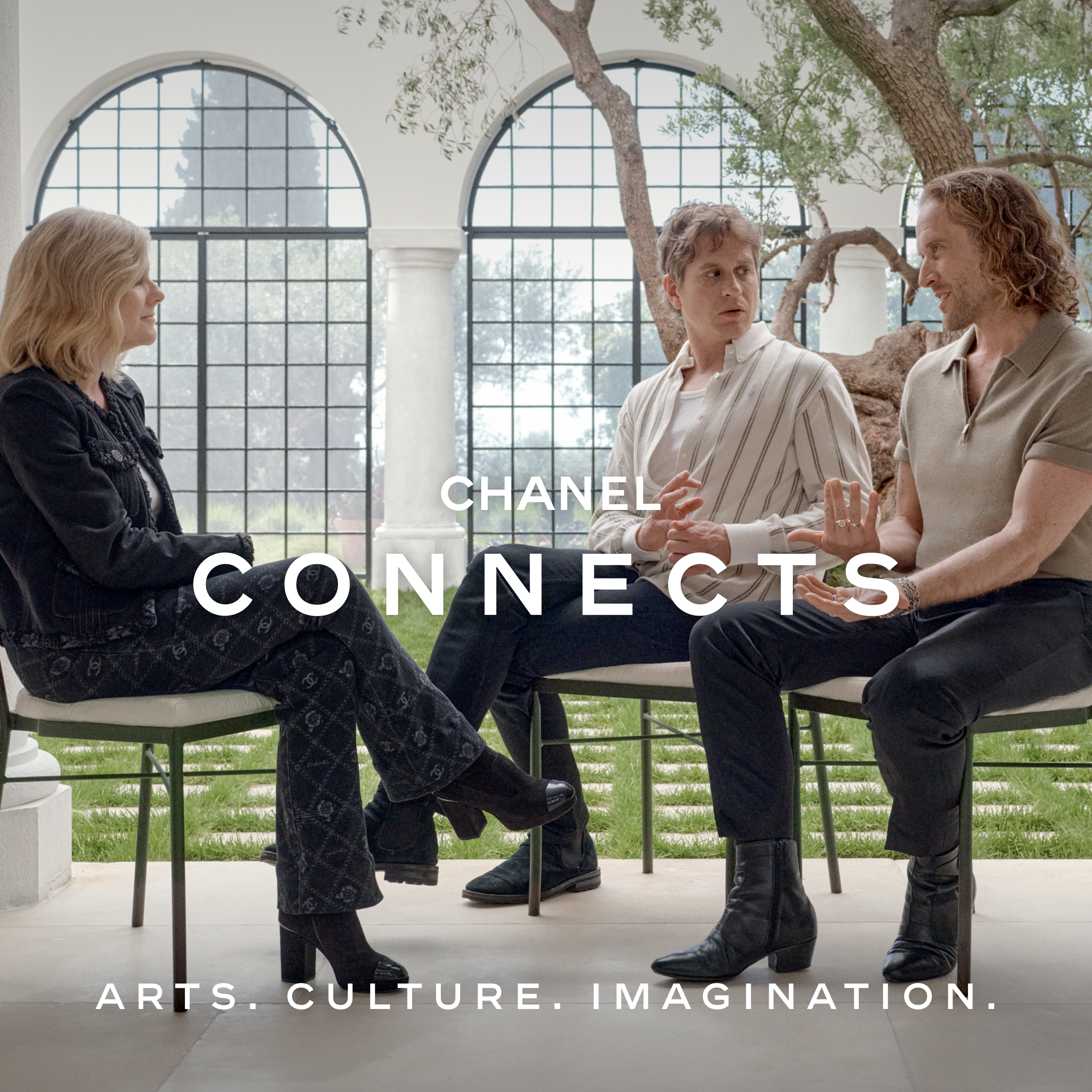
Welcome to Chanel Connects. I'm Jana Peel, President of Arts, Culture and Heritage at the house for season five, we journey to La Pausa, Gabrielle Chanel's villa on the French Riviera to hear artists and innovators discuss the future of creativity and the innate curiosity that powers their work. This time, American expats in France connect. Here are writer Lauren Collins and artist duo Gerard and Kelly in the cloisters of La Plousa.
- [00:45]
Brennan Gerard
So we are Gerard and Kelly, and we are artists who are also from America, but now based in Paris. And I'm Brennan Gerard and.
- [00:56]
Ryan Kelly
And I'm Ryan Kelly.
- [00:57]
Brennan Gerard
Ryan Kelly.
- [00:58]
Lauren Collins
Brian Gerard and Ryan Kelly. I'm Lauren Collins. It is so nice to meet you all. After delving into your work, I have so many things I want to ask you. I feel like there are so many points in common, but so many not in common also that are going to be fun to discuss. So I'm happy to be here with you all at La Pausa.
- [01:19]
Brennan Gerard
Well, we're very excited to meet you and it's so funny because I feel like we should have already met in so many different ways. And we've been following your work and reading your work. Actually. We remember that there was an article that you wrote several years ago about Tina Seagal, whose work was very important to our project, especially when we were starting.
- [01:42]
Lauren Collins
We've got to talk about the Kiss Solo. Your kind of reinterpretation, perhaps rebuttal of Tino Seagal's work. The Kiss.
- [01:50]
Brennan Gerard
The Kiss.
- [01:50]
Ryan Kelly
Quite how you found that.
- [01:52]
Lauren Collins
Yeah. I am just so curious to learn how you came up with that, actually. Do you want to, like. Do you want to get into it? Sure.
- [02:00]
Ryan Kelly
I actually think, yeah, Kiss is a good place to start because I think one of the correspondences in our work is relationships and intimacy. Kiss Solo was a video or is a video installation?
- [02:13]
Brennan Gerard
Multi channel video installation. Yeah.
- [02:16]
Ryan Kelly
And it is actually related to a performance that we made first called Reusable Endless Love. And the two works are both responsive to Sehgal's Kiss, which we encountered at the Guggenheim Museum in 2010. And we were challenged by it in many ways. Like Tino, our background is in dance before we studied visual art film. And I think we saw that there was this choreographic aspect to the work. Of course, we were challenged by the persistent male, female relationships.
- [02:51]
Lauren Collins
Well, that was what I was gonna ask. I mean, was it an important moment? Because it was a blow your mind moment. Or was it an important moment? Because it was a. Like. Like, we wanna have our say.
- [03:03]
Ryan Kelly
I think it was a bit. We wanna have our say. And over time, you know, we've met Tina over the years, and really funny story about when he saw our Kiss solo project, he said, well, yours has a lot more ass slaps in it.
- [03:21]
Lauren Collins
That's what we're looking for.
- [03:23]
Ryan Kelly
All right.
- [03:24]
Lauren Collins
The old ass slap meter.
- [03:28]
Ryan Kelly
But yeah, I would say at that moment, it was like the challenge of, like, no, we want to address these issues, but from a different point of view. And so what we did, because we were not permitted to photograph or video record the kiss as it was taking place in the rotunda of the. Good point.
- [03:45]
Lauren Collins
That's like one of the stipulations of Tino Seagal's art, right?
- [03:48]
Brennan Gerard
Yes, especially then.
- [03:50]
Ryan Kelly
So we made audio recordings in our cell phones.
- [03:57]
Lauren Collins
That's. I mean, undercover reporting.
- [03:59]
Ryan Kelly
It was undercover reporting.
- [04:01]
Brennan Gerard
It was.
- [04:01]
Lauren Collins
Yeah, get in there. But so you. Okay. You got the goods?
- [04:04]
Ryan Kelly
We got the goods. We. We deciphered through that process that it was a 12 minute choreography repeated on a loop. And so it was, you know, it was a description of a kiss. His right hand on her left shoulder. As he leans in to kiss her, they descend to the floor. I mean, it was a bit like sports casting, right?
- [04:22]
Brennan Gerard
Yeah.
- [04:22]
Ryan Kelly
And we didn't know what we would do with it, but then it became the germ of our own performance. And then a video installation where individuals of different genders would perform a kiss solo, where they had to do both the male and female parts on their own bodies.
- [04:39]
Brennan Gerard
Yeah. So we kind of became. Even though maybe the first impulse was the recognition that it was only a male and female couple.
- [04:46]
Lauren Collins
So you saw that and that pissed you off, basically.
- [04:50]
Brennan Gerard
Well, it was also like.
- [04:52]
Lauren Collins
Or just like, do you felt it was like. I mean.
- [04:54]
Ryan Kelly
Yeah, I think we were a little.
- [04:55]
Lauren Collins
Putting words in your mouth, but just like a failure of imagination.
- [04:59]
Brennan Gerard
Absolutely. A failure of imagination. And then.
- [05:02]
Ryan Kelly
But maybe that's always how art moves forward, is in the blind spots.
- [05:06]
Lauren Collins
How did it go over?
- [05:12]
Ryan Kelly
I think it was. How did it go over?
- [05:15]
Brennan Gerard
I think that the first response was perhaps right on and like, more kind of replacing one form of representation with another. But then we started to realize that we were kind of more interested in how representations of intimacy are reproduced and circulated and how those representations tend to find a model. Right. Which might be called, like, normative. And it doesn't even matter what the genders are. Right. Of the two. But there is this idea of romance that has been so constructed. And we were thinking about how when we became a solo, it was about that kind of idea of the intimacy with one's self.
- [06:00]
Lauren Collins
This is something. Okay, I'm like, sorry for the swerve, but I've been dying to ask you this as people who work with your bodies as well as your minds, because I only have one of those modalities. Like, I had this real hang up about the physical aspects of speaking French. Like molding my lips. Yeah, yeah. Because to me, I'm not trained in that. To me, it felt like almost like putting on a mask. Or is this a certain form of hypocrisy? Like having to, like, morph not only my. You know, not only what's going on inside my body, but my entire presentation to something that maybe I'm not. But what's it like for someone who feels or who feels a license to.
- [06:50]
Brennan Gerard
Perform in the process of the translation or performing this new language? For me, there was a lot of freedom in that. And I think it's also that freedom of almost escaping your origins.
- [07:03]
Lauren Collins
Yeah.
- [07:04]
Brennan Gerard
And that is the side of movement and migration, the more positive side, the kind of new freedom that one can find by being within a strange language in a strange place. And I think that that is something that we really tapped into when we were working on Eileen Gray's work. And she's an Irish woman who moved here to France, who built a house actually very close to where we are now. You can almost see it from the end of the garden. She was one of the major architects of the 20th century. For a while, she was completely forgotten. And now there has. For the past few decades, there's been a resurgence and an interest in her work, and we're discovering just how radical she was.
- [07:55]
Ryan Kelly
She was mostly known as a furniture maker.
- [07:57]
Brennan Gerard
Right, right.
- [07:58]
Lauren Collins
I know. The lights.
- [07:59]
Brennan Gerard
The lights, the lights.
- [08:00]
Lauren Collins
Chair.
- [08:01]
Brennan Gerard
And the chair.
- [08:02]
Lauren Collins
Yeah, right.
- [08:03]
Brennan Gerard
She always was kind of. That being a stranger is also about becoming more free.
- [08:08]
Lauren Collins
Yeah. I mean, that's something the three of us, if I'm extrapolating correctly from your bios, the three of us have in common. Hardcore provincials. Wilmington, North Carolina, South Carolina.
- [08:23]
Brennan Gerard
Ohio. I mean, Pennsylvania.
- [08:25]
Ryan Kelly
But it's really.
- [08:25]
Lauren Collins
It's different from someone. I mean, from growing up in New York City, totally.
- [08:29]
Ryan Kelly
Of course.
- [08:29]
Lauren Collins
From did you consciously want to reinvent yourself? To.
- [08:35]
Brennan Gerard
I don't know if it was entirely the simple.
- [08:39]
Lauren Collins
Yeah, the simple answer.
- [08:41]
Ryan Kelly
My first encounter with culture was when I was 11, and my parents drove me, myself, and my two younger sisters to New York to see Cats.
- [08:53]
Lauren Collins
Hell, yeah. And the Gateway. The gateway musical. No, but really, it's like you do something like that and it opens a whole universe.
- [09:03]
Ryan Kelly
I remember driving back on Interstate 80, heading west, and I'm looking out the back of the car at the disappearing city, tears in my eyes. And I was like, no, I'm going there. So that was a very clear decision to get out and reinvent myself. And, you know, there's a lot of correspondence to both Eileen Gray and Chanel in this respect, I think this kind of self fashioning. So it's interesting you say, when did you learn French? By kind of imitating the physicality and gestures of the French. I'm like, I think I learned New York that way.
- [09:41]
Lauren Collins
Oh, that's so funny. You're right.
- [09:42]
Ryan Kelly
Well, I also had to change my language and how I spoke. I mean, and so did you guys.
- [09:47]
Lauren Collins
Right. There's definitely like a code switching. And then when you go back, are you able to slip easily back into.
- [09:55]
Ryan Kelly
Easier than I might wish to.
- [09:56]
Lauren Collins
Yeah. I was reading Vivian Gornick's memoir, Fierce Attachments, which I love so much about her.
- [10:03]
Brennan Gerard
I was just thinking about her. That's so funny.
- [10:05]
Lauren Collins
Oh, that's incredible. About her upbringing in the Bronx and how her mother just, you know, scraped and scrabbled and put her everything into sending her daughter to making it so that her daughter could get an education. And then once she did, she was outraged. How dare you speak these words that I don't understand? Which is, you know, there's that freedom, but then there's also the worry that you're alienating yourself from who you are or from what made you or. It's a fine. It's a fine balance.
- [10:42]
Brennan Gerard
It is a very fine balance. I mean, because we're touching on, like, the link between translation, repatriation, which is what we're doing. I'm not. I don't think I'm going back. Right.
- [10:54]
Lauren Collins
Yeah.
- [10:54]
Brennan Gerard
And the transfuge class. Transfuge, like the kind of.
- [10:59]
Lauren Collins
Yeah. Don't you love the phrase in French? The social escalator? Isn't that.
- [11:03]
Brennan Gerard
Yes.
- [11:04]
Lauren Collins
And the class transfuse.
- [11:05]
Brennan Gerard
Yeah. And that. I think that these are very pertinent topics right now, and they're definitely structured. I don't know if you've read a Woman in the City. Is it called Woman in the City? It's her.
- [11:15]
Lauren Collins
Yeah. I haven't because I just. You just read the Simona Vivian Gornick gag, and that's next.
- [11:21]
Brennan Gerard
That's great.
- [11:22]
Lauren Collins
So tell me what I have, Lil.
- [11:23]
Brennan Gerard
This is about being single in the city. And I think that this state of freedom that one could have in the solitude is something that Eileen Gray knew a lot about. And our kind of speculative. The film is a speculative fiction. Right. And we're trying to imagine what her last day and night was in the house. Right. Which is really so funny. Cause it's right just down there. And I think that one of the things that she was dealing with was attachments. Attachments to place, but also to other people. Like entanglement. And then the decision to be alone, to be single, is this continual, difficult practice. Right. But there is great freedom in that.
- [12:09]
Lauren Collins
Well, there was such a sense. I mean, watching the film, the sense of trespass spoke to me so much. You know, it felt like she had her, you know, the Wolfian ideal. She had created that for herself. A room of one's own. And not only a room, but a perfect, you know, villa with her witty stencils and everything. You know, a place for everything and everything in its place. And the way she was dressed. And you sensed order and contentment in her life. And then everybody, you know, comes in and takes her space in a way. And then because the film was so interesting and because you stoked my curiosity about Eileen Gray, whom I didn't know very much about, then I got to reading about Le Corbusier and the murals and the afterlife of the house. And I loved the way that you were able to give a premonition of the trespasses that would happen later.
- [13:14]
Brennan Gerard
Absolutely, absolutely. But this also gets back to the nature of home itself. And I think that we have this idea that home is a kind of remove from the world. But you have to. It's actually more. I think more we have to think about what is the boundary between the world and the home. So it. But I think that she was really consciously trying to build a home. And then there was a trespass. So that boundary. She'd not yet figured out that boundary yet, I think.
- [13:44]
Lauren Collins
But. So what is it? What does it mean to you? I mean, are you kind of going with, like the hermit crab model, where your home is where, you know, I think you can also find a home. Like language can be a home. It can be a place as much as a nation state.
- [13:59]
Brennan Gerard
Totally.
- [13:59]
Lauren Collins
Or as much as. It's interesting to think about expanding or. Yeah, expanding the notion of home. Where do you feel at home or where do you make your home?
- [14:13]
Ryan Kelly
I mean, I think the search. I mean, this film is the most recent chapter. We call them chapters. Very linguistic, I guess, in a long Kind of study of different, mostly modernist homes. And we're usually looking at the relationship that was kind of obscured or set of relationships that might have been obscured and maybe even was the impetus for the design. So a home like Eileen Gray's or Le Corbusier Citiradio's, where we worked before the Schindler house in Los Angeles, like these. These sites are often narrated for their formal invention, but that's rarely why they.
- [14:58]
Lauren Collins
Were built, because that's not how we. It's not how you go out in public and talk about your art too. Right. It was so interesting to know the. The intimate and the emotional backstory.
- [15:12]
Ryan Kelly
Yeah, yeah.
- [15:13]
Lauren Collins
Behind.
- [15:13]
Ryan Kelly
Yeah. I mean, like, you look.
- [15:14]
Lauren Collins
I mean, you're really. You're trying to get into that, which is definitely.
- [15:18]
Ryan Kelly
And that is. I think it's also what. It's our own emotional backstory that drove us in our work to investigate.
- [15:28]
Brennan Gerard
Totally. I think that architecture.
- [15:29]
Ryan Kelly
I mean, we were. We were doing this work, like the kiss solo around the couple, in part because it was the moment when we were kind of reflecting on. I think we went to art school and realized we were the only duo there. And it was like weird and it was. We had.
- [15:48]
Lauren Collins
Did you think there were gonna be a lot of duos?
- [15:50]
Brennan Gerard
Yeah, I mean, we just.
- [15:52]
Lauren Collins
Maybe a trio.
- [15:54]
Brennan Gerard
Exactly. I think it had just become natural for us. Right.
- [15:57]
Ryan Kelly
Yeah.
- [15:57]
Lauren Collins
How did you start working together?
- [15:58]
Brennan Gerard
This. Oh, we met at a.
- [16:02]
Ryan Kelly
We met in New York.
- [16:03]
Brennan Gerard
We met in New York at a.
- [16:04]
Ryan Kelly
Party, as happens, and immediately within three months, made a performance together. And because we had no resources, we moved in together immediately following that. And I think we thought. I mean, we were a couple. We were a romantic couple living together. But I'd say our primary activity, because every couple needs an activity was making art. And if we weren't. If we hadn't been 20 years old.
- [16:35]
Lauren Collins
I think better than. Better than whittling.
- [16:39]
Ryan Kelly
We might have understood that from the jump. The nature of this intimacy was about co creation and not necessarily cohabitation or the co. Creation of domestic space.
- [16:51]
Lauren Collins
Right.
- [16:52]
Ryan Kelly
We were there to make art together, but it took us 10 years to figure it out.
- [16:56]
Lauren Collins
So where do you. I mean, having this history together, these different frequencies on which you either do or have known each other, where do you find solitude? I'm fascinated by that because for me, my process of creating is like locking myself alone in a room for hours on end. But the older I get, it's funny because I've started really craving collaboration.
- [17:29]
Ryan Kelly
I think now you're getting to the question. Of architecture. Because we went to graduate school, we discovered we were a duo, that it was a unique thing. You know, we did this series of works around the romantic couple because we knew we were not a romantic couple, but we understood there was something very important and significant.
- [17:51]
Brennan Gerard
We felt we needed to study it in our work. Like, what is intimacy? You know, what is a couple?
- [17:57]
Ryan Kelly
And that led us to, you know, leaving school, returning to New York, moving back into the apartment we had lived in as a couple.
- [18:07]
Lauren Collins
Is that a work of art? Because it should be, like, just give it a title and call it a day.
- [18:13]
Ryan Kelly
Exactly, yeah. And needing to kind of read Adaptive Reuse. Our tenement apartment in Bushwick now as a kind of uncoupled couple. And it was the recognition of how impossible that architecture was, how resistant it was to our desire to live in a different way than a romantic couple, that led us to modern living, to this project of investigating modernist domestic spaces.
- [18:48]
Lauren Collins
So just to make, like, a language analogy, you found that architecture was a kind of grammar that was becoming too constricting. Like, you wanted to find new ways of new forms of expression, or you wanted to know the rules so well that you could then break the rules, which is also what you can, of course, do with grammar.
- [19:06]
Ryan Kelly
Yes. I do think we felt very limited by the grammar we were working with to write the kind of ongoing story of our relationship. And as artists, of course, we are telling our own story, always through.
- [19:20]
Lauren Collins
Yeah, I call that embedded biography.
- [19:23]
Brennan Gerard
Embedded biography.
- [19:23]
Lauren Collins
If you're writing about something. I mean, I just made. That's not a real term, but I always think about it, because I just finished a piece about. It's kind of the Algerian Nutella, and it's a hazelnut paste. And it went viral this summer, and then the EU banned it, and there was a whole polemic around it. But I thought it was kind of the perfect Trojan horse for writing about the Franco Algerian relationship. And anyway, I got. The way I ended up writing it was totally also as a Trojan horse for my story. It was about, you know, homeland and how immigrants relate to the place they came from. And what happens when the place that you came from changes dramatically.
- [20:06]
Brennan Gerard
Well, I think also the way that we. I mean, it's also very interesting the way that autobiography appears in work. You know, like, I was our work, but also even where we are now, like, how this. We're in this courtyard where it's modeled off a Cistercian abbey, which is also where, you know, Gabrielle Chanel grew up. So the ways in which we're not Always fully aware of the ways in which our autobiography, our most important subjective experiences, those things that shape our vision of the world, how they show up in our work and our decisions.
- [20:44]
Lauren Collins
Yeah. And I'm just thinking about how your early years and your unconscious and everything that goes in those early experiences are also something you can try to shake, like an accent, but it's gonna come surging out even if you master another way of speaking. When you stub your toe or the other thing linguists say is, like, at the moment of orgasm, you're always going to speak in your real. Your real voice.
- [21:11]
Ryan Kelly
Your mother tongue.
- [21:12]
Lauren Collins
Yes, your mother tongue. Exactly. Exactly.
- [21:14]
Ryan Kelly
Untangle that.
- [21:15]
Lauren Collins
Yeah.
- [21:16]
Brennan Gerard
No, but it kind of goes back to this question of, like, about travel and freedom. What we were talking about before about this. It's a dialectic between the freedom to change, but also certain aspects of yourself as you continue to work. Right. As an artist, as a writer, that you realize what you cannot change about yourself. And so it's this, like, constant push.
- [21:39]
Lauren Collins
And pull, you know, and yourselves when you're working together.
- [21:44]
Ryan Kelly
Yes.
- [21:44]
Lauren Collins
Is it?
- [21:45]
Ryan Kelly
So I think this is why. Because we are a collaborative, and we've been a collaborative for 23 years, so there was not. There's no solo practice outside of it.
- [21:57]
Brennan Gerard
Right.
- [21:57]
Ryan Kelly
But we're in. We're two individuals in a collaboration. So language is essential because is it.
- [22:06]
Lauren Collins
Easier to communicate in an artistic collaboration than a romantic one? Or. I mean, what is. What are the. What are the respective communication challenges?
- [22:22]
Brennan Gerard
Okay.
- [22:26]
Ryan Kelly
I'm thinking about physicality now. I'm thinking about. In a romantic collaboration or romantic partnership, you have a whole other language. We also have a physicality in our relationship, but I would say language and our. I feel that when we met, we started a conversation. I remember that conversation.
- [22:44]
Lauren Collins
Literally. What was it? What did you start talking about?
- [22:48]
Ryan Kelly
We met at the Rainbow Room.
- [22:51]
Lauren Collins
What a great, like, period detail.
- [22:54]
Brennan Gerard
Yes. Oh. So the Rainbow, it was on the top floor of Rockefeller Center. Right. It's in the 40 rock, is it 30 rock.
- [23:05]
Ryan Kelly
It was the restaurant that slowly spun around itself, Right?
- [23:08]
Lauren Collins
Yeah.
- [23:09]
Brennan Gerard
With a view onto Manhattan.
- [23:11]
Lauren Collins
I think that might be an architecture that you need to revisit.
- [23:13]
Ryan Kelly
That's true. It was an architectural event. I was a ballet dancer at the time, and so customarily, kind of being invited to drinks. And then I decided I would just crash and stay for dinner.
- [23:28]
Lauren Collins
Nice.
- [23:29]
Ryan Kelly
And I was told, you can, but you've got to sit with the staff. Which was Brennan, and he was telling me about. You were working on a 1989 portfolio. It was an art auction. And so he's talking about Kiki Smith and Nan Golden. And my mind is blown because I knew nothing about art below 14th Street.
- [23:52]
Lauren Collins
And you couldn't, like, Google it under the table because it was 23 years ago.
- [23:56]
Ryan Kelly
Exactly. And I just remember how animated Brendan wasn't Charles London. He knew so much about the.
- [24:03]
Brennan Gerard
So I didn't really know that much about it, but, you know, I was.
- [24:06]
Ryan Kelly
No, he knew quite a lot.
- [24:07]
Brennan Gerard
Extremely passionate and extremely passionate about things that I had just discovered recently. But isn't that also part of a relationship, is that you discover something, you get passionate, you share it. It's like, there's not. You don't actually become an expert on it. You're actually kind of like. You're just sharing a passion.
- [24:23]
Lauren Collins
That's the best part. And particularly in a city, there's a whole kind of, like, layer of discovery that goes with every relationship. You know, where does that person's restaurant. So then you break up, and it's, like, redacted on the map. You know, places. You just can't go anywhere.
- [24:37]
Brennan Gerard
I feel like everyone.
- [24:38]
Lauren Collins
If you live in a city long enough, particularly when you're young, I mean.
- [24:42]
Brennan Gerard
To go back to your question about what is. Is it harder? What is the artistic versus the romantic? And I think that one of the things that happens in a romantic relationship that we've learned, too, through the work, is that you have all these codes. And in an artistic collaboration, there are no codes. Right. There's really, like. There's codes in romance, like, you can kind of draw upon. They help you at the beginning. You know, there's the. There's all of the myths that we.
- [25:08]
Lauren Collins
Have, just the kind of culturally. Okay. The framework.
- [25:11]
Brennan Gerard
The framework. There's a framework for how this is supposed to go or can go, or there's a time.
- [25:17]
Lauren Collins
Yeah, that's super interesting. You know, and then you stay in a romantic relationship long enough, and the codes are also no longer helpful.
- [25:24]
Brennan Gerard
Right, exactly. And that is the point, I think, that got really interesting. I think that there's a little bit kind of how we. So it was after 10 years into our relationship that we uncoupled. And there was something about that that was very interesting. But also at that moment when the codes no longer work and you do have to invent something.
- [25:43]
Lauren Collins
This is gonna be. You guys are really touching something. I mean, this is gonna be an earnest one, but that's kind of like the project of life.
- [25:50]
Ryan Kelly
Yeah, absolutely.
- [25:51]
Lauren Collins
I mean, I think there's something incredibly poignant about just knowing that you have gone through the passage of time with someone and that you've created a history. And like, to me that there's a lot of weight to that in a romantic relationship. I mean, sometimes, you know, that can. That can drag you down too. But I, yeah, I really connect with that.
- [26:22]
Ryan Kelly
Time can be a holy thing.
- [26:24]
Lauren Collins
We've been talking about the notion of timeline in private life and intimate life, but I've been thinking, I've spent The last almost 10 years writing, working on a book that's almost done about a. What began as a white supremacist massacre in my Hometown of Wilmington, NC IN, and is also thought to be the only successful coup d' etat on American soil. Because the white men, the white aristocrats of the town went out, they murdered black men in the streets, and then they marched to the city hall and they overthrew the municipal government. And this happened in 1898. And it's usually told as a story that begins in 1896 with an election and that at the outer limit, ends in 1900 with the state legislature passing a grandfather clause, disenfranchising black men. And the whole project of the book is to expand and blow out the timeline of that story and look at the long term consequences into the present moment, into the consequences for people who are living today, both families. It's a multi generational story in the way I tell it, but it's a political story too. And so anyway, I think it's incredibly important to think about moving the goalposts and the parameters of history, because how you interpret. How you interpret history depends on where you think it begins and ends.
- [27:50]
Brennan Gerard
Totally. Wow, it sounds really powerful. And this happened in your hometown where.
- [27:56]
Lauren Collins
You were in Wilmington, North Carolina? Yeah.
- [27:58]
Brennan Gerard
And is it a foundational myth kind of your place, or did you have.
- [28:02]
Lauren Collins
No, it was kind of, you know, hushed up for a long time. And of course, there were people who knew about it because they had suffered or survived or because their ancestors had been perpetrators. There were people who knew, but there weren't people who talked about it in public for quite a long time. That's changing. But no, it wasn't a foundational myth at all. It was. It was a taboo.
- [28:26]
Brennan Gerard
Reminded us of me of like. It reminded me. I'm not in your head of. Part of the reason why we made our film E for Eileen at Eileen Grace House, was because we were told a story that we knew was not historically correct. And we didn't have a lot of the resources because a lot of the archival material's not there. And plus, we're not stories.
- [28:45]
Lauren Collins
So you, like, smelled a rat?
- [28:46]
Brennan Gerard
We did.
- [28:47]
Lauren Collins
Just from the start.
- [28:49]
Brennan Gerard
From the start. So we realized we needed to turn to fiction into art in order to. I would just say we're not trying to tell the story, but to like what you're saying, like, open up history.
- [29:02]
Lauren Collins
Absolutely. And I so. I mean, in a way, watching. I so envied you the freedom, the liberties that you were able to take. And I don't think they were emotional liberties is what's interesting. I mean, you can sometimes get at a greater emotional or spiritual truth through fiction. I feel like we've talked so much about history and time. What about the future? Like, what are we doing now and what are we doing next?
- [29:31]
Ryan Kelly
Aren't we moving in here?
- [29:32]
Lauren Collins
Oh, yeah, no, I already called my room.
- [29:37]
Brennan Gerard
We.
- [29:39]
Ryan Kelly
Well, this. This film, E for Eileen, was the third in a series of short films that we shot in France since moving here. So we have a. We have a short film that we're shooting this year, imminently moving out of the kind of iconic modernist architecture into a more vernacular architecture. We're shooting in an abandoned 80s Italian disco, but still super, of course, invested in our questions of kind of lost histories, lost causes, as Brennan likes to call them. We're thinking about the AIDS epidemic. We're thinking about what that means today. And of course, always coming back to our own kind of historical position. So we're working on that. And meanwhile, we're. We're starting the very develop. Beginning development of a long form film.
- [30:37]
Lauren Collins
Yeah, that's exciting. I'm going to be there. I'll be there with. With my salty popcorn through the day. You say the word. It's funny. I mean, I'm really grappling. So I've been working on this book for almost a decade. It's a departure from my first book, but it's also very personal to me. You know, it's also a time. It's a time where journalists are feeling extremely embattled and, you know, challenging ourselves and thinking, like, what is the best way to. To combat this? We've been brought up that we're not advocates, but I think we have to.
- [31:24]
Ryan Kelly
I see what you mean.
- [31:24]
Lauren Collins
We have to find ways. It's like, what do I want to focus on in the coming years? How am I gonna use. How am I gonna bring my skills to bear on what's happening in the world? So that, for me is like, the biggest question.
- [31:41]
Ryan Kelly
I really do understand that. Really do. And I think what I'm noticing, it's so interest, like this historical turn, this interest and investment in your work, in our work in history, has become a kind of political determination. It's like there are people who are invested in history and then there are those who are not. And that, you know, without history, we're in a kind of oblivion.
- [32:11]
Brennan Gerard
I see a connection on just a kind of maybe perhaps structural way with architecture. There's a lot of architects right now, new architecture, which is thinking a lot about before just building a new building renovation, which is also interesting because it's what's happening here. So they're even in the most contemporary forms of architecture. There's this idea of reuse. So there's now this idea that maybe it's not always about building new things, but using our technologies and using our approaches to reshape the past or from these kind of traces of the past to build new futures.
- [32:50]
Lauren Collins
No, but it's interesting because like in Isabel Wilkerson's book about caste, caste is the book she compares, you know, America to an old house, and caste is the foundation of the house. So there are also way, I mean, you know, replacing the foundation, tearing that out and finding something new. But it doesn't mean that, you know, this old house that is or this relatively old house that is America. Right. We have to find ways to live in it.
- [33:22]
Brennan Gerard
Yeah, totally.
- [33:24]
Ryan Kelly
It was so good to finally meet you.
- [33:25]
Lauren Collins
More after reading your work, but there's so many. I have, like. I mean, maybe this is just the journalist me, but I have a hundred more questions I want to ask you. So we're going to have to do, like, off the Mic part two in Paris.
- [33:39]
Ryan Kelly
Good thing we all live in the same city.
- [33:40]
Lauren Collins
Yeah.
- [33:43]
Jana Peel
This is Chanel Connects, available to listen on Spotify, YouTube Music and Apple podcasts. Next time, artist Matthew Lutz Kinoy connects with chef Maro Collagreca.