Loading summary
Transcript75 lines
- [00:05]
Jana Peel
Welcome to Chanel Connects, the Venice Biennale edition. It's important to be free.
- [00:13]
Hildegunner Bergisdotter
So who was the fool who didn't recognize it all that time ago? It is seduction. Oh, absolutely.
- [00:18]
Trevor Young
Just another woman trying to survive.
- [00:21]
Jana Peel
So who of them is lying?
- [00:24]
Trevor Young
I wish that were the case. Well, let's face the terror of the new work, then.
- [00:28]
Hildegunner Bergisdotter
And this is what art is so good at.
- [00:30]
Trevor Young
I don't. Do you prepare? No, no, no.
- [00:33]
Jana Peel
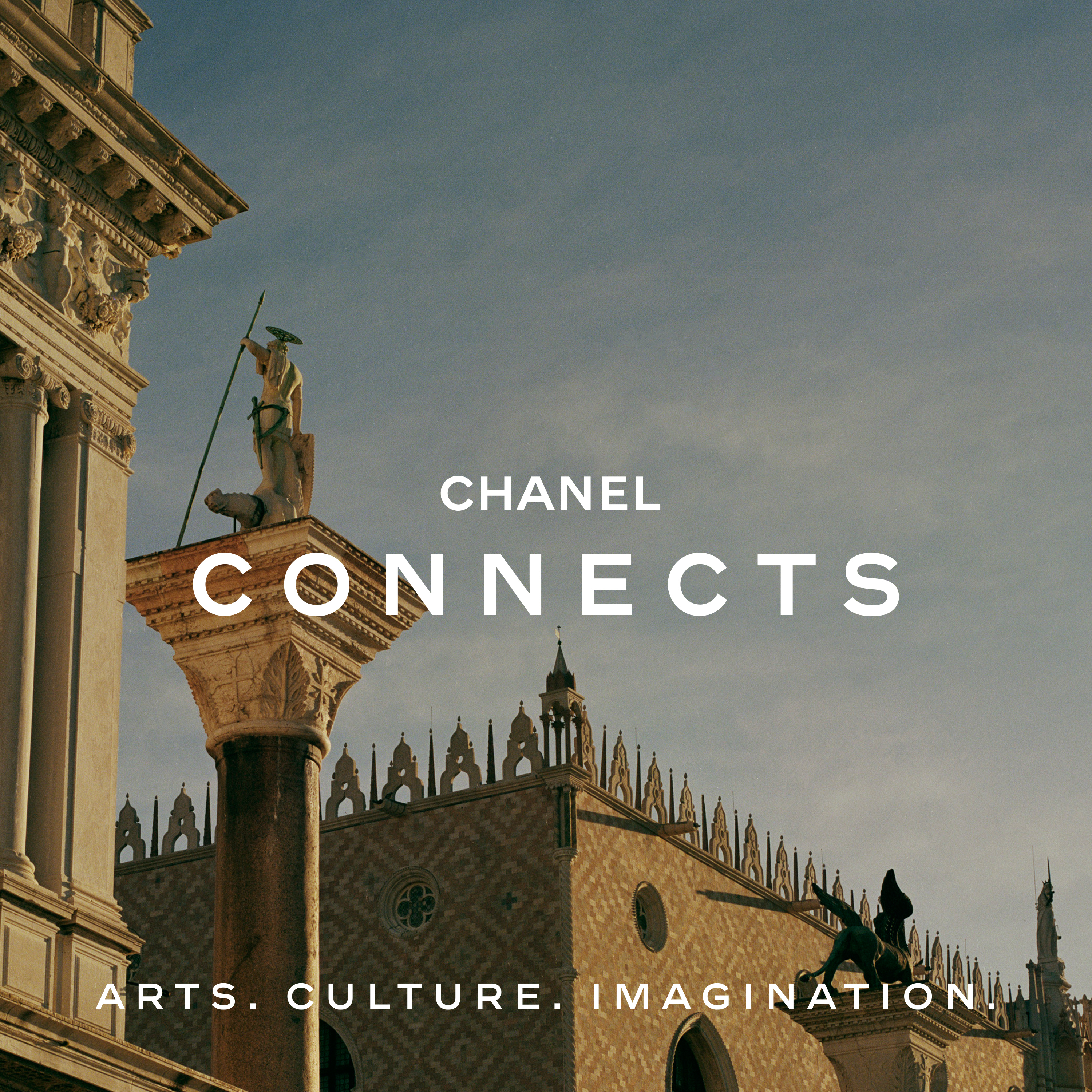
In this season of Chanel Connects, we've taken up residence in Italy to go to the center of the art world. Listen in to the artists, curators, thinkers and makers behind the Venice Biennale, the world's most important exhibition of contemporary art. Now in its 60th edition. Each of our guests is focused on what matters most and what happens next. I'm Jana Peel, global head of arts and culture at Chanel. Thank you for connecting with us.
- [01:02]
Hildegunner Bergisdotter
Could you tell where my head was at when you found me? Me and you went to. Hello.
- [01:11]
Jana Peel
The poet Andre Codrescu described Venice as a place of fleeting beauty. The knowledge that we won't be here for long gives everyone an intense appetite for living, he said. Beauty and nature are key concerns for our guests this week. Icelandic artist Hildegunner Bergisdotter and Hong Kong's Trevor Young. After a hectic week installing their exhibitions, they sat down with moderator Penny Martin in Venice's Conservatorio de Musica. With the sound of an opera class drifting through the corridors, Penny started by asking them how they were each enjoying the Biennale.
- [01:56]
Hildegunner Bergisdotter
It's been magnificent. How so? Having my dear friends helping me, you know, it's a small country, we're all friends. I've been having the, you know, time of my life, really. It was kind of a decision I made that I would like to do a project like this only if it could be a pleasant experience. So we made it one. So it's been amazing.
- [02:21]
Trevor Young
What do you avoid in making it a good experience?
- [02:25]
Hildegunner Bergisdotter
I need to have a good attitude and have perspective, and I get that through my family. I guess they're not necessarily. My partner is not the biggest art enthusiast, so come home in the evening. And he doesn't even know the title of my show. And that's perspective for me. And it's exciting and nice and that makes me more relaxed, and it makes this feel. Experience, a happy one.
- [02:51]
Trevor Young
Trevor, what's it been like for you this week?
- [02:54]
Penny Martin
I feel so connected in a way, because, I mean, Hong Kong is relatively. Also small and.
- [02:59]
Hildegunner Bergisdotter
Relatively. Yes.
- [03:01]
Penny Martin
I mean, compared to that, like. No. I mean, the accum. The Art community is also quite small and everyone know each other. And I think this is the first time that I really build up a team. And we all come here to set up the exhibition together. So we were like 10 people, 10 of us, like coming to here like for one month to build up the whole things together. And I think that's one of the beautiful things that happens.
- [03:27]
Trevor Young
Before we get onto the what's exactly inside your exhibitions. Let's spool back a little bit to your arrival. How well do you know Venice and what do you enjoy most of the city? Have you been here often?
- [03:41]
Hildegunner Bergisdotter
Yeah, I've been here quite, quite often. I came here first time, I think. Well, I know it was 20 years ago and I was very pregnant and I had an awful experience. It was a heat wave, mosquitoes pregnant, very nauseous through the whole pregnancies. It was a demon, like pregnancy on boats. And had young friends who wanted to party. You can just imagine sitting the only sober person in a party in a heat wave in Venice. It's not a pleasant thing. And I was just like, yeah, didn't really believe the city. I was like, this feels fake to me. This is like a Disney World, you know. Then I came back and I've come back so many times and every time I fall in love with the city more and more. Yeah. So I'm falling hard.
- [04:30]
Trevor Young
So what are the romantic highlights now that you're better acquainted?
- [04:34]
Hildegunner Bergisdotter
I got to teach here, which was amazing. And then you get to know the everyday. And I'm really in love with the everyday and the island mentality, which I of course know a little bit from Iceland. Just fixing it. You can't run to any store. We don't have particular stores for everything. This MacGyver way of like just getting it done, which is, you know, in my blood really. And I see that so much in the Venetians that live here.
- [05:03]
Trevor Young
Does that pragmatism resonate with you, Trevor? I saw you nodding vigorously at island mentality.
- [05:10]
Penny Martin
Well, I think all the artists who are setting up exhibition or making the projects here, everyone is looking for similar things, like even like masking tape or like tape or like glue.
- [05:21]
Trevor Young
So it's like the circus coming to town. Literally everything is in that wagon. Well, tell us how that applies to Courtyard of Attachments. Your show. What's the first thing we see?
- [05:30]
Penny Martin
The first thing that we see will be like a fountain with like 20 fish tank. Like you can actually smell. Actually, maybe you can smell some of the sea water. But at the end of the show, you Will see like a pink room, pink lighted room with like more than 40 fish tanks, but all emptied. When you talk about Hong Kong and Venice, it's also like both like city that live like really set really next to the water. And in a way that in Hong Kong, because I growing up in Hong Kong, we can see the sea next to us. However, we don't really live with the water, the food. Like we are not getting the seafood that lakes to the Hong Kong, we are imported to seafood. And also the life of water is not really connecting in a way, but in a way that you like that we have a strong pet culture. Like, we love little animal. Like actually aquarium is the best like pet to kind of have in Hong Kong. And I think this is also the pet I have since I grow up as a kid. And in a way that the sea is like, right, like, like next to you, like in Hong Kong, basically you can go to any like beach or like next to the ocean within 30 minutes. But at the same time, like, even though do I go to the beach that much? Maybe once a year. So it feels very distant. So somehow the chance of touching the water, touching the sea is not that as close as here.
- [07:04]
Trevor Young
But I believe for you there was a personal connection. Did your father not own a seafood restaurant?
- [07:09]
Penny Martin
My father owned a seafood restaurant in China. So they always have an aquarium outside the restaurant that you can see all the fish not screaming, but swimming. But in a way you think of actually those other fish that's going to be killed and cooked and being eaten Squid Makes sense.
- [07:30]
Hildegunner Bergisdotter
Yeah, it makes sense, yeah.
- [07:31]
Penny Martin
But when I was a kid, like I spent like quite a lot of time and I think it start to make me feel the connection with like the little fish. And I also look at the people who are working in the. Taking care of those like that civil corner. You feel that they're quite laid back. So they are like taking care of the fish. Compared to people who are working in the restaurant, they are the easygoing one. So it kind of makes a contrast about. Oh, it seems I want to be in a kind of safe place.
- [08:02]
Trevor Young
Hilde, Gunnar, introduce us to your exhibition. What are you exploring?
- [08:07]
Hildegunner Bergisdotter
My kind of speculations and my results or understandings of being a person within a system of sorts. The capital. And I have this thing where I wake up every morning astounded that human race has come to this. And I kind of. My works are always a reflection on that disbelief.
- [08:34]
Trevor Young
You called them objects teased from the systems of commerce.
- [08:37]
Hildegunner Bergisdotter
Yes.
- [08:38]
Trevor Young
So what are those materials? Describe them to Me.
- [08:41]
Hildegunner Bergisdotter
There are two large silhouettes made from this new invention, a veneer made out of ute bags, which are used to transport coffee, which is very related to Venice and Venetian history in some sense. One of the pieces was actually supposed to be made of blue denim that broke on the way. So it was quickly fixed and is now also a ute bag. So I went from retail to commerce with that piece, but still very relevant and exactly what the show needed. Of course, everything happens for a reason, I guess.
- [09:24]
Trevor Young
Could these exhibitions have happened anywhere? What's specific about Venice as a context for you?
- [09:31]
Hildegunner Bergisdotter
I know your connection.
- [09:32]
Penny Martin
I know some.
- [09:32]
Hildegunner Bergisdotter
Yeah, yeah. You start, I think, like, aren't you.
- [09:35]
Trevor Young
Pumping water out of the ground? Yeah, pumping water from the cannon into the lagoon. Tell us about that, please.
- [09:40]
Hildegunner Bergisdotter
How does it smell?
- [09:41]
Penny Martin
Yes, I mean, actually, it's not that bad.
- [09:43]
Hildegunner Bergisdotter
Oh, good.
- [09:44]
Penny Martin
Yes. But I mean, the first time we have a cleaned field, we have to clean the bottom of the pool. So when we start to work on this project, we think of, like, the water, how to get the. But we all feel like, oh, the water is quite dirty. So in a way of the best thing is, let's do something to filter the water. And this is what we do every day when you have an aquarium. So we got the permit to kind of extract the water from the sea, and then we filter it, and then.
- [10:10]
Hildegunner Bergisdotter
It becomes the work as we have talked about. I was invited to do the show, and I decided to do my next show, and it just happens to be in Venice. But of course, I get, like, a model that is the space that I have. And I found a window hidden behind the wall, and I opened, and then there was a canal, and then there was a wall behind that, and I hung a billboard on that wall. So it's been like, really emerged in the space. But I have slowly also, you know, understood that my show is called. That's a very large number, a Kommerzbau, which is like a nod to Kurzwitters, but also just about commerce, which Venice is like. Like we talked about with the ute bags of coffee. It's a very place. It's an old place of commerce. So, like, slowly, I've understood that my show, that I thought was just my next show is a very Venetian show. I have a plastic pizza in the wall that is made in China. And every Venetian that has ever walked through, like. Like all the pizza in Venice, they're like, oh, it's like a social commentary. And I didn't really know and understand that before I installed how very actually like a site specific thing. It is indeed.
- [11:23]
Trevor Young
Am I right in saying that you're both describing a sort of antipathy towards man's relationship with commerce and manufacturing and nature. I wonder how much that's informed by your respective upbringings and the kind of environments that you grew up in.
- [11:39]
Hildegunner Bergisdotter
I think it's very connected with me and I can hear that you know your father's history and the fascination with the fish tank. I'm also very curious and interested about the, the empty fish tank and also this way of like how we approach nature when we live in places that have excluded the sea and you have to. All the things that you have to do to make a natural habitat for a fish. But there's nothing natural about it. That's really. It's ringing my bell. So I'm really excited. I actually wrote Trevor down for one of the people I really wanted to see before I came here. So I'm so, so excited to see his show. But on the topic of like my upcoming upbringing is a huge reason for me not working with nature. Coming from a place that is very connected to nature. The city is small, nature is all around. You take 20 minutes and you're in nature. It's kind of intense but lovely. But my work is always kind of like just talking about this capitalism that has swallowed the universe or like the globe. And I'm so interested in that and I think it comes from exactly that. We used to be so connected to nature but also just deprived of modern ways of life. And it all changes in the Second World War where we have, we have our independence in 44. And before that time like my grandmother lived in a turf house for a. You know, it's. And I am like talking to her in the car when I'm eight, playing my Game Boy. So that's a harsh shift. I think Iceland was and still is because of the lack of people there. Capitalism doesn't really work there perfectly. So I can always, I've always kind of seen through it and that makes me so interested in it. When you see the flaking of the system then you really realize that it is a system and man made thing and not a law or a natural law or. And that makes me so interested in the state of things. So yeah, I think it's really influenced the way I do my art.
- [13:50]
Penny Martin
Like when you also talk about system I think it's so interesting that we are very. We come similar but at the same time because of our background like in Hong Kong we have so I mean they have like leisures in the surrounding, but it's like the core thing is we are in a city. So I was trying to like, mimic using a lot of like, artificial, like language or even having like an aquarium that try to mimic nature. And even though when people see my work about garden, they think that appropriate. I live with nature, but the thing is, like, I live in like a concrete jungle. I mean, this is always. People talk about Hong Kong concrete jungle. And in a way of they have like all the things that I was like expecting, like, about leisure is something that ideally shaped like, by people. Like, I'm anxious on the plants, but somehow they are kept in a greenhouse.
- [14:41]
Trevor Young
What role can artists play in discussions about destruction of the environment and about climate crisis? Do you feel that there is a duty to touch on that?
- [14:52]
Hildegunner Bergisdotter
I mean, I think it's just a part of being human today. It's in your face. It's, you know, and being an artist is kind of always trying to be honest or just trying to make it come from yourself. So it can't be a thing that you take on. And now I'm gon talk about nature, but it has to really be something that is within you and comes from living in a concrete jungle or a place where capitalism just took over overnight. And you really are like, what is this? So I think for me, I had like an epiphany as a kid because I was an anxious kid where I understood that I was really a speck in the, in the universe, a tiny speck before that being very anxious. And I understood that I had no real importance. I was as important as dog poo or dog poo as me. It's like, doesn't really matter which was really relaxing. Bacteria will prevail. And, you know, I was happy about that. It made me less anxious. But then as I grew up, I love people and I love human beings and I really do not want them to suffer. So I had like, oh, no, I still have a moral issue here. And I had a horrible time getting to terms with entropy just in its entirety. I was like, I cannot open this door because I will use the hinges. You know. But then slowly, I also had to come to terms with that. And I am a part of this system. And that is very helpful for me because I was paralyzed for a few, like, a couple of months before a big show where I just didn't want to do more work. And it's because of this, you know, problem of overproduction. And then I had to kind of like, breathe into it and I'm part of the system, and I'm reporting from within the system. I cannot have a vantage point from outer space or outside the system of commerce, because I am also the problem. So for me to deal with it is through the beauty and tragedy of the situation. And I really want to affect people with beauty, thought, moments. And that's why I do my art, and that's why I exhibit my art.
- [17:10]
Penny Martin
I also constantly think about, like, oh, how to be responsible in a way. I mean, the best way is, like, don't do anything. Like, don't do artwork. I mean, this is the best way. Like, you don't produce anything, but in a way that as a person, as an artist, there's something that we can do, something that can go further. Empathy is something that I believe a lot. And at the same time, when you have the aquarium, when you look at the fish, the way that you feel connected with the fish, you position yourself as a fish, it becomes something very important of, like, the audience who experience my work, I want them to feel, like, not what the artists feel. It's about what the audience feel, what the fish will feel when they see empty fish stand. Because those fish stand, they have, like, a mirror at the back. So somehow that you look at yourself. And so in a way that it really question about how a audience, how, as a human being, how they think about something, think about plants, think about, like, other animals. Because at the end, we are just equally the same in the earth.
- [18:14]
Trevor Young
You both mentioned challenges in installing your specific shows. Give us an idea of how you overcome those kinds of roadblocks.
- [18:24]
Penny Martin
I think, like, yes. I mean, since I was in school, like, learning arts, we always have to deal with, like, being alone or doing things alone. And for this project, that's the first time that I started. I mean, I still build up my team because you cannot do everything alone. And I think that the way that I overcome difficulties or, like, the challenge is, like, to trust other people and also believe on people that they are helping you. And I think this is the hardest part, but I think once you overcome that, you are much stronger than you think.
- [19:00]
Hildegunner Bergisdotter
That's beautiful.
- [19:02]
Trevor Young
Yeah.
- [19:03]
Hildegunner Bergisdotter
You have to have trust. And we seem to have had the same experience of having really trustworthy people around, both the local ones and the team. The approach has also been, with me here is just kind of engulf or emerge the problems inside the work. And somehow it's now a part of the show.
- [19:24]
Penny Martin
I had that same call from, like, physically, I have to deal with, have to tap water in here.
- [19:29]
Hildegunner Bergisdotter
Because it's like a problem that's also a definition. Like, what's problematic about this? Oh, it's broken. Could that be a thing? So it's been less fixing and more maybe reconfiguring or with a good team. That is awesome. And. Yeah. And have faith in others and not. Because if you don't do that, then paranoia, ego gets in your way and. Yeah. And that. But it's not a nice place.
- [19:57]
Trevor Young
We'd love to finish up by asking you the same question that we're asking all our conversationalists as part of Chanel Connects. And that is, what are you excited about for the future of art?
- [20:09]
Penny Martin
I think in the way that when we think about future. Future is when we talk about future, it's always something very far. But actually, the next day or the next second is the future already. I just think, like, just be who we are and try to believe on things that we believe.
- [20:22]
Hildegunner Bergisdotter
Yeah. Also, I just remembered, like, because I teach a lot, and I teach art students, and of course, they are the future of art. And I'm always intrigued. You know, artwork used to be. When I was being taught as, like, you don't do this. There are a lot of, like, do's and don'ts and da, da, da. And then they are inside me, even though I'm trying to slowly kill all of them. And then I'm teaching, and I'm trying to be a very kind of, like, open teacher. So I approach each student really, like, open and interested, and they bring me something that is totally forbidden by these invisible laws of art. Something I've never seen before. And I could not understand why a person would make such a thing. And that makes me so excited. It's just things I don't even know the things the future will provide. But, oh, my God, when I see something that I don't have no understanding of, it's like, yes, thank you. And this is what art is so good at. Yeah.
- [21:24]
Penny Martin
I cannot agree more.
- [21:26]
Trevor Young
I think that's a very good place to stop. A hopeful place. Thank you very much, Hildegunner and Trevor.
- [21:33]
Jana Peel
Thank you to Hildegunner and to Trevor and to Penny Martin for moderating that conversation. Both artists talked about getting to know Venice, so we asked some influential visitors to the Biennale about their favorite corners of the city. Where's the best place to eat?
- [21:51]
Penny Martin
I do have one, Arturo, because it's.
- [21:53]
Hildegunner Bergisdotter
Like, the only place you can eat.
- [21:56]
Penny Martin
Really good non fish food.
- [21:59]
Jana Peel
I would say just a scoop of gelato on a random street. I mean, Harry's bar is good.
- [22:04]
Hildegunner Bergisdotter
They have some good food. We had. We got good food tonight.
- [22:08]
Jana Peel
There are these amazing restaurants with the kind of best staff that you can encounter, especially considering the pressure on it being such a torture tourist destination. They can feel very familial when you find the right spot. Harry's is a pretty good place to go. And then I like lots of other small restaurants that are maybe off the beaten track. I've spent time in Venice over the years and I'm sure this restaurant has probably closed, but there was a great restaurant called Filia del Estelle which overlooked the water. And we used to have these fantastic dinners after we installed a show outside and eat delicious tuna and bacala and all kinds of Venetian delicacies. So, yeah, that sticks in my memory.
- [22:48]
Hildegunner Bergisdotter
I love Olivaneri and I feel like we found it 25 years ago and now everyone goes there. But the fried squash blossoms are amazing and the squid ink, like with the polenta, is to die for.
- [23:01]
Trevor Young
There is absolutely no good food in Venice. It is a total myth. There is necessary food in Venice, though, and that when it comes, you take it and you enjoy every bit of it. As soon as somebody gives you something to eat, you take it in this city during the Venice Biennale.
- [23:20]
Jana Peel
Thank you so much to all of our contributors who joined us in Venice for the 60th edition of the Biennale. Thank you for listening to Chanel Connects the Venice Biennale edition. Now, the number five is very important in the house of Chanel, so please consider giving us five stars on whatever platform you're listening to us. Please follow the show so you don't miss an episode for another conversation touching on the relationship between mankind and the natural world. Why not listen back to Annika Yee speaking to John Acomfra, British Pavilion artist at the 60th Venice Biennale. And for more on AI, there's a fascinating chat between Sarah Mayojas and Albert reed in season three. You can find those and lots more on chanel.com next time on Chanel Connects, celebrated designer Michael Rock connects with Irma Boom, the queen of books. Together they discuss the rich history of bookmaking in Venice, books as luxury items, and why books will live on so vibrantly in our digital age.
- [24:27]
Hildegunner Bergisdotter
People say the book is dead or something. I think the book is more alive than ever. And the future for the book is. Yeah. Because it's such a stable medium. And also think that you don't make books for the past or present, but books are really made for the future.
- [24:43]
Jana Peel
See you next week on Chanel connects.