
Podcast
Chaos Computer Club - recent audio-only feed
Hosted by CCC media team · EN
Der Chaos Computer Club ist die größte europäische Hackervereinigung, und seit über 25 Jahren Vermittler im Spannungsfeld technischer und sozialer Entwicklungen.
113episodes
Episodes
Newest firstAll episodes
Field-FX Awards Ceremony (emf2026)
4w ago00:46:38Tap to summarizeFeast your eyes on generative art, executable animations, music, art, and more. Come and see what the people of EMF and the demoscene have released at this year's Field-FX, as we round-up last night's demoparty and give cheers for the entries that the audience voted the best! Licensed to the public under https://creativecommons.org/licenses/by-sa/4.0/ about this event: https://www.emfcamp.org/schedule/2026/343-field-fx-awards-ceremony
Transcribe →
Closing Ceremony (emf2026)
4w ago00:16:40Tap to summarizeThe ceremony in which we close the festival. Goodbye! Licensed to the public under https://creativecommons.org/licenses/by-sa/4.0/ about this event: https://www.emfcamp.org/schedule/2026/279-closing-ceremony
Transcribe →
A practical guide to internet defamation (or: what not to do after you've defamed someone) (emf2026)
4w ago00:32:05Tap to summarizeIt turns out that you can't just say anything on the internet. Things that would be illegal to put in print are also illegal to publish online. We'll be going on a short journey through a real world case of this, from the process of starting a claim to turning up in the high court and what happens next. It'll be a cautionary story covering a range of things you should absolutely not do and what happens when you do them anyway, along with the three words you never want to read in a judicial decision. The presenter is not a lawyer. This will not be legal advice. But in the unlikely event that you end up on either side of a similar situation at some point, it'll give you some insight into how things can go and maybe help you decide what to do next. Licensed to the public under https://creativecommons.org/licenses/by-sa/4.0/ about this event: https://www.emfcamp.org/schedule/2026/305-a-practical-guide-to-internet-defamation-or
Transcribe →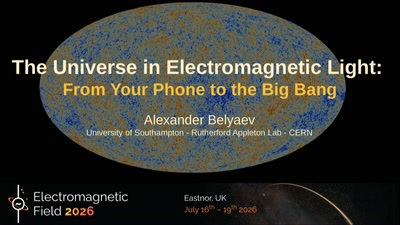
The Universe in Electromagnetic Light: From Your Phone to the Big Bang (emf2026)
4w ago00:33:19Tap to summarizeWhat do your phone, the night sky, and the Big Bang have in common? They all involve light, in one form or another. In this talk, we will follow light across the Universe and back in time, towards the Big Bang. We begin with EMF in everyday life - the electromagnetic waves around us - then move out to the light we receive from stars and galaxies, and finally reach the Cosmic Microwave Background - the oldest light we can see, an afterglow from the early Universe. This ancient signal shows us what the cosmos was like nearly 14 billion years ago, and it also points to one of the biggest mysteries in modern science: most of the matter in the Universe is dark - invisible to us - and we still do not know what it is. Without dark matter, there would be no galaxies, no stars, and no us. To uncover these hidden pieces, physicists use CERN's Large Hadron Collider to smash particles together and recreate the extreme conditions of the early Universe. From the EMF around us to the Big Bang, this is a story about light, matter, and our search for the dark, hidden pieces that dominate the Universe. Licensed to the public under https://creativecommons.org/licenses/by-sa/4.0/ about this event: https://www.emfcamp.org/schedule/2026/239-the-universe-in-electromagnetic-light
Transcribe →
How NOT to make a Random Number Generator? (emf2026)
4w ago00:21:02Tap to summarizeWhat connects quiz-show winners, on-line poker cheaters and cyber attacks on Taiwanese national ID cards? In this talk I’ll present a historical overview of randomness failures. Why are random number generators so often at the root of cyber-security problems and why are they so damn difficult to implement in hardware? I will go over several incidents of security failures caused by bad randomness in the last few decades, and from each incident we will try to learn what not to do. Finally, after eliminating all the wrong ways of generating randomness, possibly we’ll be left with the correct one. Licensed to the public under https://creativecommons.org/licenses/by-sa/4.0/ about this event: https://www.emfcamp.org/schedule/2026/59-how-not-to-make-a-random-number-generator
Transcribe →
Building a Mostly-Local, Mildly Judgemental Home Assistant (emf2026)
4w ago00:31:21Tap to summarizeVoice assistants are getting easier to deploy, but they’re still generic. This talk follows my attempt to build a mostly-local Home Assistant voice system that not only controls the house, but has a personality. We’ll explore the trade-offs between local and cloud services, improving recognition for regional accents, creating custom Piper voices, and adding character to an assistant that would otherwise sound like every other synthetic voice. Along the way we’ll discover where cloud services are still better, where local solutions shine, and why a mildly judgemental anime tsundere can be more enjoyable to live with than a perfectly efficient assistant. Hmpf. Licensed to the public under https://creativecommons.org/licenses/by-sa/4.0/ about this event: https://www.emfcamp.org/schedule/2026/88-building-a-mostly-local-mildly-judgemental-home-assistant
Transcribe →
Flexible PCBs for you and for me: lessons learned from DIY-ing flexible electronics with artists, makers, hackers and engineers (emf2026)
4w ago00:32:29Tap to summarizeFlexible circuit boards (flexible PCBs) are pretty cool: they are lightweight, can fold into small spaces, are bendable, and can be designed to stretch. You might have seen one inside a digital camera, a wearable, or connecting a screen to another board in a laptop or smartphone. Or you might have had one made for an electronics project. But have you ever made one yourself? Unlike conventional, rigid PCBs, chances are you haven’t, for a number of reasons. But it doesn’t have to be this way: this talk will tell you how (and how not to) DIY your own flexible PCBs for your next electronics project. This talk is part of an ongoing project on breaking flexible electronics fabrication out of research labs and specialised manufacturing facilities, and into the hands of makers, hackers, artists, and others. You will learn about materials and techniques for making flexible electronics, weird and wonderful uses for flexible PCBs, and hear about the results of DIY flexible PCB workshops in four different countries and counting. Licensed to the public under https://creativecommons.org/licenses/by-sa/4.0/ about this event: https://www.emfcamp.org/schedule/2026/235-flexible-pcbs-for-you-and-for-me
Transcribe →
Why The Monkey Escaped the Cage (emf2026)
4w ago00:31:32Tap to summarizeRobin Ince is a multi award winning comedian, author, broadcaster, bibliomaniac and a populariser of scientific ideas. He is perhaps best known as the former co-host and co-creator of the Sony Gold Award winning BBC Radio 4 series The Infinite Monkey Cage with Professor Brian Cox. As a stand up Robin has toured the world and as an author he has written four acclaimed books, including Bibliomaniac, which earned him the prestigious Booksellers Association Author of the Year award. His fifth, Normally Weird and Weirdly Normal, was published in May 2025. He co-created the Cosmic Shambles Network and created the groundbreaking science variety night Nine Lessons and Carols for Curious People which has been adapted worldwide. Licensed to the public under https://creativecommons.org/licenses/by-sa/4.0/ about this event: https://www.emfcamp.org/schedule/2026/296-why-the-monkey-escaped-the-cage
Transcribe →
🔒Lock Picking Robot! 🤖🔓 (emf2026)
4w ago00:17:27Tap to summarizeAn open source lock-picking robot, which counterintuitively is designed to make locks more secure. Made as an alternative to master keys, which are used widely (for example, on almost every suitcase) and have large inherent security issues. The lockpicking robot uses a series of wires which push through a custom 3D-printed steel key blank to spoof the correct key bitting. github.com/etinaude/unlocked 🔒➡️🔑🤖➡️🔓 Licensed to the public under https://creativecommons.org/licenses/by-sa/4.0/ about this event: https://www.emfcamp.org/schedule/2026/56-lock-picking-robot
Transcribe →
The Xelatype: a journey through time and space (emf2026)
4w ago00:28:56Tap to summarizeIn my quest for Weird Art, long have I wanted to build a digital slit-scan camera. The idea was to take a linear CCD, a load of RAM, and glue them together with an FPGA. But as I pursued the project, things went in a strange new direction, and I ended up creating something different, something so fascinatingly odd that it changed the way I think about time and space. It all got quite philosophical. Egotistically I named the project after my online alias, and then kept it secret for the best part of a decade. In this talk, all shall be revealed... Licensed to the public under https://creativecommons.org/licenses/by-sa/4.0/ about this event: https://www.emfcamp.org/schedule/2026/205-the-xelatype-a-journey-through-time-and-space
Transcribe →