
Podcast
Chaos Computer Club - recent events feed
Hosted by CCC media team · EN
Der Chaos Computer Club ist die größte europäische Hackervereinigung, und seit über 25 Jahren Vermittler im Spannungsfeld technischer und sozialer Entwicklungen.
112episodes
Episodes
Newest firstAll episodes
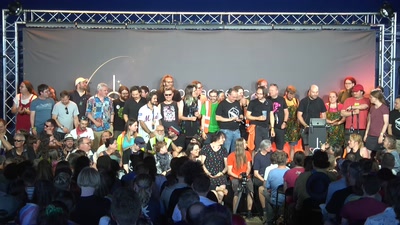
Closing Ceremony (emf2026)
3w ago00:16:40Tap to summarizeThe ceremony in which we close the festival. Goodbye! Licensed to the public under https://creativecommons.org/licenses/by-sa/4.0/ about this event: https://www.emfcamp.org/schedule/2026/279-closing-ceremony
Transcribe →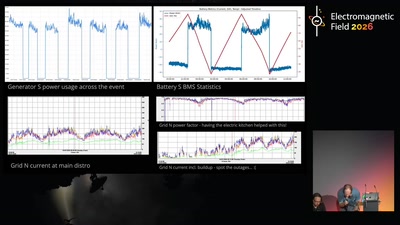
Infrastructure Review (emf2026)
3w ago00:46:35Tap to summarizeMembers of the EMF infrastructure teams will talk about how we made the event happen this year, with all the important statistics. Licensed to the public under https://creativecommons.org/licenses/by-sa/4.0/ about this event: https://www.emfcamp.org/schedule/2026/124-infrastructure-review
Transcribe →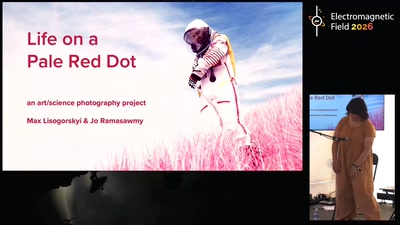
Life on a Pale Red Dot (emf2026)
3w ago00:25:27Tap to summarizeWhat could other worlds look like? Exoplanetology — the study of planets orbiting stars other than our sun — is rapidly progressing, and researchers are discovering increasing numbers of planets. Little is known about these distant worlds — perhaps their mass, or their radius, but conditions on the surface are still left somewhat to our imagination. The nearest star to the Earth after the Sun is Proxima Centauri, a mere four light years away, and we now know it too hosts a planet. Much smaller and redder than our Sun, Proxima emits most of its light in the infrared part of the electromagnetic spectrum, rather than the visible range. Life on Earth has evolved to make the most of the Sun’s energy — but how would life have evolved on a planet with a very different kind of light available? Our project explores this idea using Kodak Aerochrome, a false-colour infrared film. Sensitive to light extending into the infrared regime, where foliage reflects strongly, it produces images that mimic the red hued plant life that we might find on other planets. Through this series of photographs we explore the story of an astronaut visiting one of these distant worlds. See the exhibition of photographs in the Robot Arms and on Sunday from 1pm in the Arts tent. Licensed to the public under https://creativecommons.org/licenses/by-sa/4.0/ about this event: https://www.emfcamp.org/schedule/2026/435-life-on-a-pale-red-dot
Transcribe →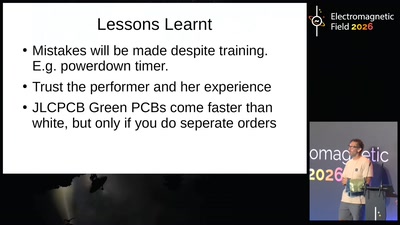
"Don't set fire to the singer!"; Making a video jacket for a world concert tour. (emf2026)
3w ago00:37:36Tap to summarizeA deep dive into the process of designing and implementing a fully custom-built wearable video screen, which was used on a 50-date international arena concert tour by a well-known musical artist in 2025 and 2026. Details of all aspects will be explored, from initial concept design with the artist's creative and tour production teams, technical electronic and mechanical aspects, integration of the electronics into the costume, as well as the practicalities of building reliable & robust hardware on a very short timescale. And of course the safety aspects of making a body-worn system capable of using over 250 watts of power. This was a commercial project, and is planned to be a joint presentation by myself (freelance electronics consultant) for the technical aspects, and my client (design studio) talking about production liaison, logistics and final hardware integration (sewing & wiring!). Licensed to the public under https://creativecommons.org/licenses/by-sa/4.0/ about this event: https://www.emfcamp.org/schedule/2026/37-dont-set-fire-to-the-singer-making-a-video-jacket
Transcribe →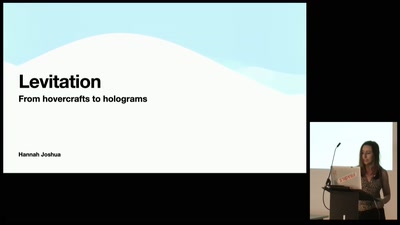
Levitation, from hovercrafts to holograms (emf2026)
3w ago00:31:02Tap to summarizeLevitation is a popular trope of magical media, but are we actually able to defy gravity and suspend things in the air? The short answer is yes. And the longer answer is we have lots of different ways. Using magnets, sound, light, and more we’ve levitated objects from single cells to entire passenger trains. We’ll go over the basic principles underpinning each approach, and consider their benefits and drawbacks, and we’ll also cover why you should care - because making stuff levitate can be useful for reasons you might not think, like making better drugs, creating holograms or improving transport networks between cities. Licensed to the public under https://creativecommons.org/licenses/by-sa/4.0/ about this event: https://www.emfcamp.org/schedule/2026/218-levitation-from-hovercrafts-to-holograms
Transcribe →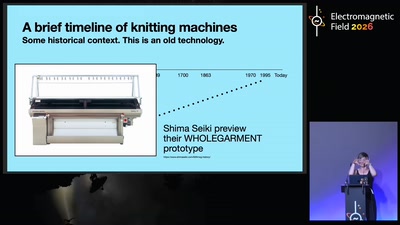
Did a Robot Knit Your Jumper? (emf2026)
3w ago00:22:51Tap to summarizeMachine knitting has grown in use and popularity over the past decade as domestic knitting machines have been rescued from dusty attics. Computerised knitting machines are now within reach for significantly less money than their older, more established industrial ancestors. But what makes an industrial knitting machine different from one you could have at home? What does it mean for it to be computerised? What is the difference between a ‘fully fashioned garment’ versus a ‘complete garment’? This talk will start with the fundamentals of how to knit a jumper and will walk through the industrial manufacturing history of knitting frames and machines, highlighting the mechanical engineering innovations that have allowed machines to move closer to replicating the agility of human hands knitting yarn. Did a robot knit your jumper? Probably not, but it is exciting to see how this technology is progressing and what it is enabling. Licensed to the public under https://creativecommons.org/licenses/by-sa/4.0/ about this event: https://www.emfcamp.org/schedule/2026/203-did-a-robot-knit-your-jumper
Transcribe →
OBD-II: Obviously Broken Design, Too... My Introduction into car-hacking (emf2026)
3w ago00:19:35Tap to summarizeIs it still your car? With a modern car running between 100 and 150 small computers - ECUs - the question is hard to answer. In 2015 some hackers took control together with a baffled Wired reporter of the car he was driving, from miles away. This led to a lot more interest in those computers constantly talking to each other over CAN bus. There is a massive playground here and most people do not even know the gate is open. Maybe you already have a Bluetooth ELM-327 dongle visualising CAN data on your smartphone. That is the crack that lets you dig deeper. The next step is the Macchina M2 - which goes so much further. You get direct access to more vehicle interfaces than most hackers even know exist. I will show you SavvyCAN and Wireshark capturing live CAN traffic and we will decode what those packets are actually saying. Your own car, your own hardware, completely legal. By the end of this talk you will want to go straight to the car park and plug something in. Licensed to the public under https://creativecommons.org/licenses/by-sa/4.0/ about this event: https://www.emfcamp.org/schedule/2026/57-obd-ii-obviously-broken-design-too
Transcribe →
How To Debug A Human: An Engineer’s Guide To Emergency Medicine (emf2026)
3w ago00:28:03Tap to summarizeWhat does designing software have in common with keeping people alive? More than you might think, probably. Decomposing software problems might take different knowledge than turning syndromes into diagnoses, but if you’ve got the skills to do one, you’re well on your way to the other. Join a computer scientist turned ambulance crew, awaiting results on their Masters in Paramedic Science, to learn how to take a software engineering approach to saving a life – from the roadside all the way to the bedside in A&E. No prior knowledge required: you won’t get a qualification, or medical advice, but you will learn what a primary survey has to do with requirements-gathering, how to put a breakpoint in a patient’s heart without opening them up, and how screwing in a lightbulb can tell you what part of someone’s brain is broken. Licensed to the public under https://creativecommons.org/licenses/by-sa/4.0/ about this event: https://www.emfcamp.org/schedule/2026/77-how-to-debug-a-human
Transcribe →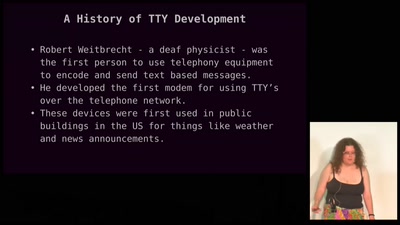
Phones for the Deaf (emf2026)
3w ago00:26:30Tap to summarizeHave you ever gotten a call from a relay operator who wants to connect you with someone who's using a text phone? Did you hang up? Stop it! I want to tell you about the past, present, and future of textphones, and how deaf people and people with difficulty speaking communicate with phone users. Finally, I want you to stop hanging up on me! Let's look at the systems behind different assistive technologies, how they are used, and the people who keep them running- people who are some of the last operators in the phone network today. From early POTS tone systems for the first landlines to modern apps, we'll see how a tiny but vital corner of the phone system works. This talk will be presented in spoken English with live captioning. I am a hearing English and BSL speaker. I have used textphones and relay phone services since childhood and have worked in phone technology and technology accessibility for a number of years. Licensed to the public under https://creativecommons.org/licenses/by-sa/4.0/ about this event: https://www.emfcamp.org/schedule/2026/76-phones-for-the-deaf
Transcribe →
So - how does the Internet really work (emf2026)
3w ago00:30:29Tap to summarizeLearn about the fascinating and fun world of computer networks and the Internet - with no previous knowledge required. Have you ever wondered how the Internet works? Or computer networks in general? Have you tried learning this in the past, but found it too confusing or intimidating? Then this talk might be for you. We will start with a walkthrough of how data crosses your home network. Building on this, we will talk about how data reaches your internet provider continues its travels through the Internet. We will briefly touch on different technologies that are used (cabled vs wifi networking), and give a high-level explanation of how pathfinding works in the Internet. Afterwards you will have an idea of how Ethernet, and common Internet Protocols (DHCP, DNS, BGP). While we cannot cover everything, we will show you how to learn more about this fascinating world. The talk will mention how you can use network simulators or participate in large distributed networks to try different Internet technologies yourself. Licensed to the public under https://creativecommons.org/licenses/by-sa/4.0/ about this event: https://www.emfcamp.org/schedule/2026/98-so-how-does-the-internet-really-work
Transcribe →