
Podcast
Chaos Computer Club - recent events feed (low quality)
Hosted by CCC media team · EN
Der Chaos Computer Club ist die größte europäische Hackervereinigung, und seit über 25 Jahren Vermittler im Spannungsfeld technischer und sozialer Entwicklungen.
107episodes
Episodes
Newest firstAll episodes
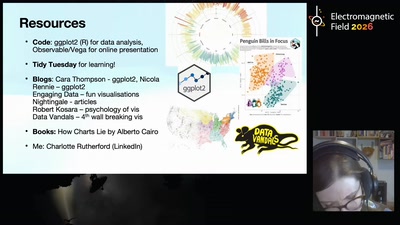
Data Visualisation: The Good, The Bad, The Ugly and the Beautiful (emf2026)
1w ago00:19:26Tap to summarize(Alt title - Look at this Graph: How to make Visualisations to be Proud of) You probably encounter at least one data visualisation every day - whether that's in the news, in your own projects, or just scrolling through r/dataisugly. But what makes a visualisation good or bad? Data visualisation lets us leverage the powerful parallel processing abilities of our visual cognition system to understand data in an intuitive way. However, this system is also subject to bias, leaving us vulnerable to misunderstanding if the visualisation is designed poorly. As Tim Harford puts it, it is not always the "ugly" visualisations that are the most misleading, but the "beautiful". In this talk I will discuss some classic dataviz rules of thumb, as well as newer research that may challenge these heuristics (spoiler alert: pie charts might not be as bad as you think!). I'll also discuss some ways you can make your own visualisations beautiful, interesting and trustworthy, using the R package ggplot2 as a worked example. Licensed to the public under https://creativecommons.org/licenses/by-sa/4.0/ about this event: https://www.emfcamp.org/schedule/2026/241-data-visualisation-the-good-the-bad-the-ugly
Transcribe →
Lightning Talks (emf2026)
1w ago00:36:31Tap to summarizeThis time is reserved for Lightning Talks - signup details to be published soon. Licensed to the public under https://creativecommons.org/licenses/by-sa/4.0/ about this event: https://www.emfcamp.org/schedule/2026/376-lightning-talks
Transcribe →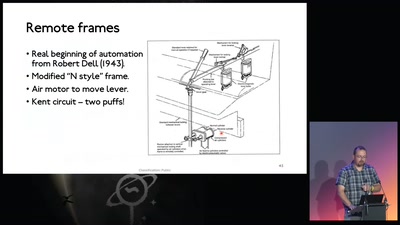
Signalling on the London Underground (emf2026)
1w ago00:38:10Tap to summarizeA deep dive into the history and technical innovations that have facilitated the (usually) speedy transit of millions of daily passengers across London. We begin with a short history of the network, cover the differences required for tunnel based signalling under a bustling capital, explore some amazing inventions to handle rising passenger demand, and finish with the current state of communications based train control which has been gradually displacing traditional fixed signalling on the underground. The author is a volunteer at the London Transport Museum but this talk is not affiliated. Licensed to the public under https://creativecommons.org/licenses/by-sa/4.0/ about this event: https://www.emfcamp.org/schedule/2026/36-signalling-on-the-london-underground
Transcribe →
A Brief History of the QR Code, and other scannable things (emf2026)
1w ago00:16:33Tap to summarizeQR Codes! They're everywhere, and after this talk you'll see them everywhere. They've invaded every part of modern life - but how did they get there? (Have they always been here, in secret?) This talk will cover the history of scanning things that contain information such as the barcode, covering not just one but TWO whole dimensions of scanning. Where was the first barcode (spoilers, it involves trains)? Is it true that barcodes caused a conspiracy in the 1980s? We'll learn what competitors are there for the QR code and why they failed under the might of the QR. We'll explore why the QR code so pervasive in modern society and what makes them so good. This presentation will generally be light hearted and whimsical, and will contain several jokes, some serious security advice, but generally be light entertainment. There will be no AI imagery or text. Licensed to the public under https://creativecommons.org/licenses/by-sa/4.0/ about this event: https://www.emfcamp.org/schedule/2026/234-a-brief-history-of-the-qr-code-and-other-scannable-things
Transcribe →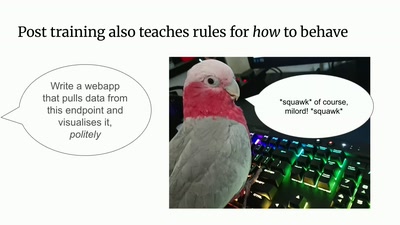
So AIs are lying to us now, huh? (emf2026)
1w ago00:26:54Tap to summarizeAs AI systems are getting smarter, safety researchers are increasingly concerned by a new capability of these models - they are getting very good at lying. This behaviour is seen both in and out of evaluation settings, and has a fascinating range of root causes. In this talk, we'll investigate the phenomena of AI deception across a broad range of scenarios. Discover how chatbots lie for your own good, when models strategically hide their capabilities, and why ChatGPT is better than you at Avalon. We'll cover how researchers are training model organisms designed to be good at deception, and how this helps us to detect scheming in the wild. Most importantly, we'll attempt to answer the question: how worried should we be about all this? Licensed to the public under https://creativecommons.org/licenses/by-sa/4.0/ about this event: https://www.emfcamp.org/schedule/2026/154-so-ais-are-lying-to-us-now-huh
Transcribe →
PolyGen - Inside the game (emf2026)
1w ago00:27:03Tap to summarizeThis talk is about how the PolyGen game works, see inside the units, a breakdown of how all the bits hang together. This is a combination of a talk and hands-on opening the units up and seeing inside them. A chance for people to ask questions, play around with the insides of the units. For those playing PolyGen this will be an opportunity to capture a special "talk only" unit. Licensed to the public under https://creativecommons.org/licenses/by-sa/4.0/ about this event: https://www.emfcamp.org/schedule/2026/293-polygen-inside-the-game
Transcribe →
A short history of arcades and arcade machines (emf2026)
1w ago00:51:57Tap to summarizeArcade machines have a rich history, at times at the forefront of technology, and often the most bizarre machines. Machines that delivered electric shocks (supposedly therapeutic) and working automata models of executions or hen pecked husbands (titled ‘Is Marriage worth it’). The first seaside arcade opened in Blackpool in 1894, under the newly built tower. The machines were all clockwork automata scenes, with an attendant constantly rewinding them. Arcades became widespread after the craze for Edison’s Kinetoscope, the predecessor of ‘What the Butler Saw’ machines. Kinetoscopes were a sensation – the first time anyone had seen moving images of any sort, so ‘Kinetoscope parlours’ sprang up in every city centre. Once cinemas got established the craze faded and the parlours diversified – adding fortune tellers, ball runs, shooting games and of course one armed bandits. The arrival of computer games in the 1980s shook everything up. At first very popular in arcades but soon eclipsed by cheaper to play home computer games. Most city centre arcades have since closed, though many seaside arcades survive with ‘redemption’ machines. These spit out tickets when you win. Before leaving you take all your tickets to the desk to ‘redeem’ a prize. The talk will be illustrated by photos and videos of the old machines and also some of Tim’s own arcade machines influenced by their history. Tim has made over 40 arcade machines and now runs two arcades. The talk will include some of Tim’s machines that were particularly inspired by the history. Licensed to the public under https://creativecommons.org/licenses/by-sa/4.0/ about this event: https://www.emfcamp.org/schedule/2026/127-a-short-history-of-arcades-and-arcade-machines
Transcribe →
Hacking a mobility scooter for features and lights (emf2026)
1w ago00:21:31Tap to summarizeFollowing the talk "Remote controlled chaos cart" at EMF 2024, I have been inspired to do my own take on the same idea. But instead of starting with a trolley and a hoverboard, I decided to start with a mobility scooter. I have ME/CFS, and get to use a mobility scooter most of the time while out and about. But they are fundamentally boring vehicles, and could use a little adapting to be more fun. They are also 24v vehicles, and it is amazing just how many 12v devices can be used at 24v. After starting with a USB charger, I moved on to lights, and then a foot pedal for speed control. Arduinos were involved and sacrificed. A diversion was had when my motor failed, but I then returned to adapting the horn, and then having to transfer much of the stuff to a new scooter when a second motor failed and couldn't be replaced. The takeaway is somewhere along the lines of "Just because you have to use a mobility scooter, it doesn't have to be plain, boring, and can be hacked for interesting features". Mine certainly is now. Licensed to the public under https://creativecommons.org/licenses/by-sa/4.0/ about this event: https://www.emfcamp.org/schedule/2026/86-hacking-a-mobility-scooter-for-features-and-lights
Transcribe →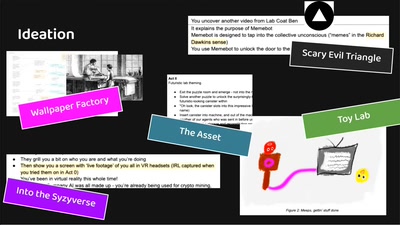
If you can dream it: building a pop-up escape room (emf2026)
1w ago00:29:54Tap to summarizeWe love escape rooms, and it's awesome how the industry has evolved to provide ever more impressive and immersive experiences. Some of the top escape rooms today are huge warehouse-spanning installations with six-figure budgets. But what if they didn't have to be? Last year, our team had the opportunity to build a pop-up escape room. We wanted to match the creative ambition and capacity for wonder demonstrated by the biggest and best escape rooms in the world; implemented with the scrappy enthusiasm, inherent impermanence, and modest budget of an amateur theatre production. What we built turned out to be a real dream. Over our five-month run, our core team (gradually bolstered by dozens more volunteers) provided a unique and delightful experience for over six hundred visitors of all ages, including twenty children, two babies, and one dog. We received amazing feedback, tremendously kind reviews, and hugely encouraging industry recognition. In this talk we'll cover how we turned our ideas into reality, what went to plan, what went wrong, and what we learned. Most importantly, we hope to show what is possible and perhaps inspire other projects, because we'd love to see more escape rooms in the world. Licensed to the public under https://creativecommons.org/licenses/by-sa/4.0/ about this event: https://www.emfcamp.org/schedule/2026/229-if-you-can-dream-it-building-a-pop-up-escape-room
Transcribe →
Vom Hacker zum Spion - die Geschichte des KGB-Hacks der 1980 Jahre (hackover2026)
1w ago01:14:57Tap to summarizeMarkus Hess wird aus erste Hand über seine Rolle als KGB-Hacker, die technischen Möglichkeiten und Methoden jener Zeit, seine Motivation sowie die Lehren für heutige IT-Sicherheits- und Resilienzfragen berichten. In den späten 1980er-Jahren war Markus Hess maßgeblich an einer der bedeutendsten Spionage- und Hackeraktivitäten des Kalten Krieges beteiligt. Als Teil der sogenannten KGB-Hack-Affäre verschaffte er sich Zugriff auf westliche Computersysteme und leitete militärische und wissenschaftliche Informationen an den sowjetischen Geheimdienst weiter. Nach der Zerschlagung der Hackergruppe wurde er 1990 wegen geheimdienstlicher Agententätigkeit verurteilt. In diesem Vortrag wird er die Geschichte aus einer sehr persönlichen Sicht - mal ernst, mal anekdotisch - über die Anfänge der Cyberspionage erzählen. Licensed to the public under https://creativecommons.org/licenses/by/4.0/ about this event: https://talks.hackover.de/ho26/talk/GQMX88/
Transcribe →