
Podcast
Chaos Computer Club - recent events feed
Hosted by CCC media team · EN
Der Chaos Computer Club ist die größte europäische Hackervereinigung, und seit über 25 Jahren Vermittler im Spannungsfeld technischer und sozialer Entwicklungen.
121episodes
Episodes
Newest firstAll episodes

Wie misst man Gegenstände nur mit einer Kamera und einem Club-Laser? (dobyte2026)
Jun 2000:21:48Tap to summarizeLasershows hat jede*r wahrscheinlich schon mal in einem Club, auf einem Festival oder einem Konzert gesehen. Aber was kann man außer buntem Licht noch alles damit anstellen? Wie wärs zum Beispiel mit Kisten vermessen? In diesem Talk erzähle ich wie (gut) das geht, was man beachten muss, und wie ich es geschafft habe, dabei die Kamera von meinem Handy in Mitleidenschaft zu ziehen. Licensed to the public under https://creativecommons.org/licenses/by/4.0/ about this event: https://fahrplan.do-byte.de/do-byte-2026/talk/8CEZGP/
Transcribe →Wie misst man Gegenstände nur mit einer Kamera und einem Club-Laser? (dobyte2026)
Jun 2000:21:48Tap to summarizeLasershows hat jede*r wahrscheinlich schon mal in einem Club, auf einem Festival oder einem Konzert gesehen. Aber was kann man außer buntem Licht noch alles damit anstellen? Wie wärs zum Beispiel mit Kisten vermessen? In diesem Talk erzähle ich wie (gut) das geht, was man beachten muss, und wie ich es geschafft habe, dabei die Kamera von meinem Handy in Mitleidenschaft zu ziehen. Licensed to the public under https://creativecommons.org/licenses/by/4.0/ about this event: https://fahrplan.do-byte.de/do-byte-2026/talk/8CEZGP/
Transcribe →
Epyy - der freie ISMS-Dokumenten-Workflow (dobyte2026)
Jun 1900:27:09Tap to summarizeInformationssicherheit in Unternehmen ist oft ein Mix aus proprietären SaaS-Tools, viel Excel und losen Dateien in Ordnerstrukturen. Dieser kurze Talk zeigt Informationssicherheit as Code, Markdown als Single Source of Truth und Git als Audit-Trail zu verstehen und stellt Epyy als freie Workflow-Lösung vor. Repo: https://codeberg.org/tomas-jakobs/isms-document-workflow Website: https://epyy.de Nur Vortrag, kein Workshop. Benötigt wird nur ein Beamer und Internetzugriff. Q&A am Ende des Vortrages für Rückfragen. Licensed to the public under https://creativecommons.org/licenses/by/4.0/ about this event: https://fahrplan.do-byte.de/do-byte-2026/talk/RNZDGV/
Transcribe →Epyy - der freie ISMS-Dokumenten-Workflow (dobyte2026)
Jun 1900:27:09Tap to summarizeInformationssicherheit in Unternehmen ist oft ein Mix aus proprietären SaaS-Tools, viel Excel und losen Dateien in Ordnerstrukturen. Dieser kurze Talk zeigt Informationssicherheit as Code, Markdown als Single Source of Truth und Git als Audit-Trail zu verstehen und stellt Epyy als freie Workflow-Lösung vor. Repo: https://codeberg.org/tomas-jakobs/isms-document-workflow Website: https://epyy.de Nur Vortrag, kein Workshop. Benötigt wird nur ein Beamer und Internetzugriff. Q&A am Ende des Vortrages für Rückfragen. Licensed to the public under https://creativecommons.org/licenses/by/4.0/ about this event: https://fahrplan.do-byte.de/do-byte-2026/talk/RNZDGV/
Transcribe →
When You Talk to ChatGPT, Is Anyone There? (dobyte2026)
Jun 1900:17:32Tap to summarizeWhen you talk to ChatGPT, is anyone there? Almost certainly not, LLMs don't have inner experience, genuine understanding, or a mind behind the words. But this immediately raises a much older and more unsettling question: how do you ever know there's a mind behind anyone's words? This talk takes a question everyone is asking about AI — is there anyone home inside ChatGPT? — and uses it to crack open one of philosophy's oldest unsolved problems: the problem of other minds. The answer to the AI question is almost certainly no. LLMs process form without grounding it in the world; they don't understand in any meaningful sense. But once you accept that, you realise the same uncertainty applies to every human you've ever spoken to. You have never been able to verify that another person is genuinely conscious rather than a very sophisticated system producing the right outputs. You just assumed. The talk draws on philosophy of mind — from Descartes to Chalmers — to explore why we're wired to project minds onto things that don't have them, what the 1966 ELIZA effect already revealed about this, and what it means for how we should think about, build, and interact with AI systems. For this talk no philosophy background required. Aimed at anyone who builds, uses, or thinks critically about AI. Licensed to the public under https://creativecommons.org/licenses/by/4.0/ about this event: https://fahrplan.do-byte.de/do-byte-2026/talk/CZQQJP/
Transcribe →When You Talk to ChatGPT, Is Anyone There? (dobyte2026)
Jun 1900:17:32Tap to summarizeWhen you talk to ChatGPT, is anyone there? Almost certainly not, LLMs don't have inner experience, genuine understanding, or a mind behind the words. But this immediately raises a much older and more unsettling question: how do you ever know there's a mind behind anyone's words? This talk takes a question everyone is asking about AI — is there anyone home inside ChatGPT? — and uses it to crack open one of philosophy's oldest unsolved problems: the problem of other minds. The answer to the AI question is almost certainly no. LLMs process form without grounding it in the world; they don't understand in any meaningful sense. But once you accept that, you realise the same uncertainty applies to every human you've ever spoken to. You have never been able to verify that another person is genuinely conscious rather than a very sophisticated system producing the right outputs. You just assumed. The talk draws on philosophy of mind — from Descartes to Chalmers — to explore why we're wired to project minds onto things that don't have them, what the 1966 ELIZA effect already revealed about this, and what it means for how we should think about, build, and interact with AI systems. For this talk no philosophy background required. Aimed at anyone who builds, uses, or thinks critically about AI. Licensed to the public under https://creativecommons.org/licenses/by/4.0/ about this event: https://fahrplan.do-byte.de/do-byte-2026/talk/CZQQJP/
Transcribe →
Winterstürme und mögliche Veränderungen in der Zukunft (oc)
Jun 1100:45:42Tap to summarizeVolker Ermert erzählt uns etwas über den Sturm Kyrill und wie sich Winterstürme in der Zukunft verändern könnten. Kyrill war ein Orkan der am 18. und 19. Januar 2007 in Westeuropa auftrat und mit Böen bis zu 225 km/h erreichte. Durch den Orkan kamen 47 Menschen ums Leben und es wurden Schäden in der Höhe von über 10 Milliarden EURO verursacht. War dieser Sturm ein Prototyp für die Zukunft? Im Vortrag schauen wir uns an, wie Stürme entstehen und welche Zutaten dafür notwendig sind. Außerdem wird das Auftreten von Winterstürmen in der Zukunft abgeschätzt. Licensed to the public under https://creativecommons.org/licenses/by-sa/4.0/ about this event: https://c3voc.de
Transcribe →
Infrastructure Review & Closing (gpn24)
Jun 701:16:35Tap to summarizeGroße Zahlen und ganz viel WOW Licensed to the public under https://creativecommons.org/licenses/by/4.0/ about this event: https://cfp.gulas.ch/gpn24/talk/MTP7YB/
Transcribe →
Popping podman/dockers bonnet: Unraveling the image pull process while developing for Forgejo (gpn24)
Jun 700:17:28Tap to summarizeDeveloping an OCI image pull through cache for Forgejo had some interesting rabbit holes and it was surprisingly hard to get in depth information on a supposedly well known system. So I got to deep dive and do bits of research and reverse engineering to make the parts communicate properly. In this talk I'll share my insights into the process of pulling OCI images according to the distribution spec (and its slight deviations) and try to answer questions like: - Which requests are sent by Podman or the Docker daemon when doing `docker pull image`? - Whats that with the /v2 endpoint and discovery? - How about authentication? - What does the pull sequence look like? - Help, I got an index manifest, what should I do? - How should Forgejo communicate with the daemon for a successful pull? If there is time, I'll also share small pieces of knowledge of where the implementation sits in the Forgejo codebase and how it interacts with the existing package registry. - PR containing the implementation: https://codeberg.org/forgejo/forgejo/pulls/11611 Licensed to the public under https://creativecommons.org/licenses/by/4.0/ about this event: https://cfp.gulas.ch/gpn24/talk/8SDDSH/
Transcribe →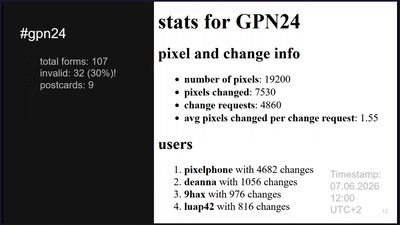
Pixel Bureaucracy At The Scale Of Chaos - or: Torturing 286 People By Pretending To Be The Government (gpn24)
Jun 700:59:01Tap to summarizeThis talk could be described as "pixelebbe Wrapped", except that it is at a different time of the year, has better jokes, provides more technical and moral insights and is not personalized. So erm it probably isn't a "pixelebbe Wrapped" at all, but hey, learn how we built and hosted pixelebbe, achieved better uptime than GitHub and spent only a reasonable amount of effort on this shitpost-turned-project (that's what we tell ourselves at night). In the history of human kind, there is a set of unfortunate innovations that have caused a lot of suffering and destroyed many lives. One might think of the nuclear bomb, or the internet. One could also think of pixelebbe. At least if one were to be untroubled by accusations of exaggeration and over-dramatising. Well what is pixelebbe? It's a pixel-setting experience designed to frustrate the player using everyones' favorite thing: ✨ excessive bureaucracy ✨. The idea is very simple: we provide a 40x30 canvas, everyone can then tell us to set a specific pixel to a specific colour from our limited colourset, which we then do and so a picture will be created. Just add on top of that large amounts of red tape, such as limited office hours, a dedicated queueing system, having to use an official government form, very strict formality control and stamps. In this talk, we want to lift the curtains and give a backoffice tour through pixelebbe. We'll talk about the technology abused to build and host pixelebbe, how we made professional software designed to look like it was put together in 2 hours. We'll even leak official secrets and risk going to pixeljail. There'll be time for a Q&A and a rare live-pixel-setting-session. Rumour has it, that even our agency lead might appear on stage, which had been notoriously always-absent during 39c3. Licensed to the public under https://creativecommons.org/licenses/by/4.0/ about this event: https://cfp.gulas.ch/gpn24/talk/VJDF8H/
Transcribe →