← Chapter & Verse: Storytime from the Stacks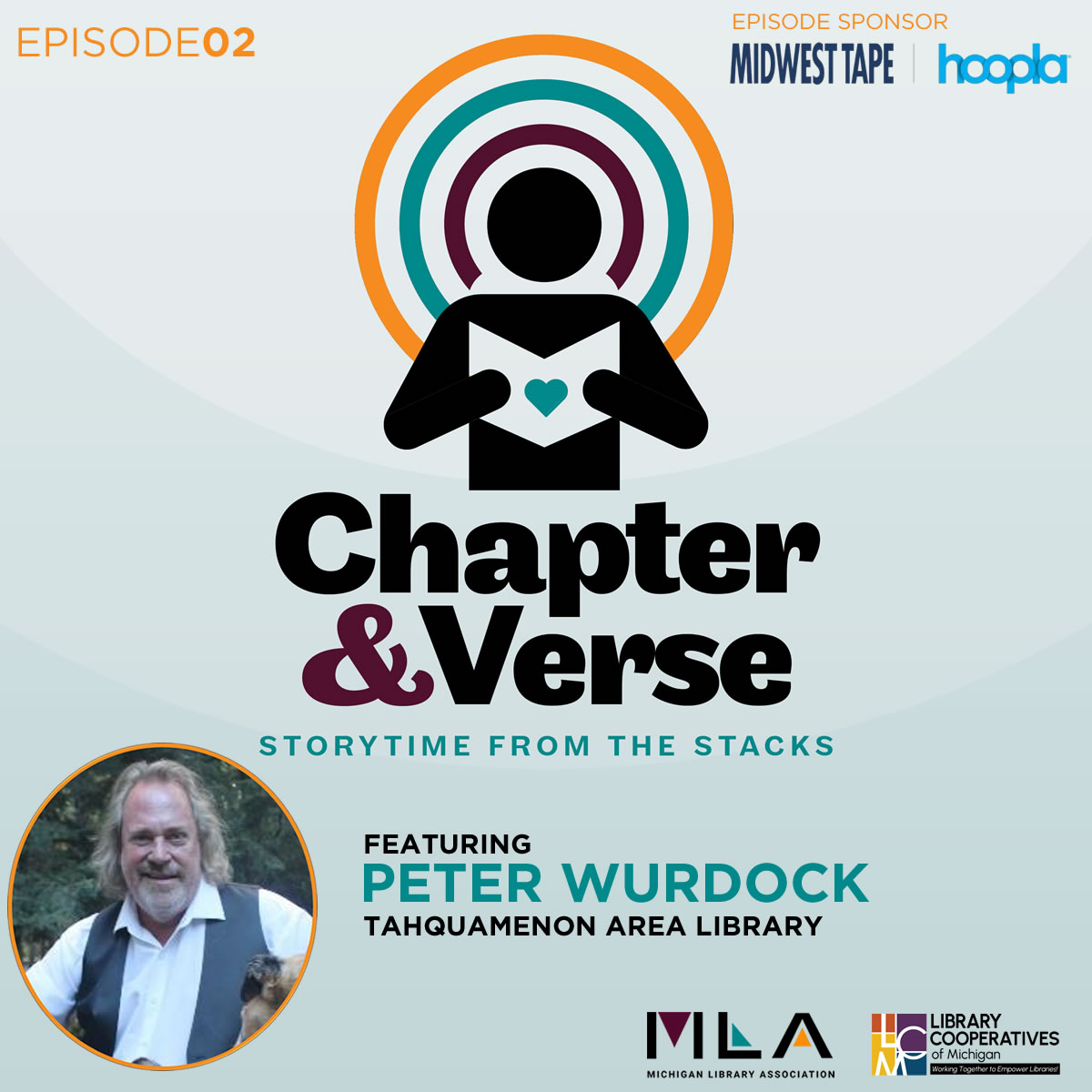
Chapter & Verse: Storytime from the Stacks
Fostering Learning and Connection through Libraries
00:23:38
Loading summary
Transcript31 lines
- [00:03]
Debbie Makula
Welcome to Chapter in Verse Storytime from the Stacks. This is an original podcast series from the Michigan Library association and the library cooperatives of Michigan. We'd like to give a big shout out to our episode sponsor, Midwest Tape and Hoopla. I'm very happy to be with you today. I'm Debbie Makula, executive director of the Michigan Library association and I'm joined by my co host.
- [00:30]
Linda Adams
Hi, I'm Linda Adams. I am the director of the Northland Library Cooperative. We're one of 11 cooperatives in Michigan and we represent 24 libraries in Northern Michigan.
- [00:43]
Debbie Makula
So with us today is Pete Wordach. He is the library assistant at the Tahquamenon Area Library in Newberry in Michigan's Upper Peninsula. Pete is an accomplished musician, award winning photographer and author, as well as the poet laureate of Luce County. So welcome to the podcast Chapter and Verse Pete. We're really happy to have you and we're hoping that you'll tell us a little bit about your background and how you ended up in the Upper Peninsula at the Tahquamenon Public Library.
- [01:19]
Pete Wordach
Yes, thank you for having me. First of all, and warm greeting from the streets of Newberry where we're getting ready for whatever winter brings here.
- [01:28]
Debbie Makula
Tell us a little bit about your background and where you come from.
- [01:32]
Pete Wordach
I was born and raised in southeast Michigan in a town called Royal Oak, where I spent most of my, most of my life up until I ventured into college, but found my way back there. I was editor of the newspaper and so I wanted to go in that direction. Pursuing journalism started at a liberal arts college in Michigan. After a year I decided that just wasn't my thing because music has been my passion. So I left there. I went to a music conservatory out in Boston where I studied theory, composition, arranging, et cetera. And that's where my life really stuck on the track of music that is still part of my life to this day, although not as it was in the old days. And music has always been a muse of mine either performing, promoting, writing, et cetera. And found my way to the Upper Peninsula later in my adult life. Actually, I should back up before that as far as how I got into the libraries. I'll share a quick story with you about when I was young. We had the library in our elementary school, of course, where all the boys go and they get the dinosaur books and, you know, then we discovered the chapter books and Hardy Boys and all that. And it was great. And what happened was my mother, my family brought in an old cast iron tub from my grandfather's house after he passed. And my mom, she's very creative, always looking to do interesting things. So she painted it in this beautiful, beautiful form, filled it with pillows, and that became the go to spot in the library for many years, even after I left is the kids would grab our books. We'd want to make a beeline for that, to be the first ones in there. And so that really created a comfortable, memorable first experience for a lot of kids, not just me. That stuck with me.
- [03:21]
Debbie Makula
So, Pete, tell us just a little bit more about how music and writing and nonprofit work has influenced you.
- [03:29]
Pete Wordach
There were years that I really didn't visit libraries much at all. During my college years, actually, you know, my focus became music. And then later in life, after my music career had run its course as a performer, I ended up going into like, music promotion and management. And I worked in Nashville as a music promoter down there for a while, promoting to radio. Then when I got that out of my system, I got into nonprofit work. I was the director of communications, marketing, public relations for a nonprofit. And a big part of that job required writing annual reports. You name it, I was the go to guy for that. And as a result, too, I also started writing articles for newspapers in southeast Michigan. And that kind of branched out into. Went from local to regional to a couple national publications. So I rediscovered writing later on again in my life. And then I wrote my first book in 2008. And that really was a turning point for me. That changed everything because suddenly I was getting invited to hold discussions at libraries. I'd be invited into classrooms to speak to kids about it. And this was just only after one or two books. I've written six since then, and that kind of has continued. So that kind of connected me again with the magic of libraries, just the resource that they are. And I was thinking about it, and I think a really good way, at least for me to describe it now, is like walking into a library. It's like a turnstile of information and ideas. You might even say dreams as well, because I've seen that with my own experience. I've seen it with the patrons in our library that experienced that. And it just. It's an intangible. It's easy to recognize, but sometimes hard to define because there's that magic in a library. And we see it all the time.
- [05:37]
Debbie Makula
Your passion is showing. That's great.
- [05:40]
Pete Wordach
Our library up here in Newberry, the Tahquament area public library, is actually situated inside the school. Even though we operate independently from the school. We have kids, we have K through 12. We have our, you know, normal regular patrons in town that come to us not just for books, they come for. We pride ourselves on bringing in programming that interests people and sometimes it's tough to get them in. Newberry, we're a very small town. It's a challenging community. It's a very impoverished community. And a lot of times we rack our brains and we think, this is going to be great, we're going to be packed, and it's not always the case. But we never give up. We're always working on something to bring people in. And more often than not, we don't always hit on all cylinders, but we hit on the important things that bring the kids in. For example, there's a Dungeons and Dragons group that meets a couple days a week and the kids are just all over that. The enthusiasm is just incredible. And what I love about that is that it's primarily the older kids, high school kids, but they are very welcoming for the younger kids that want to come in and engage in this with them. And it's just a cool thing to see.
- [06:56]
Linda Adams
I'm really interested in all of this previous experience you had as a songwriter and an author and a PR person. How did that impact your work at the library in Newberry? Have you made connections with people through that experience?
- [07:12]
Pete Wordach
Yes, I have, and it's a great question because I'm easy to talk to. I love visiting with people in the library. The conversations will go every which way. And then all of a sudden we're talking about music. That happened one day with the kids. I was up there, I had a new greyhound in my family and I was getting her acclimated to people and the kids just gravitated to her for some reason or another. We started talking about music. So I was talking to these kids about music and the discussion turned into what would you guys like to learn about songwriting? And they were like, yeah, they were all over it. Because music was so important in my life. I came from background in high school where we had a music teacher that had the impact of, if you've ever seen the movie Mr. Holland's Opus with Richard Dreyfuss. It was like that. It was something that was life changing and lifelong friendships were formed as a result. And I was excited when the kids took an interest in that because I didn't teach them instruments. It was like an extended English class. We talked about similes and metaphors and rhymes and song structure and what does this mean and what does that mean? And they became really engaged in It. And I think it was fulfilling for both of us, both the group of kids and myself, because it wasn't the norm. That's not what kids always do in school. It's not part of their curriculum. And that has also transpired into activities and things with our patrons. We have people of all ages. One of our patrons, he turns 100 next week, sharp as attack. And he thrives in the library. He needs the library. Same way that the kids who are, you know, very impressive when they find something that resonates with them, it's like the Diary of a Wimpy Kid series. Boom. All of a sudden they're reading all those books, those juvenile chapter books. So it's great to see the kids especially channel into that. And we don't have as many classes coming to the library as we would like. That kind of changed with the school when Covid hit. And the classes really just never got back to the level that they were. But we're always trying to reel them in by bringing in different kind of programming and working there. It reminds me of in my younger days, I worked at a record store, and everybody loved working at a record store. That was just like the dream job. And what the case was is that every store was very individual. You would have your jazz expert, you'd have your rock and roll expert, you'd have your classical expert, you'd have your top 40 expert, you'd have your, you know, dance music, you'd have your big band. Everybody had these, this little niche market of what they were passionate about. And we're able to do the same thing in our library because our staff were small but mighty. And it really shows because one person might have strength. I'm like the go to guy for the up and for poetry and things like that. Some of the other workers who have kids, they've been through all the chapter books, the juvenile books and the young adult books, and they know those a lot better than I do. But it's something that I'm always learning because we want to, obviously provide the best service to people of all ages. It's become a kind of a natural progression since I've been there. I'm only part time, still somewhat limited as to, you know, some of the things that I continue to discover.
- [10:43]
Debbie Makula
You went up to the Upper Peninsula. You have this great background in the arts. So musician, poet, writer, author. It's so wonderful to see the breadth of all of the things that have been a part of your life. How does all of the things that you have learned throughout Your life. How do those affect the work that you're doing within the library? You're obviously having impact on the students and on the patrons. Is there one thing that kind of stands out for you about you having impact on them because of the work that you're doing?
- [11:19]
Pete Wordach
There's little things and big things and everything in between. Nothing is inconsequential. It could be as simple as, I've had somebody come in, they're looking for an obituary from 1920 in the Newberry News. And we have stuff on microfilm and it takes us some time to look for those things. And there was one time where I just. I happened to stumble across it for somebody. And to me it was just. It was interesting because I love going through the old newspapers, but to them it was a life changing moment in a way, but because it helped them connect themselves to those relatives from 100 years ago. And that's pretty cool when you think about it. Yes.
- [12:04]
Linda Adams
Where a patron has had an impact on you.
- [12:08]
Pete Wordach
Yeah. As I mentioned, it's always. It's a turnstile of learning when we share ideas and favorite books. And the more you get to know a patron, there's a trust that's built. But that's why I'm always careful about what kind of book I recommend. I don't want to recommended dud and have them think, boy, this guy has terrible taste. Hasn't happened yet that I know of.
- [12:29]
Debbie Makula
I love all the books that you've been suggesting because my youngest son got started with Captain Underpants. Right. That was big. But you've mentioned a bunch of the books that he read as a kid that got him moving into kind of being a reader. And I think based on the conversation, you're offering that to a lot of the students that are at the library.
- [12:49]
Pete Wordach
Yeah. And one thing that was really impactful was a couple years ago we had a teacher, fifth and sixth grade, and she was really bold and very innovative. This had never been done in our district. She implemented the 40 book challenge for her students. She had a list of topics that they had to choose from. But there was a very generous open ended thing at the end where pick your own books. But there were the poetry, biography. She had all the basics. And some kids struggled with it and some kids thrived. And by the end of the year, this was her first attempt. 80% of her kids succeeded in that 40 book challenge. Because every week when they'd come in or every other week, I got to know them and I'm like, oh, you love this, Aaron Hunter series. Keep reading it, you're going to love it. And it would be interesting then to see the kids come back and then they'd get hooked that way. By the end of the year, there was one kid who read 250 books as a sixth grader. Several of them were over 100. What was great is that the kids who were strong readers because of the tutelage this teacher shared with them, they would help the kids that weren't really great readers and they improved. And to have a success rate like that was just very incredible and just great to see. That's one of the things that we always try to encourage. I'll have patrons that are my age that there's a patron who, he's just, he's a book fanatic. Oh my gosh. He went through withdrawals when we weren't able to access Melcat for six months. And now that we're back, boy, he's back with a passion. And very early on I realized that we shared a lot of common ground, especially with music. And then it comes to, the more we ended up talking about, it comes to turn out this guy, he's outrageous. He's got 40 guitars at home and he's got something, I don't know, 3000 CDs or something ridiculous like that. And those are the kind of things that it's exciting to talk about because it's again being back on the record store. Hey, have you heard the new Bruce Springsteen record? Oh no, I haven't heard of that. And so you really get excited again. That's what's fun.
- [15:06]
Debbie Makula
Let's take a quick break to hear more from our episode sponsor.
- [15:11]
John Eldred
When John Eldred began selling VHS tapes from his successful video store to libraries in 1989, the first librarian he visited became a valued mentor, teaching him about the needs of libraries. With that knowledge, John soon evolved his store into the family owned Midwest tape. Now, 35 years later, Midwest Tape and hoopla have become trusted library library partners, advocating for fair pricing and helping to provide communities with equitable access to content. That's our story, and now we are proud to be able to help share yours.
- [15:42]
Linda Adams
You're part of an army of frontline staff, people across the state that are working directly with patrons. Is there something you wish you could share that everyone should know about your job? Something that we need to understand would.
- [15:58]
Pete Wordach
Be letting people know how much information is really at their fingertips. Because a lot of our patrons, they're what I would consider traditional book readers. They come in, they check out, they Bring back. They enjoy it. But things like hoopla and a lot of the online services we have available, they're not really well versed in. But through our programming, we have people that will from time to time give a little workshop on this is how hoopla is. This is how you access books. And that was really important during our shutdown for six months because we were very limited. We could get books from our co op libraries sent to us, but our library wasn't even accessible. We were stuck in a room in the old high school and it was tough for patrons to get books. So some of them, during that time, they turned to that. Some of the other things, from time to time, we'll give discussions on how to use social media. That's a big thing that a lot of the older adults, they've heard of Facebook and things like that, but they really don't know how to use it. We have people there who can take the time to show them how to use those things, to show them as far as just gathering information and knowing that there are more resources out there than just Google. And a lot of people don't realize that there's some very specialized things.
- [17:23]
Debbie Makula
I love your metaphor for the music stores of. I like this. Let me turn you on to that. And I think it just. It transfers into the work that you're doing as the face of the library up in Newberry. I think it's really important that we recognize. Linda mentioned how many library workers. There's a thousand library workers throughout the state of Michigan, and they're not all directors. It's. It are people like you that are leading us into the library through your love of something. And you said something earlier and I started laughing is you need to get music out of your system. I don't think music has ever been out of your system. And I think you're turning people onto some of the resources that are in the library because of your love for so many of these different things that have affected your own personal life. So maybe talk a little bit more about just being the face of the library sometimes. I think it's an important role that sometimes we forget about and that you love the library just as much as the patron loves the library.
- [18:27]
Pete Wordach
Yeah. One thing going back to my love for the Upper Peninsula prior to moving here, my family's been coming here our entire lives. We have family, they're friends that we consider family. And collectively we've been coming up since the 50s. They have a camp on a lake 30 miles north of here. And Newberry is like the last stop in between the Mackinac Bridge and Muskallonge. Lake Newberry is the small town where you get groceries and there's a movie theater and things like that. That's what I gravitated to when I decided to give small town life a try because I knew of this area.
- [19:04]
Linda Adams
I just wonder if what challenges facing libraries.
- [19:08]
Pete Wordach
I think one of the challenges that we face is the downsizing of staff because as things tend to get more automated and people are able to. It's like you go to Walmart and you've got a line a mile long in the self serve checkout line and that's downsizing. And that worries me, but it doesn't keep me up at night that people will eventually gravitate that way looking for the they settle into what's comfortable and they do that without realizing that things are constantly changing. The technologies are changing, there's fewer kids that are coming. That's why we're always trying to get people there. More people are using web based information rather than looking up things in a reference book. And it's like newsflash people. You can google something and find something. That doesn't mean that it's the gospel truth. Especially when you're talking about history. We have our reference materials and there's often a disparity. I think when people started writing history books and writing nonfiction, it added some legitimacy to things because it's like the telephone game. You start with one message in one end, you go around the circle and by the time you get to the other end, the story has changed. But to have something concrete and written the way that it was presented by the people who were there in this community, we have a very deep, rich history, especially in logging and the way industry has changed here. Those are the things that are important because history these days tends to get bent and shifts a little bit more than how it really was.
- [20:55]
Linda Adams
Pete, can you tell us why are libraries so important to communities?
- [21:00]
Pete Wordach
I think they're important for a variety of reasons. They're important for patrons and they're important for the frontline workers too. With me, there's no two days that are always the same. There's a lot of people who work and their jobs are the same thing day in and day out. It's never like that at the library. It's important to the people in the community. As I've mentioned, this is an impoverished community. It has a lot of problems. And the library for a lot of people is. It's that mirage on the edge of town where they can go and just lose themselves in a way, because it's. I tell people that when you're there, it's almost like the ideas and things are unlimited. Sure, there's a finite amount of things that you can learn at the library, but we try to foster a, an environment that allows people to find their own passion, find the books that they love, find the activity that they love. We have people that offer sewing.
- [22:08]
Linda Adams
Do you see the library as a community connector?
- [22:12]
Pete Wordach
Yes, the library is a very good connector with the community. Because of our proximity to the school. People can't help but notice because of our obvious location. Especially now that we've reopened. We're getting people strolling in who've never been in the library before. They're like, oh, we read in the paper that you've had this renovation and then we give them the quick 10 cent tour. Oh, I didn't know that you had DVDs. I didn't know that I could get a public computer. That's a huge thing. Because so many people want to stay connected. We have grandmas that come in and write emails to, you know, the kids that are always there playing games after school. So it's a conduit for a lot of people because we offer so much. We're small but mighty. That's what I tell people about the Newbery Library.
- [23:01]
Debbie Makula
Thanks again for joining us today, Pete. And thanks to everyone for listening to the December episode of Chapter and Verse, Storytime from the Stacks. Join us each month for new episodes and be sure to subscribe to our podcast on Apple, Spotify or wherever you listen to your favorite podcasts. We also wish to thank our episode sponsor, Midwest Tape and Hoopla. Much appreciation for listening and we'll see you next month when our guest will be Virginia Demumbrum, the director of the White Lake Community Library.