← Chief Change Officer™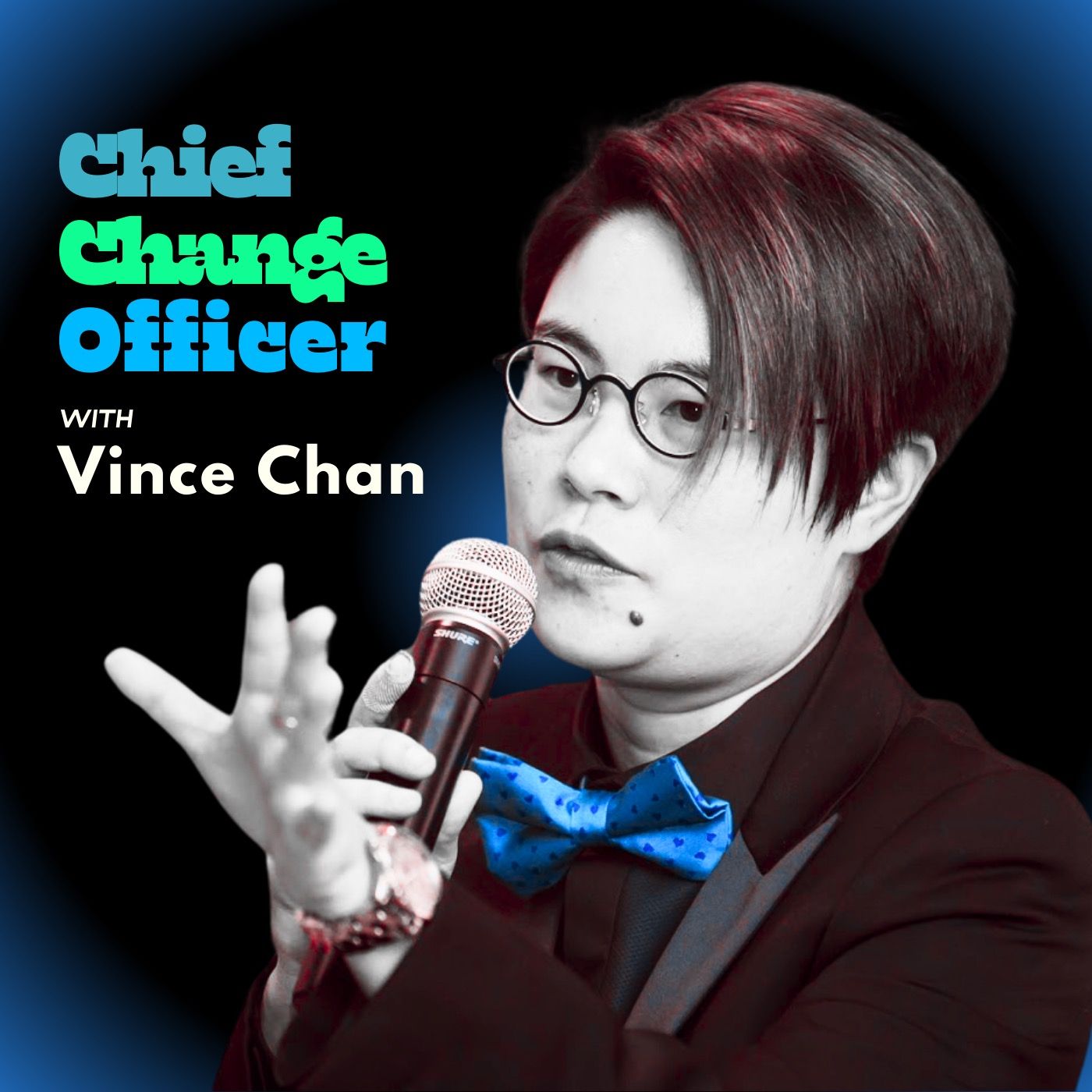
Chief Change Officer™
#244 Lisa Bodell: The Future is Simple—If We Stop Overcomplicating Everything — Part Two
00:26:09
Lisa Bodell, a Top 40 global speaker on simplification, innovation, and change, has built a career helping companies stop drowning in complexity and start thinking ahead. As the CEO of FutureThink, she’s worked with giants like Google and Pfizer to kill pointless rules, simplify work, and make change actually happen—without the usual corporate chaos. Part Two.
Loading summary
Transcript24 lines
- [00:02]
Venmo Advertiser
With the Venmo debit card, you can turn the mini golf outing your co workers paid you back for into a trip to Miami with your best friend earning you up to 5% cash back. Use Venmo to pay for the things you love to do. Visit Venmo Me Devitt to learn more. The Venmo MasterCard is issued by the Bancorp Bank NA pursuant to license by Mastercard International, Inc. Terms apply. Dosh Cashback Term supply You just realized.
- [00:31]
Indeed Advertiser
Your business needed to hire someone yesterday. How can you find amazing candidates fast? Easy. Just use Indeed. Stop struggling to get your job post seen on other job sites with Indeed sponsored jobs. Your post jumps to the top of the page for your relevant candidates so you can reach the people you want faster. According to Indeed data, sponsored jobs posted directly on indeed have 45% more applications than non sponsored jobs. Don't wait any longer. Speed up your hiring right now with Indeed and listeners of this show will get a $75 sponsored job credit to get your jobs more visibility@ Indeed.com podkatz13 just go to Indeed.com podkatz13 right now and support our show by saying you heard about Indeed on this podcast. Terms and conditions apply. Hiring Indeed is all you need.
- [01:41]
Vince Chen
Hi everyone, welcome to our show. Chief Change Officer, I'm Vince Chen, your ambitious Human Hope post. Our show is a modernist community for change, progressives in organizational and human transformation from around the world. Today we are talking about the future of work, innovation and why most companies make change way harder than it needs to be. My guest is Lisa Fadal, the top 40 global speaker on certification, innovation and change as well as the CEO of FutureThink. She's helped companies like Google and Advisor cut through the cutter, kill pointless rules and actually get things done. In this two part series, we'll dive into her journey, how she went from advertising to futurism, why most organizations resist change, and how simplicity is the secret weapon for real innovation. We'll also unpack why AI won't replace human skills, but over complicated systems just might. If you've ever sat in a meeting thinking this could have been an email, you won't want to miss this one. Let's get started. Simplicity matters not just for organizations and teams to work more efficient. Simplicity matters not just for for organizations and teams to work more efficiently and productively, but also for us as individuals. When we first met, you mentioned that this concept applies to everyone and I completely agree. Especially in today's world, social media endless noise misinformation is super overwhelming and with Mental health being a major issue, simplifying our lives feels more important than ever. So how can we do that? How can we personally practice simplicity in a way that helps us stay focused, clear headed and mentally strong?
- [04:54]
Lisa Fadal
I think first of all, just deciding that you want to is helpful, right? Because I think a lot of people put up with chaos because they feel that it's part of hustle culture, it's busy, right? And busy makes us feel valuable. I think a lot of people also just put up with simplicity, excuse me, complexity, because they feel that it makes them valuable by doing more. They typically are rewarded for doing more, not valuable. And they think that they can multitask their way through it and they can't. It's not just that work is at a breaking point. People are. And so being able to set that you want to simplify is the first step. The second thing is defining what meaningful work is. And so as an individual, it would be really helpful to write down all the things that you do in a typical month and circle the ones that you think are actually meaningful, valuable. And what you'll find is that not many of them are. They're obligations, they're necessary, work of work, things, status meetings, reports, all that. The things that aren't circle that aren't valuable, you really have to take a hard look at and say, can I get rid of some of these? Can I change the frequency on them? Can I put them on a time diet? And what that forces you to do is really think about why you do what you do. We don't question the way we work and what happens is typically we get very defensive. We get very defensive because we think there's nothing we can get rid of. And that's not true. The other thing that we, once you look through your list and you try to get rid of things or change things that you do, the other, the second half of the exercise is then defining what do you wish you could do? What do you want to spend your. If you just don't like what you're doing, then what do you wish you were doing? And I don't mean like changing your job. What don't you like about your job? What do you wish you were doing more of in your job that you were hired to do? That's going to help you define what meaningful work is to you. So that kind of gives you a compass and that allows you to make better choices with your time. The last thing I would say to people, not just deciding you want to do it and then defining it, is really Being good about deleting things. And deleting things means saying no. And if you can't say no to meetings or to reports or being included, opt out a couple times and see what happens. Start using the phrase yes if. And the reason that's good is we always think we have to yes. And things in a creative setting, yes. And building on is great. In a work setting, it's bad because you are constantly adding yes if is. If someone asks you to do things, put boundaries on it. Don't just make it a transaction with them. It's not okay for someone to take your time. So say, sure, I can do that. If you do something for me, I can do it in this timeline, I can make something else not a priority. Right. There's trade offs. And I think that starts to teach people that when you request other people's time, you better be willing to know what you're willing to trade off for it. And those are some simple things to get started. Yeah.
- [08:07]
Vince Chen
As you were explaining, it reminded me of my own corporate days. Looking back, I think a big reason I burnt out was because I did not practice some of the things you just mentioned. Saying no, setting boundaries, not taking on everything that came my way. And that hustle culture we saw over the last 10 years, especially in tech and entrepreneurship, only made it worse. Everyone was always on the go, jumping from meeting to meeting, catching flights attached to their forms. As if being constantly busy meant being successful. But these same ideas about simplicity apply to personal life too. Half the things we own, we don't even need to buy them. And if we buy them but never use them, they just turn into clutter. Even small things like deleting old files, clearing out storage make a difference. Sure, maybe you have a big house, a basement full of stuff, but it is not useful. What is the point? I was just talking to a friend about getting rid of things before a big booth and it really hit me. Simplicity is key.
- [09:53]
Lisa Fadal
Yeah, I think there's a lot of things that we can do personally at home too, outside of work. And it's easy that you say. It's interesting that you say this because we do tend to think that even in our homes, more is better. Collecting those kinds of things, it's really, I think it's cathartic. I am a really big organizer, but I'm a big purger. I like to get rid of things and only keep the things that have meaning. And one of the best things like that Marie Kondo ever did was, and this is a, a key difference, she didn't just organize things right, because being organized is not being simplified. Those are different. She didn't go in and just organize your closet. She got rid of the things that were cluttering it up, that were getting in the way of the things that you enjoyed, and then organized everything. What was left. And that's the key thing for people is it's not about organizing, it's about simplifying. And getting rid of it is really important. If you could just go through and get rid of half your stuff, your life would transform. I'd even say get rid of 10% of your stuff. Your life would transfer you. Just the weight comes off you because. Because you feel less of a mental heaviness being burdened by things that don't add any value to your life. They clutter you from using the things that have meaning. You will feel more relaxed because that's the secret about simplicity, which is simplicity is not about organizing. It is about focusing on what matters. And it is about being able to use more of what matters. That includes your time. The other thing is, it is a. You see it in yourself and you see it at work. It. It impacts the culture because people feel more valued. They're spending their time on things that they feel are worth is a mental health imperative. People feel less stressed, they feel more focused, they feel happier when things are simplified. And that's important for us as people and as leaders to know as well.
- [11:57]
Vince Chen
Let's move on to something closely related. Mental health, productivity, and of course, the future. Earlier, you mentioned how everyone these days calls themselves an AI expert. But the reality is, AI isn't just hype, is not a passing trend. It is a new paradigm, a new economy, and is here to stay. Now you and I are on the same page about this. Human skills, or what I call human intelligence, are going to become more important, not less. In fact, I believe they will become a premium asset, while technology itself becomes a commodity. Think about it. Apps, automation, AI tools, they are all becoming more accessible, more standardized. But deep human skills like critical thinking, independent thinking, storytelling, problem solving, connecting with people, those are irreplaceable. Those are unique. The challenge, though, is that we've lost a lot of these skills over the last 10, 20, even 30 years. I talk about this often on my show. How social media, for example, has contributed to this decline. We've lost the art of thinking, writing, and real human connection. Lisa, I know this is something you think about a lot. Looking ahead, how do you see this playing out? How can we rediscover and nurture our human skills. In a world increasingly dominated by AI, what needs to change?
- [14:09]
Lisa Fadal
I think it has never been more important for us to build human skills because AI will be able to do lots of tasks for us. But what it can't do are the things that yet that are things that are inherently human. Being curious, right? Asking the right question, right? With prompts, AI can give you lots of answers. But if you have to know how to ask good questions, Being very creative AI. I'm a writer and I put things into AI all the time in a chatgpt or in a Gemini. And it gets you a good start and it can organize my thinking. But I'm a better writer, I'm more human. I can connect on a meaning level. It doesn't. It also isn't good with humor or play on words, those little nuances that only humans can relate to. So I think teaching those kinds of skills that are creative, curious, agility, empathy, those are really great skills that AI can't give you yet. And I think it's never been more important to teach those as part of leaders at every level. I hope that companies start to shift towards that. There's too much depth in technical skills and not enough in human skills.
- [15:28]
Vince Chen
As you were sharing, I started thinking about how school used to be, how we had all these different subjects. Mathematics, English, French, history, biology, chemistry. Some of us love math, some hate it, some are naturally good at languages or humanities. Now imagine if schools today didn't just teach subjects, but instead focused on specific human skills. Curiosity, critical thinking, problem solving, empathy, adaptability. Just like some kids are naturally drawn to math or writing, maybe some will be more inclined towards curiosity as a skill, while others might naturally excel in problem solving. If we started recognizing human skills as areas of talent, just like academic subjects, it could completely reshape the way we educate not just kids, but also working professionals. Maybe that's part of the future of learning. A shift from memorizing subjects to mastering the skills that truly set us apart in an AI centric world.
- [16:58]
Lisa Fadal
We've got a good approach, I'll say, because this is what we do. We help people be future ready. That's what we like to say. By teaching these human centered skills, or what we call them, power skills. They used to be called soft skills, right? I think that's a passe term now, you know, because they're not soft, makes them seem weak. And actually I believe these human centered skills are what make you stronger. That's important to know. And they are less skill. They are skills but they're more mindsets. To your point, having an agility mindset, a resilience approach, a curiosity mindset. Those are different than having an AI skill because they're how you approach certain things. We teach people by there's the reason why they're important. We first have to teach people the why and then we actually give people techniques to do it and we, we apply it to work. That's how you teach these skills. So for example, if you want people to be curious, we teach them the technique around asking killer questions. And killer questions is about how do you learn how to ask really good open ended questions that are provocative, creative and really make you think. And there's certain ways to stem a question. And then we apply it to work. We use real business challenges and we teach them by doing it over and over again how to actually be more curious. And so that's how we teach it, right? We give a technique and we apply it to multiple scenarios at work. We then let them go and do it for a while and we come back and coach them again three months later. Because that's the thing about human skills is you have to try it, you have to recalibrate and then you have to try it again. And I think that approach really works for people. When you teach technical skills, yeah, you try it. Yeah, you adjust. But there's one way to do it with human centered skills. It depends on the personality and everyone has to find their own way with that skill. Deal with the Venmo debit card. You can turn the spa day that.
- [18:58]
Venmo Advertiser
Your friends paid you back for into.
- [19:01]
Lisa Fadal
Concert tickets that you can earn up to 5% cash back on.
- [19:05]
Venmo Advertiser
Where spa day with the girls becomes concert tickets. Visit Venmo Me Debit to learn more. The Venmo MasterCard is issued by the Bancorp Bank N.A. pursuant to license by Mastercard International Incorporated. Term supplies Dosh Cashback Term supply.
- [19:23]
Lisa Fadal
If you're asking about what I mean, what I would do differently for schools. I think actually applying these in schools is very important because if we learn them better at a young age, we'd be better prepared when we get out into the work world. I think there's a key thing we need to change within schools and schools right now, and I can only speak from my perspective on the west and the United States particularly, is that we are training people to be future employees. And what we should be doing is training them to be future humans. We're raising employees, we're raising humans. And I'm always fascinated when you go into a School and they teach subject matter expertise. Yes, it's very good to have technical skills. But the future isn't just about technical skills. The future is also about human skills. That's what makes people different. And by teaching more of those human centered skills in schools, I think that would make people be more prepared for work and for life. I also think within schools it would be really good to teach futuring. It's always stunning to me that we spend so much time learning about history and we should we never teach people about actually embracing change and actually thinking about the future. Why? I think that's a big opportunity for us to be able to teach people about change, how to think creatively about the future, how to think more creatively about their lives so they can be better humans, not just better employees.
- [20:47]
Vince Chen
Now for my last question. This one is a bit personal. You talk about change, the future and human skills, but you're also a mother. Your daughter is still a student studying at one of the top schools in the States. How have you personally nurtured her to be a future ready human? And if she ever came to you and said, mom, I need to figure out my future career direction, how would you guide her?
- [21:25]
Lisa Fadal
I would first ask her, like, what does she enjoy doing? What does she think really? What are the words that define her? And there's questions you can ask these students. In fact, I'm teaching at a high school in the Bronx here in a few weeks and I'm teaching high school students the same thing, which is ask yourself what could you do forever and just lose track of time because you're just so lost in the flow. What would you like to be known for? What would you be proud to say that you do? Those are the kinds of questions you should really ask yourself and then talk to people in those fields. You'd be surprised who you could reach out to and actually just get a 15 minute brain date with them. Because people love to talk about their jobs and themselves. And then I would say try and get an apprenticeship doing one of those jobs. If you're in college, now's your time to experiment. And even when you get out of college, right, it's not once you choose a career, you have to stick with it the rest of your life. But I would start to actually do a little bit more introspection before you just go out and look at a job. A lot of kids, I can just speak here in the States, they fall into the trap of they look at the jobs that make the most money and yeah, maybe they'll make a lot of money, but they certainly, it might not be the right fit for them. They might not be happy. So I think doing a little bit more definition first. There's a lot of jobs that make a lot of money and they don't have to be banking or consulting or tech by the way.
- [22:55]
Vince Chen
Yeah, I completely relate to that. It's not just a us thing, it's universal. Back in the 80s when I was in middle school, my father gave me a book about how getting an MBA was the golden passport to success. And back then that was true, especially in banking and consulting. By the time I finished my MBA studies in 2002, right after 91 1, the economy wasn't great, but finance was still one of the best paying industries. I got into it in terms of salary. It was good, but at some point I felt lost. I had followed the standard playbook, but I had no real sense of who I was. I wish someone like you had spoken to me back then, given me real genuine advice about the future. So I'm curious, when raising your daughter, did you do anything special to make her more future sensitive, more future ready?
- [24:19]
Lisa Fadal
A couple things I feel hopefully. I think it's important as parents to be role models. We talk a lot about her career. We're proud of our career, my husband and I and what we do. And I think that's important so they can understand the good, the bad and the ugly of your day. Right. So they don't just think that every job is great, they see the reality of it. I also bring my kids along with me, my work and they have traveled to many countries with me around the world to see me work, to see me speak, to see me do book signings, to see me do workshops. And it's really interesting to see. My daughter came with me once to doing a speech at Google. They gave her a tour and she says, work always like this. And I said no, she got a flavor for what work could be, what are different roles and she met different people. So those are some of the things I model it. I bring them with me and I have them meet lots of different people so they can get their own ideas of what's important to them. My daughter, I should say my son, he's in the business school and he is going into consulting. That's what he wants to do and be an entrepreneur. And my daughter at school, she's a volunteer firefighter and she was at the FBI this summer. So she's got a very different path for herself and I think that's cool.
- [25:27]
Vince Chen
The last question I asked about your parenting is because I really believe in walking the walk, talking the talk. When it comes to leadership and you as both a leader and a parent, I think role modeling is everything. Maybe in a future episode we can focus more on future humans, how we raise the next generation to be ready for what's ahead. A lot of listeners might be parents themselves. They may not have your exact background and resources, but they are shaping the future in their own families. My parents never had the chance to learn from people like you, but today's parents do and that's powerful. They can take inspiration from your approach how to raise future ready humans not just in terms of careers, but as responsible, creative, value added adults who contribute to their community, to the world. This could be a really great conversation for next time.
- [26:45]
Lisa Fadal
I love it. Count me in. I'd love that.
- [26:54]
Vince Chen
And that's where I'll leave you. We've tackled everything from future thinking to eliminating workplace chaos and why simplicity isn't just a strategy, is a survival skill. The real question now is what's one thing you can stop doing today that will make room for something better? Think about it. Big thanks to Lisa for sharing her intelligence and insights. Thank you so much for joining us today. If you like what you heard, don't forget, subscribe to our show. Leave us Top rated reviews. Check out our website and follow me on social media. I'm this Chen, your ambitious human host. Until next time. Take care.
- [28:08]
Lisa Fadal
Welcome ladies and gentlemen to Mario's Bistro.
- [28:13]
Venmo Advertiser
The special tonight is the Beef carpaccio. With the Venmo Debit card, you can turn the basketball game tickets your friends paid you back for into a romantic dinner that you can earn up to 5% cash back on. Use your Venmo balance to pay for the things you love to visit Venmo Me Debit to learn more. The Venmo MasterCard is issued by the Bancorp Bank NA pursuant to license by Mastercard International, Inc. Terms apply. Dosh Cashback Terms apply.
- [28:37]
Indeed Advertiser
You just realized your business needed to hire someone yesterday. How can you find amazing candidates fast? Easy. Just use Indeed. Stop struggling to get your job post seen on other job sites with Indeed sponsored jobs. Your post jumps to the top of the page for your relevant candidates so you can reach the people you want faster. According to Indeed data, sponsored jobs posted directly on indeed have 45% more applications than non sponsored jobs. Don't wait any longer. Speed up your hiring right now with Indeed and listeners of this show will get a $75 sponsored job credit to get your jobs more visibility@ Indeed.com podkatz13 just go to Indeed.com podkatz13 right now and support our show by saying you heard about Indeed on this podcast. Terms and conditions apply. Hiring Indeed is all you need.