← Christiane Amanpour Presents: The Ex Files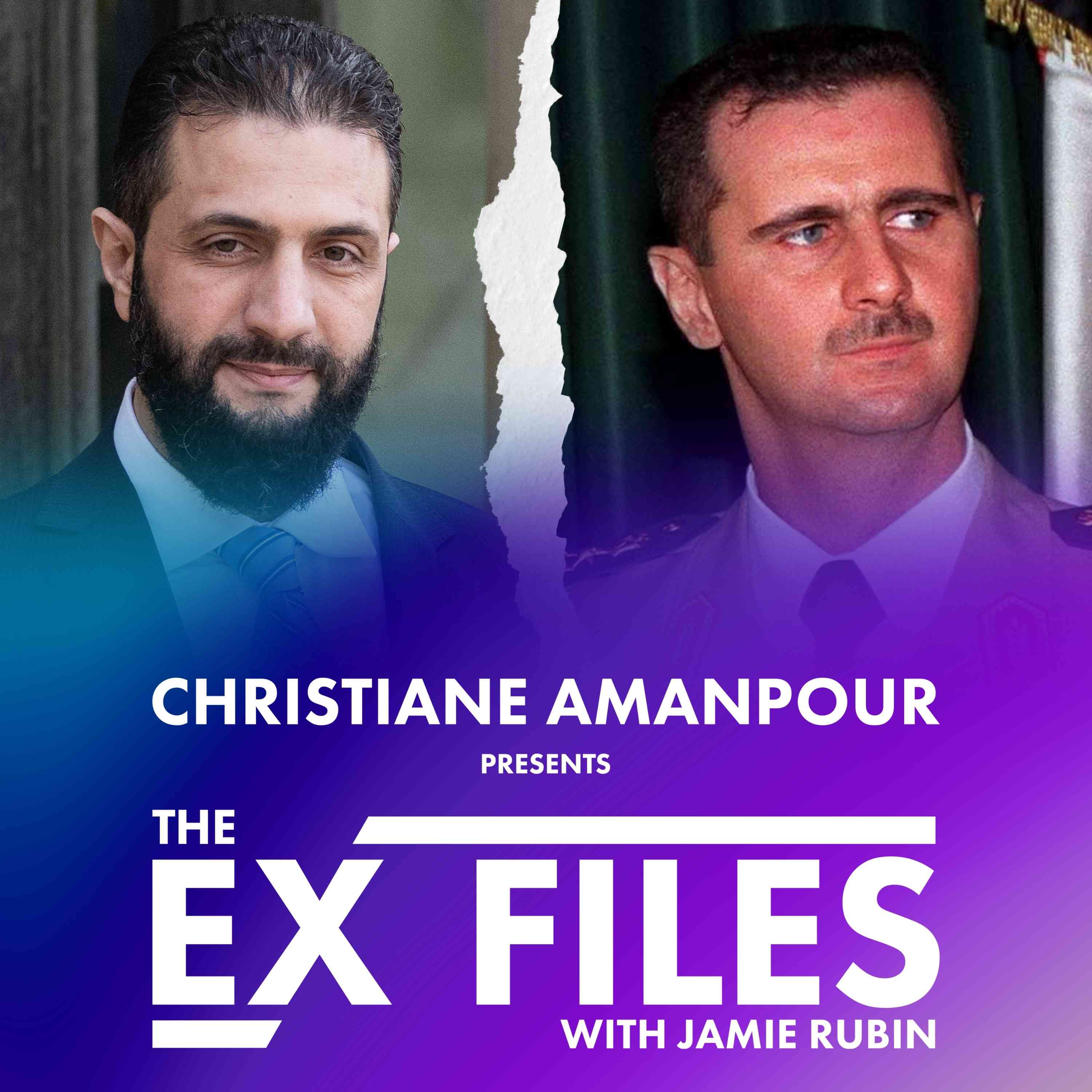
Loading summary
Transcript49 lines
- [00:03]
A
This is a Global Player original podcast.
- [00:09]
B
There has been celebratory gunfire. Celebratory. Not the kind that killed so many people under the Assad regime. For the one year anniversary of the fall of the 53 year regime.
- [00:20]
A
It is a great example of how someone labeled a terrorist, much like Jerry Adams and Martin McGinnis in Ireland were terrorists have evolved into, let's face it, a successful politician.
- [00:33]
B
Even the Taliban came from Afghanistan because they think he is their example of how to get out of the terrorist cold.
- [00:39]
A
People were scared to talk to each other. People were scared to admit what they thought. People were scared to go out in the streets during many of these years. This is a traumatized country.
- [00:49]
B
You just cannot believe that a human being at the head of a government can order his henchmen to do what they did. And including children. Absolutely horrendous. You know the guy is, is Islamic. I tried. I slid my hand forward and immediately he slapped it to here like the Islamic government members of Iran.
- [01:12]
Hello everyone and welcome to the latest episode of the X Files with me, Christiana Manpour and Jamie Rubin. I got lucky this weekend because I interviewed the now one year in president of Syria, Ahmad Al Sharar. And we are going to divide this episode into several seg. First is on Syria, one year after Assad fell and what has Al Sharad done for the country? Should the west actually have done more to stop Assad? How much has Syria changed? And then in our second segment we are going to discuss the literally unbelievable. I think so. Anyway, I'm sure Jamie, you do too. The new American national security strategy essentially boils down to I'm sorry, but seeming to push to put Russia first, to bring Russia in from the cold and to actually put Europe and the EU out into the cold. So this is a very weird situation. Let's just do a quick recap of how we got to the fall of Assad. So Bashar Assad came to power in Syria in 2000 after the death of his father Hafez Assad, who had ruled since taking over in 1971. This was a quasi military, but most definitely a one family dictatorship. 2011, when we were all covering the Arab Spring and I was in Egypt here and there, we never got to Syria because the uprising in Syria in 2011 was the worst. It was the beginning of the worst of the Arab Spring when Bashar Assad, who had been touted as some new young version of a Syrian dictator, actually then cracked down believing he was in a fight for his life, even though the Syrians had not called for him to be overthrown. They just said they wanted more liberty and democracy and this and that. But he cracked down very, very hard, including on the children who first demonstrated in Daraa. And that has become, as you know, this symbolism and this what was synonymous with the start of the revolution against Assad, as it turned out, and the whole civil war. Jamie, you know, this followed obviously the. Well, it was during the last years of the Obama administration.
- [03:30]
A
Yes, this was unfortunately one of the low moments of American foreign policy and the Obama.
- [03:38]
Perhaps because such fear developed of another Iraq war when the time came for the United States to do something in Syria, not fix the whole problem, not invade, nothing like that, but simply to follow through on the red line that President Obama had established. If Assad used chemical weapons, the United States didn't follow through. And this was a terribly tragic moment because one, it raised questions about the willingness of President Obama to use and follow through on promises all over the world. But most important, let Russia intervene in a big way. Yes, we got rid of the chemical weapons, at least some of them, but Russia intervened. And the combination of Russia and Assad and Iranian ground troops caused the deaths of perhaps 500,000 Syrians and the destruction of that country practically, with most of its people moving around either inside the country or all over the world. And that was the refugee crisis that Europeans dealt with during the mid to 2000 and tens. And it caused a lot of problems in Europe. But then something very, very strange happened and something that led to the overthrow of Assad when President Trump came to power, because he did follow through on his threat to use force if Assad's forces used chemical weapons. He did it twice, not a big deal. He launched, I don't know, 50 cruise missiles on the Assad military bas. They were concerned, they worried. Trump had real power. And so one day, and you told this story, and maybe we can get into it later, Trump decided to tell Putin and Assad not to finish off the rebels in Idlib, the northwest corner of Syria where they had all gathered. And he put out a tweet, and they were about to invade the last bit of Syria. They didn't control, and they didn't. And what's so ironic about that and so important historically, is that's the place where Alshara was ruling and Al Shara's people were in control. And many, many years later, actually almost a decade later, that's the place from which Assad was overthrown.
- [05:58]
B
It's actually very significant. I don't know whether Trump knew about, as he was known then, Abu Muhammad Al Jolani. That was his nom de guerre during the, you know, let's face it, he was a member of their version, the local version of Al Qaed, Al Qaeda. And he led a group that actually the United States called a terrorist group. And for a long time the United States had a bounty on Al Sharah's head. But then, as you say, a year ago, he stormed his troops up to out of Idlib and up to Damascus. Cities and provinces, villages fell in his wake. And it was pretty bloodless, actually, that part of it, because Assad fled and the Russians, if you remember, you know, regrouped on the coast and they, I think, got into their, into their ships off the coast. They didn't intervene to stop, as he was called then, Jolani, nor did the Iranians. Anyway, he got to Damascus and he became the de facto and now the interim president of Syria, known as Ahmed Al Sharah. And he has now met with President Trump. And right now, today, as we record December 8th, there has been celebratory gunfire. Celebratory, not the kind that, you know, killed so many people under the Assad regime. There have been military parades, there's been a whole amount of color and, you know, a lot of celebrations for the one year anniversary of the fall of the 53 year Assad regime. So he came to the Doha Forum where I was this weekend, and we were able to talk about a lot of things. Before I get into that, though, Jamie, let's just go back for these last few months, he's, I said to him in my opening, you've been here, there and everywhere. The U.N. the White House, Saudi Arabia, everywhere. So just you talk a little bit about how he's presented himself to the world leaders.
- [07:51]
A
Well, it is a great, great example of how someone labeled a terrorist, much like Jerry Adams and Martin McInnes in Ireland were terrorists, have evolved into, let's face it, a successful politician. Now, remember, his family is a prominent family. And so he grew up in a family that understood power and understood the Syrian government. And he has exercised power very wisely. He sent out all the right messages to everyone and he managed. And this I give President Trump some credit for because I think a Democratic president probably wouldn't have acted so quickly. But Trump loves to have peace and successful changes. And so he quickly suspended sanctions on Syria. And that was a major development for the Syrians. Once the United States had done that, the world opened up to Al Shara. He came to the UN as you said he's now met President Trump and people are very, very, very optimistic that this evolution of a former terrorist into a politician could bode well for Syria and open that country up after, let's face it, really, one of the horror stories of the modern era, I mean, the trauma that that country went through, every family, every region, every ethnic group, it's a complicated place. It's one of the hearts of, of the Arab world and, and now it has a chance to, to really shine. It'll take many, many years to reconstruct and to build, but as doing, I would say, a credible job of persuading Western leaders who may be skeptical of his past, to give him a chance.
- [09:29]
B
Let's take a few issues, because from October, late October to mid November, for precisely this anniversary, there is a poll that's been taken by Arab Barometer, which is a nonprofit research network. Okay, so it's the first ever survey of Syrian people across the board. They interviewed, I think, nearly 1,300 randomly selected adults in person, in their own language, whether they were Kurdish or Arab speaking. And the results were very interesting because they actually found that Al Shara himself had 81% support from Syrians. That is, 81% of Syrians are confident in Al Shara, 71% are confident in the national government as a whole, and 62% are confident in the courts and the legal system. 71% support the Army. Now this, though, doesn't tell the whole story. Talk about this for a minute, because that's never happened maybe for an a minute or an afternoon. When young, so called, Westernized, you know, educated in England, eye doctor Bashar Assad took over from his very rigid, you know, Baathist right dictator father Hafez. In 2000, there was a tinsy wincy moment when the, they thought, you know, all these young people were going to open up the Middle east and that part of the world, and they didn't. So just 81% is quite a high poll rating.
- [11:00]
A
I think it's dramatic, it's important. And I think what it reflects is the exhaustion in that country with the war, with the hatred, with the ethnic violence, with the misery that all have gone through. And because Al Shara has said the right things and done the right things and appears to be trying to create a tolerant Syria, the people want to give him a chance. And I think that's crucial because with the support of his people, with people, not immediately going to retribution, because there's a lot of retribution that could take place in that country that's what we're going to talk about because it's happening. Yeah, they're exhausted. Some is taking place. But I think he's said the right things. And I think that poll number is a reflection of people's desire for Syria to succeed. And they want to give him a chance, a fresh chance to show that he can do the right thing and do it in the right way.
- [11:59]
B
So, you know, I read on stage in Doha, and by the way, it was full. I don't know how many people that hall holds, but it was packed to the rafters. He was the main event and people were there. Even the Taliban, the Haqqanis came from Afghanistan because they think he is their example of how to get out of the, you know, terrorist cold and into.
- [12:18]
A
Yeah, I don't think they're going to be as successful as.
- [12:21]
B
In any event, they were absolutely determined and they did get a meeting. But what I'm saying is he was incredibly popular in that hall. People were just hanging on his every word. And even though, you know, there are some regional actors there who don't like him and still call him Jaw Lani, you can imagine who they are. The people who were, you know, pro the Assads, he really played to the crowd and he's a very good communicator. But when I asked him about, okay, this is a very, very, you know, important poll, I said, people will say now to me that they, they dare to dream and they dare to hope, even though they still have challenges. But I said, look, there are also a lot of people who are afraid of you. The Alawites, the Druze. There have been these massacres, this mass displacement. But Jamie, look at this. In Latakia, Sueda, Tartus, which is all of the way over towards the coast, fewer than that. 81% have confidence in the national government, apparently, 36% in the courts, 33%, in the army, 22%, and in the president himself, 36%. Because the people in those sort of minority governorates, as they're called, are pretty afraid. Just 35% of them believe the government is response responsive to their concerns. So I asked him about that. We're going to play his answer and we can talk about it today.
- [13:46]
C
We cannot say that this revolution, that the revolution in Syria was a Sunni revolution. All the components of the Syriate society were part of the revolution. The Christians were affected by the previous regime. Even the Alawites had to pay the price of them being used by the former regime. So I do not agree with the definition or with saying that all the Alawites were supporting the regime. Some of them were living in fear. They were fearing the toppling or what will happen if the regime is toppled. When we went into Alawite villages, we saw a lot of poverty and problems. In fact, we have inherited a big problem where all of us are victims. It is a big problem that we need to deal with very wisely.
- [14:39]
B
How do you react to him just reacting to that question?
- [14:43]
A
Well, I think it's an example of the sensitivity of the subject. You know, they don't want to talk about the fact that Syria is a riven society, riven between, you know, Alawites and Sunnis, between Kurds and Sunnis, between Druze and the government. They don't like to talk about it because they're proud of the idea that Syria will be a country where all of the different ethnic and religious groups can work, work and live together, which, frankly, they did over the years under different governments. And one other thing about the Assad family that's worth people remembering. Remember, they were part of the father. Hafaz was part of the Ba'ath party, this socialist Arabist party that Saddam Hussein was part of. But they were rivals. Saddam and Hafez Assad were from the same political background, but they hated each other. Syria joined the west in the Iraq back in 1991. They're going to have to transform from a country that Hafez Assad and Bashar's picture hung over every street corner. People were scared to talk to each other. People were scared to admit what they thought. People were scared to go out in the streets during many of these years. This is a traumatized country. And I think what Al Shar is trying to say is, yes, there are serious problems here, but we're gonna go about it in a fair and tolerant way. And we're not gonna focus our energies on these ethnic conflic. We don't want to promote that as the main story about Syria, because what they want is the rest of the world to reinvest, to join in Syria, to help them turn what is, you know, essentially one giant battlefield into a place that can thrive again.
- [16:30]
B
It's a unified Syria that is going to, you know, encourage outside investment. Unity is their big national strength and their big objective. They need that. You know, I think that some of those sanctions the US has suspended, but there's a bunch more, including those that were imposed under the Caesar Act. Now, I interviewed this guy who went by the name Caesar. He was the one who very bravely, under the Assad regime and during the civil war, he went into the Sednaya prison and took pictures and brought them out. And then the Guardian and CNN on my show broke this news. And then, as you know, the US Imposed the Caesar sanctions and the Caesar law. All this to say that they haven't yet lifted it. So he's trying to get the US to lift that. And of course, the atrocities in the summer against the Druze and the Alawites, they pull back the US Congress, but maybe they're going to do it pretty soon, because it's not just a thing, it's a big thing. It means a huge amount, this unity business.
- [17:32]
A
Let's stay on that for a second. Because oddly enough, during the Trump administration, I think I've admitted this, I was a lobbyist. I was a registered lobbyist. I follow laws. But one of my proudest moments was to lobby on behalf of a group of Syrian American doctors. And one of the doctors, a woman named Reem, who you also interviewed, is the one who persuaded Donald Trump to issue that tweet to save Idlib. She's a hero in Idlib because of that. But she also pushed the Congress into passing the Caesar act, because at that time, remember what we were dealing with? We were dealing with this horror of hundreds of thousands of people being slaughtered in the most gruesome, horrible ways were counted. And then, you know, lists were made and records were kept of all these monstrous atrocities. And Ream and the Syrian American doctors persuaded the Congress to pass the Caesar act to try to put pressure on Assad, because at that time, the people didn't think that this little place, Syria, in Syria, Idlib, was going to be the place from which Assad would be overthrown. And sanctions was the only tool we had.
- [18:45]
B
I saw those pictures from Sid Naya, and honestly, you just cannot believe that a human being at the head of a government can order his henchmen to do what they did. And including children and women, and I mean, absolutely horrendous. So, by the way, on the Caesar act, it'll take the US Congress to lift it, and we'll see whether they do that. Jamie, I just want to. Just because we're getting to the end of this segment, I also asked him about, hey, you were accused of being a terrorist. You had a bounty on your head. You know, what do you say to everybody here about it? And he turned it around pretty well. He basically said that he himself didn't do anything to any civilians, but he also turned it around and said, you know, what do you say that Israel's doing against Gaza or that Russia is doing in Ukraine or that, you know, so he had his talking points. He had his talking points, but on the caliphate thing, and I think this is interesting, you know, the guy is. Is Islamic. I tried. I slid my hand forward and immediately he slapped it to here, like the Islamic government, members of Iran. So I'm like, okay. So I made a point of asking him about, okay, it's not a caliphate. Will it ever be a caliphate? What about women's rights? And he said, don't you worry. Women have always been strong in Syria, and don't fear for the women. You should. You know, you should. You should fear for the men because the women are very strong. So that was one that got a big laugh. He's pretty clever. Clever as a communicator, by the way. And then on the other thing, because there are a lot of people, Jamie, and who are afraid that he's going to just consolidate power like a typical regional, you know, top dog, and stay there forever. So I asked him that. I said, you know, it happens a lot in this part of the world. And. And he said, no, we're going to have elections. And I pushed him. And he said, well, in the five years since we got here. So he said, and now one year's gone, so in four years time will have the big important election. So hopefully we'll be able to hold him to all of that.
- [20:48]
A
Well, listen, one of the mistakes that the United States and the west has often made in the Middle east is to make elections the sine qua non of democracy. And there are things more important than your first election. It's called the rule of law. And I think establishing the rule of law in Syria, obviously not going on forever, but for a period of time where people can trust in government behaving fairly and law applying to everyone. And so that when the democracy moment of an election happens, there is a system in place where people get an opportunity to, you know, to campaign properly, where there are real opposition parties and the laws are in place that permit democracy to succeed. Because the first election often can be the last we found in Egypt and other places. And what we want is for Syria to put together its history of tolerance for women, for men, for the different religious groups, the ethnic groups, but to combine that with representative government. But we need to establish procedures, processes and laws and fairness and tolerance that will survive that first election, which he.
- [22:00]
B
Sort of implied when he said that we're doing the whole constitutional process and it'll Take five years and only then can we have these elections. Just one thing that I forgot to say, but it's important, you know, he also talked a lot about the, the, I mean, massive incursions by Israel and the massive incursion on the ground by Israel to just about, you know, on the outskirts of Damascus. And we know it bombed a site in Damascus over the summer. And Al Shara was literally, I mean, he was really angry about that. And there are many who believe that Israel does not want a united Syria, but wants a fragmented Syria. So he has a lot of battles on his, on the horizon.
- [22:38]
A
It's such a tragic mistake by this Netanyahu government. Here you have a moment in history like no other where Syria, Lebanon, Saudi Arabia, all the countries that haven't recognized Israel are prepared to move in the right direction. And Israel has been successful in killing off the Hamas leadership, in squashing Hezbollah and Lebanon, and having the Assad government switch to Al Shara, who's being now supported by much of the world. This would be the moment for a grand diplomatic initiative by Israel. But instead they're doing what, what they do too often, which is relying just on their military, just on their intelligence, doing the hard power that is short term, you know, maybe achieving certain objectives, but long term, stupid. Now is the time to have diplomacy backed by force. Unfortunately, the Israeli government isn't doing that. But there is going to be an election in Israel next year and maybe that will change.
- [23:38]
B
Maybe it'll change because there's a lot else that's really going down the tubes even around the Israeli Gaza ceasefire and what's going on in the west. But bang, very aggressive moves continue by Israel on, on all and sundry, with no second phase, so called, you know, moving to the peace plan. But anyway, we'll talk about more that. More at another time. Let's take a break because I think Al Shara is a very interesting, you know, figure. I'd interviewed Bashar Assad just the. Once you also met him.
- [24:07]
A
I interviewed Bashar Assad when I, when you were on. Yes.
- [24:11]
B
Yeah, yeah, yeah. But, but he couldn't communicate, man. I mean, the guy was so stiff. This guy looks like he was a born communicator. So he has that on his side. I hope he uses it well. Okay, let's take a break and when we come back, we're going to look at. I don't know, Jamie, but I think it's the weirdest National Security strategy document that I've ever seen come out of any administration since I've been covering, you know, foreign affairs and let's, let's go back for sure. The European allies are majorly on the back foot and it's, it's dramatic.
- [24:48]
D
Owning a home is full of surprises. Some wonderful, some not so much. And when something breaks, it can feel like the whole day unravels. That's why home serve exists for as little as 4.99amonth. You'll always have someone to call, a trusted professional ready to help. Bringing peace of mind, mind to four and a half million homeowners nationwide. For plans starting at just 499amonth, go to homeserve.com that's homeserve.com not available everywhere. Most plans range between 499 to 1199amonth. Your first year terms apply on covered repairs.
- [25:23]
B
Okay, we're back, Jamie and me, to talk about the new American, the new Trumpian, maybe the new Stephen Miller, the new JD Vans, I don't know. But a lot of, you know, cooks have been in there advancing their own interests and their own view of the world. It's called the National Security Strategy, the first one of this term of the Trump administration. And just in short, the reaction from mainstream European allies is that this document, as Carl built, our old friend, the former prime minister and foreign minister of Sweden tweeted, this essentially puts America to the right of the far right in Europe, basically putting Europe out into the cold, saying that they were going to challenge mainstream European parties and governments, challenge them. Talk about bring in Russia into, you know, into the group again and also threaten civilizational erasure in Europe because of their immigration policy. So it is pretty dire. And I don't know, Jamie, should Europe listen? Should it not? Should it go its own way or first, how did you react to it?
- [26:33]
A
Yes, well, this is an attempt by some smart people to try to weave together the weird.
- [26:42]
Priorities of President Trump. But I think at its core, there's a fundamental hypocrisy in the document. As President Trump said at the UN when he spoke, they believe in the sovereignty of nations and they work very, very hard to focus on the fact that this is a world of nations and transnationalism and globalism and all these phrases that they hate should be thrown aside and let nations run the worlds. And I agree with that. But then they throw that whole idea out the window when it comes to what they don't like about the politics of European nations, where they don't like the fact that many European nations are tolerant countries that believe in immigration, legal immigran, immigration and they come up with this crazy great replacement theory, as if there's some grand conspiracy going on to let European countries be taken over by the Muslims and the poor whites are going to be, you know, replaced or civilization erasure. This is complete and utter nonsense. And coming from the United States of all places, it goes against the basic idea of America. America is an idea, not an ethnicity, not a religion, not a particular type of person. America is the idea of a nation of laws and a nation built on democratic values. And America is a nation of immigrants. So this is a national security strategy of a muddled, hypocritical, contradictory set of principles, some of which I agree with, some of which make obvious sense, but it doesn't add up to anything. But got a big, essentially sticking a finger to the Europeans for the way they choose to run their countries. It's none of our business.
- [28:33]
B
Yeah. So I asked, you know, it was breaking when I was there conducting a panel at the Doha Forum, and I asked, who but Kayakalis, former frontline Baltic state, Prime Minister of Estonia, and now the European Union's top foreign policy official. What do you make of this? I mean, Europe's the enemy. You're the enemy.
- [28:55]
E
No, I didn't read it like this. I actually read the European part. I haven't read the rest of it. Of course, there's a lot of criticism, but I think some of it is also true. If you look at Europe has been underestimating its own power towards Russia, for example. I mean, we should be more self confident. That's that. That's for sure. And you know, US is still, still our biggest ally. And there I read it as well that we are still the biggest ally and it's in the interest of the United States as well that Europe lasts.
- [29:31]
B
Well, good luck with that. I've never seen so much weaving and dodging. She's got a very hard head when it comes to understanding what's at stake, given that Russia is on their border. But look, you know, there are others who say, other historians, people who've written, you know, that yes, we should accept this. This is the Trump doctrine. You know, we, we need to stand on our own two feet. We need to do this, we need to do that. And I'm like, really? Why? What's wrong with having an alliance with the strongest country in the whole wide world? You give it vital stuff, it gives you vital stuff. What is this divorce in the midst of a war? I really don't get it. I don't get it. And I Don't get why the Europeans are on the back foot and they're like, yeah, y. Yeah, he's right. We need more self confidence.
- [30:15]
A
Here's what's going on. The Trump administration has some very smart people who believe in national security of the United States should guide our national security strategy. Then they've got some right wing political people who are trying to turn national security into politics. They want to move Europe to the right. That's what Carl Belt was pointing out. They want to use national security policies, use our laws, use our diplomacy to push European politics to the right. And this is a fundamental interference in the internal affairs of European countries. It goes against their whole principle of the sovereignty of nations. And it's just politics. It's just people in the Trump administration trying to see how they can criticize the center and the center left in Europe and promote the right in Europe. And it has no business in a national security strategy. It's not gonna work. Europeans are gonna to vote and act on their national interests. They're not going to listen to this nonsense.
- [31:17]
B
I will say though, it probably is going to have some kind of impact on the Russia Ukraine war because it was pretty warm towards Russia, although it did say we also need to have, I think it said, a viable, independent Ukrainian sovereign state. But the question is how? Because already Trump is doubling down against Zelensky again. He's pissed off that Zelenskyy doesn't like his whatever plan it is that was very pro Russian, even though the tweaks. Don Jr. Was at the Doha for apparently and he railed against Ukraine. I mean, he came out and said basically we're tired of Ukraine and now Ukraine. Zelensky has been in London as we speak. He's meeting with Keir Starmer, the Prime Minister, with the French President Macron and the German Chancellor Mertz. They're all in London. What should they do? Because they can't just ditch the US and you can't just let and leave Ukraine to the wolves.
- [32:06]
A
What matters in Ukraine is, is what the Europeans do to support Ukraine. Ukraine. What matters in Ukraine is whether the United States bases itself with this, you know, essentially Neville Chamberlain plan for capitulation. They're offering the Ukrainians. And what matters to Ukraine is what goes on on the battlefield and whether the pressure of sanctions continues on Putin. And until Vladimir Putin changes his conclusion that he can somehow win this war, nothing is going to change in Ukraine. They're not going to give up. The Europeans are not going to stop helping. And all talking about here is how the Europeans feel they need to make nice with Donald Trump. They need to not argue with him. They've concluded that it's easier just to go along and dodge and weave the way the foreign minister, foreign representative did in your question. And rather than confronting them, some European politicians want to take Trump on directly. Some have over this strategy, some will. But I think the major theme of European leaders is, you know, we've got to work with Trump. We've got to be diplomatic with him. Him. No point in getting in arguments. We're not going to end up solving anything. Let's focus on the substance. And on the substance, nothing in Ukraine.
- [33:22]
B
Has changed, actually, because of a lot of this nonsense that's been going on with interrupted, you know, supply lines of weapons, interrupted, you know, support for Ukraine by the United States. Actually, Putin is making advances and they're quite significant. They're not going to, you know, beat the Ukrainians tomorrow, but they're making enough headway that it's thought that Putin really thinks he's in a really good place now. And the chance, the choice for Ukraine, as the Americans are saying, is between, or actually, I read it, I think it was maybe Tom Friedman or somebody, the difference between a dirty deal for Ukraine and a filthy deal for Ukraine. And that's a terrible place to be. But look, let us conclude with those segments and take a break and come back with our recommendations. Foundations.
- [34:12]
D
Owning a home is full of surprises. Some wonderful, some not so much. And when something breaks, it can feel like the whole day unravels. That's why HomeServe exists for as little as $4.99 a month. You'll always have someone to call, a trusted professional ready to help. Bringing peace of mind to four and a half million homeowners nationwide. For plants starting at just 4.99amonth. Month, go to homeserve.com that's homeserve.com not available everywhere. Most plans range between 4.99 to 11.99amonth. Your first year terms apply on covered repairs.
- [34:47]
B
Okay, we're back, Jamie and I, with the final piece of this episode. And that is our recommendations. So I'm gonna go first this week because I'm rich. My heart is like bursting out of my chest trying to get this one out. You know, Jamie, and I'm sure you read it, or maybe you did didn't, but Marco Rubio, Secretary of State, did a substack. I can only think of the word spiteful against South Africa for having hosted the G20. And of course, the US government, this administration really hates. The current South African administration is favoring the whites and the Africanas there, including high level visits to the, to the embassy there, bringing them into the United States on preferential visas. But basically, basically they decided to boycott. This is the US the G20 in South Africa. And now they're basically saying that South Africa, you know, boycotted them, but they're disinviting South Africa to the G20 being held in the United States next year. So I just want to commend to people just to read and see what it sounds like. Look for the Rubio substack and then read the response to that substack by the South African Foreign Minister.
- [36:00]
Ronald Lamola. It is really dignified. It is absolutely the response of a sovereign nation. It is chapter and verse on how they have tried to run their country with the aim of national unity. And you know, he takes offense at the US saying it's just a quota system and they're, you know, doing, you know, grievance policies against the whites. And he listens, lists it down to the last Mandela basically and said that Nelson Mandela was one of the great leaders of all time. Of course, remember he was accused of being a terrorist who put his whole presidency and the success of a new democratic South Africa where everybody, not just the minority whites were in control, where everybody had a chance on national unity and trying to redress all those decades of imbalance. But it was so beautifully written that I thought people could read read both foreign ministers and get a little bit of an insight. Both Rubio and Lamola. And you can find Lamola's on the South African Foreign Ministry website.
- [37:06]
A
Terrific. Well, I will read both of them.
- [37:08]
B
Read it. It's great.
- [37:09]
A
I will. So I'm going to do something a little unusual. I'm going to say one obvious thing and one non obvious thing. So I know the much of the world is watching Slow Horses and I was very late to the game Slow to Slow Horses. But I did start watching it. I've been through five seasons and I have to adm. It's a lot of fun. It's a lot of fun because it's about London and it's about MI5 and it's got one of the great actors of all time, Gary Oldman playing a terrific character and it's got some great story lines. So that's the foreign policy one. Now I'm going to do one and it's a little bit personal and forgive me for it. There's a great band, their name is Betty and I started watching them about 35 years ago in Washington. Their two lesbian sisters, Elizabeth, Elizabeth Ziff and Amy Ziff. And they have a band that plays some of the funnest, most interesting, funny, exciting short. It's a short show. We watched their Christmas show at the Public Theater last night. They play all over America. They come to Europe from time to time. When I was in the government, I was able to help get them on the list of, you know, approved American cultural representatives so they could travel the world. And what was amazing about it, these were my first. When I was a young man, you know, I didn't know a lot of LGBT people and this was my first group of friends. And they're just a lot of fun. Their name is Betty and I recommend it.
- [38:39]
B
That is the end for this episode. Thank you for listening. Make sure you follow our feed so that you never miss an episode. Remember, you can watch our episodes on YouTube as well. Just search for Christiana Monport presents the x files on YouTube and subscribe to our channel. You can also listen for free on Global Player, download it from the App Store or go to globalplayer.com I got it right this week and we will see you on Thursday for our bonus Q and A episode. We're answering your questions as usual, so keep them coming. You can email us@amonpoorpodlobal.com or find us on social media. Amanpourpod. Over and out. Bye, Jamie.
- [39:16]
A
Goodbye. From New York City and London.
- [39:23]
D
This.
- [39:23]
A
Has been a Global Player original production.