← Christiane Amanpour Presents: The Ex Files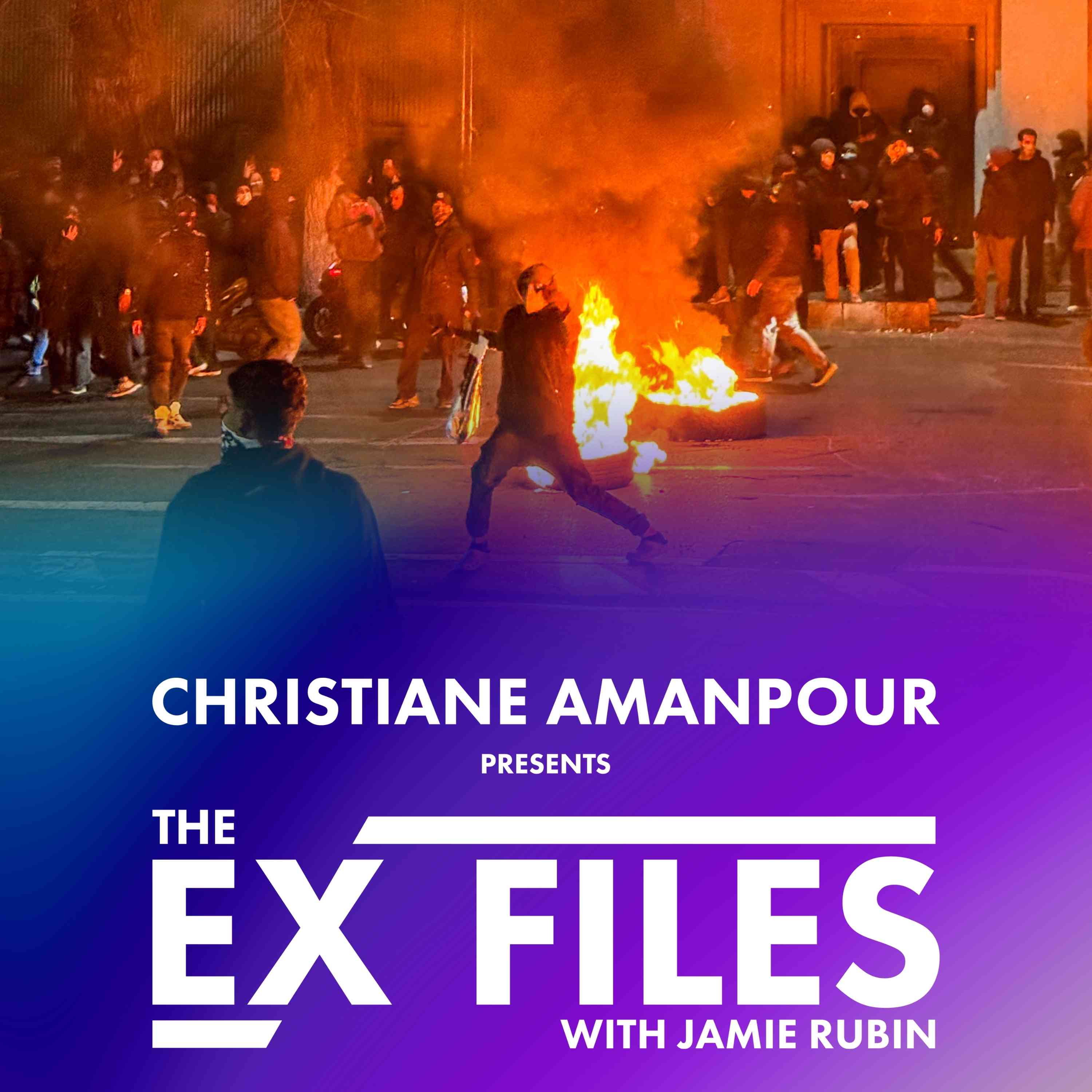
Loading summary
Transcript105 lines
- [00:03]
Christiane Amanpour
This is a Global Player original podcast. It's been quite, quite emotional as an actual Iranian as well, to have to report as a objective journalist, knowing that you have to also tell the story of all sides, but really understanding that you must tell the story of the.
- [00:23]
Jamie Rubin
People while also not being an overt activist. So for sure the Iranian regime is afraid of that. They see what President Trump did in Venezuela, extract the dictator of Venezuela, and they are worried.
- [00:36]
Cindy Strand
It was for me, and probably for you, the first time we watched a human being die in the dirt because they had not had enough to eat. It rocked both of us, just to our core.
- [00:48]
Maria Fleet
The people of Mostar didn't want the UN convoy to leave. And there were people like laying in front of the convoy. Women were laying on the street in front of the convoy because they thought that would be a measure of protection from the shelling.
- [01:05]
Christiane Amanpour
Hi everyone, it's Christiane here. And just before we get started with the full part of the episode, I.
- [01:10]
Jamie Rubin
Wanted to bring you up to speed.
- [01:12]
Christiane Amanpour
As far as we know, with what's going on on the streets of Iran.
- [01:16]
Jamie Rubin
You know, these street protests have been going on since about two weeks. They started because people, and especially merchants were protesting the collapse of the economy, essentially the collapse of the currency, the real, the massive inflation and the incredible hardship that every single person in IR has to go through, except for many in the corrupt leadership because there is a huge amount of corruption and there's a huge amount of hoarding of wealth by the leadership and the people are fed up. Now, over the last decades, there have been several big protests against this Islamic regime of the mullahs, the ayatollahs. There have been for political reasons, that is in 2009 with the so called Green Revolution, which I covered, where people were protesting for weeks about what they said was a stolen election. When the very hardline, pugnacious, provocative Ahmadinejad was installed again to be president, whereas the moderate was cast into house arrest. Everybody thought the moderate had won. That was the social. Then in 2022, you had the reaction to the death of Mahsa Amini, the young woman who died in the custody of the authorities because apparently she wasn't covering her hair well. Huge freedom pro protest that went on for a long time and it was also crushed. And why? Because the regime does not hesitate to take out its thugs, its Islamic republican, you know, the irgc, the Iranian Revolutionary Guard Corps, their foot soldiers known as the Basij, who go into the towns. And I've witnessed this on motorbikes with chains with guns and with the ability to crack down. So then this is the latest now, and this is purely economic of obviously they want a change in their regime, but it was sparked by the economic hardship. So here we are. We don't know fully what's going on. There's an Internet blackout still. Even Elon Musk, starlink, those who may have access to it, is not providing consistent window into Iran. The latest from the United States is that President Trump has said that on this day, when we drop our podcast on Tuesday, he's meeting with his national security advisors to figure out what to do and whether he's going to fulfill his promise, which he made a few days ago, to rescue and come to the help of the Iranian protesters. Remember, he said locked and loaded, ready to go, implying a military intervention. So for sure the Iranian regime is afraid of that. They see what President Trump did in Venezuela, extracting the dictator of Venezuela, and they are worried. That's absolutely for sure. So the Iranian regime In the last 24 hours has reached out to try to negotiate with President Trump over I don't know what perhaps the nuclear accord and the nuclear differences, but who knows whether this is all too little too late and what order anything will happen in. What we do know is from human rights organizations who tally these things as best they can. There have been, they say, several hundred deaths and many, many injuries. There are physicians in the hospitals in IR Iran who've been trying to get the word out that they have never seen anything like it. The number of deaths and the number of injuries. They report a lot of blood and they are trying to get that word out. And the Iranian government, it has said.
- [04:49]
Christiane Amanpour
Now it has the protests under control.
- [04:51]
Jamie Rubin
So we do not know a full picture. Suffice to say that everything is on edge. But the real fact is that the Iranian people, and I've covered it for decades, have been struggling for freedom and for basic living wage and a living standard of life because it's terrible for them, the poverty, the mismanagement and of course, the U.S. sanctions. So Iran, the regime faces internal protests on the street, the first time they've been this significant for several years. Plus external pressure from the United States and maybe even Israel. Many believe that this might be the time that the Iranian people actually managed to get some change in their country.
- [05:36]
Christiane Amanpour
Others are worried about the amount of.
- [05:38]
Jamie Rubin
Blood that will shed and what international intervention might do. There's also not a unified opposition. The most famous and popular name, the most well known name is that of Reza Pahlavi. He is the exiled crown prince. And he has been very active on social media since this demonstration started, calling on people to come out and saying that he will lead a transition back to democracy. But it's unclear what kind of organization he has inside Iran or what kind of support he has from the United States and others outside Iran. As for me, I've been covering this practically for 40 years. Iran was my home. I left 47 years ago, this time 47 years ago, 1979, when the revolution was starting. And that's what made me become a journalist. The Iranian revolution made me want to report these kinds of stories for the rest of the world. And I've been back to Iran many times. I've been banned several times for what they consider my poor reporting when I was reporting on behalf of the people there, their protests, and you know what they were, what they want. And I've been. I've empty chaired one president who refused to sit with me in New York if I didn't wear a hijab in New York. This was around the death of Mahsa Amini. And so I've had to be a journalist who's ready to report on Iran without fear nor favor. And it's been quite, quite emotional as.
- [07:11]
Christiane Amanpour
An actual Iranian as well, to have.
- [07:13]
Jamie Rubin
To report as a objective journalist, knowing that you have to also tell the.
- [07:19]
Christiane Amanpour
Story of all sides, but really understanding.
- [07:21]
Jamie Rubin
That you must tell the story of the people while also not being an overt activist. I'm a journalist and my credibility depends on that. But suffice to say, we're watching it very, very, very closely.
- [07:34]
Christiane Amanpour
So with the background of this latest Iran uprising on the streets, we've got something a little different for you this week, this episode.
- [07:42]
Jamie Rubin
There's no Jamie Rubin. Instead, I'm talking to two of my wonderful crewmates, my teammates at CNN who I started with in the FIELD More than 30 years ago, Cindy Strand, camera woman, and Maria Fleet, who started off as a sound tech lugging all the heavy equipment and also as the tape editor. We covered the news with tape all the way back then. So we're going to talk to them about what it takes to cover a story and what it takes to get into places or at least try to get information out of places where we have basically a blackout. And so far, international journalists are not able to get into Iran. So here are my good friends, my great colleagues who have been pioneers at cnn, and frankly, we altogether, we've been pioneers in terms of women covering international news. And as I say, it started more than 30 years ago. Now it's normal, and thank God for that, to see women all over the world in dangerous places covering the news from the field. But at the beginning of the first Gulf War, I think we were oddities in the fact that we were very prominent women doing that then, or we became. We were prominent to everybody who is.
- [08:57]
Christiane Amanpour
Watching on TV and couldn't believe that.
- [08:58]
Jamie Rubin
Actually women were doing this job. So with that, here is my conversation with Cindy and Maria.
- [09:09]
Christiane Amanpour
All right, Cindy and Maria, welcome to our podcast, the X Files. And I just thought it would be great, especially now, to talk about the.
- [09:18]
Jamie Rubin
Perils, the difficulty, but the absolute necessity.
- [09:20]
Christiane Amanpour
Of being in the field as reporters. We were part of each other's teams from the very beginning of my foreign correspondence, which began in 1989, 1990, with the first Gulf War. And we really did, you know, do some incredible, incredible stuff. It was when CNN first got launched onto the international stage with its prominence during the first Gulf War, and everything sort of came thereafter. And actually, CNN was the first ever live TV in your living room, literally. And it was the first ever global television network. There had been nothing like it before. And the first Gulf War sort of demonstrated that and cemented us as a major player on the international stage when it came to breaking news. So given what's going on in Iran and given what we know, which is at the moment there are no international correspondence, the authorities are not letting people in yet, if they ever do. The Internet is down and these protests are going on, and there is a lot of backlash from the authorities and a lot of uncertainty as to what's going on there. So it makes actually knowing the facts very difficult. But going back to the past, would you say that you've come across, you know, instances where it's so vital to be in there, but it's incredibly difficult to get in? And do you remember how you. Or we sort of breached that? Cindy, you were the camera woman way back then. Do you remember instances?
- [10:47]
Cindy Strand
Oh, my gosh. I mean, there's nothing more important than being at the location where the story's happening and giving voice to the people that are, you know, affected or impacting the story. And there's so many times, you know, if we couldn't get in, we'd get as close to the story as possible, and we would just think of inventive ways to get in. Sometimes we had to drive across borders, sometimes we had to charter planes, sometimes we had permission, sometimes we didn't. In the first Gulf War, for example, we'd have to drive from Amman Jordan to the border. And after this laborious process, we would cross the border and literally we'd have to drive across the desert. And you know, I went back to Baghdad during the first Gulf War when the war was underway, and we had to drive across the desert with all our equipment that the Iraqis had allowed us to bring in. But literally we're driving across the desert with truckloads of TV equipment during a war.
- [11:44]
Christiane Amanpour
And it was dangerous because it was an active war and it was mostly an air war. And I know, I remember CNN having, you know, huge CNN signage on top of trucks that were carrying equipment and that were carrying personnel. But it was really, really tough. I actually remember also trying to cross that border. And this is going back now to 1991 when the war actually started. It was grotesque. I remember crossing and trying to go to the loo and I went into these abandoned toilets and I swear to God there was excrement up to my thigh. Well, not quite thighs, but my calves. It was grotesque. And then at the same time, they were insisting on jabbing us to get AIDS results because they didn't want to allow anybody in that had. It was Kafkaesque, just trying to get in. It was horrible.
- [12:32]
Jamie Rubin
It was dirty, it was dangerous.
- [12:34]
Christiane Amanpour
But CNN said that we had to be there. And that was, I think, the beginning of the so called, you know, 247 live television, actual reportage also from quote unquote, behind enemy lines. Because Ted Turner, the founder of cnn, said that we could not not be there. We had to tell all sides of the story. And that's really relevant when it comes to Iran, which is highly politicized, the report Iran, when it comes to Israel, Gaza, which is highly politicized, we still haven't been able to get into Gaza. But do you remember, Maria, you were part of my original team and we were an all girls team who went during that first Gulf War, but into Saudi Arabia to watch the preparation for the war and the US buildup of what came to be 500,000 US and allied forces, including Middle east forces. And we were an all women team. And the Saudis could not believe it. And I remember us having to sort of do the story and also sometimes on our off hours when we did, we had to sort of dodge and weave past the morality police, remember the Mutawa or whatever they were called, and they had those sticks and they would flay our ankles if so much as an inch of flesh showed. It was a crazy time.
- [13:49]
Maria Fleet
That's right, that's right. I mean, in Fact, I mean, the Saudis relaxed some of their rules. That was the first time I'd ever been to the Middle east, actually. And I remember Jane, the camera woman that we were working with at the time. Cause I was acting as sound technician then as part of the team and editor, tape editor. It was all tape and tape editor. Yes. And she said, oh, Maria, this is not a good introduction to the Middle east because Saudi Arabia is like a different animal. It's so conservative. Before we went there, we were at a conference in Egypt because we were trying to pre position ourselves as close to the story as possible as you. As you were mentioning. And we had to go out and buy scarves, something to cover our heads, because we were. We were. So Jane said, we're going to have to cover ourselves completely. And we went to the market and we bought all these big swatches of sheer scarves, all different colors. I still have some of them.
- [14:50]
Cindy Strand
Do you know?
- [14:51]
Christiane Amanpour
Me too. Now I'm remembering where we got them. I'm trying to figure out where did I get these, these long flowing chiffon things. But the truth be told, yes, Saudi Arabia did relax its rules, not just for women journalists, but also for women members of the American armed forces, because they were there. But you remember, they had to be in the background. You could. They were not. They were barely allowed off base, the women. I remember a fellow reporter who was at the AP who then went to cnn, John King. He would, with his tongue in his cheek firmly, would call himself the custodian of the three holy. I mean, he was joking, but it was a riff on Saudi Arabia being the custodian of the two holy mosques. I hope nobody strikes us down. We're not being blasphemous. We're just remembering a joke. But it just went to show how unusual it was for women at that time to be doing this. And I remember a friend of mine who. Well, she became a friend. She was a correspondent for the Wall Street Journal, Geraldine Brooks. And she had gone to Riyadh, the capital, to talk to Saudi business people and the others about how they felt about Americans being there, how they felt about America coming to their aid to make sure Iraq, Saddam Hussein didn't invade Saudi Arabia, which they perceived that that threat was possible. And I remember the article said, oh, my goodness, who does CNN think it is? How dare it send, you know, three women to cover this story in Saudi Arabia? How culturally insensitive. Don't they understand what we are? And that really was the first time I'd really thought about the oddity of us being there. But it turned out frankly to be very good. And we were highly competitive because of the surprise factor. We got a lot of scoops, we did really well, we held our own. And I'm really proud of that.
- [16:36]
Cindy Strand
I was going to say as far as us being women and you know, people constantly asking me was, you know, did you feel like you were in more danger and were you denied access because you were seen as less important? And I would say there were cases and especially in some of these authoritarian regimes where, you know, the underlings of those in power just, it was just chest thumping masculinity. And sometimes they'd want to show off to us and we would get access and we would be taken to places and we would be allowed to do interviews and we would get scoops just because of this like bravado. Really, it was chest thumping masculinity. And people would show themselves to us in ways I don't think other people would get access to.
- [17:22]
Maria Fleet
Being a woman sometimes was kind of disarming because people, you know, maybe they didn't take you as seriously, but they would. So they would, oh yes, you can do this, you can do that.
- [17:32]
Christiane Amanpour
Little lady, little lady.
- [17:35]
Maria Fleet
Little did they know we really could do it.
- [17:37]
Christiane Amanpour
Little did they know. I remember when people asked me about being a woman and covering these places and these things at that time. Obviously now there are women everywhere. But when we were doing it, we were quite rare. When people ask me, I said, well, you know what? As you were saying, Cindy, sometimes the men of very, you know, they, they behave like men. They're chivalrous, they open the door for you, they let you go through. And I'm like, okay, they opened the door. My foot is in the door and I'm not taking it out. And that was, you know, that was.
- [18:04]
Jamie Rubin
You know, how we, how we dealt with it. Maria, though, you know, since 911.
- [18:12]
Christiane Amanpour
Reporting overseas has become very different. We had no close protection, no security guards in the first Gulf War in Bosnia and elsewhere like that. We didn't walk around with, you know, like sort of paramilitaries around us.
- [18:26]
Jamie Rubin
And we, which is very different from today.
- [18:28]
Christiane Amanpour
We didn't even have hostile environment training. That, that came after 911 and after the deliberate attacks by Al Qaeda and ISIS on actual journalists.
- [18:38]
Jamie Rubin
The beheading of Daniel Pearl.
- [18:40]
Christiane Amanpour
Daniel Pearl, the reporter for the Wall Street Journal, the American. What do you feel, Maria, about doing it before the so called training and after the training?
- [18:51]
Maria Fleet
Well, you know, I think that war has changed the world has Changed a little bit. I feel like at the beginning of my career in the 80s, I worked in Latin America and Central America quite a bit. And I joke now because we have all this training. Well, back then we didn't have any training at all. We were a bit naive, actually. But we thought our protection would be wearing a T shirt that said, journalists don't shoot. You know, and journalists were, I think, back then, journalists did have a measure of protection. They had a different level of respect. And also, being a Western journalist in a country, you felt as though people respected that as well. But war itself has changed, and over time, journalists actually became targets. We started, we were the truth tellers, and then we became, well, maybe we don't like the truth you're telling, and so we'd like to target you. I mean, we all know very well that journalists were targeted in Bosnia. And we lost one of our beloved colleagues in Bosnia. Or she was shot and she's gone now. She was not killed then, Margaret Moth, but she was shot and very severely injured, as you know.
- [20:10]
Christiane Amanpour
Yeah, and so many others. Bosnia was, in fact, the first war of modern times that anybody remembers where journalists were deliberately targeted, because like you said in Latin America or Sindhi in the Middle east or elsewhere before that, they were, if they were killed and they were in Vietnam and elsewhere, it was in the crossfire. But as you say, Maria, and I lament that and mourn it, that for a long time we journalists were protected because people on all sides thought we were there to tell their story. And then it became weaponized and politicized and journalists were considered to be either on one side or the other. And that's the most dangerous thing that can happen to journalists. And the most, the hugest disservice to being able to report the truth and do it and do it like that. Cindy I remember coming to Baghdad during the first Gulf War, when the Americans were targeting Baghdad, obviously trying to get Saddam to get out of Kuwait. They weren't even really trying to topple Saddam at that point in 1991. And I remember coming into the hotel room, having done that perilous journey across the desert where you were set up, and you were at the time recording live out of the window. I don't know, it was a cruise missile raid or whatever it was. And I came in, there was some almighty bang. And I went, oh, I can't say it on the podcast, but I swore. And I was really naive. I, I, I knew what you turned around to me, and I swear to God, I thought you were gonna kill me because I had interfered with the natural sound of. Of the actual bombing. So I learned my lesson then. But I think for all of us to talk about how Ted Turner insisted that we stay in Baghdad if we wanted, that CNN had to be there and had to tell the story, even behind enemy lines. Tom Johnson afterwards, or maybe at the time, said that the commander of US Forces, General Schwarzkopf, and maybe even the Secretary of defense and the chairman of the Joint Chiefs and, you know, Colin Powell and President Bush, all of those people, they didn't want us to be there, probably because they didn't want us telling the story of what was happening on the other side. But do you remember what it was like, that moment when Ted Turner basically gave us all a choice?
- [22:30]
Cindy Strand
You know, it's so interesting because then, you know, who controls the message? And that's why it's so important for journalists to be someplace like in Iran right now. Yeah. You have so much social media, and of course, it has to be verified, the painstaking steps to verify video that goes on every day in every newsroom. But, you know, who's got the power? Who controls the message? And, you know, during the first Gulf War, the US Controlled the message. They would send out these black and white, very antiseptic videos taken from the planes that would show the destruction. And it was infuriating Washington that we had teams in Baghdad that were showing what was happening on the ground. And this is something that was unheard of. We're in the enemy's capital, and we are showing what's happening. We're telling people's stories, and we're showing what's happening on the ground. And it just really infuriated the US Government at the time. And there were editorials written about, about cnn, and CNN was taking a lot of flack. You know, they stood firm. But I will say, if it was minutes before a broadcast, we would send our stories in very close to when they were needed. Like, very, very, very, very, you know, control room screaming, where's that video? So it would go straight to air and not go through any filters.
- [23:52]
Christiane Amanpour
Exactly. And you say, you remember, you know, this. I don't know this, but it happened just before I got there. I think that there was a US bombing of a shelter, a civilian shelter. I think it was called the Ameriya shelter in Baghdad.
- [24:06]
Jamie Rubin
Right.
- [24:06]
Christiane Amanpour
I think they tried to say that it was a regime headquarters or whatever. Talk to us about that, about what you all discovered and why that was important. And you wouldn't have known had you not been there?
- [24:18]
Cindy Strand
No, that was also. Cameraman Dave Rust was also in Baghdad at the time. And, you know, the shelter, it was women and children in the shelter and the casualties were high and it was excruciating to see. And on that particular day, you know, Dave, Russ came back with video that was just so difficult to watch. And you know, you know, we, we tend to like a good guy and a bad guy when it comes to war. And often, you know, the complications of geopolitics there, you want a good guy and a bad guy bad, but, you know, it's the civilians to remember, it's the civilians to think about. Maybe a lot of people in the shelter were probably the, you know, wives and children of some of the upper echelon or important military leaders. But you gotta show the impact of war. You need to see the people, you need to know what they're feeling. You need to go. They're through, going through. You have to give people a voice. And that's why, you know, as Western journalist, and I will, you know, give a shout out now in support of legacy media just to have the kind of reach, contacts, abilities to get in and out of countries, to cross borders, to safely, you know, for Arwa Damon to safely get into home Syria to show what it's like under siege during that very dangerous period. I mean, it's legacy media that can do these kind of things and take these kind of risks and has the kind of connections and the experience to try to keep people as safe as possible.
- [25:54]
Christiane Amanpour
You know, you bring that up. I keep thinking about that because Maria, I obviously feel very passionate about legacy media as well, for all the reasons that Cindy just said, and even more because, you know, at least we have brands that are trustworthy and that have been tried and road tested over decades and proven to be able to tell if not every single detail of the story, then as much of the whole story as we can. And I think it's really frustrating for us to be almost in existential competition with social media and Internet videos and this and that which we don't know how to verify, which often, certainly in the United States and elsewhere, Russia and wherever you want to look are full of conspiracies and fake news and deep fakes and now AI and all the rest of it, manipulation of videos. And it makes it really, really tough actually be able to sift through and tell the truth, the absolute truth, which needs to be told from these places. And that for me is a real heartbreak after spending a career trying to tell the truth. I don't know how you reflect on that, Maria, but it's just so tough.
- [27:00]
Jamie Rubin
Not being able to be there and.
- [27:02]
Christiane Amanpour
Then having to compete with those who have weaponized information.
- [27:07]
Maria Fleet
We live in, you know, a different media landscape now and it's just forced us to adapt to it. You know, we can't stop it, but it's happened. And a lot of people call themselves journalists who have social media accounts and the idea of a journalist has sort of expanded and we cannot stop that. We just have to work with it. We do have to underline continuously what our processes are, our fact checking, our processes of trying to figure out if a video is legitimate or not. And as you say, that's going to be harder and harder and harder with the advent of these very, these, these AI created videos that are so sophisticated and you know, I'm sure everyone in newsrooms in legacy media or, you know, true newsrooms with true rules and professional conduct. Yeah, with real rules, as you say, are just, you know, tearing their hair out trying to figure out how they're going to deal with this. But we do, we adapt. We always have adapted and we will adapt to this new world. The truth does get out.
- [28:28]
Christiane Amanpour
It does.
- [28:28]
Maria Fleet
There is a way of verifying the truth and there always will be. I truly believe that.
- [28:33]
Christiane Amanpour
Yeah, I believe it too. Even though it's getting harder, I do believe it. And I lament these sort of nefarious actors all around around who try to this horrible word, but it's, it's relevant and accurate, weaponizing everything. Can we just take a break? Because when we come back, I want to talk about some of the really good stuff that we and other journalists have done that's actually saved lives. But also ask the question about when.
- [28:58]
Jamie Rubin
Do you get or do you get consent from those who you training your.
- [29:02]
Christiane Amanpour
Camera on to tell their stories? Because that's now a big deal. I think when we did it, it wasn't such a big deal. We just went to tell the stories and they were just pleased that we would be telling their story. When we come back.
- [29:17]
Progressive Insurance Announcer
Logan Furey did something smart. He saved hundreds on auto insurance switching to progressive. With that money, he bought a mini treadmill. Is walking on it during video conference calls more distracting than he thought? Yes. And is that because he overestimated his foot eye coordination? Definitely. But it's Logan's savings and if he wants to burn calories and any chance at a promotion, we say, good for you, Logan. Switch and see if you could save with progressive and treat yourself progressive casualty Insurance company and affiliates.
- [29:52]
Christiane Amanpour
Can we just talk now a little bit about what I think a lot of people want to know. When you point your camera at people, are you telling them, can we get your consent? Can you sign this, you know, this document, this release and all the rest of it? I remember. I'm not sure whether you were there, Maria, but definitely Cindy and I were in SOMALIA When George H.W. bush, at the end of his administration, actually responded to the latest terrible famine in Africa. And this was in Somalia. That mounted and mounted throughout 92 when we all landed. And I think, Maria, you were there and every. I came in from, I don't know where. I was from Bosnia. In fact, they moved me from Bosnia to do this story. My position originally was on top of a building overlooking the airport in order.
- [30:41]
Jamie Rubin
To be able to report in real.
- [30:43]
Christiane Amanpour
Time the landing of the Marines on the beaches of Mogadishu to heroically come and save the people and to stop the famine. And I remember we went for 36 hours at least non stop, and it was dark and then it was, you know, morning, and we could see it, but you guys saw it from another perspective. And I remember we were in trouble. Or at least there was this thing whereby, oh, my God, you mustn't put American forces in danger. You can't do this and that in real time. How could you show them landing and this and that? But you guys, you were on the other side of the story, right, Maria?
- [31:16]
Maria Fleet
Yeah, we were actually, we were aboard one of the maritime pre position ships with the Marines that were going to land. I mean, they had invited some journalists to, you know, to come and, or, or maybe CNN had advocated for us to be aboard and they were granted that permission. So we were on board and we were being told by the Marines what they were gonna do. And we were getting all these briefings that we were gonna land with the Marines. And so I was taking it very seriously. So I get into a hovercraft with my camera, we land on the beach and I'm like, I'm feeling myself like a Marine. I gotta storm the beach and get these great drama pictures of the Marines storming the beach like in Normandy or something. And I see an apc, an armored personnel carrier. And I'm like, oh my God, that's going to be a great dramatic picture. The hatch in the back is going to open and out will come the Marines. And so I go up there, I'm rolling, and the hatch opens and out pops Bob Simon of cbs. He says, hi, Maria.
- [32:30]
Christiane Amanpour
Oh my God. And yeah, it was like metric tons, loads of journalists as well. But also, do you remember how we got into trouble for actually shining lights into the Marines and, and, and, and compromising their night vision goggles? And then we had to tell people who were complaining on the outside, you know, the chattering classes, that actually it was all organized by the, you know, the PR department or whatever they call themselves, the media relations department of that particular Marine unit, that they wanted the press to be there to cover it. So I think people should understand that there's a lot of hand in glove, often that goes. And we sometimes get caught in all of this. But it was fascinating, I should say.
- [33:10]
Maria Fleet
Shout out to the US military who have allowed journalists to come along with them in some capacity, because in Iraq, that did help us get the story. And also a shout out, just as a little side side note to all the NGOs who have ferried us into places, because they often get there before the journalists get there and stay long after the journalists leave. And so they're the ones that are a lifeline for us to get in. And, you know, I remember one time when Mostar in Bosnia was under siege, we went in on a UN convoy. They finally, you know, were able to get this UN convoy to go in, and we went in with that UN convoy to get, get to see what was going on in Mostar because no one had been able to get in there.
- [34:01]
Jamie Rubin
Yeah.
- [34:01]
Maria Fleet
And then famously, the, the people of Mostar didn't want the UN convoy to leave. And they, they were people, like, laying in front of the convoy. Women were laying on the street in front of the convoy because they thought that would be a measure of protection from the shelling that they were, they were under.
- [34:19]
Jamie Rubin
Yeah.
- [34:19]
Christiane Amanpour
Cindy, when we were in that. I don't know what we call it now, was it a feeding camp, but it was in Mogadishu, and it was, you know, finally this stuff, flour, gruel, whatever it was that the US had helped deliver, was being given to people who were skeletons, essentially. They were literally on death's door. Some were being brought in by wheelbarrows. It was the most awful thing that certainly I've ever seen in terms of people on the brink of death simply because there was a man made famine caused by these warlords, not by natural disaster or anything. We were doing live reporting. I was the correspondent, you were the camera woman, and, and we realized that because you could see even if I had my side or my back to what was happening, that this woman was dying. And we did not know what to do with ourselves, how to stop, should we stop? Shouldn't we stop? What should we do? I mean, we were almost frozen. I was, I think I was frozen.
- [35:25]
Jamie Rubin
Just fear of what to do and.
- [35:27]
Christiane Amanpour
And what the, the correct moral thing was to do and not knowing how to get out of it.
- [35:32]
Cindy Strand
It was for me and probably for you, the first time we watched a human being die in the dirt because they had not had enough to eat. A completely avoidable situation. And just, you know, it rocked both of us just to our core. And you know, we, we had seen this woman. I had certainly filmed this woman. It was like an emergency center and people would arrive, but for some people they were just too far gone and there was no way to stabilize them. So I had watched this woman over a few days and she was just so beautiful. And we were paralyzed because this woman was taking her last breath. And, you know, what a responsibility. I mean, you could later analyze this with a whole team of morally, what's the right thing to do? What should we have done? But you know, we were just frozen in this moment of just like this person is going to take her last breath for all the wrong reasons and it should never happen. Nobody should be dying because they don't have enough food to eat. And I do remember we kind of backed up and disengaged from the situation. But I think that probably changed me as a, as a, that experience probably changed me as a person and as a journalist.
- [36:50]
Christiane Amanpour
And I would add to that that we were very young. I mean, it was more than 30 years ago and we were young people thrust into those life changing experiences and dramatic experiences. And I will say, and I, I'm not doing this in order to justify what we did, but I genuinely believe that your pictures and all the other pictures that showed the famine actually did good because, because it forced a democratic superpower to actually intervene purely on humanitarian grounds and actually stop a famine. And that was phenomenal. And I don't regret it and I don't apologize for it. And I think that what we did was better than not doing. And I know it raises the question about where do you put your camera and who do you ask? But in this case it was life and death. And I think in the end, on balance, our presence did more good than harm. I think obviously it went to hell afterwards because it became a political thing afterwards, after the humanitarian, you know, situation was solved, then they decided to go all into other stuff that they had no business doing, the American administration. And then it turned into A disaster and Black Hawk down and the reverberations after that.
- [38:06]
Jamie Rubin
And the.
- [38:07]
Christiane Amanpour
I think they stayed away from the genocide in Rwanda because of the quagmire that they got themselves finally into, into Somalia. But that, that's for another day. I just remembering trying to get into places. I remember guys when Maria was just talking about Mostar. But another besieged place, of course, was Srebrenica, as we know. And one of our, you know, colleagues from, you know, from abc, Tony got in and he got in and sneaked across and climbe and got in in the most, you know, amazing time. And then I wanted to get in somehow and, and I asked our boss to ask the, you know, General Colin Powell, chairman of the Joint Chiefs, to please, could he put me on one of the pallets that they were airdropping into Srebrenica and the other, you know, so called safe zones to relieve the humanitarian situation. And I think General Powell was so shocked and so, so just contemptuous of my request and the fact that our boss actually asked him, he said, look, if you want to kill Christianov, I've got other ways to suggest you do it. No, I am not going to drop her into Srebrenica. So I regret that I wasn't dropped into Srebrenica.
- [39:23]
Maria Fleet
Like dropping in like Mary Poppins.
- [39:25]
Christiane Amanpour
Exactly, exactly. To tell that story. I wish we had been able to. In the end, it was complete disaster there. Massacred. But listen, listen, I don't know, is that a dark note to end on? Do you guys want to say something else about covering the news that that is so important and especially resonates right now again as we're trying to figure out what's going on in Iran, that's the latest place. And even in Venezuela, by the way, there were very few international journalists there throughout the whole period of the American escalation that culminated in the abduction and the rendition of Nicolas Madhun?
- [40:02]
Maria Fleet
I would just like to say that human beings are so resilient and we've seen that resiliency throughout our careers and they adapt and we as journalists adapt. But the people that we cover have amazing resilience. We've seen them in the worst moments of their lives, in the worst era of their lives. And you know this from covering the war in Bosnia, how like people just adapt. Like I was even amazed like people how people would put, they would put up blankets so they could not be seen from the snipers up above in the hills and they would put the blankets up so that they knew where they could walk in the street and they wouldn't be seen. I mean, you know, just inventive, resilient. We're going to get through this. And you know, and I will also say the truth also does find its way out. It's like water. And it will get there because we're even seeing some of those images even with the Internet blackout coming out of Iran today. So the truth will get out.
- [41:11]
Cindy Strand
Yeah.
- [41:11]
Christiane Amanpour
And that's the most important thing.
- [41:12]
Cindy Strand
Cindy, final word, I would just say so often these brave local journalists around the world, you know, their images and their work is often discredited and disparaged. And that is why it is so important to have a variety of reporters on the ground to give voice to people that don't have a platform or whose, whose message is just squashed by bots elevating fake information and just drowning the Internet with information that's not real. And I look at the US right now and what's happening here. I teach journalism courses now and I teach classes in international news gathering. And now I look at the United States here and I look at, you know, covering the story here in the US I feel it's almost like covering an international story as you see people disappearing from their homes and workplaces and cars and journalists being disparaged and you know, propaganda coming from up high. And you know, it's not just a challenge covering international news, but I think right now it's a challenge covering national.
- [42:23]
Christiane Amanpour
News in the U.S. maria, Cindy, it's been really fun reminiscing and I think, I hope our stories are useful and interesting to people who are listening and someone sometimes wonder how it gets done behind the scenes and that it's not always easy but that we're all so committed. And I think that comes across certainly from you guys. It was a real, real privilege to be working with you.
- [42:47]
Maria Fleet
Thank you. I feel the same about you too.
- [42:49]
Cindy Strand
Oh thanks Christiane. Keep the hard doing the hard work.
- [42:53]
Christiane Amanpour
Okay, I'll be back after this with my recommendation. This.
- [43:00]
Progressive Insurance Announcer
Meet Matthew Preston. Inside his apartment everything he holds dear is protected by progressives renters insurance like his laptop and a surprisingly valuable collection of baseball bobbleheads outside his apartment. His laptop is still protected as are his bobbleheads which he carries around with him for reasons no one knows. Renters. The limits of protection aren't just the four walls of your home. When you're in progressives protection system get a quote@progressive.com Progressive Casualty Insurance Company affiliates and third party insurers.
- [43:35]
Christiane Amanpour
Okay, so back now just me this week with the recommendations. And because I am, you know, totally thinking about Iran and everything that's coming out of there and remembering my childhood there and my experience as a journalist there over, over so many decades, I.
- [43:50]
Jamie Rubin
Want to actually recommend some fantastic Iranian films. Many of you may know that over.
- [43:55]
Christiane Amanpour
The last several decades, there's been an.
- [43:57]
Jamie Rubin
Absolute golden age of Iranian filmmaking. In fact, a few years ago, one director won an Oscar. His film A Separation, Farhad Asketti, won an Oscar. It was the first time an Iranian had won. So I highly recommend A Separation. And then I highly recommend also the current Iranian film, which is Making Waves. It's by Jafar Panahi and it's called It Was Just an Accident. You're going to really appreciate that. And then the last one that was nominated for an Oscar is called the Seed of the Sacred Fig. Again, a phenomenal film by, by Muhammad Rasulof and garnered so much attention in.
- [44:38]
Christiane Amanpour
The United States and around the world.
- [44:39]
Jamie Rubin
And for their pains, many of these directors have been banned from Iran, threatened by the the regime, including Pani, who spent time in jail and he's been threatened again with that. And just also to say Iranian cultural figures and Nobel laureates. We have two Nobel laureates, both of whom are women in Iran. They have all ban banded together to speak on behalf of Iranian human rights, democracy and freedom. That's my recommendation for this week.
- [45:11]
Christiane Amanpour
So everybody, thank you for listening. We really do appreciate it. Make sure you're following our feed so that you never miss an episode. Remember, you can watch every episode now on YouTube.
- [45:20]
Jamie Rubin
Just search for Christiana Manpour presents the x files on YouTube and subscribe to our channel channel.
- [45:26]
Christiane Amanpour
You can also listen for free on.
- [45:28]
Jamie Rubin
Global Player and that you can download.
- [45:31]
Christiane Amanpour
From the App Store or go to.
- [45:32]
Jamie Rubin
Globalplayer.Com and Jamie and I will see.
- [45:36]
Christiane Amanpour
You later this week for the bonus Q A episode.
- [45:39]
Jamie Rubin
Keep your questions coming.
- [45:40]
Christiane Amanpour
I'm sure many of you will want.
- [45:41]
Jamie Rubin
To know our take and the latest on what's happening in Iran, maybe even.
- [45:46]
Christiane Amanpour
The Venezuela effect, what might happen next in Greenland.
- [45:49]
Jamie Rubin
There's so much to talk about given how much President Trump is acting on the global stage. So email us@amanpourpodlobal.com or you can find.
- [45:59]
Christiane Amanpour
Us on social media. Amanpourpod okay everybody, goodbye. Thank you for listening. Thank you for watching and see you again in a couple of days. This has been a global player original production.
- [46:15]
Progressive Insurance Announcer
Logan Fury did something smart. He saved hundreds on auto insurance. Switching to progressive with that money he bought a mini treasury is walking on it during video conference calls more distracting than he thought? Yes. And is that because he overestimated his foot? Eye coordination, definitely. But it's Logan's savings. And if he wants to burn calories and any chance at a promotion, we say, good for you, Logan. Switch and see if you could save with Progressive and treat yourself. Progressive Casualty Insurance Company and affiliates.