← Christiane Amanpour Presents: The Ex Files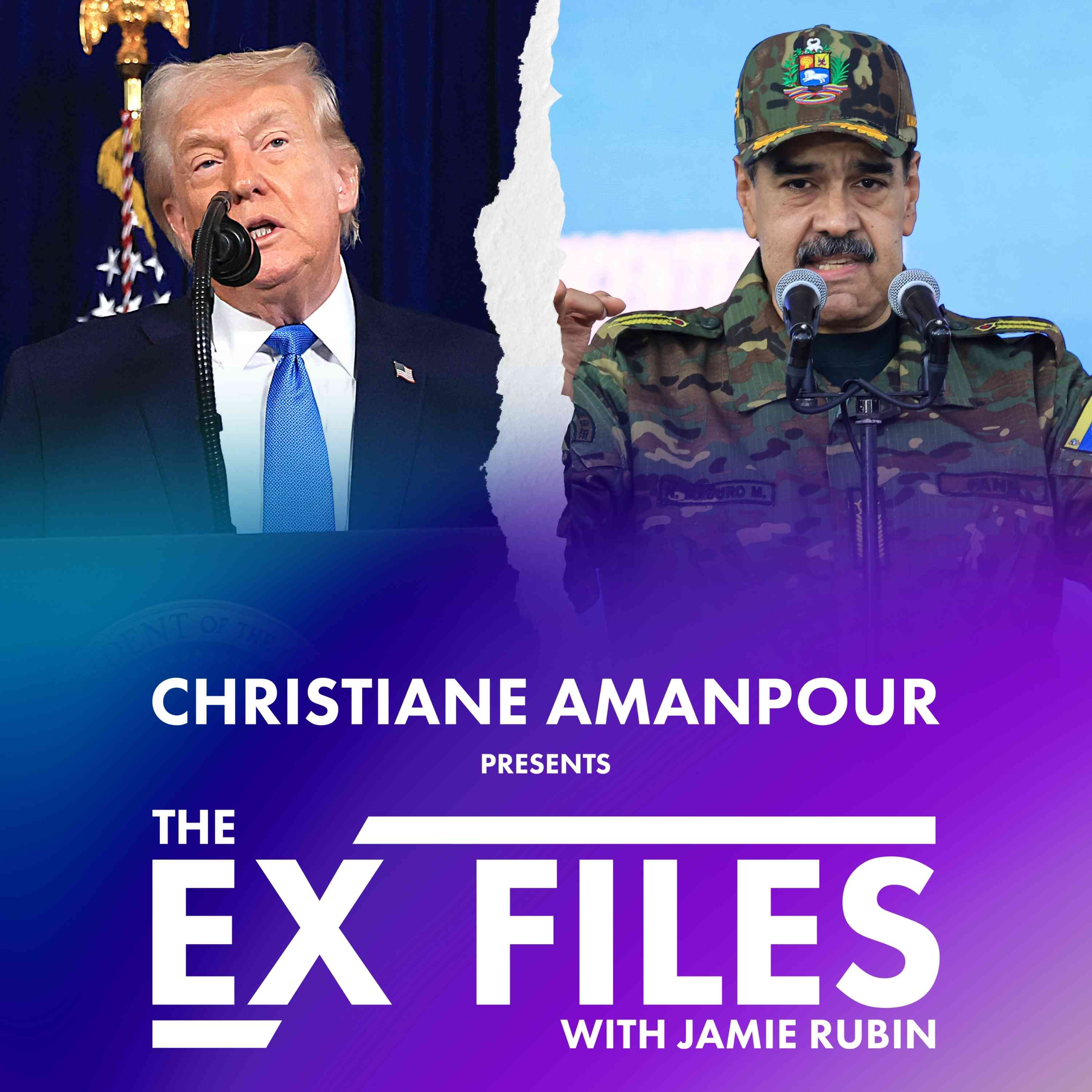
Christiane Amanpour Presents: The Ex Files
Trump 'kidnaps' Maduro and says he’ll run Venezuela: who's next?
00:42:10
Loading summary
Transcript59 lines
- [00:03]
Jamie Rubin
This is a global player original podcast.
- [00:09]
Christiane Amanpour
There are two big questions. What the heck just happened? And what the heck is planned to happen in Venezuela?
- [00:16]
Jamie Rubin
People are rightly worried that he actually believes that the world is a big game of risk and there are different regions controlled by different leaders and players.
- [00:26]
Christiane Amanpour
Let us not forget that Trump has acted against the brutal dictator in Venezuela while not acting against a much worse, much more brutal, much more land grabbing, much more corrupt leader in Russia. And that's Vladimir Putin.
- [00:40]
Jamie Rubin
Remember, he loves oil.
- [00:41]
Christiane Amanpour
Yeah, he loves it.
- [00:42]
Jamie Rubin
He was gonna keep troops in Syria to get a few oil fields in Syria. It's something he understands. Cause he lives in the world of the 50s that you're describing.
- [00:57]
Christiane Amanpour
Welcome to a special episode of the X Files with me, Cristiane Manpour in.
- [01:01]
Jamie Rubin
London and Jamie Rubin in Ital.
- [01:04]
Christiane Amanpour
Listen, when I came back from my holiday and I still had two days holiday to go, I could not believe when I turned on the radio and heard very early in the morning, because this was overnight in the Western hemisphere that Maduro had been extracted. I was just, whoa. And then we were waiting for, I don't know, regime change and all the rest of it and what next and what's happening? A lot of these questions are still unanswered, but it was a gee whiz reaction. And then my immediately thought, who comes next in this extraction theory of foreign policy? Jamie? I mean, there are two big questions. What the heck just happened? How unusual is it? And what the heck is planned to happen in Venezuela? Who's going to run it? What's going on? So I guess the what the heck just happened was telegraphed long and hard by President Trump and his ministers and cabinet secretaries for many months. Massive buildup of US Military force in the Caribbean, the aircraft carrier Iwo Jima and lots of air power. The shootings and the killings and the strafings of so called narco trafficking boats, others called them fishing boats, scores of people killed. And now this entry into Venezuela over the weekend by special forces and the, whatever you want to call it, abduction, seizure, Trump went with the word kidnap. He thought that was good. When somebody asked the kidnapping of Maduro and his wife, the president and first lady of Venezuela, did you expect it to get to this point?
- [02:38]
Jamie Rubin
No, I have to admit I didn't. And there's a very good reason for that. I believe the United States and its special Forces, the Delta Force and the seals, which weren't apparently involved, have had the ability to, you know, capture somebody and bring them home. They did that in the case of Bin Laden, they killed him. But what comes next is part of the question of whether you should do this. Because taking Maduro out of Venezuela doesn't solve the Venezuela, Venezuela problem. And in a sense what we're going to see is whether a grand theory that's been going around for centuries, it's called compellence. Can you coerce another country to do what you want by threatening to invade it? Because we didn't invade it. We did a very effective and extremely well organized and extremely well conducted raid. Taking out their lights, taking out their defenses, taking out their capabilities. A minimum loss of life. But in a sense that's just the easy part. As hard as it was and as brilliant as it was executed, it's the easy part because I've always been concerned if you want to change a regime, you have to be prepared to invade. And that's, I don't think yet on the books.
- [03:55]
Christiane Amanpour
No, I don't think it is yet on the books. But let's just take a few of those issues. Number one, I just thought it was interesting that today Cuba is holding two days of mourning officially because 32, I believe they said of their own soldiers, were Maduro's close bodyguards. So what that says about Cuba, I don't know. What it says about the fear of Cuba that they may be next, I don't know. But it's interesting that the Cubans were Maduro's close protectors.
- [04:23]
Jamie Rubin
Christiane, that's extremely important, bringing up Cuba right away, because that cuts to the heart of what this is about. This is about two men, Donald Trump and Marco Rubio. Donald Trump isn't interested in ideology or communism or capitalism. He'll work with any dictator or anybody who will do business with him. He's interested in Venezuela's oil, he's made that absolutely clear. But Marco Rubio, who had these incredible powers as national security adviser and Secretary of State, has now been able to fulfill his probably dream of being able to dictate, he thinks, the actions of Latin America and remember Latin America. And the reason why I've tended to stay out of the politics of Latin America is deep, deeply divided between right and left. There are the right leaning dictators or hard right dictators, and then there are the left wing communists. Cuba, Nicaragua and Chavismo, which is, you know, Bolivarian anti American socialism created by Chavez and now Maduro. They're on one side and on the other side are the likes of the President of Argentina, of Chile, of El Salvador. Rubio's on the side of the rightists. And he somehow hopes, I think, as a child of Cuban emigres, that weakening Venezuela, taking out Maduro, killing perhaps 32 Cuban bodyguards, is going to cause the fall of the Cuban regime. And in a way, the Cuban emigres have been hijacking American foreign policy for decades, keeping us pursuing policies that haven't worked against Cuba. This is the ultimate hijacking of American foreign policy by Marco Rubio to achieve objectives that he ideologically believes are the most important thing in the world. I don't think most Americans do. I know I don't. There are major issues in the world, China, Russia, global warming, disease, all of these big, big issues. And the United States has now focused all its resources, all its attention and all its effort on this one place. And we don't even know if it's gonna work.
- [06:33]
Christiane Amanpour
Let's just pause a little bit and just remember that over the last at least 25 years, since 9 11, the history of and the facts of American and often aided by Britain and others intervention into, let's say Iraq and Libya and Afghanistan have not gone well. The idea of nation building has not been properly executed and therefore it hasn't gone well. And it's been ping ponged by politics instead of the actual policy of trying to do something right. I just want to say, look, everybody's going well. This wasn't legal. It didn't have a US legal cover by congressional approval. It didn't have international legal cover. I have to say the sitting here in London, there's been barely a peep of disapproval by the British government, barely a peep from many of the European nations. They have chosen to focus on the horrors of Nicolas Maduro, the dictatorship, the scores if not thousands of people who've been killed and disappeared and all of that. The, the, the stealing of elections and on and on it goes. But I will get back to that in a moment because this for sure, this intervention apparently was not about democracy. Whatever Rubio wants, it wasn't because Trump is like whacked the, the legitimate democracy. Opposition leader Maria Corinna Machado, who was the Nobel Prize winner, and she immediately that Maduro was extricated and it was made official. She put out a statement saying that she was ready to unfortunate word seize power. We're ready to do, to do our thing. Maybe the word seize wasn't the right word, but nonetheless, I've interviewed her several times since they and her party won the election last year that it's clearly evident that Maduro stole the election and yet Literally, no, nothing, no tidbits, no recognition, no nothing is being thrown to the opposition, the Democratic opposition. And in fact, Trump insulted her several times, saying that she might be a nice lady, but she doesn't have the respect of the people there. I don't know whether she means people who did in fact overwhelmingly vote, or is it the military? I don't know what he's thinking, but he wants to work with Maduro's second in command, Delsey Rodrigo, who's now been named by the Supreme Court of Venezuela as the interim president.
- [08:47]
Jamie Rubin
He doesn't want to get involved in doing the hard work. He's hoping that by snatching Maduro and threatening an invasion, quarantine the area's potential for oil exports, that they can coerce this Maduro government into doing exactly what Trump wants, which is allowing the American oil companies to come in, restore the oil capacity, and begin to make profits and share those profits with Venezuelans. But none of that is going to happen until we understand what the response will be from whatever's left of Maduro's regime and the fighting that's likely to go on between them. Remember, we already see a big difference between her, the newly sworn in president, and the defense minister and the interior minister, who have the power, have the military power, the security power. Chavez created a country that's filled with local thugs running local parts of the country, making deals with drug lords, making deals with oil companies or whomever. And that world cannot easily be grafted into Donald Trump saying, we're running the place, we're not running anything now. They're hoping they can run it without doing the hard thing of invading, occupying and sustaining all of that for decades. And that's why this is so controversial.
- [10:09]
Christiane Amanpour
It is. But let's just break that down a little bit, too, because there might be different factions competing for the narrative and the actual power in Venezuela, but there are also, also in the United States, even Marco Rubio, who is the tightest, I think with Trump, they have a different view of what running Venezuela means. What does it mean? Does it mean, as one of them said, coercing, and that's the word, coercing. The new interim president, her name is Delsey Rodriguez, to do the US bidding, or as Trump has threatened, if she doesn't, another military intervention, we don't know what kind, and actually doing a full Iraq or a full Afghanistan, that means occupying and nation building.
- [10:53]
Jamie Rubin
That's why this surprised me, because I didn't. I have to remember, these people are slapdash foreign policymakers. They think they can just do something doable, namely the capture of Maduro and then everything will happen the way they want. Unfortunately, the world doesn't work that way. And what the real tragedy here, and I'll keep coming back to this, is while we're messing around in Venezuela with something that's going to take years and years, you know, only time will tell, as they say, whether this is gonna work out. Meanwhile, in the meantime, China is actually taking over the region, economically, politically and diplomatically.
- [11:31]
Christiane Amanpour
In Chile, you're talking about the Western Hemisphere, Latin American region.
- [11:35]
Jamie Rubin
Exactly. And that's what's so hypocritical. The Trump Doctrine, which was put out by this administration in a ballyhooed way, says that we're going to control the Western Hemisphere and no outside power is gonna have dominance or significant role in the Western Hemisphere. The Chines already do throughout Argentina and Chile and Peru. They run huge operations for mining, for minerals, for transportation, for imports and exports, all of which is happening as we talk and worry about the details of Venezuela. So they have failed in their own objective, which is to prevent an outside power from dominating Western Hemisphere.
- [12:19]
Christiane Amanpour
So let's talk about that.
- [12:19]
Jamie Rubin
That's what's ridiculous about this.
- [12:21]
Christiane Amanpour
Okay, so you just talked about the national security strategy, which came out late last year and shocked everybody, of course, because it was so transactional. And it seemed to you remember, it pushed, you know, Europe was under civilizational extinction and this, that and the other. And we should stop hectoring the wealthy Gulf monarchies and et cetera, et cetera. But here's the line that's relevant to this. Latin American countries, according to this doctrine, must grant no bid contracts to U.S. companies. So now let us talk about what really this apparently is all about, according to Trump, and that is oil and, quote, making America great again or America first. So can you just give a little bit of the history of why America thinks it owns or it has the right to Venezuelan oil reserves and why American companies are going to be flown in there, probably already are there, trying to figure out how to extract those profits. Why is it there's a historical relevance to the nationalization moment?
- [13:21]
Jamie Rubin
Exactly. I mean, there's two large points to be made here. And I think it was Senator Mark Warner from Virginia who pointed out something truly tragic. You know, my whole life, for 50, 60 years, the United States is trying to change perceptions in Latin America of the United States as some kind of dictator, of events in Latin America, the colonialism that was perceived that we pursued there when we conducted coups in Guatemala and Honduras and Chile and other places or were involved in such coups. And we've been trying to extricate ourselves from that reputation. All that work, 50, 60 years of careful diplomacy, careful efforts by Democratic and Republican administrations, Bushes and Reagan's and Clintons, and everybody has been thrown out the window by this action and the way Trump talks about it, because he's returning to the era when the United States conducted what was called gunboat diplomacy. Namely, we sent some naval ships down there and we told leaders that we were gonna run the banana exports or we were gonna run the oil exports or we were gon extraction of resources and they better follow our rules or they're gonna suffer military consequences. That's what we're doing all over again. Now, Venezuelan oil was permitted during the previous regime prior to Chavez. American companies went in there. ExxonMobil, Chevron, all of them. But then when Chavez took over, he nationalized the oil fields. And that happened all over the world. It happened in the Arab world, it happened in Asia.
- [14:55]
Christiane Amanpour
So is this then like America doing what they did in Iran when they caused a coup in the 50s, early 50s, when Mossadegh nationalized or was heading towards nationalizing the oil, and America and Britain, who controlled the, you know, the oil there, decided to throw him out and cause a coup? Is that the same?
- [15:16]
Jamie Rubin
Well, it's the same in this sense that I think that's Trump's motivation, much like we operated in the 50s. And that's what I was talking about, the era of the United States intervening and conducting coups on behalf of large corporations pursuing, you know, mercantile interests. But Marco Rubio is the driver of this policy. And that's not really what he's up to here, what he's up to. And this gets back to what we were talking about earlier. In Latin America, there's a deep, deep divide between right and left. When we were in school together, there were questions about El Salvador and invasions and Nicaragua, where the hard left was taking over and Reagan was trying to stop it by sending in military advisors. Latin America is deeply divided between right and left. They hate each other.
- [16:02]
Christiane Amanpour
Right now there's quite a right wing ascendancy. Chile and Ecuador. Argentina and Argentina, exactly.
- [16:09]
Jamie Rubin
But not in Colombia. Colombia went the other way.
- [16:12]
Christiane Amanpour
I know, but Trump is getting much less backlash from Latin America than, you know, you might expect.
- [16:18]
Jamie Rubin
Yes and no. I think you're right that there are Argentina and Chile elections went the way of the right wing. In Colombia, it went the other way. But even so, there are still these right and Left divisions, that's what Rubio's about. And the reason why I make this point is cuz that's why it's different than Mossaddeq. Those days we didn't care who the government was. We just wanted to get the oil out. We dealt with anyone, right, left, center. Rubio thinks that by overthrowing Maduro and threatening to invade, he will now be able to dictate policy in Venezuela and turn around all those decades of socialism that was created by Chavez's legitimate victories initially. Remember, this is about politics. Won elections in Venezuela because the poor were downtrodden and they voted against the rich Venezuelan leaders and Chavez came into power and won election after election. That's what Rubio is fighting, the socialist core throughout Latin America where left wing regimes in many, many countries have taken over socialized things, pursued social policies that the likes of Marco Rubio can't stand because he comes from an anti Castro background. And that's why I say hijack American foreign policy. This is not the most important issue in the world for the United States.
- [17:38]
Christiane Amanpour
Well, we're gonna leave that to the next segment. What's next? And as I said, the law of the jungle. This is something that Trump telegraphed very, very clearly at the beginning of his administration, even before he was inaugurated. They were talking about from Panama to, you know, to Canada, Greenland, everywhere else, not, not to mention overseas to the Middle east and Iran, which we're gonna talk about in the second segment. But I just want to, to devil's advocate this for a minute, Americans have gone in and seized leaders, whether they're military leaders, whether they're so called Democratic leaders, whether they're terrorist leaders. So Obama took out, literally, I mean he probably would have extracted him if he, Osama bin Laden, from where? Not the, you know, the way stations of the caves of Afghanistan, but from a legitimate sovereign nation called Pakistan, which happened to be an American ally. What is the difference here? What else have they done? They've done, you know, George H.W. bush did Noriega. What is the difference right now as we're talking. And maybe it'll happen while this, when this drops. Maduro and his wife are in the Metropolitan Correction facility in Brooklyn. Apparently notoriously horrible place, pretty unsanitary, pretty dangerous, very overcrowded. And he's apparently meant to go into court today and they will arraign him and do all that and he'll plead not guilty. It's specifically on charges of, of drug trafficking, narco trafficking and corruption. As we've already stated that's going to be hard to prove potentially, because Venezuela is not the biggest by any stretch of the imagination or the most significant or even a significant exporter of drugs to the United States. That would be Colombia. So what is the difference between taking out Maduro and, you know, and Noriega and. And bin Laden?
- [19:27]
Jamie Rubin
Look, the lawyers are going crazy already for the legal rationale for this military action. They're calling a law enforcement action because that's the only way they can justify it. I'm not a lawyer, I'm a foreign policy analyst. And when I look at this, I see a huge difference. Osama bin Laden attacked the United States and killed thousands of people in the World Trade center, in the Pentagon. He was a mass murderer and he deserved the justice that he got Gaddafi. We mentioned Panama's Noriega during the Bush administration. The Bush administration at least went through the legitimate exercise of passing power onto an elected official back then in 1989, and they captured Noriega and put him in prison for. He was really involved in the drug trafficking. But the point here and why I keep bringing up Rubio is this isn't just about. It isn't just about ideology, and it is definitely not about law enforcement and drugs. And that's what has made the senators infuriated. They had Rubio and Pete Hegseth before them, and they felt that they were misled, deeply misled. Those cabinet officials in a formal setting with senators of the United States of America told them this wasn't about regime change. Told them that this was just.
- [20:51]
Christiane Amanpour
Strictly speaking, it's not cottage.
- [20:53]
Jamie Rubin
Well, it is because the regime is in Maduro and Maduro was taken and that was the operation.
- [20:59]
Christiane Amanpour
I know, but he's.
- [21:00]
Jamie Rubin
So it wasn't about drug trafficking.
- [21:01]
Christiane Amanpour
His vice president is still in power. This is a tricky one.
- [21:04]
Jamie Rubin
I take your point that the regime is still there, Christiane. But they were being told that this wasn't about changing the government of Venezuela. It was about stopping the import of drugs into the United States through these attacks on speedboats and fishing boats and all of that. That's not what this was about. Rubio and Trump always knew what they were. They were going after Maduro and this combination of the ideology of Marco Rubio, the anti Communism, anti Castro mentality of this one man with all his power, and Donald Trump's being enticed by the possibility, since Venezuela does have apparently the largest oil reserves in the world and they're not being tapped because the infrastructure has collapsed under Chavez and Maduro. So Trump's Interest in oil. Remember, he loves oil. He's gonna keep troo in Syria to get a few oil fields in Syria. He loved the idea of taking oil from Iraq. It's something he understands because he lives in the world of the 50s that you're describing.
- [22:08]
Christiane Amanpour
Do you think that's why he's bombing Nigeria? I mean, he says it's to protect Christians.
- [22:12]
Jamie Rubin
He cares about the oil in Nigeria as well. Yes, that's how you get his attention.
- [22:17]
Christiane Amanpour
Yes. Well, we've sort of focused on oil because Trump has focused on the oil since the extraction of Maduro. So let us just take a of bit break because there are other dominoes that may possibly fall. And this is not just speculation. Trump administration officials are making all sorts of threatening noises against Greenland, Iran, all the rest of it. Okay, let's take a break. Okay, so here we are back again, talking about what next. We said that Trump has been telegraphing this survival of the fittest, law of the jungle. He might not call it that. He might call it assets, a land grab, not really an asset grab. And he's been doing that and talking about that since the beginning of his presidency. So, Jamie, you remember at the beginning there was all of a sudden this huge, you know, hullabaloo about Canada, about Greenland, Panama as well. But somehow Panama came and went and then Greenland was a biggie. J.D. vance went to Greenland with his wife and, you know, sort of showed his American flag there. And now the wife of Stephen Miller. So you know who Stephen Miller is. He's the hardline immigration guy. He's also happens to be Trump's most senior domestic policy person and he's got his fingers everywhere. His wife, who's a prominent right wing media person, has posted. I'm, I'm gonna get it, actually, exactly what she's posted. She has posted. Where are we here? A map of Greenland on social media, across it was overlaid the stars and stripes. And the word soon. Well, that has caused, as you can imagine, a predictable fury in Europe. The Danish Prime Minister, which has sovereignty over Greenland, has said, don't be ridiculous. The Swedish Prime Minister, the Finnish President, they've all come up and defended Denmark, which has the sovereign rights over Greenland. What do you think? I mean, is he really going to do that? Because he talks about it in terms of national security and minerals and assets.
- [24:26]
Jamie Rubin
Well, I think we need to break this into two pieces. One is Trump and the use of force. And you're absolutely right. Somalia, Yemen, Iran, Nigeria, and now big, big, big operation in Venezuela. This is a President who used to criticize previous presidents for spending too much effort and money on military action abroad and not taking care of Americ. That's where he is vulnerable politically. But let's put that aside. The hardest issue for a strategist type like me to deal with is that Donald Trump has now actualized this sphere of influence idea. They wrote about it in the National Security Strategy by saying, you know, non hemisphere countries can't operate inside our hemisphere, calling it the Trump corollary to the Monroe Doctrine. And people are rightly worried that he actually believes that the world is a big game of risk and there are different regions controlled by different leaders and players, namely him in Western hemisphere, Putin in Asia and Europe, and Xi Jinping in East Asia. And that that could cause those countries to see our action as justifying, for example, an invasion of Taiwan or a quarantine of Taiwan by the Chinese. And it would be hard to. To differentiate those things. Remember, in the case of Taiwan, they're all Chinese at some level, so it's not nearly as absurd as is in the United States. Not that I'm saying it's okay. I'm just pointing this out. And so what you're pointing out is, in his mind, Donald Trump thinks Greenland is part of the Western Hemisphere. Greenland, Canada, Venezuela, Panama. This is all part of his board, his game. He controls it. He gets the resources. He decides he's king, he's ruler, he runs them. Now, I admit that I was wrong. I didn't think they were going to try to change the regime this way in Latin America. I thought they were largely trying to bluff Maduro out. They've now taken him out. And here's where the real issue is. Every country around the world, people are leaders, are now thinking, how do I deal with this president? Would he send people in to get me? That's what they want. And now they're gonna start threatening everybody, hoping that the actual use of force in Venezuela will give them coercive power around the world to threaten to use force. But the real threat they're making now is to invade Venezuela with ground troops to run the place. The way he's talked about, and Rubio and Trump have both said they're not ruling out that option. I don't believe that's a serious thing. Threat.
- [27:11]
Christiane Amanpour
Okay, you didn't believe the last one. We'll see. It's madman theory. And I'm not saying that in any other way than Trump himself likes that. And he used that during his first term with North Korea. You know, little Rocket man and I'll hit you and this, that and the other. It's that theory to an extent, coupled with asset grab theory. So that's it. An imperial presidency, global reach, not just the Western hemisphere. So I would say those countries or the, those leaders who are worried right now would be potentially in Nicaragua, potentially in Cuba, maybe even worse in Cuba. And how about in Iran? Because this is not just speculation. So let's talk about Iran, which is not in the Western hemisphere. Trump began his presidency by not indicating he wanted to attack Iran. Then he did attack with Israel in June. And now just before the extraction of Maduro, he said to the Iran Iranian leaders, I will come and rescue the protesters if you crack down on them. And if they, if they die, well, this is clearly going to cause the Iranian leaders a great amount of, of concern because they've seen it. Israel can go in there, you know, kill people. They have their incredible intelligence and their operatives on the ground. By the way, in Venezuela, report said there was a government informant, there was a Maduro informant on the ground around who had turned in any event. So now Iran protests are in their ninth or 10th day. It's really domestic. It's about the terrible inflation, the horrendous economy, the collapse of the rial, their currency, water shortages, just everything. The government there is behaving differently than it did in past. It has not yet cracked down like it's done before. And not only that, Khamenei, the top Muller there, the ayatollah, has said that concerns are valid, although he, you know, doesn't like writing. And Pesceskian, the so called reform president, has been trying very hard to reform and his reforms are obviously under great threat because of this now. And he's also said that the people's concerns are valid. So this, we don't know where it's going to go. Obviously all the exiles and everybody are hoping, hoping that there'll be a U.S. intervention, an extraction or whatever of the mullahs, or that the regime collapses under the weight of its own domestic protests. You know, they've been hoping this for 45 years. Didn't happen in June with the attack by Israel and the United States. What do you think as you assess the Iran picture right now?
- [29:50]
Jamie Rubin
Iran is not Venezuela. The Iranian regime is very deeply entrenched. It's a religious regime. It has deep religious authority throughout the country. And every time the protesters have tried to fight that by protesting, they've been slaughtered and they have hundreds of thousands of soldiers willing to shoot and kill their own people. And as long as that's true, I've never seen the likelihood of regime change. What's going on now is very fascinating for all the reasons you suggested and more. The president did something no president in my memory has ever done in a speech. I think it was the end of the year. He said, basically, you're right, the economy is in trouble, the country's in trouble, we have a water problem, we have an economic problem, and I can't fix it. He basically said, I can't do it. I don't know how to do it. There's no obvious path forward. I've never seen a president do that. To me, that was a signal that he was telling his people that it's the regime, it's the mullahs. It's the fact that the regime has developed a system where the mullahs get rich and powerful and nobody else can live a decent life. And he was signaling that he can't solve that problem. Now, as you put that together with Donald Trump's threat to use force in Iran, again, I could be wrong. I didn't think they were going to take Maduro in this way. I don't see how an American military operation is going to contribute to the overthrow of the regime. An American military operation is more likely to inspire patriotism on the part of Iranians and to confront, confuse the struggle between the people for a legitimate, decent life and a regime that's oppressing them. I think it will confuse the situation. There's no obvious person they can just take away and solve the problem. That regime is deeply entrenched religiously. Chavez and Maduro were entrenched through the gun and through power and gangs, and they haven't changed that regime either. Regime change, real regime change, is a long way off in Venezuela, and I don't see see it happening in Iran.
- [32:01]
Christiane Amanpour
Yeah, I mean, look, Trump's maximum pressure and all the decades of sanctions have obviously contributed to this along this, this fury with their terrible economic situation. Plus what you said, the regime enriching itself and massive mismanagement of everything in terms of the economy. It's very, very interesting. I was speaking to some senior officials at the Doha Forum at the beginning, senior Iranians, and they were quite aware of the problems that they faced. They are concerned about even the whole nuclear thing flaring up again and attracting another Israeli US Strikes. They also admitted that they are allowing women to not wear the hijab because women have been not wearing the hijab. They said about 30% of women across Iran are not wearing it and they're not cracking down, they said. So it's a very, very febrile moment in Iran right now, which could go either way. So I think it's very important to just keep watching and really watch it closely because even that religion bit is losing its luster. It just is. And it's been shown in elections, for instance, electing a layman. Peseshkian. Masoud Peseshkian is a layman, one of the first laymen to be a layman, you know, since 45 years of the revolution. Just one more thing before we end and go to our recommendations, because this is an ongoing story. The Venezuela and the fallout. Just talk about the democratic nations, because these are democratic nations that are being threatened. It's been Canada, it's been, you know, Panama, Greenland. We've just talked about, who knows, Europe, what should they do? Right now they're being quite quiet. Not the prime minister of Denmark because she's had to respond about Greenland. But what should they actually do? And by the way, let us not forget that Trump has acted against what he, you know, what we know is a brutal dictator in Venezuela while not acting against a much worse, much more brutal, much more land grabbing, much more, you know, corrupt leader in Russia, and that's Vladimir Putin.
- [34:12]
Jamie Rubin
There's no obvious answer for countries like France, Germany, Britain and other friends and allies of the United States around the world. What do you say when your friend is driving drunk? You know, one theory is you have to tell, be your friend and tell them they're driving drunk. Now, in this case, that means speaking out publicly. What they've seen is that when they do that, it doesn't help and it just makes the situation worse between their country and the United States. So I think we're not going to see a lot of loud opposition other than by a politician here or there who tries to get attention. I think Europeans are going to focus on their European, European problems and leave this to be a United States moment where, again, I need to quote Senator Mark Warner, where we just destroyed 50 years of trying to prove we weren't a colonial power after the 50s. And behavior during the Cold War, which appeared to be that way, we just ruined it by Trump saying getting Maduro out will give us access to the oil fields. I mean, it just destroyed 50 years worth of diplomacy. So these countries are going to do what's good for them. And what's good for them probably is to disagree politely, but not endorse it, certainly. And not spend a lot of their capital attacking it. But democracy is not important to Donald Trump. Democracy doesn't appear to be that important to Marco Rubio because remember, as you point out, Machado and her party won the election and they don't seem to care about that very much. They did when he was a senator. It was easy to say, I'm pro democracy. He supported her taking Maduro's place. But now it's not convenient and it's very difficult. To negotiate a transition from Maduro to Machado would require extraordinary efforts diplomatically, militarily and economically. And they don't have the staying power for that. These are fly by night operatives and this operation gives them great ability to threaten the new government in Venezuela and hope that by threatening and every other government, and every other government except for.
- [36:18]
Christiane Amanpour
China and Russia now, which is the big problems.
- [36:21]
Jamie Rubin
Right.
- [36:22]
Christiane Amanpour
Just very quickly, just to conclude this before we go to our recommendations, it's not just you as a Democratic, you know, political person who's saying this stuff. Even John Bolton, who's a died in the world Republican, who was Trump's national.
- [36:36]
Jamie Rubin
Security adviser, a proper paleo con, we used to call him a hard.
- [36:40]
Christiane Amanpour
He basically said when he was asked this weekend to predict, he said Trump has no philosophy. It's something that I, I believe as well. It's just what he sees, what he wants. He said for Trump it's happening and evolving day by day. But he did also say that we're very early on in this. If it comes to pass that the USA does run Venezuela, the best it could do was what you just said, empower the Venezuelan opposition to make a quick transition and hand it back to them. So we'll see whether that happens. And I would just end by saying one more, one more thing. Could not Trump and Rubio have achieved all of this, the oil stuff? Let's just say Trump, by doing that deal that we've been talking about for a long time that Trump months ago sent his Richard Grinnell envoy to offer Maduro and Maduro offered total sharing or whatever INS into all their resources.
- [37:34]
Jamie Rubin
If this ends up being a disaster, which it could be, and I hope it won't be, but if it ends up being a forever war or a long term disaster, Trump will be very sorry he didn't take the that deal.
- [37:44]
Christiane Amanpour
Possibly, but we'll see, who knows. But we certainly know that this new year has started on just explosive a note as, as Trump indicated on the very day of his inauguration last year. Now let us take a break and we'll be back with our Recommendations. Right, Jamie, we're back with the last bit of our episode and that is our recommendation. So I am going to go with David Attenborough, Wild London. Read my lips. Wild London. Not out in the wilderness in the foreign, you know, climes. Not going to all these places and finding the wildlife that we've never ever seen before, but focusing on the urban wildlife in this capital city. I have to say, as some. Someone who was pretty upset about foxes, you know, scavenging our gardens and pigeons dropping their droppings all over the place. And I don't know, we didn't go with rats, by the way, hedgehogs and all the other things. This is absolutely charming and invigorating and beautiful and calming and just great. Who knew how clever it is of the Attenborough group to come up with that episode, Wild London. It's fantastic. I highly recommend it. It's on the beleaguered BBC for anybody who can access it. And it's yet another reason why do not destroy the BBC.
- [39:18]
Jamie Rubin
Okay, Well, I am, you know, an old guy and I like books and I still like spy books.
- [39:25]
Christiane Amanpour
I like books, too.
- [39:26]
Jamie Rubin
I know. I'm just saying spy books. And I still love a good spy book. And so I reread this over Christmas. The SP who Came in from the Cold by John Le Carre. Graham Greene declared it the best spy novel he'd ever seen or read. Now, what's great about it, it's the details. So back then, unlike today, which is so confused by the mix of ideology and oil and personality and money and democracy and communism and all of those mixed up, back then it was much simpler. There was the Soviet Union, the evil empire, and there was the west, and they were fighting a war through spies. And the details of how those spies fought each other, the details of how you turn someone into a traitor and make them a double agent and how they. You never really know, and how the East Germans worked with the Russian, the Soviet Union, the detail in that book is beyond compare. And so for those of us who like spy books, and even those who are not so sure, I really recommend it. It's not that some of my book recommendations have been very long ones. This is a good weekend read and it's a lot of fun for those of us who like that sort of thing.
- [40:40]
Christiane Amanpour
Well, I will make sure to read it because I haven't read it yet. And by the way, you might say, I don't know that that's what the Trumpies did. They have a informant who they obviously amazing inside the Maduro.
- [40:52]
Jamie Rubin
At least that's what this was a success for the CIA. Let's face it, they don't have a lot.
- [40:56]
Christiane Amanpour
And do you report? Remember, I mean Trump announced months ago covert operation, CIA was in there doing cover. I mean, oh my goodness, it's believe your eyes, basically. Thank you everybody for listening. Make sure that you are following our feed so that you never miss an episode. And remember, you can watch our episodes on YouTube as well. Just search Christiana Monpour presents the x files on YouTube. YouTube and subscribe to our channel. You can also listen for free of course on Global Player. You can download that from the App Store or go to globalplayer.com and we'll see you on Thursday for our regular bonus episode, which is our Q A where we answer your questions. I'm sure there'll be a lot on this, probably a lot on Ukraine as well and on all the other issues, Iran, whatever's been dominating towards the end of the holiday period and we are flying into the new year, we with a bang. So keep your questions coming. We'd love to hear from you. You can email us always@amanpourpodlobal.com find us on social media at amanpourpod. Bye bye, Jamie. Goodbye, Happy New Year. And to everybody.
- [42:06]
Jamie Rubin
This has been a global player, original production.