← Christiane Amanpour Presents: The Ex Files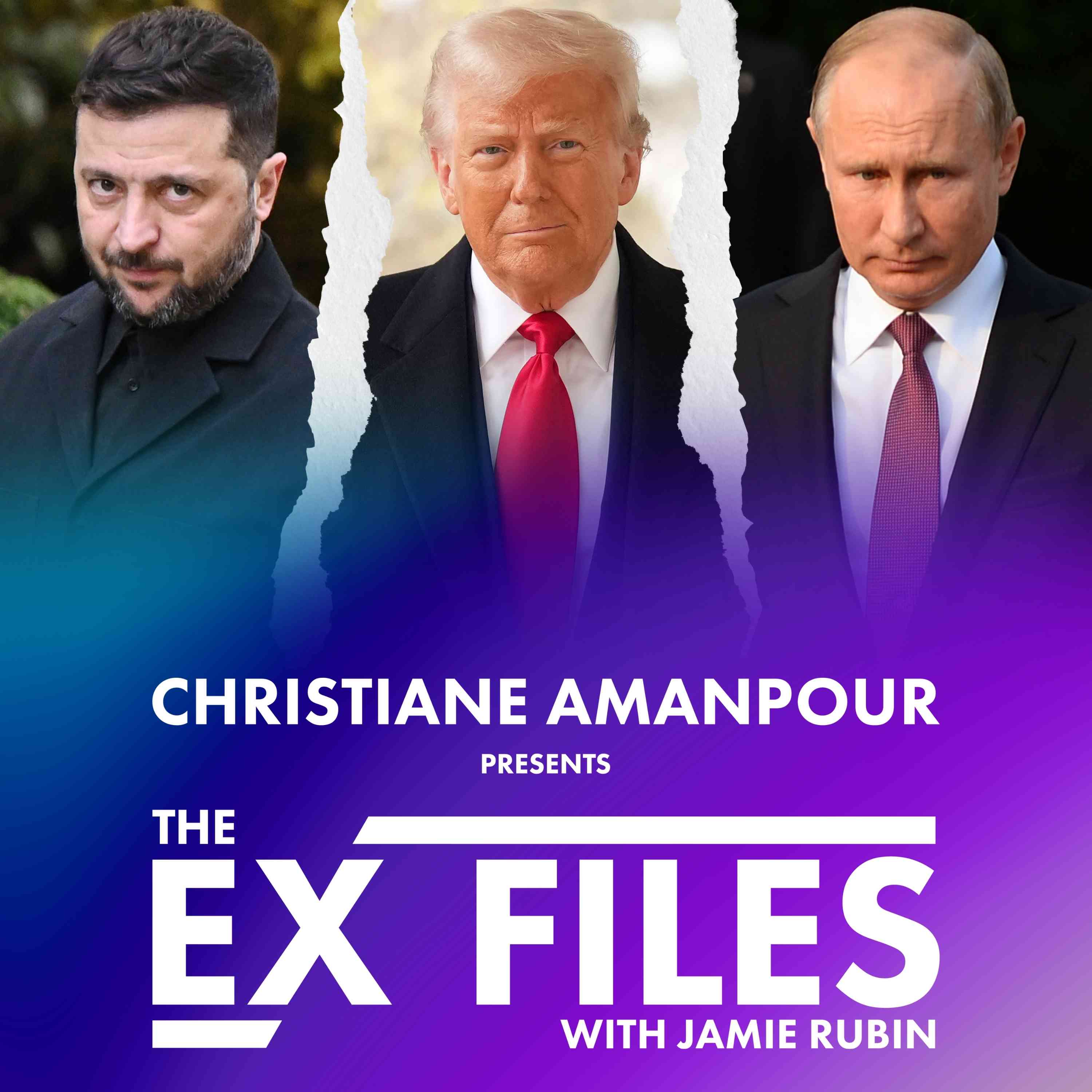
Christiane Amanpour Presents: The Ex Files
Why is Trump trying to make Ukraine sign a "surrender document"?
00:35:59
Loading summary
Transcript58 lines
- [00:03]
Jamie Rubin
This is a global player original podcast.
- [00:09]
Christiana Amanpour
Literally horrified I was last week when I heard this leaked so called peace plan for Ukraine. I don't know what idiots they take us to be or the Ukrainian people.
- [00:19]
Jamie Rubin
Russia wakes up every morning and attacks them and tries to take more territory and invades villages and attacks them with drones and missiles all over the country. Putin doesn't want to stop the war he still thinks he can win.
- [00:30]
Christiana Amanpour
When they started hearing about this peace plan, Peace plan. I hate even using that word. This 28 point surrender document.
- [00:38]
Jamie Rubin
Why have we handed our public square to Chinese companies and to American tech bosses? What have we done?
- [00:46]
Christiana Amanpour
Mamdani and Trump in the Oval Office scrambled everybody's brains. Nobody could believe it. It was a masterclass in outfoxing the expectations. Hello everyone and welcome to the latest episode of the X Files with me Christiana Amanpour in London and Jamie Rubin.
- [01:07]
Jamie Rubin
In New York State, former official in two state departments, one under Clinton, one under Biden.
- [01:13]
Christiana Amanpour
Yes, and I'm a longtime CNN ER reporting in the field. Wars, crises, all the rest of it. Now I try to make sense of all this stuff that the leadership of the world is putting before us with my own show trying to hold leaders account. So here's what we're trying to do today yet again, trying to figure out which side is up on the Ukraine Russia situation because it looks like Trump keeps changing his mind and we'll get there in a sec. So has he tried to sell out Ukraine? Is he abandoning the relationship with other key US Allies over this or not? And are the tech bros taking over U. S Politics I. E? Is it deal makers versus Policymakers and how worried should we all be about it? So Jamie, let us jump in. So first and foremost, literally horrified. I was last week when I heard this leaked version of the latest so called peace plan for for Ukraine. And as Tom Friedman has said, or at least the headline says, this is a catastrophe and disaster. I genuinely believe that if it does land in the original form that was leaked, which apparently was all Russian dictated, it's a complete Neville Chamberlain's class appeasement and a sellout and demand for capitulation. On the issue of what Russia wants again, and we've reported this over and over again, Russia has not changed, but not one iota its maximalist goals, which it said, you know, as it invaded in 2022, before it invaded in 2022 and ever since it invaded, they've literally asked for Ukraine to reduce the size of its army. Never ever to, in other words, to change its constitution and never to say that it wants to have anything to do with n to allow NATO peacekeepers in, if there's any, you know, even if there's a freeze along the current front lines. And what else did it want to do? Oh, yeah. Oh, yeah. Not just take the bits that it's staying in right now, but get more than it even has that it doesn't even control. I don't know what idiots they take us to be or what idiots they take the United States to be or the Ukrainian people, which has to be said. Some latest poll said something like 69 of them want a negotiated deal. Obviously, now they're fed up and. But they want it on Russian terms. They want it on, you know, normal terms. And 24% apparently want to fight to the end and reconquer everything, which is also pretty unrealistic at this point. But things are moving. The Ukrainians and their European allies are pushing back. So where do you think we are today as we record?
- [03:53]
Jamie Rubin
Well, I think we're no closer to peace in Ukraine. Look, Donald Trump as president thinks he can throw his friend Mr. Witkoff into a problem and solve it as if it is a real estate deal. But these are not so simple. And so the proposal as it emerged, it kind of felt like he was trying to revive what he did with Gaza. It was 20 points. This is 28 points. And he thinks everybody just puts their points down that you can make peace. Well, it's not that simple. And I don't think Witkoff has a team of experts working for him. He tends to take some stuff from the Russians. And now, presumably Rubio, having met with Andrei Yermak, the chief of staff to President Zelensky, is going to take some points from the Ukrainians. Meanwhile, the Europeans are standing on the sidelines horrified. They're horrified for many reasons, but most important because until the Trump administration, United States used to be on the side of the victims of aggression, used to be on the side of the democratic country of Ukraine, as opposed to Vladimir Putin's Russia. And from all accounts, Donald Trump doesn't seem to distinguish between the two and is perfectly happy to have a peace agreement just so he can say there's a peace agreement. It's not as if this is costing the United States very much because he stopped providing assistance to Ukraine, costing us money, the way it was under President Biden when we were providing billions and billions of dollars of help to the Ukrainians. But the bottom line is very simple. Europe, Ukraine are united in rejecting the idea that Russia should gain from its aggression and rejecting the idea that Ukraine should capitulate. The United States doesn't seem to care under President Trump and just wants a deal. A deal, as they say, at any cost. Agreement at any cost. And I don't think it's going to happen.
- [05:42]
Christiana Amanpour
I don't think it is either. But let's just, just backtrack a little bit because you know, you brought in Israel, Gaza, I go back to Afghanistan under Trump. That is the template for his so called deals and his peacemaking. We have nothing to judge anything on other than what he's done in the past. So just so everybody's clear, he wanted to pull US Forces out of Afghanistan. He wanted to quote, end that war. So what he did in his first administration was negotiated only with the Taliban, not with the legitimately or whatever you might think of it. It was nonetheless an elected government. Yes, it was corrupt, yes, it was a little bit feckless. Yes, it wasn't doing as well as perhaps it could be doing. But it was in fact the US Backed government. There were NATO forces in there, including obviously US Forces for years and years and years, women and girls had made huge progress. Then comes Donald Trump 1.0. And in my, how I say it all the time, he ended up giving Afghanistan back to the Taliban. Oops. Who hosted the 9, 11ers, the Taliban on a silver platter. And it's the haste to quote, unquote, end things, quote, unquote, make peace. That as you said, makes him side with the winning side and the, you know, aggressor instead of with the victim or at least with the US Ally. So without making judgment calls on the Israel, Gaza thing also, he went for the US ally in this case and the very strongest side and didn't include the Palestinians, which is going to be an issue when we get to actually the nitty gritty of trying to make peace there and now with the, with the Russians and the Ukrainians. He's constantly undermining the US Backed ally, that is democratic, sovereign, independent Ukraine, against dictatorial, indicted for war crimes Putin. So I mean, am I right in this? Is it just nuts? I mean this is literally deal making and peace negotiating put on, you know, put put turned on its head.
- [07:45]
Jamie Rubin
This is a repeat. He's been trying something like this several times from the beginning. The good news for those of us who care about Ukraine's future is that President Zelensky and the Europeans have at least figured out a way to not make things worse with President Trump. What they do is they go along with the idea of peacemaking. They say they're willing to be flexible and comprom. And I do think Ukraine is willing to compromise. I do think they're willing to make some hard choices, if they are what I would call fair and just hard choices. So let me give you an example of that. I think Ukraine would be prepared to freeze in place, despite the fact that Russia is on its territory in much of the Donbas and in Crimea. They would be prepared to stop the war right now. That puts them in a better position. And what may happen, ironically, from all of this, is that because this came as a Russian plan and a Russian idea of the whole process, and we could get into the 28 points, but they're not necessary to make the point that Russia may end up being the one that says no, because I think Rubio and Europeans and the Ukrainians are going to put back in some basic requirements that Ukraine is a sovereign country, that Russia can't dictate the size of its military, that Russia can't prevent Ukraine from defending itself. And when they do that, we're going to find out that that's not what Putin has in mind.
- [09:08]
Christiana Amanpour
Right.
- [09:08]
Jamie Rubin
Putin wants to subjugate UKRA to make it effectively part of the greater Russia. That is not going to happen. Ukrainians aren't going to stand for it. Europeans are not going to stand for it. As long as this response by the Europeans and Ukraine is diplomatic and smart and careful, then, as some European leaders are already saying, you know, this is a long way from a successful peace talks.
- [09:33]
Christiana Amanpour
I was talking to a lawyer this weekend who had dealings with shippers, and obviously they're important in terms of sending Russian oil, you know, to wherever he said they send it, get it refined, bring it back, etc. And there was a feeling amongst, amongst these, you know, shipping companies and the like, that actually Russia was doing badly. And within about six months, it could really feel the pinch of, of, of, of all this and, and the, and the pinch to its economy. So clearly it wants the sanctions lifted, but it shouldn't. And people were saying, well, why doesn't Trump just wait another six months? I guess the thing that I'm so confused about is what is it with Trump who, you know, you remember back in, after the Munich security conference, he sent Rubio and at that time, National Security Adviser Mike Waltz and others to Saudi Arabia and they just talked to the Russians and then he had Zelensky in the White House and completely dissed him. It was just, it's one for the ages. And then he sort of shifted back and forth when he realized that Putin was not playing ball and stringing him along. And as Trump says, he's disappointed with him. What I don't understand is how the President of the United States keeps shifting his views on Russia. Why is this?
- [10:51]
Jamie Rubin
I don't think it really matters what the motivation is. Let's just deal with the reality. And let me make two points about that. One is about the sanctions. So I found it very interesting what you said about the shipping industry believing that the sanctions are starting to pinch in a serious way and that if we just wait a little bit longer, the pressure will. We need two pressure points on Putin. One is the economic pressure of sanctions. And if we keep the pressure on, and in this case, I have to admit, Trump did something good, which was to sanction the two major Russian oil companies. If the shipping sanctions keep working, if the financial sanctions keep working and the pressure builds around the Kremlin, life is going to get worse, demonstrably worse, and Putin is going to realize there's no out from this without changing his view on the war. The second point of pressure obviously has to be military pressure. We're providing the weapons. And remember, Ukraine is doing the fighting and dying. These people are remarkably brave. They've been at it for three plus years now. They're determined to fight for their own country. When you're fighting for your own land, you have a leg up. Even if the other side often has technological advantages. And unfortunately, right now, and I'll bring this to China and we can talk about that, the Russians apparently have now improved dramatically their drone capability, the depth with which they can operate drones, and that is precisely because of the help given to them by China. The only thing the Chinese have ever done of any value is to one day early on say they would prefer that Russia not use nuclear weapons. Besides that, I think we have to be honest with ourselves. China is all in for Russia. They want Russia to win. Trump really thinks that the world is run by three people, him, Putin, and Xi Jinping, and that all he needs to really do is talk to those three. And what he's finding out is the world isn't that simple. It's not a game of risk. You don't just get to talk to the Russians and the Chinese. The Ukrainians have a say in this matter, the Europeans and the Europeans have a matter. And so that's why these things don't work. But he keeps coming back to it because, let's face it, he's not in a good position politically right now. And he's looking to pull a rabbit out of the hat like he often does in his, his business career. And it's just not gonna happen.
- [13:14]
Christiana Amanpour
You just hit on something that I think is really, really significant because every time this kind of pro Putin, pro Russian documentation or, you know, leaning from the Trump administration comes out, you see now the Europeans and Zelenskyy leap into the breach very fast. So this all caught the Europeans and the rest of the G20 by surprise when they were all huddled over the weekend in South Africa. The US Boycotted it, Trump didn't go, nor any seniors. And they all said, you know, politely, yeah, we, we support President Trump and his peacemaking efforts, but we need it to be, you know, respecting Ukraine's position and not just a capitulation to Russia. Not sure they use that word, but that's what they meant. And they came up with ways to bolster Ukraine and how to redefine this. Then Secretary of State Marco Rubio goes to Geneva, meets with Zelensky and his seniors, and then comes out and says, well, you know, this is not an ultimatum, it's a living document. Whoops, there goes my microphone. I'm getting over excited here. It's a living document and, you know, we want to make it a viable situation. I think the thing that's troubling is that Steve Witkoff hosted Kirill Dimitriev, who is the Russian interlocutor. I mean, he was first meant to be the business guy. Now he's become the Witkoff for Putin. And they spend, I don't know how long, but apparently a couple of weeks in Witkoff's personal home in Miami hammering this out.
- [14:45]
Jamie Rubin
And somebody, they didn't hammer much out. All they did is staple together, somebody stick together, Jamie.
- [14:50]
Christiana Amanpour
The whole Russian version, I mean, it.
- [14:52]
Jamie Rubin
Looks like, yeah, they stapled together the Russian version. And, you know, this is Witkoff's problem. He thinks he's dealing with real estate deals where you get one guy's offer and then you get the other guy's offer and you sort of try to split it down the middle. This isn't a real estate deal. This isn't buying a house or a building or an apartment complex. This is a complex, the most complex war in our time. Something that will have multiple elements. I mean, let's be honest, what you need for a peace agreement, you need to figure out whether there's going to be a force, a stand down in place. You need to figure out the sovereignty of the territory that Russia controls. You need to figure out what to do about sanctions. You need to figure out what to do about security for the Ukrainians going forward. You have to figure out what to do about all the hundreds of billions of dollars of Russian money that's been frozen that needs to compens the Ukrainians for their suffering. You need to have prisoners of war exchange. You need to have the children returned. You know, I'm getting my point. This is a hundred page document just for the basics. Yeah, but you know, Jamie, staple together a couple of pages and make peace.
- [15:58]
Christiana Amanpour
28 points. You know, Russia even said no accountability for any of the war crimes that have been charged. I mean, bucha, all of those places, you know, just, oh, just, just, just, just whitewash it all, just poof. And all the war crimes have gone the bottom line. And I was just talking to some officials about what we discussed last week, which is Friday was the anniversary of the end of the Bosnia War. The sine quanon for any ceasefire, any peace is a ceasefire. There's not even a ceasefire. It's not even being discussed between Russia and Ukraine. Not even the basics.
- [16:32]
Jamie Rubin
Well, right. And so I think this is where Ukraine has been very smart because you remember originally Trump wanted a ceasefire and Ukraine said no because they want to get their territory back. And then they figured out quite wisely that of course they can say yes and then show that it's Russia that keeps attacking them. Remember that Russia wakes up every morning and attacks them and tries to take more territory and invades villages and attacks them with drones and missiles all over the country. And so that first point, as you say, is the bas. Do you. Does the other side really want to stop the war? And what Trump is finally maybe sort of figuring out, and certainly Rubio knows, and the smart people in the government know that Putin doesn't want to stop the war. He still thinks he can win.
- [17:18]
Christiana Amanpour
Trump knows that, by the way. He also thinks that in his conversations, Putin has indicated that he thinks he can win.
- [17:25]
Jamie Rubin
Right. And until that changes, and that's the fundamental point here, we can talk if we want about what Ukraine could accept or not accept, but none of that is going to matter until Putin, one man, one horrible, horrible man sitting in the Kremlin, changes his mind. And until that mind is changed by virtue of correlation of forces, as the Soviet Union used to say, military, economic, political, until those correlation forces change, Russia realizing that it's going to get worse for them, not better financially, economically and militarily, Putin is not going to change his mind. And there's not going to be a peace agreement. So my sort of bottom line here is that Ukraine and the Europeans now realize that they've put a pretty good plan together, which is to continue to fight using European purchased American weapons and European weapons, remember the French are now giving them advanced fighter planes. Ukraine is going to show that it's going to fight. And until Putin realizes that that isn't going to change and his situation is going to be worse. We can talk up till we're blue in the face, but the realities won't change.
- [18:36]
Christiana Amanpour
Yes, on the other hand, there's significant pain. Obviously. We know that hundreds of thousands, up to a million or more, have been killed or wounded on the Russian side since 2022. But on the Ukrainian side, we've got a morale problem. On the, on the lines there, you've got Russia, you know, really actually digging in now, potentially going to get Pokrovs. A lot of has been made of Pocrofts. I'm not sure that it is as massively strategically important as everybody was saying before, but nonetheless, they're homing in on that. And one other thing which is important, that there's quite a lot of AWOL right now, hundreds of thousands, maybe double what there were last, you know, last year. And it's very hard for them. They are outmanned. They just are. And then, of course, they're wrapped up in this ridiculous, unacceptable corruption scandal as well, which Putin thinks makes Zielinski weaker, although he's not been accused of it, but people close to him have.
- [19:30]
Jamie Rubin
I mean, it's just, I think you're right about all of those points. The way Ukraine is suffering, the war is extremely painful for Ukrainians. And the people are worried about why they're fighting when other people aren't fighting. Are people getting out? Are people getting awol or people paying their way through it? This is what happens in a war. And Russia is bigger than Ukraine and their soldiers can be forced, forced conscription. But I'm told that one thing that is sort of a basic rule for Putin is to make sure conscripts doing the fighting, that they're doing the defending. But he's got enough others that he's paying that came from North Korea at some points, probably other mercenaries that are doing the fighting. And most of the fighting, frankly, is being done by these drones. Right now the drones are being made by Chinese companies and Chinese designs and Chinese engineering. And I think the world would do well to start to raise the pressure on Xi Jinping, because remember, all these things have to change. Chinese Support the pain of sanctions, the pressure on the battlefield. Until those change negatively for Putin, the war is going to go on.
- [20:43]
Christiana Amanpour
Yeah, I mean a point on that. Clearly, as Trump has tried to pressure Xi on trade, it's Trump who's been outplayed. So I don't know how you get a proper pressure on China. And that's very, very worrying. Last Friday, before, before, you know, when they started hearing about this, this peace plan. Peace plan, I hate even using that word, this 28 point surrender document. Zelensky went on, you know, national TV and he basically said we face a really existential choice between a key partner or our dignity. And it's really tragic that. And again, I'm going to go back to Bosnia. Everybody hoped, wished that Sarajevo would stop being such a problem and just capitulate. Well, it didn't. It didn't and it kept fighting. It was massively outgunned, massively outmanned by the Serbs and it, and eventually there was an end to the war as you say, along the front lines, the contact lines. But I also do want to say cuz we're gonna move now into our second segment which was are the tech bros taking over US Politics? Is it all about deal making rather than policy making? And I just wanna say, and we're not gonna argue about this, Jamie, but Mamdani and Trump in the Oval Office was a masterclass. It just scrambled everybody's brains. Nobody could believe it.
- [22:04]
Jamie Rubin
I thought it was great.
- [22:05]
Christiana Amanpour
So called experts and the pundits and.
- [22:07]
Jamie Rubin
It was New York, New Yorkers, whatever.
- [22:10]
Christiana Amanpour
It is, it was a master class in out foxing the expectations. And Trump in my opinion, also understands maybe the affordability crisis. But also more importantly, I think he wants to, I think he loves the winner and he wants to be liked. You cool kid in the class.
- [22:28]
Jamie Rubin
I agree with all of that. Let's just hope it all works out.
- [22:32]
Christiana Amanpour
I hope it all works out too. In any event, we're going to take a quick break and when we come back, the other part of our conversation.
- [22:42]
OnDeck Announcer
OnDeck is built to back small businesses like yours. Whether you're buying equipment, expanding your team or bridging cash flow gaps, Ondeck's loans up to $250,000 help make it happen fast. Rated A by the Better Business Bureau and earning thousands of five star trustpilot reviews, Ondeck delivers funding you can count on on. Apply in minutes@ondeck.com depending on certain loan attributes, your business loan may be issued by On Deck or Celtic Bank. On Deck does not lend to North Dakota. All loans and amounts subject to lender approval.
- [23:17]
Christiana Amanpour
Okay, so we're back from war and peace to dollars and cents. What is it about? You like that, Jamie, right?
- [23:25]
Jamie Rubin
Not bad.
- [23:25]
Christiana Amanpour
I made it up on the fly. On the fly. They're always been a headline writer. So after that, another day bacal from my perspective, because it was all about a journalist, one who'd been murdered and dismembered, another who was being berated by the President for daring to ask that question in the Oval Office last week to a, you know, multi. No, sorry, $1 trillion promise by the Saudi Crown Prince MBS to invest in the United States. And all the tech bros being at this not a state dinner but quasi state dinner, it's very, very, very mercantile and mercenary. Right? This whole policymaking, it is all about money.
- [24:06]
Jamie Rubin
Money, unfortunately, has always played too big a role in American politics, but now it's exploded to a degree that's truly intolerable. The idea that these fabulously wealthy tech bosses, I like to call them, because they're the bosses and everyone else has to live with their decision making, not just about them getting better deals and making more money, which is all they care about. It's because these two fields in which they are so powerful, the social media world and the artificial intelligence world, these are the two fields that can change our world for the better or for the worse. And I believe that the danger here is not that they're going to make more money. Fine, rich people make more money, oil barons made more money, et cetera, it's whether they're going to be regulated. Are they going to be controlled? Is the pollution that they put into our world going to be ameliorated? Are they going to come up with a filter for this pollution? So those are analogies, but I think.
- [25:13]
Christiana Amanpour
Do you mean real pollution or corruption pollution?
- [25:15]
Jamie Rubin
I mean pollution of our social media landscape. It's a pollution to have disinformation, to have a lies. And when Zuckerberg announced that he was going to remove his fact checking part of meta upon Trump's victory, you knew that these people have no social conscience. They don't care about our world. And as I mentioned in a previous episode worth quoting again, President Macron of France has realized and said in a very powerful speech, why have we handed our public square in Europe to Chinese companies and to American tech bosses? What have we done? How could we let this happen? So I am hoping that some people in our world, ideally Europeans, who have the power and the regulatory capability to act are going to slowly but steadily prevent these tech bosses from ruining our world either through AI that's uncontrolled or through social media that destroys a fact based world that is necessary for democracy to succeed. And there's going to be a filter, filter in the form of regulation on these tech bosses. It's not going to happen under President Trump. He loves these guys. He loves hanging out with the richest people. That's who he respects for whatever reason. He loves money and that's what he respects. But what we need is slowly but steadily is the democratic world to develop the filters for the pollution these AI bosses and these social media bosses are imposing on our world. And unless we do that, that our, our world is going to deteriorate and our way of life is going to be destroyed.
- [26:58]
Christiana Amanpour
Just to recap, of course we said that all these tech bosses were in the front row in front of Congress and the others at the inauguration. We know that many of them and other corporate leaders are paying huge sums to quote unquote, is it renovate or build? Oh yeah, no, it's build because Trump, you know, knocked down the, the east wing, build the ballroom. And of course they were, they populated the dinner for Crown Prince MBS of Saudi Arabia. The thing that kind of sums Trump up to me in regard to, you know, the money and all the rest of it. Did you see when he was saying he kind of had his hand on MBS's, I don't know what his knee, his arm, whatever it was, and he said, and we've got a 600 billion dollar pledge, come on, I think we can get it to a trillion. As if he was a Christian Christie's auctioneer, I swear to God. And the next day MBS went, yes, okay, all right, all right. It's a, it's a trillion dollars.
- [27:52]
Jamie Rubin
Remember, these numbers are meaningless. Nobody ever holds them. I know, but it's no specificity. It's just a way like he improved the American economy by getting these Saudis to invest in ways they were going to invest in anyway.
- [28:05]
Christiana Amanpour
Yeah, yeah, yeah. And, and, and of course let's not forget that allegedly the Trump foundation has business with, with the, with the Saudi government sovereign wealth fund and this like it has other business with other governments elsewhere in Asia and elsewhere. That's the, that's the, that's not the foundation. Sorry.
- [28:21]
Jamie Rubin
The Trump Organization is just horrific.
- [28:24]
Christiana Amanpour
I was at a summit here of, of African business people, business leaders and, and, and some political leaders and they basically said to me, you know, the, we're now moving on to tariffs. So tariffs were about anything but trade. It's just about leverage. Tariffs are leverage for anything Trump wants. How about this? I'm just reading this that somebody just sent me under the heading of luxury diplomacy. Let's be blunt, Handing a Rolex and a gold bar to a U. S. Billionaire in exchange for lower import duties is about as low as modern diplomacy gets. And yet it worked. U. S. Tariffs on Swiss goods have now dropped from 39 to 15%. And everyone is pretending it's a resounding.
- [29:09]
Jamie Rubin
What can one say about this? The Constitution was created specifically to prevent kings and royals from making decisions based on, you know, some. Whether they liked somebody or whether that someone gave them money. And now our constitution has been so manipulated by president Trump that they think they can decide for themselves when tariffs are put on or not put on, lowered or raised. And I hope and pray that the supreme Court is going to put a stop to this. At some point soon, there's going to be a decision by the court on whether Trump has the unilateral power to impose, reduce or increase tariffs without Congress making those decisions. Despite the fact that the Constitution is clear that this power of economic commerce with foreign nations is in the hands of the Congress. If this supreme Court doesn't give that decision a clear, resounding victory for the plaintiffs in this case, namely that Trump doesn't have this power, I'm going to seriously worry about the rule of law in the United States. I'm already worried, no question. But in many cases, the judges have been the guardrails of our democracy. This is the big one. Does Trump have the power to make deals around the world based on whim or whatever the hell he wants? Based on money, bribery, whatever you call it, watches, bitcoin, whatever the stuff is, this is not the way our system is supposed to work.
- [30:40]
Christiana Amanpour
Okay, we're going to take a break and we will come back with our recommendations.
- [30:47]
OnDeck Announcer
Ondeck is built to back small businesses like yours. Whether you're buying equipment, expanding your team, or bridging cash flow gaps, on deck's loans up to $250,000 help make it happen fast. Rated A by the Better Business Bureau and earning thousands of five star Trustpilot reviews, OnDeck delivers funding you can count on. Apply in minutes@ondeck.com depending on certain loan attributes, your business loan may be issued by On Deck or Celtic Bank. On Deck does not lend in North Dakota. All loans and amount subject to lender approval.
- [31:20]
Christiana Amanpour
Okay, we're back with the last part of our conversation. This is where we give you Our recommendations, you might toss them in the bin, you might take them up, who knows? But nonetheless, this is what we do. So, Jamie, you are going to go.
- [31:33]
Jamie Rubin
All right, now I'm gonna cheat a little bit, but I think you'll get a kick out of it. I'm gonna cheat by saying that I have to recommend this as Scorsese. After you recommended it, I watched it. Five parts. I watched them all. And it was extraordinary. All the movies that he's made, the stories of how he grew up as an asthmatic kid in Little Italy, near where I live now, the corner of Elizabeth street in Kenmare. I walk by it every day. I can't believe this is where Scorsese came from. And then all the mo. And what's great about the story is how he fought Hollywood and he struggled with Hollywood, who was only interested in making money. And he had his ups and his downs and his ups and his downs, and he went through personal trials and tribulations and then he succeeded. And then he took him decades to win the Oscar and he finally got it. All of those things made it very powerful. But just to show that I'm not completely cheating. If I needed to do one that hasn't been done before, I'm gonna put in my all time favorite audiobook, and it's called the Complete Essays of Montaigne. Montaigne was a brilliant Frenchman who wrote about life and he wrote about Stoic life and cynical life and the life of man's mind. And it's a beautiful, beautiful set of essays about everything about man and animals, about ego and ego death, and all of the brilliant things that philosophers have thought about. So that's my recommendation for an audiobook. But I have to admit, you are spot on on Scorsese.
- [33:10]
Christiana Amanpour
I know, it's phenomenal. And what I love, of course, is relationships, so I just adored. And the backstory. But what he did with De Niro, over all those films and the progression and then, then, you know, with Leonardo DiCaprio, the, the. The. At the time, the new it actor of the time. And how DiCaprio grew into such a phenomenal actor with this, this brilliant mentor and director, Martin Scorsese. So I just think it was just phenomenal on all fronts. So I am going to recommend a documentary that I watched this week and it is called Coexistence My Ass. Or in England, My Ass for our English listeners. And it is by this incredible Israeli, Noam Schuster Eliasi. She happens to be part Iranian, Jewish. I identify, though I'm not Jewish. I'm Iranian Catholic. Catholic and part Romanian Jewish. But the most important thing about her experience in my view is that she, her parents were very much in the peacenik camp and they took her. Well, they took their family to this very rare village in Israel called Oasis of Peace. Neve Shalom I think it is what happened is that she grew up in the ideal situation which proved to her and her family and friends that you can actually live and co exist, exist with your Arab neighbors. She learned Arabic, her best friend is Palestinian and she's a comedian. And she had gone to Harvard to do a presentation on all of this through comedy. And she's done comedy all over the world. And now of course, all of this is in question and knocked her for a loop a little bit since October 7th because it's much more difficult getting booked if you're of that political ilk. It's much more difficult, difficult trying to persuade the bulk of either side that coexistence still matters and still is possible. Hence coexistence my ass. But it is so touching. It is so incredibly brilliant. It's. It's just fantastic. I highly, highly recommend it. I interviewed her on my CNN program and she didn't disappoint. She really delivered and she's wonderful. So where people can see it is a little limited right now because it had a lit theatrical release in the US which unfortunately just finished. But for a list of upcoming screenings and festivals, check the website. Coexistence my ass. I'm just gonna put it there.
- [35:31]
Jamie Rubin
It's hard to forget that isn't that.
- [35:33]
Christiana Amanpour
Good and it will eventually be streamed, but at the moment it's screenings and festivals. But I highly recommend it because honestly, it's a feel good and it's not a la la land feel good. It's a real possibility and we know that happened before all this happened. So I still hold out hope that's it for this episode. Thank you for listening. Make sure you are following all our feeds so or our feed, however many feeds there are. Just follow it so you never miss an episode. Remember, you can also watch every episode on YouTube. Just search Christiana Monpour presents the X Files that's on our YouTube channel and subscribe there. You can listen for free online Global Player, download it from the App Store or go to globalplayer.com and don't forget that on Thursday we will drop our bonus Q and A segment. So keep your questions coming and again, email us at amanpour pod global.com or find us on social media at Amanpur Pod. Okay, that's it. War and peace. Dollars and cents.
- [36:34]
Jamie Rubin
Goodbye from New York.
- [36:36]
Christiana Amanpour
Goodbye from London. Across the pond, I think. Jamie, I'm going to let you go first. But short and sharp. All right.
- [36:44]
Jamie Rubin
That's me.
- [36:45]
Christiana Amanpour
Yeah. In your dreams.
- [36:53]
Jamie Rubin
This has been a global player.
- [36:54]
OnDeck Announcer
Original production on Deck is built to back small businesses like yours. Whether you're buying equipment, expanding your team, or bridging cash flow, gaps On Deck's loans, up to $250,000, help make it happen fast. Past rated A plus by the Better Business Bureau and earning thousands of five star trust pilot reviews, Ondeck delivers funding you can count on. Apply in minutes at ondeck. Com. Depending on certain loan attributes, your business loan may be issued by Ondeck or Celtic Bank. Ondeck does not lend to North Dakota. All loans and amounts subject to lender approval.