← CIO Leadership Live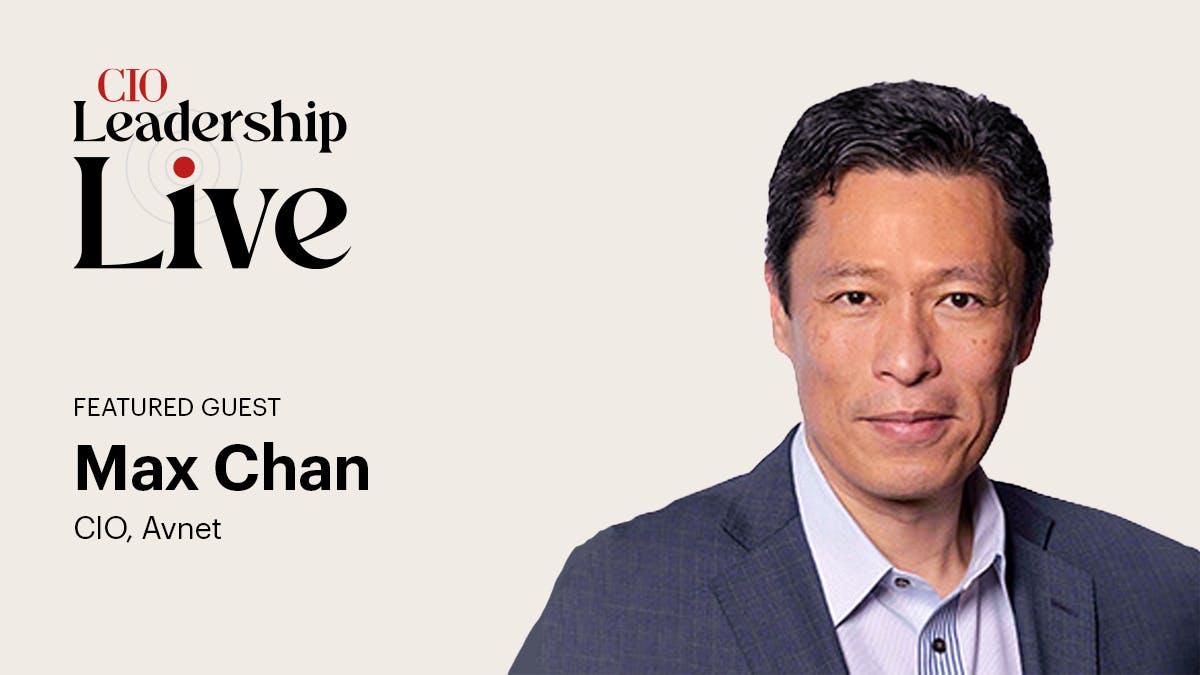
CIO Leadership Live
Avnet CIO Max Chan details AI-driven supply chain transformation strategy
00:19:53
Loading summary
Transcript38 lines
- [00:04]
A
Welcome to CIO Leadership Live. My name is Lucas Marion. I'm a senior writer for Computer World magazine, and I'm here at the CIO100 symposium and awards show in Scottsdale, Arizona. And with me I have Max Chan, who is the Chief Information Officer at Avnet Incorporated, their major global distributor of electronic components and technology solutions. And they're headquartered in Phoenix. How was your sojourn from Phoenix all the way over to Scottsdale? Tough, tough, tough trip. Yeah, yeah, yeah.
- [00:36]
B
You know, this is probably the first year that I don't have to travel, but I'm quite disappointed with that because this is probably the only time every year that I look forward to to get out of the summer.
- [00:50]
A
You see, I'm trying to convince them to go to Newport, Rhode island, or maybe Monterey Bay. We'll see. So I just want to, right off the bat, as you're a big distributor, but what are some of the technologies or projects that you're currently passionate about and why?
- [01:09]
B
You know, like what you're saying, right? We are big distributor. We orchestrate supply chain for major corporations, some of the big names that everyone is familiar with. While people think that we move boxes, actually we're not. We actually leverage intelligence, insight in the data that we have and also the data that we embrace around the ecosystems and help to orchestrate what is important for our customers to get their product from point A to point B so that they are able to maximize their profitability. So everything that we're doing from an AI standpoint helps to fulfill that philosophy. Just like the winning entry that we had for this year, which I'm so proud of the team for doing, is really leveraging AI to cleanse the data so that the customers can make the right decisions with a good data set on their fingertip, allowing them to know where exactly where things are and where it needs to go.
- [02:24]
A
I was going to ask you about that. You are an award winner here. Correct. So how is AI helping you manage distribution?
- [02:32]
B
In a few ways. Right. I think four areas that we see very strong leverage that we have is in the sales enablement site. And I can go into details in each of them. The second one is really engineering design. Right. The third one is managing inventory and forecasting. And last but not least is orchestrating the supply chain. The common thread across all this area is the leverage of insight and actionable insight and data that we have. Right. So take for example, from a sales enablement perspective, two areas come to mind. One is quoting the most important thing as a distributor, when it comes to quoting is to be able to get the right information as quickly as we can to the customers so that they can make the right decisions for them. They are able to get their products at the point that they need for us. We are able to then be able to win the business to improve the conversion. Right. Something as simple as that. AI has actually helped us with pricing, getting the right informations on end of life, getting the right information on country of origins. Right. And putting it all together so that the customer can make the best decision they can for what they do. On the other hand, again, sales enablement is this notion of customer service. How can we help our customer service agent to have readily available information on their fingertips to be able to advise our customers what they need to do? As simple as someone came back with, all right, the physical footprint of their circuit board needs to be reduced by 30%. What is the best pin to pin replacement of a component that we can give them that maintain the capabilities that they need or the power requirements that they need and still get the same product to the customers at the end of the day?
- [04:56]
A
So you're using it internally and externally?
- [04:58]
B
Oh, absolutely.
- [04:59]
A
Okay, you support. We've already been talking about a massive global supply chain. How do you prioritize technology investments across such a complex ecosystem?
- [05:10]
B
Yeah, at the end of the day, it's staying very close to what is important to the business. So we align ourselves to the business enterprise strategic priorities. Instead of having my own technology or digital AI strategy, the strategy is how we are enabling the business. So every single business capabilities that we have, we are looking at technology, digital enablement as well as AI transformations to help accelerate that, to help redesign or reimagine that, or to help transform the business completely. And for us, at the end of the day, it's down to three key things. Is it helping with our top line? Is it helping us with our market share? Is it helping to improve margin or our overall bottom line? Or is it generating more cash so that we can take that cash and invest in new capabilities?
- [06:12]
A
Have you been able to find the elusive ROI in AI? Because a lot of companies haven't.
- [06:19]
B
So this is my personal view, right? Most companies struggle to find ROI in AI because they are looking at the wrong place. They're looking for ROI from an investment in AI itself and you start thinking about the traditional ways of looking at finops, to look at how much you're spending, how much you are improving that, how much you are making out of it. We look at it differently. AI to us is transformational so when we implement something with AI in mind, we have at the end of the day, looking at what business outcome are we hoping to drive is IT conversion? And we are measuring how much of that conversion because through AI we get the right pricing, through AI we get a more complete quote to the customer. Through AI, we give the customer the information they need at the right time, as quickly as we can. And what that converts to in terms of top line and bottom line.
- [07:31]
A
Because I think to your point, a lot of companies are looking at efficiency and productivity versus what you just mentioned, actually reaching a goal of achieving some new service to a customer or even internally to one of your business units. What do you think are some of the most significant IT challenges or the unique ones to a hybrid model of distribution and digital enablement like you have?
- [07:58]
B
You know, I think at the end of the day, right, it comes down to change management and governance. Just like everything else when it comes to technology investment or digital enablement, right, the change management is very key. But the overall governance of going back to whether this is contributing to a business outcome or this is directly supporting a business strategy is key. Otherwise people will go around looking at different POCs and use cases, etc. But there could be hundreds of very good use cases out there. Only two of them are truly directly linked to our strategic capabilities and the business outcome that we're looking for. So really honing in on those and having that tough conversation of why you should not have your project is the kind of challenges. And obviously AI governance has proven to be a lot more complex than a standard governance that you see with any technology implementations, right? So that is also another thing that we keep a close eye on and making sure that we truly get to what we have to deliver something that do no harm to the organization.
- [09:29]
A
Your company's very old. It's over. And correct me if I'm wrong, it's over 100 years old.
- [09:34]
B
It's 104 years old and counting.
- [09:37]
A
How do you modernize legacy systems without disrupting global operations?
- [09:43]
B
You know, this actually has been a long journey that we have been on, right? Avnet continues to reinvent ourselves in the last hundred years to get to where we are today. And the same mentality applies to modernization of technology. Some 30 plus years ago, we decided that we wanted to go to major ERP that is going to run everything, probably last 10 years. We come to a realization that a monolithic ERP environment is not good enough. And we started building just like everyone else, right? Trying to get benefit from the Cloud transformations, et cetera, building on top of it. But what my team and I come to realization very quickly through that journey is that that is not going to cut it. And we actually have the support from the organizations to allow us to just go greenfield, start from scratch, build a modern architecture that is digital first and AI first now that allows us to, to leverage all the different capabilities, you know, the mentality of continuous improvement and not get so hung up on what we have built over the last 30 years has helped us with that success in driving AI and the transformation that we are seeing today.
- [11:23]
A
So do you see it more as applying to or adhering to a vision rather than getting stuck in the past with whatever technologies you've already employed?
- [11:32]
B
And sometimes you basically just have to put things aside and start from scratch, right? Go back to the drawing board. I know that a lot of people that I talk to hear about this, but you guys are big enough to have the luxury of that. Actually, no, we are a very low margin business and we have to make do with what we have. However, we are also very focused on our future success and that's why we do what we do.
- [12:04]
A
Talk a little bit about bringing your workforce along. With all the significant changes that AI brings upskilling regulatory concerns, I think it
- [12:21]
B
comes back to the culture and also the learning agility that we want everyone in the organizations to have. And interestingly, AI is probably a lot easier than most other technology that came before it because suddenly everyone, because of ChatGPT and you know, generative AI and the many different tools that comes up just in the last two and a half years, right? Yeah, everyone got excited about it. In fact, I would say that, you know, trying to create that learning pathway and get people systematically upskill to be able to approach AI the right way, leverage AI the right way is how we are doing across the organizations. So the way that we see it is like there are three different types of AI that we grapple with, right? One is productivity tools like ChatGPT that we give to individual that allow them to be able to do what they need to do, right. The second is what comes with all the software that you have, every major software, many of them sitting here, comes with their AI components. Then last but not the least are the things that my team would develop and build in accordance to what we want to drive the company forward and how we transform the company. So the first one, we have more than enough tools that we allow the, the organization to leverage and we have a governance process to get them to request to the point that they can use it or we give them alternative because we already have the tools, alternative tool that does the same thing, right? The second one, we're like, all right, if it comes with the software that we own, if we already have the license, go for it. Because that is embedded, it will help us better leverage the software. The focus that we have then is that here are some of the things that we are doing to try to transform the way that we work the workforce, the work itself, and in some cases the business and how we can better serve our customers as well as employee moving forward through AI. And one of the way that we approach that is reimagining some key end to end processes and ask the question, can these be fully autonomous? And if it can be, what would it look like? And we have subject matter experts getting together, bringing their knowledge and experience and draw that out. And the only criteria is that it has to be fully autonomous. And once that is done, we bring people back in the loop to augment that and make it even more powerful for our business.
- [15:44]
A
Because AI is tremendously impacting workflows as we continue to implement them. Supply chain resilience is a global concern, obviously. How has Avnet evolved its tech stack in response to disruptions over the past few years?
- [16:00]
B
You know, I think there are two sides of the disruption that we're talking about. Right, because you mentioned tech stack. Let's put that aside first. As far as resiliency from a supply chain standpoint, two things that come to mind. One is the relationship with the customers, both upstream and downstream that we work with is very important. You know, understanding what they have, what they need to do, what they want to do, and also bringing in the signals that we send around the industry help with driving that resiliency. We get asked that question, Avnet, how can you help us avoid the next supply chain debacle that we had a few years ago? It's the partnership, it's the availability of data, it's the connectivity. In order for us to do that internally from a Tech Stack standpoint, we need to drive for the modern architecture that drives micro microservices that allows us to have strong API connections. We create a platform called the Partner Exchange Digital Exchange ptx that is a platform that help us bring data from upstream to downstream and combine with what we have and drive that orchestration I was talking about now with AI that allows us to bring AI into the mix. And well, on one hand it actually helps the customers both upstream and downstream with the information they need to make the right decision. On the other hand, it actually help Avnet create that stickiness in the ecosystem.
- [17:40]
A
Okay, fun. Last question. What's your favorite tech gadget or application right now? And it can be professional or personal.
- [17:50]
B
I don't think it will get away from anything that has generative AI in it. But at this point in time, the one that I'm finding a lot of fun with is Google VO3.
- [18:04]
A
What is it called?
- [18:05]
B
Google VO3. The powerful video creation platform that Google announced. And playing with it, it can do a lot of crazy and exciting things.
- [18:20]
A
Like what? Give me an example.
- [18:22]
B
So, you know, we currently attempt to take our CEO. He does a lot of videos internally and externally. Right. And in order to demonstrate to the board and the executive team. Right. The power of Deep Fake. It has a positive applications as well. Right. Taking his presentation. Okay, forget about the fate, let's talk about the positive side. Taking his presentation, he presented in English. Now I convert that into three other languages and it lip sync to whatever.
- [19:04]
A
You're kidding me. That's hilarious. That is wild. It actually lip syncs to the language that you program it to have.
- [19:11]
B
Wow. Yeah. So that. That is something that I'm having a lot of fun with recently and we are trying to push the boundary and see what you can do.
- [19:22]
A
Awesome. Max, thank you so much for taking the time to talk today. I mean, you've gotten some great insights. I really do appreciate it.
- [19:28]
B
Thanks for having me. And I hope you're enjoying the real summer that we ordered for you.
- [19:35]
A
Yes, the 107 degrees is wonderful. Yeah.
- [19:38]
B
Yeah.
- [19:38]
A
Thanks again.
- [19:39]
B
Thank you.