← Circle Round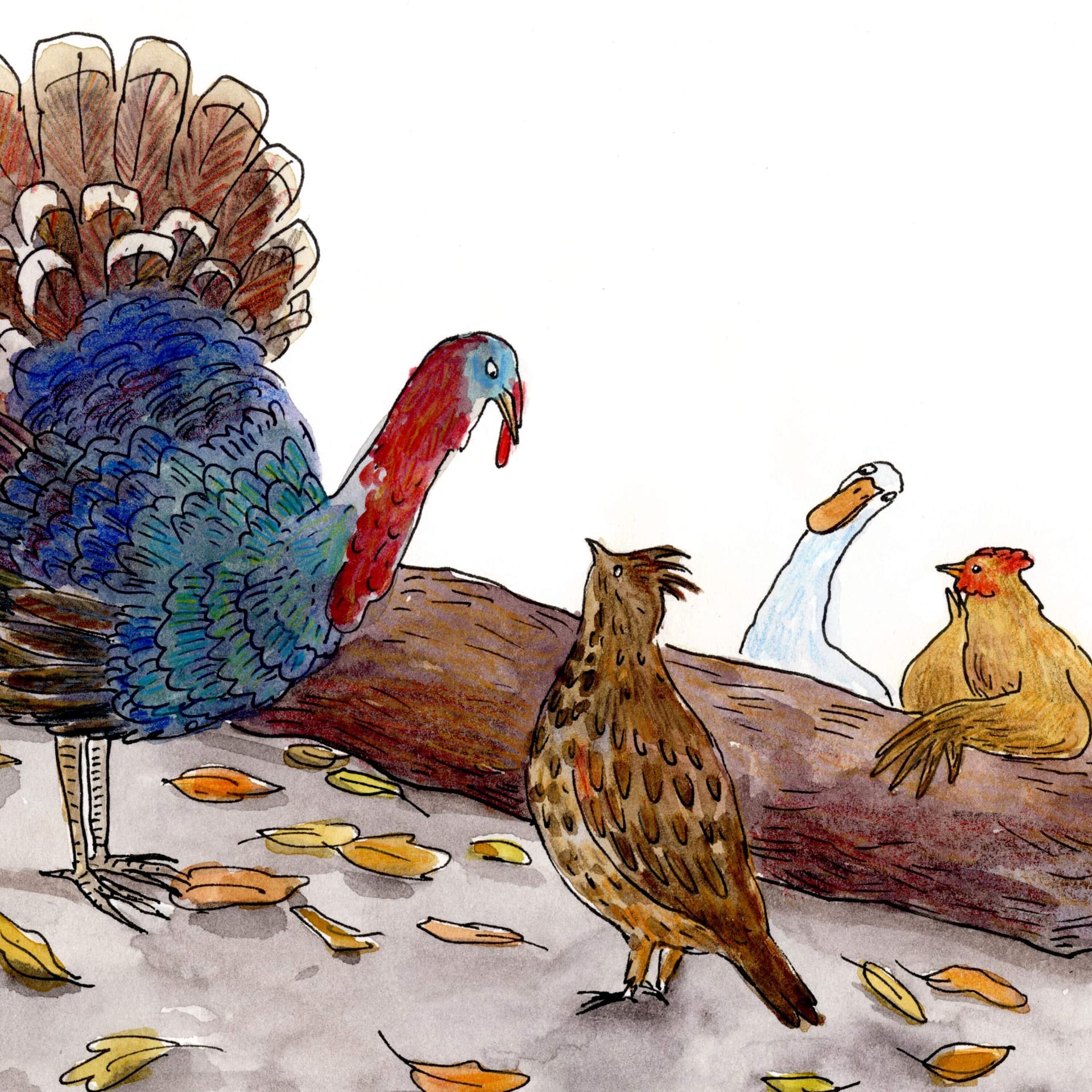
Circle Round
How the Turkey Got Its Gobble | Ep. 305 (A Podcast Turducken with Terrestrials and Wow in the World)
00:33:44
Fellow kidcasts Terrestrials and Wow in the World join us for a story-stuffed special about smart chickens, mysterious duck quacks, and how the turkey got its gobble.
Loading summary
Transcript280 lines
- [00:00]
A
Great news, Circle Round fans. New stops have been added to our 2025, 2026 circle round live tour. Join us for live episode recordings in Charlotte, North Carolina on November 22, Los Angeles, California on January 18, Boston, Massachusetts on February 7, and Cleveland, Ohio, on March 14.
- [00:20]
B
We'd love to see you there.
- [00:21]
A
Get your tickets@wbur.org circleround WBUR podcasts.
- [00:28]
C
Bo.
- [00:34]
A
Think about something you're thankful for. Maybe you're thankful for your family, your warm bed at night. Perhaps you're thankful for good books or good food or great friends. If you're listening, when this episode comes out, it's Thanksgiving time here in the United States. And if you live in the US Or Canada, Germany, Japan, Liberia, South Korea, the Netherlands, or the United Kingdom, then you know something about Thanksgiving. The holiday is different in every country, but basically it's all about celebrating, appreciation and gratitude. And today we're putting a very different spin on Thanksgiving and we're partnering with some fascinating people to do it. I'm Rebecca Scheer, and welcome to Circle Round, where story time happens all the time. Today we're presenting not one story, but three. Not from different countries, but from different kids podcasts. This Thanksgiving season, we've teamed up with Terrestrials and wow in the world to bring you a buffet of tales all about Tur duckin. Okay, not what you expected me to say, right? But stick with me. It'll be worth it, I promise. And can we start up the theme music again? Thank you. Now, you may be wondering, what is a turducken? Well, a turducken, and apologies to you vegetarians, but a turducken is a Thanksgiving meal consisting of a turkey stuffed with a duck stuffed with a chicken. So ter duck in. And since a turducken consists of three things smushed together, we're about to smush three podcasts together from Terrestrials. Host Lulu Miller and song bud Alan Gofinski will present a tale about a.
- [02:33]
B
Chicken.
- [02:36]
A
That was an amazing hen trance from wow in the World. Guy Raz and Mindy Thomas will bring us a story about a duck.
- [02:46]
D
Quack, quack.
- [02:47]
B
Quack, quack.
- [02:48]
A
That was quacktacular. Quacktacular.
- [02:52]
B
Get it?
- [02:52]
A
And I, Rebecca Shear, will tell a circle round story about a turkey. Gobble, gobble. So circle around everyone for an extra special super stuffed story filled podcast, Tur Ducking. Well, now that we're all here, why don't we go around and introduce ourselves?
- [03:18]
B
Okay. Hi, I'm Mindy.
- [03:20]
D
And I'm Guy Raz. And together we bring you the wow. In the World podcast where we search, find and share new scientific discoveries.
- [03:29]
B
Discoveries that make us say we.
- [03:31]
C
Wow.
- [03:32]
E
Wow.
- [03:32]
C
And I'm Lulu. I host terrestrials from Radiolab and we tell totally true stories about animals and sometimes break out into song.
- [03:41]
B
All right, so let's get this story tur Ducking started. A turkey stuffed with a duck stuffed with a chicken.
- [03:48]
A
Yeah.
- [03:50]
B
So I guess we probably need to start with the littlest bird first. Who's got the chicken?
- [03:54]
C
Terrestrials does. I am so excited to bring you this tale that will have you seeing the lowly chicken completely anew. Y' all ready?
- [04:05]
B
I'm ready.
- [04:05]
A
Uh huh.
- [04:06]
D
Let's do it.
- [04:07]
C
Okay. So join me if you will. On a very cold wintery day a few years ago in Germany. We're on a little farm with a little flock of chickens and one normal sized farmer named Gerald.
- [04:21]
A
Guten tag.
- [04:22]
C
And in that flock is a very handsome rooster named Horst and a bunch of female chickens, including one lovely little red hen named Inga. Beautiful red little Inga, who Horst had taken under his wing. Literally. They spent a lot of time together, wing to win.
- [04:41]
A
Inga and Horst sitting in a tree. B, E C K I, N G.
- [04:47]
C
But one day, farmer Girald, well, he needed to earn some money, so he looked into the flock.
- [04:53]
A
Hmm, which bird shall I take?
- [04:55]
C
And scooped up Inga.
- [04:57]
A
Come here, little one.
- [04:59]
C
And put her in the car with him to drive over three miles away past dark forests and snow and busy streets to sell her to Delhunerbreiter, which is German for the chicken rooster, to become a nugget. Or according to our fact checker, possibly a filet. Anyway, it seemed like her fate was seared, I mean sealed. Farewell, Inga Geralt drove home to his little farm with one less chicken. The months went by, the snow fell, and then one morning, Girald woke up. Imagine him trudging out through the snow to the chicken coop where he saw Inga. He knew it was her because of the name tag still on her ankle. And there she was, reunited with handsome Horst.
- [05:49]
A
We're standing.
- [05:50]
C
The horse Berg, which is German for.
- [05:53]
D
My hair stood up on end.
- [05:56]
C
My hair stood on end too, when I heard about this runaway chicken who made it miles and miles home through obstacles and darkness and who knows what else. Because I figured she must have been the luckiest chicken in the world who accidentally made it all the way back home. Because, you know chickens not famous for their intelligence.
- [06:19]
F
We do know that birds are fantastic with directions. Well, birds, sure, but chickens exceptional can.
- [06:26]
C
You please introduce yourself? Person suddenly correcting me.
- [06:30]
F
Well, my name is Cy Montgomery and I wrote what the Chicken Knows, and.
- [06:34]
C
Cy says the chicken knows a whole lot more than we give it credit for.
- [06:38]
F
I have kept chickens for a couple of decades. They have taught me so much. The fact that we think that they're stupid seems awfully unfair to me.
- [06:48]
C
I mean, really, though.
- [06:49]
B
Sigh.
- [06:49]
C
Like I've seen chickens pecking at their own bum.
- [06:53]
F
Well, chickens have different kinds of intellig, but we sometimes don't know how to appreciate it.
- [07:00]
C
Sy suspects Inga's journey was anything but dumb luck. And to explain, she says we should all just imagine the story back at the beginning. Right back at Del Huhnerbrighter, the nugget factory. Somehow Inga got out of the stall. And then, most likely, she ran.
- [07:20]
A
Chicken, chicken, chicken.
- [07:21]
B
Run.
- [07:22]
F
As fast as she could out of.
- [07:24]
C
The town center and toward the woods. Can they go fast?
- [07:28]
F
Actually, chickens can go nine miles an hour.
- [07:32]
C
No side note, I love running, and the best I can do is six miles an hour.
- [07:37]
D
Chicken, chicken, chicken, run.
- [07:40]
F
As soon as she felt she was out of sight, she probably then hid.
- [07:44]
A
Chicken, chicken, chicken.
- [07:46]
C
Maybe under a bush or a pile of leaves in the wintry forest.
- [07:50]
F
This is what I would do if someone was trying to cook and eat me.
- [07:55]
C
But all around her, new threats loomed in the darkness.
- [08:01]
F
Raccoons, skunks, foxes, hawks.
- [08:03]
B
Chicken.
- [08:04]
D
Hide, hide.
- [08:05]
F
And I might have even waited out the night.
- [08:07]
C
Chicken.
- [08:08]
A
Sleep, sleep.
- [08:09]
F
To just get rested and think about what am I going to do next.
- [08:13]
A
Chicken, chicken. Think, think, think, think.
- [08:22]
C
Sai thinks that Inga likely used her sharp listening skills to eavesdrop on the conversations around her.
- [08:31]
F
Squirrels, chipmunks, and birds help warn each other of approaching predators. They speak each other's language.
- [08:39]
C
Oh, like she would have recognized that little chattering alarm sound from the squirrels on her farm.
- [08:44]
F
She probably would have, yeah. And then maybe she hid under a.
- [08:48]
C
Bush until the coast was clear, until all the chattering stopped.
- [08:53]
B
Wow.
- [08:54]
C
But how would she know where to go? How would she have found her way home?
- [08:59]
F
Many birds have something called magnetite to detect the magnetism of the earth the same way that a compost does.
- [09:07]
B
What?
- [09:08]
F
And they have excellent memories for things like directions.
- [09:12]
C
Really?
- [09:13]
F
So if she could see out of.
- [09:15]
C
The car back when Girald drove her toward the chicken roaster, she may have.
- [09:20]
F
Been memorizing all those landmarks as she went. Plus, they can see polarized light.
- [09:27]
A
What does that look like?
- [09:28]
F
It may look like stripes that indicate direction.
- [09:32]
C
Almost like arrows.
- [09:33]
F
Yes.
- [09:34]
B
Wow.
- [09:34]
F
All bird eyes are exceptional. And she was highly motivated.
- [09:40]
A
What?
- [09:40]
C
What do you mean?
- [09:41]
F
If she went home, she was going to see her boyfriend, Clark Claw.
- [09:46]
C
But does a little chicken brain experience something like a bond?
- [09:51]
F
Oh, they absolutely do. I've seen in my own chickens. At night, they want to sleep next to their best friends.
- [09:58]
B
Huh.
- [10:00]
C
And like that, I saw Inga's journey totally anew. It wasn't dumb luck that let her get over three miles through the dark and cold forest, past hungry foxes and speeding cars, but her own instincts, her own memories, her own very special chicken intelligence that helped her find her way. I mean, back to her flock.
- [10:28]
F
I love this story.
- [10:30]
C
And so too, it seems, did Farmer Girald, because he has vowed to never take Inga back to the chicken roaster and instead let her live out her life peacefully with handsome Horst together raising their baby chicks.
- [10:51]
G
Wow.
- [10:53]
C
Did we just make wow in the world?
- [10:55]
B
Wow, you totally did. Yes.
- [10:58]
C
And circle round. Were you in fact circle round while listening?
- [11:01]
A
Uh huh.
- [11:02]
C
Podcast Dreams Achieved.
- [11:04]
A
All right, so next is Duck. Who's got the duck?
- [11:08]
D
Oh, we've got a duck.
- [11:10]
B
What? His name's Freddy.
- [11:12]
C
Wait, I didn't expect that you were.
- [11:14]
A
Oh, hi, Freddy.
- [11:17]
B
He says hi back.
- [11:20]
C
Okay, but wait. When you said you were bringing the duck, I didn't know you were actually bringing an actual duck.
- [11:27]
B
Well, I couldn't just leave him home. Not on ter Duckin day.
- [11:30]
C
All right, that would just be.
- [11:33]
B
But what we brought is more than just a duck. It is?
- [11:37]
D
It is?
- [11:38]
B
It is. What we brought to this turducken feast is a whole quackin mystery.
- [11:44]
A
A mystery? I thought you were going to be bringing a duck. Related story.
- [11:49]
B
Oh, well, it is a duck story. Sort of.
- [11:52]
C
What do you mean sort of?
- [11:53]
B
It's a quack.
- [11:54]
A
A quack.
- [11:55]
B
A quack.
- [11:56]
D
Stop saying quack quack.
- [11:59]
B
You know, maybe we should just get into the story. You ready, Guy?
- [12:02]
A
Raz?
- [12:02]
D
As I'll ever be.
- [12:07]
B
Our story begins way back in 1964.
- [12:11]
D
Two researchers on board a US Navy research vessel were listening for whale songs in the middle of the Arctic Ocean when suddenly they heard something a little strange.
- [12:27]
B
Whoa.
- [12:28]
D
Did you hear that, Captain?
- [12:29]
B
Yeah, I did hear that. There it is again.
- [12:33]
D
What could it be?
- [12:34]
B
I don't know, but it sure sounded like a duck.
- [12:38]
D
A duck. There it is again.
- [12:41]
B
The researchers decided to call this strange sound the bio duck signature because, well, it sounded just like a duck.
- [12:50]
D
A duck in the middle of the Arctic Ocean?
- [12:54]
B
No way. It couldn't be.
- [12:57]
D
Nobody knew what this sound was or.
- [13:00]
B
Where it was coming from.
- [13:04]
D
It wasn't until 2013, when researchers from the Woods Hole Institution decided to lead an expedition out to the Arctic, it.
- [13:14]
B
Was time to get to the bottom of this 50 year old mystery once and for all.
- [13:20]
D
Thank you. Thank you everyone, for joining us on this expedition to find out what exactly is making those quacking sounds once and for all.
- [13:29]
B
As of this moment, we have one prime suspect.
- [13:33]
A
Oh yeah?
- [13:34]
C
Who?
- [13:35]
B
It's this guy.
- [13:39]
A
A whale?
- [13:41]
D
Not just any whale. This is an Arctic minke whale.
- [13:47]
B
Wait, wait, wait, wait, wait.
- [13:49]
C
So what made the researchers think that this Arctic minke whale was the duck? I mean, the quacking culprit?
- [13:56]
B
Well, you see, whales make all sorts of noises to communicate over long distances.
- [14:01]
D
They're called whale songs. And sometimes they can sound pretty strange.
- [14:06]
A
As strange as a duck's quack?
- [14:09]
D
Sometimes.
- [14:10]
B
So to find out if these whales were making the quacking sound, they did something that all of us are very familiar with.
- [14:18]
C
What did they do?
- [14:19]
B
They mic'd em up.
- [14:20]
A
They gave the whales microphones. Yeah.
- [14:23]
B
Just like us here at this turducken feast. Is this thing on, Mindy?
- [14:27]
C
And how did they get these whales in front of a microphone? I mean, last time I checked, whales don't know how to use a podcast studio.
- [14:35]
D
They did it with a very special piece of scientific equipment.
- [14:41]
B
Okay, everyone stand back. What I hold here in my hands is a very special piece of scientific equipment.
- [14:52]
D
What is that thing?
- [14:54]
B
This, my fellow scientist, is a digital recording acoustic tag.
- [15:01]
D
A what?
- [15:02]
B
Otherwise known as a D tag. It's like a waterproof microphone, GPS tracking system and motion sensor all rolled into one. And we're going to use it to spy on these whales underwater.
- [15:13]
D
We can do that?
- [15:15]
B
Yeah. Here, take a closer look.
- [15:17]
D
Let's see here. This part must be the hydrophone, the.
- [15:22]
B
Only kind of microphone you can use underwater.
- [15:24]
D
But how are minke whales supposed to use underwater microphones?
- [15:29]
B
Oh, that's easy. We're gonna stick them right onto the whales.
- [15:33]
D
Okay.
- [15:33]
B
And then we're gonna go away, let them do their thing, and then listen back to the recordings to hear what sounds they've been making while we've been gone. Wait, wait, wait, wait, wait.
- [15:44]
C
These scientists are gonna stick the device to the whale? How are they gonna do that?
- [15:49]
B
Two words for you, Lulu. Suction cups.
- [15:53]
C
Suction cups.
- [15:54]
B
Uh huh.
- [15:55]
D
Sort of like those phone holders for your car that stick to the windshield.
- [15:59]
A
So you don't have to fiddle with your phone to play music or podcasts or whatnot.
- [16:03]
D
Exactly.
- [16:04]
B
So each of these suction cups has a hydrophone att. And after a Couple of days, they just fall off. The whales don't even realize they were there in the first place.
- [16:13]
C
And then how do they find the hydrophones again after they fall off?
- [16:17]
B
Three more words for you. Global Positioning Systems.
- [16:23]
A
Ah, gps.
- [16:25]
D
That's right. The hydrophone floats to the surface and then the scientists find it by tracking its GPS location.
- [16:33]
A
Genius.
- [16:34]
B
So can we get back to the story now?
- [16:36]
A
Yeah, yeah, yeah, totally. Sure, yeah.
- [16:38]
D
Of course it took a few months, but eventually our researchers found two perfect quacking candidates for this very special recording session.
- [16:51]
B
Okay, now that we have them in our sights, let's hop in our dinghies and head out to the whales. Got everything we need?
- [16:57]
D
Let's see here. Hydrophone recording devices.
- [17:01]
B
Check.
- [17:01]
D
Suction cups for sticking. Check. And a couple of fairy long poles. Check, check and check.
- [17:11]
C
Very long poles.
- [17:12]
A
Surely not fishing poles, right?
- [17:15]
B
Oh no, these are just poles to help the researchers put the microphones on the whales.
- [17:21]
D
Yeah, in order to not disturb the whales, they can't get too close. So these poles help them attach the microphones from a distance.
- [17:29]
B
And all they have to do is wait for the whales to pop up to the surface.
- [17:36]
D
I see one. Look, it's a minke whale reaching to the surface.
- [17:40]
B
Quick, get the pole. Ready. Got it.
- [17:44]
D
Pole is ready. Mike is attached.
- [17:47]
B
Okay, here it comes. Ready? Ready. Now. Got it. Now keep swimming, little buddy. And quack till your heart's content.
- [18:04]
D
Woo hoo.
- [18:06]
A
So what happened next?
- [18:08]
B
Well, they waited and waited and waited. I can't take this anymore. I'm so bored from waiting.
- [18:21]
D
Is that what I think it is?
- [18:23]
B
A signal from the D tag.
- [18:26]
D
Quick, let's get out all those Ds.
- [18:29]
B
The researchers then went out to retrieve their recordings from the ocean surface. And when they got them back, they found a very familiar sound waiting for them.
- [18:45]
C
So it was the minke whale. I knew it.
- [18:48]
A
But wait, couldn't it just have been another marine animal that made that quacking sound?
- [18:54]
B
Well, that is a possibility. But when the scientists lined up the times for when all of the quacks.
- [18:59]
D
Occurred, there were no other marine animals anywhere near the whales. So the scientists concluded that it had to be the minke whales making that quacking sound.
- [19:11]
B
Huh.
- [19:12]
C
So mystery solved, I guess.
- [19:14]
B
Well, half solved. You see, scientists still don't know why these animals are making those noises. But there are a few theories. Think, think, think, think. Why would these whales be making these noises?
- [19:30]
D
Maybe they're talking to each other. Some whale songs can be heard hundreds, sometimes even thousands of miles away.
- [19:37]
B
But what would they even be talking about.
- [19:40]
D
I have some theories.
- [19:41]
B
Chalkboard's all yours, buddy.
- [19:43]
D
Okay, theory number one. Mating calls.
- [19:47]
A
Ah.
- [19:48]
B
Trying to serenade the o other minke whales, huh? Maybe. Showing off, Looking for love?
- [19:54]
D
It's possible.
- [19:55]
B
Okay, theory number two.
- [19:57]
D
Theory number two. Navigation.
- [20:00]
B
Ah, yeah, it is pretty dark down there in those icy waters. Probably hard for these whales to keep track of each other when they can hardly see what's in front of them.
- [20:09]
D
Yeah, maybe these quacks are a way for these whales to let other whales know they're still close.
- [20:15]
B
Like a whale whale version of that Marco Polo game we play at the pool.
- [20:19]
D
Exactly. And theory number three. Migration.
- [20:24]
B
Migration. Explain.
- [20:26]
D
Well, research shows that these sounds become more common in the winter, which is.
- [20:32]
B
Also when these whales head up north to warmer waters. That could be it, Guy Raz.
- [20:37]
D
Could be. We'll have to do some more investigating to know for sure.
- [20:42]
B
Well, I guess it's true what they say. A marine biologist's work is never done.
- [20:46]
D
But for now, let's close the chapter on the mysterious case of the ocean quacking.
- [20:52]
B
Another scientific mystery solved.
- [20:55]
D
The end.
- [21:00]
A
Okay, so we've got the chicken, we've got the duck. And that means it's time for the turkey. Coming up, Circle Round presents a fascinating Cherokee legend about how the turkey got its gobble. Join us for this spectacular tale. After a quick break, Support for Circle Round comes from audible. Get ready for Harry Potter like you've never heard it before. In a captivating new audio production that brings the wizarding world magically to life. You'll hear footsteps echoing down the halls of Hogwarts and the whoosh of a golden snitch as it zips past your ear. With a new musical score and an A list cast of voices, it's a delightful way to introduce the Harry Potter stories to a new generation. Harry Potter and the Sorcerer's Stone is available now. Listen on audible@audible.com HP1 the reviews are in and super fans like you are loving the Circle Round Club. An exciting opportunity to support public radio and get cool stuff, including ad free episodes and a personalized birthday message from me.
- [22:11]
H
What I like about the Circle Round Club is that Rebecca Shear sends extra messages and it supports the show and there are no ads.
- [22:22]
A
Grown ups support public radio and sign up today@wbur.org CircleRoundClub. I'm Rebecca Scheer and welcome back to our podcast Turducken, a special crossover episode between terrestrials. Wow. And the world and Circle Round. Now that we've covered the Ducken in Tur Ducken, it's time to talk Turkey. Now, everybody knows that turkeys gobble. But have you ever wondered how that gobble came about? According to legend, it all began long, long ago, back in the earliest of times when animals ruled the world. In those long ago days, the turkey, with its large, plump body, tiny bald head and wide rounded tail, didn't make any sound like the other animals. In those days, Turkey could talk, but he couldn't hoot like Owl or trill like Red Winged Blackbird, or sing like Wood thrush. So naturally, he envied them all. But the bird he envied most was Grouse. Because Grouse, that reddish grayish chicken like bird, could drum. Not with an actual drum, of course. Those had yet to be invented. Instead, Grouse would climb up onto a fallen log and beat his wings in the air, flapping faster and faster and faster until he produced this amazing buzzing, thumping, drumming sound. Turkey loved hearing Grouse drum. So one day, he made a decision.
- [24:24]
G
I shall have Grouse teach me how to drum. My wings are way bigger than his, so I could do some serious things. Thumping and bumping. Then I shall make the coolest, grooviest, most special sound of all.
- [24:42]
A
The next morning, Turkey found Grouse in a clearing, pecking tender young shoots for breakfast.
- [24:47]
G
Hiya, Grouse. I need you to do me a favor.
- [24:52]
A
Grouse swallowed a mouthful and smiled.
- [24:55]
E
What kind of favor do you need, Turkey? I'm always happy to help out a.
- [24:59]
G
Fellow bird Grate, because I need you to teach me how to drum.
- [25:08]
E
Teach you how to drum?
- [25:10]
A
Grouse cocked his crested head.
- [25:13]
E
Why would you want me to teach you how to drum?
- [25:17]
G
Because it's a cool sound, a groovy sound. And in case you haven't noticed, I don't make any sound at all. Just like the narrator said, Owl can hoot and Red Winged Blackbird can trill and. I'm sorry, what was the other one again?
- [25:40]
A
Woodthrush can sing, right?
- [25:43]
G
Wood Thrush can sing. But me, I can't do anything. I want my own sound. I want to be special.
- [25:56]
E
But you are special, Turkey. You may not make your own sound, but look at your feathers. They're gorgeous. Rich brown, jet black, gleaming bronze, copper and green. My feathers are just reddish grayish. Talk about blah.
- [26:18]
A
Turkey looked at Grouse's plumage. It was kind of blah. And now that Grouse mentioned it, Turkey's feathers were pretty spectacular.
- [26:28]
G
I tell you what, Grouse, if you teach me how to drum, I'll give you some of my feathers.
- [26:37]
E
It's a Deal.
- [26:39]
A
Turkey plucked out a bunch of jet black feathers. Grouse excitedly took the plumage and arranged it around his neck in a collar like Ruff. And fun fact, he's been known as Ruffed Grouse ever since.
- [26:53]
F
Wow.
- [26:55]
E
Thank you, Turkey. Now let's get started. Watch and learn.
- [27:01]
A
Ruffed Grouse nimbly hopped onto a fallen log. Then he lifted his head, stretched his body tall and began to beat his wings. He beat them faster and faster until a buzzing, thumping drumming filled the forest. Then he stopped.
- [27:23]
E
See what I did there? The upstroke and the downstroke. Now hop on up here and let it rip.
- [27:31]
A
Turkey scrambled onto the log and tried to beat his wings. But he was far bulkier and plumper than Ruffed Grouse was, and the bright red waddle on his neck wiggled back and forth as he wobbled to and fro.
- [27:50]
G
How do you flap your wings without falling?
- [27:58]
E
It's easy for me. Maybe because I'm smaller. Try spreading your legs more and flap harder.
- [28:07]
A
Turkey tried following Grouse's instructions, but balancing his big, bulky body was a challenge.
- [28:14]
E
I don't know, Turkey. Maybe you just weren't meant to drum. Maybe you should appreciate your natural gifts, what you've already got.
- [28:29]
C
No way.
- [28:32]
A
Struggling and scrambling to stay perched on the log, Turkey teetered and let out a gurgle. Then he tottered and let out a gurgle. Then, just before he tumbled to the ground, he threw back his head, opened his beak and let out a gobble. Then another, and another, and another. And all this time later, Turkey is gobbling. Still, he had always wanted to make his own sound, after all. And though it isn't quite as pleasant as owl's hoot or red winged blackbird's.
- [29:26]
B
Trill.
- [29:29]
A
Or wood thrush's song, or Ruffed Grouse's drumming, That gurgling, gargling gobble definitely sets Turkey apart and makes him nothing short of special. Woo.
- [29:56]
D
That was amazing.
- [29:57]
B
So fun.
- [30:03]
A
And that's it for today's podcast. Turducken. This scrumptious feast for your ears was brought to you by terrestrials. Wow. In the world.
- [30:14]
B
Quack, quack, quack, quack.
- [30:16]
A
And of course, circle round wherever you're listening. And however you celebrate the season, we thank you. Now it's your turn. Find a piece of paper and draw your own Thanksgiving feast. But instead of food, draw all the things you're grateful for. So you might draw a dish stacked with your favorite books, a bowl full of sand from your favorite beach, a platter of warm clothing, a tray of chirping birds, maybe even a plate of rainbows. Draw your Thanksgiving feast, then share it with someone you love. And if you'd like, share it with us. Grown ups Snap a photo of your Circle Round fan and their drawing, then email it to circleroundbur.org we may feature you in the Circle Round newsletter, the Lion's Roar. If you haven't yet signed up for this free monthly email featuring special announcements, sneak peek previews, behind the scenes peeks, and yes, photos of your creations, visit WBUR.org CircleRound. Circle Round's original music and sound design is by Eric Shimalonis. Eric's featured instrument in our story was the frame drum. To learn more about this ancient drum dating back more than 55000 years, and to see a photo of Eric playing one, visit our website WBUR.org CircleRound Circle Round's artist is Sabina Hahn. Sabina has created a black and white coloring page for all of our Circle Round stories and you can print them out and color them in while you listen. Grown Ups. You can download all of our coloring pages@wbur.org CircleRound While you're there, I invite you to sign up for the Circle Round Club. You'll get all sorts of cool stuff as a member, including a welcome package with special swag, an ad free feed, bonus bedtime stories, pre sale tickets to our events, and a meet and greet with me and Eric after each show. You can also add on goodies like our Snuggly Lion Stuffy and a personalized birthday message from me. Sign up for the Circle Round Club today and show your love for public media@wbur.org CircleRound Circle Round is a production of WBUR, Boston's NPR. I'm Rebecca Scheer. Thanks for Circling Round with us. Now that you've made it to the end of this Circle Round episode, we want to know what's your favorite Circle Round story? Thousands of fans just like you have been telling us about the Circle Round stories they like best. Take a listen. Maybe one of their favorites is one of yours too.
- [33:00]
H
Hi, my name is Ariel and I'm from Oakland, California and my favorite Circle Round episode is out of Time. And my favorite part is when the fisherman says I've got to get out of here. My name is Rose, I live in Asheville, Northwest Carolina and my favorite Cirque story is out of Time. My favorite part is when the judge makes her own story after the suspects make theirs. Hi, my name is Sophia and I live in Sacramento, California and my favorite Circle Round episode is the Goat in the Garden. My favorite part is when the goat eats all of the food in the garden. My name is Felipe and I live in Rosendale, Massachusetts. My favorite story is Giant Steps. I like the part when the woodcutter hides the giant shoes.
- [34:00]
E
Hello.
- [34:01]
H
My name is Stevie. I'm from Portland, Oregon. And my favorite story is the Three Legged Pond. And my favorite part is when Felix got dropped in the snow by the three legged Pod. My name is Emmy, I'm from Boulder, Colorado. My favorite Circle round story is the Basilisk Stair. And my favorite part is when the older sister turns the baby basilisks to stone. My name is Yonina, I live in Jerusalem. My favorite Sacrament story is all of them. I really like how you do his stories and how the actors sound like and how all the musical instruments are very musical. I really like all of those stuff.
- [34:59]
A
Did someone mention a story you've missed? Not to worry grown ups. You can find all of our Circle Round stories plus links to the Circle Round Club, picture books, coloring pages, and oh so much more on our website, WBUR.org CircleRound.