← Civics & Coffee: A History Podcast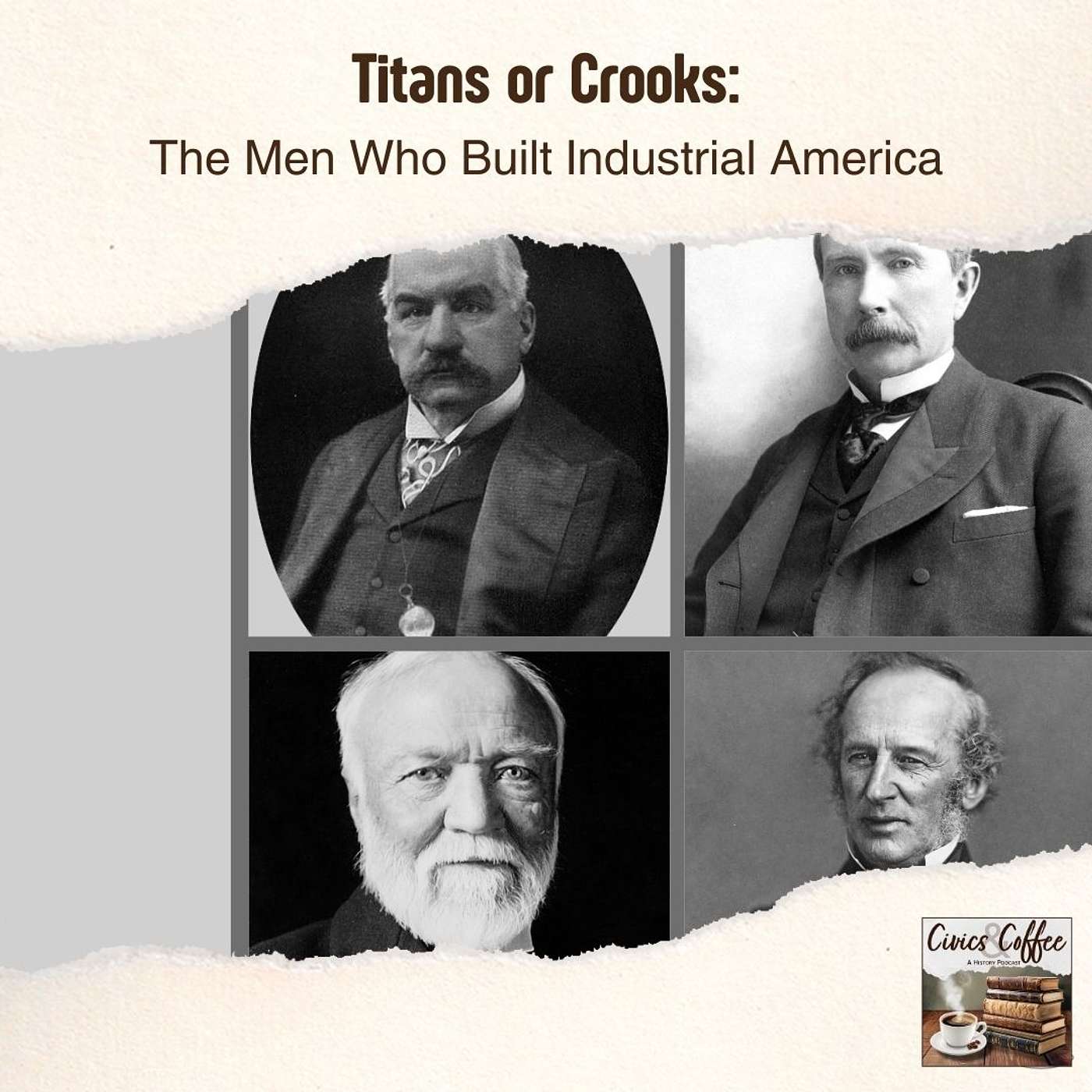
Loading summary
Transcript5 lines
- [00:01]
A
Welcome to Civics and Coffee, a history podcast. The show all about United States history delivered to you in the time it takes to enjoy your morning cup of coffee. I'm your host Alicia, a historian trained in United States history with a passion for telling both the known and unknown
- [00:18]
B
parts of America's past.
- [00:21]
A
So grab your coffee and get ready
- [00:22]
B
for some bite sized history. Hey everyone. Welcome back. In 1901, when financier J.P. morgan organized the creation of U.S. steel, it became the first billion dollar corporation in American history. $1 billion at a moment when most American workers earned less than $500 a year. Just a few decades earlier, oil refiner John D. Rockefeller had quietly consolidated control over nearly 90% of the nation's oil refining capacity. And steel magnate Andrew Carnegie was producing more steel than entire European nations. And who could forget Cornelius Commodore Vanderbilt who managed to put a significant amount of American railroad under centralized control. Supporters called them captains of industry. Critics called them robber barons. These men accumulated vast sums of wealth in an era known for excess, and their actions reshaped the American economy for generations. Yet they have complex contested legacies that make putting them into a box a bit of a challenge. To understand the Gilded Age and the Progressive Era that comes after, it is important to understand these men and the industries they built and how they chose to operate. So this week I am diving into the so called Big Four of the Gilded Age. Who were they? What industries did they dominate? How did they build their empires? And perhaps more importantly, what did their rise mean for the United States? Grab your cup of coffee peeps. Let's do this. While it would be easy to dedicate an entire episode or episodes to each individual I'm going to discuss here, I am resisting the urge since I feel like when it comes to the Gilded Age or history in general, most know quite a bit about these gentlemen anyway. However, dear listener, if you end this episode desperate for a deeper dive into any of the men featured today, let me know and I will make sure to add one or all of the men into the lineup of people and events to discuss. Lets start with John D. Rockefeller. Born in 1839 on a farm in upstate New York, Rockefeller was one of six children. Like several of the men featured in this episode, he grew up in a modest household and his family moved quite a bit before settling in Ohio in 1853. Rockefeller was not flamboyant. He took a more methodical approach and was very reserved throughout his life. He avoided vices, including gambling and drinking, and was known to be intensely disciplined. He began his career as a bookkeeper, and it was something Rockefeller really took to. The future magnate understood numbers and how to make them work to his liking. In 1863, Rockefeller and his business partner, Maurice B. Clark, jumped into the oil business as refiners. They brought in a third partner, Samuel Andrews, to build an oil refinery. Andrews, Clark Co. Disagreements over business decisions led Rockefeller to buy out one of the partners and he moved forward as Rockefeller and Andrews. The increased use of kerosene for lighting helped Rockefeller as it increased the demand for oil, and in 1870, he founded Standard Oil. At the time, the oil industry was a bit chaotic. Dozens of small refineries competed fiercely, prices fluctuated wildly and the quality varied. Where others may have only seen the chaos, Rockefeller saw opportunity. Through a series of aggressive business decisions, Rockefeller consolidated control over refining, as author Grant Siegel highlights in his article about the magnate and his company. Drilling wells, controlling supplies, underselling competitors, using spies and fronts, and laying pipelines to bypass railroads. Standard became a vertical and horizontal monopoly and the world's biggest business. End quote. By the 1880s, Standard Oil controlled the vast majority of oil processing in the United States and would eventually go on to produce 10% of the world's refined oil. Supporters argued that he brought stability and lowered prices. The cost of kerosene dropped dramatically under his system, making lighting more affordable for ordinary Americans. Rockefeller was also a key component to the American labor market, employing more than 100,000 people, and was known to pay his workers relatively well. Although Rockefeller was staunchly against any union activity. Yet critics charged that whatever efficiencies came with Rockefeller's processes came at the expense of competition. Given his ability to buy out anyone who dared to compete with him, independent refiners had little chance of survival. And Rockefeller could manipulate the markets. And for many Americans, Rockefeller became the embodiment of corporate monopoly. His empire and those like it would eventually help prompt Congress to pass the Sherman Antitrust act, the federal government's first attempt to rein in corporate consolidation. So was Rockefeller a genius organizer who modernized energy or a monopolist who undermined free enterprise? That tension sits at the heart of the Gilded Age. And if Rockefeller represents disciplined monopoly, Carnegie represents industrial scale fused with moral argument. Like Rockefeller, Andrew Carnegie was a man born into modest means who who grew up to amass tremendous wealth. Born In Scotland, about 40 miles outside of Edinburgh, in 1835, Carnegie immigrated to the United States as a child. His family settled in Pennsylvania, and like many immigrant families, they struggled financially. Carnegie went to work young, first in a cotton factory, then as a telegraph messenger boy. Carnegie did not have any connections or much to offer, only a strong commitment to work. He cultivated and carefully promoted the image of the self made man throughout his life. But in his early days, it was his work ethic that stood out. Regional superintendent of the Pennsylvania Railroad, Thomas A. Scott, noticed the young Carnegie hustling hard and decided to take him under his wing, hiring him as his private secretary. While working for Scott, Carnegie learned about investing, with Scott lending his young protege the money to buy his first 10 shares of stock. When Carnegie received his dividend payment, the first money he made that did not come from physical labor, he knew he was onto something. Carnegie realized he could invest in stocks and make much more money than he could ever make through sheer physical labor. By the time he was in his 30s, Carnegie had invested heavily in iron and steel production industries that would play a critical role in the development of the United States. After the Civil War, steel became the backbone of industrial America. Railroads required steel rails and cities relied on steel beams to build infrastructure. Bridges, factories and machinery were all built with steel and thus demanded massive quantities of it. Through vertical integration or controlling the raw materials, transportation and production, Carnegie built Carnegie Steel into the largest steel producer in the world. By the 1890s, the United States was producing more steel than Great Britain. Carnegie's expansion was not an accident or a matter of simple luck. It was the product of careful methodical planning and industrial strategy. Carnegie was relentless in his pursuit of efficiency and made sure to reinvest profits into new technologies and cut costs wherever possible to drive down prices and undercut his competitors. But cost cutting included labor expenses, which meant that wages were tightly controlled. Carnegie tried very hard to resist union power, and in 1892, conflict between management and workers at his Homestead plant in Pennsylvania exploded. The Homestead strike is known as one of the most violent labor conflicts of the Gilded Age and led to the death of at least 10 people. Although Carnegie himself was in Scotland at the time, the strike permanently complicated his reputation. And unlike some of his contemporaries, Carnegie openly defended the system that made him wealthy. In his 1889 essay, often referred to as the Gospel of Wealth, Carnegie argued that inequality was not only inevitable, but socially beneficial. As he wrote, quote, the problem of our age is the proper administration of wealth so that the ties of brotherhood may still bind together the rich and poor in harmonious relationship, end quote. Carnegie believed that millionaires were uniquely qualified to be the trustees for society and that they were equipped with the appropriate skills to distribute surplus wealth responsibly through acts of philanthropy. This was an era before federal income tax, which would not be passed until 1913. After the ratification of the 16th Amendment, Carnegie believed that vast fortunes should be administered by the wealthy themselves for the public good, through philanthropy, libraries, universities and cultural institutions. And to be fair, he did follow through. By the end of his life, he had given away about $350 million and created institutions like Carnegie hall and over 2,500 Carnegie libraries. He and his steel helped remake the American landscape as it made things like skyscrapers, suspension bridges and expanded railroad networks. Carnegie helped propel the United States into the position of the world's leading industrial power. But he also embodied a defining contradiction of the Gilded Age. Industrial expansion required scale, and scale required consolidation. Consolidation, concentrated wealth, industrial and concentrated wealth unsettled. A democratic society built on ideals of independence and equality. So that begs the question, was Carnegie a benevolent steward of progress or a man who justified inequality after benefiting from it? Again, a contradiction that is central to understanding not just Carnegie, but the entire industrial order of the late 19th century. And if Carnegie represents industrial production, the next magnate, Carnegie, Cornelius Vanderbilt, represents transportation, that connective tissue of the American economy. Born in 1794 on Staten Island, Vanderbilt is best known for his connection to the railroad industry. But he actually began his career in shipping. As a young boy, Vanderbilt worked with his father, who owned a small boat that transported goods across the New York harbor. More interested in being on the water than in school, Vanderbilt went into the cargo business himself. He quickly earned a reputation for aggressive competition by undercutting rivals fares and driving weaker operators out of business, and became one of the largest steamship operators in the country. He pioneered a transatlantic steamship route to California through Nicaragua in the 1850s that was easier and faster than the existing established routes through Panama and around the southern tip of Cape Horn. This new route alone would earn Vanderbilt $1 million annually. And after having mastered the shipping industry, the Commodore, as he was known, decided to change lanes. In the 1860s, Vanderbilt shifted his focus to the railroad industry. After the Civil War, the United States had thousands of miles of rail lines, but they were fragmented, unregulated and disconnected, with companies competing against each other and constantly slashing rates. The railroad system was expansive, but unst and highly volatile. Where others might have only seen chaos, Vanderbilt saw opportunity. Through strategic purchases and again, ruthless competition, Vanderbilt absorbed smaller lines and connected major routes into unified systems, including the New York Central Railroad. His goal wasn't just to expand, but to control, coordinate and consolidate. And to a degree, he did succeed. Under Vanderbilt's leadership, rail lines were standardized and schedules became More reliable and interstate commerce moved more efficiently. Farmers could now ship crops across state lines with greater predictability, and manufacturers were able to access distant markets. Vanderbilt's actions helped improve the industry and made railroad transportation more efficient. So in that sense, Vanderbilt kind of helped knit together. So in that sense, Vanderbilt helped knit together a truly national economy. But again, his consolidation came at a cost rate. Wars crushed smaller competitors, and independent operators all but disappeared. Economic power became concentrated in fewer hands, and decisions affecting entire regions could now be made in corporate offices that were far removed from the communities that were impacted. As Vanderbilt biographer T.J. stiles observed, quote, even before the United States became a truly industrial country, he learned to use the tools of corporate capitalism to amass wealth and power on a scale previously unknown, creating enterprises of unprecedented size. End quote. Vanderbilt was at the height of his career as Morgan, Rockefeller and Carnegie were building their empires. But he had a critical role in creating one of the most powerful entities of modern business, the corporation. Thus, Vanderbilt's career illustrates a defining shift in American business culture from localized enterprise to centralized corporate authority. And that's a shift that would come to define the Gilded Age. If Vanderbilt consolidated railroads through competition, the next generation would consolidate entire industries through finance. And no one embodied that transformation more than the final magnate on this list, J.P. morgan. By the time J.P. morgan rose to prominence in the late 19th century, the American economy had grown vast, complex, and increasingly unstable. Unlike Carnegie or Vanderbilt, Morgan did not build railroads or manufacture steel. In fact, Morgan did not manufacture any tangible product. Morgan's power came from something intangible. Finance. And unlike the men I've covered so far, Morgan was not a man who had to work his way up. Born in Hartford, Connecticut, in 1837 into a wealthy banking family, Morgan benefited from a European education, where he learned French and German and was trained in international finance. He entered a world very different from the scrappy entrepreneurial culture that shaped Vanderbilt's early career. Morgan followed his father into the banking business, where he formed a partnership with Anthony Drexel in 1871, which was later reorganized in 1891 as J.P. morgan Company, later to be known as J.P. morgan Chase. Morgan did not produce any item to be sold on the market, instead operating in boardrooms. And he did not use the rails or furnaces of manufacturers, but relied on capital and credit to exert his influence and pressure competitors to do what he wanted. By the 1890s, a cycle of fierce competition had driven several industries into destructive cycles of overproduction, falling prices followed by declarations of bankruptcy. In Morgan's eyes, this was untenable. And the solution was simple consolidation. Through a series of mergers and reorganizations, Morgan combined competing firms into massive corporations. And as I mentioned at the top of the episode, Most famously in 1901, he orchestrated the creation of U.S. steel by buying Andrew Carnegie's steel empire and establishing the first billion dollar corporation in American history. Once it was purchased, Morgan brought the company under centralized corporate management. Morgan's influence extended beyond industry and into the American financial system. Amidst the panic of 1907, as banks across the country were on the brink and the stock market was faltering, the US Lacked a central bank to help stabilize the economy. So to help prevent financial ruin, Morgan hosted the nation's wealthiest people and convinced them to bail out various financial institutions so that the markets would stabilize. While this initially earned Morgan some praise, he eventually grew to be seen as holding way too much power and as someone who could manipulate the markets for his own personal gain. If Vanderbilt consolidated railroads and Rockefeller consolidated oil, some could argue that Morgan consolidated capitalism itself. And in doing so, he marked the arrival of a new era. One in which corporate and financial institutions rivaled governments in scale and influence. By the 1900s, the United States had become the world's leading industrial power. And proof of its might was everywhere. The steel and the skyscrapers in its major cities, the coast to coast travel by train, and the oil burning in homes. These men helped make all of that possible. But they also revealed something new and unsettling about modern capitalism. When wealth concentrates at extraordinary levels, so too does influence. And when private individuals can rival governments in power, Americans are forced to decide where the boundaries should lie. The debate over robber barons versus captains of industry did not end in the Gilded Age. In many ways, it's a conversation that continues today. Thanks, peeps. I'll see you next time.
- [19:08]
A
Thanks for sitting down with me as I explored this chapter of American history. If you liked what you heard, be sure to subscribe and share with your friends. I look forward to our next cup of coffee together.