← Classical Stuff You Should Know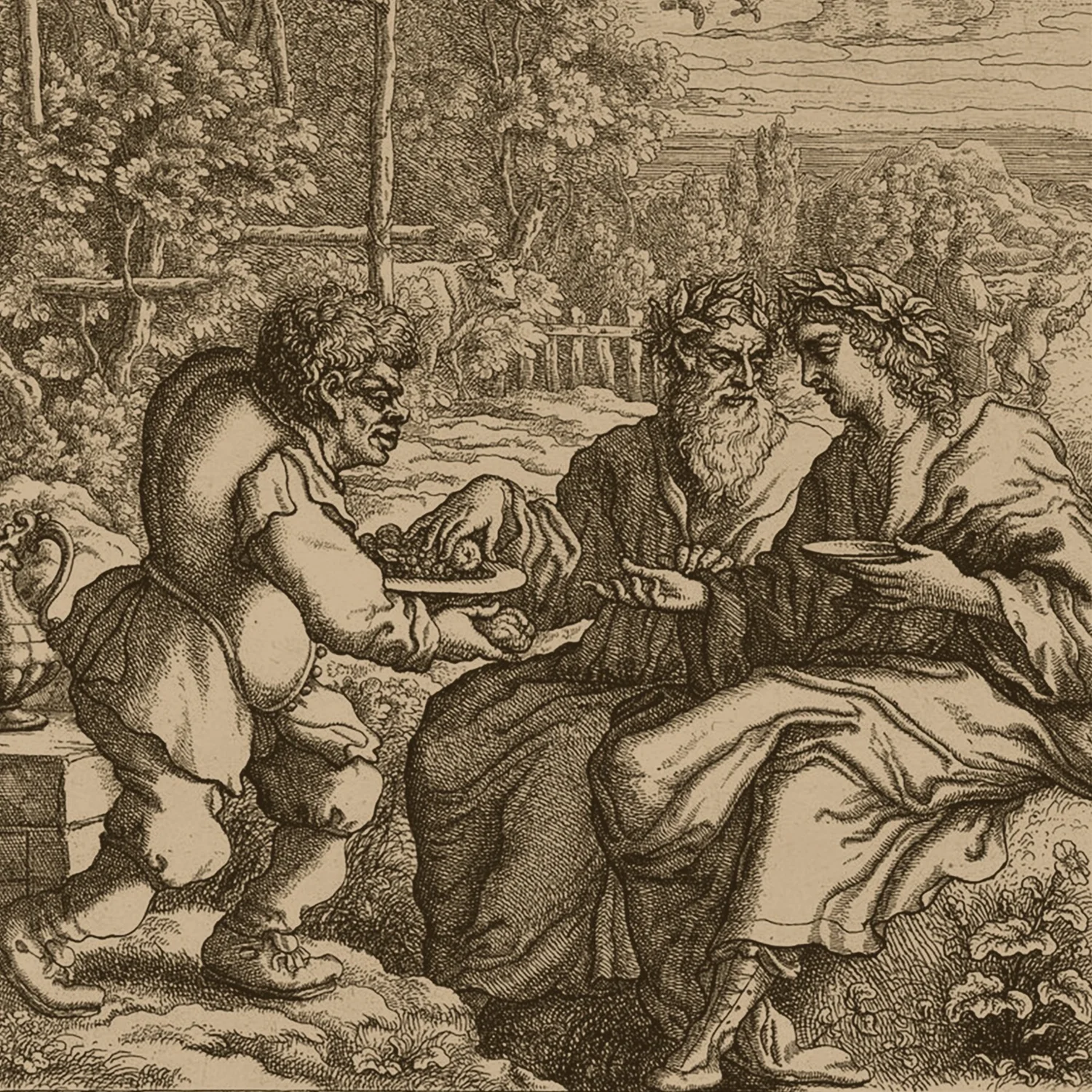
Classical Stuff You Should Know
279: Aesop's Fables
00:43:12
The good of the scorpion is not the good of the frog, yes?
Loading summary
Transcript347 lines
- [00:11]
Graham Donaldson
Hi, and welcome to Classical Stuff. You should know. A podcast about the classical world. Old books, ancient literature, philosophy, Christian classical education put on by three dudes.
- [00:25]
A.J. Hanneberg
One of our listeners described the anxiety they feel every time we intro these episodes.
- [00:30]
Graham Donaldson
Why anxiety? Like, we know what happens.
- [00:32]
Thomas Fletcher Magby
We know a little bit wrong, but we're gonna get to the episode.
- [00:36]
Graham Donaldson
Like, the whole point is to get to the episode so you don't need to be anxious. We're gonna get to the episode once.
- [00:41]
A.J. Hanneberg
We get past this.
- [00:42]
Graham Donaldson
Yeah, you know, like, you know, it's.
- [00:44]
Thomas Fletcher Magby
Like a family, you know, Road trip.
- [00:47]
Graham Donaldson
Yeah.
- [00:48]
A.J. Hanneberg
Okay.
- [00:48]
Thomas Fletcher Magby
Yeah, I'm gonna put everybody in the car. Someone's gonna poop in their pants. Yeah, like, we're gonna have to stop somewhere weird for a burger.
- [00:53]
A.J. Hanneberg
But it's all normal. We're gonna get.
- [00:55]
Thomas Fletcher Magby
We're gonna get to Seattle.
- [00:56]
A.J. Hanneberg
That's right.
- [00:56]
Graham Donaldson
Part of the process is just an adventure wrongly considered.
- [01:00]
A.J. Hanneberg
Wow. So is that.
- [01:01]
Thomas Fletcher Magby
Is that a Graham, isn't it?
- [01:02]
Graham Donaldson
No, it's Chesterton. Okay, thanks. So we. My name is Graham Donaldson, and I am joined with by. I can never do that. A.J. hanneberg right here. And Thomas Fletcher Magby.
- [01:15]
A.J. Hanneberg
Hi.
- [01:15]
Graham Donaldson
And dear listener, have you ever wondered if small woodland creatures could teach you about morality?
- [01:21]
A.J. Hanneberg
Wow.
- [01:22]
Graham Donaldson
If you've ever wondered about the limits of greed or the ability to evade predators, what have we got stories for you.
- [01:33]
Thomas Fletcher Magby
Cottontail?
- [01:33]
Graham Donaldson
No, we're talking about Aesop's Fables.
- [01:35]
A.J. Hanneberg
Aesop's Fables. Yeah. I'd be okay doing. We've done Peter Rabbit already. Right. So I guess we're continuing on. I say continuing. It's been months since the last episode. Well, you did this, Thomas.
- [01:46]
Graham Donaldson
Romp through the children's literature.
- [01:48]
A.J. Hanneberg
It's basically what things. Is Thomas actually reading somewhat regularly. And of course, it's books with my kids, so. So one of our favorite go tos is absolutely Aesop's Fables. Now, we have talked about Aesop before. It was like an intro to children's literature. It was a live episode here at Veritas as a part of their Paideia conference. So I think that was probably two years ago at this point, at least. So we talked a little bit about Aesop's Fables. I think we got to a point there of. Are these actually children's stories? And maybe we'll come around in that same. Maybe that'll come up today as well. Let's talk a little bit about Aesop. What do y' all know? Oh, Graham is paying very close attention to his posture because we got. Sorry, I'll Try to do my best to. I'm clearly the hunched over one. We got a comment on YouTube and now. But we don't want to say that. Right. That means that we listen to the criticism and we respond to it. Right. Thank you, Slouch, and just be your slouchy self. All right. Speaking of slouchy self, what do we know about Aesop?
- [02:52]
Graham Donaldson
He's Greek.
- [02:53]
A.J. Hanneberg
Okay.
- [02:55]
Graham Donaldson
He's one with the animals.
- [02:58]
A.J. Hanneberg
You made that part up.
- [02:59]
Thomas Fletcher Magby
Eating Rihanna?
- [03:00]
A.J. Hanneberg
Yeah, I think so. Is that. Tell me more. Yeah.
- [03:04]
Thomas Fletcher Magby
Is it ASAP Rocky?
- [03:06]
A.J. Hanneberg
Yes.
- [03:06]
Graham Donaldson
That's the squirrel, though.
- [03:07]
Thomas Fletcher Magby
Asap.
- [03:08]
A.J. Hanneberg
The squirrel. There's a squirrel named Bullwinkle. Aesop, what is happening?
- [03:13]
Thomas Fletcher Magby
I'm so lost. I think isn't A$AP Rocky dating.
- [03:19]
A.J. Hanneberg
That's what I want to do this episode about. Yep, nailed it.
- [03:21]
Graham Donaldson
Yeah, these things all work.
- [03:22]
Thomas Fletcher Magby
I'm following the trail you just went on. Cool. Gotcha.
- [03:24]
A.J. Hanneberg
I did not. Of course. Okay. So, yeah.
- [03:26]
Graham Donaldson
Were they for children, the stories? Do we know this?
- [03:29]
A.J. Hanneberg
No, I would say we don't know.
- [03:30]
Graham Donaldson
This if they weren't for children.
- [03:32]
A.J. Hanneberg
Well, the way that they've been used ever since they've existed is not for children. And I guess. Yeah, let's get a little bit on Aesop and then we'll get to how his stories have been used. So, yeah, so we get some references to this Aesop guy. He actually shows up in Herodotus. So we've covered him in. He's in book two, which is. We've done an episode on. I think we only made it three books in because the history is very long. So I'll just read this short little section about Herodotus. Maybe my eyesight is going. Yeah, okay, so we get. This is chapter 134 of Herodotus. There's a story about a king who leaves a pyramid. It's much smaller than others, but that there's this person, Iadmon, and Iadmon is the owner of Aesop. So Aesop is a slave to this person, IAdmon. It also records that Aesop went to Delphi. And then the Delphians, obeying an oracle, issued many proclamations summoning anyone who wanted it to accept compensation for the killing of Aesop. And so Aesop gets killed by. In Delphi. That's basically all we get about him. In Herodotus. He's described as someone who tells stories. He is described as dying at the hand of the Delphians. And that's about all that we get for him. This is a great question. So Herodotus does Not really go into it.
- [05:02]
Graham Donaldson
And we're sure it's the same Aesop?
- [05:04]
A.J. Hanneberg
Yeah. So mostly because of the reference to the guy who tells stories. So he was a fellow. Aesop is described as a slave and a story writer. So that is what gets him connected to the guy who writes.
- [05:20]
Thomas Fletcher Magby
So the oracle basically said, I'll pay anyone to kill you.
- [05:22]
A.J. Hanneberg
Yeah, because let me get. So the story is expanded on.
- [05:26]
Thomas Fletcher Magby
I didn't know Oracle had beef ever before.
- [05:27]
A.J. Hanneberg
Jeez, Oracle.
- [05:29]
Thomas Fletcher Magby
Oracle's hiring out assassins.
- [05:31]
A.J. Hanneberg
Yeah. Let me. Actually, I'll read the longer. So Plutarch has an.
- [05:34]
Graham Donaldson
Do it for the family.
- [05:36]
A.J. Hanneberg
Wow. This is on the delay of the divine justice. So I'm just going to read this whole. It's two paragraphs. Certainly, if those who have done wrong were themselves punished, there is no justice in chastising those who have done no wrong. For it is not right to punish even the evildoers in their own person twice for the same offense. And if the gods, in their remissness, failing to punish the guilty afterward, inflict penalties on the innocent, they do not fittingly make amends for their slow doing by unrighteous doing. Take the case of Aesop. It is said that he came hither with money furnished by Croesus. So rich man Croesus gives money to Aesop, intending to offer a magnificent sacrifice to the God of the temple and to distribute among the citizens of Delphi for Minas apiece. So give some money out to the people of Delphi. But as it is reported, having become disaffected toward the people here on account of some affront or quarrel. And he made the sacrifice. Indeed. But sent the rest of the money back to Sardis. So sent it back home, not thinking the men of Delphi worthy of the gift. They then raised against him the charge of sacrilege and put him to death by throwing him from yonder cliff.
- [06:52]
Graham Donaldson
Dang.
- [06:53]
A.J. Hanneberg
From that time, it is said that the God was angry with them and made their soil unfruitful and sent among them all kinds of strange diseases, so that they were round among the public assemblies of the Grecian cities, proclaiming with earnest entreaty that whoever would demand justice of them in behalf of Aesop should receive full satisfaction. So we're kind of piecing things together. Herodotus doesn't really go into details. So a much later account from Plutarch is that Aesop is supposed to give money to the people in Delphi. He doesn't do it. Sends the money home. Yeah. He gets into a fight with them. And so they throw him off a cliff.
- [07:27]
Graham Donaldson
Yeah. Solidifying their jerk status.
- [07:29]
A.J. Hanneberg
So point Aesop on that one, I guess.
- [07:33]
Thomas Fletcher Magby
Wow, they killed the story guy. How much of a jerk do you have? He tells children's stories.
- [07:38]
A.J. Hanneberg
Mr. Rogers. Yeah, it is. Oh, and I don't know if he was.
- [07:40]
Thomas Fletcher Magby
So that monster stole my cookies. Let's throw him off the cliff.
- [07:43]
A.J. Hanneberg
Yeah.
- [07:44]
Thomas Fletcher Magby
Killing Cookie Monster.
- [07:45]
A.J. Hanneberg
Yeah. So like, Mr. Rogers, like, really nice guy.
- [07:48]
Graham Donaldson
Presbyterian.
- [07:49]
A.J. Hanneberg
Presbyterian. And I guess I don't know, the way to the thing that is commented on for Aesop a lot is he's apparently an ugly dude. And I guess I just have to say it. So there's this other account of Aesop's life that's called the Aesop Romance, which is not in the affectionate sense, but in the adventure. Adventure sense. So it covers his life, it serves him serving under this guy Xanthus, his travels. He meets with the seven Sages, he goes to Delphi, and then he gets killed. So that's all recounted in the Aesop Romance, but there are also a number of references to he not so pretty. So he, much like us, he has a face for podcasting. Right.
- [08:34]
Graham Donaldson
And a posture for podcast.
- [08:35]
A.J. Hanneberg
And a posture for podcasting. Sorry, listener. I just want to read some of these because they're very funny. His appearance was such that no one could look upon him without laughing. He was flat nosed, hunchbacked, thick lipped, with a long belly, a head enormous and misshapen and short bandy legs.
- [08:50]
Graham Donaldson
Poor guy.
- [08:51]
A.J. Hanneberg
He was a grotesque figure, a very monster of a man with thick lips, a pot belly, huge head and a complexion. And he didn't look so good. Yeah, so poor guy. Yeah. So he's having a rough time.
- [09:02]
Thomas Fletcher Magby
He had stories going for him.
- [09:03]
A.J. Hanneberg
At least he had stories going for him. Okay, so your question was, are these children stories? There are a few ways to answer that. One actually comes from Aristotle. So it comes from the rhetoric. From his book on rhetoric. Do you all remember a reference to Aesop from?
- [09:23]
Graham Donaldson
Oh, man, I don't think so because I don't read much rhetoric. We do politics and ethics. You probably read rhetoric more.
- [09:33]
Thomas Fletcher Magby
I have not frequently. I'm not sure I've actually read the rhetoric.
- [09:35]
A.J. Hanneberg
Okay, so there's a story recounted in there. This is book two, chapter 20. They're talking about the. They're talking about fables. So there are many examples of fables. And he says, you know, there are two varieties. The illustrative this is quoting from. Is it just the rhetoric? Is it on rhetoric? What do you call it.
- [09:59]
Graham Donaldson
It's just rhetoric.
- [09:59]
A.J. Hanneberg
Rhetoric is the name of the book. So of the latter, so of fables again, there are two varieties, the illustrative parallel and the fable. And then he says, eg, the fables of Aesop or those from Libya. So Aesop gets referenced here. It's just a. It's a rhetorical tool, the fable. Then Aristotle will reference Aesop using one of his fables. So let me again, is this something he's using with children? No, this is how he's using one of his stories. So Aesop, when defending at Samos, a demagogue who is being tried for his life, related the following anecdote. A fox, while crossing a river, was driven into a ravine. Being unable to get out, she was for a long time in sore distress and a number of dog fleas clung to her skin. A hedgehog wandering about, saw her and moved with compassion, asked her if he should remove the fleas. The fox refused. And when the hedgehog asked the reason, she answered, they are already full of me and draw little blood, but if you take them away, others will come that are hungry and will drain what remains to me. You, that's the end of the story. You, in like manner, O Samians, will suffer no more harm from this man, for he is wealthy. But if you put him to death, others will come who are poor, who will steal and squander your public funds. Aristotle continues, fables are suitable for public speaking. And they have this advantage that while it is difficult to find similar things that have really happened in the past, it is easier to invent fables, for they must be invented like comparisons, if a man is capable of seizing the analogy. And this is easy if one studies philosophy. Thus, while the lessons conveyed by fables are easier to provide, the those derived from facts are more useful for deliberative oratory, because as a rule, the future resembles the past. So rhetoric is describing when to use these different tools. Right? And so here the point is that fables, you can create them, they're all made up. And so it's very easy to come up with a fable that makes the point you want to make. Now, whether it's good or not, I guess, is a separate question. But fables are a tool of rhetoric, and this is one that's being used to save someone's life. Right. So very much an adult context, right?
- [12:13]
Thomas Fletcher Magby
Yeah.
- [12:13]
Graham Donaldson
I feel like fleas don't work that.
- [12:15]
A.J. Hanneberg
Way though, that they get full on blood and you have to be like.
- [12:18]
Graham Donaldson
Well, I guess I'll just like not Lay eggs, you know, Like, I feel like they're gonna. I don't know.
- [12:22]
Thomas Fletcher Magby
And I feel like there's always room for more fleas.
- [12:24]
Graham Donaldson
Yeah.
- [12:24]
A.J. Hanneberg
You know what I mean?
- [12:25]
Thomas Fletcher Magby
Like, you have to be literally covered in ticks before they take a look.
- [12:28]
A.J. Hanneberg
At you and be like, no, no, I think that's. I mean, Aristotle gets criticized for his scientific understanding. Right.
- [12:34]
Graham Donaldson
Like, I don't know, it's just. It's one of those things where it's. He's clearly, he's making probably what is a good point.
- [12:40]
A.J. Hanneberg
Yeah.
- [12:41]
Graham Donaldson
That like, really, you know, the grass isn't always greener or this person is probably the damage he can do has been. Is. It is a known evil. And if you get rid of him, you are probably opening yourself to. To an unknown, worse evil. Yeah, that's a good argument. But I don't know if the tick.
- [12:58]
A.J. Hanneberg
Fable gets us there, but is there some. Because in your example, you could have just led with that conclusion. Right. You could have said, you know, better the enemy, you know, than. Than the one you don't know. But the grass is always greener is what you said, I think.
- [13:10]
Graham Donaldson
Oh, sorry.
- [13:10]
A.J. Hanneberg
Well, do you get something for having the story behind it?
- [13:13]
Graham Donaldson
I think you get the indirect. So the thing is, if you have closed ears and you just don't want to hear it, you. Your heart is set on trying. This guy is guilty.
- [13:22]
A.J. Hanneberg
Yep.
- [13:22]
Graham Donaldson
The story, because you don't know where it's going, isn't basically is like this indirect assault on you. So that when you are listening and just listening to the story and you get the conclusion and you kind of agree with it and then you're like, oh, this applies to this. It is a bit of a, like, you let your guard down, you let your defenses down, you let your bias down. So fables can do that kind of thing and, and those sorts of like, analogies. So the famous one being like Nathan going to King David and telling him the story, right. About the guy who the king took his sheep. And David's like, that guy's a friggin jerk. And then Nathan's like, you are that man. Yeah. So it's like that kind of thing. You can use the story to bypass the prejudice of the listener.
- [14:08]
A.J. Hanneberg
Yeah.
- [14:08]
Thomas Fletcher Magby
Then, you know, narratives are memorable. Like someone is more likely to remember the whole story with the fleas and the warthog than they are to remember.
- [14:15]
Graham Donaldson
Like, it was a fox.
- [14:17]
A.J. Hanneberg
You got the fleas, though.
- [14:18]
Thomas Fletcher Magby
Yeah, no, the warthog was the guy getting the fleas off.
- [14:20]
Graham Donaldson
Oh, it was a hedgehog.
- [14:21]
Thomas Fletcher Magby
Hedgehog.
- [14:22]
Graham Donaldson
Imagine a warthog trying to get the fleas off.
- [14:24]
Thomas Fletcher Magby
I was imagining a warthog and I.
- [14:25]
Graham Donaldson
Was like, big old tusks.
- [14:27]
Thomas Fletcher Magby
That poor fox is going to die of blood loss.
- [14:30]
Graham Donaldson
Hedgehogs get the sitting there I was.
- [14:32]
Thomas Fletcher Magby
I was about to ask a hedgehog.
- [14:34]
Graham Donaldson
With his big long nose.
- [14:35]
Thomas Fletcher Magby
Oh, that fox has so much more sense to my head.
- [14:38]
A.J. Hanneberg
Yeah.
- [14:38]
Thomas Fletcher Magby
Anyway, we remember. Well, now my point's dumb because I sound like an idiot.
- [14:41]
A.J. Hanneberg
We still remember the important part, which is the fleas, right? Yeah, but it's more memorable. That's going to stick with you longer. Well, that's what I was trying.
- [14:48]
Graham Donaldson
That's probably why we think it's for kids, because it's.
- [14:50]
A.J. Hanneberg
I think so. Well, I don't know if this is a strength or a weakness of it. Right. So what Aesop just shared there is the story piece of it. When we read the fables, they will have a moral at the end of them and I don't know if that weakens it. And that's what we'll go through a couple of. These are the morals.
- [15:06]
Graham Donaldson
Aesop's morals.
- [15:07]
A.J. Hanneberg
Yes.
- [15:08]
Graham Donaldson
As I understand it, some like wacky 17th century aristocrat.
- [15:11]
A.J. Hanneberg
Well, here's what's tough, right. And I should say I've given you an introduction of Aesop. But did Aesop actually write and or collect all of these stories? Probably not, I guess. How do we view Homer? Like Homer was a real person, but probably the work is more than just him. Right.
- [15:29]
Thomas Fletcher Magby
Well, now we see. I mean, it's kind of up in the air. For a long time they thought that Homer wasn't a real guy and it was just a collected bunch of stories from a different bunch of poets. Now they think Homer was real, but he was working with an inherited wealth of oral tradition. So he kept the stuff that worked. He was like a improvising, you know, traveling bard. So he would have remembered stuff from previous tellers and kept parts that worked and ditched parts that didn't work, which.
- [15:52]
A.J. Hanneberg
I think would be the same here, is that you end up with a bunch of stories that are repeated over and over and they're eventually collected together. But obviously publishing comes much later than these stories. Right. He's 7th century B.C. right. So these are very old stories. He's born in 620, dies 564. So these exist as oral tradition, oral stories much, much earlier than they are written down. And there are, you know, you get different collections of them. You're, you're talking somewhere in the like five to 700 stories. So like, it seems much more likely that these are collected into a grouping that gets associated with Aesop, but probably wasn't Aesop.
- [16:34]
Graham Donaldson
Yeah.
- [16:34]
A.J. Hanneberg
Right.
- [16:34]
Thomas Fletcher Magby
And there's probably some stories in there that were made up by just some random that got added in.
- [16:38]
A.J. Hanneberg
Right. Which again is totally fine. Okay, so what else?
- [16:43]
Graham Donaldson
Oh, nothing.
- [16:43]
A.J. Hanneberg
Oh, I thought you were about to say. Okay, so let's. We've got a little bit of background there. There's this dude, he gets described. These stories are used. Fables are used in the. I always like to reference this thing. You don't even actually teach this or use it. But the pro gymnus mater, like fables are a part of the speeches that are prepared. Right. Is that actually like an old training and rhetoric?
- [17:08]
Thomas Fletcher Magby
Yep.
- [17:09]
A.J. Hanneberg
And as I understand it, that al. That training also was not for children necessarily.
- [17:15]
Thomas Fletcher Magby
Or it was mostly for children.
- [17:17]
A.J. Hanneberg
Oh, really? So.
- [17:17]
Thomas Fletcher Magby
So that the. It was supposed to correspond with as you grew. So you started with something like a fable and then you'd work your way up to a defense of some sort.
- [17:25]
A.J. Hanneberg
Of law by the end of. Yeah, it's like legal, right?
- [17:26]
Thomas Fletcher Magby
Like it's not. Yeah, but that was supposed to be somewhere, you know, around thesis time. So when did they.
- [17:33]
A.J. Hanneberg
When would that be?
- [17:34]
Thomas Fletcher Magby
Well, I mean, I think. I think it's probably between like 13 and 18 when you'd actually be defending a law.
- [17:38]
A.J. Hanneberg
Yeah. So there you go. Like today, like the one that Veritas does now. That's right.
- [17:43]
Graham Donaldson
I was gonna say like, are all of our 14 year olds defending laws?
- [17:46]
Thomas Fletcher Magby
Yeah, well, it was just like a practice and it was supposed to prepare you for rhetoric. But it's supposed to start with a fable because that's kind of what you are dealing with as a child anyway.
- [17:55]
Graham Donaldson
Yeah, I mean they are legally minded when they're like arguing about the uniform policy.
- [18:00]
A.J. Hanneberg
Oh yeah, you experience that every day.
- [18:02]
Graham Donaldson
Every day.
- [18:03]
A.J. Hanneberg
Okay. Yeah. Well, let's read a couple of these fables. So I went and I asked my kids for their favorite. My youngest is one year old and doesn't have an answer because, you know, he's not really talking. So I have one from my three year old child, my five year old child. And then I asked my wife what her favorite is. So I have those three.
- [18:21]
Graham Donaldson
Before we can I ask if this is actually an Aesop fable or not. Is the Frog and the Scorpion a real Aesop fable?
- [18:28]
A.J. Hanneberg
The Frog and the scorpion?
- [18:29]
Graham Donaldson
Or is that just like an Internet joke?
- [18:32]
A.J. Hanneberg
Yeah.
- [18:33]
Graham Donaldson
Is it really an Aesop fable?
- [18:35]
A.J. Hanneberg
Scorpion and the Frog. Let me make sure this is Aesop, I don't see. Yeah, it's sometimes attributed to Aesop, although it does not appear in any collection of Aesop's fables published before the 20th century. So, no, the answer is no. But there is. So it's not an Aesop fable.
- [18:49]
Graham Donaldson
Okay, cool.
- [18:50]
A.J. Hanneberg
You want to talk about it?
- [18:51]
Graham Donaldson
No, it's just that it's the. It's the fable of like that. Well, no, we don't talk about it.
- [18:58]
A.J. Hanneberg
Okay. Though maybe I should probably start here. There are many famous Aesop's fables that people will know. The Tortoise and the Hare is probably the most famous of them. And so I was wondering this, even for your example before Graham of you can teach people this. Slow and steady wins the race. Right. You can give them that quote. I think you get something for having the fuller story of these two characters. And the hare has this advantage and then loses that advantage through their laziness. Right.
- [19:29]
Graham Donaldson
But if you were Gonna bet like 9 times out of 10, 99 times out of 100, maybe. Who are you betting on in that?
- [19:34]
A.J. Hanneberg
Yeah, the hare. Every time. Yeah.
- [19:36]
Graham Donaldson
Come on, Aesop. No wonder the Delphi's throw him off a bridge.
- [19:39]
A.J. Hanneberg
I wonder if what you think of some of the morals. That's interesting. What are other famous ones? The boy who cried wolf. Right. Liars are not believed even when they tell the truth. Right.
- [19:49]
Graham Donaldson
The mouse. No, the fox. And the lion's paw with the thorn.
- [19:53]
A.J. Hanneberg
Yeah. Taking the thorn out of the lion's paw.
- [19:55]
Graham Donaldson
No one else is there. Is there like a cow that like. No, a frog that puffs himself so big he pops.
- [20:01]
A.J. Hanneberg
Almost pops. Almost pops. It's the ox and the frog.
- [20:04]
Graham Donaldson
That's right.
- [20:06]
A.J. Hanneberg
There's this ox walking around.
- [20:08]
Graham Donaldson
That frog's like, he ain't so tough. I can puff myself. He's not so big.
- [20:12]
A.J. Hanneberg
Well, the one I'm thinking is that the ox is walking around, steps on a frog. Oh, and this is one of the mother's kids. And so the frog has to go tell the mother, hey, your son just got stepped on. And the mother goes, oh, was he this big? Puffs up. And the baby frog goes, no, no, he was even bigger than that. And the mother puffs herself up again. And then the baby frog goes, stop, you're going to explode if you do that again. The moral is something about self conceit. Self conceit leads to self destruction. I think is the. Is the something that isn't there one.
- [20:46]
Graham Donaldson
About like a fox and a cat? And the fox is like, I got a thousand ways to hide. And the cat's like all I can do is climb a tree. And then they hear a hunting party or they hear someone coming out of them and the fox has to figure out what to do. And the cat jumps up the tree and the fox gets eaten. Something like that.
- [21:02]
A.J. Hanneberg
Sounds like one fox and the cats.
- [21:05]
Graham Donaldson
I don't know.
- [21:07]
A.J. Hanneberg
Yes. Included in collections of Aesop's People. There you go. Look at you.
- [21:10]
Graham Donaldson
Let's go.
- [21:11]
A.J. Hanneberg
But that scorpion thing. There's no way. No. Also Anton the grasshopper. So kind of whether you save up or whether you are.
- [21:20]
Graham Donaldson
I'm sitting close to home these days.
- [21:22]
A.J. Hanneberg
You want to say some more? You want to got to save up some money. It is thrifty to prepare today for the wants of tomorrow. How's that? So there are many famous in this.
- [21:31]
Graham Donaldson
Economy though.
- [21:33]
A.J. Hanneberg
Many famous stories included there. But here are the ones that my family liked. And I will want to hear what you all think the morals to each of these are. So I'll read the story. I'm gonna ask you what the moral of that story is. And I guess this is a quiz show because there are three of them. So one of you.
- [21:51]
Graham Donaldson
Let's go.
- [21:52]
A.J. Hanneberg
We'll see if you all can win this one. So first one. This is my three year old's favorite story. I asked him, what's your favorite one? This is the one. A wild boar was sharpening his tusks busily against the stump of a tree when a fox happened. By now the fox was always looking for a chance to make fun of his neighbors. So he made a great show of looking anxiously about as if in fear of some hidden enemy. But the boar kept right on with his work, sharpening his tusks. Why are you doing that? Asked the fox at last with a grin. There isn't any danger that I can see. True enough, replied the boar. But when danger does come, there will not be time for such work as this. My weapons will have to be ready for use then or I shall suffer for it.
- [22:38]
Graham Donaldson
That's your three year old's favorite.
- [22:39]
A.J. Hanneberg
Ace of the table. How do you do? That's what I asked. Yeah. You're going to be stunned when you hear my six year olds. So I'm in. What is the moral of this story?
- [22:48]
Graham Donaldson
Doomsday Prepper kid.
- [22:52]
A.J. Hanneberg
That's your.
- [22:53]
Graham Donaldson
The moral is like. Yeah, like prepare today because there won't be time to prepare tomorrow. Or use the day to prepare. I don't know.
- [23:04]
Thomas Fletcher Magby
People who get mocked get eaten by zombies. Right? It's easy to make fun of something. Even the wise things.
- [23:11]
A.J. Hanneberg
Yeah. Is that your answer? Sure. Okay, tell me who you think gets this one. Preparedness for war is the best guarantee of peace. Feels like a kind of left field. 1. Right.
- [23:20]
Thomas Fletcher Magby
A little bit of a stretch.
- [23:21]
A.J. Hanneberg
A little bit of a stretch. I feel like that's a grand point, maybe. Yeah, I know. Pretty tough.
- [23:26]
Graham Donaldson
Prepare for war, mother.
- [23:28]
A.J. Hanneberg
We are prepared. We are prepared. Okay, I think that's probably a Graham point.
- [23:34]
Graham Donaldson
Yeah, let's go with that.
- [23:34]
A.J. Hanneberg
We got preparedness. Let's go. Let's go with that. Okay.
- [23:37]
Graham Donaldson
Yeah. Because Xaji was talking about making fun. There's nothing about that.
- [23:40]
A.J. Hanneberg
Yeah, yeah, there's nothing about that. I think, Graham, you've talked about before, we do get recurring characters through these stories as well. Right?
- [23:50]
Graham Donaldson
Well, this is what Chesterton talks about in his intro is like the personification of the animals is like the fox is a certain kind of creature. The, the bear, the lion is a certain kind of creature. And we have these human characteristics we ascribe onto the animals, which is, you know, sort of an interesting thing. And also Chesterton's intro to the Aesop's Fables, he also talks about the. The truthness of, like, how true these are. Like, they are observational truths about the nature of the world. And. And anybody can read these things and be like, yes, I get it. Even if, like, even if you took that to a. To a place on earth that didn't have foxes or bear or boars and you just sort of described it like there would be. They. They would sort of unders. They could still understand the. The, you know, the truthness of the. Of the fable.
- [24:41]
A.J. Hanneberg
Yeah, yep. I like that. But I get this is a question I have, and it relates to something. So our first example, we were kind of picking apart because this fox, this hedgehog, the fleas. The fleas. And maybe the story isn't correct. Right. Fleas may not actually work this way. Something I do wonder with this is, are these true?
- [25:03]
Graham Donaldson
Well, there's a lot of those fables where you're like, it seems like the moral is wagging the story. Like, the moral is. Is forcing the story.
- [25:11]
A.J. Hanneberg
Sure. I mean, it's almost what Aristotle says. Right. You can make up any story to reach the conclusion.
- [25:15]
Graham Donaldson
So I think the genius of. I think what makes a good fable is that the moral and the story sort of like, really do correspond to reality. Whereas that one about the fleas is a little bit more of a stretch because someone could just stand and say, like, matt, fleas don't work that way. Yeah, but no one's gonna stand up and say that pig's stupid. Right. Like someone could. Even if someone said, oh, pigs don't sharpen their tusks that way.
- [25:40]
A.J. Hanneberg
Right.
- [25:41]
Graham Donaldson
Well, that doesn't matter because the point is. But I don't know. I think what makes a good fable is the moral and reality correspond closely.
- [25:52]
A.J. Hanneberg
And I guess that, you know, I'm not going to sit here and read and review all 700. But you would think that the reason something is passed on and still a part of this collection.
- [26:01]
Graham Donaldson
No one's going to email and say, I want you to read and review all 700.
- [26:04]
A.J. Hanneberg
I would love that. Let's do a. A 700 part series on Aesop.
- [26:08]
Graham Donaldson
It could be like a special Patreon. Only subscriber. You pay for it.
- [26:13]
A.J. Hanneberg
How about. Yeah, you all are gonna go off and travel. Yeah.
- [26:15]
Graham Donaldson
And I'll read all 700 asaps.
- [26:18]
A.J. Hanneberg
Sounds awful.
- [26:19]
Graham Donaldson
That sounds great. We could categorize them.
- [26:21]
Thomas Fletcher Magby
You could have rank them one out of 100.
- [26:22]
A.J. Hanneberg
Yeah. Oh, a tier list for these. I actually kind of like.
- [26:25]
Graham Donaldson
Oh, S tier fables.
- [26:27]
Thomas Fletcher Magby
Oh, you could release that in a book.
- [26:29]
A.J. Hanneberg
Yeah.
- [26:30]
Thomas Fletcher Magby
Thomas Magby's S tier fables.
- [26:31]
A.J. Hanneberg
No, but the last one during COVID when I recorded. Because I did Purgatory. Do you remember this? And so I recorded my Purgatory episodes. They were solo. I published them. We got these emails about me droning on and on. So I'm not doing that again. I learned my lesson. I know about it.
- [26:43]
Graham Donaldson
I don't remember this. Covid was a crazy time.
- [26:45]
A.J. Hanneberg
Covid.
- [26:45]
Thomas Fletcher Magby
It was a crazy time.
- [26:46]
Graham Donaldson
Five years, boys.
- [26:47]
Thomas Fletcher Magby
So for the last couple of minutes, I'm sorry if I seem distracted. I tried to. I was trying to look up a fable I wrote for our pro gym nismata practice.
- [26:54]
Graham Donaldson
Did you find it?
- [26:54]
Thomas Fletcher Magby
I haven't found it. I do remember the fable, though.
- [26:56]
A.J. Hanneberg
Keep looking. I want this.
- [26:58]
Thomas Fletcher Magby
All right, all right, I'll keep looking. I just felt bad that I was kind of distracted, but I'll give it a shot.
- [27:02]
A.J. Hanneberg
Okay. And this. I misspoke earlier. That was actually my 5 year old's favorite story. For whatever. That's more of a firstborn worry, I think. That's right. So that was my five year old's favorite story. My three year old's favorite story is this one. This is the Tortoise and the eagle. A tortoise lazily basking in the sun, complained to the sea birds for her hard fate that no one would teach her to fly. An eagle hovering near heard her lamentation and demanded what reward she would give him if he would take her aloft and float her in the air. I will give you, she said, all the riches of the Red Sea. Then the eagle responds, I will teach you to fly. Then said the eagle, and taking her up in his talons, he carried her almost to the clouds, and suddenly he let her go and she fell on a lofty mountain. In the version we have, they fall into the sea. But I'm reading an open source, one that I can say in this version, cracks open, cracks open, dashing her shell to pieces. That's not like that. In the kids version we have the tortoise exclaimed in the moment, I have deserved my present fate. For what had I to do with wings and clouds who can with difficulty move about on the earth?
- [28:17]
Graham Donaldson
Doesn't the eagle come and like noshed on that turtle?
- [28:20]
A.J. Hanneberg
That's the story.
- [28:20]
Graham Donaldson
Oh, okay.
- [28:21]
A.J. Hanneberg
It ends right there. And then there is. Then the moral is the same as the one in the kids version, slightly translated differently, but okay. So that's the story. Tortoise wants to fly, gets taken up and then dropped. In the nicer version, it's into the sea and the tortoise is fine. Thank you. In this one it dies on the side of a mountain. What is the moral of this story?
- [28:39]
Graham Donaldson
Stay in your lane.
- [28:41]
A.J. Hanneberg
Stay in your lane. What's your. AJ's thinking?
- [28:48]
Graham Donaldson
Scintillating.
- [28:48]
A.J. Hanneberg
He's thinking content.
- [28:50]
Thomas Fletcher Magby
Yeah. I mean, it would just translate back to stay in your lane. I'll say Turtles shouldn't fly.
- [28:56]
A.J. Hanneberg
Turtles.
- [28:56]
Thomas Fletcher Magby
I'm gonna give Graham the point.
- [28:57]
A.J. Hanneberg
Shouldn't. Yeah. I think it is a Graham point also. Here's the moral. If men had all they wished, they would be often ruined. How's that for a moral? It's heavy stuff, right? But I think that's spot on. Right. If we got everything we wanted.
- [29:12]
Graham Donaldson
Hell is getting what you want.
- [29:13]
A.J. Hanneberg
Hell is getting what you want. That's right. So if men had all they wish, they would often be ruined. So is that metal? Is that so? Metal? Yeah. Okay, so my 3 year old is super metal.
- [29:21]
Graham Donaldson
Shattered turtle.
- [29:21]
A.J. Hanneberg
Good.
- [29:22]
Graham Donaldson
That's pretty.
- [29:22]
Thomas Fletcher Magby
Yeah.
- [29:23]
A.J. Hanneberg
All right, then the third of these. This is. This is one of the more famous ones. This is. My wife likes this one. I like this one as well. This is the town mouse and the country mouse. Do you all know this one? Uh huh. I guess this is your life, Graham, isn't it?
- [29:37]
Graham Donaldson
This is my life, yeah.
- [29:39]
A.J. Hanneberg
Now you must know that a town mouse once is a little bit longer. So here we go. Now you must know that a town mouse once upon a time went on a visit to his cousin in the country. He was rough and ready, this cousin, but he loved his town friend and made him heartily welcome. Beans and bacon, cheese and bread were all he had to offer, but he offered them freely. The town mouse rather turned up his long nose at this country fair and said, I cannot understand, cousin, how you can put up with such poor food as this. But of course, you cannot expect anything better in the country. Come you with me, and I will show you how to live. When you have been in town for a week, you will wonder how you could ever have stood a country life. No sooner said than done. The two mice set off for the town and arrived at the town mouse's residence late at night. You will want some refreshment after our long journey, said the polite town mouse, and took his friend into the grand dining room. There they found the remains of a fine feast. And soon the two mice were eating up jellies and cakes and all that was nice. Suddenly they heard growling and barking. What is that? Said the country mouse. It is only the dogs of the house, answered the other. Only? Said the country mouse. I do not like that music at my dinner. Just at that moment, the door flew open, in came two huge mastiffs, and the two mice had to scamper down and run off. Goodbye, cousin, said the country mouse. What? Going so soon? Said the other. Yes, he replied. What is the moral of that story?
- [31:15]
Graham Donaldson
Flight to the suburbs.
- [31:17]
A.J. Hanneberg
Oh, interesting. This would be like the countryside, though, right? This is more you than. This is the flight. More to you than me, you know.
- [31:24]
Graham Donaldson
Better simple fare in a peaceful house than a dangerous house for kings. There you go. That's mine.
- [31:37]
Thomas Fletcher Magby
The loves of one man don't necessarily translate to other men.
- [31:40]
A.J. Hanneberg
I like that. Graham almost had it word for word. Gosh dang it.
- [31:44]
Graham Donaldson
So I have read these.
- [31:45]
A.J. Hanneberg
Yeah.
- [31:45]
Graham Donaldson
Like, in my life.
- [31:46]
A.J. Hanneberg
Recently.
- [31:47]
Graham Donaldson
Not recently. Maybe two years ago. For the.
- [31:50]
A.J. Hanneberg
Oh, for when we did that. Yeah. Here's how this one has it. Better beans and bacon in peace than cakes and ale in fear. Yeah. I had almost the first one. Almost word for word. So better the simple things in peace than the nicer things in peace.
- [32:02]
Graham Donaldson
Thing is, it's like beans and bacon.
- [32:04]
A.J. Hanneberg
Sounds great.
- [32:05]
Graham Donaldson
It sounds awesome. It was like beans and bacon and.
- [32:07]
A.J. Hanneberg
Bacon, cheese and bread.
- [32:08]
Graham Donaldson
Oh, I mean, like, sign me up. Right. That sounds great. I mean, like, jellies and cakes are.
- [32:12]
A.J. Hanneberg
Great, but you only have so much the jelly. Not so much the cakes, though.
- [32:16]
Graham Donaldson
Cake and beer. People Reference cake and beer. As if they go together. I don't think cake and beer go together too much.
- [32:21]
A.J. Hanneberg
Right. Why would those go together too Heavy.
- [32:22]
Graham Donaldson
Talk about this. This is the thing.
- [32:24]
A.J. Hanneberg
Who's they? Tell me more about these people.
- [32:25]
Graham Donaldson
You know, they are the overlords.
- [32:26]
A.J. Hanneberg
Okay, cool. All right. Cake boss.
- [32:30]
Graham Donaldson
Cake boss. Big beer.
- [32:34]
Thomas Fletcher Magby
That's delicious.
- [32:36]
A.J. Hanneberg
I'm trying to look for some. I wanted some, like bad Aesop's Fables. Like, ones that.
- [32:41]
Graham Donaldson
There's definitely some where, like, the moral does not really correspond to the story in a way that intuitively makes sense.
- [32:47]
A.J. Hanneberg
Yeah. This one is not as much the left turn kind of moral. It's one that I see people saying is like, it's a bad moral.
- [32:53]
Graham Donaldson
But this is like, good fence make good neighbors. And you're like, I don't know what that. If you know what that means.
- [32:57]
A.J. Hanneberg
Yeah. Let's. Let me take this one. So this is one where the. It's like. Well, let me just read the story. This is the Wolf and the Lamb. A stray lamb stood drinking early one morning on the bank of a woodland stream. That very same morning, a hungry wolf came by farther up the stream, hunting for something to eat. He soon got his eyes on the lamb. As a rule, Mr. Wolf snapped up such delicious morsels without making any bones about it. But this lamb looked so very helpless and innocent that the wolf felt he ought to have some kind of excuse for taking its life. How dare you paddle around in my stream and stir up all the mud. He shouted fiercely. You deserve to be punished severely for your rashness. But, your highness, replied the trembling lamb, do not be angry. I cannot possibly muddy the water you are drinking up there. Remember, you are upstream and I am downstream. You do muddy it, retorted the wolf savagely. And besides, I have heard that you told lies about me last year. How could I have done so? Pleaded the lamb. I wasn't born until this year. If it wasn't you, it was your brother. I have no brothers. Well, then, snarled the wolf, it was someone in your family anyway. But no matter who it was, I do not intend to be talked out of my breakfast. And without more words, the wolf seized the poor lamb and carried her off to the forest. What is the moral of this lesson?
- [34:23]
Graham Donaldson
I'll let AJ Go first, because I've got to go first.
- [34:29]
Thomas Fletcher Magby
I feel like I have to phrase it right. There's no defense against determined evil.
- [34:41]
A.J. Hanneberg
Okay.
- [34:42]
Graham Donaldson
Yeah. I was thinking something similar, like. Yeah, like the guilty heart will make excuses for its own guilt.
- [34:55]
A.J. Hanneberg
I think that might still have to be Graham, let me read it. Both of your answers were very good. The tyrant can always find an excuse for his tyranny. The unjust will not listen to the reasoning of the innocent. I think yours is actually.
- [35:11]
Thomas Fletcher Magby
I got it.
- [35:12]
A.J. Hanneberg
Let's give that to aj.
- [35:13]
Graham Donaldson
His mind was talking about guilty hearts.
- [35:14]
A.J. Hanneberg
Guilty. There's none there. The tyrant can always find an excuse for his tyranny. The unjust will not listen to the reasoning of the innocent. I think that's one of the.
- [35:23]
Graham Donaldson
That's great.
- [35:24]
A.J. Hanneberg
Yeah. That's a good thing. It's not a nice lesson. Right. And that's probably what gets you into the. Are these children's stories? That's a pretty harsh thing to learn. But it's a good thing to learn. A good thing to learn. A good thing to be aware of. Right. All right. Any others that you all have in mind that you're like, this is my favorite story. Or. Graham, you said you read them recently. Are there any that stuck out to you?
- [35:53]
Graham Donaldson
Don't think so. There's usually ones where, like, I always like the Aesop fables where someone's making fun of something that the other animal has that's like, perfectly natural and incredibly useful to them. I guess. Is it Aesop's Fable, the Fox and the Hedgehog, where the fox has like a thousand ways to do something and the hedgehog just has one. You know that maybe that's what I was talking about with the cat.
- [36:14]
A.J. Hanneberg
Yeah. Let me see. It's ascribed to Aesop. Let me get you a version of that one.
- [36:22]
Graham Donaldson
Or the Porcupine. The Fox and the Porcupine. The porcupine has, like one way to defend itself and the fox has a thousand ways to defend itself.
- [36:27]
A.J. Hanneberg
Yeah, something like that. A fox swimming across a river was. Is this the right one? I don't think this is the same point you're making, though, because the point is supposed to be about knowing one thing versus lots of things, right? Yeah. The one that is Fox and the Hedgehog I see, is a fox swimming across a river. Was barely able to reach the bank where he lay bruised and exhausted from a struggle with a swift current. Soon a swarm of blood sucking flies settled on him. Oh, it's actually the same story from before. Oh, that was a fox and a hedgehog, wasn't it? That's the one that I have popping up. Is the one that he told to save that guy's life.
- [37:03]
Graham Donaldson
Yeah. Maybe I'm thinking of something different.
- [37:04]
A.J. Hanneberg
Could be.
- [37:05]
Graham Donaldson
But I like them because the mind that it takes to craft a fable is like someone who has observed human nature and the truism. So they're almost. They're almost like proverbs.
- [37:22]
A.J. Hanneberg
Yep.
- [37:24]
Graham Donaldson
How are. I guess the question I have is, like, how is a fable different than a parable? Because they're both being analogies. They're both sort of talking about. Trying to draw conclusions about something. Is there like, an easy difference to delineate between the two? Like, does Jesus speak in fables? He speaks in parables.
- [37:48]
A.J. Hanneberg
Parables are often with human characters, often within a larger religious context. Is what. But I don't have a great answer for that. A fable is a short, often fictional story, typically features animals or inanimate objects as characters, and conveys a moral lesson explicitly stated at the end. A parable, on the other hand, is a brief story that illustrates a moral or spiritual lesson, often with human characters.
- [38:12]
Graham Donaldson
So maybe like, parables are less about like a pithy little saying at the end and more about like, talking about a greater reality that like, almost defies a pithy saying.
- [38:24]
A.J. Hanneberg
I wonder if that's the, like, a reason for fables to be more associated for children.
- [38:29]
Graham Donaldson
Because they're. They're kind of these little.
- [38:31]
A.J. Hanneberg
They're easier. Right. They're just more straightforward. There's kind of one lesson to it. You're not going to sit around and like, really think about the meaning of this because it's kind of interpreted for you.
- [38:39]
Graham Donaldson
Because you can spend a lot of time thinking about the mustard seed and faith as a mustard seed and all that stuff.
- [38:45]
A.J. Hanneberg
There's a lot going on there. That's right.
- [38:46]
Graham Donaldson
Okay, cool.
- [38:48]
A.J. Hanneberg
All right. What are you going to say?
- [38:49]
Thomas Fletcher Magby
I could never find my fable. I do remember it though.
- [38:51]
A.J. Hanneberg
Let's hear it. What was it about?
- [38:53]
Graham Donaldson
We should write our own fables.
- [38:54]
Thomas Fletcher Magby
There were two salmon, Chris and Daniel. They had been friends since birth. Now that they were adolescent fish just coming up on their reproductive years, they came back to the breeding grounds where they were born. They both entered the head of the stream and swam relatively briskly for the first little bit. And then coming up against the first waterfall. Was it Daniel? Daniel and Chris. I made up two names. Was that it? Was that it?
- [39:16]
A.J. Hanneberg
I think so.
- [39:17]
Thomas Fletcher Magby
Okay, so Daniel the. The industrious fish swam his hardest and jumped that little waterfall and did really well. And he called down to his buddy Chris and said, chris, come on up. And Chris is like, eh, that seems like a lot of work. I think I'll stay here for a while. And he's like, chris, if you don't come right away, like all the Breeding will be done, and you will be lost, and you'll have no family, and you'll be alone forever. And he says, I'm not, so I'll be along in a minute. And so Daniel went on his way, and Chris came. And eventually Chris got close enough to another waterfall. And Daniel called down. He's like, hey, how's it going down there? And Chris is like, all right. I'm just taking my easy time. And Daniel's like, I'm telling you, you're not gonna make it. Like, you're gonna keep on trying, but all the breeding will be done, the eggs will be there, and you'll be alone. And then Daniel, on the next waterfall, swam his hardest and leapt his little heart out, and he was caught in the jaws of a bear, and the bear ate Daniel. And the moral of the story is that no matter how hard you work, everybody dies.
- [40:14]
A.J. Hanneberg
That's terrible. Wow.
- [40:16]
Graham Donaldson
Yeah, it's brutal.
- [40:17]
A.J. Hanneberg
So who did it better, Aesop or AJ Coyle?
- [40:19]
Thomas Fletcher Magby
D Toil away.
- [40:20]
Graham Donaldson
There you are, young mortal.
- [40:22]
Thomas Fletcher Magby
Everyone dies. I wrote that when we were doing pro gymnasmata practice with my students. And that's why I thought I could find it somewhere on my drive, but I just couldn't.
- [40:29]
A.J. Hanneberg
So you did. You used to teach that? And then.
- [40:32]
Thomas Fletcher Magby
Yeah. What I found is that, like, that's why I said it's. It's age centric, is because my kids weren't really interested in it anymore. Right. Like, it needed to be something that developed as they did, and it just was not hitting. So I like it.
- [40:44]
A.J. Hanneberg
Well, there you go. That's Aesop's Fables. Check them out. You know, as with a bunch of the old works, they're all online, and again, not only for children. I think super useful thing just to take home, to bring home the moral lessons or. I don't know if you're speaking or writing. Just kind of easy references to point to, to make certain conclusions.
- [41:08]
Graham Donaldson
Maybe we'll try to write fables in the in between.
- [41:10]
A.J. Hanneberg
There we go.
- [41:10]
Thomas Fletcher Magby
If you're looking for a fun fable, one of my favorite comedians does a great one. James Acaster. Look up the fable of the Goose and the Swan, or the Goose and the. What is it? What's the really slow animal called? Sloth. Goose and the sloth.
- [41:22]
A.J. Hanneberg
Okay.
- [41:23]
Thomas Fletcher Magby
And we'll listen to it before the in between.
- [41:25]
A.J. Hanneberg
So we can talk about it.
- [41:26]
Thomas Fletcher Magby
Yeah, we can talk about it if you want to. I like this one. I think it's clean, if I remember correctly. It's a clean little fable. He's not always clean, but I think this part is. So look it up. YouTube. That's a good one.
- [41:35]
A.J. Hanneberg
I like it.
- [41:36]
Graham Donaldson
Awesome. Well, this has been Classical Stuff. You should know. Classical Fables, you should know with Graham Thomas and AJ and you can find. Find us on Patreon where we have in between episodes, where we have monthly AMAs, where we have other sort of backlogs of episodes that never miss. Seen the light of day, don't we?
- [41:57]
A.J. Hanneberg
Some. Are you talking about the ones we've taken down or.
- [41:58]
Graham Donaldson
Or just like old talks we've been doing?
- [42:00]
A.J. Hanneberg
Oh, you do? Yeah. We have bonus things. Yes.
- [42:01]
Graham Donaldson
And we also have Twitter where I will sort of like and sometimes say stuff. We've got a website where you can also find our episodes classical stuff.net and you can email us at the guys@classical stuff.net and are we dating ourselves by.
- [42:18]
Thomas Fletcher Magby
Still calling it Twitter?
- [42:20]
A.J. Hanneberg
Doesn't everyone still call it Twitter? X. X formerly known as Twitter.
- [42:24]
Graham Donaldson
Everyone sort of says X and an apologetic and makes the same joke.
- [42:27]
A.J. Hanneberg
Yes.
- [42:27]
Graham Donaldson
Yeah, no, I will. You know what? I'm gonna call it Twitter because.
- [42:32]
Thomas Fletcher Magby
Because you know what? Screw the man.
- [42:33]
Graham Donaldson
Yes. Right.
- [42:34]
A.J. Hanneberg
Wow.
- [42:35]
Graham Donaldson
Come, come at us taking the stand. Anyway, you can find us on X at Classical Stuff and we thank you for listening and we'll catch you next week or on the secret Patreon pages.
- [42:51]
A.J. Hanneberg
That's right.
- [42:52]
Thomas Fletcher Magby
Bye.
- [43:02]
A.J. Hanneberg
Sa.