
Podcast
CMC Live - Chemistry, Manufacturing & Controls
Hosted by Meranda Parascandola, Ed Narke · EN
FDA CMC regulations and guidance simplified through examination, real life experiences and risk-based advice. This podcast hopes to educate sponsors and individuals on agency related regulatory CMC matters. We will focus on the critical CMC issues and build programs that enhance drug development. CMC topics will include Regulatory Starting Materials, API and Drug Product Process, Formulation Development, Supply Chains, Analytical Controls. Advocating and interpreting CMC Strategy, directing CMC Operations and Quality Assurance oversight in conjunction with developing CMC submission content that represents the best interests of emerging biotech. NOT INTENDED TO BE PRESCRIPTIVE ADVICE BUT RATHER INTERPRETATION THAT IS RIGHT FOR YOU. Since 2007 we have provided our partners with innovative strategies and exceptional advice intended to enhance program development, product approval, and marketing presence.
10episodes
Episodes
Newest firstAll episodes
025 - The Parenteral Drug Association & Evolution of Drug Development with Michael Carroll
Mar 12, 202100:31:51Tap to summarizeWhat We Covered00:55 – Ed, Meranda and Brian welcome today’s guest, Mike Carroll, who speaks to his background in microbiology and product development 04:28 – Mike talks about his involvement in the Parenteral Drug Association (PDA) 07:51 – Lessons Mike has learned throughout his career and expounds on the relevance of PDA technical reports 15:03 – The evolution of regulatory approvals in the pharmaceutical industry 17:34 – Mike describes the influence of the PDA today, given the pandemic 20:18 – Mike explains a typical day working in microbiology and quality control and assurance23:11 – The pressure of working in pharmaceutical drug development and final comments from Mike Tweetable Quotes“The PDA was kind of the bridge. It’s the Parenteral Drug Association – its focus is sterile injectable product. But it’s into all kinds of different things.” “The biggest things that are most frequently used in my case are the media fill, as Brian mentioned, and environmental monitoring.” “When you cite regulations from Europe, it used to be you would pull the British because they were gonna be the standard. If you could pass Brit, you could worry about anybody else at all; you were fine.”“It’s an entire system that you’re trying to get where every little thing that fits into the process has been qualified and can be depended on. From the raw materials coming in the door to the viles, to the stoppers, to the machinery, the environment, the filters, the air quality and differentials – all of that stuff fitting together.” “With drug development, you’re not having a life depend on you. You’re having tens of thousands of lives depend on you.”Relevant LinksDesign Space InPharmatics – LinkedInDesign Space InPharmatics – TwitterEdward Narke on LinkedInMichael Carroll on LinkedInPDA
Transcribe →
024 - Quality Management Systems Explained!
Mar 5, 202100:38:59Tap to summarizeWhat We Covered00:54 – Ed, Meranda and Brian welcome a special panel of guests to break down today’s topic: Quality Management Systems (QMS) Explained! 07:53 – The panel expounds on the timing necessary for QMS and what role the quality manual plays 13:06 – The panel explains the Code of Federal Regulations (CFRs) 17:30 – The panel defines Phase Appropriate as it pertains to QMS23:12 – Identifying which guiding documents to follow 27:29 – The value in having an experience quality professional 31:54 – Why a quality agreement is necessary 35:32 – The panel provides final words of wisdom on Quality Systems Management Tweetable Quotes“Quality System Management provides an infrastructure for a company to ensure the quality of your drug product with patient safety in mind as its primary function.” “It helps determine and define management’s commitment to quality. Because if you don’t have senior management commitment, all could be lost.”“To begin at the beginning, when you set up your QMS, you need to start with the procedures and processes that will reduce risk and help you prepare for your submission in the long run. That would come through managing your documents.” “Guidance documents are just an opinion. And they actually say that in the documents. So, you kinda try to do a combination of everything.”“The biggest thing is that when you have somebody who’s experienced and they’ve been through various things like FDA audits or have worked with a very small company versus a very large company, they can differentiate what you really need right now.” Relevant LinksDesign Space InPharmatics – LinkedInDesign Space InPharmatics – TwitterEdward Narke on LinkedInBettina Kaplan on LinkedInSusan Fasso on LinkedInRobbi Freisem on LinkedInMaria Arakil on LinkedIn
Transcribe →
023 - A Broadway Performance Analogy for API Process Validations with Jim Mencel
Feb 26, 202100:43:53Tap to summarizeWhat We Covered00:52 – Ed, Meranda and Brian welcome back Jim Mencel who shares his extensive experience with process validation07:46 – The importance of Proven Acceptable Range (PAR) and Critical Process Parameter Program (CPP) 11:14 – The evolution of the batch documentation and the value of critical parameter studies 18:07 – Registration laws and gathering necessary stability data 20:49 – How validation material can be used for launch 24:15 – Jim speaks to the importance of writing a Protocol and having a quality supplier team 32:34 – Jim discusses timing when moving towards validation 38:02 – Jim reinforces the notion that communication is key when it comes to process validation 40:42 – Final recommendations Jim would give regarding process validation Tweetable Quotes“Validation’s very formal. Validation really, in a stage analogy, is Opening Night. This is where the critics are all present, everybody’s breathing on you, you’re gonna be in the headlines the next day and everything needs to go right. So, when you think about it in that context, the validation batches are very visible to regulatory authorities.”“Your batch record really is a document that’s going to evolve. And if you look at the batch record for even the same step of a process, what that’s going to look like when you’re in the early phases of clinical development is different from what it’s going to look like towards the end. It’s going to be much more refined.”“There is a point where the process is the process. And as inefficient as it may be, it’s what you have.” “Yes, your validation batches certainly count as launch stock as long as they pass all specs.” “When you go into validation, you’ve gotta have your suppliers identified. And quality plays a huge role in assessing your suppliers” “What it all comes down to is that preparing for the validation is something that you should be thinking about as you’re making your later clinical batches, your Phase 2 batches especially.”“When you’re in Phase Three it’s not a place to be penny-pinching. The old saying is, ‘you drive for show, you put for dough.’ When you’re validating, you’re putting for dough.” Relevant LinksDesign Space InPharmatics – LinkedInDesign Space InPharmatics – TwitterEdward Narke on LinkedInJim Mencel on LinkedIn
Transcribe →
022 - Filter Validation & How It Impacts Getting Your Product to Market with Shelli Connelly
Feb 19, 202100:32:10Tap to summarizeWhat We Covered00:51 – Ed, Meranda and Brian introduce today’s guest, Shelli Connelly, who discusses her background and speaks to some of the elements of filter validation 05:41 – Shelli talks about the process of selecting a filter and why not all filters are the same09:03 – The evolution and importance of sizing filters 11:26 – Shelli speaks to the shift to single-use disposable filters 13:05 – Qualifying a filter before validation 16:51 – Shelli explains the Bubble Point test 18:53 – Shelli expounds on everything that goes into filter validation22:57 – How to use filters in a media simulation challenge 25:07 – Shelli’s philosophy on what to include in your filter validation 28:28 – Final recommendations Shelli would give regarding filter validation Tweetable Quotes“I highly recommend reaching out to the filter vendors. They’re your best support, especially with this process.”“Most people when you start with a drug process you’re looking less than a hundred liters, knowing that your commercial back size could actually be 1500 liters. And then the question comes down to are you doing redundant filtration, are you utilizing two filters, are you utilizing one? To understand your product, I think the filter vendor can definitely still help with that.” “Normally if you’re utilizing a sterilizing filter, you definitely have to run it through some type of sterilization process.”“A Bubble Point test is related to the micron-size of your filter, meaning if you have a 0.2 or a 0.45, those bubble points are gonna be different.”“I think utilizing your filter validation in conjunction with your media fill program – whatever that may be – they have to be synced and in alignment.”Relevant LinksDesign Space InPharmatics – LinkedInDesign Space InPharmatics – TwitterEdward Narke on LinkedInShelli Connelly on LinkedIn
Transcribe →
021 - Regulatory Odd Couple with Ed Narke & Meranda Parascandola
Feb 12, 202101:00:18Tap to summarizeWhat We Covered00:51 – Meranda and Ed discuss the Regulatory Odd Couple blog series and constructing the CTD Module 3 11:54 – Ed explains the importance of building the Quality Overall Summary (QOS) and the different starting points for drug process development 19:45 – Ed and Meranda talk about characterization, the process of manufacturing drug substances/products and the importance of excipients 37:44 – Ed expounds on the analytical aspect of API and regulatory drug development 46:55 – Ed and Meranda share their thoughts on the process of packaging drug substances 49:09 – Ed and Meranda discuss the role that stability plays in development methods 53:42 – P2 Pharmaceutical Development Tweetable Quotes“If anyone’s listening and not familiar with the drug development process, the one area that’s most important is the FDA guidance.” “Characterization is, in my mind, one of the fundamentals of a product and a process and a program. If you don’t know what you’re dealing with to start, it’s hard to catalog it, make it consistently and answer questions about it.”“This is probably, in some folks’ minds, the most important. It’s the manufacturing of the drug substance and the drug product. If you don’t have a process, you don’t have a product.” “There are a few caveats to excipients. One of the things you’ll want to recognize and a question that might come up is ‘are they of human or animal origin?’ And the other big thing is ‘are they novel?’” “Any changes to anything in the program – process-wise or control-wise – late in the game could be a problem because you’re gonna have to generate additional data. There’s an unknown there. What does that change mean?” Relevant LinksDesign Space InPharmatics – LinkedInDesign Space InPharmatics – TwitterEdward Narke on LinkedInOdd Couple Series
Transcribe →
020 - Lessons Gleaned from Twenty Five Years of a Regulatory CMC Life with Ed Narke
Jan 29, 202100:48:13Tap to summarizeWhat We Covered00:54 – Meranda and Brian flip the script by introducing fellow host, Ed Narke as today’s guest01:56 – Ed speaks to his extensive background in CMC and the importance he places on building relationships based on trust11:06 – Ed expounds on his role at DSI and the impact he, Brian, Meranda and the entire DSI team are having on the CMC industry17:11 – Ed talks about his personal background and roots and the value of being adaptable and the impact COVID-19 has had on his business21:36 – Ed thanks some of the many mentors and friends who have assisted him throughout his career26:48 – Ed provides best practices and advice for operating within the CMC industry30:55 – How Ed strives to build trust in relationships37:27 – Ed shares some of his thoughts on the keys to his success40:32 – Ed answers a listener question about microbiome-based products43:31 – The value of developing powerful, positive routines45:46 – Understanding the urgency of self-improvementTweetable Quotes“I look back on my career and I kind of made a few big mistakes. For example, I went into the office of the Vice President at this company to resign. I was a kid and I was just upset about certain stupid little things. And, when I walked in there, instead of leaving the job, I made a connection with him as another lifelong mentor.” “Comparing INDs, NDAs, BLAs, I’ve always had this fascination with putting stuff together into a story.” “I hope I look back in fourteen years and say, ‘These are the best days of my life.’” “One of the things I have to remind myself every day is that life really hasn’t changed, I have.”“Everything I learned that is valuable and dicey and on the edge I learned from Dan [Torok].” “My goal, hopefully, is to grow CMC Live, make it more interactive and maybe have a live audience with questions.” “To truly build trust, I learned it’s better for my colleagues to get to know me as a person.” “Two things control the way we operate and who we are: our brains and our gut.” Relevant LinksDesign Space InPharmatics – LinkedInDesign Space InPharmatics – TwitterEdward Narke on LinkedIn
Transcribe →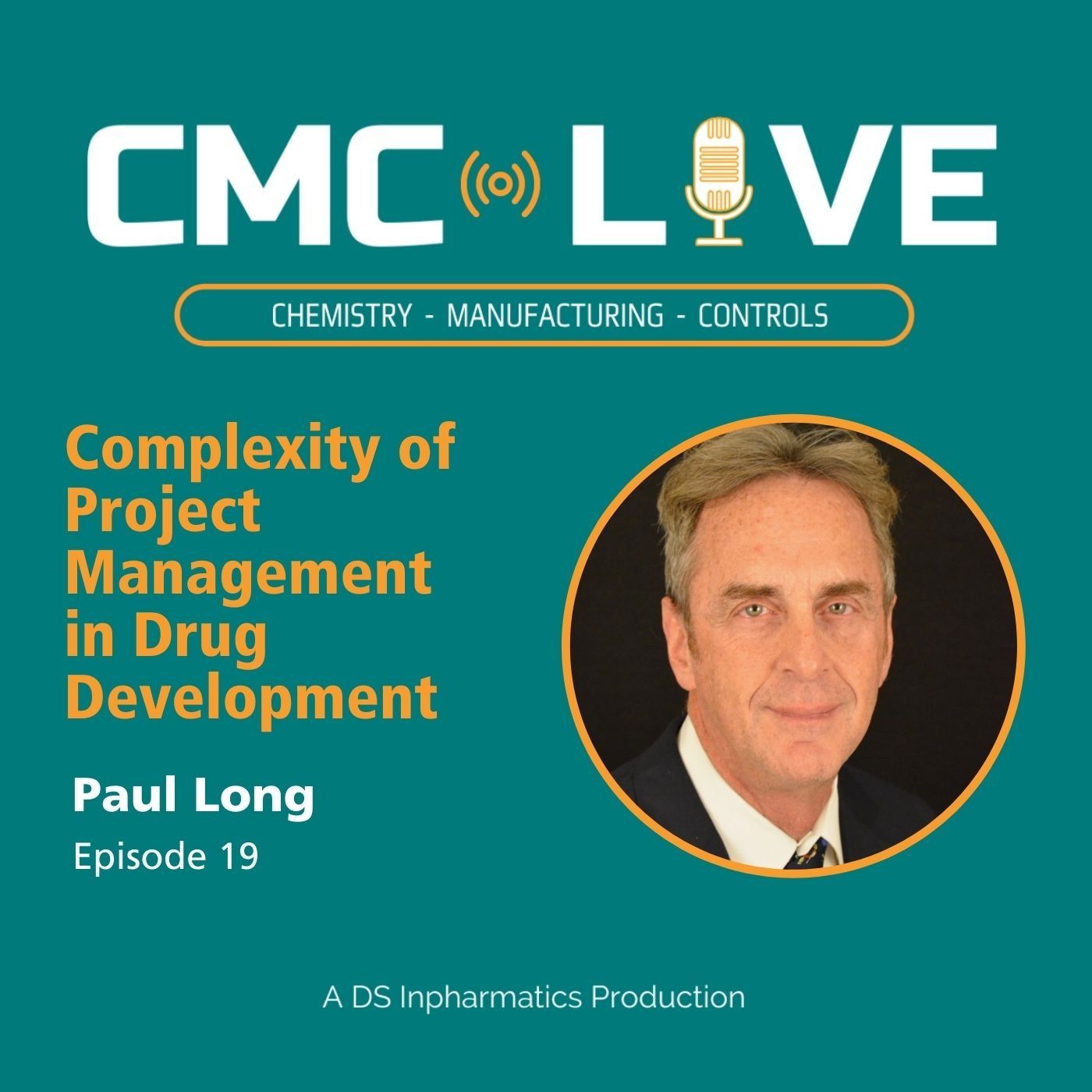
019 - Complexity of Project Management in Drug Development with Paul Long
Jan 22, 202100:43:17Tap to summarizeWhat We Covered00:55 – Ed, Brian and Meranda welcome to the show Paul Long who shares his well-rounded background as a project management consultant and speaks to some of the benefits and challenges of virtual project management17:09 – How Paul manages working with clients virtually19:08 – Tools Paul integrates in his project management process21:17 – Paul provides examples of how project management fits into drug development24:52 – Paul shares some project management tools that he utilizes, including the Gantt Chart29:35 – Paul makes a final case as to why project management is important33:41 – Paul differentiates between a project coordinator and a project manager34:28 – Ed, Brian and Meranda thank Paul for joining the showTweetable Quotes“We’re fairly comfortable with the virtual environment that allows us to be flexible in who we staff. That’s a plus. It allows us to be flexible in our time when there is a global project. That flexibility has always been there at DSI.” “It’s similar to managing the communication prior to the COVID environment. You have to establish how the person wishes to communicate, what level they wish to communicate on. So, when I meet a client, I ask them these questions directly. ‘Are you comfortable with this kind of communication? Do you want a weekly update? What’s the cadence for meetings?’” “I have to integrate our team and the client’s needs into a common goal and make sure we’re meeting that.”“The challenges haven’t changed with COVID, but our work environment has.”“Again it comes down to communication, transparency and open discussion. And that’s one of the things I try to drive as a project manager.”“Keeping the communication up avoids risk. We don’t want surprises, unless they’re good.” Relevant LinksDesign Space InPharmatics – LinkedInDesign Space InPharmatics – TwitterEdward Narke on LinkedInPaul Long on LinkedIn
Transcribe →
018 - 2020: A Year in Review with Ed Narke, Brian Lihou & Meranda Parascandola
Jan 8, 202100:52:38Tap to summarizeWhat We Covered00:43 – Ed, Brian and Meranda introduce today’s 2020 Year-In-Review show and look back on learnings from Jim Mencel, Dave Adams and Daniel Torok10:11 – Ed, Brian and Meranda reflect back on their conversations with Rick Offerman, Les Mintzmyer and Dave Blasingame19:06 – Ed, Brian and Meranda talk about a recent panel discussion they held with other CMC experts21:00 – Ed, Brian and Meranda recap episodes featuring Kyriakos Michailaros, Bettina Kaplan and Colman Byrne31:06 – Ed, Brian and Meranda highlight a very special external guest, Hedley Rees who spoke with them about how to create a value chain37:39 – Ed, Brian and Meranda speak to their discussions with Judy Magruder and Catherine Bernard43:05 – Ed, Brian and Meranda wrap up this 2020 Year-In-Review, thank the listeners for their support in 2020 and look forward to what 2021 has in storeTweetable Quotes“One of the things that resonated with me on that particular podcast was how Dave [Adams] took a step back and said, ‘You really can’t underestimate the importance of the skilled technicians that actually run the process.’” “The reality is they still need that person-in-plant. So, I think what Dan [Torok] brings to the table is what a lot of clients look for. Some clients don’t have that infrastructure and they blindly trust the CMO – and sometimes not always to the right result.” “I think people are now realizing that they do need to take a lot of different factors into consideration when selecting their CMO and they might need that assistance from experts like us.”“If you know that you have properly identified and characterized the development history of your product, and its pitfalls, and its areas of concern – and you’ve explored those – it really makes for a much more robust filing that stands up to scrutiny.” “We had a special external guest, Hedley Rees, who talked a bit about supply chain and how to create a value chain.” “Our job as regulatory reviewers, strategists, authors, CMC experts, is to decipher what the data is saying.” “I think that’s the experience that Judy brought to bear is that holistic approach to a client’s program.” Relevant LinksDesign Space InPharmatics – LinkedInDesign Space InPharmatics – TwitterEdward Narke on LinkedInBrian Lihou on LinkedInMeranda Parascandola on LinkedInTaming the Big Pharma MonsterzcTR6b8N5mnoOKtALIZa
Transcribe →
017 - 4 Experts, 120+ Years of Drug Substance Experience: Major Trends You Should Know
Dec 4, 202000:34:30Tap to summarizeWhat We Covered01:03 – Ed, Brian and Meranda welcome to the show a panel of drug substance services experts, Daniel Torok, Dave Adams, Jim Mencel and David Blasingame who speak to trends they’ve observed in the landscape of API manufacturing 07:04 – The panel speaks to the types of drug manufacturing requests they’ve been seeing 14:42 – The panel expresses their shared concerns over the diminishing number of API manufacturing professionals in the United States 23:53 – The panel provides their thoughts on the immediate future of API manufacturing 30:04 – The panel discusses the current state of regulation 33:15 – Ed, Brian and Meranda thank the panel for joining the showTweetable Quotes“We’re certainly seeing a very rapid change in the API/CMO world. I think if you went out with an RFP maybe two years ago and you threw this RFP out to eight vendors, you’d have eight proposals back fairly rapidly.” “I don’t know how many of you guys have been involved in plant build outs and plant qualifications. It is not a slam dunk, especially when you’re trying to retrofit an existing site.” “The number of people in the U.S. who have manufacturing backgrounds in small molecules is just small and diminishing rapidly because all the jobs have been offshored.” “Good operators are worth their weight in gold.” “I think what has to happen [in the future of API manufacturing in the U.S.] is that the industry has to know that the demand is there.”Relevant LinksDesign Space InPharmatics – LinkedInDesign Space InPharmatics – TwitterEdward Narke on LinkedInDaniel Torok on LinkedInDavid Adams on LinkedInJim Mencel on LinkedInDavid Blasingame on LinkedIn
Transcribe →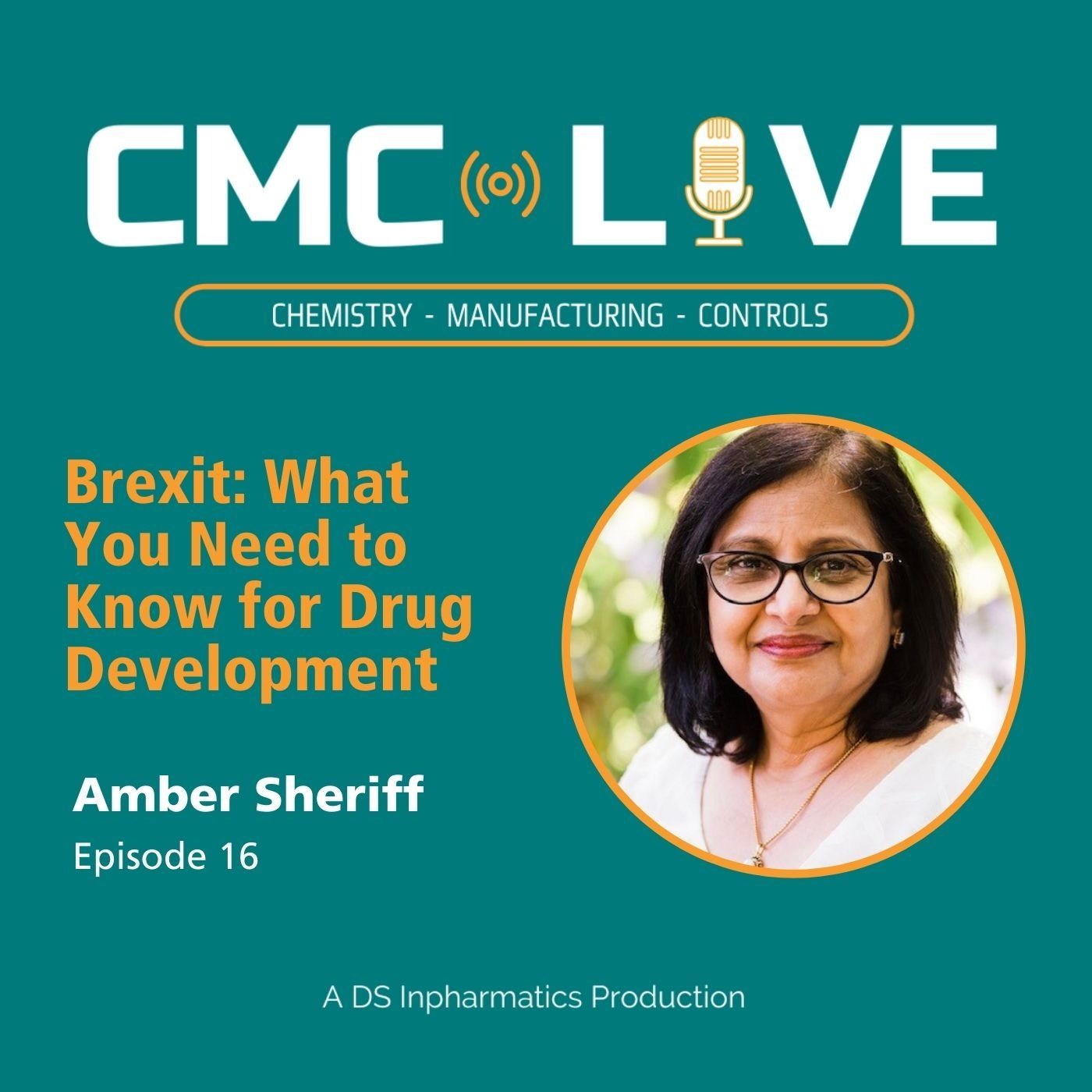
016 - Brexit: What You Need to Know for Drug Development
Nov 20, 202000:32:41Tap to summarizeWhat We Covered00:54 – Ed, Brian and Meranda welcome to the show Amber Sheriff who speaks to her background as a regulatory affairs specialist in the pharmaceutical industry and the three procedures for obtaining market authorization in the European Union06:15 – What CMC drug development looks like in the EU and how it differs from the United States11:24 – Amber breaks down specifics of the centralized filing procedure in the EU15:49 – Amber provides insights on the impact of Brexit on CMC filing in the EU18:40 – Benefits and advantages of a decentralized or mutual recognition procedure23:28 – Amber speculates on the future of drug regulation, including collaborations between the FDA and the EU27:57 – Finals thoughts from Amber31:28 – Ed, Brian and Meranda thank Amber for joining the showTweetable Quotes“In principle, there are three procedures for obtaining market authorization in EU. One is the mutual recognition procedure. The second one is the decentralized. And then the third one is the centralized procedure.” “If you get an approval in Europe, there are testings that you have to do for EU.” “Effective planning is the key. Because then basically you know when you’re going to get approval and you’ll know when you will be able to market.” “So, what is happening now, people who have filed in the UK can no longer sell their products in EU because UK walked away from the European Union. So now they are setting up their own procedures because, by the end of this year, they will be fully separated from the European Union.” “The mutual recognition that is between the FDA and EU, I see that as becoming more and more the norm.” “Once you get the approval [in the EU], you get it in all twenty-seven countries, including Norway, Iceland and I think Lithuania.”Relevant LinksDesign Space InPharmatics – LinkedInDesign Space InPharmatics – TwitterEdward Narke on LinkedInAmber Sheriff on LinkedIn
Transcribe →