← Collector Nation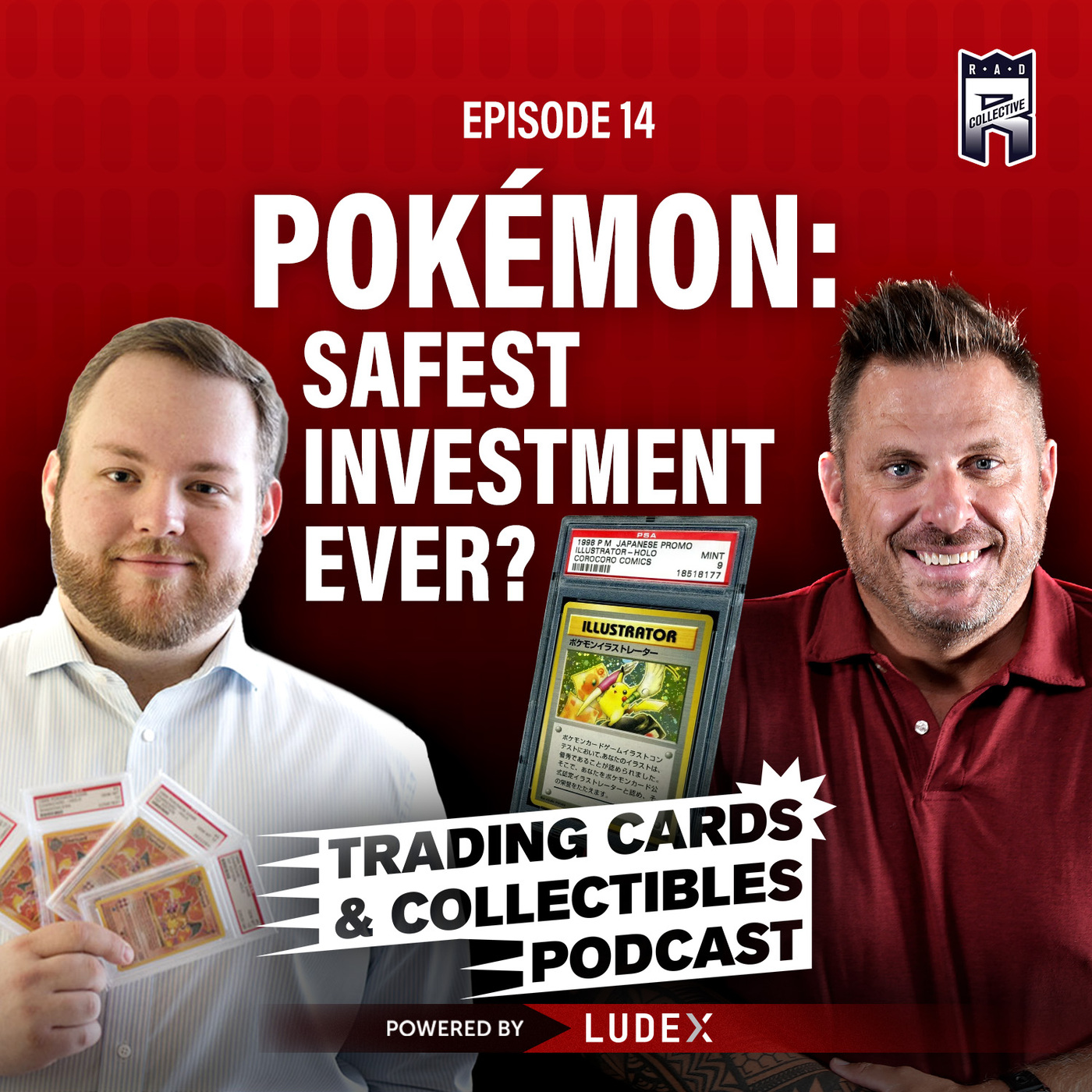
Collector Nation
Pikachu Beats Athletes: The Secret Reason Pokemon Value Crushes Sports Cards
00:39:04
Loading summary
Transcript74 lines
- [00:00]
Zach Browning
I remember my parents and everyone around me saying, you know, you should sell this stuff, man. You actually have this real value. I didn't care if the cards went to zero. I loved it because it was something I couldn't afford to do as a kid that I can do today.
- [00:10]
Podcast Announcer
Welcome to the Trading Cards and Collectibles podcast on the Radcast Network. From chasing grails to calling bluffs and going inside the hobby, are you ready to collect? Let's get at it. Here is your host, radio Ryan Alford.
- [00:29]
Ryan Alford
Hello and welcome to Trading Cards and Collectibles here on the Radcast Network. We are your top five sports show, regardless of category, already on Apple. We appreciate everyone that's listening. We appreciate everyone sending the messages, the emails. It's been really exciting getting the show off the ground. We're here, I don't know, episode 10, 11, 12. We're getting up there and we can't do it without you. And, you know, we're trying to cover the gamut here of the hobby. And there's going to be some insider details given not only from our guests, but for myself, because I have, you know, I don't want to call it like a. I don't know, a quiet interest. I'm not embarrassed in any way, but I always think of myself as like the sports guy. I did not anticipate getting into this, but I'm actually pretty into it. I'm going to tell you why here in it. That's why I go to the. To the master. I gotta get the experts for every category. We got Jim Mint Pokemon. That's his username, I guess we call it, but it's Zach Browning. What's up, Zach?
- [01:30]
Zach Browning
How's it going, man? Excited to be here. Happy to be on the Radcast. Thank you for having me.
- [01:35]
Ryan Alford
Welcome to the Radcast Network. All the best shows. But the hobby is taking off, both figuratively in the broad industry and literally here on the show. It's been exciting and I'm. Hey, I'm ready to talk and look, man, guilty pleasure, that was the word. I was kind of searching for a little bit, I have to admit. I don't right now. I don't know if we've. My boys and I, we rip a lot of packs. It's just our, our time together, you know, like it used to be. It gives. It got a little crazy four or five times a week. Now it's like one night a week. I don't know if I don't enjoy ripping a Pokemon pack more than just about anything else right now. And I. And I couldn't tell you how to play the game. I couldn't even remotely tell you how to play the game of Pokemon. But I enjoy opening the packs, and I do enjoy the artwork. I mean, I'm a artistic guy. I'm an ad agency guy, and so I appreciate the art and the thought that kind of goes into it maybe more than anything. And they're cool to open, and they don't cost $100 a pack like everything else. Clearly, I'm not alone, Zach.
- [02:37]
Zach Browning
Now, ripping Pokemon is a ton of fun. And what's crazy about Pokemon is it's so hard to get a hold of. You know, you're starting to see Pokemon at gas stations, and, you know, you go to Best Buy, Pokemon's there. You know, GameStop's now doing the PSA submissions. It's, you know, Pokemon's just everywhere, and it's almost nearly impossible to get. And the beautiful thing about Pokemon is it doesn't matter if they got a game tonight. You know, they're never going to get injured. Pikachu's always in. You know, Pikachu's never hurt. He's never going to the ir. So the beautiful thing is you can feel a lot more confident when you. When you go long Pikachu, he's going to be there for you.
- [03:09]
Ryan Alford
That's so true. Yes, he is. The names are fascinating as well. Like, everyone I open, you know, like, the thought that goes into them, I'm like, is it, you know, these real names, real words? But it's like we've combined a lot of words into them, and. But they are fun to open, and the scarcity and rarity of them. I mean, good grief. Grown men fighting on Rose at Walmart over Pokemon packs is a trip.
- [03:33]
Zach Browning
Yeah, it makes no sense. I mean, when we were kids, you know, I collected sports cards for a number of years. Then Pokemon came out as kind of the new fad. And so you have all these people who, you know, I'm in my mid-30s, that, you know, we go back to nostalgia, you know, what we loved as kids and stuff. And so. So, like, I do collect some football cards and basketball cards, but I spent more time as a kid collecting Pokemon. And so you have this odd divide of, you know, do kids today, are they going to go back and collect more football and sports or, you know, like, you see, kind of the coin collectors are kind of aging out a lot, and luckily, you know, with fanatics and a lot of stuff, they're doing, they're getting the kids back into the hobby, collecting football, sports. But Pokemon, it's just got this relentless nostalgia that just brings people back in. And so you have all these people who are getting to their mid-30s, they finally got some cash, they, where they want to spin it on, they want, they want to buy that pack they couldn't buy when they were nine years old. And so I just, I think Pokemon's in its infancy. I think it's got a long way to go and I think we're just getting started with, with the hobby.
- [04:29]
Ryan Alford
You've got all this money kind of coming in and people that aren't, haven't been in it and like investors seeing as potential asset class. And then what, what's not going to change is my gener, you know, I'm in my 40s, I have kids that are now card age. That's not gonna change. And so you've got this, I don't know, like the, the generation behind me, where they fall and when they have kids, the, the return of the nostalgia. But you know, 40 year olds for the most part put the hobby on the shelf, myself included. And it's been on the shelf for 25 years. And it, I didn't know if it would ever come back because I didn't force it on my kids. But they got into it late, I mean late for kids. I mean my 13, 14 year old didn't get into it at 8. I mean my 9 year old I guess is early or about where a lot do because of his older brothers. But my 13, 14, 15 year olds just got into it in the last year and so they brought me back into it. I was happy to get back into it, but I wasn't going to like force the issue. And I think there's a lot of us like my generation out there that collected as a kid and now the hobby's bigger, brighter, more accessible in some ways, money aside, maybe, but, but we also are at a place where I guess the most four year olds are more economically on better economic footing than they were in their 20s and 30s. So you can sort of afford the increase. And I think it's like this magical 10 year period with all that going on. Now I can't speak to the generation behind me, maybe it'll be the same thing, but I think maybe the generation behind me was already when, in when the uptick started to happen. So they've been collecting but I think there's this, I don't know, 42 to 52 year olds that have kids now that are collecting and you've got this magical. That combined with the bigger money coming in. And so there's like this demographic thing combined with investment thing all hitting at once.
- [06:38]
Zach Browning
It's a whirlwind. You know, I always thought the celebrity money would be kind of like the pinnacle of the hobby. I always thought once, you know, Floyd Mayweather shows a card or Derek Jeter, I always thought that would be kind of like, like the heat. And then now I think it's like the institutional money, it's the people who want to start, you know, an ETF or a fund or, you know, they want to take experts in the hobby and say, hey, I know you're not an exper expert, but you can invest with an expert, this and that. I think that's going to be kind of the new peak. And, and the odd thing for me, like you said with kids, is kids kind of decide what they like and don't like. You don't really get to pick what the younger generation wants to do. And so they kind of define it for themselves. And there's this beautiful thing where, you know, like the 40 year olds and the kids get to collect together and you guys might like different things. And I think there's a lot of other factors like the hobby becoming more global. You know, you have like Ohtani coming in and I mean, how many people in Japan collect baseball cards because of Ohtani and Ichiro and all these guys? You know, China's just opened the world up for Pokemon cards like three or four years ago. And it's like there's a lot of money in China and a lot of it's flowing to trading cards. So I think the globalization is kind of another big catalyst as well.
- [07:48]
Ryan Alford
Yeah, 100%. That's. I think that's just starting. And not that it's new, but I think we're going to start to feel those effects in availability in certain things because there's only so much to go around if you want to keep scarcity, there's this balance of production and scarcity. Right, right, right. And if you have more global demand and more domestic demand, something's got to give. And so that'll be interesting to sort of watch. But I think there's enough factors and energy around it. I don't think this is a blip or a fad. And this isn't a completely original thought, but one I share, which is the grading aspect has certainly made it more of an asset class too, because you have some amount, the distribution like you said where it's available. I'm not scared to pick up 30 packs if they're laying there, you know, like. So I'm not going to, like, knock on one person near me doing something if I find it. But it's, it's kind of like it all. It all kind of creates the same thing. Like, you get all the scalpers or everybody else that goes and raise the store, but so then you're the one doing the rating when you go in because you're like, if I don't do it, they're not gonna have it.
- [08:57]
Zach Browning
Right, right.
- [08:58]
Ryan Alford
It sort of creates this cycle. But I don't know. I don't. And then if it's. If it was available everywhere, anywhere, it doesn't have the value.
- [09:09]
Zach Browning
It's so weird because they're printing billions and billions of cards a year. And like, you know, word recently is for this holiday season that Pokemon, I don't want to give the exact number, but that they have multiples more, you know, being printed the new sets that they did previously. So I was talking to Buddy, I was like, you know, if they're printing so much more, isn't that going to change? And he like, well, when demand is 20x, what's available? You can print 5x more. And demand still is outpacing supply. So just even with Pokemon, you know, up in the printing, like, you can't believe they're printing more today than they've ever printed in the history of Pokemon. Demand is still just so much further beyond. And you gotta think, if you're a store and you're getting distributor prices, this, you know, assume your distributor doesn't overcharge you. You get something in for 100 bucks and it's instantly worth 300. I mean, people forget trading card hobbies are thin margins. You know, people would fight and claw for 5 cents, 10 cents, 50 cents on a card. And now you got people getting 200 bucks at release per product. They get. The hobby today is nothing like it was 10 years ago. And it's, it's going to be a really difficult readjustment period whenever supply and demand do even out. But it doesn't seem like it's going to happen anytime soon.
- [10:16]
Ryan Alford
I can't fault it. I mean, I've gotten involved in it from a business standpoint. And so I'm not like, what's good for the goose is good for the gander, so to speak. But like, yeah, when my kids and I just want to go buy some packs to rip for a night, you know, it's like, if you don't plan ahead, you gotta. Gotta buy online, get it shipped to the house, because, you know, trying to catch it at retails. Good luck. Unless you get up early or, you know, I'm pretty sure they've got the schedules figured out, because around here, you know, you hit a store that, you know is supposed to get it in and, you know, I'm sorry, I'm not waiting in line. I might pay somebody to go wait in line, but I'm not waiting in line.
- [10:52]
Zach Browning
You put an air tag on the restocker.
- [10:56]
Ryan Alford
You know that. I mean, that's what's crazy, man, that, you know, that stuff's probably happening. It's. It's crazy, you know, but it's fun too, at the same time. The chase is on. Zach, talk to me, man. You know, you did the sports card thing. Still do a little bit, but a lot of set building going on. As I followed your feed and, and have been, you know, my team doing research and then hearing, you know, seeing what you're doing. What are we up to? Overall? Hobby.
- [11:20]
Zach Browning
I'm just a true collector, man. I love, love, love collecting. I love the passion for the hobby. I love just, you know, meeting friends out of shows. Isn't that building sets one at a time? And I started getting back into around 2012, you know, I'd hop on ebay and I'd buy a first edition base set Pokemon for 90 bucks in a PSA 9. And to me, it was. It was always a good deal. If it was under 100, I was paying over 100. I was getting ripped off. And then slowly, you know, you complete one set, then another set, and you keep expanding your scope. It's really important when you collect to have a defined scope so you don't go bankrupt. And I was doing that 20 bucks an hour at the time. And I remember my parents and everyone around me saying, you know, you should sell this stuff, man. You actually have this real value. You have $10,000 of cards. You should sell it. You should do something else. And I remember saying, like, you know, I didn't care if the cards went to zero. You know, I just. I loved it because it was something I couldn't afford to do as a kid that I can do today. You look back over the last 10, 15 years, and you should have sold it many, many times, but because you just had that true passion. I mean, how many people pulled a Giannis 101 and never sold it? Because they love Giannis? You know, a lot of people oh, it's $60,000 card. That could be a mortgage payment, house. They sell it, you know, and so it's one of. It was never really about the money. It was always just about the passion of the hobby. And I think I'm really, really stubborn for not selling a lot of those times. But today, you know, I still have probably 95% of those sets in the registry. And, you know, I just. I love to collect, I love to build, I love to meet friends. And my favorite part about the hobby is meeting other people with a similar mindset that I feel like a lot of Pokemon collectors were a little autistic, a little bit, you know, where maybe we chugged a little extra Tylenol as a kid. And I wake up every day and just make sure I get electric dose. So I'm right on point.
- [12:55]
Ryan Alford
There you go. I love it. Let's talk. Okay. Someone that's listening, that's not into Pokemon, but maybe they're Pokemon Curious. What's the best thing about Pokemon versus other things? And how does one sort of start to dabble in Pokemon?
- [13:17]
Zach Browning
You know, for years, I would always tell people it's important to do a ton of research and just see the markets, how everything interacts like other Hobb and that everything is related to each other. And so for Pokemon, you have the blue chip investments, which would be the first edition Charizard, you know, the Pokemon Illustrator. And then for the modern cards, it'd be like the Moonbrian and. And a couple of specific ones. And you want to see how everything relates, and you want to see how everything sort of moves in price and stuff. And if you truly just want to hop in the hobby and collect, I always say just collect what you love. Collect what appeals to the eye. Collect. You know, the tens obviously accelerate more than the nines, this and that. And the chances are that if you love a card and this and that, there are other people out there that love the same thing for similar reasons. And then if. If you truly just want to hop in as an investor and you don't really want to take risk, and you. You aren't really trying to gamble this and that, you want someone else to do it for you. There are a lot of people in the Pokemon hobby that are building sort of funds and things like that, that allow that are essentially experts that are trying to build the ETF model I mentioned earlier. So there's two ways to do it. You can do it yourself, or you can. You can find somebody else that can do it more strategically for You?
- [14:26]
Ryan Alford
Yeah. The one thing I do like compared to. And I'm definitely more of a sports guy, but I'm into Pokemon, too. Like, I know more. More than you would think.
- [14:36]
Zach Browning
Who's your favorite Pokemon?
- [14:39]
Ryan Alford
The most valuable one.
- [14:41]
Zach Browning
Just don't say Pikachu Charizard. Say Pikachu Charizard. We know you're not. True.
- [14:45]
Ryan Alford
I don't like those guys. I mean, I like them. I mean, because they're valuable if they're the right ones. But I like, typically the really artistic ones that are like, that look like they all look like pieces of art. So that's kind of an odd thing to say, but I think some of them really. The detail and dynamic colors. And, you know, I've been into the new Mega Evolution set because a little different, little vibrant. The vibrant colors being a little different. And then, I don't know, I think that the more detail and the more complex the art, the more I like it. And so I think that lends to, like, the stuff that I kind of squirrel away, even if it's like $2, you know?
- [15:24]
Zach Browning
Yeah. I mean, the new Evolution set, they did some new texturizing on the surface of the card, so you actually pull some of the bigger hits so you get a box actually presents really, really well compared to other sets. You know, they have the Gold Ex foiling at the top, too. And I think that's one of the key points when it comes to artwork that Pokemon's done really well. That if you look at the Black White era 2012, and you look at the XY area 2016, the art is very lackluster, and it's almost like, like, disappointing. And then you go up to, like, 2019, where you have tag team come out and you have Poke interacting with each other on the same team. And they are. There's more of these scenes. And then you get to today where the art for some of this stuff, like you have an artist named Canda, then you have Kamiya, and the art is, like, incredible. It's like this. This picture that you're pulling out of a card. That guy might have spent 100 hours drawing that. And you feel like you're getting actual value. Like it's almost going beyond the cards. And it's like you're almost getting more into art. And I think if Pokemon hadn't stepped up their art game the last few years, I don't think the modern market will be anywhere close to where it is today. Because like you said, you said you don't play the game. I Don't play the either. I don't know how to play Pokemon, which is kind of crazy. And I think a lot of people collecting today, I don't think a lot of them play the game either. I think they like the art, they like the collectibility, they like to gamble, they like the chase, they like going for the tens. And if the art's not cool, why do you want the card?
- [16:40]
Ryan Alford
Yeah, I agree 100%. That's what got me into it. It's like, okay. Like, the boys were kind of into it, and I was kind of looking over the shoulder. I was like, I don't get it. But then, okay, well, that's cool. Then started opening some packs and, like, you know, this got in and I'm this. I'm definitely not. I kind of joked at the beginning, you know, guilty pleasure. I don't. I don't really give a. What people think, like, about. Okay, whether I, you know, I'm not playing Pokemon. This is art, number one. I appreciate art. I'm proud of that. And I like value and investment and. And collecting things that. That increase in value or typically, at worst, stay or hover around the same area. Let's talk grading. It's an interesting topic. The standardization of, you know, what the card grade is versus, you know, a raw card. That could be truly subjective and. Or, you know, you never know what's there. You know, if you're holding a bunch of raw cards, you could argue, you know, what condition are they, what, you know, but the grading sort of sets a standard that's higher than and. And more reliable, so to speak, than not. And I think that's where the institutional money is getting more comfortable coming in, because you have that standardization. And so I think you have got a lot of variables that are going to make this. Make this sustainable and, you know, buckle up.
- [17:56]
Zach Browning
Like, we're in the Gold Rush days, man. It's like, is it early? Are we too late? But I don't know.
- [18:01]
Ryan Alford
Yeah, I'm gonna open up a can of worms a little bit. We kind of live in this PSA world. I know why. Because you've got the legacy and the history, and you got all these guys that are 50 plus. That's all they know. They all they trust, and that legacy's carried over, and they do a good job. I mean, I'm not saying they don't do a good job overall, but it's kind of a little monopolistic to me on the value side. I mean, there's other companies, obviously, and in Pokemon You've got CGC and, like, you've got these other players. But what says you about the overall grading landscape with Pokemon?
- [18:35]
Zach Browning
I think PSA is going to be the top brand. They're going to be the go to. A lot of people Forget, you know, 10 years ago, Beckett and PSA were essentially 50. Fifty, you know, magic collectors went more Beckett. A lot of sports guys, you know, hockey guys would go more, you know, Beckett. And so really, a brand that evolved with the times. You know, they modernize. You know, they're. They're automating all their centering. When they check cards, you know, they have layers and layers of value. They add. They invest in their set registry team. You know, they have, you know, what used to be the SMR magazine. They have magazines that come out. They, you know, redid it to where it's more pop culture relevant. It's less of a traditional magazine. And so Peter said, they tell you.
- [19:13]
Ryan Alford
All this when they send you the card back. Why can't they tell you that when you get the card back? Instead of, here's your seven, here's your eight that you thought was a ten. You got no guidelines for what was used, why it didn't get it, why you got docked. I mean, it drives me crazy.
- [19:29]
Zach Browning
I know, I know. But they added greater notes as well. So if you have a higher dollar card, you know, you can check the notes. And I do think they lean a lot on the group submitters and stuff to kind of go through a lot of that process. But. But essentially what I'm saying is PSA evolved with the times. And then, you know, it opened the door for competitors like cgc, who they just started grading basically during the middle of COVID and they've graded, you know, probably 5 million cards at this point. And then you have other graders like Tag, who's kind of taken an ulterior approach and saying, hey, we want to do everything digital. You know, we want to literally use machines and stuff to grade. And so when it comes down to it, like. Like, what do we care about as collectors when it comes to grading? You know, I think if we all had 100% trust with each other and we were all experts, grading wouldn't exist. You know, but grading is that third party, that neutral person that can say, is this a nine or a ten or an eight? You know, should I give you ten grand for that ten or a thousand bucks for the nine or two hundred bucks for the eight? You know, PSA is an entity that sort of helps determine that in between Us to allow us to have that exchange. That's really the only reason they're necessary.
- [20:34]
Ryan Alford
Is that go trade in a card.
- [20:36]
Zach Browning
Yeah.
- [20:37]
Ryan Alford
They give you a report, they tell you what's wrong.
- [20:39]
Zach Browning
Right.
- [20:40]
Ryan Alford
Headlights are out. Needs a new engine. You know, anything else in life, if you're trying to get a value and someone that you trust as a third party, they're telling you, no matter if it's a dollar or a million dollars, what's wrong with it, right? And so why not just be transparent and embrace notes or whatever, you know, I got a friend named Mike Baker who was with PSA and is starting NBA, you know, and not paid by Mike. I just like what he's doing. Transparency, digital tracking of exactly what's wrong with the card. Like, you know, we need some innovation. And. Yeah, I'm not a PSA hater. I just hate the fact that you get cards back and you don't know why. Whether it's $10 or 10 million.
- [21:24]
Zach Browning
No, I agree. I think Mike, you know, he was there when PSA was founded, right? Like, he was one of the early guys. Oh, he was the first employee.
- [21:30]
Ryan Alford
Yeah, first paid employee. He was there. He was their lead grader or oversaw the grading department for 10 years. So, I mean, no one has more credibility. I mean, like, love or hate them, and I. I like them, but I'm sure there's this. This. The whole hobby's so polarizing. Everybody likes or loves or hates somebody.
- [21:47]
Zach Browning
Right.
- [21:48]
Ryan Alford
You know, and I. But I love the fact that I could look up the barcode that he puts on there, and you go there and you see. Exactly. Okay, this corner's soft. This is that. You got degrees of 9 and 10. Like, because every 9 and every 10 isn't the same. And so, I don't know. I just. It's like this lack of innovation and transparency a little bit that bothers me.
- [22:07]
Zach Browning
You want the real answer there? Mike owns his own company. He reports himself. Psa, you know, they've got a lot of investors that want a lot of money. So, yeah, that's probably the real answer there. But I love that Mike has that simple scale. You know, the black, diamond, gold, diamond, silver. You got three categories, and either you're. You're making the cut or you're not making the cut. And it's like. I love how simple that is. And putting the dual grade on top. I mean, it's like, do you put the PSA case inside of another PSA case? It's like, how many layers of grading are we going to Go, you know, are you putting the, are you putting the sleeve on top of the card? And so I, I think it's necessary.
- [22:42]
Ryan Alford
If PSA just did it right the first time.
- [22:43]
Zach Browning
I know, I know, I agree. But I think, I think we should stop it at Mike. I think after Mike, there's no more grading.
- [22:48]
Ryan Alford
Like, I agree.
- [22:49]
Zach Browning
The second layer is enough.
- [22:51]
Ryan Alford
I know, I know Pokemon, you're. You do the set building. You're building all the sets out when a new set comes out or a new edition. And this is the hardest, you know, as much as I've gotten into it. And I know, you know, full art and I know illustration, I, I go to like the, the stuff like that. But what I do struggle with is knowing, okay, black and white come out black. The names here are escaping me. But like those editions that are sub editions and then you've got mega evolutions that I do struggle with. Knowing what's part of the grander set versus a small set was just like, I can't quite keep up with that yet.
- [23:30]
Zach Browning
So I think Pokemon has done an incredible job to make it to where if you want to casually open, you can casually open. You get some hits in the box. I don't really like the EV per box. I think that's really bad. They should improve that. But they've done a job to where you could open 60 cases of a new set and not pull every card. And so they've incentivize you just if you have the ability, you know, they say anytime you offer a selection of products, you got to offer that, that rich person product, the product that's obscenely overpriced that someone's going to buy because they want to prove. And so Pokemon said if you want to rip all the, you know, 60 cases, you can, and maybe that you'll, you'll pull the whole set. So what they've really done is made it possible for anyone to build sets out of ripping packs today. And with the release schedule, with having like holiday sets and main sets and, you know, all these other things, they've really made it really difficult for that person, you know, to actually complete. But if you get back to like the core of like set building and stuff that someone doesn't want, that wants to build a set, I think the number one piece of advice I'd give someone is to be patient. Typically at release is when all the cards are going to be at their highest point, you know, for a period of time, you know, that's when all the dealers want to sell it's. When all the card shops want to sell. That's when the players that actually play the game want to put the new cards in their deck. And so you're going to have this, you know, really concentrated pricing spike in the beginning then for Pokemon, typically over the next three to six months, you'll see prices decline as things stabilize. Is that Charizard one every four packs or one in every 1200 packs? Packs, you know, you don't really know right away until you actually start pulling the packs. Because you know, things can change with, with the distribution. And so long story short, what I'd say is, you know, when I build sets, especially older sets that have been out for a while, I don't care if it takes me two or three years to build a set. There are cards today that are on eBay. For 200 bucks I could buy that, knock out a set. But I'd rather, I think they're 50 cards. And I don't mind waiting until someone auctioned one for 50 bucks because if I bought every $200 card, I'm probably reducing the scope of my collecting. It's probably not as enjoyable and I'm probably not completing as many goals. And so I think you just have to follow some core principles. Just be patient. And the thing is, the cards are going to be there. Pokemon, Print, you know, hundreds of millions of each of these cards. That new Charizard card that came out that everyone's super stoked about, I bet you there's 10 million of those out there. Like think about that. That's so many cards. Like you will get one eventually. Just, just be a little patient and don't blow your money up front.
- [25:53]
Ryan Alford
Zach, you full time collector, you gotta be doing some other things.
- [25:57]
Zach Browning
So I was actually in healthcare for about 10, 15 years on the consulting side. And then I think my passion for the hobby is just so strong. I couldn't go a day without waking up and thinking about the hobby. You know, at lunch you're thinking about the hobby, at night you're thinking about the hobby. And about two years ago I actually left healthcare and I'm full time hobby today. And so I have a, I've run a business, it's a private business called Slabzy LLC. And essentially our core business is B2B. And so I think there's a lot of B2C businesses out there that you know, retailers, live streamers that service customers. I think there's very, very few businesses that in our hobby that service other businesses. And our goal is to try to make it as easy as possible for other businesses to exist in the space. So whether we help people through wholesale inventory or whether, you know, we build different products for people or whether we build some technologies for technology solution that automates some things, our real goal is to, to make it easy for businesses to exist in our space. And we're still early, you know, we still have a long way to go. We got a good roadmap. We've got about 10 ideas. I think if we can execute on three of them, I think it'll make the hobby a better place for everyone.
- [27:06]
Ryan Alford
Hey, I love that. Hey, we have to talk some. I got the Rad Collective started which is sort of marketing and all things hobby, you know, both in and out of the hobby. You know, kind of a consultant role as well as, you know, aggregating solutions within the hobby. We should definitely have a caulk offline. The. There could be some synergies there for sure.
- [27:30]
Zach Browning
I think my goal is I want that six year old boy to walk in a card shop and have a fantastic experience. And 20 years later I want him to still be in the hobby and loving everything about it. And so anything around that, you know, that, that helps have that kid have a good experience I think is kind of sort of what we're targeting, what we're trying to do. Just, just make the hobby a more enjoyable and lively place for all ages.
- [27:52]
Ryan Alford
How would. Okay, someone's listening, they want to get into it. You've talked about set building, talked about being patient, talking about, you know, starting and you know, don't overpay if you start to get into that. What maybe let's give them like the stock advice. You know, who, what are some cards, you know, maybe new you can do like a few new and a few old. If you were buying right, and you do that, you'd be keeping your eye.
- [28:21]
Zach Browning
On, you know, when people talk about the hobby like what's going to 10x? I think there's probably 100 cards that'll 10x. I think some cards have an extremely high risk level. I think some cards have a very low risk level. And so what I'd recommend is basically the cards I think are more likely to, to go up without that risk.
- [28:37]
Ryan Alford
Risk.
- [28:38]
Zach Browning
The cards with the high risk level, you know, you could bet on them, but they could also go down too. And so for example, I think Terrastar Festival, it's a special set from, from last year. I think that's an incredible set. You know, for it's the prismatic evolutions equivalent For English, if you ever open English packs, you could rip box after box and not pull anything. For the Japanese sets, you get a hit in every single pack, you get a guaranteed, you know, big hit. You know, it could be one of the evolutions. It's loaded with hits. The box is probably 80 to 100 right now. I don't think there's world where that box is under 2 or 300 bucks in a year or two. And so it's, I think that's one of the key investments where I think the risk is really, really low compared to where the upside is. And I think if they were to reprint that set, it's so much fun to rip online. You see the whatnot streamers, ripping it left and right. Then I think if it came out at 40 bucks a box, I think it shoot back up to 80 right away. So that'd be one of the key investments. Another one would be anything Pokemon partners with with. And so if you see the collaborations like the Van Gogh Pikachu, which I think if you got into that six months ago would have been way better, you know, the entry point that you enter is, is obviously very important. I probably would not buy Van Gogh Pikachu's today. I think it's probably still going to keep going up. But I think the risk level and that's a little too high. But if you look at other cards like the Mario Pikachu, you know, where Pokemon has that brand collaboration, you know, if they were ever to come out and do something else that's similar, you know, like outside of Pokemon, the Otani, you know, one piece collaboration for that Dodger game. Yeah, that's a thousand dollar PSA ten today. I bet you that's a ten thousand dollar card someday. It's like when you have those two major ips that cross collaborate, I think that's almost like the, the blessing that this, this is, you know, gonna do well. And another thing you want to look at is you want to look at the distribution to release the items. If, and I give this advice all the time, I think it's really, really important. If something is collectible and it's distributed as collectible and everyone perceives it as collectible, a lot of times it's not really collectible, it never really goes up. But if something is distributed to the masses, where a lot of the people that get the item are not the intended target. So the people that went to that game, I bet you that 90 of them are not card collectors. But because 90 of them got that Otani card, the one piece that's going to make that thing so collectible because it's going to slowly drip into the hobby. It's slowly going to leak out. And so like those are kind of some key things. You can look at that. And I bet you if Pokemon ever did another Van Gogh collaboration, I bet you that would just be the. That would be a lock.
- [31:08]
Ryan Alford
Yeah. So then me buying up a lot of the Magic Marvel Spider man isn't such a bad idea.
- [31:17]
Zach Browning
Well, Spider Man's having a big collapse right now because people are upset the no serialized this and that. A lot of people think it was underdeveloped compared to Final Fantasy and they think the new Avatar set is a lot more development coming out later. I do think the collapse is an overreaction. I think if you're buying Spider man at four bucks a box, I think it's going to be a thousand dollar box someday. I think it's an overreaction. So it kind of goes a piece of advice that, you know, if other if everyone's going this way, maybe you should look the other way because the opportunity is going to be where everyone else isn't.
- [31:47]
Ryan Alford
It's still Marvel, it's still Spider man, and it's still, you know, magic, which is still, I think, on the rise in some ways. It still has. You know, I'm not even into it per se, but I saw it and I just bought, I bought a lot of the booster packs, you know, the, those and I'm just throwing them in the closet, you know, and 20, you know, 15 years, something tells me they're not worth less.
- [32:08]
Zach Browning
I think you're gonna feel a little pain right away and you know, maybe six months from now you look, you're like, man, why'd I buy that Spider Man?
- [32:14]
Ryan Alford
Oh, I want, I don't do that stuff that I throw in the closet, baby. It stays there. I don't, I don't even look at the value. I mean, if somebody wants to tell me like, okay, you know, like that's not worth, you know, then that's fine. But I don't go look at it. Like there's stuff, there is stuff that I do the weekly check in on, but the stuff I have to throw it in the closet to go. That feels like it ain't going down to 15 years.
- [32:34]
Zach Browning
Yeah, there's so many things in Pokemon that have like a three year cooker on them. And it's like if you wait three years, you're good. There's so many times a year, two or year two and a half. I'm like, man, why isn't this thing moving? I've had it for almost a time. And then you have something else that comes out. You see the, you know, the bright red dress walking down the street and you end up switching up your position and then it's like six months later. You're like, man, that thing tripled. I should, you know, should have held firm.
- [32:58]
Ryan Alford
So I love your closet theory, collecting version versus investing. You know, like, where's the line? Because I feel like some of the youth are getting too worried about the investing. And not that I don't, hey, I think it's great if somebody want a kid wants to hustle around and go to dollar bins and turn a dollar into three or four or five and do that a hundred times a good for you. I don't have any problem with that aspect. But it does just feels like, so transactional.
- [33:34]
Zach Browning
Yeah.
- [33:34]
Ryan Alford
At all times. Like, and it's, it's the, the beauty of like cartridge. Everything else that you talked about is okay, 40 year olds and 9 year olds having conversations and there's no air of who's older or who's wiser. It's the cards or what's on the table and whoever has, you know, whoever wants to, to. Yeah, if you want to do a deal, you can do a deal. But everybody's got knowledge at their fingertips and what do you want to happen? And I think that's great. The first thing I did when I got back into it was like, all right, okay, where's the apps? What's making this easier? You know, because, and it, and it has, some things have. So I don't think we're far enough along, but we're getting there. And, but then it's like again, walking around and, and, and, and, and the king of cards I had on the show, he made this point. I agree with him. Everyone at the card shows aren't necessarily the masses because those are the hyper into it. So I don't want to paint this whole picture, but it's just like walking around. It gets exhausting. And when I've had tables, it shows. It gets a little exhausting with every 12 year old that, that thinks of themselves as the dealer. They want 110% of retail for every card they have.
- [34:44]
Zach Browning
Right, right.
- [34:45]
Ryan Alford
You know, they want to, you know, lowball every card I have, have. And it's like, that's fine. That's the art of negotiation. I'll have it. But it's like, it's that Seems to just be more the norm than it used to be.
- [34:56]
Zach Browning
They're watching all the vendor POVs, man. They're, they're coaching them, they're teaching them. They're seeing these winners say, hey, I only traded 80%, you know, and then they give these free 20 bumps on thousand dollar deals. It's, that's, that's free money. I mean, how many times have you worked a day in your life and made less than 200 bucks? You know, it's like people are making a ton of money these days and no, you're spot on.
- [35:16]
Ryan Alford
Yeah, you gotta set it. Forget it, throw it in. Hey man, where can everybody keep up with what you're doing? I know you got a good following online, but where's the best place for everyone to follow all that Jim Mint Pokemon's up to?
- [35:28]
Zach Browning
Yeah, at Jimin on Instagram. Jim at Pokemon on Instagram. That's the best way. That's where I communicate DMS all day, every day. So reach out to me there. I'm happy to help anyone in the hobby and one of the biggest things I pride myself on is if anyone ever has any advice or questions as to that. I love helping people for free and so I, you know, people were there for me when I joined the hobby and I'm happy to give back anytime I can. So reach out and I'll help you if I can.
- [35:53]
Ryan Alford
Zach, guys like you're why the hobby is in good hands. I really appreciate you for coming on.
- [35:58]
Zach Browning
Thank you, sir. I really appreciate the opportunity.
- [36:00]
Ryan Alford
Hey guys. You're to find us Collectibles Show. You'll find links to gym, mint, Pokemon, everything. Zach's up to see where he's at in that set building. You never know, you might have a card he needs or, or need some advice. He is there and one of the good guys in the hobby, you know to find me at Ryan Alford on all the social media platforms. We'll see you next time on trading cards and collectibles. Collectibles show is where you'll find all of the channels and learn more about what we're doing and ultimately, hey, we want to hear from you. You do case hits at Collectibles Show. I want you to send in your favorite pulls of the week. And here's the difference. This isn't about just value. Hey, we want to see some ten thousand dollar hits. Had a couple of those myself a few months back. But it's not just about the value. It's about what you're collecting, what means something to you. Share a story. Share a video of you holding up the card that you hit last week that was your favorite player and you nailed it. So case hits at Collectibles Show. Send in those videos. I want to know the stories. We're going to bring them to life here on the show. We're going to do a segment each each week once we get rolling and get some videos in where we share that on the show with us. We want to feature you on Collectibles Show.
- [37:11]
Podcast Announcer
Thanks for tuning in to the show. Don't forget to follow us on your favorite podcast platform and don't miss the full video version on YouTube. You can find us at www.collectibles show or follow Ryan on Instagram at ryanoford. Now get out there and collect yours.