Loading summary
Transcript68 lines
- [00:00]
A
We're not trying to impress anyone. We're not trying to educate anyone. We are just trying to render this place more unique and more incredibly beautiful.
- [00:14]
B
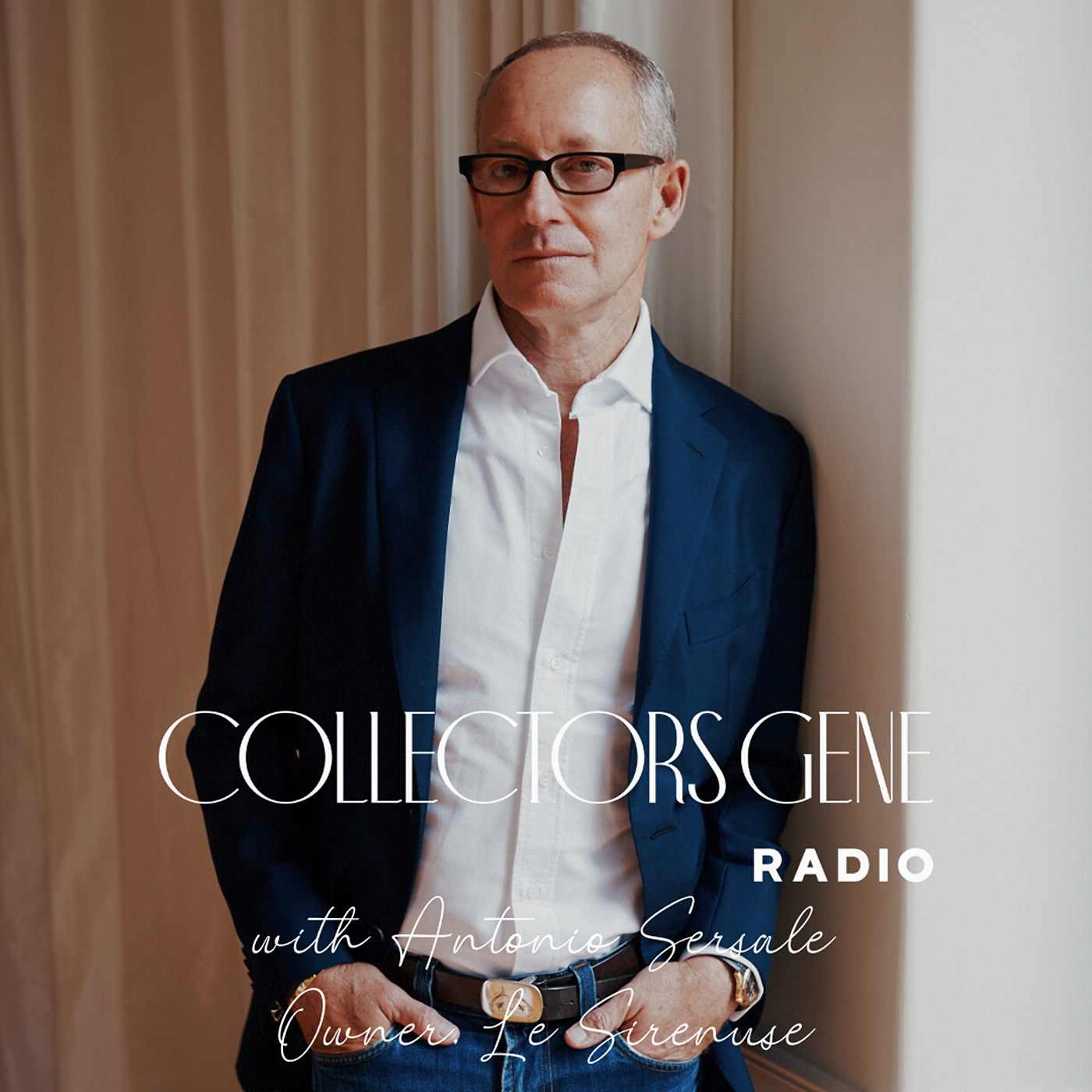
What's going on, everybody? And welcome to Collector's Gene Radio. This is all about diving into the nuances of collecting and ultimately finding out whether or not our guests have what we like to call the Collector's Gene. If you have the time, please subscribe and leave a review. It truly helps. Thanks a bunch for listening and please enjoy today's guest on Collector's Dream Radio. Today's guest is Antonio Cersale, the owner and custodian of one of the world's most beloved and sought after hotels, Le Cerrinus in Positano. Since his family transformed it from a private holiday home into a legendary destination, Antonio has carried on their legacy, curating not just a hotel, but an experience, a feeling and a sense of place unlike any other. LE s is more than a luxury retreat. It's a living collection. From its carefully chosen art and design collaborations to the meticulous attention to detail in every corner, Antonio has elevated the idea of hospitality into an art form. His passion for collecting extends beyond objects. It's about moments, traditions, and the invisible thread that connects past and present. We explore how Antonio selects artists for the Artisat Les Cyranus program, the role of contemporary art in a historically rich setting, and the personal philosophy that guides both his hotel and his own growing collection. We also discuss the delicate balance of preserving history while embracing change. The small yet significant details that make a lasting impression, and the unexpected ways collecting and hospitality intersect. Next time we do this, it will for sure be at Le Sirenus, Negroni in hand. But for now, please enjoy. This is Antonio Sersale for Collector's Gene Radio. Antonio, welcome to Collector's Gene Radio.
- [01:58]
A
It's a pleasure to be here.
- [02:00]
B
It's a pleasure to have you. And I'm such a fan of you and your family and everything that you guys have done at Le Sirenus. I mean, you, your family has transformed this property from a private holiday home into one of the most iconic hotels in the world. And today we're going to talk a lot about collecting. And in a way, that was kind of an act of collecting that you and your family did, right? You curated this experience, a sense of place and this legacy. Do you see yourself as a collector not just of art and objects, but of moments and traditions?
- [02:38]
A
Very much so. You know, I'm continuing, really a tradition that was begun by my family previously. So I'm stepping in Their footsteps. And so I definitely see myself as a collector, and at the same time, I see myself as a curator also of experiences, as you were saying, and of the guests interaction with the hotel.
- [03:05]
B
Absolutely. And Le Sirenus has long been known for its artful approach to hospitality. And Italian collectors have this reputation for discovering artists and things early in their careers. How do you decide which artists, designers and artisans to collaborate with? For the artists that list, sir, a new program, because they have to come and stay at the hotel and then create a piece of art. Is that correct?
- [03:31]
A
Yeah. So I would start by making two categories. On the one hand, you have the artisans. So there are people that are incredibly talented and they're almost artists, really. They're artists in their own field. So, like for example, the upholster from Rome who's incredible at. And he does all our furniture, but he remembers if I call him and I say, look, we have a problem in room 82, he knows exactly the. The material that is on the couch, that is on the chairs, that's on the bed, that's on the headboard. And so that's sort of an artist that I would call more of an artisan. And then there's of course, the artist that we started working with together with my curator, our curator called Silke Ritson Thomas, that's London based.
- [04:16]
B
Le Sir Nous is known for this beautiful, you know, deep red facade and your swimming pool and your bars and your restaurants. And Positano wasn't always this place that was portrayed this way. You know, it was kind of this hidden paradise. And Steinbeck did an article in 1953 and like, collecting, preserving the essence of Le Sirenus while allowing it to evolve is so key, and it's evolved so much over the years. I'm curious to know how you maintain its unique character while continuing to innovate.
- [04:52]
A
Well, the first thing is the art program we have is a very specific one because, you know, we go, for example, through a visual identity of various artists. We look at them together with my curator, and then we select one that we feel will be able to interpret the atmosphere of the place and really immerse him herself in what? Positano, the Sirenuse, the colors, the atmospheres are, and interpret that in a work of art after they've been there. And it's quite funny because my father was an enormous collector, but he didn't really have a passion for contemporary art. So when I decided before really formalizing this art program to do my first work of art for the Sirenuse, I came up with this idea of doing a video installation that I would run through the in house TV system so that I would not upset my father by installing a contemporary work of art somewhere in the hotel that would not really be to his pleasure. And then we had long conversations, one thing and another, and he sort of opened up to the idea. And then as we were doing the first installation with Martin Creed, and Martin Creed was visiting the hotel, my father was not very well. And then he sadly passed away. And I continued along those lines. So on the one hand, we have these works of art that follow one another done by artists that have been in the hotel that have looked at it. So that these works of art sort of are all site specific and they, they marry themselves to the property very, very well. You know, artists might spend one or two days just walking around the hotel to try and understand what they want to do and where they want to do. So these are very, very well integrated work. And then on the other hand also is the idea of maintaining the property, making sure that the art is well looked after, it's curated. You know, there is that side as well.
- [06:56]
B
Something that I find really interesting is you put a lot of trust into these artists, right? You expect them to come and stay with you and you know that they're talented because of what they do. But you never really know what a piece is going to turn out to be until you get it in your hands to you what makes a piece feel like it belongs in the hotel's collection because you have such an extensive collection of art there.
- [07:20]
A
I think the artists themselves feel such a desire and the responsibility of the commission that they really take it upon themselves to do something that is unique. For example, with Nicholas Partey, when we did the contract son, of course, one has to do with, with, with, you know, for an artwork as important as that. He redid our swimming pool. We had the power of one veto so he could present to us a drawing and, and we could veto it if we didn't like it. But, you know, when he presented it to us, it was just so perfect. I was practically in tears. I was so moved. And, you know, it's. It's like going to an artist and saying, add more blue. You know, you just can't do that. You just have to trust them. It's just a sense of total trust.
- [08:10]
B
Something that I find really welcoming is the way that you display art at Le Sir News. You want guests to interact with it and get close to it, but if they happen to not engage with it and Just exist within it. That's okay, too. Does this influence the way that you collect and what you choose to add to the collection with an artist?
- [08:30]
A
Well, we feel very much that we're not trying to impress anyone. We're not trying to educate anyone. We are just trying to render this place more unique and more incredibly beautiful. And so the way that the art is installed is very much a decision of the artist. So the artist definitely decides what and where. And then we sometimes have to accommodate because, for example, there might be a painting hanging where an artist wants to install his painting. So we rehang. And that, in a way, is a fun way of being forced outside of your comfort zone. For example, a painting's been there for 20 years, 30 years, and all of a sudden, along comes an artist and says, you know what? If you don't mind, I'd like to put my painting right here where that painting is. So then you have got to take that one and maybe. And that creates a whole movement, and that's part of a sort of a little growth and change and evolution of the hotel itself.
- [09:34]
B
Don't you feel that that's kind of what makes a great collector, is when you take the ego out of it and you do things and you just kind of let someone else, you know, take the reins and you put your trust into them and they create something special. And you do it for you, you do it for other people, but it's never to show off what you've done.
- [09:54]
A
Yeah, we really. And I mean, it's not easy, you know. I mean, it's really not easy because you. You grow affectionate, desperately affectionate to a certain equilibrium that you think is so perfect that it can't be touched. And yet here comes along someone that tells you, no, you have to change it. So actually, I've almost had terrible fights with myself saying, is it right? Is it not right? But in the end, I always give in. And it's very funny how, you know, we talk about it in the family, and sometimes we have almost internal arguments over it, because it's difficult to explain how traumatic it is just to move a painting when you've been looking at it for 20 years in the same space.
- [10:39]
B
Of course, I'm sure it creates not only a sense of what people expect to see, but also a certain essence and a flow and familiarity with a place that's probably the most near and dear to your heart. Out of all the properties that you have, this one's got to be the most near and dear to your heart. To you know, change up as much as you guys do.
- [11:00]
A
Absolutely. I mean, we love it and we spend, you know, we spend most of our time there. I mean, I spend around seven to eight months a year in Positano walking through the halls of the hotel. So it's a lot of time, you know.
- [11:14]
B
Yeah. Lacernews has welcomed generations of guests, you know, many of whom returned year after year. Do you ever feel like you're collecting and curating not just for your family and the hotel, but for the guests that come, too?
- [11:29]
A
Very much. Very much. Because, you know, my father always felt important for the guests to understand that we were, in a way, refined and that the establishment was refined. But, you know, this extends to many areas because, you know, you have to be just as refined with plants. I mean, we have an incredible gardener. We have a landscape architect that helps us choose the plants. We research and curate the glasses we use, which are all handmade. In Murano, the furniture is all handmade. I mean, the cloth is of the highest quality. You know, we use a combination of linen and sometimes we have some cotton. I mean, so we try and curate every single aspect because every single person have different areas that are meaningful to them. And so we want that if someone has an obsession, for example, with the quality of paper in the room, that they find the quality of paper that they expect in that establishment, if that makes sense.
- [12:35]
B
Absolutely. I mean, it's very clear to you and me that, you know, every detail matters. And that's something that your father actually taught you pretty early on. He said, there's always going to be a guest who notices if one little thing is off. I'd be curious to know an example of a typically maybe overlooked or seemingly small element that you've obsessed over to ensure perfection.
- [12:57]
A
You know, we've been working on these booklets that we do when people arrive. So we give a little booklet which is a carnet des voyage. And then someone else said to me, ah, you know what's really nice and it's very Zen, is coloring books. So then I took a few pages of this little carnet des voyage, which we have bound by this very talented paper sort of binder in the north of Italy. And so we insert. I got an artist, a little British illustrator, to do some illustrations. And so then when you walk in, we give you this carne de voyage, which has some blank papers where you can take some notes, and it has some papers with a little drawing that you can color. So we give you a little set of different colors. So these are our Details that we sort of spend hours talking about that might seem totally unimportant, but we feel is what makes the difference.
- [13:55]
B
And I'm sure it does. I mean, each. Each little detail, when you're experiencing staying at a hotel or even someone's home, every little detail matters. And I love that that's the advice your dad gave you because he was such a great collector and such a influence for you, as is, you know, a lot of people in your family. I mean, collecting. Collecting is often about repurposing something old and giving it a new life. And this hotel has been in your family for generations, and you guys have breathed this new life into it. There's a hotel boat that once belonged to your uncle, and it now takes guests on these curated experiences along the coast. And it's a beautiful example of repurposing something that, you know, has history and creates new memories, and that's such a big part of collecting. What other examples throughout the hotel have you blended past and present in this way?
- [14:45]
A
Well, for example, a very interesting thing that happened was my son Aldo, who's 32, last year, went to Japan, and when he was in Japan, he went to a music bar in Tokyo, and he came back filled with this idea that we had to do a music bar. So we had this bar that was a bit sleepy. It's mostly indoors with a small part outdoors. And it was never really nothing much happened there. And so we. We changed it. We added some onyx to the counter, we sort of jazzed it up a little bit, and then created an amazing DJ station. We got this hi Fi expert to design for us a very simple but highly refined stereo system for the bar. And so now you walk into this bar, there's a DJ that plays only vinyl records, music of the 70s, the 80s, and he's there every night, and everyone goes and has a drink after dinner. And that place now is become an enormous success. So it's also very interesting to see how, for example, I'm 63, my son is 32, how, you know, it's time that a new generation came and began innovating and bringing new ideas to the hotel so that it never really stops, so that this relay now is slowly being passed to the next generation.
- [16:16]
B
When you initially took over the hotel, I mean, it's such a special place, especially that it started out as a family home. Were there ever moments where you were maybe nervous to change something because it was original to what the home was before it turned into the hotel? Or have you always had this Progressive mindset.
- [16:34]
A
I think this. We cannot become a museum. Our sort of mission is not to be a museum, and we're not there to educate people. So we have to constantly change, not to change. Also, you've got to think that each new hotel that opens wants to raise the bar. So you have to be ready for when a hotel near you or maybe on the other side of the world opens. So you've constantly got to be changing so you can't stop thinking of how to innovate. You know, if it's from the smallest detail, can we improve on the glassware? Can we improve on. I mean, we had, for example, these commercial plates that were made by this wonderful company called Villeroy and Bosch, but they're still commercial. So now we've changed that. We've gotten. Put them to the side. And now we have these wonderful handmade plates which are made in our region with some drawings that we purchased from a British artist, Lucy Stein, that's decorating them. So here we have a plate that most people just, you know, would. Would look at and not even think about that. We probably spent two, three months designing, working on and creating for the hotel.
- [17:47]
B
Le Sir Nus has really turned into this living piece of art. Each turn, every corner, every has something collected, something with history. Even the spa was designed by Guy Alenti. Does the art ever rotate in or out, or are most pieces there to stay?
- [18:05]
A
No. So, for example, in the spa, we do photographs. So we're doing. Now we did an exhibition with a friend of ours, that's a photographer that photographed Naples after it won the Italian football cup and all the celebrations. So it was very interesting. Now we're going to do another sort of exhibition on with some portraits, both local and some that my father took in his travels. But there is a constant turnover, but very, very gentle. So, for example, when we did this bar, I went and bought some carpets. So I spent a lot of time thinking of what was the right carpet. We came up with these mats that are made in Mauritania. These are antiques. They're very, very beautiful. They're like long matchsticks that are sewn together with different patterns and that form a carpet. And because they're old, they've got this patina, this. These dark colors with these bright woven material. It's just incredibly beautiful. And they blend in very, very well. So there is a rotation, there is sort of an addition of things that slowly come in to create a constant change.
- [19:14]
B
Now, you've spent decades perfecting the art of hospitality, and surely you Visited other hotels. What elements have you collected from other experiences that you've now implemented at Le Cernus?
- [19:27]
A
Well, you know, I mean, they're often. They're technical things, but like an amazing mini bar. I mean, I went to a few hotels and I saw that there were these very beautiful minibars. So then we. We designed our own version of our minibar. I mean, in a very elegant, simple, but Chicago. And I mean, and then the way that the bed is covered, we are going to now take the bed cover that was always covering the entire bed and just folded it. I mean, different things like that. For example, I don't know that the glasses, you know, you go to a hotel and you see that they have a type of glass that you like, and you inquire. I mean, I was in Mexico and I saw these beautiful tequila cups, and I fell in love with them. And we inquired, imported a few of them. And now if you ask for a tequila shot, you get this very particular Mexican glass made of ceramic in which to drink your tequila, which is much more fun than just a regular glass. So it's little things like that that you collect over time as you travel, and then you bring back.
- [20:33]
B
I love it. Beyond the hotel, you are now building a collection for your new Milan home. How do you see your personal collection evolving in comparison to what you collect for Le Cernus?
- [20:45]
A
Well, you know, it's different because I believe that you have to really surround yourself with objects and works of art that are very, very meaningful to you. And so I was very much around art when I was young, and I sort of have developed this strange instinct where I am attracted to certain works of art in almost a physical way. And so I try and bring those, collect those for our house. And strangely enough, which is wonderful, my wife and I tend to agree very much on the works.
- [21:24]
B
That's the toughest part.
- [21:25]
A
It is. But it's very interesting that we tend to agree. I mean, yes, sometimes I might have got something that it's not 100% to her liking, but it's okay. The majority she really likes.
- [21:37]
B
You mentioned that your dad was a true collector through and through. He had amazing auction records that he kept. And you inherited much of his collection. For someone who's so focused on contemporary art for Le Cernus, how did you translate that same sensibility into your private residence in Rome, where you're calling from today, with the more traditional items that he left behind?
- [21:58]
A
Well, you know, Italians have always had this ability, in a way or this passion to bring the old and the new together, and it somehow works. And, you know, it's sort of nice to walk into a house which is not monothematic. And also, you know, these are all objects again, some antique and some more recent. That had a tremendous meaning to my father. So through them, I see a connection to my father. They're not just objects or works of art that I inherited, but they are like, each one is a little piece of my father that surrounds me and in a certain way, almost like keeps me company.
- [22:43]
B
Do you look at your home as a form of personal collecting in other areas that's different from Le Sirenus? I mean, you know, when. When you're looking at a new piece of art or an artist to work with for the hotel, it's pretty focused on contemporary art. But your home is obviously so different. So is that kind of a different way for you to flex those muscles a little bit?
- [23:04]
A
Yeah. For example, you know, we love textiles, so we were recently in Turkey, and I have a passion for textiles, which come from Central Asia, mostly known as suzannis, they are silk embroideries that were done by these nomadic people that would adorn their tents and also use them as bed covers. And they were part of a dowry that a family would give when the women would marry. And they're incredibly decorative. And so we were recently. And so we bought two when we were in Istanbul. You know, we found a dealer that we. We'd known in the past, and then we went and saw what he had to offer, and we found two pieces that we loved, so we bought those, you know, so I think we love. You know, we have various passions. It's not just for contemporary art, but they all sort of seem to blend in with one another when they are brought together.
- [24:01]
B
Textiles and linens are obviously such a big part of a hotel. I mean, it's what your guests sleep in. It's the napkins that they use at a restaurant. As someone who collects textiles, did that change the way that you use textiles at the hotel?
- [24:16]
A
Well, you know, in the hotel, we have one tremendous problem, and that is sunlight. So you have to be very, very careful, because sunlight is the great killer of all textiles. So we have very few textiles hanging, and we just have them, for example, in some corridors, which they don't gather too much light, but they're not that many. We have it in some rooms where we make sure that they don't get in direct sunlight. And then also, you know, we. We spend a lot of time. Now, this year, we're just Updating the quality of the. Of the bed sheets. We had linen before, but we are finding that some people find linen a bit harsh. And so now we are moving to a very, very, very high count of. Of cotton, which is very, very soft. Also, trends change. You know, linen was the most refined thing in the. In the past, and now people are looking for a softer bed sheet. So we are going to give the option. When you come. Would you rather have linen or would you rather have, you know, a very high count of, like a poplin of a very high count cotton?
- [25:28]
B
Now, you mentioned that you collect in all sorts of different areas, right? Obviously, contemporary art, but also, you know, you love vintage and you love objects and flea markets. Is there one or the other that's more exciting to you? I mean, do you prefer uncovering vintage objects at a flea market, or do you like discovering the new work of a contemporary artist more?
- [25:50]
A
Well, they're different. When you walk through a flea market, it's always such a. Such an exciting moment. You know, my father was the great master. He would walk through a flea market and find one object, and that object was, you know, usually a very beautiful piece. You need a very good eye and you need to be highly concentrated. It's different. You know, while maybe with a new artist, you're trying to understand what he's communicating, what he or she is communicating, what they're trying to express in the painting. Do you feel a connection? You know, when you're looking at that flea market, you've really got to be, like, with your radar out and very highly focused.
- [26:33]
B
Absolutely. I want to talk about the idea of, you know, problem solving rather than perfection, because, you know, the fresco in your dining room in Rome was designed to visually correct the ceiling's imperfections. And I'd love to get your opinion on whether or not you feel great design and art is often more about problem solving rather than perfection.
- [26:57]
A
Well, I mean, something that has, I feel, a purpose that has something that it needs to do, moves away from. From the sphere of art to more of a sphere of. Of. Of. I would call it decoration. So I think that art is something unique. It's something that is created. I think it's almost like an expression of an inner thought or of an inner feeding an inner emotion that an artist has that he can sort of translate into something either visual or in a way, it can be sort of many mediums. You know, it can be music and can be writing. It can be so many different things, but I think it comes from an inner thought. So if you try and channel that into rather. I mean, if I went to someone and said, you know, I want a painting which is three by three, I want it on the theme of blue with a bit of yellow in it. I don't think that could be called a work of art anymore. Although maybe there would be an amazing artist that would be able to turn this very sort of schematic sort of frame into something really incredible.
- [28:08]
B
Yeah. Is there a place at Le Cernus that has yet to have a piece of artwork installed that you are just waiting for the right moment and the right piece of art and the right artist?
- [28:20]
A
Well, I mean, there was one. I think there are certain areas that receive more pieces. I mean, we've got a new artist that's about to do an installation around the work of another artist. So, you know, just when you think this space can take no more, another artist finds a way to insert another work of art. So people say, but don't you think there is no more space for another work of art? And I don't. I don't. Sometimes I do and sometimes I don't.
- [28:54]
B
It just takes a new perspective. Right.
- [28:56]
A
Yes.
- [28:57]
B
Antonio, let's wrap it up with the collector's gene rundown. You can answer these questions based on any of the things that you collect. So the first one is, what's the one that got away?
- [29:07]
A
The one that got away. We were thinking of doing a Daniel Buren in the hotel and then for a series of reasons, we didn't do it. And then it's now become slightly past our budget.
- [29:23]
B
How about the On Deck circle? So what's next for you in collecting? Maybe something you're hunting after?
- [29:29]
A
Well, for the moment, we're working on the next artist that we are going to have at the Syranuse, and we have a few ideas that we've talked about, but we have to take it further. And I mean, it's just. It's an ongoing process. It takes time and. But it's a very nice journey to select the right artists that we feel is. Is right for. To continue this, this collection.
- [29:56]
B
Good things take time.
- [29:58]
A
Yes, absolutely.
- [29:59]
B
How about the unobtainable? So this is one that's too expensive in a museum, a private collection, just complete Unobtainium.
- [30:06]
A
I mean, I would love to have a Rothko. I mean, I think they're so meditative, so beautiful. I saw the wonderful show that was on at the Bois de Boulogne Museum and it was just, you know, so beautiful and I mean, it would have been so, so amazing. To have even one of his early works, I mean, it was just. Is just so fantastic.
- [30:27]
B
Yeah, I feel like a lot of what Rothko did is a great culmination of maybe everything that you guys love about the contemporary art that you have at Le Cernus. I think. I think it sums up a lot of it, don't you think?
- [30:41]
A
Yes, very much so. I mean, it's so talented. This is just unbelievable. And so meditative. You look at these paintings and you just want to sit and stare for them, for them for years.
- [30:52]
B
You know, I would say it'd be good in your spa, but I don't know if the moisture would be the best idea. How about the page one rewrite? So if you could collect anything besides your current and money was no object, what would it be?
- [31:07]
A
I don't know. I'd love to have a few Picassos, for example. I don't know. I just. I. You know, it's an artist that I was. I remember seeing when I was very young, and it somehow moved me, and it's. It's stayed with me, you know, just. Just something that really moves me.
- [31:24]
B
How about the goat? Who do you look up to in the collecting world? Or who do you think is a great collector?
- [31:30]
A
I'll tell you who I think is a great collector. I think the great collector are these. These Italians that, as we were saying, go in young, have the guts to buy artists that maybe no one else is buying. I remember Rashid Johnson. I had. I met him once, and we were having a chat, and I told him I was from the south of Italy. And he said, you won't believe it, but when no one was buying my art, my shows in Naples were selling out, you know, and that's just what I love to think of. These Italian collectors that had the guts and continue to have the guts to buy these artists when no one else is looking at them. And I sometimes want to have a bit more courage in that area, but I'm sometimes a bit too conservative.
- [32:13]
B
How about the hunt or the ownership? Which one do you enjoy more?
- [32:18]
A
I think I'm very attached to objects, so I love the ownership. I love to think that an object is there and I can look at it and I can connect to it on a continuous basis, which I love.
- [32:31]
B
And most importantly, do you feel that you were born with the collector's gene?
- [32:35]
A
Absolutely.
- [32:37]
B
I love it. Thank you so much, Antonio, for coming on Collector's gene radio. I wish we could have done this with you in Positano, but I can't wait to come and visit Le Cerrinus.
- [32:45]
A
Well, I look forward to having you very soon. Thank you so much.
- [32:51]
B
All right, that does it for this episode. Thank you all for listening to Collector's gene radio.