Loading summary
Transcript78 lines
- [00:01]
A
You know, I got to this point in the fashion business where I thought there was a lot of design pollution, the overproduction of things. I mean, honestly, how many more blue jeans do we need on the planet?
- [00:12]
B
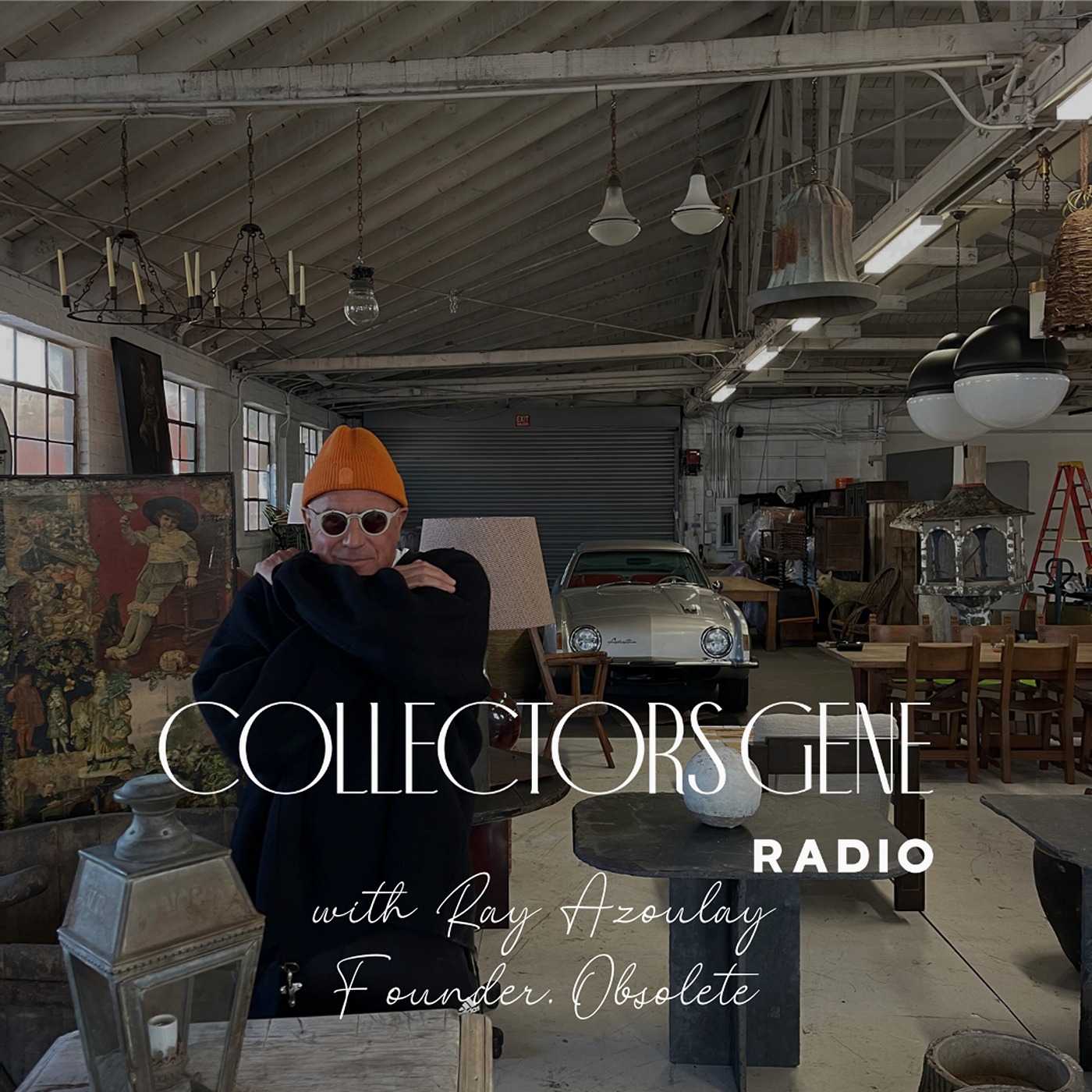
What's going on, everybody? And welcome to Collector's Jean Radio. This is all about diving into the nuances of collecting and ultimately finding out whether or not our guests have what we like to call the Collector's gene. If you have the time, please subscribe and leave a review. It truly helps. Thanks a bunch for listening and please enjoy today's guest on Collector's Dream Radio. Today I'm sitting down with Ray Azule, founder of Obsolete, one of the most well known and coveted antique stores around. Ray got a start in the fashion world, ultimately becoming a director at Macy's and Liz Claire Bourne. And to escape the city here and there, he made the decision to buy 40 acres in Bucks County, Pennsylvania, where he started collecting furniture, art and photography. Ray's always had a good eye, so he decided to take his talents to Los Angeles and open up Obsolete. Over the years, Obsolete has been a second home to a Listers like Sheryl Crow, Ellen DeGeneres, Barbra Streisand, and many more. In fact, Ellen once told Ray that his phone number was the only one she's remembered by heart. He's been featured in first dibs and many other publications showcasing not only the items that he collects and sources, but his hand picked interior design projects. But what gets Ray really excited to continue sourcing furniture in the obscure is that whether it's you, the collector, or someone in the public eye, we continue to put our trust in his taste. Oh, and he has a three digit bonsai collection, so please enjoy. This is Ray Azuleh for Collector's Dream Radio. Ray, welcome to Collector's Dream Radio.
- [01:47]
A
Great, thanks. Glad to be here.
- [01:49]
B
So I've been a fan of Obsolete, your vintage and antique furniture company for a long time. But I recently actually learned from you that you actually had a previous career in fashion and you were design director for Macy's and Liz Claiborne. So let's start there because I think that that's something that not everyone probably knows about you and it's also probably a big part of why you are where you are today.
- [02:14]
A
Yeah, I mean, I started kind of in the fashion business because I was always fascinated by fashion and loved it. And it, you know, was in New York and it just kind of moved myself sort of through the ranks of, you know, assistant designer, associate designer to then become finally director of design. And I think it was interesting for me. I was always interested in high end fashion, but I always worked for sort of mainstream American menswear clothing designers. And that for me was really kind of interesting to kind of take sort of inspiration from high end design and see how does it work for the everyday man. And that is kind of what I loved. I did it for over 20 years and loved it and learned a lot, learned a lot about everything. Business, fashion, manufacturing, worldwide sourcing, sales, marketing. It was just kind of probably one of the best educations I could have received.
- [03:16]
B
Amazing. And so it's clear that you obviously always had a good eye for stuff as you have to in the fashion world. So at what point do you start collecting antiques and art?
- [03:28]
A
Well, when I lived in New York City and working in fashion, in order to survive in New York City, you kind of have to have a place to leave. And you either go from New York City either to the Hamptons or upstate New York, or the more sort of third choice is Bucks County, Pennsylvania. And I opted for Bucks County, Pennsylvania. I grew up in Long island as a kid and sort of wasn't as interested in the sort of wealth and fame of the Hamptons. And upstate New York was a little bit not right for me. And Bucks county seemed the most authentic and real. I ended up buying a 40 acre farm that was built in 1790. And I think that's where maybe the collecting really sort of started, Just because of the number of antiques that were out in that area in Bucks county and all the surrounding areas really became fascinated by what those markets were sort of offering and furnished my house pretty much through flea markets and auctions. At some point, I was so proud of often the purchases that you could buy a floor lamp for $7. And friends of mine, when they would come visit, said, why don't you leave all the price tags on everything? This way people see the sort of extraordinary. The other part I always loved was photography, paintings and sculpture. And I could never really understand why those two worlds never existed together. You know, there's fine art galleries, there's museums of fine art, but there really is not antiques shown with that. And for me, I think all artists were always inspired by the past, or mostly inspired by the past. And the idea of this connectiveness of 2, 300 years between a contemporary photograph or painting and antiques from the 18th, 19th century were always fascinating to me to have these juxtapositions. And I think that's what the house in Bucks county sort of taught me and began to sort of reveal these sort of combinations of things.
- [05:43]
B
Yeah, absolutely. And I think the interesting thing about going the Bucks county route was that it was really like a. It foreshadowed kind of what a lot of obsolete is today, which is this very primitive and rustic, you know, furniture and antiques and stuff like that. And that's probably not too much of what you would have seen in the Hamptons.
- [06:10]
A
Yeah, correct. I think the Hamptons are probably a little bit modern, which we do. And I love having, I think, to have a singular vocabulary, Whether you're deco or modern or primitive seemed always so limiting to me. You know, I love the idea of a 17th century Windsor chair next to a contemporary lighting fixture. I once did an exhibition where we showed sort of chairs from the 17th century to chairs through the 20th, 21st century, and how they kind of all connected to each other, even though there's two to 300 years between them. And to me, I think that collecting can be that wide. And it's more interesting to me to sort of mix these various periods. As long as the form, the color, the texture all kind of have a common reality within them.
- [07:10]
B
Yeah, absolutely. It's kind of interesting when you do put furniture from all different eras in a room. And you can see how they can all coexist with each other. It's like putting a bunch of 9 11s in a room from every different decade. And you see how they could all work in one garage. I kind of find it that people usually skip over that part. They say, oh, well, I need the chair to be from this decade, because my lamp is from this decade, or the sconce above it is from this decade. So it's got to match. And people don't usually turn that light bulb on in their head. That they can mix and match things from different eras.
- [07:43]
A
Well, I think it's not as easily done, as said. I think that that challenge is. It's easier to sort of follow the rules of a particular period. And to be mixing these periods, you have to have a certain amount of confidence and visualization. And there are many, many, many people who sort of do it and do it really well. But it is something that can be learned. It's really just an awareness, a heightened sort of sense of what's possible of looking at these things. And I think once you sort of put them side by side, either in your mind or in person, you can see if they do sort of work. But to me, that's always something. We've done it obsolete. Always something I do in my House. There's always hundreds of years between pieces that look like they were always sort of meant to be side by side with each other.
- [08:34]
B
Absolutely. And so you end up leaving the fashion world, you move to California, you start obsolete. And for anyone that visits your gallery or your website, it's clear that the pieces that you're finding are truly one of a kind. I mean, you may find a set of something or a couple pairs of something, but as a collector first, were you always after these kind of one of a kind pieces or did the business just evolve that way?
- [08:59]
A
No, I think I've always been interested in one of a kind. Even when I was collecting photography. If it had an edition of 30, I wasn't interested. If it had an edition of two or three, I was definitely interested. The idea that there's two to three on the entire planet was more fascinating to me than if there were 50 or 60 of them. And I think coming out of the fashion business where you're manufacturing thousands and thousands of pieces, for me, this was the kind of antithesis of that to sort of look at unique, singular, individual pieces that are one of a kind and no longer. I've never wanted to produce anything in obsolete, in mass quantities. You know, I got to this point in the fashion business where I thought there was a lot of design pollution, the overproduction of things. I mean, honestly, how many more blue jeans do we need on the planet? And I look at that with tables and chairs and furniture, do we really need to still manufacture each year thousands and thousands of chairs where there are so many brilliant ones made better and with style that have sol that exists for a long time. So that became sort of the philosophy of obsolete was to kind of look for these unique, one of a kinds. People have often said, well, you know, don't you find it hard to find these pieces? And I've never found it hard to find these pieces. You just have to pay attention. They're there, they're not apparent, they don't have a big light on them saying, pick me. You have to sort of look for them and find them and see what is the hidden meaning of these pieces that are tucked away in a corner, covered in dust and can be saved.
- [10:44]
B
Well, I want to talk about, you know, you talk about things being overly produced in mass production. And I'm curious to know if you think that modern furniture stands a chance to ever be collectible one day. I mean, things are so commercially produced. Are there any future, you know, Jean Breuers out there? Does it exist?
- [11:03]
A
Yeah, I do think there are contemporary furniture makers who are doing really cool, unique pieces, you know, and I think that they aren't doing them in thousands for mass production. So no, I definitely look at contemporary design and you know, I think my role as was certainly was the responsibility of a design director is to pay attention to everything. So I think for me, I still pay attention to everything, whether it be antiques or whether it be contemporary design. I'm fascinated by where contemporary design sort of moves to. And I'm hopeful that yes, there are things that will be in 50 to 80 to 100 years from now very special and very unique. So I do have confidence in that.
- [11:56]
B
I do find though that with the contemporary furniture makers now that are producing things in limited quantities, the barrier to entry for folks is pretty high. I mean, some of these chairs are already 20, $30,000 to get one or at such a point that it doesn't allow people who are average, everyday collectors to find their way in and get something special for the future.
- [12:21]
A
Yeah, that's true. I do think there are brands out there. At a quick glance, I look at what CB2 does and I find it really refreshing to look at a company like that that's creating sort of good design that isn't a fortune. So I do think that there are certain brands out there that are doing it and they're actually more interesting to me than, you know, I always thought you have to be a genius to buy a Rothko painting. You know, it's like to me it's more interesting to find something that isn't so much money and yet speaks and has great sort of value. So I do think it's out there. I think it's just a question of looking. I mean the obvious choice is to look at the really high end, most expensive and to me those are more inspiration and then to see sort of how does it get interpreted at different levels of the market. But certainly be cautious of design pollution, the overproduction of things.
- [13:27]
B
Sure. Now you bring in items from all over the world, England, France, Italy, Belgium, et cetera. The list goes on. And if I understand correctly, it's really just you sourcing them. Is there a place that is a go to standout for you? A lot of people say the Paris flea market, but what's the spot for you?
- [13:46]
A
I think it changes at one point. Belgium was very important back in the day when industrial was a trend. I haven't been to Belgium or really bought anything in Belgium in years. The Paris flea market has become very trendy. It's very modern. It has a particular look throughout the entire market. So that hasn't been as interesting to me over the years as it's become very trendy and very much of the moment. I love England primarily just because there's such amount of vastness of cool, interesting, straightforward design. Italy sometimes has it. It can be sometimes a bit too fanciful for me, but to me, I think I look everywhere. I don't really kind of zero into one particular place, but I do sort of evolve it as my tastes and as the company sort of evolves. I look at kind of everything. But England, to me, is more of a source than, let's say, France or Italy.
- [14:51]
B
Amazing. And 90% of the items that you source are from 17th, 18th, 19th century.
- [14:58]
A
Correct.
- [14:58]
B
What do you think it is about vintage that keeps people coming back for antiques, whether it's for their collection or their homes?
- [15:06]
A
Well, you know, I think there's a soulfulness that exists in pieces that are 50, 80, 100, 200 years old. There's a whole sort of sense of patina, of wear that something doesn't have when it's new. And to me, I'm always looking for the soulfulness in a piece, and often it could just be the way the wood has worn down or the coloration of it. You know, there are reproductions of things that are 80 to 100 years old, and I kind of see them often as a bit soulless. You know, to me, a dining table that has wear and nicks and scratches and kind of beat up a little bit seems more authentic to me. You know, I. I'm not interested in, you know, facelifts. I like the real authenticity of a person and the real authenticity of furniture, of lighting, things that have soul and spirit to them.
- [16:09]
B
And I want to talk about what you mentioned earlier about people missing the beauty and the mundane or the item that's covered in dust. Because in a lot of industries of collecting, condition matters quite a bit. And for you, while of course, it does matter and needs to be functional for you to sell it or put it in someone's home, all of your pieces have character and tell a story. And I would love it if you could tell the listeners from your point of view why scratches, dents, dings, etc. Are okay, and it's okay to reupholster a vintage piece of furniture and not something to be overly concerned with.
- [16:48]
A
Yeah, I think it's. It's this little bit of a judgment in looking at it if it's so beat up and sort of a disaster. Then, no, it's not interesting. But if it has so much more integrity, if it has a lot of body and soul to it, then, yeah, I'm definitely interested. So I think there is within that search the kind of discerning eye of how much character, how much soul is still left in it that you almost can resurrect and heighten it. You know, the idea of reupholstery, to me has always been fascinating because it's a bit of a Cinderella story. If you look at all the chairs and sofas from even from 1930, 1950, 1960, they could use a more contemporary fabric, kind of a refurbishing, if you will. And when you change them and give them that second opportunity with a new fabric, they come to life again. And to me, it's a true Cinderella story. In the upholstery market, I must want to do a book on the before and afters, because it's often unrecognizable. How well they turn out and become sort of this new life that they get by reupholstering versus buying a new chair, a new sofa. We're working on a project for a client, and they said, I think I have to get rid of that sectional. And I thought, well, before we get rid of the sectional, which works perfectly in the room in size and shape, let's reupholster it. And you will see, and it's now unrecognizable. That that was the same sectional that we had previously. Just by sort of changing the fabric.
- [18:36]
B
Before you upholster items. Do you do before and after photos? I would love to see a book on all of that.
- [18:42]
A
Yeah, we've begun to do that quite a bit on our Instagram account, where we're doing a lot of the reels of them before, and then we may roll out the new fabric and then we show the after. And that transformation is. Is, like I said, it's truly a Cinderella story of the before and after. And they're significant as far as that change. And to me, that that's where the fashion background sort of came into sense. When you're looking at a fabric, you know, you're holding it in your hand, you can determine if it's going to be a shirting fabric, a pant fabric, a jacket fabric, a suiting fabric, a vest. And I think, for me, I look at a frame of a chair or a sofa or a day bed and feel the fabric and feel like, oh, that would upholster really beautiful on that particular chair. So there's also that relationship of form and structure and hand of fabric that then gets applied to this. So for me, that education, that instinct of what fabric to apply to what piece of clothing has now become that kind of language of how do you do it with furniture? And that's why I think we're pretty successful with our upholstery program. And you get to see it. You know, clients who are working with designers have to show them a swatch of fabric and say, imagine what this would sort of look like. We remove that imagination part because you see it then produced and you can then see it in person and be like, oh, wow, that chair looks amazing. Or if I showed them a swatch that was 6 inches by 6 inches, they may not have been able to imagine it as easily as seeing it in person.
- [20:29]
B
And it's a much more affordable route to go than going out and buying a whole new sectional.
- [20:33]
A
Well, for sure. And it's also probably better made than perhaps some of the pieces that are now. I mean, if we reupholster a chair from the 19th century from England, that chair has existed for 100 plus years. It will exist for another 100 plus years based on the type of wood they made, how they constructed it. So usually the quality of things are better than they would be today. There's a term I used to use in fashion called trash fashion. Things that are good for a year or two years. And I think there's a lot of furniture manufacturing today that falls into that category of trash fashion, and that it will be great for two years or three years and then it's going to start to come apart at the seams, where I think some of this earlier furniture is not manufactured to come apart at the seams. That's not how their world existed then at that time.
- [21:33]
B
Right now you've been featured in a lot of articles, but there's one I wanted to ask you about which was from first dibs, Introspective, and it was on your friend's Tudor house near San Francisco.
- [21:44]
A
Right.
- [21:45]
B
You mentioned the one thing that you have is certainty and that you know it when you see it. And I'm curious to know, was this always the case for you or did you learn it as you went along?
- [21:57]
A
You know, it's a good question. I was asked that by a journalist years ago and they said, when did you kind of know that you had them? I think I may have said, like in the seventh grade. And is that something that. I think what you do is if you have it, you have it. And Then it becomes. You become more confident in it. When you kind of make a choice and then you realize, oh, that was the right choice, then you become more confident in that choice. But I've always had that ability to look at eight things and say, I like that one better than the others. I don't know why, I just do. And I think that there's a certain thing, I think I heard Colin Powell once say in a speech that great leaders have certainty and that people will follow people who have that sort of sense of, yes, that's the right way to go. And again, I guess I was born with it. I don't really know. It just sort of was. And I just tapped into it and now feel more confident and making those choices. There's no fear. It's not fear based. It's just like that. It's just kind of, if it's fear based, you're going to trip over yourself. And I used to call it paralysis by analysis, where somebody is looking at something and unsure and they worm themselves into an entire spiral of making the right choice. I don't ever really have felt that. I just feel. I think that's the right one. So, yeah, that's interesting you picked up.
- [23:33]
B
On that quote and now not anyone can just hire you to do full interior design. It has to, as you said, feel right, as you said in the article. But what I find to be most impressive is that in the article of your friend's Tudor house, Douglas Friedman, of course, captured it so well. But it looks like your main job is interior design. Each piece, each fabric. The stained glass, it was also thoughtful and cohesive. So it begs the question, why not do more design projects?
- [24:03]
A
Oh, well, because I really love what I do at obsolete. The acquiring and the doing. The design projects to me are sort of like extra credit, you know, that you can sort of take these things and work. But the point about working with someone to do this, I'm much more interested in a collaboration between the owner and myself versus me, sort of legislating a particular design vocabulary. You know, I much more prefer to show them what's possible and to see it. You know, the challenge with the stained glass window you're talking about was we were staring at this kind of not such great looking house in this neighborhood in Oakland. And we thought, okay, how do we make this kind of go away without affecting the design? Curtains would have been the obvious choice, but we wanted light to come through. And I thought, what if we did a stained glass window there and the owner was like, that's a great idea, let's sort of do it. And we began to develop it. I mean, I think the interesting thing with design is if you say no to a design possibility, it ends it. There's no development of it where if you say yes or maybe there is, then the evolution of what could be possible. I think when it's yes, you get that. Plus it evolves into what would be the right solution, where you say no, I don't think so. It ends it. It's a moratorium on the possibility. So to me, the design projects I love, but it's because I like the people I'm working with, I like the projects, I like the site. So it's not out of arrogance, it's more so out of. I think this would be successful because we're both coming from it at a place of let's develop this and see what's possible.
- [26:01]
B
One of my favorite moments from that project were the three life sized 1930s Italian garden statues. And anyone listening to this when they hear garden, they're going to think this was outside in the garden. But you actually brought them inside and turn that space into a gallery. Tell me the impetus behind this.
- [26:20]
A
So I think the obvious choice was to take these life size garden statues and to put them outside in the garden. And I think to me they kind of become significantly more important by putting them in an environment that is not where you typically would see them. And I thought, let's bring them in. And the owner again, we brought them in, we placed them in the spot and thought, that's extraordinary. It was an odd little walkway that looked out onto the garden. So it wasn't going to be populated with furniture, with chairs. We didn't need it for that. And I thought, why not take these pieces and stand them up there that are sort of on the facade of the garden and put them there. We put them there and everyone's like, those look amazing, let's leave them. So it was that type of experimental thought of does this work? And that's what happened. And they become very significant there. Of just placed inside versus outside.
- [27:25]
B
Yeah, I think it's something that most people don't play with enough. You know, when people do galleries in their homes, they cover the walls with art, which is great. And maybe there's a statue here and there. But there was so much. It was so dramatic to have those three statues in that room. It was just. Yeah, it was. It was great. I loved it.
- [27:42]
A
We also had an iron crucifix which was just a monstrous Big iron crucifix. And I said to the owner, I go, why don't we just lay it on top of the coffee table in the living room? And she's a bit irreverent as I am, and she's like, that'd be amazing. And we laid this big iron crucifix on the coffee table in the living room, and there it sat.
- [28:04]
B
I was going to say, I think I remember in the article you said, it's pretty irreverent.
- [28:07]
A
Yeah. And I think you kind of have to do that in a way. I remember once, and I'll drop a name here, which was really pretty cool, I was working on Sheryl Crow's house in Los Angeles, and when I went to look at the house, I remember walking in and there was a massive oil painting of a priest or a pope in red, sort of big monks like outfit. And the painting was hanging upside down. And I said to her, go, that painting is extraordinary. You've hung it upside down. She goes, yeah, I know a lot of people don't like that. And I thought, this is perfect. This is the kind of person I love sort of working with, who thinks of what is possible. So, yeah, it's that type of philosophy that someone looks at that wants to be a bit sort of left of center.
- [28:58]
B
Absolutely. And some of your biggest champions are people who are often in the spotlight, like Sheryl crow and Ellen DeGeneres, Diane Keaton, Barbra Streisand. But they aren't your only clients. I mean, you have clients that are everyday folks like me. What's the one thing that you see in common with a list client collectors and your everyday collectors?
- [29:19]
A
Well, I think they all have this sense of loving what's possible. And I think they come into obsolete because they're seeing things that maybe reminds me of something, of something from 30, 40 years ago or. I've never considered that. I've never considered hanging something from the ceiling or a bicycle onto a wall. And I think whether they're a list celebrities or whether they're a producer or an artist, they come in and appreciate the kind of what's possible. And I think for us, everybody is treated equally. They all kind of. We consider all of them and like all of them and we work with all of them. So to me, it's just, you know, and I often thought, you don't have to buy anything if you just come in and like what we're doing. That's. That's just great. That makes me happier than just, you know, I'm Always to this day still if someone says I want to buy that, I'm like, really? Are you sure he wants to buy anything?
- [30:25]
B
When it comes to a Listers, if you will, a lot of times they really don't have the time to look for furniture. They hire a designer and expect them to execute on their vision. Is there anyone that the listeners would be shocked to hear is very hands on in curating and collecting each piece?
- [30:42]
A
Well, Ellen was always the hands on. I mean, Ellen had, you know, for as many houses and as many projects as she sort of done. It was always extraordinary to me to kind of see her knowledge and kind of retention. You know, she was working on one project and said, oh, in bedroom two, in the gas in the bathroom, I wanted to do this mirror. And I think it would sort of work. And you know, so her. And this was not having one of her assistants or anyone calling. She would call and she said to me, you know, your cell phone is really the only cell phone number I know by heart. And it was this kind of thing that kind of blew me away. And I think when it comes to these people, these celebrities or these producers, I think the ones that come to us are very involved in their own process. And if they are working with their, it's very much in collaboration with them. And although they don't have the time. And I was always fascinated by the number of times she would call me in a day. I was thinking, shouldn't you be doing something? And I remember working with Barbra Streisand. I thought, shouldn't you be practicing singing? Like you really. You just really. This is what you. But I think because we're not in their business and we're not in that world, they come to us as a joyous kind of experience, that they really are finding unique things for their homes. And that was always fascinating to me of having a place in Los Angeles that you can work with that part of the industry. People who are in the creative world who then come here to sort of add to their homes as a unique creative experience.
- [32:27]
B
I love it. One thing that you also collect, like my previous guest, Rob Moffett, are bonsais. And the Gardenette obsolete has over 100 bonsais, anywhere from 200 to 300 years old, but none of them are for sale. I mean, that's a lot of work to take care of. 100 bonsais.
- [32:46]
A
Yeah, I think that's probably within the past 10, eight years, probably has been a growing collection. And most people kill bonsai. As I guilty as well. I. Anytime I've tried to own a bonsai, you know, two to three weeks, it would be dead. And I think when I, obsolete, moved to Culver City, we bought the building. We had a space outside the building that I thought, oh, let me try one. And it worked. And then, you know, it lived. By working, I mean, it lived for more than a month. And then I tried another one, and it also lived. So next thing, I sort of thought, okay, well, we're here six days a week. There's always people here to tend to, then water them and do whatever. And it just began, like, okay, let's start this. And what happened was someone told me, oh, you could find really kind of sometimes cool bonsai on ebay. And I thought, well, that's insane. And I tested it out and did see that, yes, you can buy a bonsai on ebay. It'll be here in two to three days. It worked. And then I became sort of searching through ebay to see, and I saw that a bonsai master in San Diego is passing away. Passed away. And they were selling 60 of his bonsai from his entire collection. And I thought, okay, let's do it. And I bought all 60 of them. We had to go to San Diego, pick them up, and bring them in. And that began the kind of possibility of the development of our bonsai collection, which is now significantly grown. And pretty much the reason I don't sell them is because people will kill them. And I think they're a lot of money. And although they are the ones who killed it, I will be somewhat responsible for their error. So therefore, we don't sell them, and they just are part of our sort of private collection, if you will. But they're fascinating to see.
- [34:44]
B
I love it. Before we wrap it up with the collector's dream rundown, I picked three items from your site that I absolutely love, and I would love that you could just tell me something interesting about each. Maybe why you bought it, where you sourced it, any stories, et cetera.
- [34:59]
A
Okay.
- [35:00]
B
So the first one is this oak fire hood, and it has these laid patterns, almost like fish scales, if you will. And it's just hard to imagine people doing a design like this these days, but you can picture it in someone's home.
- [35:17]
A
Yeah, I think when I saw that, I was fascinated by the beautiful color and the quality of the wood and the age of it and the fact that it. It was this sort of simple yet ornate piece that would become a hood for a fireplace, I thought was amazing. And again, I have no Idea if anyone's going to buy it, how they're going to use it. But I just thought the form of it was amazing. And I got it in England, in northern England, and I just thought it's just beautiful. And if I look at that form all day long, it's all I kind of needed. It's just really, really pretty and unique. I've never seen a wood fire hood, if anything, come up for sale. I see a lot of fireplace things that are stone or iron or. This one just was really, really special and extraordinary. You found a good one in the site.
- [36:11]
B
I agree. The next one is this winding staircase and it is so narrow and it's maybe not structurally sound enough for someone to put in their home. I could be wrong, but how do you picture someone using this in their home?
- [36:26]
A
Well, to me, I looked at it as a piece of contemporary sculpture. I don't really know if. I mean, there are definitely homes or designers we work with that would figure out how to put that into a home. You know, they would almost build a home around it. I saw it as an amazing piece of sculpture that is probably 14ft tall. And we. It didn't have its foundation and base. It kind of was leaning against. When we got it, it had no footing. It would have had to be applied. And we built entire footing landing of it that it can now stand on its own, going straight up into the sky. And that. To me, it's in our warehouse in Englewood because it's too tall to bring to obsolete. The ceilings are not that tall. And they're tall, but not that tall. And I just thought, I loved seeing it. It's beautifully made. It came from Italy and you know, somewhere in some either factory or farmhouse, this staircase would have existed. And again, it's one of those forms things that I think it transforms itself from a structural spiral staircase to a piece of beautiful sculptural architecture.
- [37:43]
B
Couldn't agree more. The last one was this George III mahogany sofa. And I chose it because of the size and it's almost more of like a settee size. And the details on the legs are incredible. I don't know if you reupholstered it or not, but the upholstery on it is in my mind exactly what it should be for that time. Tell me about this piece.
- [38:06]
A
So that piece I saw in England about six months ago, and I passed it and stopped and then walked back and saw it. Just because I think that when I've never seen anyone quite like this, and it is a real brilliant Example of fine English furniture making. Probably one of the best types of English furniture making that I've seen. It came in a muslin fabric and we, when it arrived, the muslin fabric was good. But I thought it needed to be brought forward to be brought to this timing. And I found this gray ombre wool that I thought really was kind of contemporary, yet also was in synergy with the piece, the form of it, the ombre stripe to it. And that's how we got married. It was just one of those things where fell in love with the form, the construction, the quality of it. And then applying this fabric kind of made it be what it is now. And again, if you know, I think most people will walk past it. I did and then stopped and I thought, wait, wait, what was that? And came back. And now you saw it, which is also another one that you picked out. Pretty good.
- [39:31]
B
No, it definitely caught my eye. I'm curious to know, know from your experience, was that size normal back then? Was that considered large? Small?
- [39:40]
A
That is considered probably rare size. It's. It's somewhere between a love seat and a single chair. It's probably would have done been made for a fine English house that would have been custom made for the house. So back in the day when that was made, I'm sure it was commissioned to be made for a particular place, particular size, particular project, which makes it really even more unique that it wasn't manufactured across. I've never seen one that size, that shape, the wings on the top of it. It's beautiful. And whoever's house it existed in, they were probably delighted to sort of have it. But I'm guessing it came out of a fine English home that was custom made for them.
- [40:31]
B
Yeah, absolutely. I think the size was the first thing that I kind of noticed on that because you can tell in the photo that it's not in a normal size or something that you've seen often. Great piece. I love it. All right, Ray, let's wrap it up with the collector's jean rundown. You can answer these questions based on any of the things that you collect, whether it's bonsai or vintage furniture. Sound good?
- [40:54]
A
Yeah, sure.
- [40:55]
B
What's the one that got away?
- [40:57]
A
Well, it's interesting. It was one of the first Miami Basels and I saw a Louise Bourgeois sculpture that was a wax heart with needles and thread sticking into the heart and creating this entire thing. And when I saw that it was Louise Bourgeois and when I saw I think it was 60 or $70,000 and I thought, I don't have that money. But if I kind of thought, what could I sell? What could I do? How do I get that money to buy this piece? And I kind of went. Went through this whole thing, and I thought, okay, well, that's preposterous. What are you gonna do with it? And, you know, I think that piece is worth hundreds and hundreds and hundreds of thousands, which I don't buy for things for that reason, but I just kind of remember that piece. And that was more than 20 years ago when the first Miami Basel ever occurred. I was just sort of blown away by that sculpture.
- [41:54]
B
How about the On Deck circle? So what's next for you in collecting? Maybe something you're hunting after?
- [41:59]
A
You know, I never really know. I don't ever really have a plan of, oh, I'm going to look for this. I look for this. Someone once asked me, you know, you're going on a buying trip. What are you looking for? I go, I have no idea. It's kind of. It's when I see it and, you know, then I'm like, oh, that's great. And it just begins. So there is no real mission or plan. I know that may sound disappointing, but there isn't.
- [42:28]
B
What's the process for the buying trips? Because obviously, you got to send containers back if you buy enough stuff, but, you know, a lot of times you're sourcing from different places within a country. You know, England, for example, you're sourcing from one person to the next, but you got to get it all on a container and then get it back to the States.
- [42:45]
A
Yeah, that process is much easier. It's easier to get a piece from Europe here than it is to get something from Beverly Hills to Culver City in the sense that there are always Europe and the UK have had transporters that will pick up anything you want anywhere and consolidate it and do that. We consolidate everything out of London. So if we buy it in France or Italy or Spain or Germany, certainly in the uk, it all gets picked up and goes to London. And once there's enough for a container, which could take two months, three months, you know, there's no process. It's when we have enough for a container, they pack it and ship it. So for me, it's quite easy. We work with one company that does all of that for us. They do all the paperwork, they do all the packing, all the shipping, and then it comes. It's easier. You know, if we're shipping 110, 10 pieces on a container, it's definitely cheaper than sending one table across. So for us, the economics work out because of the number of pieces that we prorate across for the packing and shipping. But it honestly is more organized and easier than getting something from one end of LA to the other. Or forget New York to Los Angeles, you might as well just forget it, write a book.
- [44:11]
B
All right, what's the unobtainable? So this is one that's too expensive in a museum private collection, just complete unobtainium.
- [44:18]
A
I think it is some of those museum pieces, whether it be a painting or a sculpture, like the Louise Bourgeois piece or a Jackson Pollock painting, I think it's looking at those things and seeing. And I think for me, one of the most fascinating and inspiring art shows. I don't, I don't find a lot of them inspiring, but I do think the Venice Biennale is that place where you can see really this broad breadth of what's possible and sort of the rhythm of things are moving. And to me, I've always gone there and, you know, I would play this game in my head of, okay, I'm going to buy that and then I'm going to buy that. I'm going to buy that. And none of it's for sale, none of it is attainable. But in my mind it's like, like I'm acquiring those sort of things. And I think when I sort of see that, that's what's really fascinating to me.
- [45:12]
B
I love it. The page one rewrite. So if you could collect anything else and money was no object, what would it be?
- [45:21]
A
I think it would be Milton Avery paintings. I find his work. And I did also see at that same show in Miami Basel, one dealer who his entire booth was Milton Avery paintings from the beginning to the middle to the end. And when I could see an artist's full body of work and available for sale, which is rare, most of these galleries in selling will show 10 different artists work. And it's very kind of schizophrenic. And this particular gallery, I think, out of Holland showed these Milton Avery paintings that were incredible and that I also bought in my mind every painting in that booth. So to me, I think of all of this just there's something very poetic to me about Milton Avery's paintings.
- [46:12]
B
I love it. How about the Goat? Who do you look up to in the collecting world or who do you think is just a great collector?
- [46:19]
A
You know, there's been a couple that I kind of see. You know, he's not well known, but I think for me, in Bucks county, there was this guy, Jim Hirscheimer, who was a collector, folk art collector. And for me, a lot of the American folk art is how obsolete sort of started, you know, in looking at these pieces. And for him, it was really about patina and wear and the authenticity of the pieces. So it's always this kind of my education really became of paying attention to people around me who had brilliant eyes and to try to understand what are they seeing, that I could fine tune my sort of set of eyes. And I think for Jim, that was always looking at how he looked at things. He could look at a weather vane, he could look at a whirligig, he could look at a sign and really zero in on that's real, that's been around, and that has such character, the lettering, the definition of it. So to me, I think he was one of those people early on that kind of set me on the course of looking at these things beyond the object of itself, but looking at the character and the spirit and the soul, the patina of them, that's what became really sort of significant in the fine tuning of my eye.
- [47:40]
B
I love it. The hunt or the ownership? Which one do you enjoy more?
- [47:44]
A
I like them both. I don't know. It's sort of heard this thing where someone said, who's your favorite child? And she said, well, I'm not sure I was supposed to choose one of my own, but to me, I think it's sort of asking that. I like both. I like looking and finding. There's just this kind of surprise, you know, walking past that chaise or Sophie you were talking about and then coming back, it's like, wow, that I could have just kept on going. But also when someone says, you know, you have it and you got it, that's great. Or if I'm in an auction and I kind of really am auctioning and trying to get something, and all of a sudden you win, you know, winner. And you're like, wow, okay, that's mine now. So I think I like both of them. I like looking and finding. You know, I'll end it with this. I had to do a quote for Ellen's book, and one of the quotes I came up with was, you know, the blessing and the curse. And the blessing is I see everything, and the curse is I see everything. So I think the idea of paying attention and looking is really important to just pay attention and to look and to see everything.
- [48:59]
B
And most importantly, do you feel that you were born with the collector's gene?
- [49:03]
A
I think so. I mean, yeah, I think I was born with it, but then I kind of developed it and continued to, you know, I think it's a gift that you have and you continually evolve it and develop it as time goes on. That's kind of one of the advantages of aging. I can't think of many others, but I think wisdom and the fine tuning of what, you know, you sort of see. A friend of mine said to me, oh, you want to go surfing? I go, no, I don't surf, but I go shopping. I'm a really good shopper, so I kind of know what I love and do, and then I also know what I don't like and do.
- [49:44]
B
Amazing. Ray, thank you so much for joining me on Collector's Dream Radio today. I can't wait to see all the new items that you bring in for obsolete and everything that you guys have going on over there.
- [49:53]
A
Great. Thanks so much. It was fun talking today.
- [49:55]
B
Likewise. Cheers. All right, that does it for this episode. Thank you all for listening to Collectors. Gene Radio.